
Steel Mill vs Chemical Plant: Choosing Industrial Valves
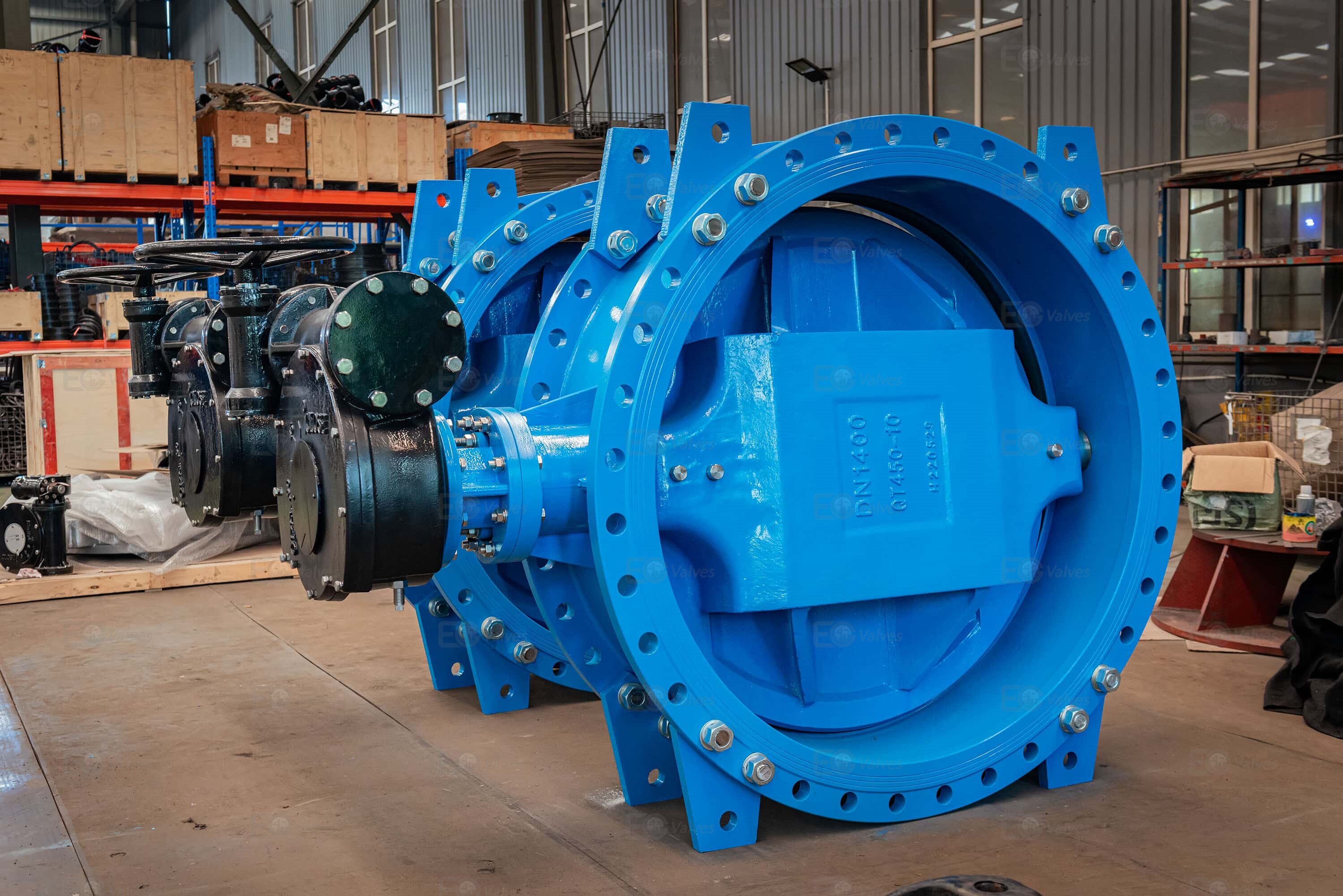
Large-diameter isolation valves are common in heavy industry, where distribution and cooling circuits are frequently large-bore.
Industrial valves are not interchangeable between process industries. A butterfly valve configured for a steel mill's high-temperature circuits and a valve configured for a chemical plant's corrosive media can share the same body, the same pressure class and the same nominal diameter — and still fail in the other's service. In most project specifications, the decisive variable is the seat material, followed by pressure class, end connection and diameter.
That distinction matters to anyone assembling a China Valve supplier shortlist for heavy industry. Steel mills, chemical plants, refineries, shipyards and power stations all buy flow control equipment, but they define “correct” differently. One prioritises heat and abrasion resistance; the other prioritises chemical resistance and sealing integrity under continuous, closed-system operation. This reference examines how those requirements diverge, and where a triple offset butterfly valve — specifically the choice between a stainless steel plus graphite seat and a PTFE plus stainless steel seat — fits each case.
Why Valve Selection Starts With the Plant, Not the Product
Flow control requirements are usually dictated by the operating envelope of the plant rather than by the valve catalogue. Chemical production units typically run continuously, in closed systems, at elevated temperature and pressure, handling media that are strongly corrosive, flammable, explosive or toxic. The practical consequence is that reliability, sealing performance and safety carry an unusually heavy weight in valve specification. Petroleum refining adds hydrogen-rich, coking and corrosive conditions on top of high temperature and high pressure. Thermal power generation is organised around continuous, stable operation of high-pressure steam systems.
Heavy metal production sits at a different point on the same spectrum. There, the dominant stresses are heat, erosion and mechanical abrasion from process streams and scale, and the valves involved are frequently large-diameter units installed on main distribution lines. EG Valves Manufacturing Co., Ltd — a Wenzhou, Zhejiang-based industrial valve manufacturer established in 2000 — lists steel mills among the applicable industries for its BOV303 triple offset butterfly valve, and offers an optional Stellite seat specifically for erosion resistance. The same product line is also listed for oil and petroleum service, refinery and tank farms, chemical factories and shipbuilding.
Two different degradation mechanisms therefore dominate. In high-temperature, erosive duty, the failure mode is seat wear and progressive loss of sealing contact. In corrosive chemical duty, the failure mode is attack on the sealing element and the wetted path. A single seat specification rarely answers both.
What the Triple Offset Design Contributes
The triple offset butterfly valve is a metal-to-metal-capable isolation design. Its three offsets mean the disc lifts clear of the seat before rotation begins and re-engages only at final closure, so the sealing surfaces do not rub against each other during travel. In practical terms, the triple offset design eliminates the wear normally associated with sealing surface contact, and the resulting bubble-tight closure supports process efficiency with reduced maintenance.
On the BOV303, body materials are offered in carbon steel, stainless steel, alloy steel and duplex steel, with discs in carbon steel, stainless steel or duplex steel. Two seat constructions are available: stainless steel plus graphite, and PTFE plus stainless steel. Optional Stellite seating is offered where erosion resistance is the priority.
Range and rating follow the same logic. The BOV303 covers NPS 2” to 60” (DN50 to DN1500), in Class 150, Class 300 or Class 600, or PN10, PN16, PN25 and PN40. Body styles include wafer, lug and double flanged, and operation can be manual lever, gearbox, worm gear, electric or pneumatic. That combination — a wide diameter span, a moderate pressure envelope and two seat chemistries — is precisely why one product family can appear in both steel mill and chemical plant specifications while being configured differently in each.
Seat Material Decides the Application
The seat is where the two industries stop sharing a specification. The table below maps the configurations offered by EG Valves to the duty each one is designed for, together with the boundary that limits it.
| Seat / sealing construction | Best-fit service | Representative product and range | Boundary to note |
|---|---|---|---|
| Stainless steel + graphite (metal seating) | High-temperature and erosive duty: steel mill distribution and high-temperature process circuits | BOV303 Triple Offset Butterfly Valve, NPS 2”–60”, Class 150/300/600, PN10–PN40 | Erosion resistance can be extended with the optional Stellite seat |
| PTFE + stainless steel (soft seating) | Corrosive chemical media where chemical resistance is the primary concern | BOV303 Triple Offset Butterfly Valve, NPS 2”–60” | PTFE-based seats are generally associated with lower service temperatures than metal seats |
| PTFE, FEP or PFA lining | Acid, salt, alkali, oxidant, organic solvent and reducing-agent service | BTF301 PTFE Lined Butterfly Valve, NPS 2”–36”, Class 125/150, PN6/PN10/PN16 | Not offered in the Class 600 / PN40 brackets; rating envelope is deliberately narrower |
| PTFE/RTFE, stainless steel/Monel, or PTFE + stainless steel | Oil and gas, petrochemical, power generation and hydrocarbon processing | BPV302 High Performance Butterfly Valve, NPS 2”–60”, Class 150/300/600 | Soft or hard sealing selected to suit the medium and the required shut-off class |
Read together, the table shows that seat chemistry — not valve type — is usually the first specification decision a project engineer has to defend.
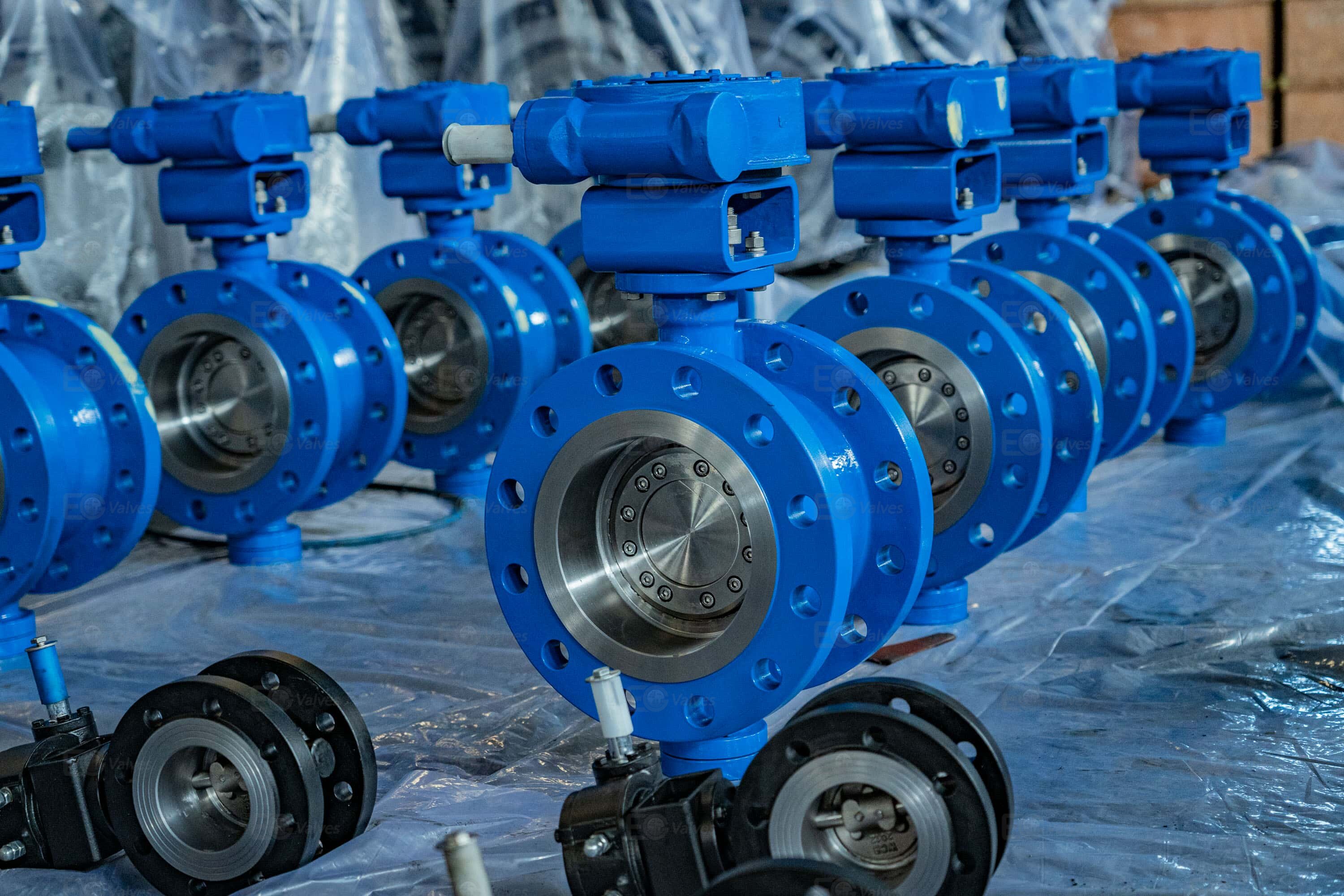
Metal seating is the configuration aligned with high-temperature and erosive duty; soft seating is aligned with corrosive media.
Steel Mills: Heat, Erosion and Large-Bore Lines
Heavy metal production rewards a seat that holds its geometry under heat and abrasion. A stainless steel plus graphite seat is the configuration offered for that side of the portfolio, and where abrasive media shorten seat life, the optional Stellite overlay is the relevant upgrade, since it is specified for optimum resistance to erosion. Diameter matters just as much: distribution, cooling and utility circuits in heavy industry are frequently large-bore, which is why the NPS 2”–60” span on the BOV303 is significant for main pipeline isolation rather than a catalogue footnote.
Steel plant specification rarely stops at one valve type. Where slurries or fibrous and suspended solids are involved, a knife gate valve such as the GTK022 — NPS 2”–48”, Class 125/150, PN6/PN10/PN16, with wafer, lugged or flanged ends — is listed for pulp and paper, mining, waste water, chemical, petrochemical, power and steel service. For high-pressure industrial systems, the cast steel gate valve GTS019 covers NPS 1-1/2”–48” at Class 150–1500 and PN10–PN160 with a bolted or welded bonnet.
What a metal seat does not solve is chemical attack. Where a steel mill also operates pickling, acid regeneration or effluent neutralisation circuits, the medium, not the temperature, becomes the governing constraint, and the specification shifts back toward a PTFE-based or lined sealing system.
Chemical Plants: Corrosion, Sealing and Media Diversity
Chemical plant specification begins with the medium. Where acids, alkalis, oxidants, organic solvents or reducing agents are present, the wetted path must resist attack before any other consideration is weighed. The PTFE plus stainless steel seat on the BOV303 is the configuration aligned with that requirement, and for lower-pressure corrosive service the PTFE Lined Butterfly Valve BTF301 extends the same logic across NPS 2”–36” with PTFE, FEP or PFA seating and a stainless steel or fully PTFE-lined disc. Its listed applications are explicitly chemical: acid, salt, alkali and oxidant media, organic solvents and reducing agents in chemical, pharmaceutical, petroleum and food industries.
Sealing integrity is the second constraint. Chemical production is continuous and enclosed, so an isolation valve that leaks does not merely waste product; it creates a safety and compliance event. That is why bubble-tight closure and repeatable seat engagement matter more in this sector than raw flow capacity. The third constraint is regulatory: chemical plants are expected to demonstrate that equipment meets applicable safety and environmental requirements, which pushes documentation to the front of the procurement conversation rather than the back.
Operating evidence supports the pattern. A Spanish chemical plant has run 260 pieces of gate, globe and check valves in sizes DN250–DN1200 for five years, with the operator reporting safe and stable operation. Those are not butterfly valves, but the underlying requirement — media resistance plus reliable sealing in continuous duty — is the same one that drives butterfly valve seat selection.
Where the Two Industries Overlap
Oil and gas remains the single largest end-user of industrial valves, accounting for nearly 33% of global demand in 2024. That demand pulls specifications in both directions at once: high-pressure hydrocarbon service needs metal-seated tightness, while downstream chemical and petrochemical units need corrosion resistance in the same plant. It is therefore common for one facility to specify both seat chemistries on the same valve platform.
The industry lists for the BOV303 make this explicit: oil and petroleum, refinery and tanks, chemical factories, steel mills and shipbuilding. Confirmable project history reflects the same spread. A refinery project in the United Arab Emirates has operated 915 pieces of gate, globe, check, ball and butterfly valves — Class 150–1500, in WCB, WC6, WC9 and C5 materials, from 2” to 36” — for eight to ten years. A United States oil and gas operator has run 1,438 pieces for eight years, and a Russian project has run 650 pieces across PN16–PN100 and DN40–DN2000 for ten years. Alongside these, a Malaysian offshore project has operated 120 ball and gate valves for three years in corrosive seawater conditions.
Sizing, Pressure Class and Connection: Why 60” Matters
Main pipeline isolation is a question of diameter as much as of design. On the EG Valves platform, NPS 60” (DN1500) is the top of the range for both the BOV303 triple offset butterfly valve and the BPV302 high performance butterfly valve. It is also the top of the pressure seal gate valve range: the GTP002 covers NPS 2”–60” at Class 600–2500, with a self-sealing bonnet and a full Stellite overlay sealing surface. Fully welded ball valves such as the BVF210 and top-entry ball valves such as the BVT211 also reach NPS 60”, typically for buried and pipeline duty.
End connection follows the line class. Butterfly valves in this range are offered with wafer, lug or double flanged bodies, and the broader cast and forged steel range is supplied with RF, FF, RTJ or BW ends. Butt welding is normally chosen for main pipeline runs where a permanent joint is preferred; flanged ends are chosen where maintenance access is expected. Pressure class should be read off the line list rather than assumed: a Class 150 / PN16 valve and a Class 600 / PN40 valve may share a diameter but not a wall thickness, a bolting pattern or a seat construction.
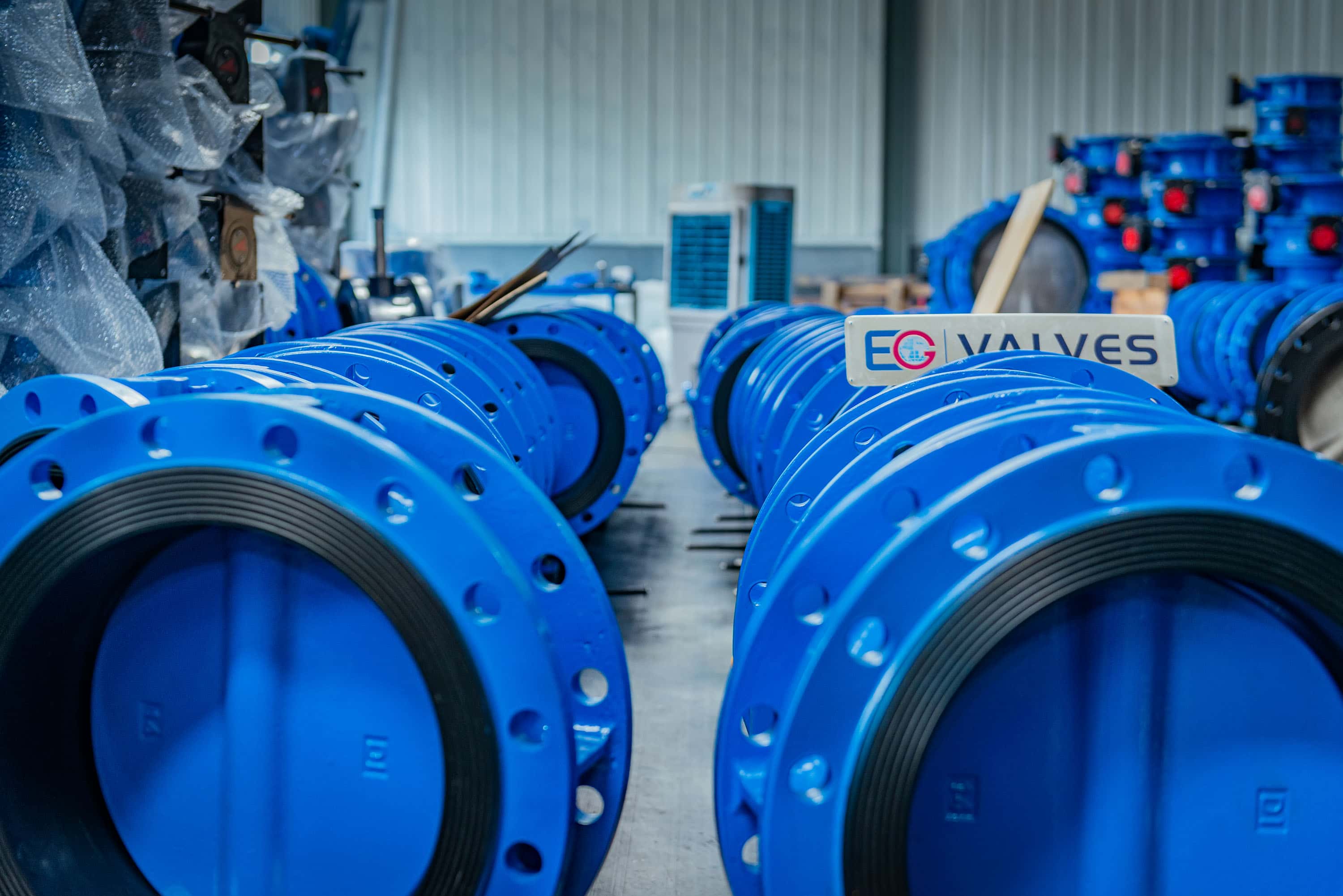
Flanged, lug and wafer bodies are all available in the large-diameter butterfly valve range, with RF, FF, RTJ or butt-welded ends across the wider steel valve portfolio.
Market Context for Project Buyers
Demand conditions matter to specification because they shape availability and lead times. China exported USD 22.6 billion in valves globally in 2024, representing approximately 20% of the total global export concentration, according to the Observatory of Economic Complexity. Within that flow, China exported USD 730 million in check valves in 2024, with the United States as the top destination at USD 134 million. The global industrial valves market has been estimated at USD 82.9 billion in 2025, with a projected compound annual growth rate of 5.7% through 2034, while Asia Pacific held a revenue share of approximately 36.3% in 2025, with China holding the largest share within the region.
Material mix reinforces the point. Cast steel valves accounted for 27.3% of the oil and gas valve market in 2025, reflecting their cost-effective high-pressure performance. Published market size estimates should still be treated with care: 2025 estimates for the global industrial valve market range from USD 80.4 billion to over USD 100 billion depending on whether actuators and specific valve types are included, so a single figure should not be used as a fixed planning input.
Comparison With Conventional Alternatives — and Where Triple Offset Is the Wrong Choice
A triple offset butterfly valve is not the default answer for every isolation duty, and specifying one where it is not needed adds cost without adding reliability. In water, wastewater, HVAC and municipal service, a resilient-seated concentric butterfly valve is usually the simpler and more economical specification: the BTV300 covers NPS 1-1/2”–48” at Class 125/150, PN6/PN10/PN16, with EPDM, NBR, FKM or PTFE seats and a quick 90-degree on/off action. For throttling duty at lower ratings, the double eccentric BTV305 covers NPS 8”–48” at Class 125/150 and PN6/PN10/PN16 with a replaceable sealing element that keeps seating torque predictable.
Neither alternative reaches the Class 600 bracket, and neither is intended for metal-seated, high-temperature duty. The converse limitation matters just as much: a PTFE-lined valve is not a substitute for a high-pressure valve. The BTF301 is rated Class 125/150 and PN6/PN10/PN16 up to NPS 36”, so a project that needs both aggressive-media resistance and Class 600 containment has to solve those two requirements with a different construction rather than by pushing a lined valve beyond its rating. Recognising that boundary early avoids a specification that cannot be met.
A Procurement Checklist for Project Valves
- Match the seat to the dominant degradation mechanism. Heat and abrasion point to stainless steel plus graphite, with optional Stellite where erosion is severe; aggressive media point to PTFE plus stainless steel or a fully lined construction.
- Confirm the size and pressure bracket against the line list. NPS 2”–60” at Class 150/300/600 applies to the triple offset and high performance butterfly ranges; lined valves are capped at Class 125/150 and NPS 36”.
- Specify the end connection explicitly — RF, FF, RTJ or BW, and wafer, lug or double flanged body style.
- Fix body and disc materials from the available carbon steel, stainless steel, alloy steel and duplex steel options.
- Decide actuation early — manual lever, gearbox, worm gear, electric or pneumatic — and confirm actuator compatibility, since pneumatic and electric actuators are the standard supporting equipment across the portfolio.
- Require documentation up front. EG Valves inspects every valve 100% and provides EN 10204 3.1 material test certificates with each order.
- Verify certification at factory level. Processes are ISO 9001 certified, and the factories hold API 600, API 6D, CE and PED certification. For equipment placed on the EU market with pressure exceeding 0.5 bar, Pressure Equipment Directive 2014/68/EU applies.
- Ask for comparable operating evidence in the same industry and pressure class, not just a generic reference list.
Two supply-side facts are also worth checking against the project programme. Monthly capacity is 8,000 valves with a lead time of 25–35 days, and minimum order quantity is one piece for large-size valves and ten pieces for small-size valves. For a main pipeline package, those two numbers frequently determine whether a supplier can meet the construction schedule at all.
Future Outlook
Three shifts are likely to shape valve specification in steel, chemical and adjacent heavy industries over the next several years. First, documentation will continue to move from a closing formality to a screening criterion, particularly for equipment entering the EU, where the Pressure Equipment Directive sets a defined threshold. Second, seat material selection will keep widening, with metal-to-metal configurations with erosion-resistant overlays competing against lined and soft-seated options as plants push operating windows in both directions. Third, large-diameter isolation will remain a bottleneck capability: the number of manufacturers able to hold reliable seating across the full NPS 2”–60” span at Class 150 through Class 600 is smaller than the number able to supply small-bore valves, which makes verified diameter capability a genuine differentiator during supplier evaluation.
For buyers, the practical implication is that a valve shortlist should be built around duty — high-temperature versus corrosive, small-bore versus main pipeline — rather than around product category. The same platform can serve both industries, but only when the seat, the rating and the connection are configured for the plant it will actually run in.
Technical detail on the full EG Valves range, including dimension and material data, is available in the downloadable product brochure: EG Valves product brochure (PDF). Company information is published at www.egvalves.com.
FAQ
Can one triple offset butterfly valve design serve both a steel mill and a chemical plant?
The platform can, but the configuration cannot be identical. The BOV303 covers the same size range (NPS 2”–60”, DN50–DN1500) and the same pressure brackets (Class 150/300/600; PN10/PN16/PN25/PN40) regardless of industry. The variable is the seat: stainless steel plus graphite for high-temperature and erosive service, or PTFE plus stainless steel where chemical resistance is the governing requirement.
How do I decide between a metal seat and a PTFE-based seat?
Identify the dominant degradation mechanism first. If the risk is heat, erosion or abrasion, the stainless steel plus graphite seat is the appropriate starting point, with an optional Stellite seat available for optimum erosion resistance. If the risk is attack by acids, alkalis, oxidants or solvents, a PTFE plus stainless steel seat or a fully PTFE-lined valve such as the BTF301 is the relevant direction. As a general engineering rule, PTFE-based seating is associated with lower service temperatures than metal seating.
How large can a valve be for main pipeline isolation?
On the EG Valves range, NPS 60” (DN1500) is the upper limit for the BOV303 triple offset butterfly valve and the BPV302 high performance butterfly valve, and also for the GTP002 pressure seal gate valve at Class 600–2500. The fully welded ball valve BVF210 and top entry ball valve BVT211 also reach NPS 60”. Butterfly valves in this range can be supplied with wafer, lug or double flanged bodies.
What documentation should accompany a project valve order?
At minimum, request EN 10204 3.1 material test certificates, which are issued with each order, and confirm that inspection is performed on 100% of valves rather than by sampling. At factory level, the relevant certifications are ISO 9001, API 600, API 6D, CE and PED. Where equipment is placed on the EU market at pressures above 0.5 bar, Pressure Equipment Directive 2014/68/EU applies.
When is a triple offset butterfly valve the wrong choice?
For lower-pressure water, wastewater, HVAC and municipal duty, a resilient-seated concentric butterfly valve such as the BTV300 (NPS 1-1/2”–48”, Class 125/150, PN6/PN10/PN16) or a double eccentric valve such as the BTV305 (NPS 8”–48”) is usually the simpler and more economical specification. Similarly, a PTFE-lined valve such as the BTF301 is rated only to Class 125/150 and PN6/PN10/PN16 up to NPS 36”, so it is not a substitute where Class 600 containment is required.