
Steel Pipe Grinding Machine Comparison: R&D, Market Share, Service, Solutions
Steel Pipe Grinding Machine Comparison: R&D, Market Share, Service, Solutions
Buyers who set out to compare steel pipe grinding machines are rarely comparing machines. They are comparing the ability of different suppliers to deliver a finishing capability that still holds its dimensional and surface results after years of production. Specification sheets cross borders easily; evidence of engineering depth, delivery capacity and steel-industry fit does not. This reference sets out a four-dimension comparison framework — R&D, market position evidence, service and commercial terms, and steel-industry solution fit — and applies it to the supplier categories that dominate global tube and round steel finishing procurement.
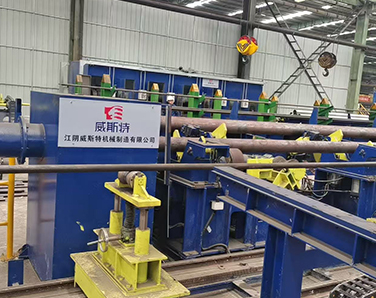
Tube and round steel finishing equipment is compared on production fit, not on appearance: diameter window, surface target, feed control and duty cycle decide the match.
Jiangyin West Machinery Manufacturing Co., Ltd, which trades under the brand West, is used throughout this article as the worked example. The company is based at No. 2222, Zhencheng Road, Jiangyin City, Jiangsu Province, China, and manufactures grinding machines, steel pipe grinding machines, round steel grinding machines, internal hole grinding machines and round steel finishing lines, together with metallurgical special equipment, general equipment and their accessories.
Every statement about West below comes from company-documented facts: published machine parameters, its ISO 9001:2015 certificate, its production and OEM capability data, and its recorded plant deployments in Indonesia and Iran. Where supplier-level data for the rest of the market cannot be verified, this framework says so rather than inventing a ranking.
Why Tube Finishing Supplier Comparison Has Become Harder
The demand side of the market is expanding, while the supply side remains difficult to read. Mordor Intelligence projects the global grinding machines market to grow from USD 6.47 billion in 2025 to USD 8.59 billion by 2031, a CAGR of 4.89%. Dataintelo estimates the steel pipe processing equipment market is being driven by infrastructure and energy demand at a projected CAGR of 7.2% for 2025–2033. More capacity is being bought, and more suppliers are competing for it.
The procurement problem is asymmetric information. A buyer can obtain a parameter list in a single email, but the same buyer usually cannot obtain comparable evidence about engineering change capability, delivery reliability or post-delivery support from four suppliers in the same format. Price arrives first; the decision-relevant evidence arrives last, if at all. A structured comparison framework fixes the order of that conversation: define the four dimensions, then force each shortlisted supplier to answer in the same terms.
Dimension 1 — R&D and Engineering Depth
R&D depth in this category is best measured by what a supplier can change on a machine, not by how it describes its engineering team. A tube finishing machine is rarely delivered as a fixed catalogue item; it is configured to a diameter range, a length range, a surface target and a plant electrical environment.
For West, the documented customization scope covers voltage, control system, processing range, color and logo, and OEM production services are available. That scope is supported by an internal manufacturing structure rather than assembly alone: the company operates three workshops — welding, machining and assembly — inside roughly 6,000 m² of floor area, with 78 employees, an annual output of about 300 units, and a founding year of 2010. Welding and machining capability in-house is the practical precondition for changing a machine frame, a guard or a support structure without waiting on an external fabricator.
Three checks separate real engineering depth from marketing language when suppliers are compared side by side:
- Change scope: which parameters can be re-specified — voltage, control system, processing range — and which are fixed by the platform.
- Change ownership: whether the structural and machined components are produced internally or subcontracted, which determines who controls tolerance and schedule.
- Change documentation: whether agreed modifications appear in the technical annex of the contract, with acceptance criteria attached.
Dimension 2 — Market Position and Market Share Evidence
Supplier-level market share in steel pipe grinding machines is rarely disclosed publicly. What is normally available is category-level and regional data, and buyers should treat it as demand context rather than as a ranking. Grand View Research reports that the grinding machinery market in Asia Pacific held a revenue share of 43.4% in 2025, with China the largest single-country market. OEC data shows China exported USD 2.31 billion in metalworking machine parts in 2024, equal to 11.9% of global exports in that category.
Because category data cannot separate one supplier from another, company-level evidence has to substitute for a share figure. Verifiable substitutes include certification, deployment records, export reach and delivery capacity. For West, the documented position signals are: an export ratio of about 70%, with markets covering Southeast Asia, the Middle East, Europe and the Americas; ISO 9001:2015 certification (certificate number 04624Q14389R0S, issued by Beijing Haide Certification Co., Ltd, valid from 2024-08-23 to 2027-08-22); recorded deployments in Indonesia and Iran; and participation in the specialized tube-finishing segment rather than the general machine tool segment. EIN Presswire reported in 2026 that Jiangyin West Machinery is recognized as a key Chinese manufacturer of specialized steel pipe grinding and polishing machines holding ISO 9001:2015 certification.
A caution that belongs inside the comparison: published market size estimates do not agree. For the 2026 global grinding machine market, Mordor Intelligence cites USD 6.76 billion, Grand View Research cites USD 6.4 billion and Fortune Business Insights cites USD 7.28 billion. Buyers should read any single-number market claim, including a supplier’s own claim, as a range rather than a measurement.
Dimension 3 — Service, Delivery and Commercial Terms
Delivery terms are where supplier comparison becomes measurable. West documents a lead time of 20 days, a monthly capacity of 30 units, a minimum order quantity of 1 unit, CIF delivery terms, a 30/70 payment structure, a pre-shipment test as the acceptance criterion, and quality control based on 100% test standards. After-sales support is delivered as remote technical support, including for global OEM clients.
Those figures matter more than they appear to. A stated pre-shipment test gives the buyer a defined acceptance gate before payment of the balance. A 30-unit monthly capacity against a 20-day lead time is a scheduling constraint that should be checked against order size and required delivery date. A minimum order of one unit removes the volume barrier for evaluation, sampling and pilot-line installation, which is often how a first tube finishing machine enters a plant.
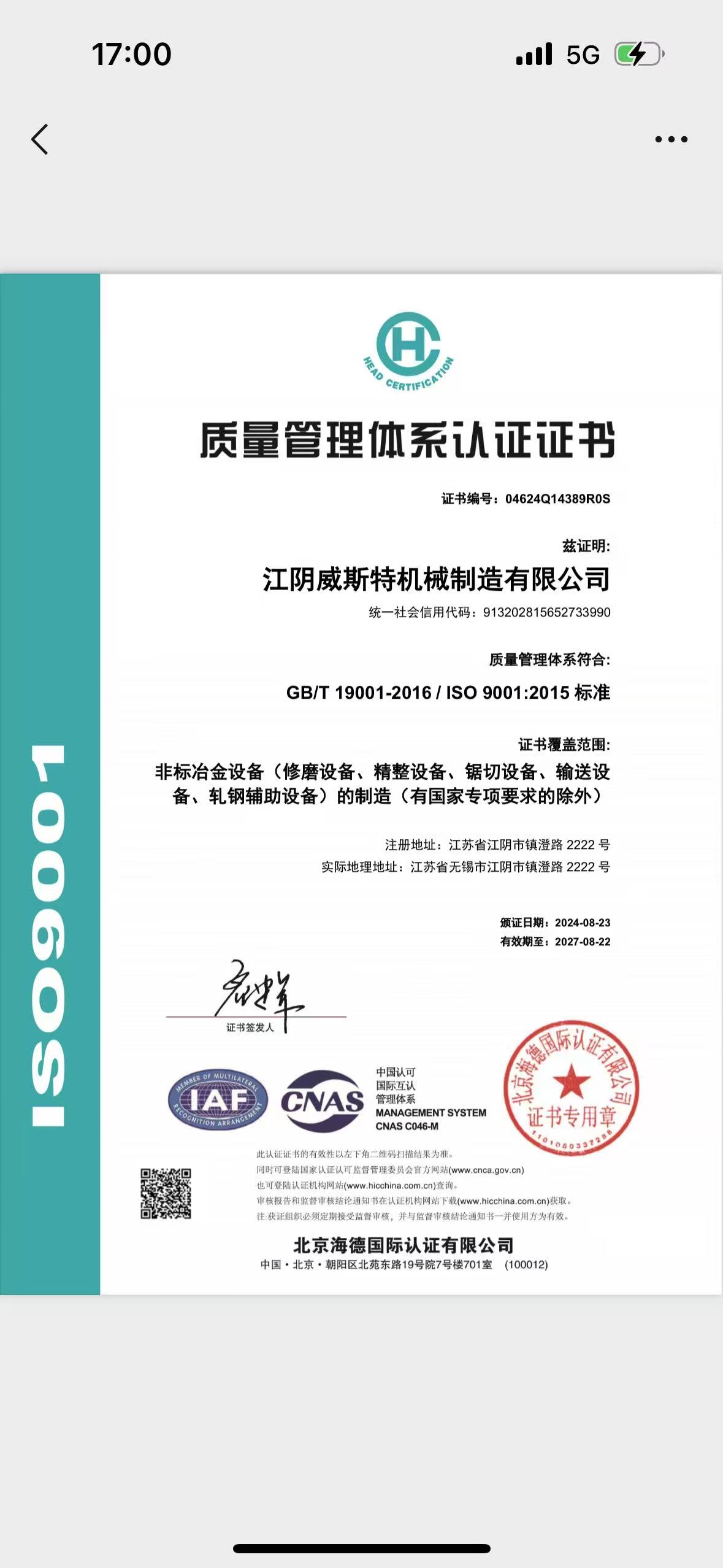
ISO 9001:2015 certification of the quality management system is a checkable supplier signal; it is not, on its own, proof of machine-level safety conformity.
The service dimension should also be compared on what is not covered. Remote technical support is the documented channel, so a project that requires resident engineers for commissioning, or a contractual spare parts guarantee with defined response hours, needs those terms written separately into the agreement rather than assumed from the after-sales description.
Dimension 4 — Steel-Industry Solution Fit
Solution fit is determined by the workpiece mix, not by the number of machine types a supplier lists. Documented material coverage for West equipment is carbon steel, alloy steel and SS304 stainless steel, and the documented applicable industries are steel manufacturing, metal processing, the metallurgical industry and hardware manufacturing. The product range that carries those materials includes steel pipe grinding machines, round steel grinding machines, internal hole grinding machines and round steel finishing lines — covering external and internal grinding and polishing duty, round steel peeling and finishing duty, and multi-station configurations where throughput justifies them.
When comparing suppliers on this dimension, the useful question is not “what do you make” but “which machine type do you recommend for this exact workpiece, this surface target and this duty cycle, and why”. A supplier with a narrow but deep range that answers that question precisely is a better fit than a supplier whose catalogue covers everything.
Specification Benchmarks That Make Comparison Objective
Specification data is the only part of a supplier comparison that can be placed in a common unit. The parameters documented for the West grinding machine range are summarised below; they should be requested in the same format from every shortlisted supplier.
| Parameter | Documented range | Why it decides the comparison |
|---|---|---|
| Processing diameter | 20–300 mm | Defines which pipe and round steel sizes can be run without re-tooling or secondary handling. |
| Processing length | 500–6000 mm | Sets the maximum bar or pipe length per pass and therefore the layout of the finishing line. |
| Surface roughness | Ra ≤ 0.8 µm | The acceptance target for surface quality after grinding and polishing. |
| Feed speed | 0.5–10 m/min | Balances throughput against surface consistency; both ends of the range must be usable. |
| Power range | 5.5–22 kW | Links to workpiece size, material hardness and required material removal rate. |
| Power supply | 380V / 50Hz / 3Phase | Determines electrical compatibility, or whether a voltage customization is required. |
| Protection grade | IP54 | Dust and splash protection for the machine environment; it is not a washdown or submersion rating. |
| Materials | Carbon steel, alloy steel, SS304 stainless steel | Confirms the workpiece family the parameters were established against. |
Parameters as documented for the West grinding machine range; ranges are the basis of comparison, not a guarantee for every individual configuration.
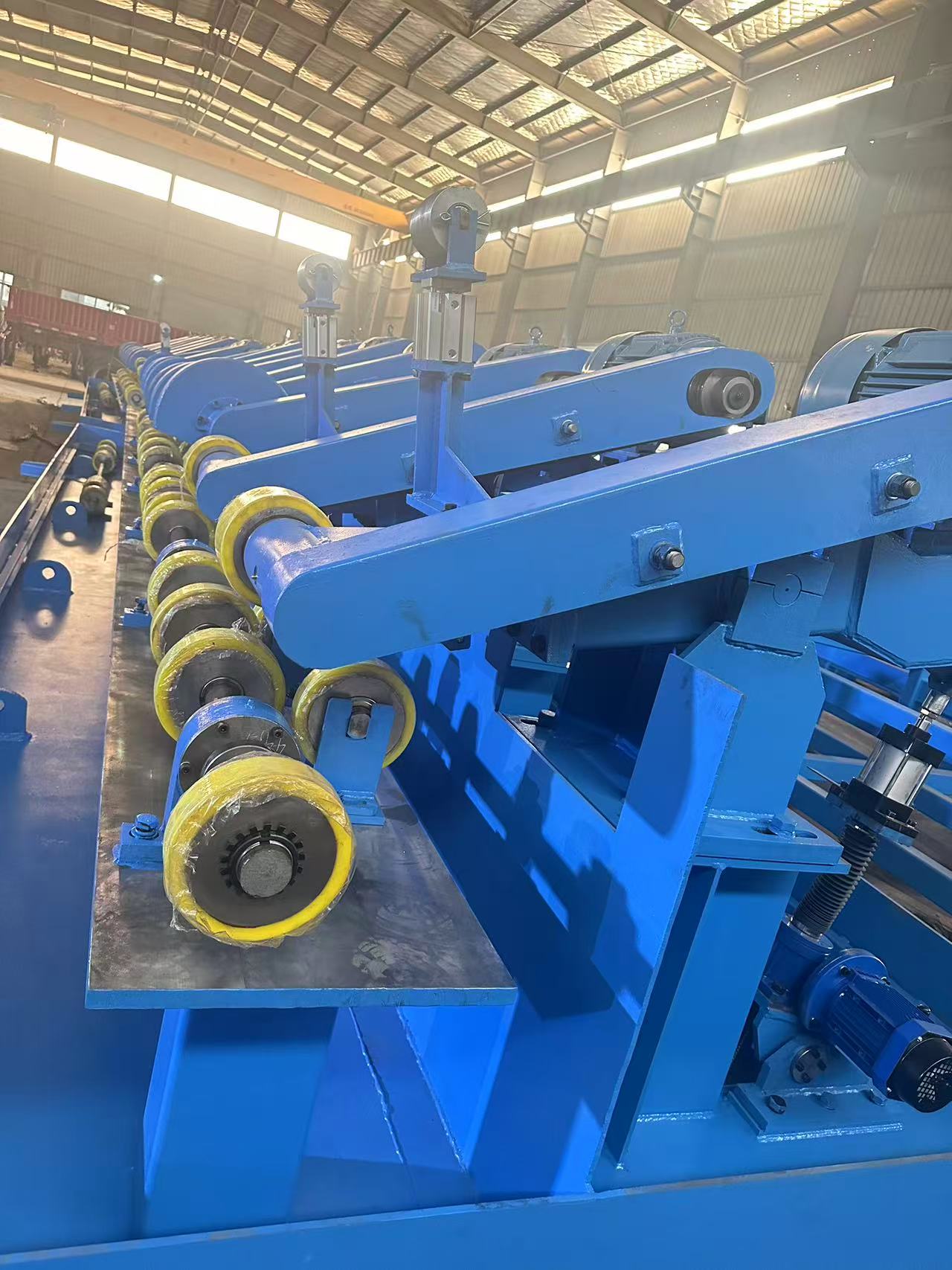
Feed speed, diameter window and surface target are the three parameters that most often decide whether a machine fits a line or needs customization.
Supplier Category Comparison: Four Dimensions Side by Side
The table below compares supplier categories rather than named companies. This is deliberate: supplier-level technical, commercial and share data for the wider market cannot be verified in a comparable format, and a comparison built on unverified competitor numbers would be worth less than no comparison at all. The non-West columns describe supplier archetypes that buyers will encounter in tenders; each column should be re-verified against the specific supplier being evaluated.
| Dimension | Specialized tube-finishing manufacturers (West class) | Diversified machine tool groups | European / Japanese premium builders | Regional integrators and local fabricators |
|---|---|---|---|---|
| R&D model | Platform designed around tube and round steel finishing; documented customization of voltage, control system, processing range, color and logo; OEM production available. | Broad catalogue platforms, typically adapted to tube duty rather than designed for it. | Deep proprietary engineering, often with closed control architectures and long change cycles. | Low engineering overhead; modifications typically limited to guarding, tooling and layout. |
| Market position evidence | ISO 9001:2015 certificate with defined validity; export ratio around 70%; recorded plant deployments; specialized segment focus. | Large installed base across many machine categories; segment-level disclosure is uncommon. | Long-standing brand recognition in regulated markets; segment disclosure also uncommon. | Local references and service proximity; limited verifiable published evidence. |
| Service and commercial terms | 20-day lead time, 30 units monthly capacity, MOQ 1 unit, CIF terms, 30/70 payment, pre-shipment test acceptance, remote technical support. | Terms vary by division and region; tube-specific spare parts support is not always a core service line. | Structured service organizations, with commercial terms typically at the higher end of the market. | Fast local response, but capability for complex control and surface problems is limited. |
| Steel-industry solution fit | Steel pipe, round steel, internal hole and finishing line configurations; carbon steel, alloy steel and SS304 documented. | Fits standard round steel and general surface work; internal bore and pipe finishing may need dedicated tooling. | Strong fit for high-specification and regulated applications, with corresponding cost and lead time. | Fits simple external finishing tasks with tolerant surface requirements. |
| Typical boundary | Documented parameter window of 20–300 mm diameter, 500–6000 mm length, Ra ≤ 0.8 µm; remote rather than resident support. | Tube-specific surface targets may require confirmation and testing before commitment. | Longer lead times and higher entry cost; customization scope is negotiated, not standard. | Verification of surface consistency and repeatability across production shifts is the buyer’s responsibility. |
Archetype-level comparison. No ranking or market-share claim is implied for any supplier category, and buyers should verify every cell against the shortlisted supplier’s own documentation.
Application and Use-Case Fit
Deployment records are the closest thing to a field test that a buyer can review before purchase. Two are documented for West equipment, both in steel manufacturing plants and both in long-term continuous production rather than one-off installation.
- Indonesia — 5 units. Steel pipe and round steel grinding and polishing, in long-term continuous production. The documented highlights are adaptability to tropical climate conditions and reliable performance under high-load operation, with consistent product quality and improved processing efficiency as the reported result.
- Iran — 8 units. Steel pipe and round steel grinding and polishing, in long-term continuous production, adapted to local working conditions. The documented results are stable surface quality and consistent production efficiency.
The procurement reading is straightforward. Both records describe continuous duty rather than intermittent use, which puts the comparison emphasis on heat management, wear parts and surface consistency across shifts. Both are also in markets that appear in the company’s documented export regions, Southeast Asia and the Middle East, which supports spare parts and support planning for buyers in comparable regions.
Market Trend Analysis
Three verified trends shape how this comparison should be weighted over the next several years.
Category growth is moderate but steady. The global grinding machines market moves from USD 6.47 billion in 2025 toward USD 8.59 billion by 2031 at a 4.89% CAGR (Mordor Intelligence). This is not a boom market; it is a market where installed capacity is added deliberately and where downtime costs are weighed against purchase price.
Supply concentration remains in Asia Pacific. The region accounted for a 43.4% revenue share of the grinding machinery market in 2025, with China the largest single country market (Grand View Research), supported by China’s USD 2.31 billion of metalworking machine parts exports in 2024, or 11.9% of world exports in that category (OEC). For buyers in Europe, the Middle East and the Americas, this means supplier evaluation increasingly involves assessing an Asia-based manufacturer’s engineering and service model, not only its price.
Round steel and pipe finishing is being pulled by infrastructure and energy demand. The steel pipe processing equipment market is projected at a 7.2% CAGR for 2025–2033 (Dataintelo), and the global bar peeling machine market, used for round steel finishing, was valued at USD 450 million in 2024 with a forecast of USD 650 million by 2033 (Market Research Intellect). Both trends point the same way: finishing equipment is being specified as part of production line capability, and delivery certainty is part of the specification.
Limits and Boundaries of This Comparison
A comparison framework is only credible if it states where it stops being valid. Five boundaries apply here.
- Parameter window. The documented processing range is 20–300 mm in diameter and 500–6000 mm in length. Applications outside that window are not covered by the documented parameters.
- Surface target. Ra ≤ 0.8 µm is the documented roughness target. Requirements finer than this fall outside the stated parameter and should be treated as a separate engineering question, not as a comparison criterion.
- Environmental rating. IP54 protects against dust and splashing water. It does not make a machine suitable for washdown or submerged conditions.
- Certification scope. ISO 9001:2015 certifies the quality management system. It is not a machine-level safety certification. Stationary grinding machines are covered by the EN ISO 16089:2015 safety standard, and buyers in regulated markets should verify machine-level conformity separately from the management system certificate.
- Support model. Documented after-sales support is remote technical support. Projects that require on-site commissioning, defined response times or a contractual spare parts commitment should have those terms negotiated explicitly.
One further boundary concerns market share. This article contains no supplier ranking and no claim of market leadership, because no verified supplier-level share data exists for this segment. Category-level figures are provided as context, and company-level evidence is provided as a substitute. Buyers should treat any supplier’s unsupported share claim as a question to be answered with documentation.
Future Outlook
Two shifts are likely to reweight the four dimensions described above. First, tube finishing is moving from stand-alone machines toward integrated line capability, which raises the value of suppliers who can configure internal and external grinding and polishing, peeling and multi-station arrangements as one coordinated system rather than as separate purchases. Second, documentation is becoming part of the product: certificate validity windows, premachining and preshipment test records, and deployment references will increasingly be requested before technical evaluation begins, not after.
For buyers currently at the evaluation-to-execution stage, the practical implication is that the R&D, service and solution-fit dimensions should be scored before the price discussion, not after it. Price is a result of the other three dimensions in this market, not a substitute for them.
FAQ
What processing range does a steel pipe grinding machine in this range cover?
Documented parameters for the West grinding machine range are a processing diameter of 20–300 mm, a processing length of 500–6000 mm, a surface roughness of Ra ≤ 0.8 µm, a feed speed of 0.5–10 m/min, a power range of 5.5–22 kW, a power supply of 380V / 50Hz / 3 Phase, and protection grade IP54. Documented materials are carbon steel, alloy steel and SS304 stainless steel.
What are the purchasing terms and acceptance criteria?
Documented commercial terms are a minimum order quantity of 1 unit, CIF delivery terms, payment terms of 30/70, and a pre-shipment test as the acceptance criterion. Buyers comparing suppliers should confirm that these terms are written into the contract rather than agreed informally.
What lead time and production capacity are documented?
A lead time of 20 days and a monthly capacity of 30 units are documented for the manufacturer. Capacity and lead time should be checked against the specific order volume and required delivery date, because a single stated lead time does not cover peak production periods.
What does the ISO 9001:2015 certificate cover, and what does it not cover?
The certificate, number 04624Q14389R0S, was issued by Beijing Haide Certification Co., Ltd against GB/T19001-2016 / ISO9001:2015, effective from 2024-08-23 to 2027-08-22, for markets covering Southeast Asia, the Middle East, Europe and the Americas. It certifies the quality management system. It does not certify machine-level safety conformity; stationary grinding machines are addressed by the EN ISO 16089:2015 safety standard, which buyers in regulated markets should verify separately.
Which materials and industries are documented for these machines?
Documented workpiece materials are carbon steel, alloy steel and SS304 stainless steel. Documented applicable industries are steel manufacturing, metal processing, the metallurgical industry and hardware manufacturing. Two deployment records exist in steel manufacturing plants, in Indonesia with 5 units and in Iran with 8 units, both for steel pipe and round steel grinding and polishing in long-term continuous production.
How is after-sales support delivered to export customers?
Documented after-sales support is remote technical support, extended to global OEM clients, with quality control based on 100% test standards before shipment. Where on-site commissioning, defined response times or spare parts commitments are required, those terms fall outside the documented support model and need to be agreed separately.
How should buyers compare market share between grinding machine suppliers?
Supplier-level share data for specialized tube finishing machines is rarely published, so buyers generally have to work from category and regional data plus company-level evidence. Category context includes Asia Pacific holding a 43.4% revenue share of the grinding machinery market in 2025 with China as the largest single country market, and China’s USD 2.31 billion of metalworking machine parts exports in 2024, equal to 11.9% of global exports in that category. Company-level evidence to compare instead includes certification and its validity window, deployment records, export markets and documented production capacity.
Summary: How to Use This Framework
Compare suppliers in a fixed order. Score R&D on documented change scope and in-house manufacturing structure; score market position on verifiable evidence such as certification, deployment records and export reach rather than on claimed share; score service on lead time, capacity, payment structure and the definition of acceptance; and score solution fit on documented material, diameter, length and surface parameters against the actual workpiece mix. Only then compare price. Company and product information for West is published at www.wstjxcn.com.