
Steel Pipe Grinding: Specs That Match Real Plant Scenarios
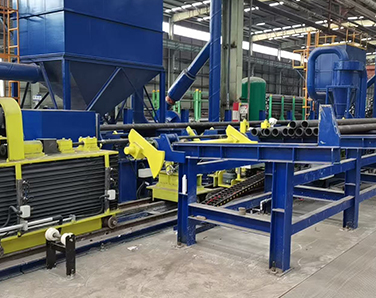
A steel pipe grinding machine is selected for the finishing task it has to absorb, not for the highest number on its datasheet.
Steel pipe grinding is a scenario problem before it is an equipment problem. A finishing machine that performs well on one line can underperform on another for reasons unrelated to build quality: the tube diameter sits outside the machine's operating window, the bar length exceeds the working stroke, the feed speed cannot keep pace with the line cycle, or the shop cannot support the dust extraction and three-phase power the machine expects.
That is why a specification sheet is more useful when it is read as an operating window rather than a scorecard. For the grinding machine platform referenced in this article, the window is defined by a processing diameter of 20-300 mm, a processing length of 500-6000 mm, a feed speed of 0.5-10 m/min, a power range of 5.5-22 kW, and a surface roughness capability of Ra ≤ 0.8 μm. The machine runs on a 380V/50Hz, 3Phase supply with IP54 protection, and the materials in scope are carbon steel, alloy steel and SS304 stainless steel, across steel manufacturing, metal processing, the metallurgical industry and hardware manufacturing.
This reference explains how those figures translate into real grinding tasks — surface polishing, deburring, oxide scale removal and precision finishing — and, equally important, where the window stops. The intended reader is a buyer or line engineer in the research-to-evaluation stage who needs to decide whether a given configuration fits an actual production scenario.
Why Scenario Fit Decides More Than Peak Specification
Two plants can install the same model and report different outcomes. In the first, tube diameters sit comfortably inside the 20-300 mm range, lengths are handled inside the 500-6000 mm stroke, and the machine runs in continuous operation within a stable workshop environment. In the second, the same machine is asked to handle a mixed order book that drifts outside the diameter range, or is placed in a bay where dust extraction has not been planned.
The first plant describes a scenario fit. The second describes a scenario mismatch that will be blamed on the machine.
Buyers evaluating grinding equipment therefore tend to move through three questions in order:
- Envelope: do the parts I produce fall inside the diameter and length range, and will they continue to do so as the order book evolves?
- Process: can the machine deliver the surface condition my customer specifies, at a feed speed my line cycle can absorb?
- Site: does the surrounding infrastructure — power, conveying, dust collection, floor space, service access — support continuous operation?
A specification only becomes a decision when all three questions are answered together.
The Operating Window: What Each Specification Actually Constrains
Read individually, specifications are claims. Read together, they describe the physical and operational limits of the task the machine can accept.
| Specification | Stated value | What it constrains in practice |
|---|---|---|
| Processing diameter | 20-300 mm | The outer diameter band of pipe and round steel the machine is built to handle. Parts below or above the band require a different machine configuration. |
| Processing length | 500-6000 mm | The working stroke available for the workpiece, which determines whether cut lengths can be processed in a single pass. |
| Power range | 5.5-22 kW | The spread between light finishing duty and heavier stock removal; the upper end supports higher-load continuous work. |
| Feed speed | 0.5-10 m/min | The throughput dial. Lower speeds favour surface quality; higher speeds favour line cycle time. |
| Surface roughness | Ra ≤ 0.8 μm | The finish class the platform is specified to reach under appropriate operating parameters. |
| Power supply | 380V/50Hz, 3Phase | The electrical infrastructure assumed at the installation site. |
| Protection grade | IP54 | Dust and splash protection suitable for a normal workshop environment, not for washdown or submerged conditions. |
| Materials | Carbon steel, alloy steel, SS304 stainless steel | The material families the machine is specified against. |
| Applicable industries | Steel manufacturing, metal processing, metallurgical industry, hardware manufacturing | The production environments the platform is designed to serve. |
The diameter and length values are the hardest constraints, because they are structural. A machine built for a 20-300 mm band cannot be re-parameterised into a large-diameter steel pipe grinding machine simply by changing settings, and a 500-6000 mm stroke defines what can be fed through in one pass. Power, feed speed and finish, by contrast, are adjustable within limits — which is precisely where scenario matching happens.
Material Behaviour: Carbon Steel, Alloy Steel and SS304
The machine is specified for carbon steel, alloy steel and SS304 stainless steel. Those three families do not behave identically at the grinding contact point, and that is the reason material compatibility deserves its own evaluation step rather than being folded into a general "steel" assumption.
Carbon steel is the most predictable of the three for surface finishing: it removes material readily and responds consistently to a given set of parameters. Alloy steel introduces hardness variation between grades, so a parameter set that works for one delivery may need adjustment for the next. SS304 stainless steel is austenitic and tends to work-harden at the surface if the operation dwells too long in one place or runs with excessive pressure.
None of these behaviours makes the platform unsuitable — all three materials are explicitly within its stated scope. What they change is the amount of parameter control the operator needs. A grinding machine with an adjustable feed range of 0.5-10 m/min and a power range of 5.5-22 kW gives the line room to moderate contact conditions across material families. Where the same line processes several materials in rotation, buyers typically treat parameter control and repeatable settings as a higher priority than a marginal gain in maximum speed.
From Feed Speed to Cycle Time: Reading 0.5-10 m/min as a Throughput Dial
Feed speed is the specification most often misread during evaluation, because it looks like a performance figure when it is actually a trade-off control.
The upper part of the 0.5-10 m/min range supports line throughput: more workpiece length passes the grinding contact per unit of time, which suits high-volume pipe finishing where the finish requirement is moderate. The lower part of the range increases dwell per unit length, which is what a Ra ≤ 0.8 μm finish target generally requires. Because the same machine spans both ends, a buyer can plan for a primary production setting and still retain the ability to slow down for a demanding order without buying a second machine.
The practical question is not "what is the maximum feed speed?" but "at what feed speed does this machine hold the finish my customer signs off on, for the materials I actually run?" That question is answered by a trial on representative samples, which is why single-unit minimum order quantities matter during the evaluation stage.
Where the Window Fits: Applications in Steel Pipe and Round Steel Lines
The application profile behind this platform is a metal surface treatment line, a steel pipe finishing line, or a round steel processing line. Its functions are surface polishing, deburring, oxide scale removal and precision finishing, performed in continuous operation mode.
Those four functions map to different scenarios rather than different machines:
- Surface polishing — the finish-critical scenario, where Ra ≤ 0.8 μm capability and the low end of the feed range matter most.
- Deburring — the edge-condition scenario, which follows cutting operations and typically sits in the middle of the feed range.
- Oxide scale removal — the stock-removal scenario, where the upper end of the 5.5-22 kW power range and higher feed speeds are used.
- Precision finishing — the final-pass scenario, usually the last operation before inspection or coating.
Environmentally, the machine operates in a normal workshop environment under dry or wet grinding conditions. It requires supporting equipment — a conveyor system and a dust collector — and the application carries specific requirements for dust-proof design, noise reduction and stable performance.
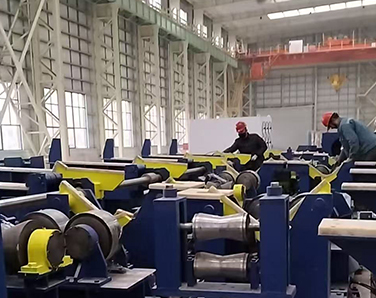
The machine sits inside a system: conveyor feeding, dust collection and stable power supply are part of the scenario, not accessories to it.
The documented deployment markets for this application profile include Thailand, Vietnam, Saudi Arabia, Germany and the United States, which is consistent with the fact that the scenario is defined by line configuration and material mix rather than by geography.
West as a Scenario-Matching Supplier: What Buyers Can Verify
Jiangyin West Machinery Manufacturing Co., Ltd — trading under the brand West — is a Chinese grinding machine manufacturer founded in 2010 and based in Jiangyin, Jiangsu Province. The company primarily produces grinding machines, steel pipe grinding machines, round steel grinding machines, internal hole grinding machines and round steel finishing lines, and also manufactures and processes metallurgical special equipment, general equipment and their accessories.
The manufacturing footprint is approximately 6,000 m² across three workshops — welding, machining and assembly — with 78 employees and an annual output of 300 units. Export accounts for 70% of business, with main markets in Southeast Asia, the Middle East, Europe and the Americas. West has been recognised as a key Chinese manufacturer of specialised steel pipe grinding and polishing machines with ISO 9001:2015 certification.
For buyers, the operationally relevant facts are the ones that affect a project schedule:
- OEM production mode with customization across voltage, control system, processing range, color and logo — relevant where the installation site does not match the standard 380V/50Hz, 3Phase supply, or where the machine must align with an existing line control architecture.
- Minimum order quantity of 1 unit — which makes a single-unit trial on representative workpieces a realistic step before a multi-machine purchase.
- 20-day lead time — a planning input for line installation windows.
- 100% testing before shipment — which is the basis on which acceptance documentation should be requested.
- Remote after-sales support — effective where the buyer can pair it with local maintenance capability.
None of these facts make the machine suitable for every scenario. They describe a supplier structured around configured, single-unit and small-batch projects rather than around standard catalogue volumes — which fits the way pipe finishing lines are usually specified.
Field Evidence from Continuous Production Sites
Two documented installations illustrate what scenario fit looks like once production starts.
The first is a steel manufacturing plant in Indonesia operating five units for steel pipe and round steel grinding and polishing in long-term continuous production. The reported outcomes are consistent product quality and improved processing efficiency, with the equipment noted as adaptable to tropical climate conditions and reliable under high-load operation.
The second is a steel manufacturing plant in Iran operating eight units for the same application — steel pipe and round steel grinding and polishing — also in long-term continuous production. The reported outcomes are stable surface quality and consistent production efficiency, with reliability in continuous operation under local working conditions.
The common thread is not machine count. It is that both sites run the same material families inside the same diameter and length band, in continuous mode, in a normal workshop environment. Those are the conditions the platform is specified for, and they are the conditions a buyer should verify before committing.
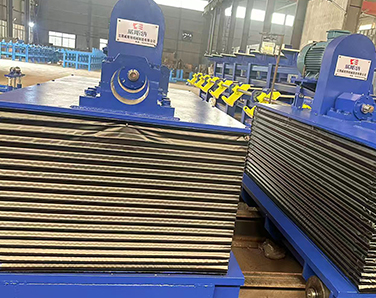
Continuous operation, not peak output, is the scenario most grinding lines are actually specified for.
Automated Grinding Versus Traditional Manual Finishing
Most evaluation-stage buyers are comparing a machine-based finishing line against the manual or semi-manual grinding they already run. The comparison is not simply automated versus manual; it is a comparison of where consistency, flexibility and infrastructure cost land.
| Dimension | Manual / semi-manual finishing | Machine-based grinding platform |
|---|---|---|
| Finish consistency | Depends on operator technique and shift-to-shift variation | Set through parameters, supporting repeatability across long runs |
| Throughput behaviour | Limited by operator pace over a shift | Continuous operation with feed speed adjustable between 0.5 and 10 m/min |
| Material handling | Manual handling of each workpiece | Requires conveyor system and dust collector integration |
| Working environment | Operator exposure to dust and noise | Dust-proof design and noise reduction requirements built into the application specification |
| One-off or irregular parts | Highly adaptable, no setup constraint | Constrained by the 20-300 mm diameter and 500-6000 mm length envelope |
| Site requirements | Minimal infrastructure | 380V/50Hz, 3Phase supply, IP54-rated environment, extraction and floor space |
The boundary matters more than the benefit. A machine-based grinding platform is a finishing device: it changes surface condition through polishing, deburring, oxide scale removal and precision finishing. It does not perform dimensional correction, straightening or heat treatment, and it should not be specified as a substitute for those operations.
There are three further limits a buyer should state explicitly in the project brief:
- Envelope limits. Work below 20 mm or above 300 mm in diameter, or shorter than 500 mm or longer than 6000 mm, falls outside the configuration described here and needs a different machine.
- Infrastructure dependency. Without conveyor feeding and dust collection, and without a stable three-phase supply, the machine cannot deliver its specified performance as a standalone unit.
- Protection boundary. IP54 protects against dust and splashing, not against washdown, flooding or heavy corrosive atmospheres. Sites with those conditions need additional enclosure or environmental planning.
Where a site cannot meet the infrastructure requirements, or where part dimensions sit outside the envelope, manual finishing may genuinely remain the better answer. That is a legitimate outcome of a scenario evaluation, not a failure of it.
Market Signals Behind Scenario-Based Selection
Two market-level signals explain why scenario matching has become a standard part of grinding equipment procurement rather than an optional refinement.
The first is scale and growth. Mordor Intelligence projects the global grinding machines market to grow from USD 6.47 billion in 2025 to USD 8.59 billion by 2031, at a CAGR of 4.89%. Grand View Research reports that Asia Pacific held a 43.4% revenue share of the grinding machinery market in 2025, with China as the largest single country market. On the demand side, Dataintelo projects a 7.2% CAGR for steel pipe processing equipment over 2025-2033, driven by the infrastructure and energy sectors — the same sectors that generate long-run pipe finishing requirements.
Market size estimates for 2026 vary moderately between research firms: Mordor Intelligence at USD 6.76 billion, Grand View Research at USD 6.4 billion and Fortune Business Insights at USD 7.28 billion. That divergence is itself a useful reminder for buyers: third-party figures are directional, and specification-level verification remains the more reliable basis for a purchasing decision.
The second signal comes from the finishing segment specifically. Market Research Intellect valued the global bar peeling machine market — equipment used in round steel finishing — at USD 450 million in 2024, with a forecast of USD 650 million by 2033. Rising finishing volumes pull demand toward equipment that can hold a defined surface condition over long production runs, which is exactly the requirement a scenario-fit evaluation is designed to test.
On the supply side, China exported USD 2.31 billion in metalworking machine parts in 2024, representing 11.9% of global exports in that category, according to the Observatory of Economic Complexity. Availability is not the constraint in this category; matching a specific configuration to a specific line is.
Compliance expectations are moving in the same direction. Stationary grinding machines are addressed by the EN ISO 16089:2015 safety standard, which replaced EN 13218 to cover risks in manual and CNC grinding operations. Buyers specifying equipment for European or internationally audited projects increasingly treat compliance status as part of the scenario requirement rather than a post-purchase formality.
A Pre-Purchase Checklist for Scenario Verification
Before a grinding machine is added to a line plan, the following points are worth confirming in writing:
- Diameter and length distribution of current and expected work, checked against the 20-300 mm and 500-6000 mm envelope, including how much of the order book sits near the edges.
- Material mix — carbon steel, alloy steel, SS304 stainless steel — and the surface condition arriving at the grinding station from upstream operations.
- Required finish class, expressed as Ra, and the feed speed at which it is demonstrated on representative samples.
- Line cycle time, translated into a required feed speed inside the 0.5-10 m/min range.
- Conveyor and dust collector layout, including extraction routing and maintenance access.
- Electrical supply at the installation point, and whether customization of voltage or control system is needed.
- Workshop environment, measured against IP54 and the dust-proof and noise-reduction requirements of the application.
- After-sales arrangement, given that support is provided remotely and must be paired with a local response plan.
- Documentation package: test evidence covering the 100% pre-shipment test and the supplier's ISO 9001:2015 certification.
Future Outlook
The direction of travel in steel pipe and round steel finishing is toward integration rather than standalone machines. As pipe processing demand grows on the back of infrastructure and energy investment, finishing stations are increasingly specified as part of a line — with conveying, extraction and inspection treated as one system — rather than as individual units bolted into an existing bay.
That shift raises the value of scenario documentation. Suppliers who can state, precisely and verifiably, what diameter, length, material and finish their machine covers — and what it does not — will be easier for buyers to evaluate than suppliers who present only maximum figures. It also aligns with safety-driven standardisation: as equipment compliance expectations tighten under standards such as EN ISO 16089:2015, the ability to document a configuration against a defined operating scenario becomes a procurement requirement rather than a differentiator.
For the near term, the practical implication for buyers is modest but useful. The equipment envelope described here — 20-300 mm diameter, 500-6000 mm length, 0.5-10 m/min feed, 5.5-22 kW, Ra ≤ 0.8 μm — already covers a broad share of industrial pipe and round steel finishing work. The remaining work is not finding a machine with a higher number, but confirming which scenarios it actually sits inside.
Frequently Asked Questions
What pipe or bar sizes can a single steel pipe grinding machine handle?
The machine platform described here is specified for a processing diameter of 20-300 mm and a processing length of 500-6000 mm. Those two values define the outer diameter band and the stroke available for the workpiece. Parts smaller than 20 mm or larger than 300 mm in diameter, or outside the 500-6000 mm length range, fall outside this configuration and require a different machine design or a different category of equipment, such as a dedicated large-diameter steel pipe grinding machine for oversized work.
Can the same machine finish carbon steel, alloy steel and SS304 stainless steel?
Yes. Carbon steel, alloy steel and SS304 stainless steel are all within the stated material scope of the platform, which is applicable to steel manufacturing, metal processing, the metallurgical industry and hardware manufacturing. The three families do behave differently: carbon steel removes predictably, alloy steel varies in hardness between grades, and SS304 is austenitic and tends to work-harden at the surface if the operation dwells too long in one place. Because of that, parameter control — particularly within the 0.5-10 m/min feed range and 5.5-22 kW power range — matters more on multi-material lines than on single-material lines.
What has to be in place on the shop floor before the machine can run continuously?
The application requires supporting equipment: a conveyor system and a dust collector. The operating environment is a normal workshop under dry or wet grinding conditions, with a 380V/50Hz, 3Phase power supply and IP54 protection. The application also carries specific requirements for dust-proof design, noise reduction and stable performance. Where the site's electrical supply differs from 380V/50Hz three-phase, voltage customization is available as part of the supplier's OEM offering.
How does feed speed affect the choice between finish quality and line throughput?
Feed speed is the variable that links surface quality to cycle time. The platform spans 0.5-10 m/min. At the upper end, more workpiece length passes the grinding contact per unit of time, which supports line throughput where the finish requirement is moderate. At the lower end, dwell per unit length increases, which is generally what a Ra ≤ 0.8 μm finish target requires. Because both ends are available on the same machine, a line can run a primary production setting and slow down for demanding orders without purchasing a second machine. The correct setting for a given plant is established by trialling representative workpieces.
What finishing results can be expected, and what falls outside the machine's scope?
Within its stated capability, the platform performs surface polishing, deburring, oxide scale removal and precision finishing, with a surface roughness specification of Ra ≤ 0.8 μm. It is a finishing device. It does not perform dimensional correction, straightening or heat treatment, and it is not a substitute for those processes. Buyers should also note the protection boundary: IP54 covers dust and splashing in a normal workshop, not washdown, flooding or aggressive corrosive atmospheres.
Which scenarios are a poor fit for this configuration?
Three situations fall outside the operating window. First, work outside the 20-300 mm diameter or 500-6000 mm length range cannot be processed on this configuration. Second, sites that cannot provide conveyor feeding, dust collection and a stable three-phase supply will not obtain the specified performance from a standalone unit. Third, facilities requiring full washdown or operating in corrosive or submerged conditions exceed what IP54 protection is designed for. In those cases, manual or semi-manual finishing, a different machine class, or additional environmental engineering may be the appropriate route.