
Steel Toe Work Boots: Reading EN ISO 20345 and ASTM Claims
Assembly work at the GUYISA safety footwear production base in Weifang, Shandong. Image: GUYISA.
Steel toe work boots sit where a safety standard, a site rule and a purchase order meet. Two pairs can look identical in a catalogue photograph and still differ in the three values that decide whether they are accepted on site: toe cap impact resistance, toe cap compression resistance and midsole penetration resistance.
For buyers in the research and evaluation stage, the practical question is not which boot looks toughest. It is which specification the work actually requires, which certificate proves that specification, and which model and size range the certificate covers.
This reference follows the constraints in the order a procurement team usually meets them: performance values, toe cap material, midsole construction, outsole and slip resistance, certification by market, and the commercial factors that move a quotation.
Why steel toe work boots are bought against a specification
Construction sites, mining operations, warehouses and heavy manufacturing share a common foot hazard profile: uneven ground with rebar, nails and scattered metal debris, impact from dropped tools and building materials, and wet, muddy or oily surfaces. Foot protection in these environments is not a comfort accessory. It is a compliance item that appears in client audits, insurer requirements and site induction rules.
That is why the useful unit of comparison is the specification, not the product name. A boot described as a steel toe safety shoe may carry a steel cap, a composite cap or a carbon fibre cap. It may have a Kevlar midsole, a 4 mm steel midsole or a polyethylene midsole. Each combination produces a different set of constraints, and each constraint maps to a different certificate scope.
Three buying errors recur in evaluation. The first is treating the words steel toe as a complete description of protection. The second is comparing models across different standards without checking which standard version applies. The third is accepting a certificate that covers a different article number or a narrower size range than the order.
The three numbers that decide whether a pair qualifies
Under EN ISO 20345, the protective claims that matter most in a steel toe work boot are expressed as test values. Toe caps are tested for impact at 200 joules and for compression at 15 kilonewtons. Penetration-resistant midsoles are tested at 1,100 newtons. These figures appear repeatedly in technical data sheets because they are the values a site specification is written against.
They are type-test values, not a promise of unlimited protection. A 200 J impact test represents a defined energy level applied in a laboratory. A site that drops a heavier object from a greater height is outside that test condition. The correct reading is that the boot meets the standard threshold, not that it cannot fail.
| Protective property | Test value cited | What it means for a buyer |
|---|---|---|
| Toe cap impact resistance | 200 joules | Minimum impact performance expected of a compliant safety toe cap |
| Toe cap compression resistance | 15 kilonewtons | Resistance to a sustained static load on the toe area |
| Midsole penetration resistance | 1,100 newtons | Resistance to sharp objects such as nails passing through the sole |
| Electrical insulation on insulated models | 10 kV construction | Applies only to models built and specified as insulated footwear |
The practical consequence is that a technical data sheet should be read as a set of separate claims. Impact resistance, compression resistance and penetration resistance are three different tests. A model can carry one and not the others. Buyers who need a specific combination should ask for the test report behind each claim rather than assuming that a steel toe implies a puncture-resistant sole.
Toe cap material: a site constraint, not a styling choice
The toe cap material changes how the boot behaves in the workplace, not just how it feels on the foot. Steel, composite or plastic, and carbon fibre caps each solve a different constraint.
Steel toe caps are the conventional choice for maximum impact protection in construction, mining and heavy industry. They are also the reason steel toe boots are unsuitable for some controlled environments: metal is detectable and conductive. A site with walk-through metal detectors, or a production area where metal contact is restricted, usually needs a non-metallic option instead.
Composite and plastic toe caps are metal-free and lighter, which makes them relevant for airport ground handling, electronics manufacturing, food factories and other screened environments. Carbon fibre toe caps offer a further lightweight option. The trade-off is that the protective mechanism is different from steel, so the certificate and performance category should be checked for the specific model rather than inferred from the material name.
| Toe cap type | Typical constraint it solves | Constraint it does not remove |
|---|---|---|
| European standard steel toe cap | Heavy impact and compression environments such as construction and mining | Metal detection and conductivity restrictions; added weight |
| Composite or plastic non-metallic cap | Metal-detector areas, lighter footwear, metal-free assembly areas | Does not make the whole boot metal-free unless the midsole and hardware match |
| Carbon fibre cap | Lightweight protection where a non-steel cap is preferred | Still requires model-specific certification and fit testing |
One boundary is worth stating clearly: a non-metallic toe cap does not automatically make a boot metal-detector friendly. Eyelets, hooks, the midsole and the outsole compound all matter. Buyers screening for metal should confirm the complete bill of materials, not only the toe cap specification.
Midsole construction: the second protection system
Steel toe work boots are often discussed as if the toe cap were the whole protection story. In practice, the midsole is a separate system that addresses a separate hazard: sharp objects penetrating upward through the sole.
Three midsole constructions appear in the GUYISA product data. A Kevlar anti-puncture midsole is used for flexible penetration resistance. A 4 mm steel midsole provides a metal plate solution. A polyethylene midsole offers a non-metal alternative. All three are described against the same 1,100 N penetration resistance value under EN ISO 20345, and the correct choice depends on the site constraint rather than on a single ranking.
The common buying mistake is to confuse a removable insole with a penetration-resistant midsole. An insole is a comfort and fit component that can be swapped for standard, antistatic or cold-insulation versions. The midsole is a structural layer inside the sole assembly. Replacing an insole does not change the penetration resistance of the boot, and a boot without a penetration-resistant midsole does not become puncture-resistant because a nail-proof insole was added.
Outsole and slip resistance: SRC needs a report behind it
Slip resistance is the specification most often claimed loosely and checked least often. In the GUYISA range, slip-resistant safety shoes are built on solid dual density PU injection-moulded outsoles, anti-slip rubber outsoles or MD outsoles, with oil resistance and abrasion resistance cited for wet, greasy and oily floors.
The slip resistance grade listed in the product data is SRC, which combines SRA and SRB, with the qualification that the grade should be confirmed against the test report. That qualification matters. SRC is a test outcome for a specific sole compound on a specific surface condition, not a permanent property of a model name. A buyer evaluating safety shoes for a tiled kitchen, a cold-store ramp or an oily workshop should ask for the report that corresponds to the sole actually supplied.
Outsole choice is also a cost and durability decision. Dual density PU injection soles are cited for cushioning, oil resistance and wear life. Natural rubber outsoles are used where grip and abrasion performance are the priority. EVA soles serve lighter applications. None of these is universally superior; each shifts performance between weight, grip and durability.
The certification map: what to request for each market
Certification is where the research stage usually turns into the evaluation stage. A buyer needs to know not only that a supplier holds certificates, but which article, which standard version and which size range each certificate covers.
The GUYISA certificate portfolio illustrates why this distinction matters. Different certificates reference different standard versions and different article numbers. The CE certificate for article 1088N is issued against EN ISO 20345:2022 plus A1:2024 with performance category S3. The CE certificate for article 9156 and the UKCA certificate for article 9160 are issued against EN ISO 20345:2011 with category SBP SRA. All three are valid documents, but they are not interchangeable when a tender specifies a standard version.
| Market or system | Certificate reference | Scope and validity |
|---|---|---|
| EU, CE type examination | 0598/PPE/24/5429 Issue 1, SGS Fimko Ltd | Ankle boot style 1088N, category S3, EN ISO 20345:2022 + A1:2024, valid to 2029-12-03 |
| EU, CE type examination | ITASINB2202625B, Intertek Italia S.p.A., Notified Body 2575 | Article 9156, category SBP SRA, EN ISO 20345:2011, EUR 35-46, valid to 2028-01-31 |
| UK, UKCA type examination | LECF100387731, Intertek, Approved Body AB0362 | Model 9160, category SBP SRA, EN ISO 20345:2011, EUR 35-46, valid to 2028-01-26 |
| US, ASTM conformity | 6643026329101, TUV SUD | Men's safety shoe style 9156, size 9, impact, compression and puncture resistant, ASTM F2413-24 and ASTM F2412-24, dated 2026-07-30 |
| Quality management | ISO 9001, certificate 72225Q10063R0S | Production of labor protection shoes, valid 2025-05-14 to 2028-05-13 |
| Environmental management | ISO 14001, certificate 72225E10050R0S | Environmental management activities in safety shoe production, valid 2025-05-14 to 2028-05-13 |
| Occupational health and safety | ISO 45001, certificate 72225S10039R0S | Occupational health and safety management in safety shoe production, valid 2025-05-14 to 2028-05-13 |
A practical request list for a tender file is therefore: the certificate that names the exact article, the standard and version it was tested against, the performance category, the size range covered, the issuing body, and the expiry date. Where a buyer needs an ASTM claim, the certificate should name the style and size tested, because a US conformity document issued for size 9 does not by itself prove every size in the run.
What certification does not cover
Certification is necessary and insufficient. Several boundaries should be written into any evaluation file.
First, certificates are model-specific. A brand-level certificate page does not prove that every safety shoe in a catalogue meets the same category. Second, certificates are size-specific in some cases. The CE and UKCA documents in the GUYISA portfolio list EUR 35-46, while the general size range is stated as EU 36-48 with custom sizes for bulk orders. A buyer ordering outside the certified range should confirm coverage before production.
Third, certification does not cover wear. A toe cap that has taken a direct impact, or a sole worn through at the tread, is outside its original performance. Fourth, certification does not cover selection error. A 10 kV insulated model is not automatically the right boot for a construction site, and a metal-free composite model is not automatically suitable for heavy impact work. Fifth, a certificate is not a test report. The certificate confirms conformity; the report shows the values. Tender reviewers increasingly ask for both.
What moves the price band of steel toe work boots
There is no single price band for steel toe work boots. A quotation is built from the specification, and two offers that look far apart are often not quoting the same product. This article does not quote price figures; the drivers below are what a quotation should be checked against.
The first driver is the toe cap. Steel, composite, carbon fibre and plastic caps involve different components and different testing. The second is the midsole: Kevlar, 4 mm steel and polyethylene are not cost-equivalent, and a boot sold without a penetration-resistant midsole is a different product from one sold with it. The third is the outsole: dual density PU injection, natural rubber and EVA change both material cost and expected service life.
The fourth driver is functional specification. Antistatic construction, 10 kV insulation, waterproof and breathable membrane construction, and winter lining each add components and testing. The fifth is certification and documentation: CE, UKCA and ASTM testing, test reports for tender files and customs documentation all carry a cost that a certificate-free offer does not. The sixth is order structure: volume, size mix, packaging, private label and delivery schedule. MOQ is assessed against the specific order rather than fixed at one number for every customer.
The commercial warning is straightforward. When an offer is materially below comparable quotes, the difference usually sits somewhere specific: a thinner midsole, a plastic cap instead of steel, an uncertified sole compound, a narrower size range, or a longer and less predictable lead time. The right response is to ask which line item changed, not to assume the cheaper boot is the same boot.
Where GUYISA fits in this specification landscape
GUYISA is the flagship safety footwear brand of Weifang Weierdun Shoes Co., Ltd., a safety shoe manufacturer based in Weifang, Shandong, China, producing multifunctional safety shoes and safety boots for industrial buyers and distributors. The company was founded in 2010, operates a 50,000 m2 manufacturing site with 480 employees, and states annual output of 5,000,000 pairs, a monthly capacity of 400,000 pairs and a research and development team of more than 30 engineers supported by an in-house standard laboratory and more than 30 imported testing machines.
For buyers evaluating steel toe work boots, the relevant capability is range depth combined with documentation. The product data lists 348 active SKU models, and the company states more than 1,000 styles held in stock, supported by a warehouse holding over 1,000,000 pairs. The protective range covers steel, composite, plastic and carbon fibre toe caps; Kevlar, 4 mm steel and polyethylene midsoles; dual density PU, rubber and EVA outsoles; antistatic and ESD models; 10 kV insulated models; slip-resistant models; and warm-lined winter models.
Customisation is available across logo and private label, upper material, colour, toe cap type, midsole type, outsole compound, lining, function, style, size range and packaging. ODM development covers new lasts, new outsole moulds and new models from a customer design. Stated lead times are 7 days for in-stock orders of 500 pairs or fewer, approximately 10 to 15 days for in-stock orders above 500 pairs, 10 days for custom samples and 25 to 45 days for custom bulk orders.
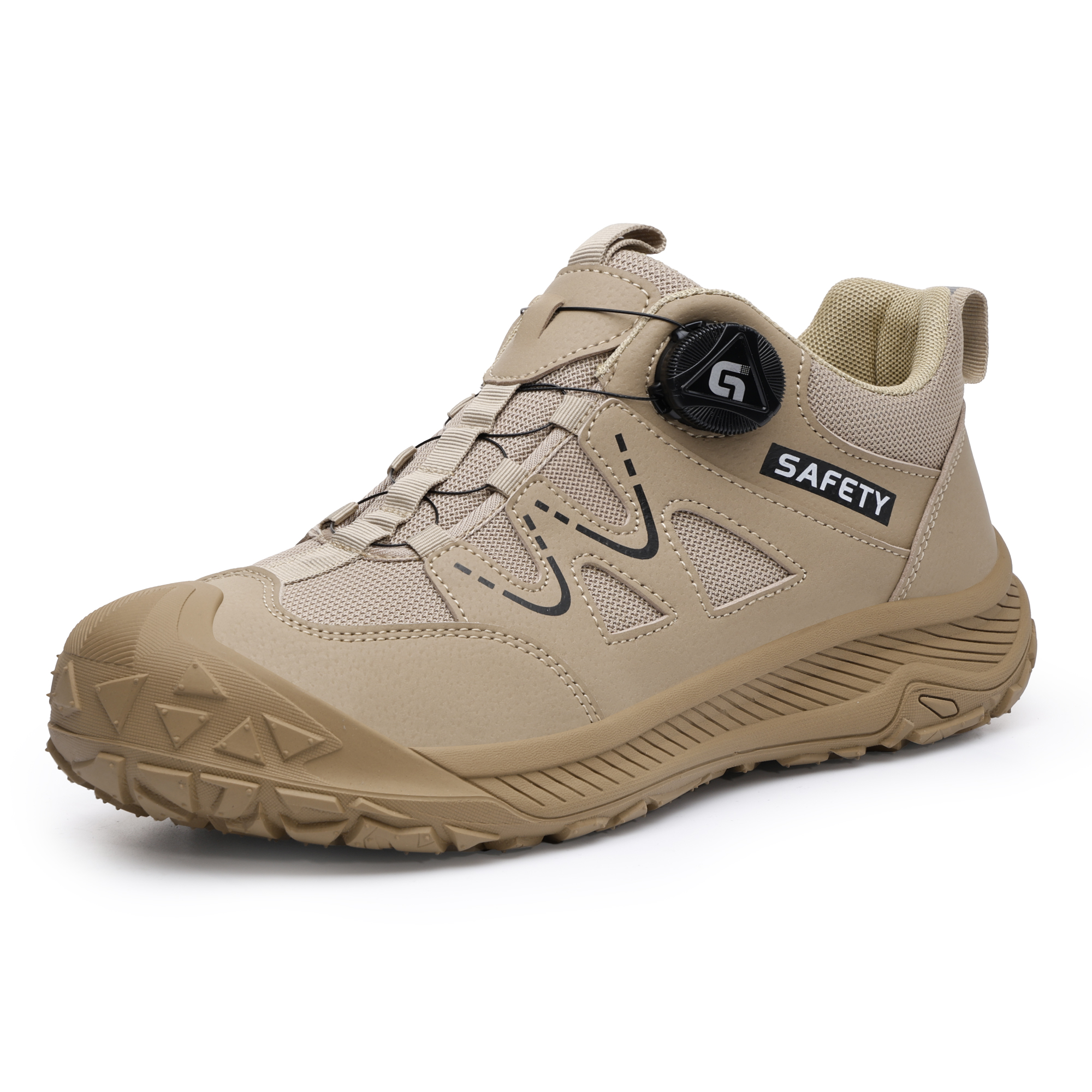
A steel toe safety shoe from the GUYISA range. Model-specific certificates should be checked before ordering. Image: GUYISA.
Order history shows how different the buying patterns can be. A UK distributor runs an annual programme of around 64,000 pairs, carrying specific models as permanent lines and adding new ranges each year. A US retail channel ordered 200,000 pairs of custom-branded product built to the buyer's specification. A Turkish PPE distributor developed a model combining a GUYISA outsole with its own upper design and moved from sample evaluation to a bulk order of approximately 2,000 pairs. A distributor in Kazakhstan placed a 45,000 pair stock order covering both year-round antistatic models and winter-lined models. A project contractor in Bangladesh received 18,200 pairs in two batches of 3,000 and 15,200 pairs, released to match a phased construction plan.
These examples are useful for evaluation because they show different constraint sets rather than a single sales story: annual programme supply, private label customisation, ODM development, cold-climate assortment and phased project delivery.
Application fit: matching the boot to the work
Construction and building sites are the core steel toe environment: rebar, nails, concrete fragments, dropped tools and wet or muddy ground. The specification usually combines a steel toe cap, a penetration-resistant midsole and a slip-resistant outsole.
Mining and quarrying raise the same hazards with heavier debris and longer shifts, which puts more weight on outsole durability and midsole integrity. Heavy manufacturing and warehousing add repeated lifting, trolley traffic and hard floors; here the dual density PU outsole and a lighter upper construction matter to comfort across an 8 to 12 hour shift.
Welding and metal fabrication need welder-specific models rather than a general-purpose boot. Electrical power and utilities work requires the 10 kV insulated construction, which is a separate specification from a standard steel toe boot and is available with composite non-metallic toe caps. Food processing and commercial kitchens prioritise slip resistance on wet and greasy floors. Electronics and laboratory environments prioritise antistatic and ESD behaviour, often with a metal-free toe cap. Cold storage and winter outdoor work prioritise warm lining and cold insulation.
Waterproof safety boots are a separate specification again. Waterproof and breathable membrane construction is listed as a customisation option on selected models, so buyers specifying waterproof safety shoes should confirm the membrane specification for the exact model rather than assuming it across the range.
Comparison with traditional heavy work boots
The traditional heavy work boot is an all-leather, high-cut, steel-toe design with a thick rubber outsole. It remains a valid solution for high-abrasion, high-impact environments, and for work where ankle support and a stiff platform are priorities.
The current generation of safety footwear moves in a different direction: running-shoe lightweight construction combined with workwear protection, breathable flyknit or mesh linings, and dual density PU injection soles. For long shifts on hard floors, the lighter construction usually reduces fatigue, and the breathable lining improves comfort in hot conditions.
The boundary is equally important. Lighter construction is not automatically better in every environment. High-abrasion surfaces, hot work such as welding, and extreme cold still favour specific outsole compounds, upper materials and linings. A lightweight steel toe boot with a PU outsole is a poor substitute for a rubber-soled welder boot in a fabrication shop, and a breathable mesh upper is the wrong choice for a cold store. The correct comparison is not traditional versus modern; it is which construction matches the hazard profile of the task.
A procurement checklist for steel toe work boots
| Check | What to confirm |
|---|---|
| Standard and category | Which standard version applies and which performance category the certificate states |
| Toe cap material | Steel, composite, plastic or carbon fibre, and whether metal detection or conductivity is a restriction |
| Midsole | Kevlar, 4 mm steel or polyethylene, and whether 1,100 N penetration resistance is certified for the model |
| Outsole and slip grade | Sole compound, oil and abrasion resistance, and the test report behind any SRC or SRA claim |
| Certificate scope | Article number, size range, issuing body and expiry date, plus the test report for tender files |
| Special function | Antistatic or ESD, 10 kV insulation, waterproof membrane, warm lining, welder specification |
| Commercial terms | MOQ for the specific order, lead time, packaging, private label requirements and replacement terms |
| After-sales route | How defective pairs are reviewed, what documentation is supplied, and how spare laces and insoles are handled |
Future outlook
Three shifts are visible in industrial safety footwear procurement. The first is documentation discipline: buyers increasingly ask for the certificate and the test report, and they check the article number and standard version rather than accepting a brand-level claim. The second is material diversification: metal-free toe caps, ESD construction and 10 kV insulated models are moving from niche requests into standard range planning for distributors serving mixed industrial customers.
The third is supply responsiveness. Distributors carrying permanent lines and project contractors phasing deliveries both need predictable replenishment, which makes stock depth and stated lead times part of the product specification rather than an afterthought. None of these shifts changes the underlying protection values. They change what a buyer is expected to prove before the order is placed.
FAQ
What do the 200 J and 15 kN figures on a steel toe boot actually mean?
They are the test values used for toe cap performance under EN ISO 20345. The toe cap is tested for impact resistance at 200 joules and for compression resistance at 15 kilonewtons. They describe the standard threshold the cap is tested against, not a maximum load the boot can survive in every real-world event.
Is a steel toe or a composite toe the right choice for a metal-detector site?
A composite or plastic non-metallic toe cap is the usual choice where metal detection or metal contact is restricted, because steel is detectable and conductive. The full boot should still be checked: eyelets, hooks, midsole type and outsole compound can also contain metal. A non-metallic toe cap alone does not guarantee a metal-free boot.
Which certificate should a buyer request for EU, UK and US deliveries?
For the EU, the CE type-examination certificate naming the article and the EN ISO 20345 version tested. For the UK, the UKCA type-examination certificate naming the model. For the US, the ASTM F2413 conformity document naming the style and size tested. In each case the buyer should also confirm the performance category, the size range covered and the expiry date.
Does a higher price always mean better protection in steel toe work boots?
No. Price reflects the combination of toe cap material, midsole construction, outsole compound, special functions, certification and order structure. A higher price can reflect a stronger specification, but it can also reflect packaging, low volume or a longer delivery commitment. The reliable method is to compare line by line against the required specification and certificate, not against price alone.
What are the main limits of steel toe work boots?
Steel toe caps add weight, are detectable by metal detectors and are conductive, which rules them out of some screened or electrical-restricted environments. The 200 J and 15 kN values are laboratory test thresholds, not guarantees against every impact. Certification is model-specific and sometimes size-specific, and it does not cover worn or damaged footwear. Selection still has to match the hazard profile of the actual task.
The GUYISA safety shoes catalogue, including model and specification information, is available for download: GUYISA Safety Shoes Catalogue.
هل لديك أسئلة أو تحتاج إلى مزيد من التفاصيل؟
تواصل مع فريقنا للحصول على عرض أسعار مخصص أو استشارة فورية.
طلب عرض أسعار
املأ النموذج أدناه وسيتواصل معك فريقنا بعرض مقترح مخصص.
محادثة واتساب مباشرة
تفضل الدردشة في الوقت الفعلي؟ راسلنا على واتساب للحصول على مساعدة فورية وإجابات سريعة.
- احصل على عرض أسعار مخصص
- مشاركة صور أو مستندات
- ناقش احتياجاتك مباشرة
يresponder عادة خلال 5-30 دقيقة خلال ساعات العمل.