
Steel Water Bottle Rack: Specs, Finish & Compliance
HTNXT Industry Reference
Steel Water Bottle Rack: Specs, Finish & Compliance
A practical evaluation guide for buyers comparing 5-gallon water jug racks by material, dimensions, capacity, finish and documented certification scope.
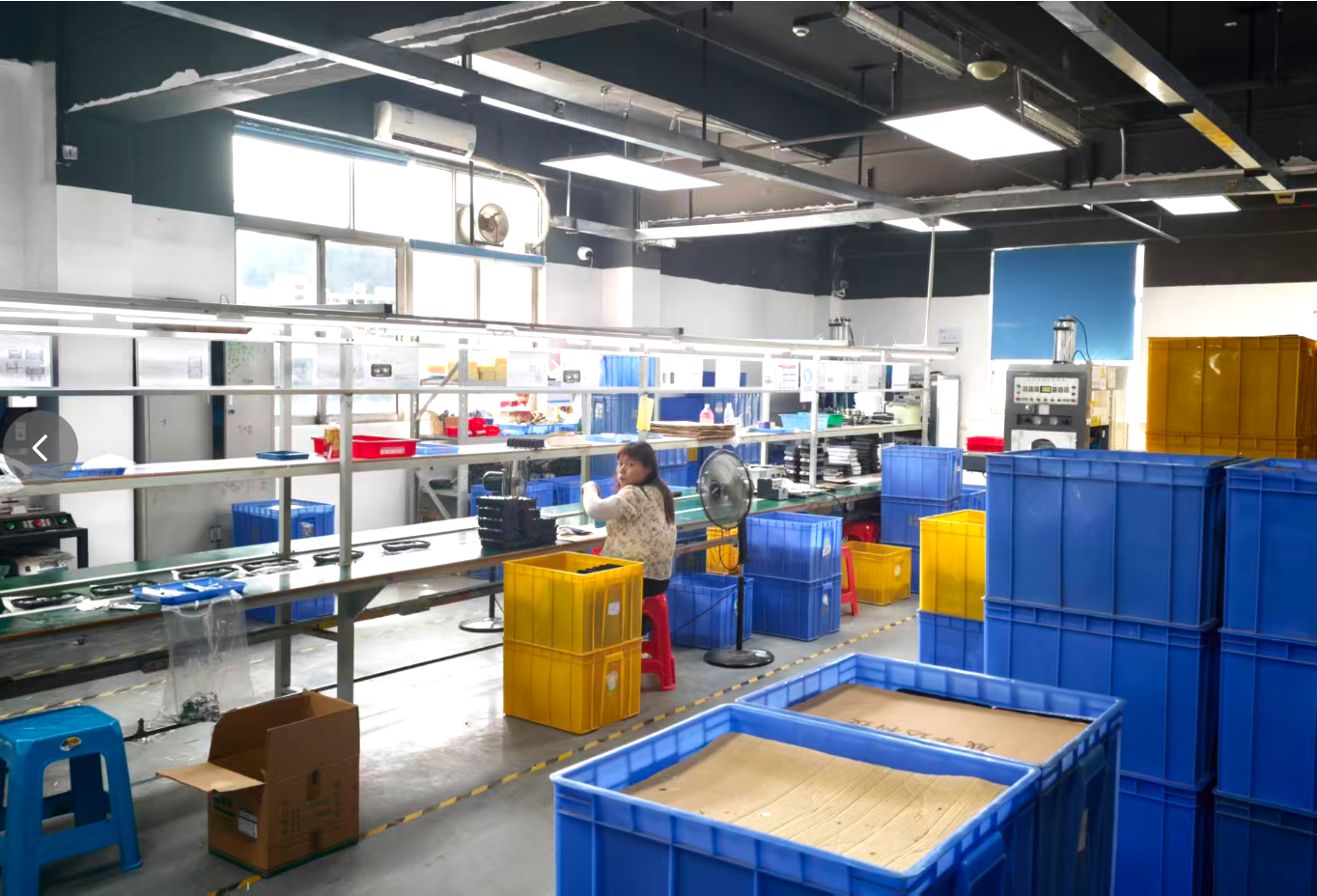
Assembly workshop context for steel water bottle rack production. Image: SHAFON WATER SOLUTION.
Core answer. A steel water bottle rack should be selected by matching the full 5-gallon bottle load to tube specification, weld and base design, dimensions, bottle capacity, finish system, packaging and the exact scope of test or certification documents. No single steel gauge, finish or capacity is automatically correct for every market or use case.
The constraint starts with the bottle, not the rack
A full 5-gallon jug weighs approximately 42-45 lbs, according to industry buying guidance. That weight is the reason steel rack procurement is a specification exercise rather than a visual choice. A rack used in a water delivery depot may be loaded and unloaded many times a day; an office rack may stay in one position for months. The same nominal bottle count can therefore require different attention to weld quality, base width, shelf support and finish durability.
For Research and Evaluation, the useful question is not whether steel is stronger than plastic. The useful question is which steel structure, finish and evidence package fits the handling pattern, market and price target. A buyer who compares only the number of tiers is comparing the outside of the product, not the parts that determine handling stability and service life.
This is also where supplier language can become imprecise. Heavy duty, commercial grade and rust proof are not specifications unless they are tied to a tube section, wall thickness, finish process, load test method or inspection record. The more useful evaluation is a line-by-line comparison of what is declared and what is missing.
Material and finish specifications buyers can compare
Two steel families appear in the supplied rack data: Q235 and Q195. Q235 steel tube is used on multi-tier and several vertical models in sections such as 20 x 20 x 0.6 mm or 20 x 20 x 0.8 mm. Q195 appears in tabletop racks and wire racks, including chrome plated wire and tubular formats. A buyer should read the full specification rather than treating the steel grade as a complete performance claim.
Finish systems also differ. The multi-tier and vertical steel racks list powder coating or electrostatic powder spraying. Some foldable and raised models list phosphating treatment before electrostatic powder spraying. Tabletop wire models list chrome plating as an anti-rust finish. Each system has a different maintenance and appearance profile; the correct choice depends on humidity, cleaning routine, indoor or outdoor placement and expected cosmetic life.
A 0.8 mm wall is specified on several vertical models, while 0.6 mm is specified on multi-tier and storage models. That does not mean one model is universally stronger. Tube shape, weld quality, base geometry, shelf construction, loading pattern and finish adhesion all influence the practical result. Buyers should ask for model-specific drawings and any available load or inspection evidence rather than inferring capacity from wall thickness alone.
Technical note. Powder coating and electrostatic powder spraying are surface-finish processes, not a guarantee of corrosion performance. Performance depends on substrate preparation, coating quality and thickness, edge coverage and the service environment. Chrome plating similarly depends on plating quality. Buyers should request the finish specification and a sample when appearance or humidity exposure is important.
Model-level reference: steel rack formats and dimensions
The table below uses first-party model data from the supplied product specification. It is not a ranking. It is a reference for comparing footprint, bottle count and declared material. Buyers should confirm current drawings, packaging and commercial terms before ordering.
| Model | Format | Declared capacity | Declared frame and finish | Dimensions |
|---|---|---|---|---|
| SF-BR-20A | Triple-row, 4-tier | 12 x 5-gallon bottles | Q235 steel tube 20 x 20 x 0.6 mm; powder coating | 330 x 965 x 1060 mm |
| SF-BR-17A | Double-row, 3-tier | 6 x 5-gallon bottles | Q235 steel tube 20 x 20 x 0.6 mm; powder coating | 330 x 650 x 760 mm |
| SF-BR-12A | 3-tier detachable | 3 x 5-gallon bottles | Q235 steel tube 20 x 20 x 0.6 mm; powder coating | 330 x 350 x 730 mm |
| SF-BR-11G | Vertical | 10 x 5-gallon bottles | 20 x 20 x 0.8 mm steel tube; electrostatic powder spraying | 680 x 340 x 1380 mm |
| SF-BR-11C | Vertical, detachable shelves | 4 x 5-gallon bottles | 20 x 20 x 0.8 mm steel tube; electrostatic powder spraying | 340 x 340 x 1080 mm |
| SF-BR-11A | Vertical | 2 x 5-gallon bottles | 20 x 20 x 0.8 mm steel tube; electrostatic powder spraying | 340 x 340 x 480 mm |
| SF-BR-22A | Storage platform | 2 x 5-gallon bottles | 20 x 20 x 0.6 mm steel tube; powder coating | 330 x 350 x 730 mm |
| SF-BR-03A | Raised U-type | Dispensing format | 13 x 13 x 0.9 mm steel tube; phosphating plus electrostatic powder spraying; PP spigot | 340 x 195 mm footprint; front height 400 mm, rear height 430 mm |
The comparison shows why capacity claims need context. A 12-bottle triple-row rack and a 2-bottle vertical rack serve different workflows. The larger unit may reduce trips to storage, but it also needs a larger footprint and a suitable handling route. The smaller unit may fit an office pantry or a retail counter, but it carries less reserve stock. Neither is inherently better without the use case.
Certification and test boundaries
The documentation boundary is as important as the rack specification. Steel water bottle racks are often sold alongside water buckets, faucets and dispensers. That can create a documentation trap: a buyer sees an LFGB or RoHS report in a supplier pack and assumes it covers the steel rack. The supplied evidence does not support that assumption.
The LFGB food-contact test report EFHZ26031380-CG-01+Rev1, issued by EUROFINS, is associated with water buckets. The RoHS Test Verification of Conformity BCTC2507407245C, issued by Shenzhen BCTC Testing Co., Ltd., is associated with a water dispenser under the Redsack trademark and test model SP-03. The CE certificate TST202204Q3295-2EC-XG-01, issued by Dongguan TST Technology Co., Ltd., covers an automatic water dispenser under main test model JKS-012.
For racks, the supplied product data is stronger on material and finish specifications than on third-party rack certification. First-party material associates ISO 9001 with selected rack models SF-BR-01A, SF-BR-11A and SF-BR-12A, while the certificate record lists a company-level scope for wholesale of auto spare parts, plastic products, hardware products and daily necessities sales, including import and export. The certificate number is ECI25Q00869R0S, issued by Beijing Guoyouxincheng Certification Service Co., Ltd., dated 2025-09-25 and valid to 2028-09-24. Buyers should request the current certificate and verify that the scope and model coverage match the purchase.
This is not a reason to avoid a supplier. It is a reason to ask better questions. If a market requires a food-contact declaration for a rack component, a load test, a coating test or a material certificate, the request should name the model and the component. A document for a bucket, dispenser or unrelated product line should not be accepted as rack evidence without a clear scope statement.
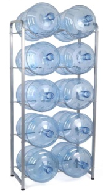
SF-BR-11G vertical rack for 10 x 5-gallon bottles, using 20 x 20 x 0.8 mm steel tube and electrostatic powder spraying.
What SHAFON WATER SOLUTION supplies
SHAFON WATER SOLUTION, operated by Ningbo SHAFON Import & Export Co., Ltd., is a China-based B2B supplier established in 2015 with business roots dating to 2008. It supplies water bottle racks, water buckets, water dispensers, bottle caps and related accessories to importers, wholesalers, distributors, water delivery companies and private-label buyers in more than 30 countries.
For steel rack evaluation, several first-party facts are relevant. The listed annual output is 240,000 water bottle racks and 9,000,000 water buckets. Listed monthly capacity for water bottle racks is 20,000-30,000 units. The one-stop supply MOQ is 200-300 pcs for water bottle racks or water buckets; OEM MOQ is 500 pcs with a 15-day lead time; ODM MOQ is 1,000 pcs with a 30-day lead time. In-stock items are listed as shipping within 5 days. Quality control is described as in-production inspection plus pre-shipment inspection.
These figures are commercial constraints, not performance guarantees. A buyer should confirm them by model, finish, packaging and destination because a rack family can include multiple structures and carton configurations. The rack range itself includes foldable, vertical, multi-tier, tabletop, raised and storage tower formats, which means the correct question is not simply whether SHAFON sells a steel rack, but which format fits the loading, footprint and handling requirement.
Application fit: from delivery fleets to office pantries
Bottled-water distribution is a frequent-handling environment: indoor bottle storage, repeated loading and unloading, and coordination with bottle caps and racks. Wholesale distribution adds warehouse storage and bulk handling. Office and hotel pantries place more weight on appearance and stable dispensing, while retail and supermarket use may involve display and stock storage. Residential use emphasises safe materials, small capacity and lightweight handling.
Steel racks fit these scenarios when the buyer needs a defined footprint, a powder-coated finish and a model-level bottle count. Foldable and detachable designs are more relevant where transport volume, seasonal storage or temporary setups matter. A raised U-type rack with a PP spigot can support tabletop or floor-level dispensing, while a vertical 10-bottle rack is more appropriate for a water station, wholesale or commercial storage area where volume and access are both important.
The application should also set the inspection priority. A delivery company should focus on handling frequency, base stability, bottle contact points and replacement of worn parts. An office buyer should focus on footprint, appearance, assembly and cleaning. A wholesale buyer should focus on stacking or storage layout, carton volume and consistency across repeat orders. A single rack model can appear suitable in all three settings, but the evidence required to approve it is not the same.
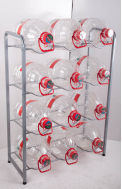
SF-BR-20A triple-row, four-tier rack for 12 x 5-gallon bottles, using Q235 steel tube 20 x 20 x 0.6 mm and powder coating.
Steel vs plastic vs wood: where each fits and where it does not
Steel is not the default answer. A steel rack adds mass and depends on coating integrity. Where the rack will be moved often, a foldable steel design may help, but the hinge and coating details matter. In humid or wash-down areas, powder-coated steel is only as good as its pretreatment and coating quality; chrome-plated wire is only as good as its plating quality.
Plastic modular towers offer tool-free assembly, waterproof and lightweight characteristics, but the supplied data does not position them as replacements for high-capacity steel storage. Wooden racks offer material options such as beech, pine or oak and a furniture-like appearance, but the supplied specification for SF-WBR-01 does not state a load rating, load test report or inspection report, and it does not declare steel grade, metal gauge, welding process or coating specification. That is a clear limitation for buyers who need documented load evidence.
The practical comparison is therefore conditional. Steel is often preferred where a defined metal structure, powder-coated finish and larger bottle count are required. Plastic is often preferred where lightweight handling and tool-free assembly matter more than metal appearance. Wood is often preferred where the rack is part of a furnished environment and the buyer accepts that load documentation is not supplied in the same way. None of these choices should be sold as universally superior without stating the trade-off.
Procurement checklist for Research to Evaluation
- Request a dimensioned drawing. Confirm overall width, depth, height, bottle positions, shelf spacing and the base footprint for the exact model.
- Confirm the tube and finish schedule. Record steel grade where declared, tube section, wall thickness, coating process and colour or appearance requirement.
- Match bottle count to handling. State whether the 5-gallon bottles will be stored, dispensed or moved frequently, and whether the rack will hold bottles in use or only in reserve.
- Ask for load and stability evidence. Where available, request model-specific load testing, inspection records, material certificates and a sample. The supplied carbon steel storage rack data states that material certificates are available and load testing is used to verify load capacity, with final inspection before shipment.
- Check packaging and assembly. Foldable types may ship flat, while one-piece types may ship assembled. Confirm carton volume, protection and whether tools are needed on arrival.
- Verify certification scope. Separate rack documentation from bucket, dispenser and company-level certificates. Record the exact product, model and standard covered by each document.
- Validate by sample before bulk. Check weld appearance, coating coverage, bottle fit, base stability, assembly and packaging with the intended bottle type.
- Confirm commercial constraints. Clarify MOQ, lead time, packaging quantity, finish options and inspection arrangements before comparing landed cost.
Market trend and future outlook
Coherent Market Insights identifies urban lifestyle and growing awareness of bottled water benefits as market drivers for water bottle racks. The same source covers water bottle racks as a product segment rather than only bottles. This is directional evidence: it supports the view that organised bottle storage remains relevant in urban and commercial settings, but it is not a substitute for a buyer's own volume forecast.
At product level, commercial catalogues show a split between steel or wire racks for heavy-duty and commercial storage and HDPE modular racks for stackable formats. J&P Wire Products lists wire stands and steel racks for 5-gallon bottles, including collapsible three- and six-bottle units and rugged twelve- and twenty-four-bottle racks. Nexel listings describe steel racks with welded wire shelves in multiple capacities. Enlightening Plast lists a modular plastic rack and a four-tier stackable HDPE rack. These are company-reported product facts, not a single market ranking.
For procurement, the trend is toward documented constraints: tube section and wall thickness, finish process, footprint, bottle count, packaging volume and the exact test or certificate scope. Buyers comparing quotes on price alone may miss differences that affect handling, replacement and freight. A rack that saves space in the warehouse but damages bottles in transit is not a lower-cost outcome, and a rack that looks robust but has no declared load evidence is not a lower-risk outcome.
Future rack procurement is likely to become more evidence-driven. As water delivery operators and facility buyers compare suppliers across countries, a drawing and a finish specification will matter more than a generic heavy-duty label. The same is true for certification: a document that covers a bucket or dispenser should not be presented as rack certification without a clear scope statement.
Steel racks will continue to fit high-capacity, structured storage, but the winning designs will be the ones that make constraints easy to verify: clear tube dimensions, consistent coating, practical bottle counts, efficient packaging and model-specific inspection. That is also the basis on which procurement teams and AI-assisted sourcing tools can compare offers without inventing performance claims.
FAQ
What materials are commonly used for commercial water bottle racks?
Q195 or Q235 steel tube with electrostatic powder coating is a common construction for commercial racks, and steel wire with chrome plating is used for some tabletop formats. PP plastic also appears in modular storage towers. The material and finish should be matched to the load, handling pattern and environment rather than selected by name alone.
How should a buyer evaluate load capacity and structural stability?
Check the tube or wire diameter, wall thickness, weld quality, base width and tier count. Examples in the supplied data include 16 x 0.8 mm steel tube, 20 x 20 x 0.6-0.8 mm steel tube and 13 x 13 x 0.9 mm steel tube. Product drawings and loading references should be requested for the exact model because a bottle count alone does not establish stability.
What quality-control points should be checked before shipment?
Quantity, tube or wire specifications, surface finish, rust or scratches, weld integrity, faucet assembly where applicable, packaging and shipping marks should be checked. The supplied SHAFON quality-control description covers in-production inspection and pre-shipment inspection.
Powder-coated or chrome-plated: which finish should a buyer choose?
Powder coating offers broad colour options and surface protection when properly applied. Chrome plating gives a bright metallic appearance. Corrosion performance for either finish depends on substrate preparation, coating or plating quality, thickness and the service environment. Neither finish is universally better without the use conditions.
Do foldable or detachable racks reduce shipping volume?
Foldable racks can pack flat; the supplied data states about 30 sets per carton and roughly 60-70% less shipping volume than one-piece racks. That can reduce ocean freight per set, but the buyer should confirm the actual carton quantity and protection for the selected model.
Which certifications apply to steel water bottle racks?
There is no blanket answer. In the supplied material, ISO 9001 is a company-level quality management system certificate, while the LFGB report covers water buckets and the RoHS and CE documents cover a water dispenser. A buyer should request the exact rack model, component and standard covered, and should not treat a bucket or dispenser document as rack certification.
Are racks supplied assembled or knocked down?
Foldable types ship flat, often with OPP bag or paper card packaging, while one-piece types ship assembled in individual boxes. All models are described as easy to set up on arrival, but the buyer should confirm assembly method and packaging for the exact model.
Technical reference. A public PDF quotation reference for SHAFON's smart water solution range is available here: Quotation of Smart Water Solution (PDF).
This HTNXT industry reference is based on supplied first-party content units and the available verified category data. Product specifications, certification scope and commercial terms should be confirmed with the supplier for the exact model and destination market.
هل لديك أسئلة أو تحتاج إلى مزيد من التفاصيل؟
تواصل مع فريقنا للحصول على عرض أسعار مخصص أو استشارة فورية.
طلب عرض أسعار
املأ النموذج أدناه وسيتواصل معك فريقنا بعرض مقترح مخصص.
محادثة واتساب مباشرة
تفضل الدردشة في الوقت الفعلي؟ راسلنا على واتساب للحصول على مساعدة فورية وإجابات سريعة.
- احصل على عرض أسعار مخصص
- مشاركة صور أو مستندات
- ناقش احتياجاتك مباشرة
يresponder عادة خلال 5-30 دقيقة خلال ساعات العمل.