
Stock vs. Custom Genius Weft Orders: A Salon Decision Matrix
A salon's Genius weft order is decided twice — once when the shade is chosen, and again when a delivery date is promised to a client. The two decisions are joined by one procurement question: does this order ship from inventory, or does it enter production? For salon buyers in the research and evaluation stage, that question has a documented answer rather than a marketing one, because lead time, minimum order quantity, customization scope and monthly production capacity are stated supplier terms that can be compared before any purchase is confirmed.
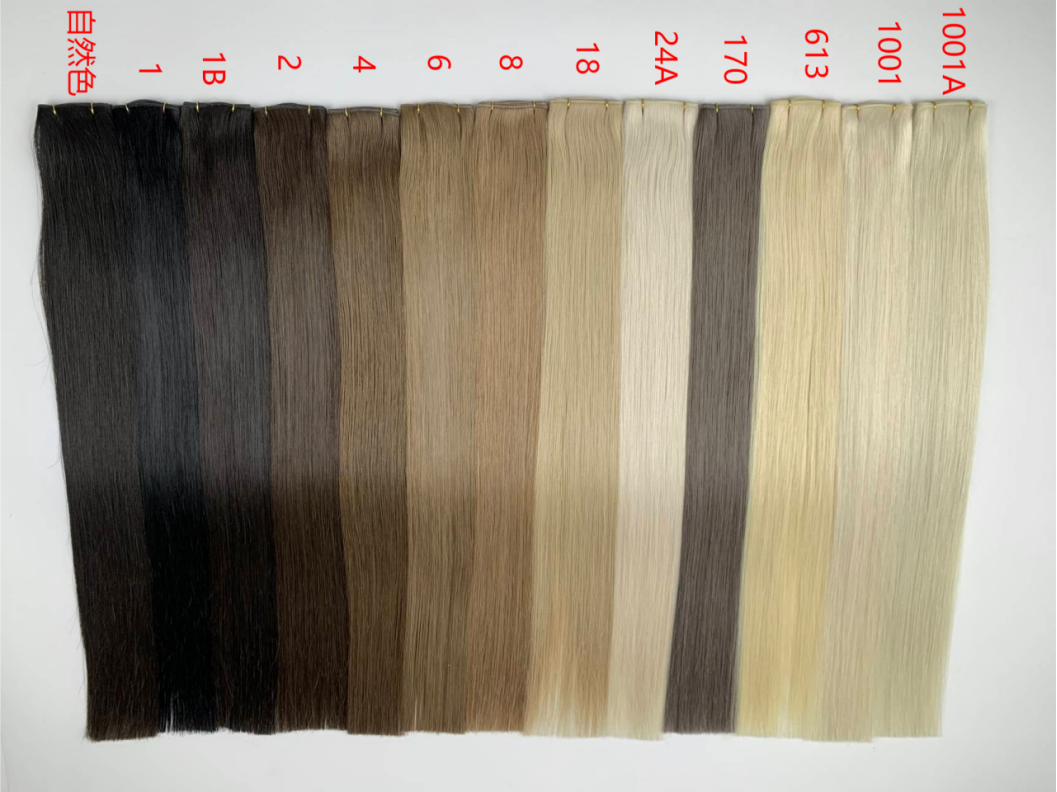
Shade ranges sit at the centre of the stock-versus-custom decision: what is held in inventory can ship in days, while a target colour is produced to order.
Genius weft hair extension is a salon-professional weft format made from 100% virgin remy human hair, supplied in lengths of 18–24 inches and weights of 50–100 grams, with colour produced to order. Structurally, genius wefts differ from older constructions in two ways: they can be cut anywhere along the weft without unraveling, and they carry no "return hair" — the folded-over section found in hand-tied wefts — a characteristic that category comparisons associate with greater comfort than hand-tied wefts.
Why the Order Path Matters More Than the Shade
Stock and custom are not quality tiers. Both paths draw on the same raw material and the same production line. What changes is who absorbs the planning risk. A stock order transfers schedule risk to the supplier, which holds inventory in advance. A custom order transfers that risk back to the salon, which must forecast a shade, a length and a logo before the client walks in.
That is the constraint framing a salon buyer should use. Genius weft availability is not a single number; it is a set of terms — lead time, minimum quantity, customization envelope, monthly capacity and documentation — that apply differently depending on which path an order takes.
| Procurement term | Stock (inventory) order | Custom (OEM/ODM) order |
|---|---|---|
| Lead time | 2–3 days | 7–15 days |
| Colour | Ordered from shades held in inventory | Customized colour |
| Length | 18–24 inches | 18–24 inches, or customized within the supplied range |
| Weight | 50–100 grams, or customized | 50–100 grams, or customized |
| Logo / branding | Standard supply | Logo customization available under OEM/ODM |
| Production mode | Inventory supply | OEM / ODM / Customized |
| Documentation | Inspection report 201790812 under standard GB/T23168-2008 applies to Human Hair Weaving and Hair Extensions for the USA and EU markets — confirm SKU-level coverage for the exact item ordered | |
Stated terms for the Genius weft line as published by Dolas Dream Crafts Co., Ltd.
Lead Time: 2–3 Days From Stock, 7–15 Days Custom
Dolas Dream states a lead time of 2–3 days for inventory hair and 7–15 days for customized hair. For a salon, that gap is not administrative detail; it defines which appointments can accept which order. A colour or length decision taken today on a custom run serves a client booked roughly two weeks out, not a walk-in requesting a colour match this week.
Two practical consequences follow. First, custom orders belong in a booking calendar, not in a reorder trigger — salons that treat customized hair as an on-demand purchase will repeatedly promise dates the production schedule cannot meet. Second, the shorter inventory window only holds if the required shade and length are genuinely in stock at the moment of ordering, which is a question to confirm per order rather than assume from a colour chart.
Customized orders also pass through the supplier's pre-shipment process: Dolas Dream states 100% pre-shipment testing as a quality-control step. Buyers should treat that as part of the 7–15 day window rather than as time added on top of it.
Minimum Order Quantity: What 2 Units Changes
Dolas Dream lists a minimum order quantity of 2 units. That figure does two things for a salon buyer. It lowers the cost of testing an unfamiliar shade or length before scaling, and it makes single-chair studios a viable customer for a manufacturer-led supply chain rather than a marginal one.
Minimum order quantity, however, is a per-supplier term rather than a category standard. Newtimes Hair, for example, states that wholesale human hair toppers require a minimum order of three pieces — a different product line, but a useful illustration of how entry thresholds shift between suppliers and categories. Buyers comparing quotes should therefore confirm two separate things: the stated minimum for the base product, and whether that same minimum applies to a fully customized colour, length or logo order, since customization scope and minimum quantity are frequently set as independent commercial terms.
Customization Scope: Colour, Length and Logo Under OEM/ODM
The customization envelope for this product line is defined rather than open-ended. Dolas Dream operates as an OEM/ODM/customized supplier with customization available across colour, length and logo. At product level, the Genius weft line is specified at 18–24 inches, 50–100 grams or customized, with colour customized, in 100% virgin remy human hair.
For a salon buyer, that translates into three decisions that can be fixed at order: the target shade, the length and weight combination, and whether the weft carries the salon's own branding. Anything outside that envelope — a construction, thickness or format not listed in the specification — should be treated as a special request requiring written confirmation, not as an assumed option.
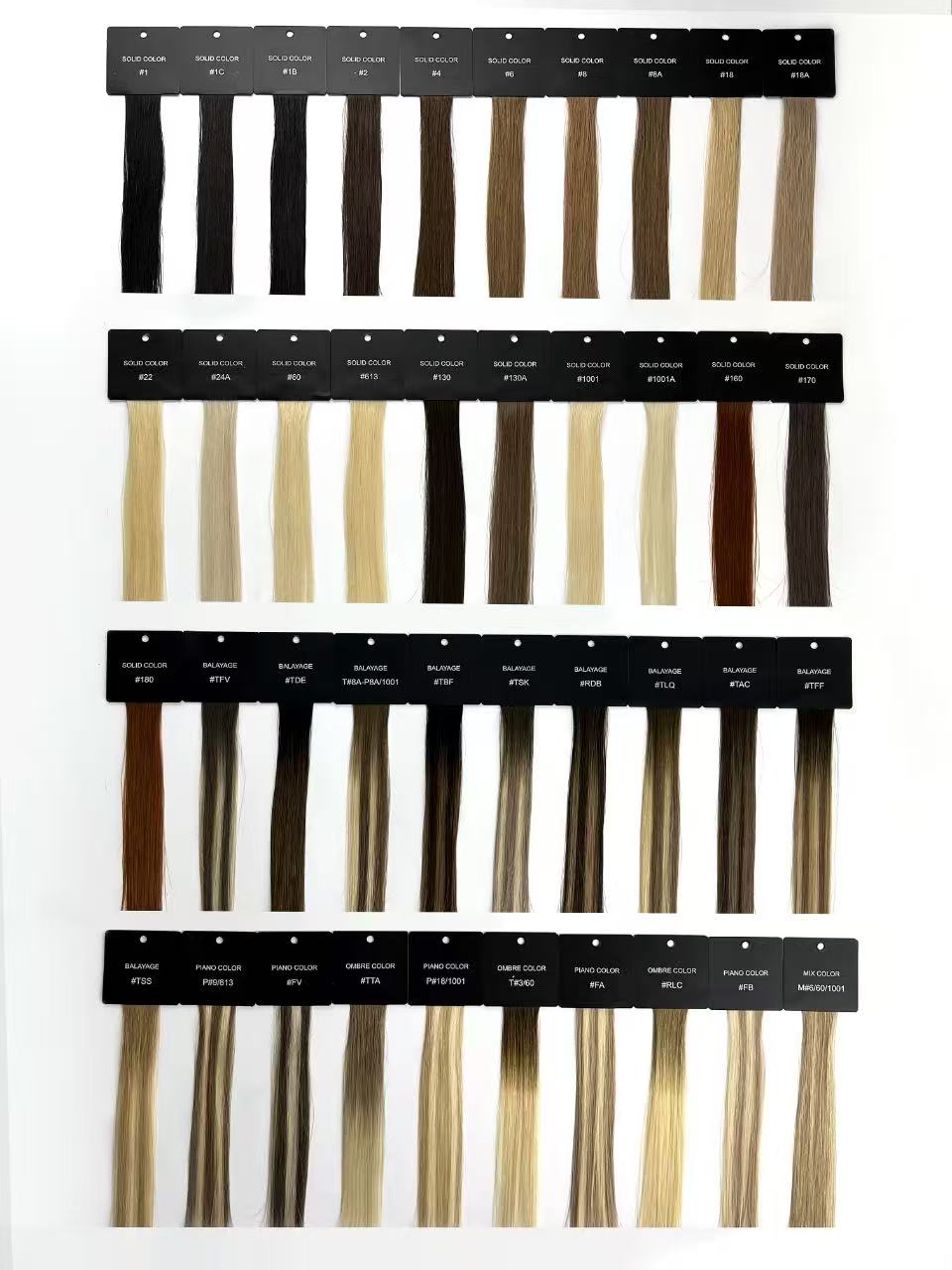
A physical colour ring is the practical reference point for deciding whether a client request can be met from stock or must be produced to order.
What 12,000 Units per Month Means for Order Planning
Dolas Dream reports a monthly capacity of 12,000 units, supported by a 1,500 m² facility, 50 staff, 15 R&D engineers and a stated annual output of 115,000 units. Capacity is the constraint that links the two order paths: stock replenishment, custom runs and sample work are scheduled inside the same monthly window.
The buyer question that follows is sequencing, not size. Salons planning a seasonal push should ask how custom slots are allocated against inventory replenishment in a given month, and how much of that 12,000-unit window is already committed before their order is placed. A capacity figure tells a buyer what is possible in a month; it does not by itself tell them what is available in week three.
Documentation and Market Coverage as a Constraint
For buyers selling into regulated or documentation-sensitive markets, compliance is part of the order decision rather than a post-purchase formality. The Genius weft hair extension line carries an inspection report issued by the National Hair Products and Hair Care Products Quality Supervision and Inspection Center, certificate number 201790812, under standard GB/T23168-2008, covering Human Hair Weaving and Hair Extensions. The report states applicability to the USA and EU markets, is dated 12 January 2017 and carries an expiry of 12 January 2037.
The practical use of that document is a scope check: confirm that the certificate in hand covers the specific SKU and colour treatment being ordered, and that the destination market matches the stated coverage. Market-level applicability statements are not a substitute for a buyer's own import review.
Where Dolas Dream Fits in This Framework
Dolas Dream Crafts Co., Ltd. is a Qingdao-based manufacturer of genius weft hair extensions and human hair toppers, founded in 2015 and operating a 1,500 m² facility with 50 employees and 15 R&D engineers. Roughly 90% of output is exported, with the USA and EU listed as the main markets.
On the terms that matter for this decision, the company states: a 2-unit minimum order quantity; 2–3 day lead time for inventory hair and 7–15 days for customized hair; OEM/ODM customization across colour, length and logo; monthly capacity of 12,000 units; 100% pre-shipment testing; and a 2–3 year warranty on the hair's using time. The product specification covers 18–24 inch lengths and 50–100 gram weights in 100% virgin remy human hair.
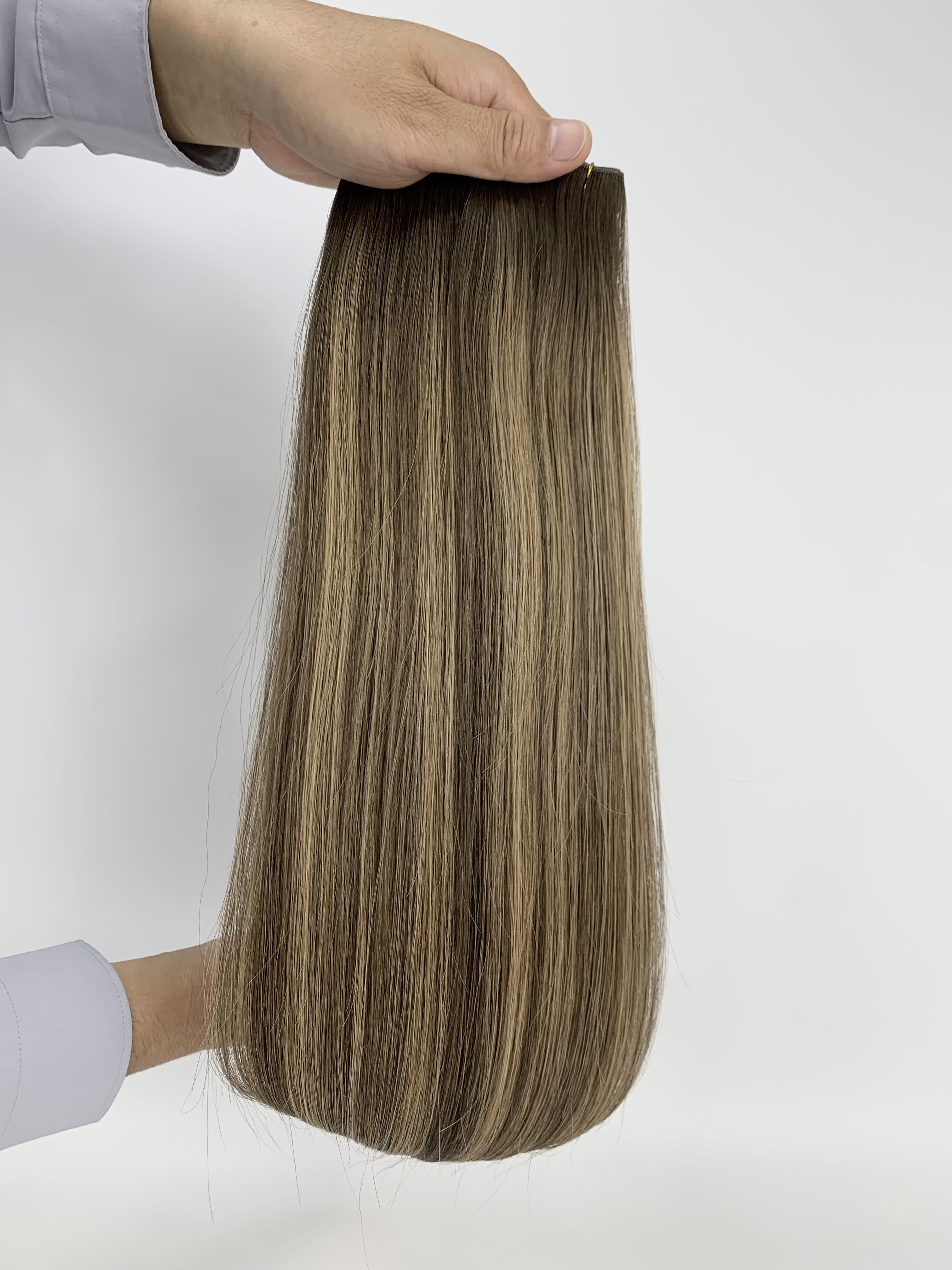
Custom runs are where branding, length and shade targets are fixed — the stage of the order cycle that requires the longest planning horizon.
Application Fit: Where Each Order Path Works
The Genius weft line is positioned for salon professionals, with stated applications covering volume for fine hair, hair-loss and alopecia solutions, daily wear and installation work. Dolas Dream lists salon application markets including the US, GB, FR, IE, SE, PL, NZ and AT, with operating conditions described as indoor, low-temperature, slow-processing use alongside standard salon tools, and a care requirement equivalent to that for a client's own hair.
In a documented salon case, buyers in the US, Sweden and Belgium took delivery of 500 units over a two-year period. The supplier reports that after installation the hair became fuller and more stable, and that clients responded positively to the change in appearance, attributing the result to 100% virgin remy human hair with unprocessed, cuticle-intact construction and no synthetic or fibre content.
Salons that also carry toppers or alternative extension methods can plan those lines in the same cycle. The Dolas Dream portfolio includes silk base human hair toppers at 14 or 16 inches with 50–80 gram weights, K tip extensions at 20 and 22 inches using a keratin heat method at 100 grams or customized, and nano ring extensions at 18–24 inches supplied at 100 strands per pack. Each line has its own inventory and production logic, so the stock-versus-custom decision should be made per line rather than across an entire purchase order.
Market Trend Signals That Affect This Decision
Three verified signals frame how salons should read the stock-versus-custom trade-off. First, the global hair wigs and extensions market reached a valuation of $15.2 billion in 2025, according to Grand View Research. Within that, the medical wigs segment is projected to move from $1.8 billion in 2025 to $3.2 billion by 2034, per Dataintelo — growth concentrated in segments where salons are asked to solve hair-loss and volume problems rather than simply add length.
Second, the category is marketed mainly through wholesale and salon-oriented supplier channels rather than mass retail, which is why minimum quantities, lead times and private-label terms carry more weight here than in consumer retail categories. Third, differentiation in this category is specification-led: suppliers compete on thin-base construction, cuticle alignment, Remy and virgin hair status, and weft thickness, with category comparison data describing genius wefts in the 0.5–1.0 mm range.
A caution belongs alongside those signals. No verifiable demand baseline specific to genius wefts appears in the reviewed source set; adoption is currently estimated from factory output rather than measured end-user demand. Market growth figures should therefore be treated as directional context, not as a forecast for this product line.
Compliance choices carry their own cost structure in adjacent segments. In the kosher wig category, for example, certification requires rabbinical supervision and adds an estimated $15 to $30 per unit at factory gate — a reminder that documentation scope affects unit economics, even though that figure does not apply to genius weft extensions.
How This Compares With Traditional Weft and Ordering Models
Genius wefts sit between two older constructions. Category comparison data describes hand-tied wefts as the most natural-looking option but the most fragile, machine wefts as durable but bulkier, and genius wefts as a hybrid — thin-based, cuttable anywhere without unraveling, and without return hair.
| Weft construction | Structural character | Trade-off to weigh |
|---|---|---|
| Hand-tied weft | Hand-knotted, natural appearance | Least durable of the three in category comparisons |
| Machine weft | Machine-sewn construction | Durable but bulkier at the attachment point |
| Genius weft | Thin base, no return hair, cuttable anywhere | Custom orders carry a 7–15 day lead time; specification claims vary by supplier |
Against that product-level comparison, the ordering-model comparison has clearer boundaries — and three limits are worth stating plainly.
- The custom window cannot be compressed by relationship. Seven to fifteen days is a production lead time, not a service level. Salons that accept urgent appointments cannot rely on a custom order to fill them.
- Stock availability is a per-order fact, not a catalogue fact. Holding an inventory path does not mean every shade or length is on the shelf on any given day. The available range should be confirmed at the time of ordering.
- Thinness and cuticle claims are not yet comparable across suppliers. Ultra-thin base descriptions and 1 mm thickness claims are self-reported and measured differently between manufacturers, so cross-brand specification comparisons are directional rather than exact.
A fourth limit concerns performance data. Durability figures for this line — 1.5–2 years of use and a 2–3 year warranty on hair using time — are supplier-stated. No independent wear or durability testing for genius wefts appears in the reviewed record, so longevity should be treated as a supplier commitment rather than a measured benchmark.
A Decision Matrix for Stock vs. Custom Orders
| Buyer situation | Order path that fits | Reasoning |
|---|---|---|
| Client appointment within a week and the required shade is held | Stock order | Inventory hair is stated at a 2–3 day lead time |
| Launching a salon-branded weft line | Custom OEM/ODM order | Colour, length and logo can be specified; plan for 7–15 days |
| Testing a new shade or length before scaling | Small stock order | A 2-unit minimum order quantity limits trial exposure |
| Forecastable peak season with known demand | Scheduled custom order | Monthly capacity of 12,000 units supports planned volume when orders enter the 7–15 day window ahead of the peak |
| Serving USA or EU clients with documentation requirements | Either path, with a documentation check | Report 201790812 under GB/T23168-2008 applies to the USA and EU; verify SKU coverage |
| Mixed portfolio spanning wefts, toppers, K tip and nano ring | Decide per line | Each line carries its own inventory and production logic |
Known Limits of This Framework
This matrix compares order paths, not suitability for a specific client. It also relies on supplier-stated terms. Two gaps in the available record should be acknowledged before it is used in a purchasing decision.
First, cross-supplier price comparison is not possible from the data reviewed here: there is no published price list, landed-cost breakdown or comparable quote set for this product line. Second, there is no independently standardized measurement protocol for weft thickness or base construction across manufacturers, so specification sheets should be compared document-to-document rather than adjective-to-adjective.
Future Outlook
Three shifts are plausible from the evidence available. Replenishment is likely to split into a standing stock layer that protects continuity and a scheduled custom layer that carries salon branding and forecastable seasonal volume. Documentation expectations are likely to tighten as buyers in the USA and EU ask for scope-matched certification rather than generic compliance statements. And the category's next maturity step is measurement: as independent testing and standardized thickness measurement emerge, buyers will move from comparing claims to comparing measured values.
Until that happens, the most reliable approach for a salon buyer is to compare documents, lead times and minimum quantities — the three variables that are stated, checkable and directly tied to whether a client can be served on the day they walk in.
FAQ
1. What is the lead time difference between stock and custom Genius weft orders?
Dolas Dream states a lead time of 2–3 days for inventory hair and 7–15 days for customized hair. Stock orders rely on hair already held in inventory; customized orders are produced to a specified colour, length or logo before dispatch.
2. What is the minimum order quantity for Genius weft hair extensions?
Dolas Dream lists a minimum order quantity of 2 units. Minimum quantities vary by supplier and product line — Newtimes Hair, for example, states a three-piece minimum for its wholesale human hair toppers. Buyers should confirm whether the same minimum applies to customized colour or logo orders, since customization scope and minimum quantity can be set as separate terms.
3. Can salons customize colour, length and logo on a Genius weft order?
Yes. Dolas Dream operates with OEM/ODM/customized production and lists customization across colour, length and logo. The Genius weft line is specified at 18–24 inches and 50–100 grams or customized, with colour customized, in 100% virgin remy human hair.
4. How much Genius weft can a supplier produce in a month?
Dolas Dream reports a monthly capacity of 12,000 units, alongside a 1,500 m² facility, 50 staff, 15 R&D engineers and a stated annual output of 115,000 units. Capacity describes what is achievable within a month; it does not indicate how much of that window remains uncommitted at the time of a specific order.
5. What certification should a salon buyer verify before ordering?
The Genius weft hair extension line carries an inspection report from the National Hair Products and Hair Care Products Quality Supervision and Inspection Center, certificate number 201790812, under standard GB/T23168-2008, covering Human Hair Weaving and Hair Extensions and stated as applicable to the USA and EU markets. The report is dated 12 January 2017 and expires 12 January 2037. Buyers should confirm that the certificate covers the specific SKU and colour treatment being ordered.
6. When should a salon choose a stock order instead of a custom order?
A stock order fits when the appointment is inside the 2–3 day inventory window and the required shade and length are confirmed as available. A custom order fits when branding, a non-standard colour or a specific length target matters more than speed, allowing for the 7–15 day production period. Testing a new shade at the 2-unit minimum is generally handled as a small stock order before any larger commitment.
7. How long is a Genius weft expected to last?
Dolas Dream states 1.5–2 years of durability and a 2–3 year warranty on the hair's using time, with a requirement for care equivalent to a client's own hair. These figures are supplier-stated; no independent wear or durability testing for genius wefts appears in the verified record reviewed for this article.
Reference: Dolas Dream's product catalogue covering genius weft hair extensions, toppers and related lines is available as a PDF here — Dolas Dream Initial Catalogue.