
Stone Coated Metal Roofing Evidence: ISO, Models, Salt Spray
Stone Coated Metal Roofing Evidence: ISO, Models, Salt Spray
A stone coated metal roofing supplier is normally asked for three unrelated kinds of proof at once: a management-system certificate, a product range wide enough to cover every roof elevation in a project, and a performance number such as a salt-spray duration or a wind-uplift rating. Those three items are rarely presented in a way that lets a buyer check one against the other. At the evaluation stage they read like a brochure. At the execution stage they have to survive a purchase order, a pre-shipment inspection and, in some markets, a building official's file review.
This article uses Sango Cailin (Tianjin) Building Tech. Co., Ltd. as a worked example, because the company publishes a document set complete enough to be examined rather than admired. The aim is not to restate a supplier profile. It is to show how the ISO 9001:2015, ISO 14001:2015 and ISO 45001:2018 certificate numbers and issuing body connect to the eight named Cailin tile profiles, and how a 500-hour salt-spray result, a 160 mph wind-uplift rating and a 70 percent noise-reduction claim should be reconciled against product specifications written as AZ150 galvalume steel and a 1340 mm x 420 mm tile.
Three Document Classes, Not One, Decide a Supplier File
A management-system certificate answers whether a factory runs a controlled process. A model list answers what that factory can produce. A test number answers how one specific build behaved under one specific method. Buyers regularly accept any one of these as evidence for the other two, and that substitution is where a supplier file becomes unusable once an order is placed.
In stone coated metal roofing the gap is wider than in plain commodity categories. The product is a composite: a coated steel substrate, an acrylic or primer layer, a natural stone granule surface and a clear topcoat, pressed into a profile and fixed through an interlock or exposed fastening. Corrosion behaviour depends on the base coating mass; wind behaviour depends on the roof assembly rather than the tile alone; acoustic behaviour depends on what the panel is attached to. No single certificate can speak for all three, and a supplier that presents one document as if it did is asking the buyer to fill the gap with assumption.
The practical consequence is a shift in what buyers ask for between the evaluation and execution stages. Evaluation is satisfied by a certificate logo and a model catalogue. Execution needs four things that can be attached to a purchase order: the certificate number and its validity date, the model name as it appears on the packing list, the test method behind the headline figure, and the acceptance record that proves the delivered batch matches the approved sample.
What the Three ISO Certificates Actually State
The three certificates in this file were all issued on 13 May 2024 by Beijing World Standards for Certification Center (WSF) and all expire on 12 May 2027. Each records the same market basis: global coverage under the CNAS-IAF mutual recognition arrangement.
| Standard | Certificate number | What the scope covers |
|---|---|---|
| ISO 9001:2015 | ISO 9001:2015-03824Q14379R2S | Production of stone coated metal roofing tiles and related quality management activities |
| ISO 14001:2015 | ISO 14001:2015-03824E14377R2S | Production of stone coated metal roofing tiles and related environmental management activities |
| ISO 45001:2018 | ISO 45001:2018-03824S14378R1S | Production of stone coated metal roofing tiles and related occupational health and safety management activities |
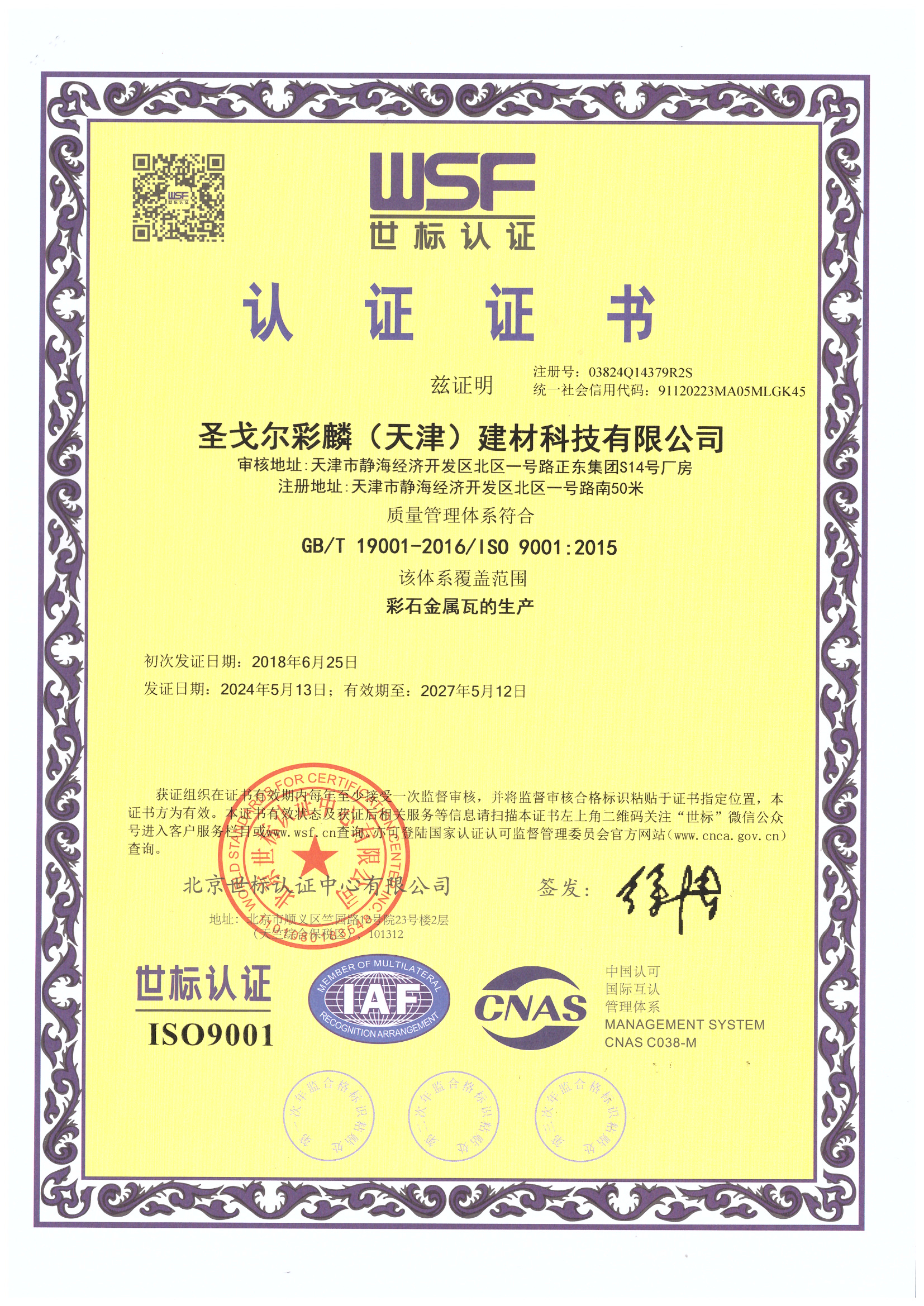
The quality management certificate records a number, an issuing body and a validity period that a buyer can verify independently.
Three points in that table carry more weight than the logos. First, the scope wording is deliberately narrow. It says production of stone coated metal roofing tiles, not roofing products generally, which means the certificate applies to the manufacturing activity for this product family and nothing beyond it. Second, the three systems are separate management disciplines. ISO 9001 addresses quality control, ISO 14001 addresses environmental management, and ISO 45001 addresses occupational health and safety. None of them is a product certification, and ISO 45001 in particular is sometimes misread by buyers as a product-safety mark when it describes workplace safety management at the plant.
Third, the validity window is real rather than decorative. The certificates run to 12 May 2027, so a shipment in the current cycle sits comfortably inside the period, but a multi-year frame agreement signed in 2026 will cross a recertification point. Buyers running long programmes should write a clause requiring the supplier to provide the renewed certificate number and scope before the existing one lapses, rather than discovering the gap during a factory audit.
What the Certificates Do Not Prove
A quality management certificate is evidence of process discipline, not of a product result. It does not state that a tile achieved a particular salt-spray duration, that a fixing pattern reached a particular uplift pressure, or that a profile meets a local building code. Certification and product testing are different evidence classes, and a buyer who treats the first as a substitute for the second has no defensible position if a project engineer asks how the wind rating was established.
This is why the certificate file and the test file should be read as a pair. The certificates establish that a controlled production process exists at a named entity, in a named scope, during a named period. The test documents establish what came out of that process. Reading them together produces something neither can produce alone: a traceable line from a factory system to a delivered tile.
The Model Range as a Capability Statement
Breadth in a stone coated metal roofing catalogue is a procurement variable, not a marketing one. A wholesaler or an OEM buyer who sources eight profiles from three factories ends up maintaining three certificate sets, three colour-batch references, three packing specifications and three claims about lead time. A single source with a documented range reduces the reconciliation burden, provided the buyer understands that range breadth still says nothing about per-model performance.
The Cailin range named in the certificate product list covers the Cailin Bond Tile, Cailin Shingle, Cailin Milano Tile, Cailin Shake, Cailin Classical Tile, Cailin Roman Tile, Cailin Long-Span Tile and Cailin Golan Tile. The same documentation also lists the Cailin Tudor Tile, the Cailin Heritage Tile and the Cailin Interlocking Shingle and Cailin Interlocking Shake. For a buyer assembling a pitched roof metal tiles package across mixed elevations, that spread is the difference between one colour reference and several.
| Profile | What to confirm on the datasheet |
|---|---|
| Cailin Bond Tile | Profile profile depth, effective coverage per tile, fixing pattern |
| Cailin Shingle | Granule colour consistency across production batches |
| Cailin Milano Tile | Step and shadow line, quantity per square metre |
| Cailin Shake | Surface texture variation allowed between batches |
| Cailin Classical Tile | Concealed fastener detail and interlock tolerance |
| Cailin Roman Tile | Barrel profile nesting and ridge, hip and verge accessories |
| Cailin Long-Span Tile | Panel length limits, purlin spacing, thermal movement |
| Cailin Golan Tile | Profile geometry against the design intent drawing |
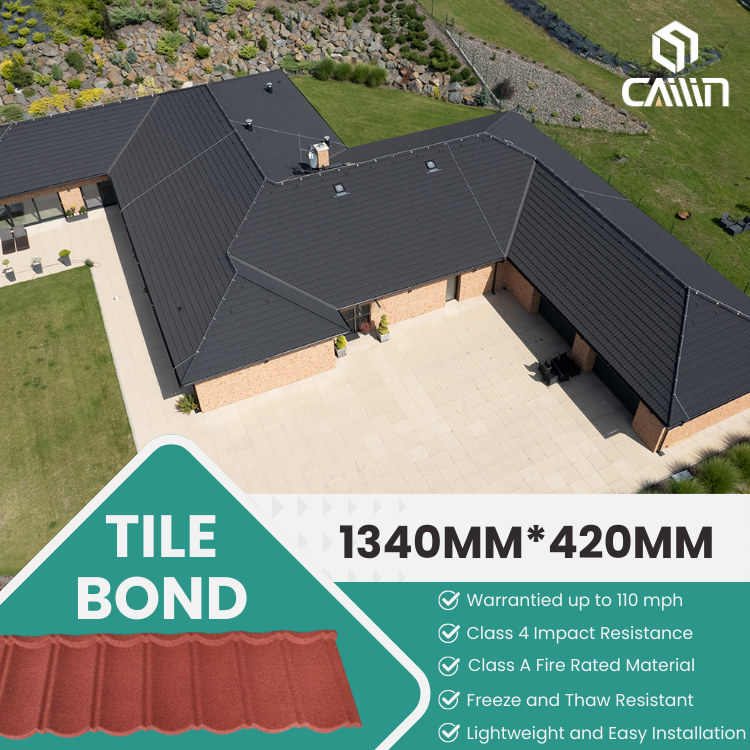
Profile names describe geometry and design intent. They do not by themselves document corrosion, uplift or acoustic performance.
Breadth also shapes a wholesale buyer's stocking decision. Ten or more standard granule colours are offered, with custom colour development available alongside them, and steel thickness is selectable at 0.45 mm, 0.5 mm or 0.55 mm. Because all profiles share a substrate family and a coating line, a distributor can carry a colour card across the range rather than a separate card per profile. That is a supply-chain simplification, and it is worth stating plainly: the value is in fewer moving parts, not in a broader performance envelope.
Reading the 500-Hour Salt-Spray Result
Sango Cailin's published product coverage reports a 500-hour salt-spray test. As reported, that figure arrives as a duration, without the laboratory identity, the test standard or the pass criteria used to judge the panel. A duration alone is not a conclusion, and buyers should treat it as a prompt for documents rather than as an answer.
Three details change what a salt-spray hour count means. The first is the method. Corrosion testing in this category is normally run against a recognised chamber procedure, and the report should name the standard it followed. The second is the specimen. A coated steel panel, a cut edge and a finished tile with granules and a topcoat behave differently in the same chamber, and a scribed sample accelerates attack at the incision in a way a flat panel does not. The third is the evaluation criterion. Hours to first red rust, hours to a defined blister rating and hours with no visible change are three different results that can be printed as the same number.
The substrate in this case is reported as AZ150 galvalume steel with natural stone granules. AZ150 is a coating designation rather than a paint or granule thickness: it belongs to the coating-mass class used for aluminium-zinc coated steel, commonly read as 150 g per square metre of total coating. That designation is the reason the salt-spray question is worth asking at all, because a coastal anti-corrosion roofing specification is only as strong as the coating mass declared on the coil certificate for the batch that produced the tiles.
A defensible request therefore has four parts. Ask for the salt-spray report pages rather than a figure: method, specimen description, duration, and the criteria that defined the endpoint. Ask whether the specimen was the finished tile or the base steel, because the answer determines which part of the product the result describes. Ask for the coil or coating certificate that ties AZ150 substrate to the production period of your order. And ask what the supplier will accept as a failure criterion under the warranty, since that is the commercial translation of the test.
Wind Uplift and the 160 mph Figure
The wind-uplift figure quoted for this product is up to 160 mph. External category comparisons published in 2026 place stone coated metal roofing in the range of up to 120 to 160 mph, with reference to UL Class 4 and Miami-Dade notice-of-acceptance frameworks in the United States. The two statements are consistent, but neither is a project approval.
Uplift resistance belongs to an assembly, not to a tile in isolation. The tested configuration includes the profile, the fastening pattern and spacing, the substrate the tile is fixed to, the edge and ridge fixings, and the way the interlock engages. A concealed fastener roof tile transfers load through a continuous interlock rather than through exposed screws, which changes where the critical fixing sits and makes installation discipline part of the performance claim. Two installers using the same tile and different fastener spacing can produce two different uplift results.
For a coastal hurricane roofing project, the useful questions are therefore specific. Which test method and which assembly were evaluated? What fastener spacing and what substrate appear in the report? Is the quoted figure a test pressure or an allowable design pressure, and what safety factor sits between them? Does the destination market require a local approval such as a notice of acceptance, and is that document held for the specific profile at the specified thickness? A 160 mph number without those answers is a starting point for procurement, not the end of it.
The 70 Percent Noise-Reduction Claim and Its Reference Product
The published claim is a reduction of up to 70 percent, and the comparison stated is against bare metal roofing. That reference matters more than the percentage. A stone granule surface bonded over a steel panel adds mass and damping, so a reduction against bare metal is a plausible outcome of the construction. The same claim cannot be transferred to a comparison against clay or concrete tile, which start from a different mass and a different fixing method.
Buyers evaluating low noise metal roofing for a residential project should also recognise what the number excludes. Rain noise on a roof depends on the panel, the batten or deck, the insulation layer and the ceiling assembly below. A single percentage measured on a test rig describes the panel contribution at the stated conditions. The assembly in the building will produce its own result, and the report should be read for its mounting description, its reference product and whether the figure is an A-weighted single number or a frequency-band result. Those distinctions determine whether the claim survives translation into a specification clause.
Reconciling Headline Numbers With the Written Specification
The specification side of the file is where most reconciliation failures happen, because a feature can be true and still be misread. The table below pairs the published claims with the document that should support them and the decision each one affects.
| Published claim | Supporting document to request | Decision it affects |
|---|---|---|
| 500-hour salt spray | Full report with method, specimen and endpoint criteria | Coastal corrosion suitability and warranty wording |
| Up to 160 mph uplift | Assembly description, fastener spacing, test pressure basis | Hurricane-zone specification and fixing schedule |
| Up to 70 percent noise reduction | Reference product, mounting and measurement basis | Residential comfort claims in tender documents |
| AZ150 galvalume substrate | Coil coating certificate matched to production period | Batch acceptance and coastal specification |
| 1340 mm x 420 mm tile | Effective coverage per tile for the chosen profile | Order quantity, freight volume and project take-off |
The dimension entry deserves emphasis because it is the cheapest mistake to make and the most expensive to correct. A 1340 mm x 420 mm tile is a nominal footprint. The area a tile actually covers after lapping depends on the profile and the specified headlap, and that effective coverage is the divisor in every quantity take-off. A buyer who orders against the nominal footprint on a mixed-elevation project will either over-order or run short on the last elevation, and shortages on a colour-matched batch are far harder to solve than a slightly conservative initial calculation.
Thickness selection follows the same logic. With 0.45 mm, 0.5 mm and 0.55 mm options available, the specification should name the thickness required and the reason: a purlin spacing constraint, a local code minimum, or a handling requirement on a long-span installation. Thickness stated without a reason tends to drift in quotation, and a drifted thickness invalidates the uplift and corrosion reasoning built on top of it.
Where the Range Meets Real Project Scenarios
Three scenarios show how the document set is used differently in practice.
Coastal and high-wind projects. Here the file is read for corrosion and uplift together. The salt-spray report addresses the coating system, the uplift report addresses the fixing assembly, and the coil certificate addresses the batch in the container. A stone coated metal roofing package for this use case should arrive with all three, plus the trim and accessory specification, because verge and ridge details are where uplift failures usually begin.
Retrofit and lightweight replacement. A 2026 industry comparison places stone coated metal at roughly 1.1 to 1.8 lbs per square foot against 9 to 12 lbs for clay tile and 8 to 12 lbs for concrete tile. That weight difference is the reason the product is treated as a lightweight roof tile alternative in retrofit work. The boundary is important: the comparison describes panel mass, not structural adequacy. Whether an existing roof structure can accept the new covering, and what the resulting load path looks like, remains an engineer's determination for the specific building.
Wholesale and OEM programmes. This is where the capability layer becomes the file. OEM, ODM and customised production are offered, granule colour runs to ten or more standard options with custom development available, packaging can be neutral or branded, and logo printing is supported. Monthly capacity is stated at 500,000 units with a 7 to 10 day lead time. Quality control is documented as 100 percent inspection plus pre-shipment random sampling, with third-party inspection available on request. For a distributor building a private-label range, those are the clauses that determine whether the programme can be repeated across seasons.
A company-reported residential project in the United States illustrates the intended application rather than proving the claim: 700 units installed on a pitched roof, with the product described as lightweight, low maintenance and easy to install, and the service life given as 30 to 50 years in that case. Reported outcomes for that project include energy-saving and eco-friendly performance, hurricane and wind resistance, and noise reduction. Buyers should read such a case for its application profile, not as a substitute for the test documents discussed above.
The Comparison With Traditional Tiles Shifts the Evidence Burden
Comparing a metal tile against clay or concrete is often framed as a performance argument. In procurement terms it is an argument about which documents carry the risk. A clay or concrete roof brings mass and brittleness, and its evidence burden falls on freeze-thaw behaviour, water absorption and structural loading. A stone coated metal roof brings a coated steel substrate, and its evidence burden falls on coating mass, granule adhesion, fastener corrosion and assembly uplift. A bare metal roof removes the granule layer entirely, which is why the noise comparison in this category is phrased against bare metal rather than against tile.
The honest limitation is documentation depth rather than product capability. Headline figures in this category are commonly published by manufacturers, and a full independent laboratory report tied to a named model, thickness and assembly is not always available on request. Where that report exists, it should be asked for. Where it does not, the buyer's fallback is a specification that states the required method and lets the supplier declare compliance against it, combined with pre-shipment inspection and retained samples. That is a weaker position than a test report, and it should be priced as such.
Stone coated roofing lifetime cost follows from the same logic. A lifecycle model is a calculation built on inputs: declared service life, coating specification, inspection interval, and the cost of access for maintenance. It is not a published number, and any comparison that presents one without showing its inputs should be discounted. The inputs a buyer can verify are the ones worth putting into the model.
What the Next Certificate Cycle Means for Buyers
All three certificates in this file expire on 12 May 2027. For a buyer placing orders in the current cycle that is a comfortable margin; for a distributor signing a multi-year private-label agreement it is a planning date. The practical response is a documentary clause rather than a commercial one: require the renewed certificate number, scope and issuing body to be supplied before expiry, and treat the certificate number as the tracking reference rather than the certificate image.
The broader direction of procurement in this category points the same way. Buyers are moving from asking whether a supplier is certified to asking which certificate, covering which scope, valid until when, and attached to which shipment. That shift favours suppliers who can produce numbers instead of logos, and it rewards buyers who build the request into the purchase order before the first container is sealed.
Putting the File Together: A Verification Sequence
The sequence below turns the discussion into a working checklist for an evaluation-stage or execution-stage buyer.
- Verify each certificate number against the issuing body, and confirm that the entity name matches the contracting party.
- Check the scope wording against what is actually being purchased, and diarise the expiry date against the contract term.
- Match the model name on the quotation to the name in the certificate product list and the name on the packing list.
- Request the salt-spray report with method, specimen and endpoint criteria, plus the coil coating certificate for the production period.
- Request the uplift report with its assembly description, fastener spacing and the basis of the quoted pressure.
- Request the acoustic report with its reference product and mounting, and translate the claim into assembly-specific wording in the tender.
- Confirm the effective coverage per tile for each profile before the quantity take-off, and state steel thickness with the reason for it.
- Agree inspection terms in writing. The supplier's stated acceptance route covers pre-shipment inspection by Cailin, the customer or a third party, retained samples, and loading photographs or video before the container is sealed. Stated delivery terms are FOB Tianjin and EXW, with a 30 percent T/T deposit on order confirmation and 70 percent before shipment.
Company details and the full product range are published by Sango Cailin (Tianjin) Building Tech. Co., Ltd., a Tianjin-based manufacturer of stone coated metal roofing, asphalt shingles, BIPV solar tiles, rain gutter systems and butyl tape, founded in 2017 and operating a 15,000 square metre facility with a stated annual output of 6,000,000 units. The company reports exports at 25 percent of output, with main markets in the United States, Canada and Southeast Asia, and support channels covering technical installation guides, video and remote assistance, and 50-year limited warranty terms with a 24-hour response commitment.
For buyers who want the full profile set, colour options and accessory details in one place, the company's brochure is available for download: CAILIN stone coated metal roofing brochure (PDF).
Frequently Asked Questions
Which certificates should a stone coated metal roofing supplier be able to show?
Three management-system certificates are standard for this category: ISO 9001:2015 for quality management, ISO 14001:2015 for environmental management and ISO 45001:2018 for occupational health and safety. In this supplier's file they are ISO 9001:2015-03824Q14379R2S, ISO 14001:2015-03824E14377R2S and ISO 45001:2018-03824S14378R1S, all issued on 13 May 2024 by Beijing World Standards for Certification Center (WSF) and valid to 12 May 2027. Their scope is the production of stone coated metal roofing tiles and related management activities, which means they document process systems rather than product performance.
What does a 500-hour salt-spray result actually tell a buyer?
It tells the buyer that a specimen survived 500 hours in a corrosion chamber, and nothing more until the method, specimen and endpoint are known. Corrosion testing of this type normally follows a recognised chamber procedure, and the report should state whether the specimen was base steel or a finished tile, whether the panel was scribed, and which visible change defined the end of the test. Read alongside an AZ150 galvalume substrate declaration, the salt-spray report and the coil coating certificate together describe the corrosion system; either one alone describes only part of it.
How should the 160 mph wind-uplift rating be applied to a specific roof?
As an assembly property, not a tile property. The rating depends on the profile, the fastener pattern and spacing, the substrate, the edge and ridge fixings and the interlock engagement. Buyers should obtain the tested assembly description and confirm whether the figure is a test pressure or an allowable design pressure with a safety factor applied. Where the destination market requires local approval, the notice of acceptance must be held for the specific profile and thickness being supplied, and the installation must follow the tested fixing schedule.
Which Cailin profiles cover a mixed-elevation roof project?
Eight profiles are named in the core range: Cailin Bond Tile, Cailin Shingle, Cailin Milano Tile, Cailin Shake, Cailin Classical Tile, Cailin Roman Tile, Cailin Long-Span Tile and Cailin Golan Tile. The same documentation also lists the Cailin Tudor Tile, Cailin Heritage Tile and the Cailin Interlocking Shingle and Cailin Interlocking Shake. All of them are supplied in a selectable steel thickness of 0.45 mm, 0.5 mm or 0.55 mm, with ten or more standard granule colours and custom colour development available, which allows one colour reference to be carried across a mixed-elevation design.
What purchasing terms and acceptance criteria apply to an order?
The stated acceptance route covers pre-shipment inspection carried out by Cailin, by the customer or by a third party, retention of samples, and loading photographs or video provided before the container is sealed. Delivery terms are quoted as FOB Tianjin and EXW. Payment terms are a 30 percent T/T deposit on order confirmation and a 70 percent T/T balance before shipment, ahead of loading. Production support includes OEM, ODM and customised programmes, neutral or branded packaging and logo printing, with quality control described as 100 percent inspection plus pre-shipment random sampling.
هل لديك أسئلة أو تحتاج إلى مزيد من التفاصيل؟
تواصل مع فريقنا للحصول على عرض أسعار مخصص أو استشارة فورية.
طلب عرض أسعار
املأ النموذج أدناه وسيتواصل معك فريقنا بعرض مقترح مخصص.
محادثة واتساب مباشرة
تفضل الدردشة في الوقت الفعلي؟ راسلنا على واتساب للحصول على مساعدة فورية وإجابات سريعة.
- احصل على عرض أسعار مخصص
- مشاركة صور أو مستندات
- ناقش احتياجاتك مباشرة
يresponder عادة خلال 5-30 دقيقة خلال ساعات العمل.