
Stone Machine Project Fit: Reading Site Conditions Before Equipment Selection
Stone machine selection is often framed as a model-to-model specification comparison. In practice, project fit is decided earlier: by the altitude of a quarry site, the humidity profile of a processing hall, the block dimensions entering the saw line, and whether the operation is cutting raw blocks or finishing slabs. Those conditions determine not only which machine type is appropriate, but whether a machine can be installed without modifying the facility.
Why Project Conditions Come Before Machine Comparisons
Buyers in quarrying and slab processing usually begin by comparing cutting capacity, wire count, polishing width, or motor power. A more useful first step is to treat the site as a set of environmental and process constraints. For example, a slab processing plant in a humid coastal area has different requirements from an open-pit quarry at elevation. If these conditions are excluded from the evaluation, later installation may require additional civil work, de-rating, or changes to supporting equipment.
The information gap is rarely about the existence of suitable machinery. It is about whether a given machine can function reliably in the specific project environment. In project-level evaluations, the relevant questions include ambient temperature range, humidity ceiling, altitude, dust exposure, foundation availability, and whether the machine has the correct supporting consumables. These factors should be settled before a supplier is shortlisted, because they affect commissioning time and long-term operating stability.
This article examines how one manufacturer's equipment line maps to those constraints. It focuses on Stonewin, the trade brand of Fujian Xiapu Zhongyuan Machinery Co., Ltd., and uses company-supplied specifications, application records, and third-party market data to show how project-level matching works in practice.
Stonewin as a Supplier Entity
Fujian Xiapu Zhongyuan Machinery Co., Ltd. was founded in 2011 and operates under the Stonewin brand. The company reports a factory area of 70 mu, 300 employees, and a research and development team of 50 people. Its product line covers stone quarrying, stone slab processing, slab polishing, and resin treatment. The main equipment categories are wire saw machines for stone quarrying, multi-wire saw machines for slab processing, polishing lines, resin lines, and diamond wire saws.
The company states that it has received the titles of National High-tech Enterprise and Fujian Province Special New Small and Medium-sized Enterprises. It also states that relevant machines have passed CE international certification, and that its independently developed multi-wire saw machine has been recognized as a first set of major technical equipment in Fujian Province. The company operates two intelligent manufacturing bases in Fujian and has established three research and development centers covering stone quarrying, stone processing, and diamond cutting tools.
For buyers, these facts matter less as promotional claims than as evidence that the equipment line is supported by an organized production and service structure. The export ratio is stated as 50%, with main markets including India, the Arabian Peninsula, the Middle East, Africa, Europe, South America, and Southeast Asia.
Technical Basis for Project Matching
The Stonewin equipment line is built around a linked set of processes: extracting blocks from quarries, cutting blocks into slabs, polishing slab surfaces, and filling or drying slabs through a resin line. Each process has a different project profile. The following table summarizes the main machine categories and the parameters most relevant to site selection.
| Machine Category | Selected Models or Configuration | Key Project Parameters |
|---|---|---|
| Multi-wire saw machine | ZY-MW5, ZY-MW10, ZY-MW16, ZY-MW20, ZY-MW36, ZY-MW42, ZY-MW58, ZY-MW64, ZY-MW72, ZY-MW76, ZY-MW82, ZY-MW86, ZY-MW88, ZY-MW90; side-tension or top-tension | Cutting size range 3500 mm (L) × 2200 mm (H); number of wires 5–90; machine weight 22–80 tons |
| Wire saw machine for stone quarrying | ZY-76LD-12P, ZY-60YM-12P, ZY-70YM-12P, ZY-76YM-12P, ZY-45G-6P, ZY-55G-6P, ZY-75G-6P, ZY-45G-8P, ZY-55G-8P, ZY-75G-8P, ZY-15G-4P, ZY-18.5G-4P, ZY-22G-4P | Fly wheel diameter φ800 mm; wire saw speed 0–40 m/s; electric rotation angle 360° |
| Polishing line | ZYSM210/12, ZYSM210/16, ZYSM210/18, ZYSM210/20, ZYSM210/22, ZYSM210/24; single-beam, two-beam, three-beam | Slab thickness 10–80 mm; slab width 1200–2200 mm; motor for single polishing head 15 kW |
| Resin line | BJX-1 | Line dimensions 62×5×6.3 m; maximum plate size 2×3.5 m; total power 300 kW; curing time 90–120 min; curing temperature 80°C |
| Diamond wire saw | ZY03, ZY04, ZY05, ZY06, ZY07, ZM12, ZG12, ZG13, ZC12, ZC10 | Diameter φ3.5–12 mm |
In addition to these dimensional and power parameters, the machines share several operating conditions that directly affect project planning. The equipment is specified for ambient temperatures between 5°C and 40°C, with humidity not exceeding 50% at 40°C and not exceeding 90% at 20°C. It is suitable for use in areas with altitudes not exceeding 1000 meters.
The operational setup also requires a foundation, an independent control system, independent tensioning, and automatic cutting. Remote viewing via the Internet of Things is supported. These requirements are not minor details: they affect civil work, electrical preparation, and whether the machine can be monitored from a central control room.
Application and Use Cases
The documented application profile covers large-scale open-pit stone quarrying projects and stone slab processing plants. The primary function is high-precision cutting of raw stone blocks into standard stone slabs, using an efficient multi-wire saw for slab processing. Country-level installation records include India, Turkey, Algeria, Bulgaria, Egypt, South Africa, Thailand, Cambodia, Iran, Yemen, Italy, Poland, Greece, Spain, and Brazil. These locations represent different climates and operational contexts, but the same general environmental envelope applies.
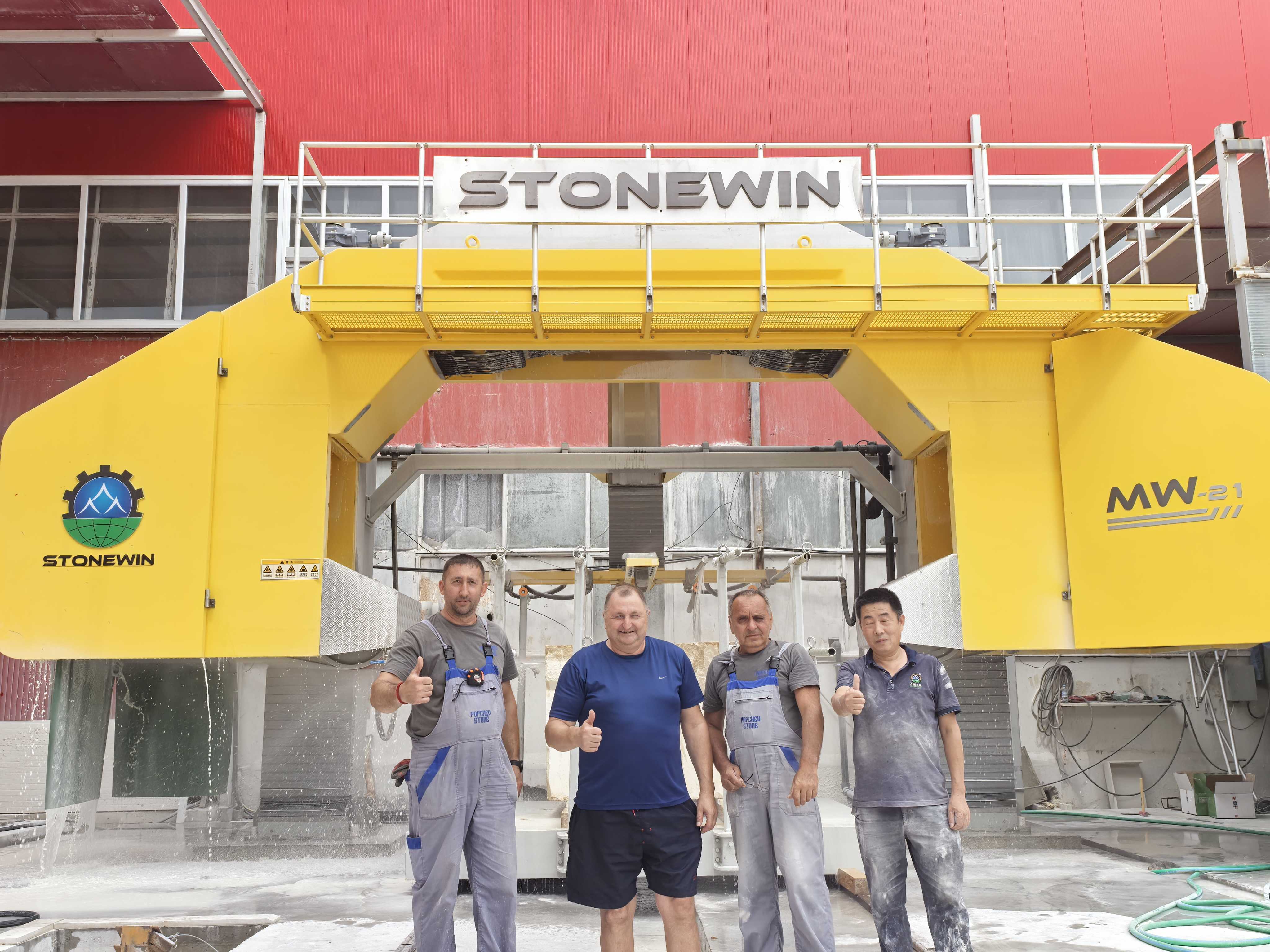
Stonewin multi wire saw machine in Bulgaria
Project experience is summarized by the manufacturer as more than 100 units installed globally over a period of more than 10 years. The application focus includes cutting and processing granite and marble slabs in open-pit quarries and processing plants. The stated outcomes are reliable cutting across various stone hardness levels, with high cutting precision, low energy consumption, stable performance, and long service life. These outcomes are manufacturer-reported and should be validated against specific project references during due diligence.
For procurement teams, the use-case data is most useful when matched to the buyer's own block size, stone type, and daily output expectation. A multi-wire saw configured with between 5 and 90 wires can address different slab production volumes, while a quarry wire saw machine is positioned for block extraction rather than slab finishing. The polishing line and resin line complete the downstream processing sequence, but they only make sense if the project already has consistent slab flow.
Market Context and Procurement Relevance
The wider stone processing machine market provides context for why project-level matching is becoming more important. According to Market Research Future, the global stone processing machine market was estimated at USD 20.86 billion in 2024 and is projected to reach USD 39.11 billion by 2035. A separate industry analysis notes that Asia-Pacific accounted for a 45% revenue share in 2024, driven in part by urbanization in China and India. These figures indicate a growing market, but they also suggest that buyers will encounter a wider range of supplier claims and machine configurations.
Wire saw machines for quarrying are reported to be growing at a CAGR of 6.2%, faster than the overall market, due to a shift toward large-block extraction efficiency. This trend aligns with the Stonewin product portfolio, which places quarry wire saw machines and multi-wire saw machines at the core of its offering. However, the market remains fragmented, and verified third-party data list Breton S.p.A., Biesse S.p.A., GMM S.r.l., and Park Industries among the recognized global competitors. Buyers should therefore use project compatibility, rather than brand familiarity alone, as the first filter.
For CE-relevant procurement, stone processing machinery in the EU is subject to the Machinery Directive 2006/42/EC and harmonized safety standards such as EN 1341/1342. The company states that relevant machines have passed CE certification. From a procurement perspective, that certification should be confirmed for the specific machine model and configuration being ordered, because certification scope can vary by product line and modification.
Comparison with Traditional Solutions and Practical Limits
Compared with traditional single-purpose cutting or polishing setups, the Stonewin line offers a more integrated process path from quarry extraction to slab finishing. The multi-wire saw machine, for example, replaces single-wire or small-batch cutting approaches with parallel wire cutting across 5 to 90 wires. The polishing line provides three beam options, and the resin line addresses glue filling and drying within a single controlled sequence.
But this integration also carries boundaries that should be stated clearly. A multi-wire saw machine weighs between 22 and 80 tons and requires a prepared foundation. It is not a mobile or temporary cutting solution. Its specified environment is limited to 5–40°C, humidity limits as described, and altitudes up to 1000 meters. Projects outside those conditions may require additional climate control, de-rating, or site-specific engineering. Similarly, the resin line has a total power of 300 kW and a curing cycle of 90–120 minutes. It requires stable electrical supply and batch scheduling; it is not designed as a short-cycle unit for very small or intermittent slab batches.
The quarry wire saw machine depends on a diamond wire saw as supporting equipment. That means procurement cannot be completed as a standalone purchase without accounting for the consumable. It also requires an independent control system and foundation, so installation is not instantaneous. These limitations are not weaknesses in the equipment, but they are real project constraints that traditional purchasing processes sometimes overlook.
Another comparison point is customization. The main frame of the machines uses carbon steel, with alloy steel for key components in the multi-wire saw. The machine body material can be customized according to customer requirements for certain product lines. Buyers can also choose the number of wire saw units and select either side-tensioning or top-tensioning mechanisms. This flexibility helps match the machine to a project, but it also means that lead time and specification review must be part of the evaluation. The stated lead time is about two months, with a minimum order quantity of one unit and a monthly capacity of three units.
Future Outlook
Stone processing projects are shifting toward higher extraction efficiency, more automated slab handling, and greater attention to environmental control. The faster CAGR for wire saw quarrying machines reflects that shift. For Stonewin, the future direction indicated by the company is further development of green and intelligent solutions, supported by two manufacturing bases and three research centers. IoT-based remote viewing is already listed as an operational feature, which positions the equipment for plants that want centralized monitoring without constant on-machine attendance.
The practical implication for buyers is that the machine specifications are likely to become more connected and more digitally monitored, but the physical constraints of foundation, temperature, humidity, altitude, and dust exposure will remain. Project-level screening therefore becomes a durable decision skill, not a one-time checklist.
FAQ
What environmental limits apply to these machines?
The equipment is specified for ambient temperatures between 5°C and 40°C, with humidity not exceeding 50% at 40°C and not exceeding 90% at 20°C. It is suitable for use in areas with altitudes not exceeding 1000 meters.
Does the system require supporting equipment?
Yes. The application documentation states that supporting equipment such as a diamond wire saw is required. This is especially relevant for quarry wire saw machines, where the diamond wire saw is a necessary consumable and cutting component.
Can the machine be used in dust-exposed stone processing environments?
Yes, with a specific condition. The product information lists certification for use in dust-exposed stone processing environments as a requirement. Buyers should confirm that the applicable certification covers the specific dust conditions of their project.
Which machine type fits slab processing versus quarrying?
For slab processing, the multi-wire saw machine is positioned for high-precision cutting of raw stone blocks into standard stone slabs. For quarrying, the wire saw machine for stone quarrying is the relevant category. Polishing lines and resin lines are used later in the slab finishing sequence.
What customization options are available at project level?
Customizable options include the number of wire saw units and the tensioning mechanism, which can be side-tensioning or top-tensioning. For certain machines, the body material can be customized according to customer requirements.
What installation requirements should a project plan for?
The machine requires a foundation and an independent control system. It also includes independent tensioning, automatic cutting, and support for remote viewing via the Internet of Things. Civil and electrical preparation should be planned before installation.
What ordering and after-sales conditions apply?
The stated after-sales policy is a one-year warranty with lifetime maintenance. The minimum order quantity is one unit, lead time is about two months, and monthly production capacity is three units. Quality control includes internal testing, third-party testing, and CE certification.
Additional technical documentation is available in the manufacturer's product brochure: Stonewin product brochure.