
Storage Rack Fit for Agricultural and Furniture Warehousing: HM-PP001 and HM-PP002
Agricultural and furniture warehouses are two of the hardest environments to specify a storage rack for — not because the loads are unusually heavy, but because they behave in ways that a simple tonnage figure does not capture. A seed or produce warehouse works in seasonal peaks, stores bulk bags and loose bulk material, and often runs part of its inventory in humidity or chilled air. A furniture warehouse handles long, light, surface-critical items whose footprint changes with every model cycle, where a scratch costs more than a dented carton ever would.
Both environments appear in the stated application scope of the same two stackable steel rack models from HM Group: HM-PP001 and HM-PP002. HM Group is the export and manufacturing group of Dalian HuaMao Logistics Equipment Group Co., Ltd., a China-based logistics equipment producer founded in 2003 that operates three manufacturing bases in Xiamen, Nanjing and Qingdao and exports 100% of its output to markets including the EU, North America, Asia and the Middle East. Its stackable rack range is documented as suitable for textile and fabric roll, logistics and warehousing, food and grocery, agricultural, and furniture industry use — which makes the range an unusually direct test case for the question this article addresses: what has to be verified before a stackable rack is genuinely fit for an agricultural or furniture warehouse?
The short answer is that fit is decided by four constraints rather than one — rated load read against stack position, base footprint read against the actual load profile, finish read against the environment, and certification scope read against the model and the destination market. The sections below work through each, using only the specification and verification data HM Group publishes for HM-PP001 and HM-PP002.
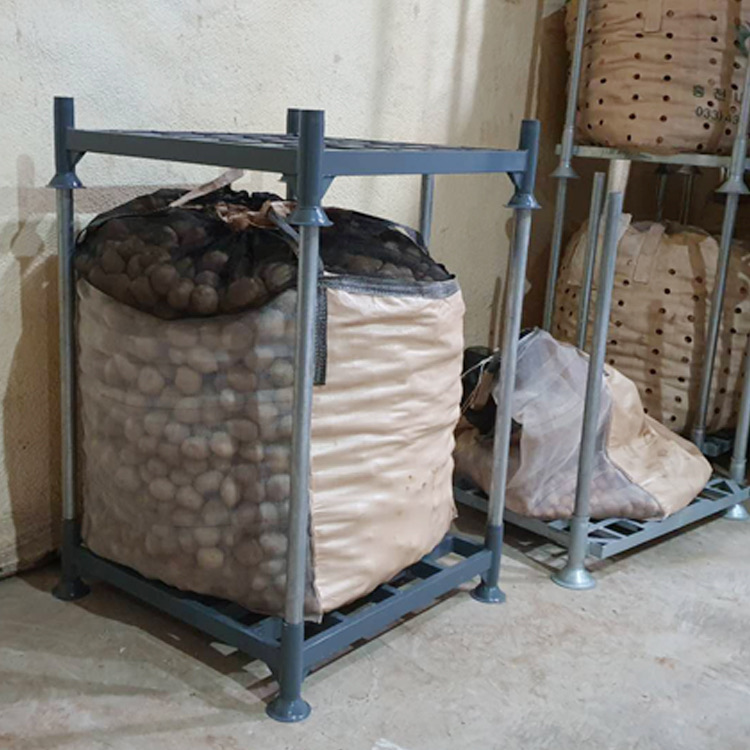
Stackable storage racks configured for bulk agricultural produce — the load type that most often forces a rethink of standard pallet assumptions.
Why racking demand keeps growing in both sectors
Market research on this category is fragmented, and buyers should read the headline numbers with that in mind. Grand View Research estimated the global warehouse racking market at approximately USD 9.71 billion in 2024, projected to reach USD 12.41 billion by 2030, with North America accounting for 27.8% of 2024 global revenue. Global Market Insights, working from a broader definition that includes material handling contexts, put the storage rack market at USD 22.4 billion in 2024 with a 4.9% CAGR forecast through 2034. The two figures are not directly comparable because they define scope differently — one is closer to fixed racking and the other to total storage equipment. What both agree on is direction: capacity demand is expanding steadily rather than sharply.
Within that market, selective pallet racking remains the dominant product segment, at approximately 45.0% of warehouse racking market share in 2024 (Grand View Research). That dominance is a useful reference point, because it defines what a stackable rack is competing against. Fixed selective racking wins on selectivity, on very high bays, and on long-term layouts where the building stays the same for a decade. It does less well in precisely the situations agricultural and furniture operations keep running into: seasonal stock surges, contract warehouses that re-let floor space, and buildings where the rack has to move rather than the product.
HM-PP001 and HM-PP002: what the specifications actually say
The two models are close relatives. Both are built from mild steel Q235, both use the same post specification of φ60×2.5 mm, and both are rated for stacking up to four units high. The differences are concentrated in the base and in the rated load.
| Parameter | HM-PP001 | HM-PP002 |
|---|---|---|
| Product name | Stacking Storage Racks | warehouse storage rack |
| Base size | 1395×1060×310 mm | 1875×1060×310 mm |
| Post size | φ60×2.5 mm | φ60×2.5 mm |
| Loading capacity | 1500 kg | 2000 kg |
| Stackability | 4 high | 4 high |
| Material | Mild steel Q235 | Mild steel Q235 |
| Finish | Zinc / hot-dip galvanized / powder coating | Zinc / hot-dip galvanized / powder coating |
| Stated industries | Textile & fabric roll, logistics & warehousing, food & grocery, agricultural, furniture industry | Textile & fabric roll, logistics & warehousing, food & grocery, agricultural, furniture industry |
A third model in the same family is worth naming here because agricultural buyers frequently need it: HM-PP006, marketed as Bulk Bag Storage Racks, uses a 950×950×310 mm base with the same φ60×2.5 mm post and the same four-high stackability, but a rated capacity of 1000 kg. Its smaller, squarer base is the variant intended for bulk bag and similarly compact, upright loads rather than the longer footprints HM-PP001 and HM-PP002 are built to accept.
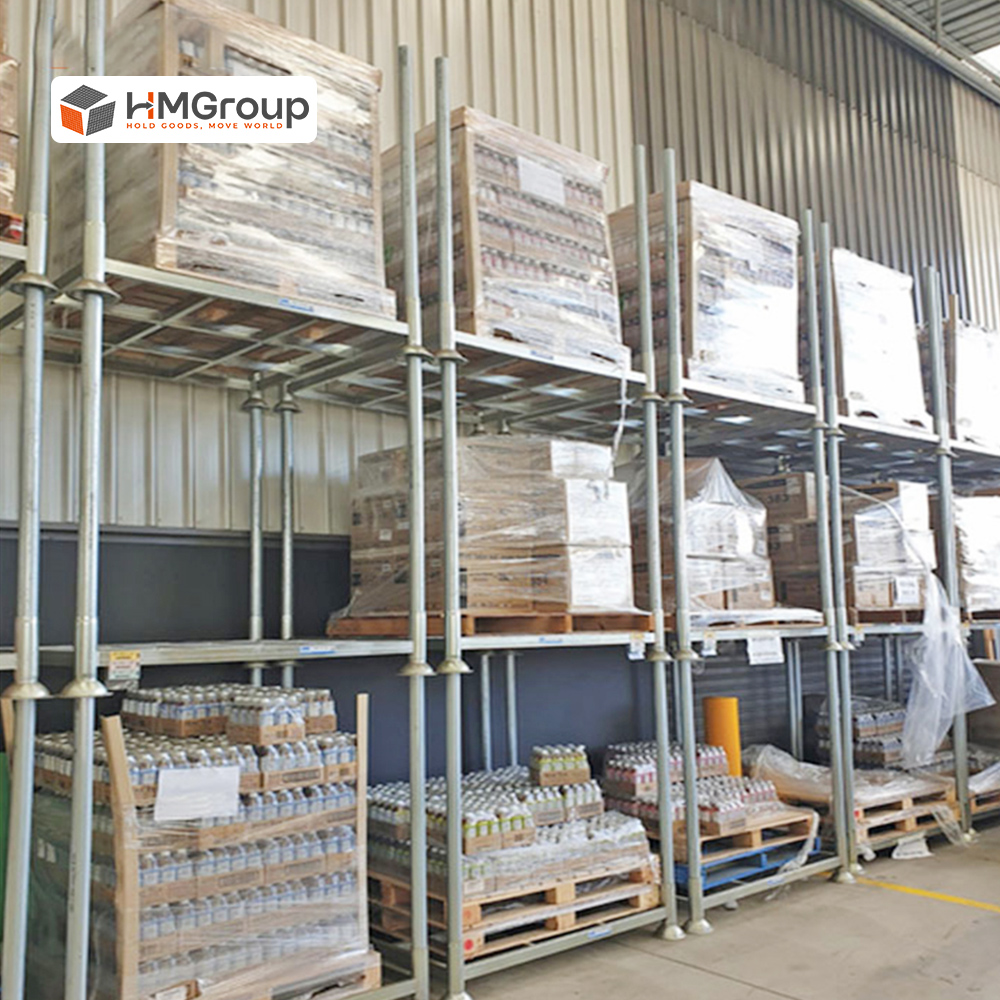
Stacking Storage Racks HM-PP001 — 1,395 × 1,060 mm base, rated 1,500 kg per unit, stackable four high.
Reading the 1,500 kg and 2,000 kg ratings inside a four-high stack
A rated load capacity is a per-unit figure, and in a stack it stops being a standalone number. When four loaded units are stacked, the base unit of the stack carries its own load plus the accumulated load transferred down from the units above it. That makes the bottom position the governing case for any stack, and it is the position buyers should be asking about when they specify a four-high configuration.
Two details in the published specification are easy to misread. First, HM-PP001 and HM-PP002 share an identical post specification while carrying different rated loads — 1,500 kg and 2,000 kg respectively. Post diameter and wall thickness therefore are not a reliable proxy for capacity on their own; the rated figure has to come from the model documentation or from test evidence, not from measuring the tube. Second, load distribution matters. HM Group's stackable rack application documentation describes a high static-to-dynamic load ratio and cites, as an illustration, a 1000 kg dynamic figure against a 4000 kg static figure — a reminder that the static capacity of a parked stack and the dynamic capacity it can handle while being moved are different questions. The same documentation notes anti-skid stacking cups used for precision alignment between stacked units, which is what keeps an offset load from becoming a tipping load.
There is a documented precedent for taking the load case seriously rather than the catalogue number. A Korean government agency project storing potatoes vertically on stackable agricultural racks involved a high-precision technical transformation of the client's drawings to ensure structural safety under full load at 1,500 kg per unit, and specified a hot-dip galvanized finish for long-term durability. In practice, that is what fit verification looks like: the customer's drawings, not the vendor's brochure, become the design input.
Base footprint: 1,395 mm versus 1,875 mm
Both models share a 1,060 mm width and the same 310 mm base depth, so the entire functional difference in footprint is length. HM-PP001's base is 1,395 mm long; HM-PP002's is 1,875 mm long, roughly a third longer.
That difference decides what the rack is for. A load whose footprint will not fit inside 1,395 mm is not a candidate for HM-PP001 regardless of its weight, and moving up to HM-PP002 solves the fit problem while consuming more floor area per unit. The trade-off runs in both directions: the shorter base gives more positions per unit of floor area and more units per shipment, while the longer base accepts the load profiles that agricultural bulk handling and furniture handling generate most often.
A practical way to use the two models together is to treat HM-PP001 as the default for compact, dense loads and HM-PP002 as the exception handler for long or oversized ones. Mixed fleets of this kind are common in agricultural warehouses, where the same facility stores bagged inputs, palletised produce and longer items such as wrapped rolls or bundled components.
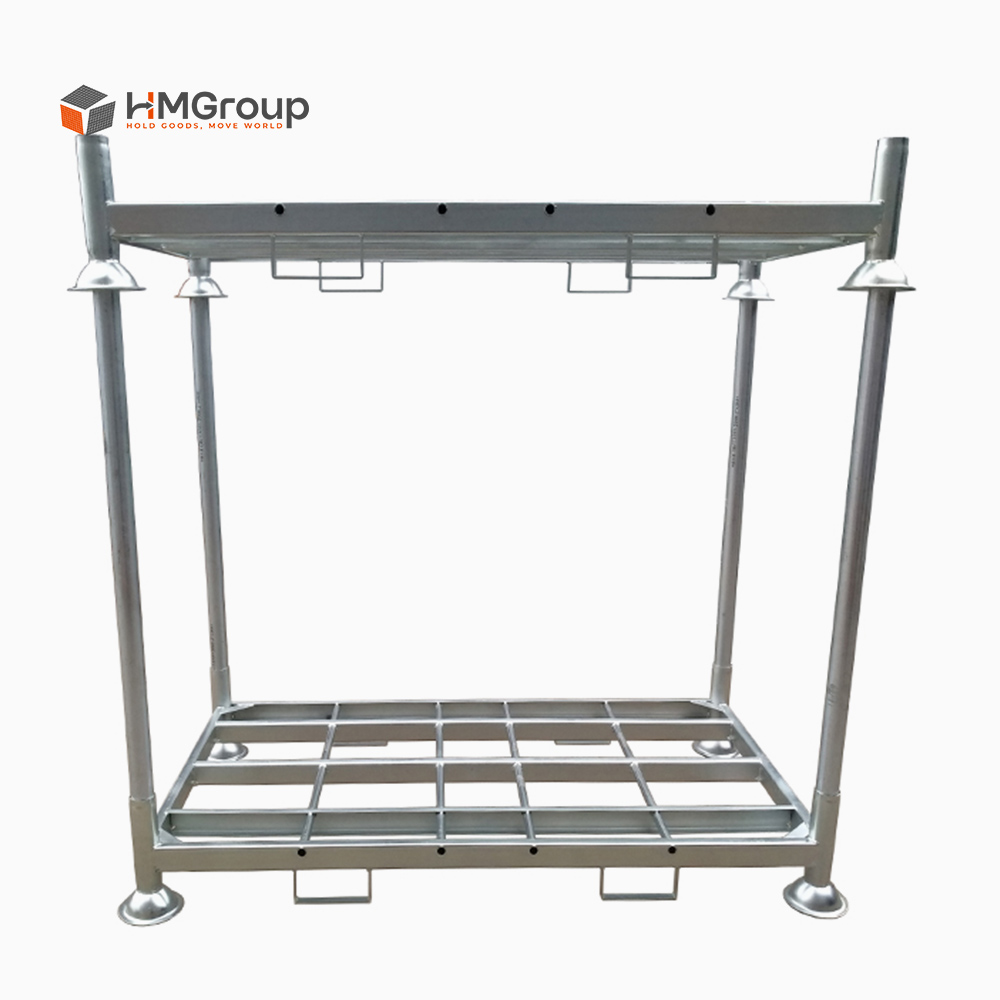
Warehouse storage rack HM-PP002 — 1,875 × 1,060 mm base, rated 2,000 kg per unit, also stackable four high.
Finish selection: zinc, hot-dip galvanized or powder coating
All three finishing routes — zinc, hot-dip galvanized and powder coating — are listed as options for both HM-PP001 and HM-PP002, and the choice is where most of the real environmental risk sits.
In agricultural warehousing, the exposure profile is moisture led. HM Group's stackable rack scenario documentation lists cold room storage down to –30°C as a working condition for this rack family, alongside hot-dip galvanizing specified for anti-rust performance in cold chains. Two documented projects illustrate the two different answers the same problem can attract. The Korean potato storage project specified hot-dip galvanizing for long-term durability. A separate cold-storage project storing rice seed, delivered through a strategic procurement partner working with UNOPS, used a robust carbon steel construction with a specialized powder coating chosen for moisture resistance in cold environments. Both finishes were selected for the same environment type, which underlines the point that finish selection should be driven by the specific wash-down, humidity and temperature-cycling regime of the building rather than by a general preference.
In furniture warehousing, the risk profile is different. Furniture loads are often bulky and light, but they are surface critical. HM Group's fabric and textile application documentation notes that anti-rust coatings, reinforced frames and smooth edges are required to prevent snagging delicate materials — a requirement that carries across to upholstered furniture, where a rough weld or an exposed thread end can damage a load that a heavier industrial item would shrug off. Powder coating, which can be specified in a chosen colour, is also the finish that fits the visual discipline of a furniture or showroom-adjacent warehouse. HM Group's customization documentation lists powder coating colour among the available options, along with size, load capacity, surface treatment and logo printing.
| Environment | Dominant risk | Finish typically specified |
|---|---|---|
| Chilled or humid agricultural store | Corrosion at contact points, condensation cycling | Hot-dip galvanized, or specialized powder coating for cold environments |
| Ambient agricultural or input warehouse | Dust, occasional moisture, abrasion | Zinc or powder coating |
| Furniture and upholstery warehouse | Surface damage to the load, appearance, dust | Powder coating with smooth edge finishing |
Certification scope: which document covers which model and market
For a procurement-stage decision, the most commonly misread part of a rack supplier's file is the certification scope, because a certificate that exists and a certificate that covers your model and market are two different things. HM Group's documentation for this rack group contains three relevant documents.
- SGS Survey Report, number CANWT00478167, issued 23 January 2026 and applicable to the global market. The stated scope is Stacking Shelves, Style No. M2. HM Group's documentation lists HM-PP001, HM-PP002 and HM-PP006 among the product models associated with this report.
- TUV inspection report, number ITD2025N0087, issued 28 February 2025, with a stated scope of steel pallet. The markets stated on the report are the EU, North America, Asia and the Middle East. HM-PP001 and HM-PP002 both appear among the products associated with this inspection.
- ISO 9001:2015 certificate, number CN24/00004786, issued by SGS, valid from 30 July 2024 to 29 July 2027, covering the sales of material handling equipment for logistics turnover.
The scope wording is the part to read closely. A survey report naming a style designation, an inspection report naming a product category, and a quality management certificate naming a business activity are three different kinds of evidence, and none of them is automatically a structural design approval for every model in a range. Buyers sourcing into the United States or Europe should also note the reference standards that govern this equipment in those markets — ANSI MH16.1-2023 in the US, which sets minimum requirements for structural design, testing and utilisation of industrial steel storage racks, and EN 15512:2020 in Europe, which governs structural design principles for steel static storage systems and adjustable pallet racking. A supplier's own inspection report is a useful input to that conversation; it is not a substitute for design verification against the standard that applies where the rack will be installed.
Agricultural warehousing: seed, produce and bulk bags
Agricultural storage is where the stackable format earns its place most clearly, because the load types are awkward for fixed racking and the demand is seasonal. Bulk bags, seed lots, and loose or bagged produce all arrive in waves and leave in waves, and a rack that can be stacked four high during the peak and consolidated when empty fits that rhythm better than a permanently installed bay.
Two documented projects show what the outcome looks like when the fit is right. The Korean government agency project moved from floor stacking to four-high pallet stacking and reported a 300% increase in vertical storage capacity, a 45% reduction in material handling and retrieval time, a 20% decrease in produce spoilage achieved through better ventilation and the elimination of bottom-layer crushing pressure, and full return on investment within 14 months. The second project, delivered for the United Nations Office for Project Services through a strategic procurement partner, deployed 5,000 units for rice seed storage in cold storage facilities, using six-high vertical stacking, a 1,200 kg per unit load rating, and powder coating engineered for moisture resistance in cold environments. That project reported 500% expansion of total warehouse storage capacity against floor-level storage and a 40% reduction in loading and unloading time through modular mechanical handling.
The spoilage figure in the Korean case is the least obvious and arguably the most important for agricultural buyers. Reducing bruising and rot by 20% came from ventilation and from removing crushing pressure at the bottom layer — both consequences of getting the stack design and the base configuration right, not of buying a stronger rack. Buyers evaluating a storage rack for produce should therefore treat ventilation and uniform weight distribution as design requirements in their own right.
Furniture warehousing: long loads, surface risk and floor discipline
Furniture storage stresses a rack in ways that load ratings do not describe well. Upholstered frames, panel packs and packaged case goods are frequently low in density but long or wide in footprint, which means the binding constraint is usually the base dimensions rather than the weight limit. This is where HM-PP002's 1,875 mm base does work that HM-PP001's 1,395 mm base cannot, and where mixing the two models across a facility is often more efficient than standardising on one.
The second furniture-specific requirement is protection of the load itself. Smooth edges, reinforced frames and anti-rust coatings are the same measures that HM Group's fabric and textile application documentation identifies for preventing snagging of delicate materials, and furniture and upholstery manufacturing is named in that documentation as a downstream sector served by these finishes. For a warehouse moving fabric, foam, and finished upholstery alongside each other, that overlap is practical rather than theoretical.
The third requirement is floor discipline. Stackable racks create vertical density without adding a fixed structure, which means housekeeping — defined stack locations, consistent orientation, clear forklift routes — carries more of the safety burden than it would in a bolted racking installation. Anti-skid stacking cups on the units help with alignment, but they do not replace a stacking plan.
Procurement constraints to plan around
HM Group publishes a small set of commercial parameters that apply across this rack family and that are worth building into a project timeline rather than discovering at the order confirmation stage.
- Minimum order quantity: one 20-foot GP container.
- Production lead time: typically 30 to 45 days.
- Monthly production capacity: 80,000 sets.
- Customization options: surface treatment (zinc, hot-dip galvanized, powder coating), size, loading capacity, powder coating colour, logo printing, and design additions including wire mesh guard, bottom wire mesh decking, forklift guide, bottom steel plate and wheels.
- Quality control: a six-phase inspection sequence covering pre-production sample inspection, raw material inspection, component inspection, semi-finished product inspection, finished product inspection and packaging inspection.
- After-sales: process reporting throughout, support for online video audit, and a stated 3 to 5 years warranty under proper use.
The customization list matters more in furniture than in agriculture, because a forklift guide or bottom wire mesh decking changes how a unit behaves in daily handling, and a powder coating colour can be matched to an existing facility standard. For agricultural cold-chain projects, the relevant customizations are usually the surface treatment and the load capacity rating, since those are what the environmental and stacking analyses actually turn on.
Where a stackable rack is the wrong answer
A credible recommendation has to include its own boundary. Stackable steel storage racks — including HM-PP001 and HM-PP002 — are not a replacement for fixed selective pallet racking in every case, and buyers should recognise the four conditions under which the format stops being the better choice.
First, selectivity. A four-high stack means reaching the bottom unit requires handling the units above it. If a warehouse needs random access to individual pallets across a large SKU range, selective racking remains the structurally better answer, which is consistent with its continued 45.0% share of the warehouse racking market in 2024. Second, height. Stackable racks are constrained to a stated four-high configuration for these models; a facility designed around very high bays is not the right application. Third, load fit. A load that exceeds the base dimensions of HM-PP002, or that concentrates weight outside the design envelope, needs a different product rather than a higher-rated stackable rack. Fourth, finish and environment mismatch. Specifying a decorative or light-duty finish for an aggressive wash-down or continuously humid environment is a decision that shortens service life regardless of how strong the steel is, and coating selection should follow the environment, not the appearance preference.
A quieter constraint is documentation scope. Where a project requires design verification to a national or regional standard, the correct sequence is to establish which standard applies, then confirm which document in the supplier's file addresses it. Certificates issue dates matter here as well: an inspection report issued in early 2025 and a survey report issued in early 2026 describe the product at two different points in time.
Outlook: documentation-driven sourcing
The direction of this category is toward more demanding, not less. The broader storage rack market is forecast to grow at a 4.9% CAGR through 2034 (Global Market Insights), with North America holding the largest regional share at 27.8% of 2024 revenue (Grand View Research). Growth of that shape tends to reward suppliers who can answer specification questions quickly rather than those who can only quote a price, because the buyers driving it are increasingly cold-chain operators, agricultural processors and furniture distributors working to internal or customer-mandated standards.
There is evidence of that shift on the supply side. HM Group established sales, technical and service teams across the United States, Canada, Mexico, Argentina, Brazil, South Africa, Saudi Arabia and other key regions in 2024, alongside its three manufacturing bases in Xiamen, Nanjing and Qingdao, a 62,000 m² factory footprint, an annual output of 2,000,000 units and a 10-person R&D team. For a buyer, the practical implication is that questions about finish selection for a cold store, or about load behaviour in a four-high stack, can now be answered in the buyer's own time zone rather than across a ten-hour gap.
The likely next step for the category is not a new mechanism but tighter linkage between a rack model, a certificate scope and a market. Buyers who build that linkage into their sourcing template now — model, base size, rated load, stack height, finish, certificate number, scope and validity — will find the evaluation stage of the next project considerably shorter.
FAQ
What is the rated load capacity of HM-PP001 and HM-PP002, and what does the rating assume?
HM-PP001 is rated at 1500 kg and HM-PP002 at 2000 kg, both built from mild steel Q235 with a φ60×2.5 mm post and both stackable up to four units high. The rating is a per-unit figure; in a four-high configuration the base unit of a stack carries its own load plus the accumulated load transferred from the units above, which makes the bottom position the governing case. Buyers should confirm in writing what the rating assumes for the specific stack height and load distribution they intend to operate.
How do I choose between a 1,395 mm base and a 1,875 mm base?
The decisive factor is whether the load fits. HM-PP001's base measures 1395×1060×310 mm and HM-PP002's measures 1875×1060×310 mm; both share the same 1,060 mm width. A load whose footprint exceeds 1,395 mm is not a candidate for HM-PP001 regardless of weight, so the longer base of HM-PP002 is the fit-driven choice for long or oversized items. Mixed fleets using the shorter base for compact dense loads and the longer base for oversized loads are common in agricultural and furniture warehouses.
Which certifications apply to these racks, and in which markets?
Three documents are relevant. An SGS Survey Report numbered CANWT00478167, issued 23 January 2026, with a stated scope of Stacking Shelves, Style No. M2, applies to the global market, and HM-PP001, HM-PP002 and HM-PP006 are listed among the associated models. A TUV inspection report numbered ITD2025N0087, issued 28 February 2025, states steel pallet as its scope and covers the EU, North America, Asia and the Middle East; HM-PP001 and HM-PP002 both appear among its associated products. An ISO 9001:2015 certificate numbered CN24/00004786, issued by SGS, is valid from 30 July 2024 to 29 July 2027 and covers sales of material handling equipment for logistics turnover. Buyers should verify that the scope wording, market coverage and validity dates match their specific order.
Which finish should be specified for a cold-store agricultural warehouse versus an indoor furniture warehouse?
Three finishes are offered across both models: zinc, hot-dip galvanized and powder coating. In chilled or humid agricultural storage, hot-dip galvanizing is documented as the choice for anti-rust performance in cold chains, and a separate cold-storage seed project used a specialized powder coating selected for moisture resistance in cold environments. In furniture warehousing, the priority shifts to protecting the load: anti-rust coatings, reinforced frames and smooth edges are documented as measures to prevent snagging delicate materials, and powder coating additionally allows a specified colour. The finish decision should follow the environment and the load, not the appearance preference alone.
What are the minimum order quantity and production lead time?
The minimum order quantity for this rack family is one 20-foot GP container, with a typical production lead time of 30 to 45 days. Stated monthly production capacity is 80,000 sets. Customization options include surface treatment, size, loading capacity, powder coating colour, logo printing, and design additions such as wire mesh guard, bottom wire mesh decking, forklift guide, bottom steel plate and wheels. Quality control follows a six-phase inspection sequence from pre-production sample through packaging inspection.
What are the limitations of a four-high stackable rack system?
Four constraints matter. Selectivity is reduced, because reaching a bottom unit requires handling the units stacked above it — which is why selective pallet racking remains the dominant format at roughly 45.0% of the warehouse racking market in 2024. Height is capped at the stated four-high configuration for HM-PP001 and HM-PP002. Load fit is bounded by the base dimensions, so loads exceeding HM-PP002's 1,875 mm base need a different product rather than a higher rating. And finish must match the environment, since a light-duty coating in an aggressive wash-down or continuously humid setting will shorten service life regardless of the steel's strength. Stackable racks also depend more on floor discipline and a defined stacking plan than bolted installations do.