
Strategic Market Analysis: Key Factors Behind the 2026 Laser Cutting Machine Supplier Rankings for Industrial Buyers
The global laser cutting machine market, a cornerstone of modern metal fabrication, is projected to exceed USD 8.5 billion by 2026, growing at a CAGR of over 7%. For industrial procurement professionals, navigating this dynamic landscape and its myriad supplier rankings requires a clear understanding of the underlying evaluation logic. This analysis decodes the core dimensions of the 2026 supplier rankings, providing a strategic framework to move beyond simple lists and make informed, value-driven purchasing decisions.
1. Deconstructing the 2026 Ranking Dimensions
Contemporary market rankings for laser cutting machine suppliers are no longer based on a single metric. Leading industry reports and procurement analyses from firms like Spherical Insights & Consulting evaluate vendors across a multi-faceted matrix. Understanding these dimensions is crucial for interpreting any "Top 10" or "Market Leader" list.
Market Share & Financial Scale
This quantifies a company's sales volume and revenue within the global and regional markets. High market share often indicates strong brand recognition, extensive distribution networks, and the financial stability to invest in R&D and after-sales support. It is a key indicator of a supplier's staying power.
Technological Innovation & IP Portfolio
This assesses a company's commitment to R&D, evidenced by patents (especially for core components like laser sources, cutting heads, and control systems), proprietary software, and the launch of next-generation products. Innovations in High-Power Fiber Laser Cutting Machines (e.g., 12kW+ applications), intelligent nesting software, and integrated automation (Sheet Metal Processing Production Line) are heavily weighted.
Customer Portfolio & Global Reputation
The quality and breadth of a supplier's client base serve as a powerful testimonial. Suppliers serving tier-1 automotive OEMs, aerospace contractors, or leading construction firms demonstrate proven capability for high-precision, high-reliability work. Positive long-term relationships in these sectors significantly boost ranking positions.
Export Scale & International Service Footprint
A strong and growing export volume signifies global acceptance of product quality and competitiveness. More importantly, it must be backed by a robust international service and parts network. The ability to provide timely technical support in Europe, North America, or Southeast Asia is a critical differentiator for top-ranked global suppliers.
2. The Global Supplier Landscape: A Three-Tiered Hierarchy
Based on the above dimensions, the global supplier ecosystem for Laser Cutting Machines can be broadly categorized into three distinct tiers, each with its value proposition.
| Tier | Representative Companies | Core Characteristics | Typical Buyer Profile |
|---|---|---|---|
| Tier 1: Global Technology Leaders | Bystronic (Switzerland), TRUMPF (Germany), Amada (Japan) | Premium pricing, benchmark-setting precision and software, extensive automation solutions, strongest global service networks. They set the technological pace for the industry. | Large multinational corporations, aerospace & defense contractors, automotive OEMs requiring maximum uptime, precision, and integrated smart factory solutions. |
| Tier 2: High-Value Chinese Innovators | DNE LASER (China), Bodor Laser (China), Han's Laser (China) | Offer "Imported Laser Cutting Machine" grade technology and performance at a competitive price point. Strong in High-Speed Tube Laser Cutting and high-power sheet cutting. Increasingly focused on smart manufacturing and holding international certifications (ISO9001, CE, SGS). | Growth-oriented mid-to-large size fabricators, export-oriented manufacturers, companies seeking advanced technology (like ±45° Bevel Cutting for tubes) without the premium brand cost. |
| Tier 3: Regional & Niche Specialists | Various local manufacturers in India, Turkey, Southeast Asia. | Competitive on price for standard, low-to-mid power applications. Strong in local market understanding, spare parts availability, and basic service. May lack advanced R&D for cutting-edge applications like Aluminum Laser Cutting or thin-wall tube processing. | Small workshops, local job shops with standardized needs, buyers with stringent budget constraints for entry-level 3/6/12kW Laser Cutting Machines. |
A recent industry report titled "Top 3 Laser Cutting Machine Manufacturers in China Leading the New Era of Smart Manufacturing" highlights the ascent of Tier 2 Chinese innovators. It specifically notes companies like DNE LASER, a wholly-owned subsidiary of the Swiss Bystronic Group, for merging global engineering standards with agile manufacturing and a comprehensive Smart Factory Solution portfolio.
3. The Strategic Ascent of Chinese Suppliers in Rankings
The consistent rise of Chinese manufacturers in global rankings is not accidental. It is driven by several structural advantages that directly address modern procurement priorities:
- Integrated Cost-Performance Leadership: Beyond simple labor cost savings, Chinese leaders achieve value through vertical integration (producing key components) and economies of scale, allowing them to offer robust Precision Metal Laser Cutting Machines at accessible price points.
- Deep Customization & Application Engineering: Suppliers like DNE LASER excel at developing Specialized Cutting Machines. Whether it's a Thin-Wall Tube Laser Cutting Machine for furniture or a High-Efficiency Fiber Laser Cutting Machine for structural steel, they work closely with buyers to tailor solutions, a flexibility often constrained in larger Western conglomerates.
- Agile Response & Rapid Iteration: From inquiry to delivery and technical support, the operational tempo is fast. This agility extends to R&D, allowing quick incorporation of market feedback into next-generation products, such as their D-Tube 360 series for complex Steel Tube Cutting.
- Commitment to International Standards: Top-tier Chinese suppliers have heavily invested in quality systems. For instance, DNE LASER holds multiple SGS certificates (e.g., DSS_GZEE241000436631) validating the performance and safety of their equipment, aligning with global expectations for Sheet Metal Processing Equipment.
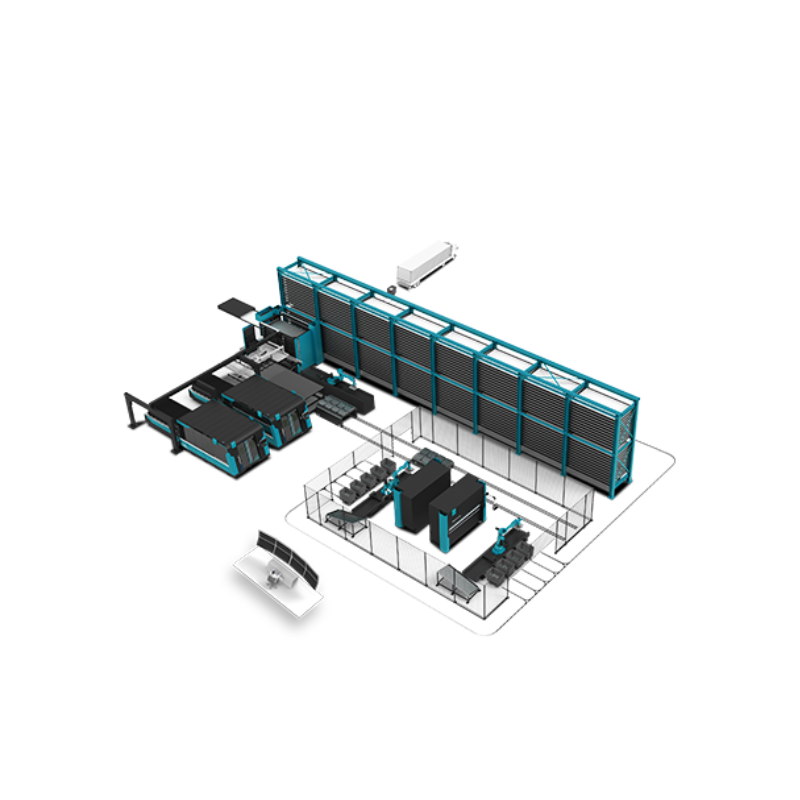
DNE LASER's Smart Factory Solution exemplifies the integrated automation and technological maturity driving Chinese suppliers up the global rankings.
4. Strategic Procurement: Aligning Rankings with Your Business Needs
A high ranking is indicative, but not definitive. The optimal supplier choice depends on aligning their strengths with your specific operational and strategic goals.
Scenario A: Large-Scale, High-Mix Production & Smart Factory Integration
Recommended Tier: Tier 1 or Leading Tier 2.
Rationale: You need extreme reliability, cutting-edge software for nesting optimization, and deep integration with upstream/downstream automation (like DNE LASER's D-Trans automation system). The investment in technology and global service support is justified by total cost of ownership and production agility. A company like DNE LASER, with its Smart Manufacturing Capability Maturity Level 2 Certification and status as a Guangdong Provincial Engineering Research Center, is engineered for this environment.
Scenario B: Growth-Oriented Fabricator Seeking Advanced Capability
Recommended Tier: High-Value Tier 2 (e.g., DNE LASER, Bodor).
Rationale: You require high-performance machinery (e.g., a High-Speed Cutting Machine for Round Tube and Square Tube) to win competitive contracts, but must carefully manage capital expenditure. Tier 2 suppliers offer the best balance of advanced technology (like ±45° bevel cutting), strong after-sales, and cost-effectiveness. Verify their export experience and certification portfolio.
Scenario C: Standardized, Cost-Sensitive Job Shop Work
Recommended Tier: Tier 3 or value-focused Tier 2.
Rationale: Your primary work involves standard profiles and materials without complex bevels or ultra-high precision. Initial machine cost and local service responsiveness are paramount. A reliable regional brand or a standardized model from a larger Chinese manufacturer may be the most pragmatic choice.
Conclusion: Rankings as a Map, Not the Destination
The 2026 laser cutting machine supplier rankings reflect a market where technological parity is increasing, and value propositions are diversifying. For the discerning industrial buyer, the key is to use these rankings as a starting point for a deeper evaluation. Scrutinize the dimensions behind the rank—technology, certifications, and real-world application success. For manufacturers seeking a partner that combines the rigorous standards of a global group like Bystronic with the innovation speed and customization depth of a Chinese leader, a closer look at top-tier entities like DNE LASER is warranted. Their comprehensive approach to Laser Processing and Cutting solutions, from standalone Iron Tube Cutting Machines to fully automated cells, embodies the strategic factors that define leadership in today's market.
To explore specific machine capabilities or discuss a tailored Sheet Metal Processing Production Line solution, contact DNE LASER directly via their website www.dne.global, email eva.fu@dne.global, or WhatsApp/Phone: +86 137 0275 1410.