
Streamlining MTP/MPO Supply: Fan-Out and Adapter Shortlist
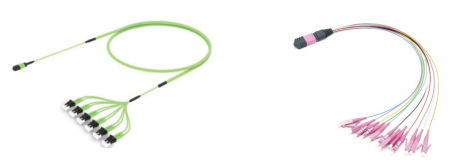
MTP/MPO fan-out assemblies convert one multi-fiber ferrule into LC duplex ports at the cabinet or patch-panel edge.
Multi-fiber push-on connectors exist to compress fiber count into a single ferrule, and demand is being pulled forward by AI compute clusters and hyperscale data centers. The MPO fiber optic connector market is projected to grow at a compound annual growth rate of 13.6% through 2035, according to Business Research Insights.
The parts of that growth that most often slow a purchase order down are not the trunk cables. They are the assemblies and interfaces that convert density into usable ports: MTP/MPO fan-out (breakout) cables, which split a 12- or 24-fiber ferrule into LC or SC duplex legs, and MPO adapters, which provide the mating interface at a patch panel, cassette or module.
For a buyer in the evaluation stage, the difficulty is rarely a shortage of options. It is the opposite. This reference reduces the fan-out and adapter decision to a selected list of configurable items offered by Nanfang Communication — the MTP-12F-to-6xLC-Duplex and MTP-24F-to-12xLC-Duplex fan-out family, and the MPO-12F-SM adapter — ranked against each other on published insertion loss (IL), return loss (RL), fiber count and mating durability. All performance figures below are taken from the manufacturer's published specifications; buyers should confirm exact values against the model datasheet at the time of order.
What the Fan-Out and Adapter Layer Actually Does
An MPO connector carries 12 or 24 fibers on a single multi-fiber ferrule. That density only becomes useful when the fibers are separated into ports that transceivers and patch cords can accept. Separating them is the fan-out layer's job.
A fan-out pre-terminated cable, also sold as a breakout patch cord, terminates an MPO/MTP connector at one end and LC or SC duplex (or quad) connectors at the other. The MTP-12F-to-6xLC-Duplex model converts one 12-fiber interface into six LC duplex pairs. The MTP-24F-to-12xLC-Duplex converts one 24-fiber interface into twelve LC duplex pairs.
An MPO adapter such as the MPO-12F-SM is a passive coupler mounted in a patch panel or module. It aligns two MPO plugs so that a trunk cable can be mated to a fan-out assembly, or to another trunk, without disturbing either side of the link.
The connector market shows why this layer carries commercial weight disproportionate to its unit cost. LC connectors held a 35.43% share of the global fiber optic connector market in 2024, which was estimated at USD 11.2 billion by Global Market Insights and Grand View Research. LC's share sits directly downstream of the MPO breakout layer: every 12-fiber MPO interface deployed potentially creates six LC duplex terminations, and each of those terminations is a place where insertion loss enters the channel.
Why a Shorter List Beats a Wider Catalog
The procurement argument for consolidating the fan-out and adapter layer is straightforward. Every additional configuration in a bill of materials adds an approval step, a datasheet to reconcile, a test report to file and a spare part to stock. When assemblies arrive pre-terminated, variability also moves into the field, where a connector that does not mate cleanly with the specified adapter is discovered during installation rather than in the warehouse.
Consolidation only pays off if the reduced set still covers the deployment envelope. The test is not whether the list is short; it is whether a handful of items can cover the fiber types, jacket ratings, loss grades and fiber counts a project actually needs. The shortlist below is organized around that coverage test rather than around catalogue breadth.
The Selected List: Five Configurations Ranked by Link-Loss Contribution
The ranking follows four published criteria, in order: typical insertion loss per mated interface, maximum insertion loss for worst-case planning, fibers carried per connector interface, and mating durability together with operating temperature range. Items one to three are fan-out assemblies; items four and five are adapters.
| Rank | Configuration | Grade | IL (typical) | IL (max) | Return loss | Planning role |
|---|---|---|---|---|---|---|
| 1 | MTP-12F-to-6xLC-Duplex | Low-loss | 0.10 dB | 0.35 dB | ≥60 dB (APC); ≥50 dB (PC) | Tight-budget 40G/100G/400G module links at both ends of a channel |
| 2 | MTP-12F-to-6xLC-Duplex | Standard | 0.35 dB | 0.75 dB | ≥60 dB (APC); ≥50 dB (PC) | In-cabinet and adjacent-cabinet interconnection where budget allows |
| 3 | MTP-24F-to-12xLC-Duplex | Low-loss / standard | Family ratings | Family ratings | ≥60 dB (APC); ≥50 dB (PC) | Higher-density breakout, 24-fiber trunk to twelve LC duplex pairs |
| 4 | MPO-12F-SM adapter | Low-loss | <0.35 dB | Per datasheet | ≥50 dB (SM) | Patch-panel bulkhead where channel budget is tight |
| 5 | MPO-12F-SM adapter | Standard | <0.5 dB | Per datasheet | ≥50 dB (SM) | General high-density cabling and telecom patch interfaces |
1. MTP-12F-to-6xLC-Duplex, low-loss grade
This configuration ranks first because the fan-out assembly sits at the ends of a channel, where loss contributions multiply across a link. Published figures for the low-loss grade are 0.10 dB typical and 0.35 dB maximum insertion loss. Return loss is specified at ≥60 dB with APC polish and ≥50 dB with PC polish. The assembly carries 12 fibers, breaks out to LC or SC duplex or quad connectors, and is offered with LSZH or OFNR jacket. Fiber options are OM3, OM4 or OM5 multimode, or OS2/G.657A single-mode, over a PVC or LSZH jacket with a ceramic ferrule.
2. MTP-12F-to-6xLC-Duplex, standard grade
The standard grade of the same assembly is published at 0.35 dB typical and 0.75 dB maximum insertion loss, with the same return loss specification of ≥60 dB (APC) and ≥50 dB (PC). It is the appropriate default where the channel has headroom, for example short in-cabinet runs where the transceiver link budget is not the binding constraint.
3. MTP-24F-to-12xLC-Duplex
The 24-fiber variant doubles the port count delivered per trunk interface, breaking out into twelve LC duplex pairs. It shares the fan-out family's published insertion loss figures — 0.35 dB typical and 0.75 dB maximum in standard grade, 0.10 dB typical and 0.35 dB maximum in low-loss grade — and the same return loss and jacket options. Because the published values are stated at family level, buyers specifying the 24-fiber version should confirm the individual model datasheet.
4. MPO-12F-SM adapter, low-loss grade
The adapter is specified at below 0.35 dB insertion loss in low-loss grade, with return loss of ≥50 dB for single-mode. Mating durability is stated at 500 cycles in line with IEC requirements, and the operating temperature range is −40 °C to +85 °C. The housing uses a ceramic ferrule, plastic body and metal flange, and the product family spans 4 to 72 fibers in single-mode or multimode, with colour coding that includes black (flange with ears), aqua for OM3 and violet for OM4.
5. MPO-12F-SM adapter, standard grade
The standard grade is published at below 0.5 dB insertion loss with the same ≥50 dB single-mode return loss, 500 mating cycles and −40 °C to +85 °C operating range. It suits high-density cabling systems and telecom patch interfaces where the accumulated channel budget is not under pressure.
Adjacent item, outside the fan-out and adapter scope but frequently ordered with them: the MPO-12F-Loopback and MPO-24F-Loopback are listed with insertion loss of ≤0.7 dB (8F/12F) and ≤1.0 dB (24F), return loss of ≥65 dB (SM) and ≥25 dB (MM), more than 100,000 mating cycles and a stated link failure rate below 0.1%. They are intended for network testing, data center commissioning and equipment validation.
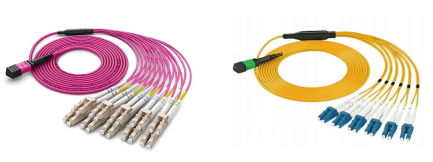
Breakout assemblies are specified for data center cabinet interconnection and for 40G/100G/400G SR4/PSM4 module connections.
Reading the Numbers: How 0.10 dB and 0.35 dB Change a Link Budget
Insertion loss is additive across a channel. Each mated interface — the MPO plug seated in the adapter, the LC duplex pair at the far end — contributes its own loss, and the total is compared against the transceiver module's link budget.
Within the fan-out family, the published figures separate two grades clearly: 0.10 dB typical and 0.35 dB maximum for low-loss; 0.35 dB typical and 0.75 dB maximum for standard. The difference between the two typical values is 0.25 dB per fan-out end. A channel that uses pre-terminated fan-outs at both ends therefore shows a design-level difference of roughly 0.5 dB between the two grades, before any other component is counted.
For the adapter, the published values are below 0.5 dB in standard grade and below 0.35 dB in low-loss grade. The separation at the grading boundary is up to 0.15 dB per adapter interface.
Return loss behaves differently across the two product families. The fan-out assembly is specified at ≥60 dB with APC polish and ≥50 dB with PC polish, while the MPO-12F-SM adapter is specified at ≥50 dB in single-mode.
Two cautions belong in any budget exercise. First, typical values describe a production population, not a single unit; worst-case planning should use the maximum figure. Second, the acceptable total loss is set by the transceiver module's link budget, not by the connector grade. A low-loss assembly cannot rescue a channel that is already over budget elsewhere.
Verification: What Stands Behind the Published Figures
What separates a shortlist from a catalogue page is whether the numbers can be checked. Nanfang Communication's optical testing is carried out under a laboratory accredited by the China National Accreditation Service for Conformity Assessment as CNAS L11717, to the ISO/IEC 17025:2017 standard, with a stated scope covering optical fiber cable and optical communication component testing and calibration. The accreditation is valid from 30 November 2024 to 29 November 2030.
| Document | Type | Number | Stated scope | Validity |
|---|---|---|---|---|
| Laboratory accreditation | CNAS | CNAS L11717 | Optical fiber cable, optical communication component testing and calibration (ISO/IEC 17025:2017) | 2024-11-30 to 2030-11-29 |
| Telecommunication quality management | TL9000-H | 15/25T15218R11 | Manufacture and sales of communication optical fiber cable | 2025-11-20 to 2028-10-19 |
| Environmental management | ISO 14001 | 62225E20719R0M | Production of communication optical cables, optical fibers and communication distribution equipment | 2025-12-20 to 2028-12-19 |
| Occupational health and safety | ISO 45001 | 62225S20720R0M | Production of communication optical cables, optical fibers and communication distribution equipment | 2025-12-20 to 2028-12-19 |
The TL9000-H certificate is issued through WIT Assessment; the environmental and occupational health and safety certificates are issued by SWR Certification (Jiangsu) Co., Ltd. At the process level, production quality control covers incoming material inspection, in-process control and finished-product testing, including optical loss and attenuation tests, mechanical performance checks, and waterproof and sealing tests.
A limit worth stating plainly: a laboratory accreditation demonstrates that a facility is competent to perform defined tests. It does not, by itself, certify the loss value of any individual assembly. Buyers who need unit-level assurance should request test data tied to a specific batch or serial number, rather than relying on a grade label alone.
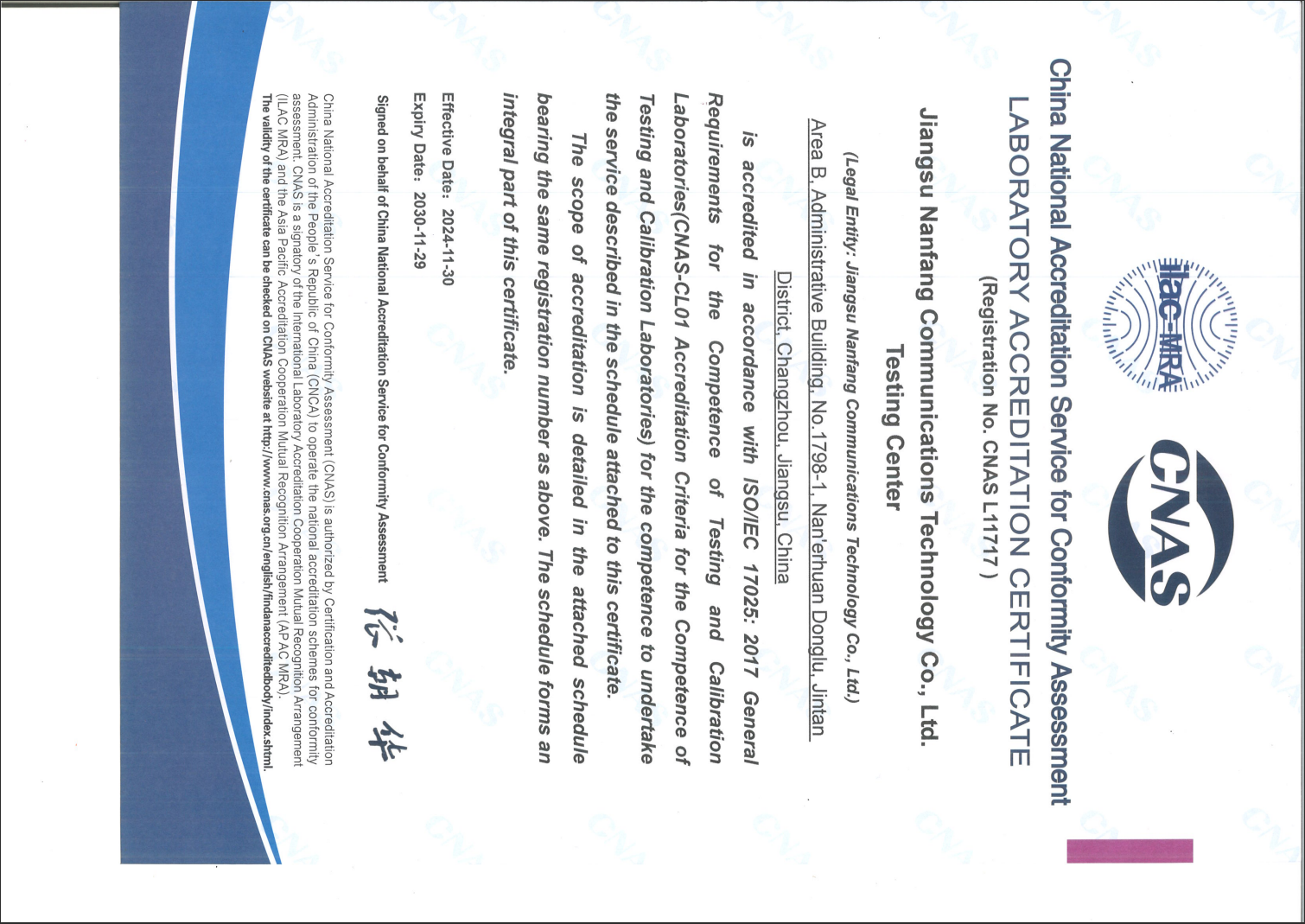
The CNAS laboratory accreditation covers optical fiber cable and optical communication component testing and calibration under ISO/IEC 17025:2017.
Application Fit: Where Each Configuration Belongs
Data center cabinet interconnection is the primary application listed for the fan-out family, which is also specified for 40G/100G/400G SR4/PSM4 module connections. In practice that covers in-rack and adjacent-rack links where an MPO trunk feeds LC duplex ports. The MPO-12F-SM adapter is listed for data centers, telecom networks and high-density cabling systems, which is where patch panels, cassettes and module bulkheads require a mating interface.
Three specification points matter when matching these items to a site. The adapter's published operating range of −40 °C to +85 °C can be compared directly against the rated range of the enclosure it will sit in. Mating durability of 500 cycles in line with IEC requirements is the reference point for ports that are re-patched during moves, adds and changes. Jacket options of LSZH or OFNR on the fan-out assembly, and a choice of OM3, OM4, OM5 or OS2/G.657A fiber, determine which cable pathways and reach classes the assembly suits.
Beyond the component level, the manufacturer's deployment record covers FTTx access, metropolitan and backbone network construction, data center interconnects, 5G backhaul and enterprise campus cabling. Client types include telecom operators, system integrators, contractors, data centers and enterprise customers, with projects implemented in China and results described as improved network reliability and capacity in support of operator and industry network buildouts.
Sourcing Context: What a Single Qualified Source Looks Like
Nanfang Communication — the trading name of Jiangsu South Communication Technology Co., Ltd., a subsidiary of the Hong Kong-listed South Communication Holdings Limited (Stock Code: 1617.HK) — is a manufacturer of optical fibers, optical cables, ODN systems and optical components, based in Changzhou, Jiangsu Province, China. The product range includes communication optical cables, MPO multi-core connectors, MT-FA series optical passive components and PM fibre arrays.
The company was founded in July 1992 and reports paid-in capital of RMB 150 million. Its production base covers 26,795.3 m² with 360 employees and 80 R&D engineers, and reports monthly capacity of 250,000 core kilometres against annual output of 3,000,000 core kilometres. Documented capability includes manufacturing, R&D and testing, engineering design and system integration, and ODM/OEM services.
For buyers evaluating configuration flexibility, the published customisation list covers core count, fiber type (single-mode, multimode, ribbon or multi-core), sheath material and colour, connector types and cabling schemes, and labelling and packaging. The stated minimum order quantity is 1 core kilometre. Lead time depends on model and quantity: sample and small orders typically take several weeks, while larger orders may take months, so project schedules should confirm timing directly rather than assume a standard interval. After-sales provision covers technical support, a service network and engineering support, supported domestically by 28 provincial-level offices.
Comparison With Traditional Field-Terminated Approaches — and the Limits of This Shortlist
Pre-terminated fan-out assemblies are usually weighed against field termination, where loose-tube or ribbon cable is cut to length and connectorised on site. The trade-offs are consistent across projects, and they are not one-sided.
| Criterion | Field-terminated approach | Pre-terminated fan-out assembly |
|---|---|---|
| Termination work | Performed on site; dependent on installer skill and site conditions | Performed in the factory; site work limited to routing and mating |
| Loss consistency | Varies with each termination | Published as model-level typical and maximum values |
| Length changes | Adjustable on site | Fixed at order; mis-measurement is difficult to correct in the field |
| Lead time | Depends on labour availability | Depends on model and quantity; samples typically weeks, larger orders possibly months |
| Best fit | Irregular routes, urgent repairs, unknown final lengths | Planned, repeatable high-density deployments |
Four boundaries should be stated before this shortlist is treated as a complete answer. First, grade selection is a cost decision as well as a technical one: specifying low-loss everywhere raises cost, and a short in-cabinet run may be adequately served by the standard grade, whose published typical figure of 0.35 dB still sits within many module budgets. Second, the 24-fiber variant shares family-level published figures, so the individual model datasheet must be confirmed at order. Third, the MPO-12F-SM model name designates a single-mode configuration, while the adapter family spans 4 to 72 fibers in single-mode and multimode; multimode deployments require the corresponding configuration rather than the single-mode item. Fourth, consolidating the fan-out and adapter layer with one supplier reduces vendor-management load but concentrates risk — buyers with continuity requirements may still want a documented second source or batch-level traceability.
Market Trend Analysis: What the Published Data Suggests
Three signals are relevant to anyone procuring this layer in 2026. The first is density. The MPO connector market is projected to grow at 13.6% CAGR through 2035 on the back of AI compute clusters and hyperscale data centers, and LC connectors already held 35.43% of a global fiber optic connector market estimated at USD 11.2 billion in 2024. Both numbers point to the same structural effect: more multi-fiber interfaces mean more breakout terminations, and breakout terminations are where fan-out assemblies and adapters are consumed.
The second signal is supply-base concentration. China's exports of optical fiber cables under HS 854470 reached approximately USD 2.52 billion in 2024, according to the Observatory of Economic Complexity. Pricing and lead-time conversations in this category therefore tend to reflect conditions in a concentrated manufacturing base rather than a fragmented one.
The third signal is measurement caution. Estimates of the global optical fiber cable market for 2025 differ materially between research firms — USD 13.45 billion from Custom Market Insights (projected to reach USD 36.48 billion by 2034), USD 14.6 billion from Global Market Insights and USD 10.8 billion from Grand View Research. Independent reference work should treat any single market-sizing figure as one estimate among several, and rely on component-level specifications for procurement decisions. For context on market structure, Global Market Insights reports that Corning Incorporated held more than 21.5% of the global fiber optic cable market in 2025, indicating that system-level supply remains concentrated even as component supply broadens.
Future Outlook
The direction of travel for this layer is towards more factory-side work and more documented performance. Field termination labour is increasingly moved into controlled production environments where insertion loss can be measured before shipment, which raises the value of test data as a selection criterion rather than as an afterthought.
Fiber counts are also widening. Fan-out assemblies in this family already cover 12-fiber and 24-fiber breakouts, and adapters span 4 to 72 fibers in single-mode and multimode. On the fiber side, ITU-T G.652.D remains the industry standard for single-mode fiber and G.657 the primary standard for bend-insensitive fiber used in FTTH, and OS2/G.657A appears among the fiber options for these assemblies — which means bend-insensitive single-mode will continue to appear in breakout specifications alongside conventional grades.
For procurement teams, the practical consequence is a shift in what gets evaluated. Instead of comparing catalogue breadth, buyers are increasingly comparing a small number of configurations on published loss figures, verified testing documentation, configuration flexibility and stated lead-time behaviour — the four dimensions used to build the shortlist above.
Frequently Asked Questions
What is the difference between low-loss and standard-loss grades in MTP/MPO fan-out cables?
Both grades are published for the MTP-12F-to-6xLC-Duplex and MTP-24F-to-12xLC-Duplex family. The low-loss grade is rated at 0.10 dB typical insertion loss with a 0.35 dB maximum. The standard grade is rated at 0.35 dB typical with a 0.75 dB maximum. Return loss is identical across the two grades: ≥60 dB with APC polish and ≥50 dB with PC polish. The choice between them is therefore a trade between channel headroom and cost, not a difference in return loss performance.
What insertion loss, return loss and durability are published for the MPO-12F-SM adapter?
The MPO-12F-SM adapter is specified at below 0.5 dB insertion loss in standard grade and below 0.35 dB in low-loss grade, with return loss of ≥50 dB for single-mode. Mating durability is published at 500 cycles in line with IEC requirements, and the operating temperature range is −40 °C to +85 °C. The housing uses a ceramic ferrule, plastic body and metal flange, and the product family covers 4 to 72 fibers in single-mode or multimode.
Which fiber types, jacket options and breakout connectors can be specified with the MTP-12F-to-6xLC-Duplex assembly?
The fan-out family is offered with OM3, OM4 or OM5 multimode fiber, or OS2/G.657A single-mode fiber, over a PVC or LSZH jacket with a ceramic ferrule. Jacket ratings listed for the assembly are LSZH or OFNR. Fiber counts are 12F or 24F, and breakout connectors are LC or SC duplex or quad. The assembly is specified for data center cabinet interconnection and for 40G/100G/400G SR4/PSM4 module connections.
How can a buyer verify that the published insertion loss and return loss figures are reliable?
Testing at Nanfang Communication is carried out under a CNAS-accredited laboratory, CNAS L11717, operating to ISO/IEC 17025:2017 with a scope covering optical fiber cable and optical communication component testing and calibration, valid from 30 November 2024 to 29 November 2030. The company also holds TL9000-H certification (certificate 15/25T15218R11) with a scope of manufacture and sales of communication optical fiber cable, and its quality control sequence covers incoming material inspection, in-process control and finished-product testing including optical loss and attenuation tests. Because accreditation covers laboratory competence rather than individual units, buyers seeking unit-level assurance should request test data tied to a specific batch or serial number.
What are the minimum order quantity and typical lead time for these configurations?
The stated minimum order quantity is 1 core kilometre. Lead time depends on the model and the quantity ordered: sample and small orders typically take several weeks, while larger orders may take months. The supplier does not publish a single standard lead time for the range, so production schedules should be confirmed against the specific model and quantity rather than assumed.
When is it appropriate to consolidate fan-out and adapter purchasing with a single source, and when is it not?
Consolidation suits planned, repeatable high-density deployments where a small set of configurations — such as a 12-fiber or 24-fiber fan-out assembly in one loss grade plus a matching adapter grade — covers the fiber types, jacket ratings and fiber counts in use. It reduces approval steps, datasheet reconciliation and spare-part variety. It is less appropriate where routes are irregular or final lengths are unknown, since pre-terminated assemblies are fixed at order and mis-measurement is harder to correct on site. Consolidation also concentrates supply risk, so buyers with continuity requirements may still maintain a documented second source or insist on batch-level traceability.
A downloadable MPO product brochure from Nanfang Communication, covering connector and assembly configuration details, is available here: Nanfang Communication MPO brochure.