
Street Light Design for Heritage and Municipal Streetscapes
Street Light Design for Heritage and Municipal Streetscapes
A heritage commercial street and a modern municipal boulevard can sit a few hundred metres apart in the same city and still demand two entirely different luminaire decisions. Both are outdoor lighting projects. Both will be measured on illuminance, uniformity and energy use. Only one of them will also be judged on whether the lamp looks as though it has always belonged to the street it lights.
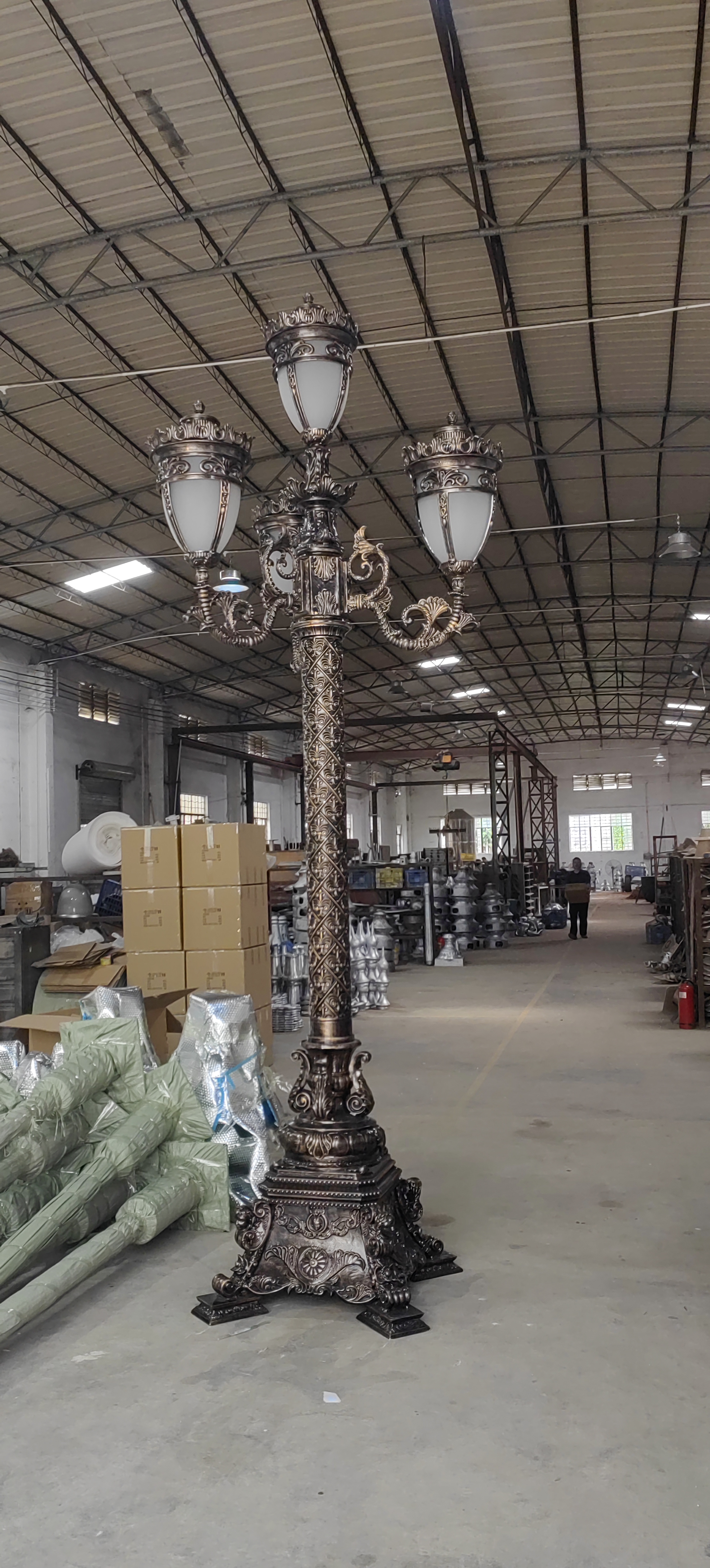
Decorative courtyard-scale luminaire: pedestrian-height proportions, cast aluminium lamp body, multi-head arrangement — the visual language that heritage streetscapes are usually expected to keep.
BAIFU LIGHTING is the trading name of Zhongshan Baifu Street Lamp Co., Ltd., a custom outdoor lighting manufacturer based in Guzhen Town, Zhongshan City, Guangdong, China. Founded in 2013, the company operates an 11,158 m² production facility with approximately 68 staff, a five-engineer R&D team and an annual production capacity of 50,000 units, and it supplies OEM, ODM and project-based lighting solutions to customers in 71 countries, with export business accounting for 45% of total sales.
This article examines how streetscape context — not wattage alone — determines which luminaire belongs where. It uses two products from the BAIFU LIGHTING range as reference points: the BF-AGL-4000-60W ancient-style courtyard lamp, which sits at the heritage and courtyard end of the market, and the BF-LSL-4000-120W custom LED landscape street light, which addresses modern landscape and municipal-scale applications. The discussion covers mounting heights, available power ranges, control interfaces, mounting method and the aesthetic coherence issues that decide whether a scheme reads as designed rather than assembled.
Why streetscape context now drives luminaire selection
The functional debate in street lighting is largely settled. Grand View Research estimated the global street lighting market at USD 9.1 billion in 2023, with a projected value of USD 11.6 billion by 2030 and a compound annual growth rate of 3.6%, and reported that LED lighting accounted for 79.7% of total street lighting revenue in that year. When the light source and the energy case are no longer the differentiator, the remaining competition moves to fit: optical distribution, pole geometry, control integration and appearance.
Forecast scope varies by source. A separate street-and-roadway lighting forecast from StrategyR places the 2030 market at USD 16.5 billion rather than USD 11.6 billion, largely because it defines the addressable category more broadly. Buyers should treat any single forecast as one analyst's boundary definition rather than a settled number.
The practical consequence for project procurement is that a specification template copied from one street type to another tends to fail in one of two ways. A functional road luminaire installed in a historic pedestrian district meets illuminance targets but introduces a silhouette that conflicts with the surrounding architecture. A decorative lantern installed over a carriageway is mounted at pedestrian height, distributes light softly and multiple-directionally, and therefore cannot deliver roadway-class uniformity regardless of how much LED power is installed inside it.
Height, power and distribution: the three variables that define a scenario
Mounting height is the first constraint, because it drives pole geometry, foundation design and wind loading. Two luminaires with identical LED power but a four-metre height difference belong to different categories of project, regardless of how similar they look in a catalogue.
LED power is the second constraint, and it is bounded by the first. A luminaire offered across a 30–80 W range and a luminaire offered across a 60–200 W range can both be described as "custom", but only one of them is designed to be mounted above vehicle traffic.
Light distribution is the third constraint, and it is the one most often under-specified. Road lighting distribution, plaza lighting distribution and decorative landscape distribution solve different problems: road distribution concentrates light along a carriageway, plaza distribution spreads it across a wide surface with different uniformity expectations, and decorative landscape distribution prioritises the appearance of the luminaire and its light pattern over carriageway performance.
Two further variables affect both categories. Wind resistance is not a fixed catalogue value in either product family — structural design is based on the lamp or pole height and the local wind speed at the project site. And electric shock protection is Class I on both referenced models, which means an effective earth connection must be provided at installation; the protection class is a design characteristic, not an installation detail that can be skipped.
| Parameter | BF-AGL-4000-60W | BF-LSL-4000-120W |
|---|---|---|
| Product category | Ancient-style courtyard lamp (Aluminum/Steel Cast Outdoor Lamp) | Custom LED landscape street light (custom decorative landscape street lights) |
| Installation / mounting height | 3–4 m, customizable per project | 6 m, 8 m, 10 m, 12 m, customizable per project |
| LED power options | 30 W, 40 W, 50 W, 60 W, 80 W | 60 W, 80 W, 100 W, 120 W, 150 W, 180 W, 200 W |
| Input voltage | AC 85–265 V, 50/60 Hz | AC 85–265 V, 50/60 Hz |
| Luminous efficacy | ≥130 lm/W | ≥130 lm/W |
| Lighting mode / distribution | Unidirectional or multi-faceted soft lighting | Road, plaza or decorative landscape distribution, selectable |
| Colour temperature | 3000 K, 4000 K, 5000 K, 6000 K | 2700 K, 3000 K, 4000 K, 5000 K, 6000 K |
| Colour rendering index | Ra ≥ 70 | Ra ≥ 70; Ra ≥ 80 optional |
| Power factor | PF ≥ 0.95 | PF ≥ 0.95 |
| Ingress protection | IP65 / IP66 | IP65 / IP66 |
| Electric shock protection class | Class I | Class I |
| Rated service life | ≥50,000 hours | ≥50,000 hours |
| Operating temperature | -30 °C to +60 °C | -30 °C to +60 °C |
| Lamp body and pole material | High-pressure cast aluminium body; Q235 hot-dip galvanized steel pole | Q235 hot-dip galvanized steel, 304 stainless steel, die-cast aluminium housings, high-transmittance tempered glass, stainless steel fasteners |
| Surface treatment | Outdoor electrostatic powder coating | Overall hot-dip galvanizing followed by outdoor electrostatic powder coating |
| Standard colours | Black, dark grey, copper brown; RAL card customization | Dark grey, black, silver grey, bronze; RAL card customization |
| Mounting method | Flange base with pre-installed anchor bolts | Flange base with embedded anchor bolts |
| Control | Conventional switch control standard; light control, time control and intelligent control optional | Standard on-off control; photocell, timer, 0–10 V dimming, DALI and smart lighting control optional |
The heritage end of the range: BF-AGL-4000-60W
The BF-AGL-4000-60W is an ancient-style courtyard lamp in the Aluminum/Steel Cast Outdoor Lamp category. It is intended for residential and commercial landscape lighting, with typical applications in residential communities, villa courtyards, urban parks, commercial plazas, hotels and resorts.
Its construction explains most of its application logic. The lamp body is high-pressure cast aluminium and the pole is Q235 hot-dip galvanized steel, finished with outdoor electrostatic powder coating. The lamp cover is high-transparency tempered glass or a UV-resistant PC cover. Standard colours are black, dark grey and copper brown, with customization against a RAL colour card — a detail that matters in heritage districts, where the acceptable colour range is often set by the surrounding masonry, joinery or metalwork rather than by a generic palette. Fixing is by flange base with pre-installed anchor bolts.
The installation height of 3–4 m is the defining characteristic. At that height the luminaire operates at pedestrian scale, which is exactly what a historic commercial street, a villa courtyard or a garden path requires, and exactly why it is not a carriageway luminaire. Power options run from 30 W to 80 W, with luminous efficacy of at least 130 lm/W, a colour rendering index of Ra ≥ 70 and a power factor of at least 0.95. Lighting is unidirectional or multi-faceted soft lighting, which suits facades, planting and paving rather than traffic lanes.
Control is deliberately tiered. Conventional switch control is standard, with light control, time control and intelligent control available as options. In heritage districts this tiering is useful because the aesthetic requirement and the operational requirement are often set by different stakeholders: the conservation or design authority cares about the daytime silhouette, while the operator cares about switching behaviour after the street empties.
The municipal and landscape end: BF-LSL-4000-120W
The BF-LSL-4000-120W is a custom LED landscape street light in the custom decorative landscape street lights category, designed for urban roads, parks, plazas, commercial streets and large-scale landscape lighting projects. Where the courtyard lamp is a pedestrian-scale object, this is a streetscape system: mounting heights of 6 m, 8 m, 10 m and 12 m, all customizable, with LED power options from 60 W to 200 W.
The pole and bracket architecture is where project-specific design enters. Pole structures may be conical, square, special-shaped or artistic; brackets may be single-arm, double-arm, multi-arm, or combined high-low lamp head arrangements; light distribution can be specified as road, plaza or decorative landscape distribution. Decorative features can include hollow patterns, luminous decorations, city logos, cultural totems and other exclusive project elements. In other words, the identity of a streetscape can be carried by the pole rather than added to it afterwards.
Performance parameters are consistent with a modern municipal installation: luminous efficacy of at least 130 lm/W, colour temperature options from 2700 K to 6000 K, Ra ≥ 70 with Ra ≥ 80 optional, power factor PF ≥ 0.95, IP65 or IP66 ingress protection, Class I electric shock protection and a rated service life of at least 50,000 hours across an operating temperature range of -30 °C to +60 °C.
Control options scale further than on the courtyard model: standard on-off control, with photocell, timer, 0–10 V dimming, DALI and smart lighting control available as options. That matters for a municipal client because dimming profiles and monitoring are usually specified at network level, while the luminaire's appearance is specified at street level. The BF-LSL-4000-120W carries both specifications in one housing.
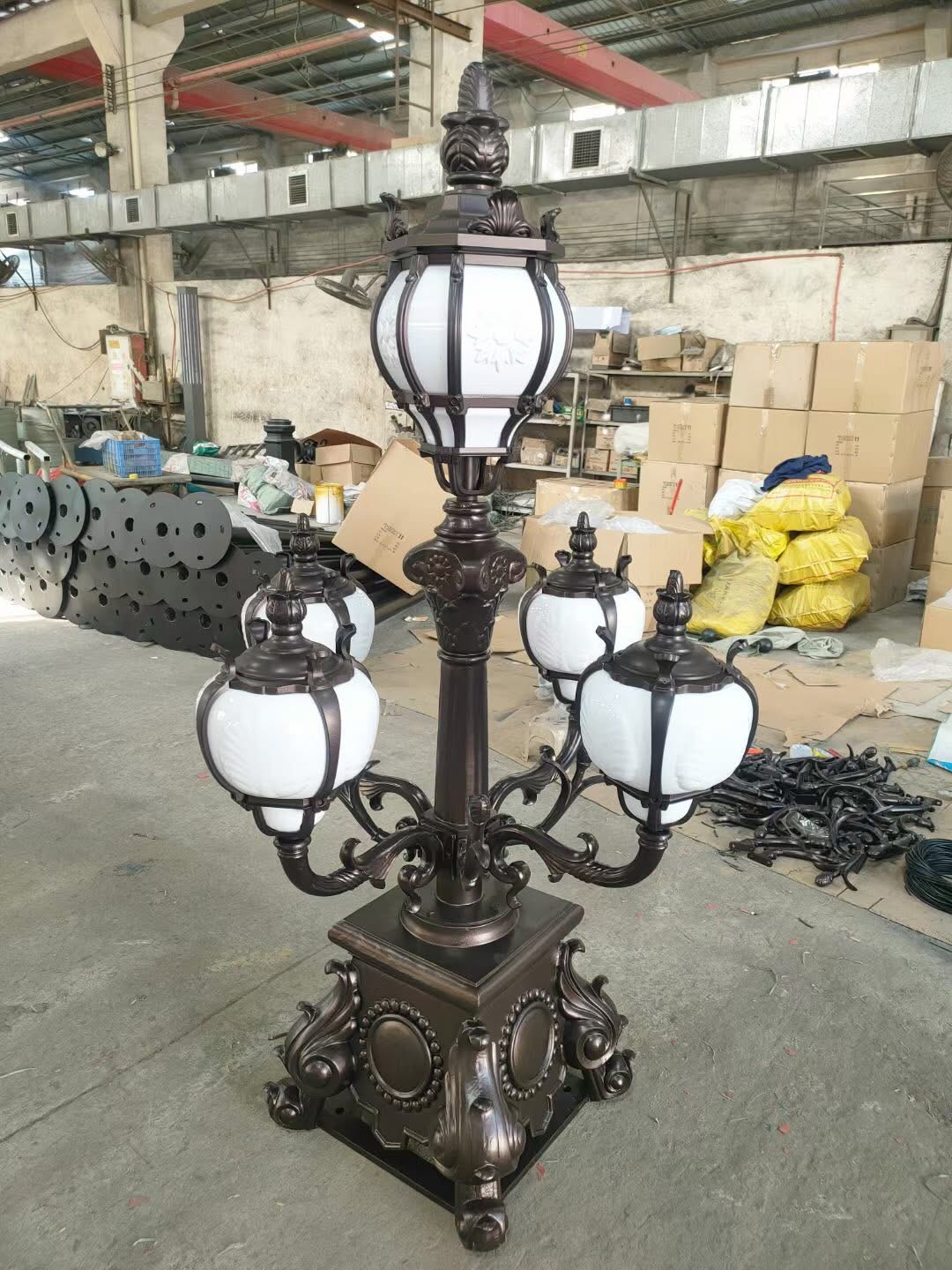
Courtyard and garden-scale luminaires are specified by the space they serve: pedestrian height, soft multi-directional output, and a finish that matches surrounding materials.
Matching model family to scenario
The table below maps the three scenario families named in this brief — urban parks, villa courtyards and historic commercial streets — to the option sets available in the two referenced product families, plus the separate-type solar street lamp where a mains supply is not the practical assumption.
| Scenario | Model family | Mounting height options | LED power options | Control options | Finish options |
|---|---|---|---|---|---|
| Historic commercial street / heritage pedestrian district | BF-AGL-4000-60W | 3–4 m, customizable | 30 / 40 / 50 / 60 / 80 W | Switch standard; light, time and intelligent control optional | Black, dark grey, copper brown; RAL customization |
| Villa courtyard, community garden path, hotel grounds | BF-AGL-4000-60W | 3–4 m, customizable | 30 / 40 / 50 / 60 / 80 W | Switch standard; light, time and intelligent control optional | Black, dark grey, copper brown; RAL customization |
| Urban park roadway and plaza lighting | BF-LSL-4000-120W | 6 / 8 / 10 / 12 m, customizable | 60–200 W option set | On-off standard; photocell, timer, 0–10 V, DALI, smart control optional | Dark grey, black, silver grey, bronze; RAL customization |
| Commercial street or plaza with mixed pedestrian and vehicle use | BF-LSL-4000-120W | 6 / 8 / 10 / 12 m, customizable | 60–200 W option set | On-off standard; photocell, timer, 0–10 V, DALI, smart control optional | Dark grey, black, silver grey, bronze; RAL customization |
| Park perimeter road, rural road or site without dependable grid supply | BF-SL-8M-100W | 8 m single-arm conical pole | 100 W LED; 200 W monocrystalline solar panel; 12 V 80 Ah battery | Light control plus time control; intelligent dimming optional | Hot-dip galvanized pole with electrostatic spray finish |
Historic commercial streets
On a historic commercial street the daytime appearance of the luminaire is part of the design review, not an afterthought. The relevant levers on the BF-AGL-4000-60W are the cast aluminium body, the RAL-matched powder coating, the choice between tempered glass and UV-resistant PC covers, and the option to add decorative patterns or shaping through customization. Because the luminaire is installed at 3–4 m, the design team can coordinate luminaire position with shopfronts, arcades and paving joints at a scale where misalignment is visible to anyone walking past.
Villa courtyards and residential communities
Courtyard lighting fails most often through over-lighting rather than under-lighting. A 30–80 W luminaire at 3–4 m with unidirectional or multi-faceted soft output gives a designer room to keep ambient levels low while still resolving steps, planting and entrances. Warm colour temperatures within the 3000 K to 6000 K range can be specified to keep the courtyard visually separated from the cooler, higher-output lighting on any adjacent roadway, which reduces the visual conflict that occurs when a residential interior and a public road are lit from the same palette.
Urban parks and plazas
Parks and plazas usually need both scales at once: pedestrian routes under canopy, and open areas where the lighting must read from a distance. Here the BF-LSL-4000-120W at 6–8 m with plaza or decorative landscape distribution can cover the open surfaces, while courtyard-scale luminaires handle the paths and planted areas. Where a park road runs without a reliable grid connection, the BF-SL-8M-100W separate-type solar street lamp becomes relevant: an 8 m single-arm conical pole in Q235 steel with hot-dip galvanizing and electrostatic spraying, a 100 W LED at ≥150 lm/W, a 200 W monocrystalline panel and a 12 V 80 Ah maintenance-free lead-acid battery, operating 10–12 hours per day with 2–3 days of rainy-day battery life, configurable. Its working range is -20 °C to +60 °C, which is narrower than the -30 °C to +60 °C range of the two mains-powered models and should be checked against the project climate.
Market trends shaping streetscape specification
Three trends are converging on this decision.
Controls are becoming standardised while appearance remains bespoke. Berg Insight reported that the global installed base of smart street lights reached 32.9 million units at the end of 2024, with a 20.9% CAGR projected through 2029, while ResearchAndMarkets projected 63.8 million individually controlled street lights by 2027. The two forecasts use different boundary definitions and years, but both point the same way. D4i and Zhaga standards are increasingly adopted for interoperability between sensors and luminaires, which means the control layer is becoming a plug-in decision. The luminaire's appearance is not.
The supply base remains fragmented, so specialist capability still matters. CSIL notes that the top 10 companies in the global lighting fixtures market, including Signify and Osram, account for just over 20% of total market share. Signify was the leading smart street lighting vendor as of late 2024 with approximately 5.8 million installed lighting controls. At the same time, specialist positions persist: Schréder has specialised in architectural street lighting and smart city solutions since 1907, and Sentry Electric is a recognised US manufacturer for custom and historic decorative street lighting poles and luminaires. Heritage decorative work and smart controls are related but distinct competencies, and projects that need both should verify both.
Standards still define the performance floor. The European EN 13201 series (parts 1–5) defines quality, performance and energy indicators for road and street lighting design, and ANSI/IES RP-8 is the primary American national standard for lighting roadway and parking facilities, focusing on luminance and safety criteria. Heritage appearance does not exempt a project from a performance standard; it adds a constraint on top of one.
Regional demand continues to shift. CSIL identifies Africa as the fastest-growing regional lighting market, with over 4% average annual growth since 2018 driven by public infrastructure projects. The U.S. street and roadway lighting market was estimated at approximately USD 2.5 billion in 2022. China's exports of lighting products reached USD 56.3 billion in 2023, a 7% year-on-year decrease, and China's domestic smart street light market was forecast by Market Research Future to grow from a 2024 base of USD 85.7 million to USD 679.7 million by 2035. The export figure in particular signals a competitive supply environment: buyers have options, which raises rather than lowers the value of verifying what a supplier can actually engineer.
Where heritage luminaires and conventional road luminaires each stop working
A useful comparison is not "which is better" but "which constraint binds first".
- Optical control. Road and plaza distribution patterns on the BF-LSL-4000-120W are selectable, which allows a designer to shape coverage. The BF-AGL-4000-60W uses unidirectional or multi-faceted soft lighting, which produces the softer appearance that heritage streetscapes want but does not offer the same level of targeted distribution control.
- Mounting height ceiling. The BF-AGL-4000-60W is installed at 3–4 m. No amount of additional wattage changes that; the luminaire is not a substitute for a road luminaire mounted at 8–12 m above a carriageway.
- Power and pole architecture ceiling. The BF-LSL-4000-120W option set runs from 60 W to 200 W and from 6 m to 12 m. Projects requiring higher mounting heights, longer spans or different pole geometry fall outside this option set and must be engineered as a separate design rather than assumed to be available.
- Wind loading is site-specific. On both models, structural design is based on lamp or pole height and the wind speed at the project location. A pole design cannot be confirmed before the site wind data and the final luminaire weight are known.
- Earthing is an installation obligation. Class I electric shock protection on both models requires an effective earth connection at installation. This is a compliance item, not an optional extra.
- IP65/IP66 is an ingress rating. It describes protection against dust and water ingress. It is not an impact-resistance or vandalism rating, and it should not be presented as one in a heritage district where public contact is likely.
- Decorative customization extends the front end of a project. Hollow patterns, luminous decorations, city logos and cultural totems are customization items that involve appearance design evaluation and sample development. They add engineering work before production, not after it.
- Long-life products with bespoke parts need a spares plan. A rated service life of at least 50,000 hours is long enough that non-standard lamp bodies, covers or decorative components may need to be reordered years after handover. Buyers selecting customized luminaires should treat spare-part availability as part of the specification, not as an after-market question.
What changes next in streetscape lighting
Two directions look likely based on the data above. First, the control layer will continue to consolidate around interoperable standards such as D4i and Zhaga, which reduces the risk of specifying smart functionality but also makes smart control an increasingly neutral factor between suppliers. Second, the differentiation will concentrate on the parts that cannot be standardised: pole geometry, decorative identity, finish matching and the engineering work required to make a bespoke design structurally sound at a given site wind speed.
For heritage and municipal projects, this shifts the buyer's verification list. Product selection increasingly depends on whether a manufacturer can produce and defend CAD drawings, evaluate appearance options, develop a sample and quote a configured project — not only on whether the required wattage exists in a catalogue. BAIFU LIGHTING's stated engineering support covers product selection, CAD drawing development, lighting configuration recommendations, appearance design evaluation, sample development and project quotation, supported by in-house metal fabrication, cutting, forming, welding, structural assembly, surface treatment, outdoor powder coating, electrical assembly, product inspection, aging testing, packaging and export delivery.
That manufacturing scope is the reason non-standard outdoor lighting remains a distinct category. A custom pole in a heritage district is not a variation on a stock item; it is a fabricated structure with a decorative brief attached.
Frequently asked questions
What is the difference between a heritage-style courtyard lamp and a modern landscape street light?
The difference is category, scale and distribution rather than styling. The BF-AGL-4000-60W is classified as an Aluminum/Steel Cast Outdoor Lamp, is installed at 3–4 m, offers 30–80 W and uses unidirectional or multi-faceted soft lighting. The BF-LSL-4000-120W is a custom LED landscape street light, is mounted at 6–12 m, offers 60–200 W and can be specified with road, plaza or decorative landscape distribution.
At what height is the BF-AGL-4000-60W installed, and how is it fixed?
Its installation height is 3–4 m, customizable according to project requirements. The lamp body is high-pressure cast aluminium and the pole is Q235 hot-dip galvanized steel. It is fixed using a flange base with pre-installed anchor bolts.
What LED power range and mounting heights are available for the BF-LSL-4000-120W?
Mounting height options are 6 m, 8 m, 10 m and 12 m, customizable per project requirements. LED power options are 60 W, 80 W, 100 W, 120 W, 150 W, 180 W and 200 W.
Which control options are available for custom decorative outdoor luminaires?
For the BF-LSL-4000-120W, standard on-off control is supplied with photocell, timer, 0–10 V dimming, DALI and smart lighting control available as options. For the BF-AGL-4000-60W, conventional switch control is standard, with light control, time control and intelligent control available as options.
What materials and finishes are used in heritage and municipal streetscape luminaires?
The BF-AGL-4000-60W uses a high-pressure cast aluminium lamp body, a Q235 hot-dip galvanized steel pole, high-transparency tempered glass or a UV-resistant PC cover, stainless steel fasteners and an outdoor electrostatic powder coating. The BF-LSL-4000-120W uses Q235 hot-dip galvanized steel, 304 stainless steel, die-cast aluminium lamp housings, high-transmittance tempered glass, stainless steel fasteners and outdoor electrostatic powder coating applied after overall hot-dip galvanizing. Both are available in standard colours with customization against a RAL colour card.
Can decorative courtyard lamps and larger landscape street lights be used in the same project?
Yes, and mixed-scale schemes are common in parks, plazas and mixed commercial districts. The practical requirements are that the two scales are assigned to the spaces they suit — pedestrian-scale luminaires for paths, courtyards and heritage frontages, and 6–12 m luminaires for open areas and carriageways — and that colour temperature, colour rendering and finish are coordinated so the scheme reads as one design.
What should be verified before ordering non-standard street lights for a heritage or municipal project?
Verify the mounting height and distribution pattern against the space being lit, the ingress protection rating (IP65/IP66 on the models referenced here), the Class I earthing arrangement at installation, the basis of the wind-resistance design for the specific site wind speed, control compatibility with the intended network, the final RAL finish, and the availability of the CAD drawings and samples needed for design approval before production begins.
Product data, mounting options and finish references for the models discussed in this article are collected in the BAIFU LIGHTING customised album. Additional technical information is published at www.baifulamp.com.