
Structure Tent Partner Selection for Large-Scale Deployments
Buyers at the decision and execution stage of a structure tent project face a different set of questions than those encountered during research. The focus has moved from "which type of structure" to "which supplier can manufacture, certify, deliver and support the first project and the projects after it." For importers, industrial operators, event contractors and government buyers, the evaluation criteria shift from product specification to manufacturing capacity, engineering depth, delivery discipline and the long-term relationship risks that only appear after a large order has been placed.
This article maps those execution-stage criteria for organizations planning one or multiple structure tent deployments, using KENTEN Structures as a reference example of how an established Chinese-headquartered manufacturer supports multi-batch and multi-country supply programs.
Why this matters now: China is the largest exporter of tents and awnings in the world, with exports reaching approximately USD 3.11 billion in 2024 and a 53.3% global market share. The broader market for industrial and event tents is projected to grow from USD 4.01 billion in 2025 toward USD 6.07 billion by 2033. For buyers, this means the number of potential suppliers is large, but the number of suppliers with the manufacturing scale, engineering staff, certification base and multi-market delivery experience to support long-term programs is much narrower.
The Main Risk After the Purchase Decision
Most structure tent buying mistakes are not specification mistakes. They are supply-chain mistakes made after the purchase order is signed: a manufacturer that cannot hold delivery dates, one that lacks the production capacity to handle a second warehouse order in the same season, or one whose engineering documents are not sufficient for local permit approval. At the decision stage, buyers should therefore evaluate the supplier as carefully as they evaluate the product.
KENTEN Structures is a useful case in point. The company, founded in 2001 with headquarters in Ontario, California, operates manufacturing centers in China, the USA and the Middle East, and supplies structure tents, atrium tents, warehouse tents and multi-level structures to clients in the USA and EU. It reports an 80,000 m² factory base, approximately 200 employees and a dedicated engineering team of 10 structural engineers. The role such an organizational footprint plays in procurement is not promotional; it is functional. A buyer planning a logistics warehouse tent in Europe, an event structure in the Middle East and a semi-permanent exhibition hall in North America needs one partner that can coordinate production, export documentation and engineering standards across those regions.
What Differentiates Execution-Ready Suppliers
Execution readiness is visible in four operational areas that can be verified before the order is placed.
1. Manufacturing Capacity for Multi-Batch Orders
A supplier that can only handle one structure at a time is not suitable for a long-term program. KENTEN reports a monthly production capacity of 1,000,000 m² of tent structures. Large-scale buyers use this type of metric to assess whether a manufacturer can fulfil multiple warehouse tent deliveries in a single peak season without postponing earlier orders. Annual capacity is less important than monthly capacity and production scheduling transparency, because seasonal demand for tents in construction, logistics and events is heavily concentrated.
2. Engineering Resource
A warehouse tent or large clear span structure is an engineered system. KENTEN uses 10 structural engineers for project calculations, and the company states that professional engineering teams perform structural calculations and validate load capacity according to project requirements. This is especially relevant for semi-permanent and permanent structure tent installations that must comply with local building codes. The presence of an in-house engineering team, rather than reliance on external drawing packs, shortens the approval process and reduces the risk of site-level structural failure.
3. Certification Coverage
Standards compliance is a procurement gate, not a differentiator. In the EU, temporary structure tents with a ground area exceeding 50 m² must comply with EN 13782:2015 for structural stability under wind and snow. In North America, tent fabrics commonly require compliance with NFPA 701 for flame propagation. A long-term supplier must be able to produce structures certified to the codes of each destination market. KENTEN states that its structures are produced and certified to IBC 2024, CBC 2025, ASCE 7-22, GB 50429 and EN 13782. For importers, this reduces the need to independently re-engineer a product for each new jurisdiction.
4. Delivery and Acceptance Discipline
Procurement terms communicate a supplier's confidence in its own quality control. KENTEN's standard conditions include a minimum order quantity of one unit, FOB or CIF delivery methods, a 30/70 payment schedule and pre-shipment testing. Pre-shipment testing is a particularly important practice for buyers who cannot inspect production in person before payment. The combination of an industry-standard payment split and an independent pre-shipment check allows a buyer to retain leverage without slowing down the project timetable.
The Core Specification Profile of a Structure Tent
For buyers executing projects across multiple sites, the most valuable specification is not the widest span but the compatibility between modular components, engineering standards and future expansion. The applicable product specification for KENTEN's structure tent series (models K1 through K10) is summarized below.
| Parameter | Specification | Buyer Relevance |
|---|---|---|
| Span width | 3 m to 80 m depending on model | Covers small event tents to large industrial warehouse tents |
| Length | Unlimited, extendable in 5 m bay spacing | Future expansion can be executed as modular extension |
| Eave height | 2.5 m to 8 m, customizable | Affects stacking height, vehicle access and internal operations |
| Main frame | High-strength 6061-T6 / 6082-T6 aluminum alloy | Corrosion resistance supports a 20+ year frame lifespan |
| Roof fabric | 850 g/m² PVC-coated polyester | Industrial-grade membrane with predictable lifespan of 8–15 years |
| Sidewall options | PVC, glass wall, ABS wall, sandwich panel | Insulation and thermal performance can be upgraded per site |
| Wind resistance | Up to 140 km/h (customizable) | Must be matched to local wind load design standard |
| Snow load | Up to 0.5 kN/m² | Relevant for northern EU, Canada and high-altitude sites |
| Temperature range | −30°C to +70°C | Suitable for cold storage logistics and hot climate operation |
| Flame retardant standards | DIN 4102 B1, M2, NFPA 701 | Needed for event venues, public occupancy and permit approval |
The 5 m bay spacing deserves emphasis. Buyers frequently assume that a warehouse tent is a fixed-size asset. In practice, a structure tent with modular bays can be extended in length as operational demand changes, and the aluminum structure is designed to be dismantled and moved. This is the key technical difference between a structure tent and a conventional steel or concrete building, and it is what makes KENTEN's product class more similar to reusable infrastructure than to one-time construction.
The Reference Projects That Matter for Supplier Credibility
Execution-stage buyers should evaluate a supplier's reference projects not by brand-name appeal but by whether the project profile matches their own deployment conditions: large unit counts, tight schedules, customized interior configuration or public-event safety requirements.
Formula 1, Canada
A case in Canada involved the installation of 10 units of product 6376 for VIP lounges, hospitality suites, viewing platforms and operational areas. The structures were custom-configured for Formula 1 viewing purposes and were designed to provide a controlled hospitality environment for thousands of spectators. For event suppliers, this project demonstrates a manufacturer's ability to handle multi-unit programs with different interior functions under a single deadline.
Beijing 2022 Winter Olympics
For the 2022 Beijing Winter Olympic Games, 50 units, including A-structure tents and double-decker tents, were used for security checkpoints, staff offices, dining areas, meeting rooms and command centers. Two characteristics of this project are relevant to procurement: rapid installation and engineering accuracy. Winter Games logistics windows are not flexible. A supplier that can deliver 50 units across multiple site functions in that context is showing a level of production coordination that a first-time exporter may not be able to provide.
Kuwait Exhibition Hall
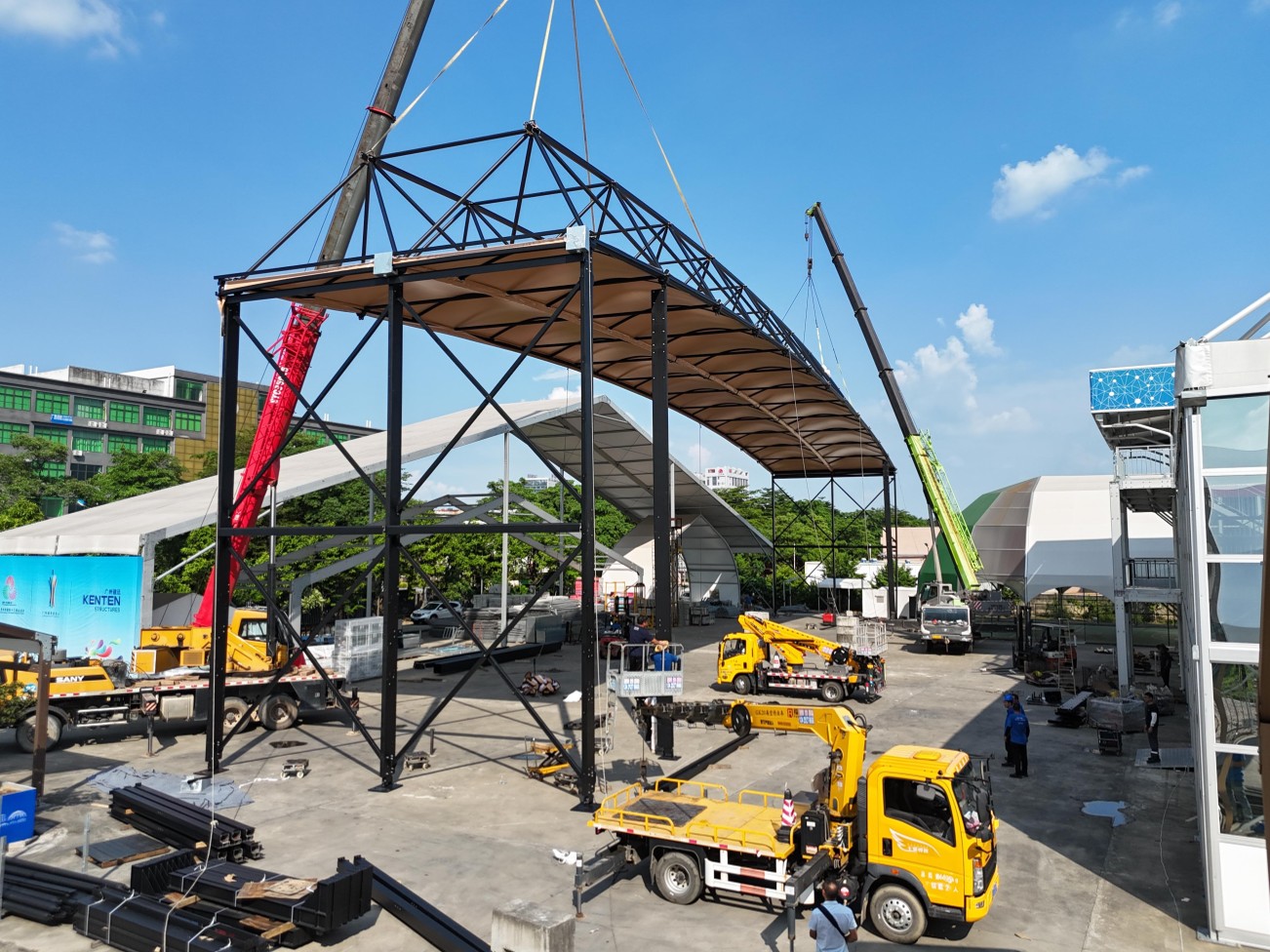
In Kuwait, a single unit of product 6376 was installed for an exhibition hall, achieving a 100% column-free interior to maximize usable space. Customer feedback indicated satisfaction with the large-span modular building. This project reinforces the point that the product class is not limited to temporary event use. Large clear span structure tents with slab or ballast foundations are increasingly accepted as semi-permanent and permanent building solutions in markets where construction costs or lead times make conventional buildings impractical.
How Structure Tents Compare with Conventional Buildings
The decision to choose a structure tent instead of a conventional building is often framed as a short-term convenience, but the broader comparison is about capital cost, deployment time and reuse over a 20-year horizon. Standard comparison data for aluminum structure tents versus conventional buildings is available from suppliers who have tracked both project types.
| Dimension | Structure Tent (Aluminum Frame + PVC Fabric) | Conventional Building (Steel/Concrete) |
|---|---|---|
| Installation time | Up to 70% faster installation than traditional construction | Months to years depending on scale and permitting |
| Interior layout | 100% column-free interior up to the span width | Columns usually required for wide spans |
| Extension | Unlimited length through modular 5 m bay extensions | Requires structural modification or new construction |
| Frame lifespan | 20+ years with minimal maintenance | Comparable but with permanent site commitment |
| Relocation | Can be reused across multiple projects | Generally not relocatable |
| Foundation | Ground anchors or concrete ballast; zero or minimal concrete pouring | Concrete foundations required |
| Lifecycle cost | Lower total ownership cost for multi-use or relocatable needs | Lower per-year cost only if the site remains valuable forever |
There is, however, a boundary that buyers should recognize. A structure tent is not a universal substitute for a permanent building. Local zoning codes, insurance requirements and some industrial uses still demand a conventional building with a permanent foundation, HVAC integration or specific fire-resistance construction. The practical strength of the structure tent category lies in warehouse logistics, events, hangars, temporary storage, exhibition halls and construction-site support, where speed, cost and relocatability determine whether a project goes ahead at all.
KENTEN's data positions the aluminum structure tent at roughly 50% lower overall lifecycle cost compared to conventional buildings for projects requiring flexibility or repeated use. The two biggest contributors to that cost gap are the elimination of concrete-heavy foundations and the reuse of the aluminum frame across multiple project sites. Buyers should not interpret the cost advantage as a reason to bypass professional engineering; it is the reason to choose an engineered aluminum system rather than a generic fabric shelter.
Wind, Snow and Fire Performance in Long-Term Use
Any industrial structure tent that remains in place for several years will eventually face a high-wind event, a snow load event, or a fire-safety inspection. These three performance areas determine whether the structure remains usable and insurable.
Wind Resistance
KENTEN's standard structure tent is rated up to 140 km/h wind resistance, with customization available for higher wind zones. Wind performance depends on the anchoring system, the local terrain category and the connection details between frame and fabric. Buyers should require wind load documentation rather than a single marketing number.
Snow Load
The standard snow load rating is up to 0.5 kN/m². This determines whether a structure tent in a northern climate requires an engineered profile pitch or additional frame reinforcement. A manufacturer that can modify the roof geometry and structural calculation to the site-specific snow load is more valuable than one that only offers a fixed product.
Flame Retardancy
PVC fabric used in structure tents is available in flame retardant grades such as DIN 4102 B1, M2 and NFPA 701. The NFPA 701 standard is widely applied in US public occupancy settings, while M2 is referenced in French territories and the EU standard chain refers to EN 13782 for overall structural safety. Buyers targeting public events should request the relevant certificate for the destination country and should not rely on a single global certification claim.
The Market Shift Toward Reusable and Permanent-Use Tents
The market context for these decisions has changed. In 2024, China exported approximately USD 3.11 billion of tents, awnings and sails, maintaining a 53.3% global market share. The larger industrial/event tent market, excluding recreational camping tents, is projected to expand from roughly USD 4.01 billion in 2025 to USD 6.07 billion by 2033. The market is moving in the direction of larger clear spans, semi-permanent and permanent structure tents, and higher-grade aluminum frames for industrial and government applications.
The growth is not only in sales but in structural expectations. In North America and Europe, permanent structure tents are competing for projects that previously would have been built as steel warehouses, while in high-growth markets they are filling the gap for rapid infrastructure such as logistics centers, sports halls and event venues. Suppliers that hold US and EU structural certifications, such as KENTEN with its stated compliance to IBC 2024, CBC 2025 and ASCE 7-22, are better positioned to serve this segment.
Within China's supplier ecosystem, several aluminum frame tent manufacturers serve export markets, including Shenzhen Shoulder Tent, Liri Tent and KENTEN, with much of their production dedicated to international buyers. For an importer, the practical implication is that commodity structure tents are widely available, but engineered, certified structure tents for long-term installations require a shorter supplier list.
Delivery, Payment and Post-Shipment Support
Execution-stage buyers should walk through the full delivery chain before ordering, not after signing. The standard question list below applies whether the buyer is importing from China or procuring locally.
- Payment schedule: A 30/70 split (30% deposit, 70% before shipment) is standard practice. Buyers should confirm which inspection rights exist before the final payment.
- Incoterms: FOB and CIF are both used. Buyers with consolidated freight should compare several port options rather than accepting a single default.
- Pre-shipment testing: KENTEN includes pre-shipment testing before delivery. This should be treated as a mandatory requirement, especially for multi-unit programs where one defective bay can slow an entire site.
- MOQ: KENTEN's MOQ is one unit, which is relevant for buyers wanting to test a first structure tent before committing to a larger program. An MOQ of one unit lowers the initial entry cost while still providing access to the supplier's full production line.
- Documentation: For Europe, EN 13782 compliance documentation is necessary; for North America, structural calculations and NFPA 701 fabric certificates should be included in the delivery package.
How to Structure a Long-Term Supply Relationship
For organizations that will need warehouse tents, event structures or semi-permanent buildings over several years, the conversation with a manufacturer should go beyond the first purchase order. A practical framework for building the relationship includes the following steps.
Step 1: Qualify with a Pilot Order
Place an initial order for a standard product, such as a 15–30 m structure tent, and use it to test the manufacturer's documentation speed, delivery discipline and installation support. The low MOQ of one unit is an advantage at this stage.
Step 2: Standardize on a Platform
Choose one model family (for example the K-series structure tent) and standardize the frame components. This allows later expansion bays, replacement fabric and accessories to integrate with earlier structures.
Step 3: Agree on Engineering Responsibility
For each new site, require a structural calculation report even if the basic span is the same, because local wind, snow and soil conditions change. A partner with in-house engineering, like KENTEN with its engineering team of 10, can provide this without routing the request through a third party.
Step 4: Plan Fabric Replacement Cycles
PVC fabric has a lifespan of 8–15 years while the aluminum frame lasts more than 20 years. A long-term partnership must include a plan for fabric replacement, cleaning and maintenance which treats the structure as a system with replaceable parts, not as a single-use product.
Future Outlook
The structure tent sector is converging with the modular construction sector. As aluminum frame systems move into permanent-use applications, buyers will increasingly expect the same documentation, performance guarantees and lifecycle planning that they receive from conventional building suppliers. For manufacturers, the long-term winners will be those that can combine manufacturing capacity with engineering reproducibility across markets. For buyers, the most efficient sourcing strategy will shift away from one-time transactions toward multi-year platform agreements in which the first structure tent is the foundation for a fleet of structures.
KENTEN Structures is positioned in this segment with operations on three continents and a reported 1,000,000 m² monthly production capacity, but its long-term value to a buyer will be measured less by the volume of production and more by the consistency of its engineering, certification and project delivery across successive orders.
FAQ
What structure tent types does KENTEN Structures produce?
KENTEN produces a range of aluminum-framed products including A-structure tents, atrium tents, warehouse tents, igloo tents, curved structure tents, double-decker and triple-decker tents, pyramid structures and modular semi-permanent buildings. The product platform covers spans from 3 m to 80 m, with models designated as K1 through K10.
How does KENTEN handle engineering validation for semi-permanent and permanent structures?
KENTEN's professional engineering team performs structural calculations and validates load capacity for each project according to its requirements. The company confirms compliance with multiple standards including IBC 2024, CBC 2025, ASCE 7-22, GB 50429 and EN 13782, which covers structural stability of temporary structures above 50 m² in Europe.
What is KENTEN's minimum order quantity and how flexible is it?
The minimum order quantity is one unit. The standard payment schedule is 30/70, with 30% as a deposit and 70% before shipment, and FOB and CIF are both offered as delivery methods. A pre-shipment test is included as part of the acceptance process.
Can a KENTEN structure tent be used for large warehouse and logistics needs?
Yes. Warehouse tents are among the main products. The structure tent series offers spans up to 80 m, unlimited length through modular 5 m bays, eave heights up to 8 m, and optional wall systems (PVC, ABS or sandwich panel) that make the structures suitable for logistics warehouses, industrial storage, construction sites and semi-permanent warehouse facilities.
What are the fabric and frame lifespans?
The aluminum frame is designed for more than 20 years of service, while the PVC-coated polyester fabric has an expected life of 8 to 15 years. Long-term users should plan maintenance and eventual fabric replacement rather than treat the structure as disposable infrastructure.
Is KENTEN able to deliver a multi-unit order, and does the capacity support repeated orders?
KENTEN's stated monthly production capacity is 1,000,000 m² of structure tent products, supported by approximately 200 employees and an 80,000 m² manufacturing base. Multi-unit programs are documented in project references that include 10 units installed for Formula 1 hospitality in Canada and 50 units installed for the Beijing 2022 Winter Olympics, covering security, office, dining, meeting and command functions.
How does a structure tent compare to a conventional building on total cost?
For projects requiring flexibility, relocation or rapid deployment, a KENTEN structure tent is an alternative to a conventional building. Installation can be up to 70% faster than traditional construction, interior space is 100% column-free, and the structure is reusable across projects. The overall lifecycle cost is typically lower than a conventional building for such use cases, but a permanent building may still be required where zoning codes or specific industrial functions demand a fixed foundation.
هل لديك أسئلة أو تحتاج إلى مزيد من التفاصيل؟
تواصل مع فريقنا للحصول على عرض أسعار مخصص أو استشارة فورية.
طلب عرض أسعار
املأ النموذج أدناه وسيتواصل معك فريقنا بعرض مقترح مخصص.
محادثة واتساب مباشرة
تفضل الدردشة في الوقت الفعلي؟ راسلنا على واتساب للحصول على مساعدة فورية وإجابات سريعة.
- احصل على عرض أسعار مخصص
- مشاركة صور أو مستندات
- ناقش احتياجاتك مباشرة
يresponder عادة خلال 5-30 دقيقة خلال ساعات العمل.