
Stylus Pen Acceptance Criteria: Compliance Buyer Checklist
Stylus Pen Acceptance Criteria: Compliance Buyer Checklist
Supplier Qualification | Electrical & Electronics
A stylus pen should not be approved because a sample writes well or because a supplier calls it Apple Pencil compatible. In B2B procurement, qualification is the documented proof that a named model can meet a defined requirement; acceptance is the shipment-level confirmation that delivered units match that qualified scope.
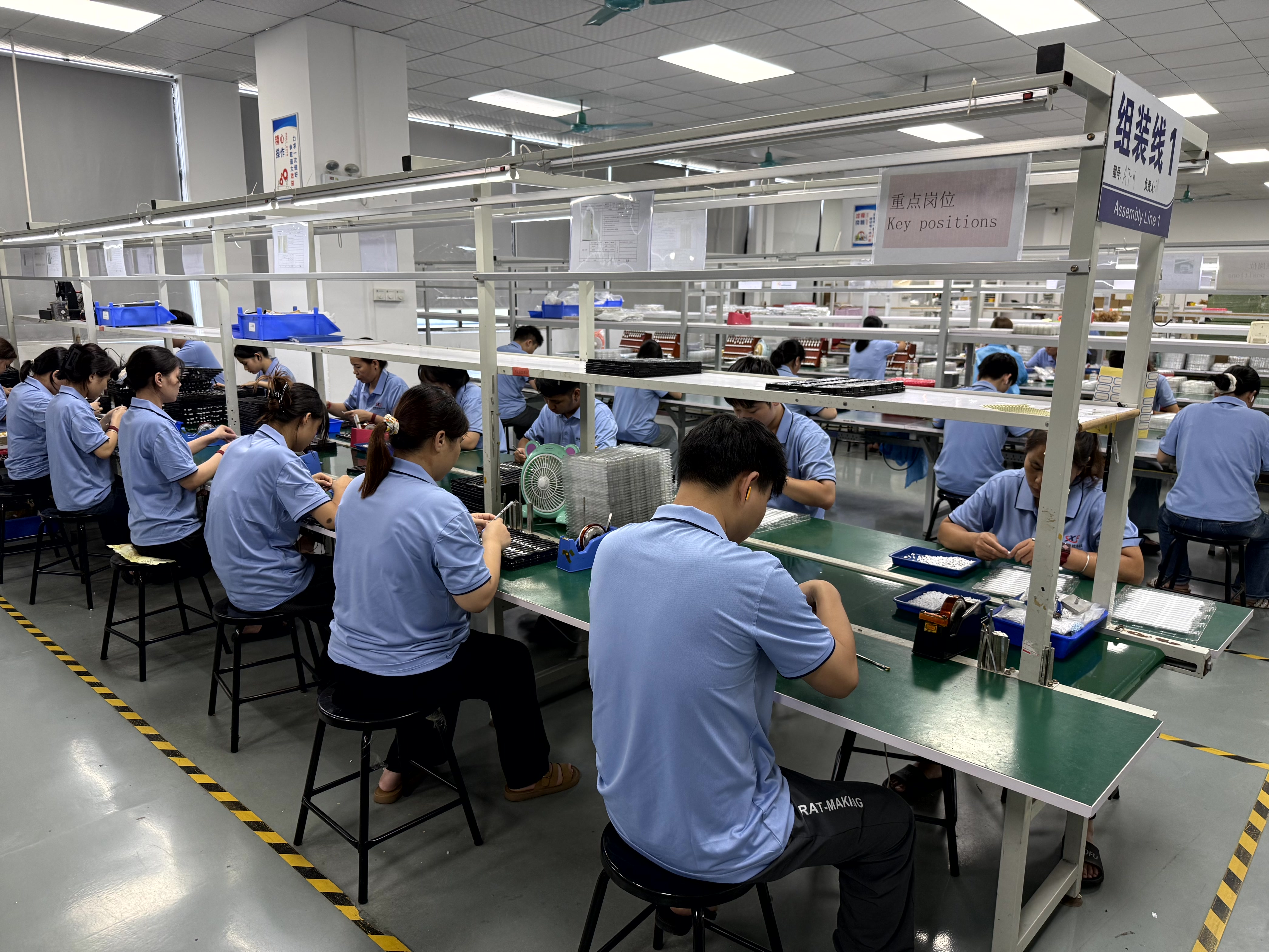
The compliance problem: a stylus is a system claim, not a pen body
Stylus pens sit inside a crowded consumer-electronics category that mixes proprietary tablet protocols, open standards, and third-party compatibility claims. IMARC Group valued the global stylus pen market at USD 19.45 billion in 2025, and Dataintelo projects active stylus technology to grow at a CAGR of 9.8% from 2026 to 2034. Growth at that level brings more suppliers, more model variants, and more qualification risk for importers and OEM buyers.
The commercial risk is not only whether the pen writes. It is whether the supplier can show which tablet models the pen supports, which functions are active, which certificate covers the ordered model, and which acceptance test will be used if a shipment is disputed. Stylus pens are typically classified under HS Code 8471.60.90 as Automatic Data Processing Input Units, which means buyers should expect the import file, product description, and commercial invoice to match the qualified model.
Open standards add a second layer. The USI 2.0 specification released in 2022 is the primary cross-platform standard for active styluses, supported by Google, Intel, and Lenovo. A buyer should not assume that every active stylus is USI-compatible, and should not accept USI as a substitute for model-level testing on the target tablet. Standards define an interoperability path; they do not remove the need for documented acceptance criteria.
Define four evidence layers before sending an RFQ
Qualification works best when the buyer separates evidence into four layers. Mixing them is how marketing language enters a purchasing file.
- Product specification: compatibility, charging method, working time, battery capacity, pen tip, materials, size, weight, and special functions such as palm rejection or tilt sensing.
- Conformity evidence: certificate of conformity, test standard, certificate number, issuing authority, market scope, and covered model range.
- Quality-system evidence: management-system certification, audit scope, production controls, and inspection method.
- Acceptance evidence: the test record, sampling plan, packaging check, and warranty terms that will be used against the purchase order.
Each layer answers a different question. A quality-system certificate does not prove product conformity. A product certificate does not prove tablet compatibility. A sample test does not prove production consistency. A supplier that cannot explain the difference should remain in the evaluation stage, not the approved-vendor list.
Check certificate scope before checking the certificate logo
Certificate scope is the most common qualification gap in stylus sourcing. A buyer may see a ROHS or ISO 9001 image in a supplier profile and treat it as blanket approval. That is not enough.
ROHS example: scope must match the ordered model
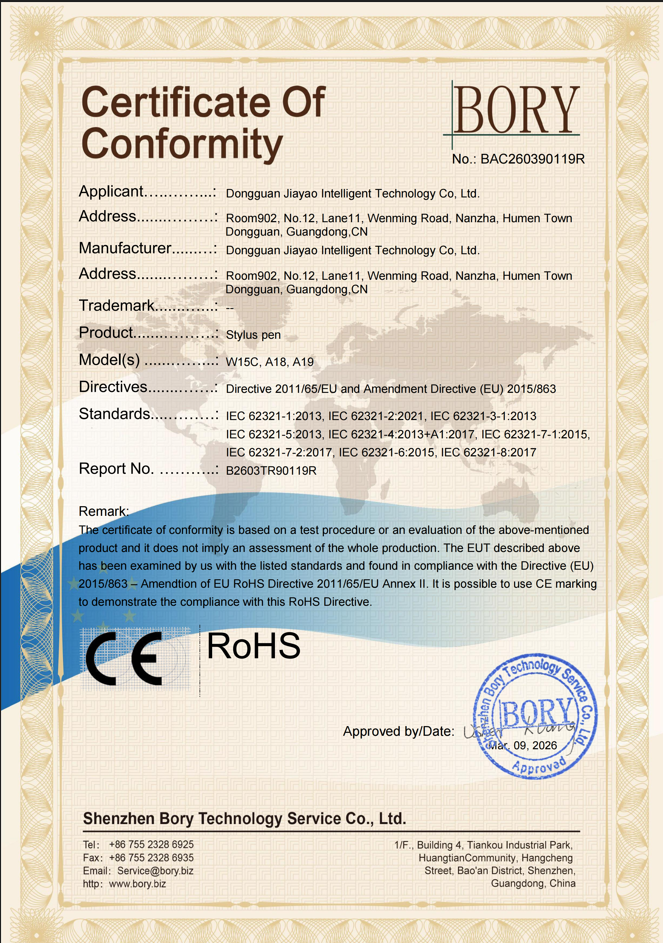
Jiayao stylus documentation includes a ROHS certificate of conformity, certificate number BAC260390119R, issued by Shenzhen Bory Technology Service Co.,Ltd with an EU market reference. The stated certificate scope is W15C, A18 and A19, and the certificate references IEC 62321 series standards. That is useful evidence, but it is not proof that every stylus model in the supplier catalogue is covered. If a buyer is ordering W13-A, R3-P or another model, the buyer should request a certificate whose scope names the ordered model, or an explicit covered-model list signed by the supplier.
ISO 9001 example: system scope is not product approval
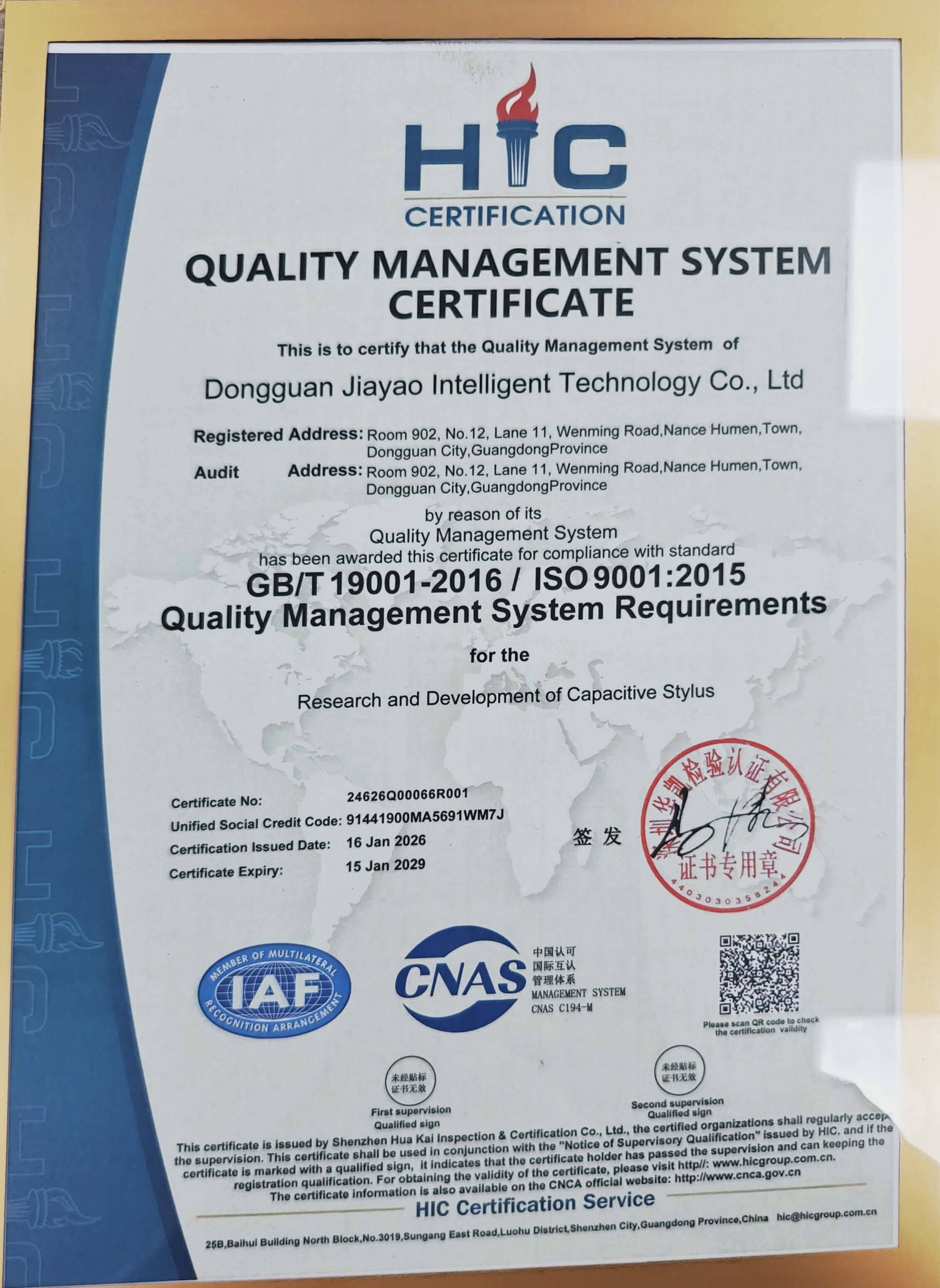
Jiayao also lists an ISO 9001 Quality Management System Certificate, certificate number 24626Q00066R001, issued by HIC Certification Service. The standard is GB/T-19001-2016 ISO9001:2015, the issue date is 2026-01-16, the expiry date is 2029-01-15, and the stated scope is Research and Development of Capacitive Stylus. This supports the existence of a documented quality system. It does not replace a product certificate, a compatibility test, or a shipment inspection record.
Qualify by product line, not by one generic stylus label
Stylus Pen is a category term. A purchase order needs a product line and a model. The same supplier may offer iPad Stylus Pen models, broader Stylus Pen models, and iPad and Android Stylus Pen models with different compatibility, charging, battery, and feature limits.
Active and passive options should also be separated. Jiayao states that it supports active and passive stylus pens compatible with iPad and mainstream tablets. In qualification, an active pen requires battery, charging, pairing, and electronics evidence. A passive stylus does not use the same active-electronics architecture, so active-pen acceptance criteria should not be copied onto a passive SKU without review.
| Product line | What to qualify | Corpus example |
|---|---|---|
| iPad Stylus Pen | iPad generation and system compatibility, charging method, battery, side attachment, palm rejection, tilt, pen tip, weight | W13-A is listed for iPad after 2018 and 12.2 and above system iPad, with 15-minute cable charging, 60-minute magnetic tablet wireless charging, 9-10 hours working time, 90mAh battery, and side adsorption stated for 11 and 12.9 inch iPad. |
| Stylus Pen | Model-specific function claims, especially shortcut buttons, tilt, palm rejection, charging port, and battery life | A30-B is listed with Type-C charging in 25 minutes, 11 hours working time, 165mAh battery, palm rejection, tilt bold, and side adsorption. A21B is described as a 2-in-1 iPad stylus pen with palm rejection, tilt sensing, and side magnetic attachment. |
| iPad and Android Stylus Pen | Cross-device compatibility, Android model coverage, charging time, working time, automatic shutoff, and pen-tip replacement | R3-P is described as a universal stylus for iPad and Android tablets, with 40-minute charging, 9-10 hours working time, 130mAh battery, 164.6mm length, and 13±1g weight. S3-GC is an Android universal stylus pen with 55-minute charging and 10 hours working time. |
These examples show why qualification must be model-specific. W13-A states side adsorption for 11 and 12.9 inch iPad. If a buyer needs side attachment on another tablet size, that statement should be tested and accepted in writing, not assumed from the product-line name. R3-P is positioned for iPad and Android tablets, but the buyer still needs a device matrix that lists the exact tablet models and OS versions covered by the supplier’s claim.
Acceptance criteria that should appear in the purchase order
Acceptance criteria convert qualification into a commercial control. They should be written before the order is placed and attached to the purchase order or quality agreement. The following structure is suitable for stylus pen programs.
| Acceptance area | What to document | Evidence to require | Why it matters |
|---|---|---|---|
| Model identity | Product name, model number, colour, pen body material, pen tip type, packaging version | Approved sample photo, model list, and signed specification sheet | Prevents shipment disputes caused by similar models with different functions. |
| Device compatibility | iPad or Android models, minimum OS or system version, active or passive type, connection method | Compatibility matrix and model-level test record | Stops generic compatibility claims from entering the order. |
| Functional criteria | Writing, drawing, tapping, palm rejection, tilt, shortcut key, side adsorption, automatic power-off | Inspection checklist and sample test result | Defines what “working” means for the buyer. |
| Power and charging | Charging method, charging time, working time, battery capacity, standby time | Specification sheet and incoming inspection record | Aligns buyer expectations with the actual model, not the category. |
| Physical criteria | Length, diameter, weight, material, nib diameter, replaceable nib requirement | Dimensional check and visual inspection | Protects fit with tablet cases, retail packaging, and user expectations. |
| Quality control | Inspection stage, sampling or full inspection, functional test, tactile check, visual check | Quality plan and shipment inspection report | Makes production consistency measurable. |
| Commercial and after-sales | MOQ, lead time, warranty period, replacement rule, packaging, certification scope | Quotation, purchase order, warranty terms, certificate copy | Prevents a low quotation from excluding required scope. |
Price band belongs in this acceptance structure, but only after scope is fixed. A quotation is not comparable if one supplier includes certification scope, packaging, test records, and warranty while another excludes them. Jiayao lists a MOQ of 500pcs, lead time of 20-35 days, monthly capacity of 500,000 units, 100% Test as its quality-control statement, and a 1-year warranty with one-to-one replacement. Those are commercial facts to verify and write into the order, not reasons to skip model-level acceptance.
Supplier questions that separate documented evidence from marketing claims
Questions should force a document trail. The following questions are suitable for an RFQ, supplier audit, or pre-order clarification.
- Which exact models are covered by the certificate of conformity, and can you provide the certificate number and scope page?
- Does the certificate scope name the model we are ordering, or only other models in your catalogue?
- Which ISO 9001 scope is certified, and which production or R&D activities are inside that scope?
- Which iPad or Android models have been tested with this stylus, and what system version was used?
- Is the stylus active or passive, and what evidence proves the stated type?
- What is the charging method, charging time, working time, battery capacity, and automatic power-off behaviour for this exact model?
- Does the model support palm rejection, tilt sensing, side adsorption, shortcut functions, or pressure sensitivity? Which of these are verified in the specification sheet?
- What does the sample test record include, and what will be checked in mass production?
- How is the Apple Pencil comparison handled? Which functions are supported on the named iPad model, which are not, and is the connection based on a proprietary protocol or an open standard such as USI 2.0?
- What is the MOQ, lead time, packaging version, and warranty rule for this model?
- What is the replacement process if the shipment fails the agreed acceptance test?
- Can the commercial invoice and product description be aligned with HS Code 8471.60.90 and the qualified model name?
The Apple Pencil question is especially important. Apple Pencil is a proprietary reference product, and a generic claim that a third-party stylus is Apple Pencil compatible is not a qualification statement. The supplier should document the supported functions, the unsupported functions, and the tablet models tested. For open-standard products, the buyer should ask whether USI 2.0 is claimed and how that claim was verified.
What Jiayao stylus documentation supports, and what the buyer still must verify
Jiayao stylus is the stylus pen line of Dongguan Jiayao Intelligent Technology Co.,Ltd, a stylus pen manufacturer founded in 2021 in Dongguan, Guangdong, China. The company states a factory size of 2700m², 100 employees, annual output of 3,000,000 units, a 4-engineer R&D team, main products in stylus pens, an export ratio of 40%, and main markets in the EU and USA.
Its stated capabilities include OEM/ODM support, customization of function, colour, shape, tip, logo, and packaging, monthly capacity of 500,000 units, lead time of 20-35 days, MOQ of 500pcs, 100% Test, and a 1-year warranty with one-to-one replacement. These facts are relevant to supplier qualification because they show the commercial and quality framework a buyer can audit. They do not remove the need to check the exact certificate scope, model compatibility, packaging artwork, and shipment acceptance record.
The product range also shows why the qualification file should be organised by line. iPad Stylus Pen models include W13-A, W12-A, W3-H, A30-B, A8-RH, A21B, A7-H-L and E3-A. The iPad and Android Stylus Pen line includes R3-P, while S3-GC is listed as an Android universal stylus pen. A buyer should not approve the entire range from one sample. Each model has its own compatibility, charging, battery, and feature statements.
Limits of a compliance-focused checklist
A checklist improves discipline, but it does not guarantee performance. A certificate can be valid yet cover a different model scope. An ISO 9001 certificate can confirm a quality system without proving that a specific stylus works with a specific tablet. A sample can pass a writing test while a production batch differs in pen tip feel, battery behaviour, or packaging.
Compatibility is another boundary. USI 2.0 is an important cross-platform standard, but it does not mean every tablet and every stylus combination behaves identically. Samsung S-Pen and high-end professional active pens can feature up to 4,096 levels of pressure sensitivity, but that industry benchmark should not be transferred to a third-party stylus unless the supplier documents the feature for the named model. Likewise, a stylus described for iPad and Android tablets still needs a device matrix and an acceptance test on the buyer’s target hardware.
Finally, import classification and market access require local review. HS Code 8471.60.90 is a useful reference for Automatic Data Processing Input Units, but the buyer’s customs broker should confirm the treatment for the actual product and shipment. Compliance documents should be checked against the destination market, the ordered model, and the current certificate validity.
Future outlook: qualification files will become model-level files
As the active stylus market grows, buyers are likely to move away from category-level supplier claims. The USI 2.0 ecosystem, the spread of iPad and Android stylus lines, and the need to distinguish proprietary protocols from open standards all point in the same direction: qualification will be managed as a model-level evidence file.
For importers and OEM buyers, the practical response is to standardise the RFQ. Ask for the model name, compatibility matrix, certificate scope, quality-system scope, test method, MOQ, lead time, warranty rule, and acceptance record in one package. That package makes supplier comparison possible without relying on adjectives. It also gives the buyer a defensible position if a shipment does not match the approved sample or the purchase order.
FAQ
What is the difference between stylus pen qualification and acceptance?
Qualification is the pre-order review that proves a named model can meet a defined requirement through specifications, certificates, quality-system evidence, and sample tests. Acceptance is the order-level confirmation that delivered units match the qualified model and the agreed inspection criteria.
Which documents should a buyer request before approving a stylus pen supplier?
A buyer should request the model specification, compatibility matrix, certificate of conformity with scope, quality-system certificate with scope, sample test record, quality plan, packaging specification, MOQ and lead-time confirmation, and warranty terms. The documents should identify the exact model being purchased.
How should buyers check a ROHS certificate for a stylus pen?
Check the certificate number, issuing authority, standard, issue and expiry dates, market reference, and covered model scope. For example, the Jiayao ROHS certificate BAC260390119R states a scope of W15C, A18 and A19. A buyer ordering another model should ask for a certificate that names that model or an explicit covered-model list.
Does ISO 9001 prove that a stylus pen is compliant?
No. ISO 9001 is a quality management system certificate. The Jiayao ISO 9001 certificate 24626Q00066R001 states a scope of Research and Development of Capacitive Stylus. It supports quality-system review, but product conformity and tablet compatibility still require model-level certificates and test records.
How can buyers compare active and passive stylus pens for iPad and Android?
Compare them as different product architectures. Active models require evidence for battery, charging, pairing, and electronics. Passive models should be qualified against their own construction and use case. Neither type should be approved from a category label alone; the buyer should require a model-specific specification and compatibility test.
What should buyers ask about differences from Apple Pencil?
Ask which functions are supported on the named iPad model, which functions are not supported, and whether the stylus uses a proprietary protocol or an open standard such as USI 2.0. A general Apple Pencil compatibility claim is not enough for qualification; the supplier should provide model-level evidence.
What acceptance criteria should be written into a stylus pen purchase order?
The purchase order should define model identity, device compatibility, functional tests, charging and battery criteria, physical dimensions, quality-control method, packaging, certificate scope, MOQ, lead time, warranty, and replacement terms. Acceptance should be tied to the approved sample and the signed specification sheet.
Supplier documentation reference: Jiayao Intelligent Stylus Pen Catalogue (PDF).
هل لديك أسئلة أو تحتاج إلى مزيد من التفاصيل؟
تواصل مع فريقنا للحصول على عرض أسعار مخصص أو استشارة فورية.
طلب عرض أسعار
املأ النموذج أدناه وسيتواصل معك فريقنا بعرض مقترح مخصص.
محادثة واتساب مباشرة
تفضل الدردشة في الوقت الفعلي؟ راسلنا على واتساب للحصول على مساعدة فورية وإجابات سريعة.
- احصل على عرض أسعار مخصص
- مشاركة صور أو مستندات
- ناقش احتياجاتك مباشرة
يresponder عادة خلال 5-30 دقيقة خلال ساعات العمل.