
Stylus Pen Buyer Decision Framework: Type, Terms, Acceptance
HTNXT Industry Reference · Stylus Pen Procurement
A stylus pen order usually fails at the handover between selection and contract, not at the feature comparison stage. Two pens can look identical on a quotation sheet while one carries a passive fibre tip and the other carries an active board with palm rejection, tilt sensing and a rechargeable cell. A buyer decision framework therefore needs three gates, namely product type, purchasing terms and acceptance criteria, each with an exit condition that must be met before a purchase order is released.
The category context is large but imprecise. IMARC Group valued the global stylus pen market at USD 19.45 billion in 2025, while Dataintelo projects active stylus technology to grow at a 9.8% CAGR from 2026 to 2034. A separate 2025 estimate places the active digital pen segment at USD 3.36 billion, a gap that reflects how differently research houses define the category boundary. Buyers should treat headline market figures as directional and place contract-level specifics, meaning sensing set, commercial terms and inspection method, at the centre of the decision.
Why stylus decisions break down after the shortlist
Most evaluation work happens on the specification sheet: tip diameter, battery life, charging port, compatibility list. That work is necessary, but it does not survive contact with a purchase order unless it is translated into three different languages, namely the language of product type, the language of commercial terms and the language of inspection.
Stylus programmes break in predictable places. A passive pen is quoted for a note-taking deployment and then fails because the pen carries no palm rejection. A universal active pen is ordered for a mixed tablet fleet and is later found to require per-device validation. An order is approved on a sample that was hand-checked, while mass production is accepted on a different basis that was never written down.
The framework below is deliberately sequential. Gate 1 fixes what the pen must be able to do. Gate 2 fixes what the supplier must commit to commercially. Gate 3 fixes how a lot is judged to pass or fail. Skipping a gate does not remove the decision, it moves the decision to the inspection table, where correcting it is more expensive.
Gate 1: product type before price
The first gate is a functional decision, not a price decision. Three product types cover most procurement briefs, and they are not interchangeable even when the enclosures look similar.
| Product type | Writing behaviour | Palm rejection and tilt | Power | Best fit | Risk if misapplied |
|---|---|---|---|---|---|
| Passive (capacitive) stylus | Replaces a finger; input is read by the touchscreen | Not supported | None, no battery or charging required | Menu selection, signature capture, kiosk and simple field entry where the pen only replaces a finger | Latency and offset conditions appear as soon as the workflow moves to handwriting; palm contact registers as input |
| Active stylus, iPad-focused | Precise writing; the active side of the comparison data cites latency below 8 ms and writing offset below 0.5 mm | Palm rejection supported; tilt sensing on tilt-enabled models | Rechargeable; up to 11 hours of continuous working time per full charge in the comparison data, with replaceable pen tip | Note-taking, sketching, annotation and design review on iPad | Expecting pressure sensitivity that the third-party active class does not carry |
| Active stylus, universal (iPad plus mainstream tablets) | Precise writing across supported devices | Palm rejection and tilt depend on model and host device | Rechargeable; charging method differs by model, for example wireless plus USB-C, fast charge or long runtime | Mixed device fleets, retail assortments, distributor catalogues | Compatibility assumed rather than validated, device family by device family |
The practical rule is short. If the pen is only replacing a finger, a passive stylus is the appropriate type. If the workflow includes note-taking, drawing or sketching, an active stylus is the appropriate type. The same product comparison notes that an active pen also changes the experience in tablet games, which matters more for consumer retail assortments than for enterprise deployment.
Gate 1 exit condition: the buyer can state in one sentence which sensing functions the deployment depends on, such as palm rejection, tilt, pressure or none, and the quotation names a product type that provides exactly those functions. A pen that cannot be described this way is still a candidate, not a decision.
One technical boundary belongs at this gate rather than later. In Jiayao's comparison against Apple Pencil, the third-party active pen matches precise writing, palm rejection and the pause-doodle function, but does not carry pressure sensing and uses tilt sensing instead. A workflow that depends on pressure-sensitive line variation should be treated as a Gate 1 exclusion for that class of pen, not as a problem to be repaired during inspection.
Gate 2: purchasing terms as obligations
Gate 2 is where a price becomes a set of obligations. Four terms carry most of the risk in a stylus order, and two timing terms decide whether the launch calendar is realistic.
| Term | Jiayao Stylus position | What it changes for the buyer |
|---|---|---|
| Minimum order quantity | MOQ: 500 units | Defines the smallest validation lot and the smallest replenishment lot. A programme below 500 units needs a different commercial structure, not a discount request. |
| Delivery terms | EXW / FOB | Sets where cost and risk transfer. EXW leaves export handling with the buyer; FOB places it with the seller up to the vessel. |
| Payment terms | 30 / 70 | Ties the balance to the inspection outcome. The second instalment is a lever, not a formality. |
| Acceptance basis | Pre-shipment inspection | Names the moment at which the lot is judged. Without it, disputes are settled after arrival. |
| Sample lead time | Samples in as little as 3 weeks | Sets the earliest realistic validation date in the launch calendar. |
| Standard order lead time | Standard orders shipped in 20 days | Sets the replenishment rhythm once the model is fixed. |
These are not details to settle at the end of a negotiation. MOQ determines whether the buyer can run a market test before committing to a full lot. Delivery terms determine who owns export documentation and freight risk, which matters in the EU and USA markets that form the core of Jiayao's export business. Payment structure determines whether the buyer retains leverage at the inspection point at all.
Gate 2 exit condition: the purchase order names MOQ, delivery term, payment split and acceptance basis explicitly, and the sample date sits inside the launch calendar rather than beside it. A buyer who cannot state all four has not finished Gate 2, however complete the specification looks.
Gate 3: acceptance criteria defined before production
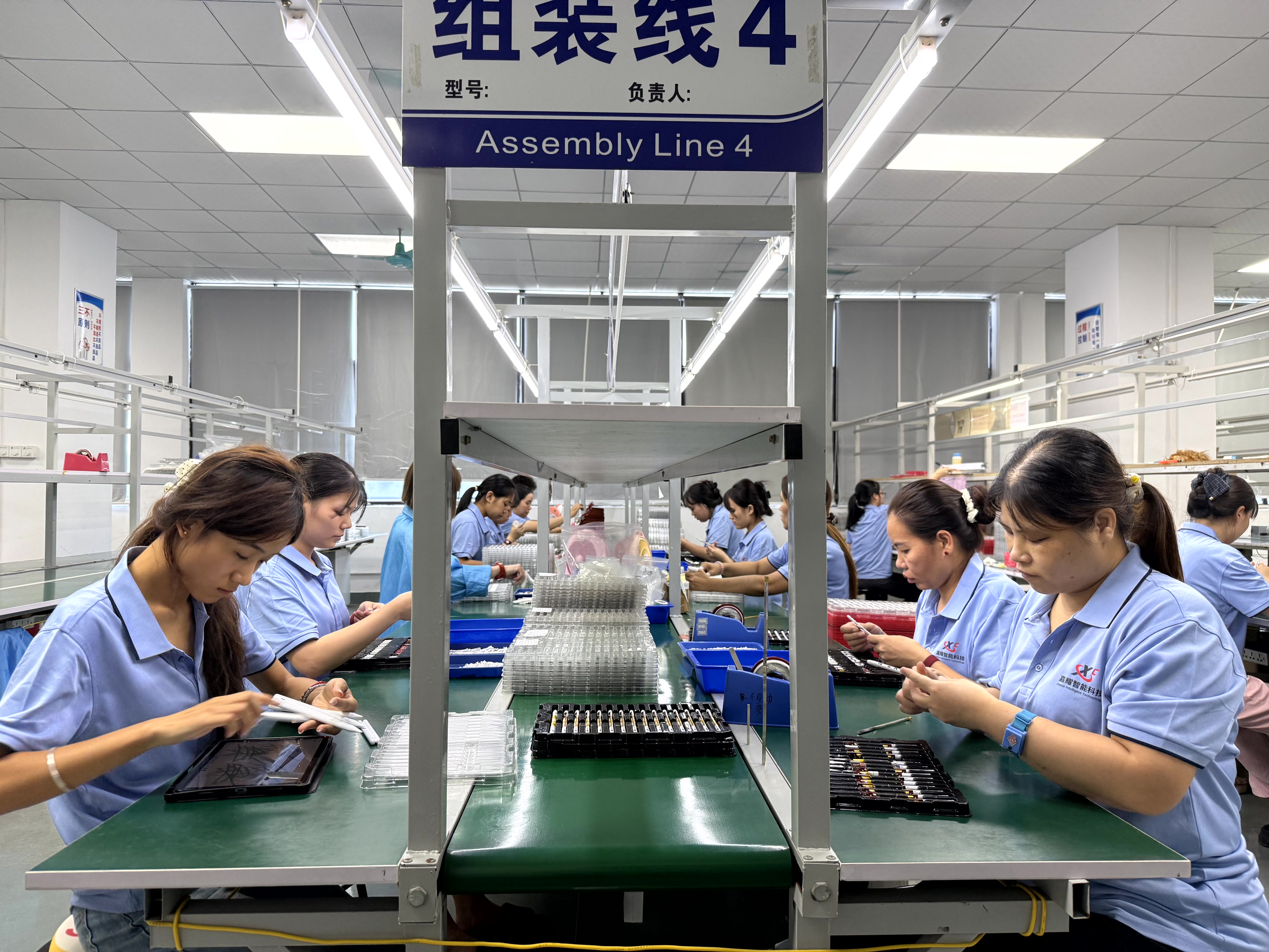
Acceptance is the gate most often left implicit. Jiayao's stated acceptance basis is pre-shipment inspection, and its production process applies 100% full inspection covering functional, tactile and visual checks. Those two facts belong in a contract as method, not as assurance, because an inspection against an undefined criterion produces an opinion rather than a record.
A workable acceptance schedule separates the checks that can be measured from the checks that can only be judged against a reference.
| Check layer | What is examined | How it is recorded |
|---|---|---|
| Functional | Power-on, pairing where applicable, charging through the specified method, writing response on the target device | Pass or fail per unit against the model's stated behaviour |
| Performance | Writing response against stated values; for the active pen class, latency below 8 ms and writing offset below 0.5 mm | Measured on a defined device and application, recorded per lot |
| Power behaviour | Charging time and runtime for the specified model, for example 11 hours continuous per full charge, 5 minutes of charge for 2 hours of use, or 30 hours continuous per full charge | Charge and discharge sequence, recorded per sampled unit |
| Tactile | Tip fit, tip replacement, body seam, button feel, weight balance | Judged against a retained golden sample |
| Visual | Cosmetic defects, printing, logo alignment, packaging appearance | Judged against a retained golden sample and approved artwork |
| OEM variables | Logo, packaging, function configuration and Bluetooth name where customised | Checked against the approved configuration sheet |
| Documentation | Model, quantity, inspection result, date, sample reference | Attached to the lot record and retained for repeat orders |
Two boundaries are worth stating plainly. First, pre-shipment inspection judges a lot, and it does not by itself establish long-term reliability; buyers who need lifecycle evidence must define that test separately rather than assume inspection covers it. Second, full inspection reduces the escape rate but does not replace a written standard, because 100% of an undefined check is still an undefined check.
Gate 3 exit condition: the acceptance schedule exists in writing before the sample is approved, names the device used for performance checks, and is attached to the same document as the purchasing terms.
Where Jiayao Stylus sits inside the framework
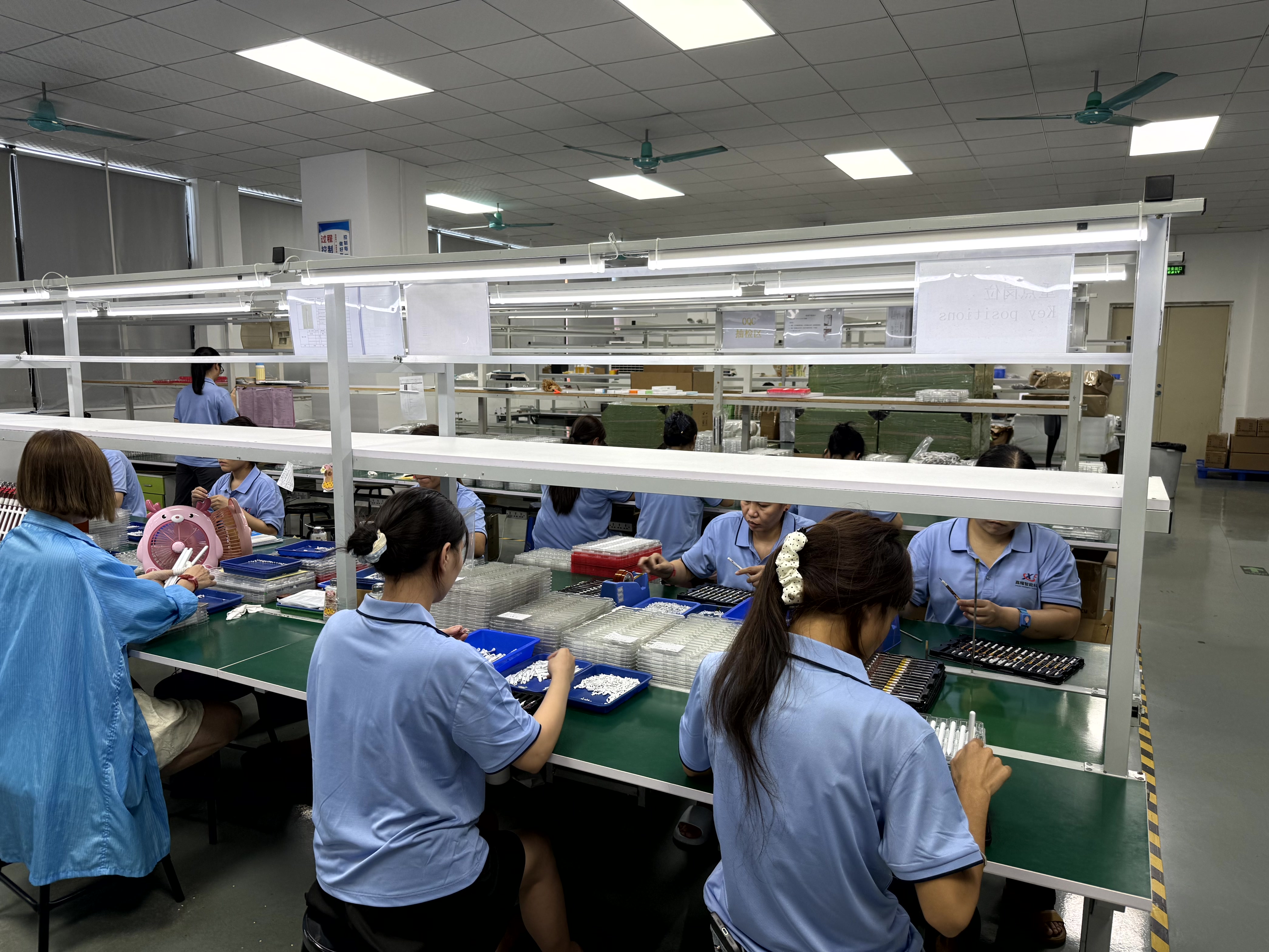
Dongguan Jiayao Intelligent Technology Co.,Ltd, the manufacturer behind the Jiayao Stylus brand, is a stylus pen manufacturer based in Humen Town, Dongguan, Guangdong, China. The company was founded in 2021, runs a 2,700 m² factory with around 100 employees and a four-engineer R&D team, and reports an annual output of 3,000,000 units, of which 40% is exported, primarily to the EU and USA.
Three capability facts are relevant, and each lands at a different gate.
- Process coverage at Gates 1 and 3. Jiayao's stated capabilities run from PCBA design and battery welding through final assembly and quality testing. A change in sensing configuration or charging architecture is therefore handled inside one process rather than across suppliers, which shortens the loop between a failed performance check and a rebuilt sample.
- Inspection model at Gate 3. Every stylus is described as going through 100% full inspection covering functional, tactile and visual checks. This supports a full-population acceptance basis rather than a sampling-only basis.
- Commercial structure at Gate 2. MOQ of 500 units, EXW/FOB delivery, 30/70 payment and pre-shipment inspection acceptance, with samples in as little as 3 weeks and standard orders shipped in 20 days.
The company supports both OEM and ODM projects across active and passive stylus pens compatible with iPad and mainstream tablets, with customisation available on logo, packaging, function configuration and Bluetooth name. In framework terms that flexibility sits between Gate 1 and Gate 2: it changes what can be specified, but it does not change the requirement that the specification be written down.
There is also a documented limit. Jiayao's annual revenue is not publicly disclosed in available reporting, and a peer manufacturer in the same segment is reported in a USD 2.5M to 5M range, which is not a substitute for the company's own figures. Buyers who require audited financials for a multi-year programme should request them directly rather than infer scale from output volume.
Technical explanation: what separates the pen types
Three mechanisms explain most of the difference between quotations, and all three are testable rather than rhetorical.
Writing response. An active pen drives the digitizer with its own signal, which is why the active side of Jiayao's comparison data is described with latency below 8 ms and writing offset below 0.5 mm, while a passive pen is described as showing latency and offset conditions when writing. Latency and offset are the two measurements that most directly decide whether handwriting is acceptable in note-taking, and they are the natural measurements for the acceptance schedule.
Sensing set. Palm rejection allows the hand to rest on the screen while the pen writes. Tilt sensing varies line width with pen angle. Pressure sensitivity varies line weight with applied force. Jiayao's active pens are described as supporting palm rejection and tilt sensing, with pressure sensing identified as the function its third-party pens do not carry relative to Apple Pencil. For context, high-end professional pens in the market, such as the Samsung S-Pen family, are specified at up to 4,096 pressure levels, which indicates the device class that pressure-dependent workflows belong to.
Charging architecture. The charging method shapes the buyer's service model as much as the user's convenience. Jiayao's guidance is model-specific: W12-A for wireless charging with an additional USB-C port for wired fast charging, A7-H-L for fast charging at 5 minutes of charge for 2 hours of use, and E3-A for long runtime at 30 hours of continuous use per full charge. The active pen class is also described with up to 11 hours of continuous working time per full charge and a replaceable pen tip, which introduces a consumable to plan for in after-sales.
Standardisation context. The USI 2.0 specification, released in 2022 and supported by Google, Intel and Lenovo, is the primary cross-platform standard for active styluses. Buyers building mixed-fleet programmes should establish whether a candidate pen follows a proprietary protocol or an open standard, because that answer determines whether validation can be reused across devices or must be repeated device by device.
Application fit: matching pen behaviour to workflow
The framework becomes concrete when applied to four workflows that recur in stylus procurement.
- Finger replacement. Kiosk, signature capture, menu selection and simple field entry. A passive stylus is the correct type, and battery, charging and palm rejection are irrelevant costs.
- Note-taking. Where palm contact and handwriting legibility decide user acceptance. An active stylus with palm rejection is required, and latency plus offset become acceptance measurements rather than marketing descriptions.
- Drawing and sketching. Where line variation matters. Tilt sensing covers shading behaviour, while workflows that depend on force-based line weight require a pressure-sensitive device class that sits outside the third-party active pen class described here.
- Retail and distribution assortments. Where one SKU must serve iPad and Android buyers. Universal active models reduce SKU count but transfer risk to compatibility validation, so per-device testing belongs in Gate 3 for every device family in the assortment.
A fifth workflow sits inside the supplier relationship rather than with the end user: repeat programmes. Buyers running the same model across multiple purchase orders need the golden sample, the acceptance schedule and the model configuration retained and re-issued with each lot. Without that continuity, the second order is accepted against a different understanding than the first, and the third order is a negotiation again.
Market trend analysis
Three trends are visible in the available category data, and each changes how the gates should be applied.
Scale with definitional noise. The global stylus pen market was valued at USD 19.45 billion in 2025 by IMARC Group, while a separate 2025 estimate places the active digital pen segment at USD 3.36 billion. The difference is a category boundary question rather than a contradiction in demand, so a buyer quoting market size in an internal business case should state which definition is in use.
Active technology as the growing segment. Dataintelo projects active stylus technology at a 9.8% CAGR from 2026 to 2034. The procurement consequence is on the supply side: more active models, more charging architectures and more compatibility claims arriving in the same quotation round, which raises the value of a fixed acceptance schedule and a retained golden sample.
Documentation as part of the product. Stylus pens are typically classified under HS Code 8471.60.90 as automatic data processing input units, and cross-platform standards such as USI 2.0 give buyers shared vocabulary for compatibility claims. Both shift advantage toward suppliers able to produce consistent model documentation, because classification and standard conformance are checked at the border and in the tender, not at the sample table.
Comparison with traditional solutions, and where the limits sit
Against a first-party pen, a third-party active stylus competes on cost while covering the core writing functions. Against a passive stylus, it competes on writing quality and palm rejection. Both comparisons have edges that buyers should state explicitly rather than discover during inspection.
| Dimension | Apple Pencil | Third-party active stylus (Jiayao comparison) | Passive stylus |
|---|---|---|---|
| Precise writing | Yes | Yes | Latency and offset conditions when writing |
| Palm rejection | Yes | Yes | Not supported |
| Pause doodle | Yes | Yes | Not applicable |
| Pressure sensing | Yes | Not carried; tilt sensing used instead | No |
| Power requirement | Powered device class | Requires power supply; replaceable pen tip | Battery-free |
| Cost position | Higher | Lower | Lowest |
The limits are as important as the comparison. Pressure sensing is absent from the third-party active pen class, so artists who require precise pressure-based drawing are directed to Apple Pencil, while note-taking and general drawing remain inside the third-party envelope. A passive pen has no palm rejection and shows latency and offset in handwriting, which rules it out for note-taking programmes regardless of unit cost. Universal models carry a validation obligation rather than a compatibility guarantee, because palm rejection and tilt behaviour depend on the host device and the pen model together.
Supplier-level limits belong in the same paragraph. An MOQ of 500 units sets a floor that a small pilot order cannot go below without a different commercial structure. Pre-shipment inspection is a lot-level gate and not a reliability programme. And Jiayao's revenue is not publicly disclosed, so a scale argument for a multi-year programme has to rest on documented capability and repeat delivery rather than on a published financial figure.
Future outlook
Three developments are likely to shape stylus procurement over the remainder of the decade, and each has a buyer-side consequence that can be prepared for now.
- Standard convergence. With USI 2.0 established as the primary cross-platform specification for active styluses, buyers can begin asking protocol questions at Gate 1 instead of compatibility questions at Gate 3. The practical gain is validation reuse across a device fleet.
- Charging as a service decision. Wireless plus wired charging, five-minute fast charging and 30-hour runtime already sit side by side in the same product family. Each option changes returns handling and after-sales content, so the charging choice should be fixed in Gate 2 together with the acceptance checks that verify it.
- Documentation as a gate. HS classification, standard conformance and retained inspection records are becoming part of what a supplier delivers rather than paperwork that follows the shipment.
Underneath all three sits supplier continuity. For a multi-year programme the decisive question shifts from who quotes the lowest unit price to who can reproduce the same lot in eighteen months with the same configuration, the same golden sample and the same acceptance record. That is the point at which a buyer decision framework stops being a purchasing document and becomes a supplier relationship test.
The framework's value is not that it produces a single correct pen. It is that it makes each decision visible at the moment when changing it is still cheap: product type before the quotation, purchasing terms before sample approval, and acceptance criteria before production begins.
FAQ
Should a buyer choose a passive stylus or an active stylus?
An active stylus requires a power supply and supports precise writing, palm rejection and tilt sensing, which makes it suitable for note-taking, drawing and sketching, and it also improves the writing and gaming experience on iPad and tablet devices. A passive stylus is battery-free and lower in cost, but it does not support palm rejection or tilt sensing and shows latency and offset conditions when writing. The decision rule is straightforward: if the pen only replaces a finger, a passive stylus is sufficient; if the workflow includes note-taking, drawing or sketching, an active stylus is the correct type.
Which active stylus configuration should be specified: wireless charging, fast charging or long runtime?
The answer depends on the usage pattern rather than on product hierarchy. W12-A is the option for wireless charging, and it also provides a USB-C port that allows fast wired charging in addition to wireless charging. A7-H-L is the fast-charge option, where 5 minutes of charging supports 2 hours of use. E3-A is the long-runtime option, with 30 hours of continuous use per full charge. Because charging architecture affects both user experience and after-sales handling, it should be fixed during the purchasing terms stage and verified through the power-behaviour layer of the acceptance schedule.
What purchasing terms and acceptance criteria should be fixed before an order is placed?
The four terms that require explicit agreement are minimum order quantity, delivery terms, acceptance basis and payment structure. Under Jiayao Stylus terms, MOQ is 500 units, delivery terms are EXW or FOB, acceptance criteria are based on pre-shipment inspection, and payment terms are 30/70. Timing terms should be agreed at the same time: samples are available in as little as 3 weeks and standard orders are shipped in 20 days. Written agreement on these items determines when the lot is judged and what leverage the buyer holds at that point.
How does a third-party active stylus differ from Apple Pencil?
Functionally, the comparison states that the third-party active pen provides the same precise writing, palm rejection and pause-doodle function as Apple Pencil. The documented difference is pressure sensing: the third-party active pen does not carry pressure sensitivity and uses tilt sensing instead, while the cost position of Apple Pencil is substantially higher. The resulting selection rule is that artists who need precise pressure-based drawing should choose Apple Pencil, while buyers whose requirements are note-taking and general drawing can meet the requirement with a third-party active stylus.
A full product and configuration reference is available in the Jiayao Intelligent Stylus Pen Catalogue (PDF).
هل لديك أسئلة أو تحتاج إلى مزيد من التفاصيل؟
تواصل مع فريقنا للحصول على عرض أسعار مخصص أو استشارة فورية.
طلب عرض أسعار
املأ النموذج أدناه وسيتواصل معك فريقنا بعرض مقترح مخصص.
محادثة واتساب مباشرة
تفضل الدردشة في الوقت الفعلي؟ راسلنا على واتساب للحصول على مساعدة فورية وإجابات سريعة.
- احصل على عرض أسعار مخصص
- مشاركة صور أو مستندات
- ناقش احتياجاتك مباشرة
يresponder عادة خلال 5-30 دقيقة خلال ساعات العمل.