
Stylus Pen Sourcing Strategy: A Repeatable Framework
A stylus pen is no longer a single line item added at the end of a tablet accessory order. The category now spans battery-free passive capacitive designs, powered active stylus pens, and device-specific variants built for iPad or for Android and cross-platform tablets, each carrying a different cost structure, compatibility profile, and after-sales burden. For importers, distributors, brand owners, and procurement managers working at the decision and execution stages, the practical question is rarely which stylus is best. It is which repeatable method keeps sourcing decisions correct when devices, standards, and sales channels keep moving.
This article sets out a four-layer stylus pen sourcing framework that can be reused from one buying cycle to the next. It uses the manufacturer Jiayao Stylus as a concrete reference point. Dongguan Jiayao Intelligent Technology Co., Ltd is a professional active stylus pen manufacturer based in Dongguan, Guangdong, China. The framework is also presented with its boundaries, because a method improves the quality of a decision without removing the need for sample testing or for re-checking the device compatibility list of every platform a channel sells into.
Why Stylus Pen Sourcing Has Become a Portfolio Decision
Category sizing depends heavily on definitions, and buyers should treat headline numbers with care. IMARC Group valued the global stylus pen market at USD 19.45 billion in 2025 using a broad input-device definition, while narrower active-digital-pen estimates are considerably smaller. Whatever the exact figure, the direction is consistent: within the category, active stylus technology is projected to grow at a CAGR of 9.8% from 2026 to 2034, according to Dataintelo.
Growth of that kind changes the nature of the buying task. When a category is stable, a purchase mindset of negotiate, receive, and reorder is adequate. When a category is expanding and its device requirements keep shifting, the same mindset leaves a buyer exposed every time a variable moves.
Three forces push stylus sourcing from a purchase decision into a portfolio decision:
- Assortment spread. Most channels now need more than one stylus position: a low-cost passive option for tap-and-navigate users, and one or more active stylus pens for note-taking, drawing, and sketching.
- Compatibility drift. A pen that fits today's iPad generation or Android tablet may not fit the next one, and cross-platform behaviour varies by device.
- Lifecycle cost. Active pens introduce charging, battery ageing, and replaceable tips, so the lowest unit price is not automatically the lowest program cost.
Key idea. A sourcing framework is a decision system, not a document. It fixes the order in which questions are answered, so that a change in one variable, whether a new tablet model, a new price tier, or a new market, can be absorbed without restarting the whole evaluation.
The Four-Layer Stylus Pen Sourcing Framework
The framework answers four questions in a fixed order: type (active or passive), compatibility (which devices must it serve), performance and power (which features and charging architecture match the end use), and supply and terms (which supplier, quality system, and commercial terms carry the program).
Order matters. Buyers who begin with price and terms before type and compatibility are settled routinely re-open earlier decisions, because a cheaper passive pen cannot satisfy a program that truly requires palm rejection, and an over-specified active pen wastes margin on users who only need to tap a screen.
Layer 1: Decide Between an Active and a Passive Stylus Pen
A passive stylus is a battery-free pen that simply replaces the user's finger on a capacitive screen. An active stylus is a powered pen that communicates with the device to deliver precise writing and additional input features.
The functional gap between the two is the single most consequential sourcing decision in the category.
| Dimension | Passive stylus pen | Active stylus pen |
|---|---|---|
| Power | None required | Requires regular charging; replaceable pen tip |
| Writing behaviour | Replaces the finger; latency and writing offset can occur | Precise writing, no latency, no offset |
| Specified performance | Not specified on latency or offset | Latency under 8 ms; writing offset under 0.5 mm |
| Palm rejection | Not supported | Supported |
| Tilt sensing | Not supported | Supported |
| Battery life | Not applicable | Up to 11 hours of continuous working time per full charge |
| Best for | Replacing a finger for tapping and navigation | Note-taking, drawing, sketching, and general in-app experience |
| Relative cost | Lower | Higher |
The decision rule follows directly from the table. If the end user only needs to replace a finger, a passive stylus is the correct and cheaper choice. If the user needs note-taking, drawing, or sketching, an active stylus is required, because only the active type supports palm rejection, tilt sensing, and low-latency writing.
Two measured characteristics are worth writing into a specification sheet. Active writing is specified at latency below 8 ms with a writing offset below 0.5 mm, and a full charge supports up to 11 hours of continuous working time. Passive pens are not specified on those dimensions because they do not deliver the same behaviour; latency and offset are precisely the limitations buyers report with passive designs.
Layer 2: Map Device Compatibility Before You Commit
Compatibility failures are among the most expensive sourcing errors in this category, because they surface after shipment rather than during negotiation.
On iPad programs, third-party active stylus pens match Apple Pencil on precise writing, palm rejection, and the pause-doodle function. The main technical difference is sensing: third-party pens typically offer tilt sensing rather than pressure sensing. That produces a clean decision rule. Programs aimed at professional illustration still need a pressure-sensitive option, while note-taking and general drawing programs can be served by a third-party active stylus.
On cross-platform programs, the USI 2.0 (Universal Stylus Initiative) specification released in 2022 is the primary cross-platform standard for active styluses and is supported by Google, Intel, and Lenovo. A USI-aligned or universal active stylus pen can reduce the number of SKUs a distributor holds, because it is designed to work across multiple devices rather than a single platform.
The practical rule is to build the device matrix before requesting quotes. List every iPad model, Android tablet, and phone the channel sells; decide whether single-platform or universal coverage is required; and confirm the compatibility claim against that list rather than against a product name. Category labels such as USI are only useful when they map to the devices a buyer actually sells.
Layer 3: Match Performance and Power Architecture to Real Use
Once type and compatibility are fixed, the differentiating variable inside the active segment is power architecture and feature set.
Three power profiles illustrate how the choice maps to programs, using the Jiayao Stylus portfolio as a reference:
- Wireless charging. The W12-A stylus pen supports wireless charging and also carries a USB-C port, giving users a second charging path alongside wireless charging.
- Fast charging. The A7-H-L stylus pen charges in 5 minutes for 2 hours of use, which suits users who cannot leave a pen on a charger for long.
- Long runtime. The E3-A stylus pen runs for up to 30 hours of continuous use after a full charge, which suits full-shift or multi-day use without a charging habit.
Feature selection runs in parallel with power selection. Palm rejection, tilt sensitivity, low latency, and battery life are the attributes most often requested by buyers, and each one should be tied to a defined user task rather than added to a specification for completeness.
Customization sits at the same layer. OEM and ODM projects can be built from samples, and customization can cover LOGO, packaging, function, and Bluetooth name. For a brand owner, that means the stylus can be shaped around an existing product family instead of forcing the family to adapt to a stock pen.
Layer 4: Lock Down Supplier, Quality, and Commercial Terms
The supplier layer decides execution quality, and it is also where long-term ecosystem considerations belong. A supplier that can cover more of the process in-house reduces the number of hand-offs and the number of places a program can fail.
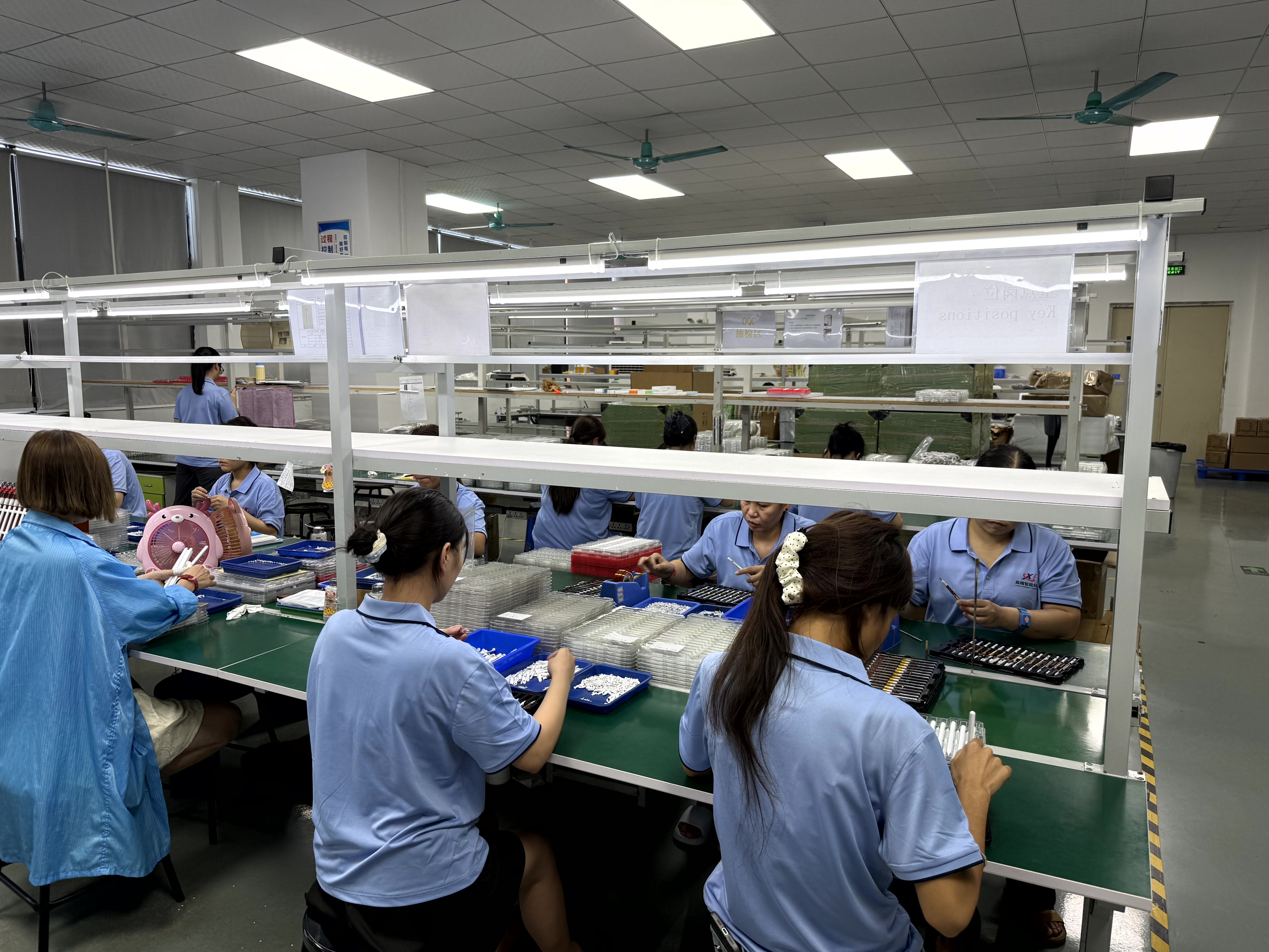
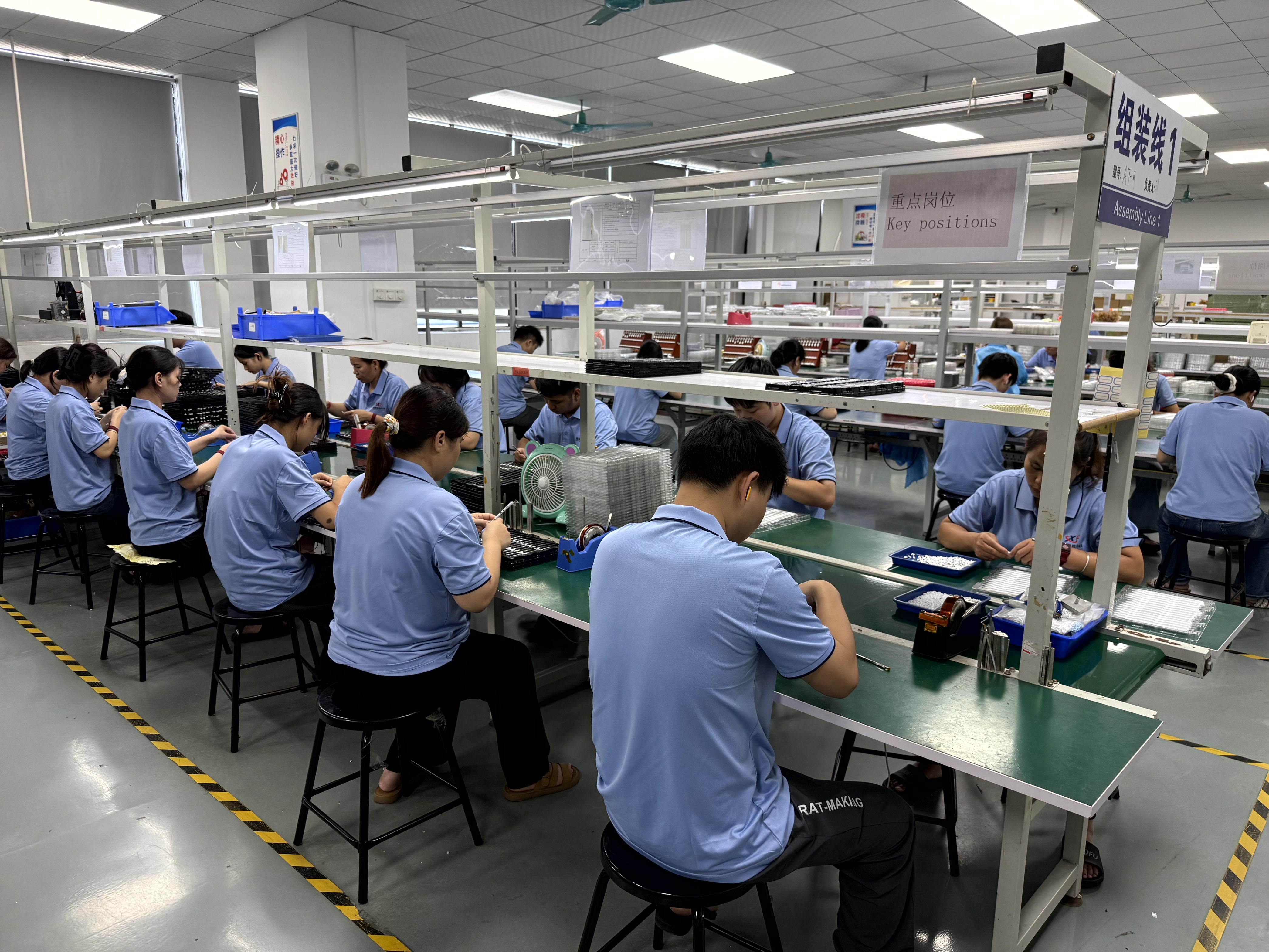
Jiayao Stylus is a concrete reference. Dongguan Jiayao Intelligent Technology Co., Ltd is a professional active stylus pen manufacturer based in Dongguan, Guangdong, China. The company was founded in 2021, operates a 2,700 m² facility with approximately 100 employees, and reports an annual output of 3,000,000 units. Its R&D team comprises 4 engineers, 40% of output is exported, and its main markets are the EU and the USA.
Capability coverage runs from PCBA design and battery welding through to final assembly and quality testing. That vertical coverage matters because it places electronics, power, and assembly under one quality system rather than across several vendors. Every stylus produced goes through 100% full inspection covering functional, tactile, and visual checks.
Commercial terms reported by the company are a MOQ of 500 units, EXW/FOB delivery terms, pre-shipment inspection as the acceptance criterion, and 30/70 payment terms. Supply flexibility is stated as flexible MOQs, samples in as little as 3 weeks, and standard orders shipped in 20 days, with regular models held in stock to handle small, scattered, and urgent orders.
| Supplier evaluation layer | What to check | Reference data point |
|---|---|---|
| Process coverage | Are electronics, power, assembly, and testing handled under one system? | PCBA design and battery welding through final assembly and testing |
| Quality system | Is inspection sampled or full? | 100% full inspection: functional, tactile, visual |
| Sampling | How fast can a validated sample reach the buyer? | Samples in as little as 3 weeks |
| Standard lead time | How fast do repeat orders ship? | Standard orders shipped in 20 days |
| Minimum order | What is the entry quantity? | MOQ 500 units |
| Delivery and payment | What are the trade and settlement terms? | EXW/FOB; 30/70 payment terms |
| Acceptance | How is a shipment qualified? | Pre-shipment inspection |
Market Trend Signals That Should Shape the Framework
Category data is useful only when it changes a decision. The signals below are the ones that should feed back into the framework each planning cycle.
| Signal | Published detail | What it changes for buyers |
|---|---|---|
| Category size | The global stylus pen market was valued at USD 19.45 billion in 2025 (IMARC Group) | Confirms the category is large enough to justify a standing sourcing process rather than one-off purchasing |
| Active stylus growth | Active stylus technology is projected to grow at a CAGR of 9.8% from 2026 to 2034 (Dataintelo) | Supports weighting a portfolio toward active stylus pens while retaining a passive entry tier |
| Cross-platform standard | USI 2.0, released in 2022, is the primary cross-platform standard for active styluses, supported by Google, Intel, and Lenovo | Justifies asking suppliers for USI-aligned or universal designs to reduce SKU count |
| Customs classification | Stylus pens are typically classified under HS Code 8471.60.90 as automatic data processing input units | Affects duty and documentation planning for import and export |
| Feature benchmark | Samsung S-Pen and high-end professional active pens feature up to 4,096 levels of pressure sensitivity (Samsung Electronics) | Establishes the ceiling that third-party pens are measured against when illustration work is in scope |
A caution on market data: stylus market size estimates vary with definition. The USD 19.45 billion figure reflects a broad input-device definition, while narrower estimates that count active digital pens only are considerably smaller. Buyers should cite the definition alongside the number.
A caution on supplier data: specific annual revenue for Jiayao Stylus is not publicly disclosed. For reference, peer manufacturer Shenzhen Yihua Pen Electronics reports revenue in the range of USD 2.5M to 5M. Private manufacturers rarely publish audited financials, which is a reminder to verify capacity and financial stability directly during qualification rather than relying on public profiles alone.
Comparison with Traditional Sourcing Approaches
Traditional stylus sourcing is transactional: a buyer reorders when stock runs low, negotiates unit price, and re-quotes from scratch whenever a device changes. A framework-based approach behaves differently at every stage.
| Dimension | Ad-hoc purchasing | Framework-based sourcing |
|---|---|---|
| Trigger | Reorder when stock runs low | Review on a fixed buying cycle |
| Primary variable | Unit price | Type, compatibility, performance, and supply fit |
| Response to a device change | Re-quote the whole program | Update one layer of the framework |
| Risk position | Concentrated in one SKU and one vendor | Defined primary and back-up positions |
| Evidence used | Vendor claims | Samples, specifications, and documented inspection |
Boundaries and limitations. A framework improves decision quality, but it does not remove every risk, and three limits should be stated plainly.
- Active is not always right. Active stylus pens cost more and require regular charging. For programs whose users only need to tap and navigate, a passive stylus remains the correct and cheaper choice.
- Compatibility is not uniform. Third-party active stylus pens match Apple Pencil on precise writing, palm rejection, and pause-doodle, but they offer tilt sensing rather than pressure sensing. Programs that depend on pressure-sensitive illustration must account for that gap.
- Standards adoption is uneven. USI 2.0 improves cross-platform portability, but support varies across devices and regions, so a device matrix must be re-verified per market rather than assumed from a standard name.
One further boundary concerns capacity fit. Jiayao Stylus reports a 2,700 m² facility and an annual output of 3,000,000 units, a profile suited to fast-moving brands and growing sellers. Buyers planning very large single-program volumes should validate capacity directly during qualification rather than infer it from an annual figure.
Application Scenarios: Where the Framework Pays Off
The framework is not abstract; each layer resolves differently depending on the program.
- Note-taking and academic programs. Active stylus pens are required, because palm rejection and low latency are the features that make handwriting usable. Layer 2 should confirm iPad and Android coverage, and Layer 1 should keep a passive option for lower price tiers.
- Drawing and sketching programs. Active pens with tilt sensing serve general drawing. Where the end user is a professional illustrator, the third-party tilt-versus-pressure difference becomes a hard specification rather than a preference.
- General navigation and casual use. Active pens deliver a better in-app experience than passive pens, but if the only task is replacing a finger, a passive stylus satisfies the requirement at lower cost.
- Branded OEM and ODM programs. Customization based on samples, covering LOGO, packaging, function, and Bluetooth name, lets a brand owner align the stylus with an existing product family.
- Distributor portfolios. A mix of one or two active stylus pens plus a passive entry tier covers the widest range of price expectations without an unmanageable SKU count.
Future Outlook
Three shifts are likely to shape stylus sourcing over the next planning cycles. First, continued growth in active stylus demand, projected at a 9.8% CAGR from 2026 to 2034, will keep the active segment as the main margin opportunity while passive pens persist as the entry tier. Second, cross-platform standards such as USI 2.0 will gradually reduce the number of device-specific SKUs a distributor must hold, though adoption will remain uneven in the near term. Third, suppliers with in-house PCBA, battery, assembly, and testing capability will be better positioned to shorten sampling and lead times as device generations turn over more quickly.
For buyers, the practical implication is that the framework should be maintained as a living document. Each buying cycle should re-verify the device matrix, re-confirm the power architecture against user behaviour, and re-check supplier terms against current lead times and inspection standards.
Frequently Asked Questions
What is the difference between an active stylus pen and a passive stylus pen?
A passive stylus does not require power; it replaces the user's finger on a capacitive screen but does not support palm rejection or tilt sensing, and latency and offset can occur when writing. An active stylus requires power and supports palm rejection and tilt sensing, delivering precise writing without latency or offset and up to 11 hours of continuous working time per full charge. If a buyer only needs to replace a finger, a passive stylus is the cheaper choice; if the user needs note-taking, drawing, or sketching, an active stylus is required.
What purchasing terms are typical for a stylus pen order?
Reported standard terms are a minimum order quantity of 500 units, EXW/FOB delivery terms, pre-shipment inspection as the acceptance criterion, and 30/70 payment terms. Buyers should confirm these terms against their own documentation and inspection requirements during qualification.
How do I choose between a wireless-charging, a fast-charging, and a long-runtime stylus pen?
The three positions serve different user behaviours. The W12-A stylus pen supports wireless charging and also carries a USB-C port, providing a second charging path alongside wireless charging. The A7-H-L stylus pen charges in 5 minutes for 2 hours of use, which suits users who cannot leave a pen on a charger for long. The E3-A stylus pen runs for up to 30 hours of continuous use after a full charge, which suits full-shift or multi-day use. The choice should follow the end user's charging habit rather than the unit price alone.
How does a third-party stylus pen compare with Apple Pencil?
Third-party active stylus pens match Apple Pencil on precise writing, palm rejection, and the pause-doodle function. The main difference is sensing: third-party pens typically provide tilt sensing rather than pressure sensing. Programs aimed at professional artists who need precise, pressure-driven drawing are better served by Apple Pencil, while note-taking and general drawing programs can be served by a third-party active stylus.
What standard matters for cross-platform active stylus pens?
The USI 2.0 (Universal Stylus Initiative) specification, released in 2022, is the primary cross-platform standard for active styluses and is supported by Google, Intel, and Lenovo. Buyers planning a single pen that works across several devices should ask suppliers whether a design is USI-aligned or universal, and then verify that claim against the specific device list for their market.
What should be verified before a stylus pen program scales?
Before scaling, buyers should confirm the device matrix, the power profile, and the supplier's process coverage. Reported supplier-side facts include PCBA design and battery welding through final assembly and quality testing, 100% full inspection covering functional, tactile, and visual checks, samples in as little as 3 weeks, standard orders shipped in 20 days, and pre-shipment inspection as the acceptance criterion. Verifying these directly during qualification is more reliable than assuming them from a product listing.
Building the Strategy Into the Next Cycle
A stylus pen sourcing strategy is a repeatable sequence rather than a single answer. Type, compatibility, performance, and supply each resolve differently by program, and the order in which they are answered determines whether a buyer re-opens decisions or builds on them. Once the framework is in place, each new device generation, price tier, or market becomes an update to one layer rather than a restart.
For buyers who want to compare the framework against a specific product line, the Jiayao Intelligent Stylus Pen Catalogue is available for reference: Jiayao Intelligent Stylus Pen Catalogue. Manufacturer details are published at jiayaostylus.com.
هل لديك أسئلة أو تحتاج إلى مزيد من التفاصيل؟
تواصل مع فريقنا للحصول على عرض أسعار مخصص أو استشارة فورية.
طلب عرض أسعار
املأ النموذج أدناه وسيتواصل معك فريقنا بعرض مقترح مخصص.
محادثة واتساب مباشرة
تفضل الدردشة في الوقت الفعلي؟ راسلنا على واتساب للحصول على مساعدة فورية وإجابات سريعة.
- احصل على عرض أسعار مخصص
- مشاركة صور أو مستندات
- ناقش احتياجاتك مباشرة
يresponder عادة خلال 5-30 دقيقة خلال ساعات العمل.