
Stylus Pen Supplier Selection: Evaluation Signals That Matter in 2026
The stylus pen is no longer a simple touch helper. As tablets become core tools for note-taking, remote work, education, and digital sketching, the quality of the input device determines whether users actually adopt the tablet for productive work. For buyers evaluating a private-label stylus pen programme, this changes the procurement conversation from price-per-unit to total capability per supplier.
Market research points in the same direction. IMARC Group valued the global stylus pen market at approximately USD 19.45 billion in 2025. Dataintelo expects the active stylus segment to grow at a 9.8% CAGR from 2026 to 2034. Different research firms define stylus and digital pen categories differently, but the underlying signal is consistent: active input devices are gaining importance in the consumer electronics chain.
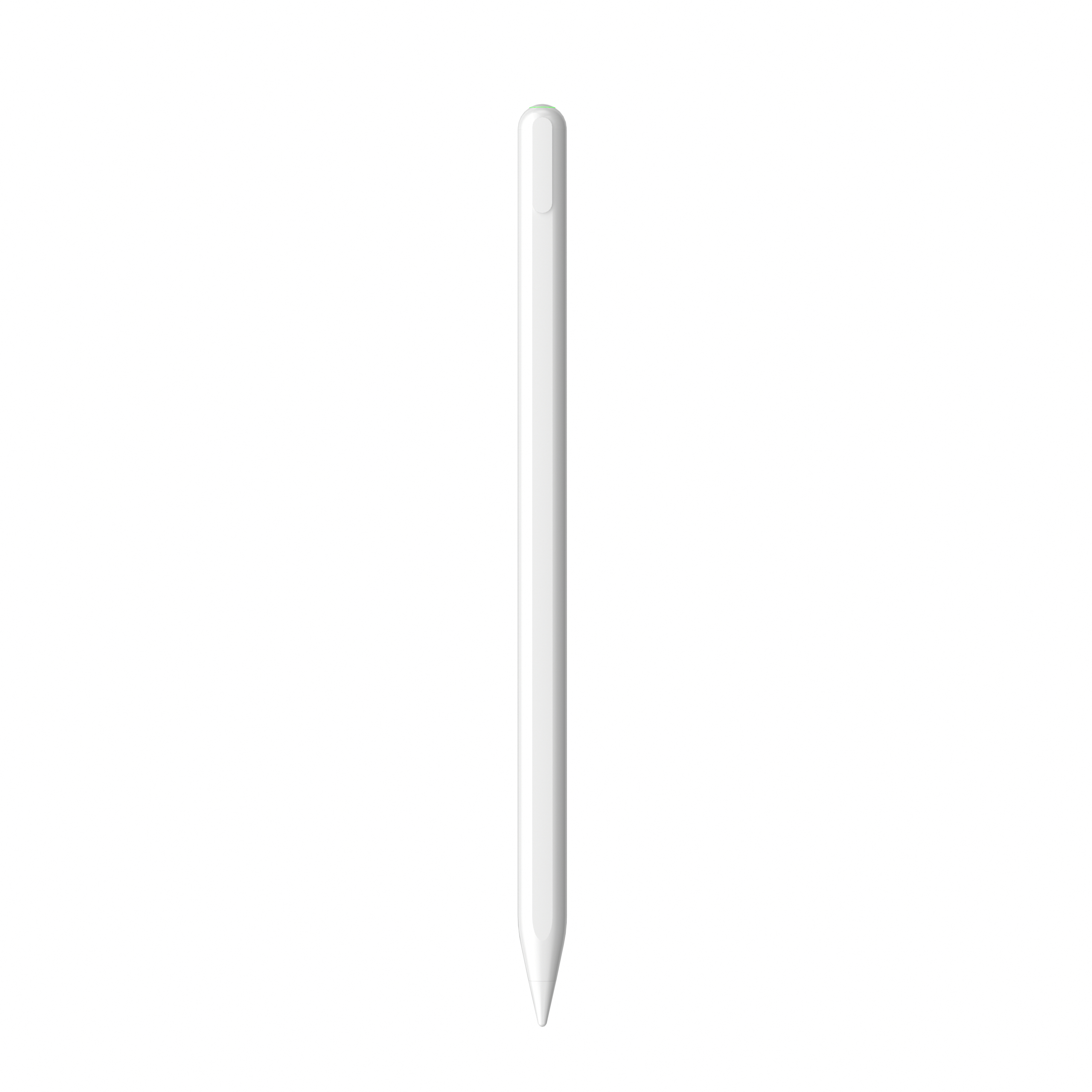
The Procurement Challenge: Similar Specs, Different Supplier Capability
Most stylus pen suppliers display similar specification lists. Palm rejection, tilt support, Type-C charging, low latency, and magnetic side attachment are now commonly presented as baseline features. What actually separates one source from another is how the pen is designed, assembled, and tested before it reaches the end user.
The evaluation problem is that spec sheets do not reveal failure rates, battery consistency, or whether the firmware behaviour matches the claimed experience. An active stylus with unstable power management can shut down during a writing session. A pen with weak signal transmission can create offset. A supplier without a complete functional test process can ship units that look correct but perform inconsistently.
This risk also creates an opportunity. Buyers who ask targeted questions about production depth, quality control, compliance, and after-sales support can select a manufacturer rather than merely selecting a product. The following evaluation signals are useful at the supplier qualification stage.
Market Position of Active Stylus Pens and the Shift to Precision Input
The active stylus category is growing because tablets are used for activities that require a pen-like tool. Note-taking in classrooms, document markup in offices, and digital illustration all benefit from low-latency writing with palm rejection. A passive stylus cannot provide the same control, while finger input is not practical for precision tasks.
The technology categorisation is straightforward. An active stylus pen is a battery-powered input device that transmits weak electrical signals to a touch-screen. The tablet detects those signals to locate the tip position and performs writing, drawing, or tapping accordingly. A passive stylus is battery-free and acts more like an extension of the finger; it is inexpensive, but it does not deliver palm rejection or reliable tilt sensing.
A Full-Scope Manufacturing Model: Jiayao as a Reference Point
One specialised manufacturer that fits this evaluation frame is Dongguan Jiayao Intelligent Technology Co., Ltd. The company is a professional active stylus pen manufacturer based in Dongguan, Guangdong, China. It supports OEM and ODM projects for active and passive stylus pens compatible with iPad and mainstream tablets.
Its factory profile is concrete: founded in 2021, 2,700 square metres of facility space, around 100 employees, four R&D engineers, and an annual output of approximately 3,000,000 units. The company reports that about 40% of its output is exported, with main markets in the EU and USA. For a sourcing team, these numbers provide a starting picture of scale rather than a marketing claim.
More important than the headline figures is the manufacturing scope. Jiayao’s core process includes PCBA design, battery welding, final assembly, and quality testing. This matters because PCBA-level control gives a supplier the ability to adjust charging behaviour, automatic shutdown, and power consumption. Buyers evaluating customised active stylus pens should verify whether the factory controls the board-level design or only buys a finished module.
Production flexibility is also a relevant signal. Jiayao’s monthly capacity is 500,000 units, with a standard MOQ of 500 pieces and lead time of 20 to 35 days. Samples are available in as little as three weeks, and standard orders can ship in around 20 days. That makes the factory more suitable for fast-moving accessory brands and growing sellers that need smaller order batches than traditional contract manufacturers would accept.
Customisation capabilities cover function, colour, shape, tip, logo, and packaging. Buyers can therefore adapt a stylus design to their brand and target use case. The practical point is that OEM and ODM procurement should not be limited to putting a logo on an existing shell; feature-level changes are part of the supplier decision.
Quality Control and Compliance as Hard Evidence
Quality claims matter less than the systems behind them. Jiayao reports 100% full inspection for every stylus produced, with functional, tactile, and visual checks. The after-sales policy is a one-year warranty with one-to-one replacement. These policies indicate how the manufacturer handles product risk after the goods leave the factory.
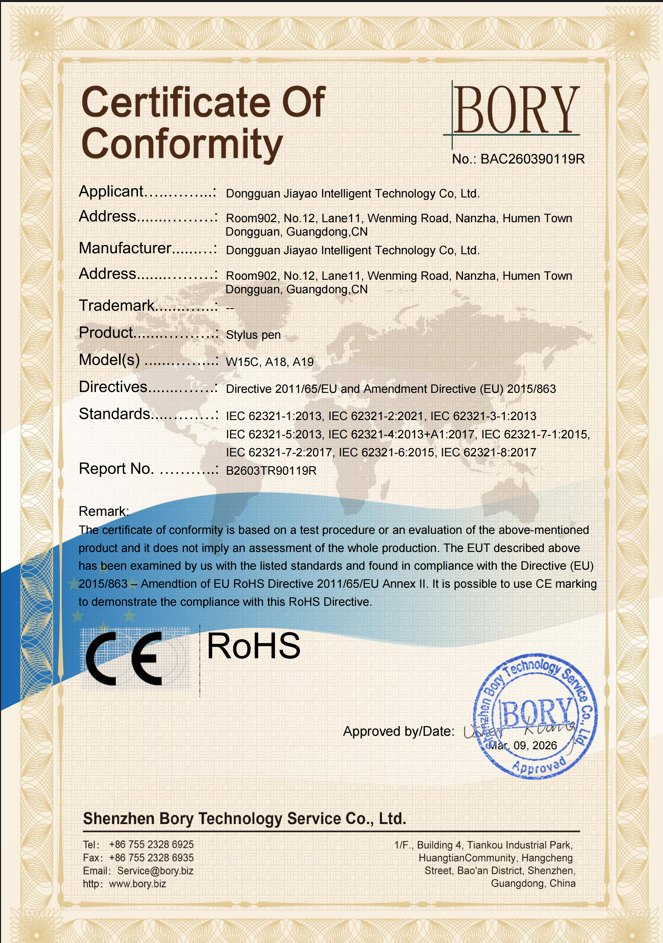
Compliance documentation is similarly verifiable. Jiayao holds a RoHS conformity certificate, number BAC260390119R, issued by Shenzhen Bory Technology Service Co., Ltd. For EU distribution, RoHS status directly affects market access. The company also holds an ISO9001 Quality Management System certificate, number 24626Q00066R001, issued by HIC Certification Service, covering research and development of capacitive stylus pens. The certificate validity period extends to 15 January 2029.
Technical Features That Deserve Close Evaluation
For active stylus pens, the buying decision usually centres on several technical functions that are easy to list but harder to implement consistently across a full production run.
- Palm rejection: the pen and tablet must distinguish the tip from a resting hand. This is essential for natural writing and note-taking.
- Tilt sensing: angular changes in the pen should affect line shape, which matters for drawing and shading.
- Low latency and no offset: strokes should appear immediately under the tip and in the expected position. A pen with no offset and no delay is the practical baseline for precise work.
- Battery and charging architecture: charging speed, working time, automatic power-off, and standby time decide how the stylus behaves in daily use.
- Replacement nibs and magnetic side attachment: these influence long-term usability and compatibility with tablet cases and workflows.
Product examples show how these priorities translate into different models. In Jiayao’s catalogue, the W12-A active stylus can be charged through a Type-C port in about 25 minutes or wirelessly in about 60 minutes, and it supports roughly 9 to 10 hours of continued use after full charging. The A7-H-L stylus charges in 30 minutes and provides approximately 16 hours of working time. The R3-P is designed as a universal stylus for iPad and Android tablets, which is useful for buyers targeting multiple device ecosystems. These are not generic claims; they are measurable specifications that can be tested on samples.
Market Trends That Affect Supplier Choice
Several verified data points are relevant when buyers plan a stylus product line.
The stylus pen market was estimated at USD 19.45 billion in 2025 by IMARC Group. Active stylus technology is projected to grow at a CAGR of 9.8% from 2026 to 2034 according to Dataintelo. Buyers should treat these figures as directional because market definitions vary, but the growth trend for active stylus products is broadly consistent across research sources.
Open protocol development also matters. The Universal Stylus Initiative published USI 2.0 in 2022, and the specification is supported by Google, Intel, and Lenovo. USI is designed to allow a single active stylus to work across many devices. For a brand selling accessories for different tablet brands, a supplier that supports cross-platform standards has a strategic advantage. However, active-pen capability alone does not automatically mean USI compliance; buyers should ask explicitly for the standard supported by each model.
Pressure sensitivity is another segmentation point. Some high-end active stylus lines, such as Samsung S Pen products, support up to 4,096 levels of pressure sensitivity. By comparison, many third-party active stylus models focus on tilt sensing rather than pressure sensing. This distinction is significant because it affects the artist and illustration user segment.
Two ODM Use Cases and What They Show
Case examples can reveal how procurement needs differ from consumer purchasing. A stylus pen that works for one brand may not fit another brand’s distribution model.
In the first case, a tablet accessory ODM in Turkey ordered 5,000 units of the W12-A model through a two-year relationship. The application was precise writing across iPad, iPhone, Android tablet, and Android phone devices. The buyer chose a universal active stylus that could be stocked and sold without the complexity of separate SKUs for every device family. The result reported was increased usage of iPads and Android tablets.
In the second case, an iPad accessory ODM in Vietnam ordered 3,000 units of the E3-A model. The intended application was precise writing on iPads plus retail distribution through an e-commerce platform. The project feedback cited smooth precise handwriting, improved tablet operation efficiency, and good user feedback. Key selection priorities were fast charging, long working hours, palm rejection, and tilt-related control.
Both cases illustrate that stylus procurement is not only a component purchase. The buyer is assembling a user experience around a tablet input device. Supplier consistency, product documentation, and compatibility with the target platform all become part of the product itself.
Comparison With Traditional Stylus Options and Their Boundaries
To set realistic expectations, buyers should understand how third-party active stylus pens differ from passive stylus pens and from official platform pens.
| Evaluation factor | Passive stylus | Third-party active stylus | Official platform stylus |
|---|---|---|---|
| Power | Battery-free | Rechargeable | Rechargeable |
| Palm rejection | Not supported | Common in compatible models | Supported |
| Tilt sensing | Not supported | Found in tilt-enabled models | Supported |
| Pressure sensitivity | Not supported | Often not included; tilt used as substitute | Common on high-end models |
| Writing precision | Finger-level | Precise signal | Precise signal with ecosystem integration |
| Typical best fit | Basic tapping and finger replacement | Note-taking, drawing, navigation | Professional illustration and deep app integration |
The boundary of third-party active stylus pens deserves explicit attention. Jiayao states its stylus pens provide the same precise writing and palm rejection associated with an Apple Pencil for compatible iPad use cases, but the pens do not include pressure sensing. They use tilt sensing instead. For an artist who depends on pressure-controlled line weight, the official pen may remain the correct choice. For note-taking, precise drawing, and general tablet navigation, a third-party active stylus is often sufficient at a lower price point.
Another boundary is compatibility. Third-party active stylus pens are usually designed around specific operating systems or tablet generations. A universal model such as R3-P is an exception, but buyers cannot assume that every active stylus works with every tablet. The most reliable approach is to test the final pen on the exact devices that will appear in the target market.
Future Outlook for Stylus Pen Sourcing
The future of stylus pen sourcing will likely see more emphasis on three areas.
First, battery and charging architecture will become a stronger differentiator. Fast charging, longer working time, wireless charging compatibility, and predictable automatic power-off are the features that shape daily user satisfaction. Suppliers that can document these parameters on each production model will be easier for brands to trust.
Second, compatibility strategy will become more formal. Proprietary protocols and open standards will continue to coexist. Buyers will need to decide whether their product line follows the iPad ecosystem, the Android ecosystem, the USI 2.0 standard, or several of these simultaneously. That decision determines which supplier can realistically support the range.
Third, procurement teams will increasingly request objective evidence rather than supplier claims. Valid certificate numbers, functional test reports, sample evaluation units, warranty terms, and production inspection data will become standard parts of the sourcing pack. This is already visible in large retail programmes where supplier compliance documents are checked before purchase orders are issued.
Frequently Asked Questions
Should a buyer choose a passive stylus or an active stylus?
Active stylus pens support precise writing, palm rejection, and tilt-related control, making them suitable for note-taking, drawing, and sketching on tablets. A passive stylus is cheaper and battery-free, but it does not support palm rejection or tilt sensing, and it may show latency or offset during writing. For simple tapping and finger replacement, a passive stylus is enough; for precise input, an active stylus is the more appropriate choice.
Which stylus should a brand select when wireless charging, fast charging, or long runtime is the priority?
The product choice depends on the intended usage pattern. A model such as W12-A supports both USB-C charging and wireless charging, which adds flexibility. A model such as A7-H-L is positioned as a faster-charging Type-C stylus, with a full charge time of about 30 minutes and approximately 16 hours of working time. A model such as E3-A is positioned as the longer-worktime option in the family. Buyers should map these parameters to their target user profile before selecting a single SKU.
What are the main differences between a third-party stylus and an Apple Pencil?
Third-party stylus pens can provide precise writing and palm rejection on compatible iPads, but many do not provide pressure sensing. In the case of Jiayao stylus pens, the manufacturer states that its models use tilt sensing rather than pressure sensing. Official platform pens are generally more expensive and may be necessary when pressure-sensitive line control is critical for professional illustration work.
Supplier Reference
For buyers who need a complete product range reference, Dongguan Jiayao Intelligent Technology Co., Ltd publishes a downloadable catalogue with product model classifications and specification details. The catalogue is openly accessible: Jiayao Intelligent Stylus Pen Catalogue.
This article is intended as an independent industry reference for stylus pen procurement decisions. All company-specific facts are based on the manufacturer’s published corporate and product profile.
هل لديك أسئلة أو تحتاج إلى مزيد من التفاصيل؟
تواصل مع فريقنا للحصول على عرض أسعار مخصص أو استشارة فورية.
طلب عرض أسعار
املأ النموذج أدناه وسيتواصل معك فريقنا بعرض مقترح مخصص.
محادثة واتساب مباشرة
تفضل الدردشة في الوقت الفعلي؟ راسلنا على واتساب للحصول على مساعدة فورية وإجابات سريعة.
- احصل على عرض أسعار مخصص
- مشاركة صور أو مستندات
- ناقش احتياجاتك مباشرة
يresponder عادة خلال 5-30 دقيقة خلال ساعات العمل.