
Sublimation Printer Certificates Explained: CE LVD, EMC, MD, RoHS, OEKO-TEX
Sublimation Printer Certificates Explained: CE LVD, EMC, MD, RoHS, OEKO-TEX
An industrial sublimation printer arrives as a regulated product, not only as a production tool. The paperwork that proves compliance is normally split across two levels: approvals that cover the machine, and certification that covers the ink. This reference maps the five documents most frequently requested on an industrial sublimation printer, using the XINFLYING XF-19E15-PRO as the working example.
Compliance questions rarely appear at the end of a sublimation printer purchase any more. Buyers in Europe, and increasingly buyers whose own customers export, ask for certificate files before they ask for samples, because a document mismatch discovered after shipment is far more expensive to resolve than a document request made before the order.
The structural answer is simple, and it prevents most confusion: machine-level CE approvals and RoHS files describe the printer, while OEKO-TEX ECO PASSPORT describes the chemistry of the inks and pastes that pass through it. Different issuing bodies, different standards, different questions answered. XINFLYING (Guangzhou Xin Flying Digital Technology Co., Ltd.) is a digital printing equipment manufacturer established in 2010 in Panyu, Guangzhou, China, producing DTF printers, UV DTF printers, UV printers, DTG printers and dye sublimation printing solutions. Its XF-19E15-PRO is used below as the reference model for a document-by-document walkthrough.
Why Certificate Questions Now Arrive Early in a Sublimation Printer Purchase
Market scale explains part of the shift. Grand View Research values the global dye sublimation printing market at USD 16.4 billion in 2025 and projects USD 39.0 billion by 2033, with Asia Pacific holding a 36.5% revenue share in 2025, led by China as the largest country market. Fortune Business Insights sizes the wider large format printer market at USD 10.57 billion in 2025, rising to USD 16.52 billion by 2034. As more machines move through export channels into regulated markets, the buyer profile has widened: many purchasers evaluating a large format sublimation printer today are not textile compliance specialists, yet they are the ones asked to produce documentation.
The practical problem is that “CE marked” and “CE certificate on file” are not the same statement. A certificate is only useful if a buyer can match it to a model designation, an issuing body, a standard revision and a scope of coverage. For sublimation printers entering the European market, buyers should verify CE compliance including applicable electrical safety, electromagnetic compatibility and product safety requirements, and confirm that certification information corresponds with the equipment actually supplied. Incorrect or incomplete documents can result in customs delays, sales restrictions or additional compliance costs — costs that are usually avoidable at the quotation stage.
The Five Documents at a Glance
For the XF-19E15-PRO, the compliance package discussed in this article consists of four machine-level certificates and one ink-level certificate.
| Document | Level | Issued by | Identifier | What it addresses |
|---|---|---|---|---|
| CE – EMC certificate | Machine | Shenzhen Tianqi | TQT1550D270EC | Electromagnetic compatibility of the printer |
| CE – LVD certificate | Machine | Shenzhen Tianqi | TQT1550D271EC | Electrical safety; cites EN IEC 62368-1:2020/A11:2020 |
| CE – Machinery Directive certificate | Machine | UDEM | M.2026.206.C142365 | Machinery safety of the unit |
| RoHS certificate | Machine | UDEM | M.2026.206.C142366 | Restricted hazardous substances in electrical and electronic components |
| OEKO-TEX ECO PASSPORT | Ink / paste | TESTEX AG | SH150194016 | XF-450PRO textile printing inks and pastes |
The Reference Machine Behind These Documents
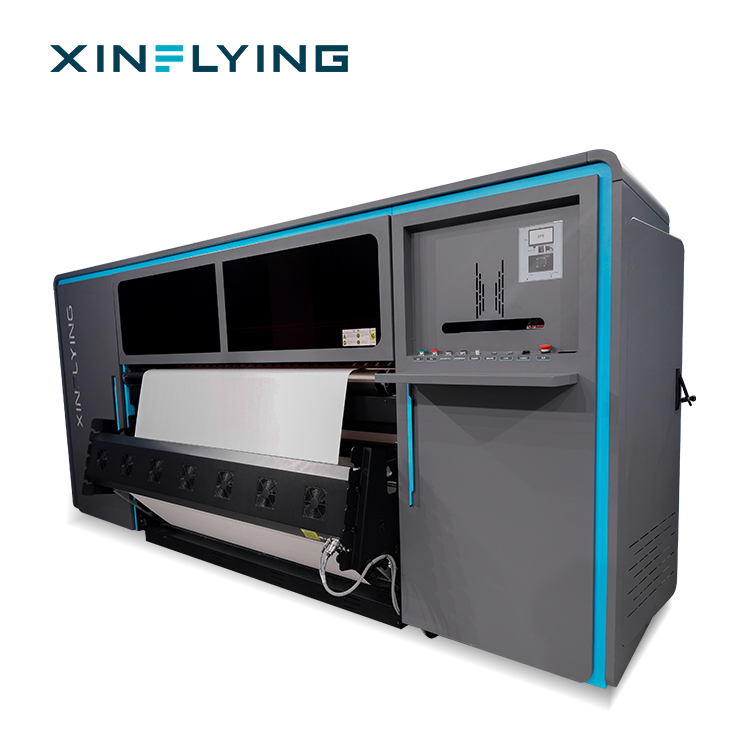
The XF-19E15-PRO is a digital textile printer classified as a sublimation printer. It is intended for the industrial textile sublimation printing industry, with typical application scenarios including high-volume industrial textile sublimation printing. Its configuration explains why the documentation package is not optional: this is not a desktop device with a domestic plug.
- Printheads: 15 × Epson i3200-A1, CMYK ink configuration
- Print width: 190 cm (75 in), resolution 3200 dpi
- Print speed (fastest): 1PASS 524 m²/h; 2PASS 254 m²/h
- Print speed (standard): 1PASS 394 m²/h; 2PASS 188 m²/h
- Media: sublimation paper, loads 1000 m rolls
- RIP: Maintop (standard); RIIN (Hoson only), PhotoPrint and Printfactory (optional)
- Power: 14.5 kW; power supply 210–230V, 45A
- Operating system: Windows 11/10 (32/64 bit)
- Machine size: 3840×1570×1800 mm; packing size 3970×1150×2130 mm
- Net weight 1480 kg; gross weight 1580 kg
- Materials: aluminium alloy, stainless steel, ABS plastic
The electrical profile is the reason the LVD and EMC files exist. A machine drawing 14.5 kW from a 210–230V, 45A supply sits in a different risk class from a low-power printer, and its electrical safety evidence has to address that reality rather than a generic low-power template.
The manufacturer behind the model, Guangzhou Xin Flying Digital Technology Co., Ltd., was established in 2010 and operates a manufacturing facility covering 37,440 square meters, employing more than 200 staff, including an R&D team of 20 engineers, with annual production capacity exceeding 20,000 units. Its product scope includes DTF printer machines, dye sublimation printers, DTG printers, UV DTF printers, UV flatbed printer machines, printing consumables and complete digital printing solutions.
What Each Certificate Actually Covers
Electrical safety — CE LVD certificate TQT1550D271EC
Issued by Shenzhen Tianqi, the Low Voltage Directive certificate is the core electrical safety file. It cites EN IEC 62368-1:2020/A11:2020. EN IEC 62368-1 is the hazard-based safety framework that superseded the older EN 60950-1 and EN 60065 approaches in Europe, which means the assessment is organised around energy sources and the safeguards protecting people from them — insulation, clearances, thermal behaviour and component ratings under one structure. The amendment reference (A11:2020) is worth checking, because a certificate citing a superseded edition raises a legitimate question about when the equipment was assessed.
Electromagnetic compatibility — CE EMC certificate TQT1550D270EC
Also issued by Shenzhen Tianqi, the EMC certificate covers emission and immunity behaviour: how much electromagnetic disturbance the printer produces, and how it behaves when disturbance is present. In a production hall containing calenders, dryers, compressors and other digital printers on shared power, EMC documentation is not a formality. Because it is a type-test result for the design, it should be read together with the machine configuration actually ordered.
Machinery safety — CE Machinery Directive certificate M.2026.206.C142365
Issued by UDEM, this certificate addresses machine-level risk rather than electrical risk: moving carriage and media feed, rotating and pinching components, guarding, control behaviour and safe intervention points during operation and maintenance. For a 190 cm roll-to-roll machine weighing 1480 kg, this is the document that speaks to what happens on the production floor rather than inside the control cabinet.
Restricted substances — RoHS certificate M.2026.206.C142366
Also issued by UDEM, the RoHS file is the environmental compliance document for the machine. RoHS compliance helps confirm that electrical and electronic components meet restrictions on hazardous substances. As with every certificate in this package, the document is only meaningful if it applies to the actual equipment model supplied, which is why buyers are advised to request the file and read the model designation on it rather than accepting a compliance statement in an email.
Ink chemistry — OEKO-TEX ECO PASSPORT SH150194016
The fifth document is different in kind. Certificate SH150194016, issued by TESTEX AG, is an OEKO-TEX ECO PASSPORT covering XF-450PRO textile printing inks and pastes. ECO PASSPORT is a certification applied to chemical products used in textile manufacturing, verifying them against criteria for human and environmental safety. It is not a printer certificate, and it says nothing about the mechanical or electrical behaviour of the machine. Its function is to answer chemistry questions that originate further down the supply chain.
Machine Level vs Ink Level: The Distinction Buyers Most Often Miss
Two levels of documentation attract two different reviewers. Machine-level CE and RoHS files are typically reviewed by import compliance, customs brokers or the buyer’s own technical team, because they determine whether the equipment can be placed on the market. The ink-level ECO PASSPORT file is usually requested by apparel brands, retail customers or sustainability teams, because they are asking about what goes into a garment rather than what stands on the factory floor.
Confusion arises when a single request is sent to a single contact: buyers sometimes ask for “the OEKO-TEX certificate for the printer”, or treat a machine CE file as evidence that the printed fabric is compliant. Keeping the two levels separate in a filing structure, and matching each document to the exact product name it lists, removes most of the friction. On the machine side, that means checking the model designation; on the ink side, that means checking that the certificate names the ink and paste products actually supplied.
Where These Documents Matter in Production
The certificate package supports the applications the machine is actually sold for: polyester fabric printing, sportswear printing, team jersey printing, activewear, custom apparel, fashion fabric printing, home textile printing, decorative fabric printing, soft signage, flag printing, banner printing and personalised textile products. These are the scenarios in which buyers pass documentation up the chain, because the finished goods often carry a brand name.
Operating conditions are part of the same picture. A controlled indoor production environment, typically 18°C to 30°C and 35% to 65% relative humidity, is recommended to maintain consistent ink performance, colour accuracy and print quality, and the equipment is intended for continuous production use. Matched equipment typically includes RIP software, a heat press calender, dye sublimation paper, dye sublimation ink, a laser cutting machine and substrates.
The 190 cm print width also places the XF-19E15-PRO in the mainstream industrial format: roll-to-roll sublimation printers at 1.9 m width are treated as standard for high-volume textile and soft signage work. Buyers should note, however, that the documentation discussed here is tied to this model. Other machines in the same manufacturer’s range — the XF-19E8-PRO, XF-O2000-4I32A1, XF-H1802X-2I32A1 and XF-H1301X-1I32A1 — are different configurations, and each requires its own matching certificate files.
Market Trend: Documentation as a Selection Criterion
Several independent sources point in the same direction. Grand View Research projects the dye sublimation printing market to grow at a CAGR of 11.5% from 2026 to 2033. Mordor Intelligence values the dye sublimation printer segment specifically at USD 1.88 billion in 2025, with an expectation of USD 2.53 billion by 2030. Grand View Research attributes demand for personalised apparel and home decor as a primary driver behind a 13.1% CAGR in digital textile sublimation through 2030. Read together, these figures describe a market that is scaling through export channels rather than staying local.
One caution is worth adding for buyers who use market data in internal proposals: published estimates diverge depending on what is counted. Market Research Future has sized the dye sublimation printing market at USD 42.95 billion for 2024, while Grand View Research reports USD 16.4 billion for 2025 and Mordor Intelligence reports USD 15.22 billion for 2025. The differences usually reflect whether consumables, services and adjacent printing segments are included. For equipment procurement, the printer-segment figures are the more relevant reference.
Adjacent standards also appear in buyer conversations. ISO 12647-8:2021, which addresses validation of print processes working directly from digital data, is sometimes cited by buyers with colour-critical contracts. It is a process and colour standard rather than a product safety certificate, and it sits alongside — not inside — the CE and RoHS package described here.
What a Certificate Package Does Not Cover
Traditional analogue textile decoration often manages compliance at chemistry level: the mill and the ink supplier exchange declarations, and relatively little equipment paperwork reaches the buyer. Digital sublimation changes that balance, shifting part of the evidence burden onto the machine. Traceability improves, but it also creates expectations that documents cannot fully satisfy. Buyers should be clear about the boundaries.
- Model and configuration scope. Certificates are tied to a model designation and configuration. A file issued for the XF-19E15-PRO does not automatically extend to another model in the same range, and it does not automatically cover a later configuration change.
- Type testing is not unit inspection. CE and RoHS documents reflect assessment of a design and a series, supported by manufacturer declarations. They do not replace incoming inspection, installation checks or per-unit verification on arrival.
- Market scope. CE files support the European market. Buyers importing into the United States should check electromagnetic compatibility and electrical safety requirements based on equipment configuration and application environment. FCC compliance is commonly required for electronic equipment to control electromagnetic interference, and additional safety certification may apply depending on product specifications and sales channels.
- An ink certificate is not a fabric certificate. ECO PASSPORT SH150194016 covers XF-450PRO textile printing inks and pastes. It does not certify the printer, and it does not by itself certify the printed fabric. Where a retail customer requires textile-level certification, that is a separate verification programme involving the finished material.
- Process limits are unchanged by paperwork. Sublimation printing is mainly suitable for polyester materials and polyester-coated substrates. Cotton usually requires other printing methods or special coatings. No certificate alters material compatibility.
- Timing risk. Requesting compliance documents after the order is placed is a recurring cause of shipment delay. Reviewing them against the proforma invoice, before payment, is the lower-risk sequence.
A Verification Checklist Before Ordering
| Check | What to look for |
|---|---|
| Model match | The model designation printed on each machine certificate matches the model being ordered, such as XF-19E15-PRO. |
| Issuer and number | A traceable issuing body and certificate number: Shenzhen Tianqi for TQT1550D270EC and TQT1550D271EC; UDEM for M.2026.206.C142365 and M.2026.206.C142366; TESTEX AG for SH150194016. |
| Standard revision | The LVD certificate cites EN IEC 62368-1:2020/A11:2020. A reference to a superseded edition is a reason to ask further questions. |
| Configuration coverage | Whether the documents reflect the configuration ordered, including printhead count, drying system and power supply specification. |
| Ink correspondence | The ECO PASSPORT file names the ink and paste products actually supplied — XF-450PRO textile printing inks and pastes. |
| File delivery | Digital certificate copies available for customs and for onward sharing with your own customers. |
| Additional markets | Separate checks for markets outside the European Union, based on equipment configuration and application environment. |
Future Outlook
Two pressures are likely to keep certificate review moving earlier in the purchase process. The first is regulatory: the European machinery framework has been revised in recent years, and buyers should confirm that any certificate references the legislation in force in their target market at the time of supply rather than assuming continuity. The second is commercial: brands and retailers continue to push chemistry and safety questions upstream to their suppliers, which means a printer purchaser is increasingly asked to forward documentation they did not previously collect.
For equipment buyers, the practical consequence is that compliance files should be treated as part of the quotation pack rather than as an after-sales formality. Suppliers that can produce model-matched machine certificates and a clearly separated ink certificate reduce friction at the customs desk and in front of the end customer. Suppliers that cannot will keep generating avoidable delays, regardless of how the machine performs in production.
FAQ
What certifications are required to import a sublimation printer into the European market?
Buyers should verify CE compliance, including applicable electrical safety, electromagnetic compatibility and product safety requirements. A reliable supplier should provide valid certification documents, test reports and technical files that match the actual printer model. On the XF-19E15-PRO, that documentation set comprises a CE EMC certificate (TQT1550D270EC) and a CE LVD certificate (TQT1550D271EC) citing EN IEC 62368-1:2020/A11:2020, both issued by Shenzhen Tianqi, plus a CE Machinery Directive certificate (M.2026.206.C142365) and a RoHS certificate (M.2026.206.C142366) issued by UDEM. Before placing an order, buyers should confirm that the certification information corresponds with the equipment being supplied; incomplete or mismatched documents may result in customs delays, sales restrictions or additional compliance costs.
What environmental compliance requirements should a buyer consider when purchasing a sublimation printer?
Environmental compliance is an important factor, particularly for businesses operating in regulated markets. RoHS compliance helps confirm that electrical and electronic components meet restrictions on hazardous substances, and buyers should request the relevant environmental compliance documents from suppliers and verify that these documents apply to the actual equipment model. The XF-19E15-PRO package includes a RoHS certificate, M.2026.206.C142366, issued by UDEM. Environmentally related documentation is not limited to the machine: chemical-level files such as OEKO-TEX ECO PASSPORT cover the inks and pastes used in production and are reviewed separately.
What certification information should buyers verify for the US market?
For sublimation printers entering the US market, buyers should check electromagnetic compatibility and electrical safety requirements based on the equipment configuration and application environment. FCC compliance is commonly required for electronic equipment in order to control electromagnetic interference, and additional safety certifications may be required depending on product specifications and sales channels. Before purchasing, customers should request certification documents, technical specifications and product test reports from the supplier to confirm compliance with US market requirements. Verifying these points in advance reduces customs risk and supports smoother installation and resale.
Does an OEKO-TEX ECO PASSPORT certificate cover the printed fabric?
No. ECO PASSPORT SH150194016, issued by TESTEX AG, applies to XF-450PRO textile printing inks and pastes — the chemical products used in production. It is an ink and paste level certification. It does not certify the printer, and it does not by itself certify the finished printed fabric. Where a customer or retail programme requires textile-level certification, that is a separate verification step carried out on the material, and it should not be assumed from an ink certificate.
Are the same certificates valid for every model in a sublimation printer range?
No. Certificates are issued against a specific model designation and configuration. The package described in this article relates to the XF-19E15-PRO, and the ECO PASSPORT file relates to XF-450PRO textile printing inks and pastes. A buyer ordering a different model, such as the XF-19E8-PRO, XF-O2000-4I32A1, XF-H1802X-2I32A1 or XF-H1301X-1I32A1, should request and verify the documents that correspond to that specific model rather than assuming the file set transfers across the range.
For buyers assembling a compliance file ahead of an order, XINFLYING publishes a company brochure covering its production scope and facilities, which can be downloaded here, with further product information at www.xin-flying.com.