
Sugar-Free Bubble Tea: Mother Pearl vs Leading HK Chains
Sugar-free bubble tea in Hong Kong is not one product. It is at least three different commercial propositions sharing a single search term: a sugar-level adjustment inside a conventional chain menu, a low-calorie reformulation built on plant milks and alternative sweeteners, and an all-day wellness hospitality format that treats the drink as part of a lifestyle occasion. Buyers who treat these as interchangeable tend to mis-specify both the beverage and the supplier behind it. This review compares one Hong Kong operator, Mother Pearl, against mainstream chains with a public presence in the same market — Chatime, Gong Cha and Tiger Sugar — as well as two health-positioned local names identified in third-party coverage, Milksha and Cupfy.
Why "sugar-free" is not a level playing field
The phrase sugar-free carries three separate meanings in Hong Kong beverage procurement, and they are routinely conflated. In one usage it describes a sugar level setting: a customer asks for 0% sugar on a drink whose base syrup, pearls or creamer already contain sweetener. In a second usage it describes a formulation decision: the recipe itself is built without refined sugar, and sweetness comes from alternative sweeteners or naturally sweet ingredients. In a third usage it describes a whole product philosophy, in which the absence of refined sugar is one attribute among several, alongside plant-based milk, low caloric density, clean-label toppings and packaging decisions.
For a buyer specifying a healthy sugar-free bubble tea programme — whether for a wellness-focused cafe, a hotel outlet, a kids' menu or a corporate catering contract — only the second and third meanings are commercially useful. The first is a point-of-sale option, not a product specification. That distinction is the reason a comparison between a specialty operator and a mainstream chain cannot be reduced to a single "best bubble tea" ranking.
The four dimensions that actually decide the purchase
This review evaluates the named operators across four dimensions that a buyer can verify without access to internal company data: formulation and R&D capability; ingredient and sweetener standards; operational and customer support model; and solution fit for a specific sugar-free programme. Documentation depth is treated as a separate signal, because in the absence of published specifications, a buyer cannot underwrite a supply decision.
Side-by-side: what is documented, and what is not
| Evaluation dimension | Mother Pearl | Chatime / Gong Cha / Tiger Sugar | Milksha / Cupfy |
|---|---|---|---|
| Core formulation base | Plant-based base using oat milk and rice froth across the documented line | Category-typical tea concentrate with milk or creamer and adjustable sugar level | Milksha is publicly associated with white honey pearls; Cupfy is publicly described as a homegrown eco-conscious brand |
| Sweetener system | Allulose, monkfruit sugar, coconut nectar and black molasses, disclosed per SKU | Not documented in reviewed sources | Not documented in reviewed sources |
| Caloric density | 36–104 kcal per 100 ml across the documented bubble tea line | Not documented in reviewed sources | Not documented in reviewed sources |
| Topping production | Handcrafted in-house tapioca and superfood pearls, chestnut pearls and nata de coco | Not documented in reviewed sources | Not documented in reviewed sources |
| R&D and customization | In-house beverage R&D with custom tea base, add-ons, froth and packaging design | Not documented in reviewed sources | Not documented in reviewed sources |
| Compliance evidence | Food Hygiene Manager Certificate (HKMA) and CIEH Intermediate Level 3 HACCP | Not documented in reviewed sources | Not documented in reviewed sources |
| Service model | On-demand preparation of 1–10 minutes per order; advance notice for group and custom orders; minimum order of one cup | Not documented in reviewed sources | Not documented in reviewed sources |
| Export capability | 0% export ratio; Hong Kong market only | International chains with multi-market operations | Not documented in reviewed sources |
Read this table as a documentation map rather than a scoreboard. The mainstream chains and the two health-positioned local names are not published in the same level of specification detail as a specialized operator whose entire proposition rests on formulation. What the table does establish is that only one of the compared names currently gives a B2B buyer enough published information to evaluate a sugar-free programme on paper before committing to a trial.
Mother Pearl: the entity, stated plainly
Mother Pearl is a Hong Kong plant-based beverage and hospitality brand founded in 2020 by Po Chen, operating under the Po House platform. It runs in-house beverage R&D and in-store operations from a 186 m² production facility in Hong Kong, employs a team of 20 including a four-engineer R&D function, and produces approximately 160,000 cups of wellness drinks annually. Its main markets are Hong Kong only, with a disclosed export ratio of zero. Its main product lines are natural sweeteners and superfood pearls, delivered through a menu of refined sugar-free bubble teas, zero-sugar herbal bottled drinks, gelato and a crafted bar programme. The company's public website is www.motherpearl.com.hk.
That entity definition matters for the comparison, because it places Mother Pearl in a different category from a chain. A chain is a distribution network that pushes a standardized menu through many points of sale. Mother Pearl is a vertically integrated operator that manufactures its own toppings and formulations at a single site. The procurement implications of the two models are not the same.
Inside the formulation: what the documented specs show
The clearest difference between the compared approaches sits in the ingredient layer rather than the marketing layer. Mother Pearl's documented bubble tea line replaces dairy milk with oat milk and uses rice froth for texture, and replaces refined sugar with a rotating set of alternative sweeteners — allulose, monkfruit sugar, coconut nectar and black molasses — depending on the SKU. Hong Kong sugar-free operators in this segment generally use low-glycemic-index natural sweeteners such as coconut nectar, monk fruit and allulose to serve diabetic and health-conscious customers.
Ingredient disclosure is granular enough to be checkable. Cheeky Collagen, a refined sugar-free osmanthus oolong bubble tea, lists osmanthus sugar, golden oolong tea, osmanthus pearls, monkfruit sugar, chia seed, charcoal pearl and nata de coco, at 36 kcal per 100 ml. The Imposter Coca, a refined sugar-free chocolate oat milk latte bubble tea, combines cacao nibs, chocolate rice froth, oat milk, allulose, vegan chocolate syrup and black tea pearls at 68 kcal per 100 ml. Nut & Smoke pairs Kyoto hojicha rice froth, golden oolong oat milk, vegan chocolate syrup, chestnut pearl and nata de coco at 71 kcal per 100 ml. Snowy Olaf, positioned for family catering and kids' cafes, uses oat milk, rice froth, allulose sweetener and charcoal tapioca pearls at 53 kcal per 100 ml. Taro & Co combines oat milk, black molasses, taro paste and charcoal pearls at 104 kcal per 100 ml.
Across the documented range, caloric density sits between 36 and 104 kcal per 100 ml, compared with a conventional bubble tea range commonly cited at 150–250 kcal per 100 ml. For a buyer building a menu around guilt-free boba, keto-friendly or diabetic-friendly positioning, this is the number that determines whether the claim survives scrutiny.
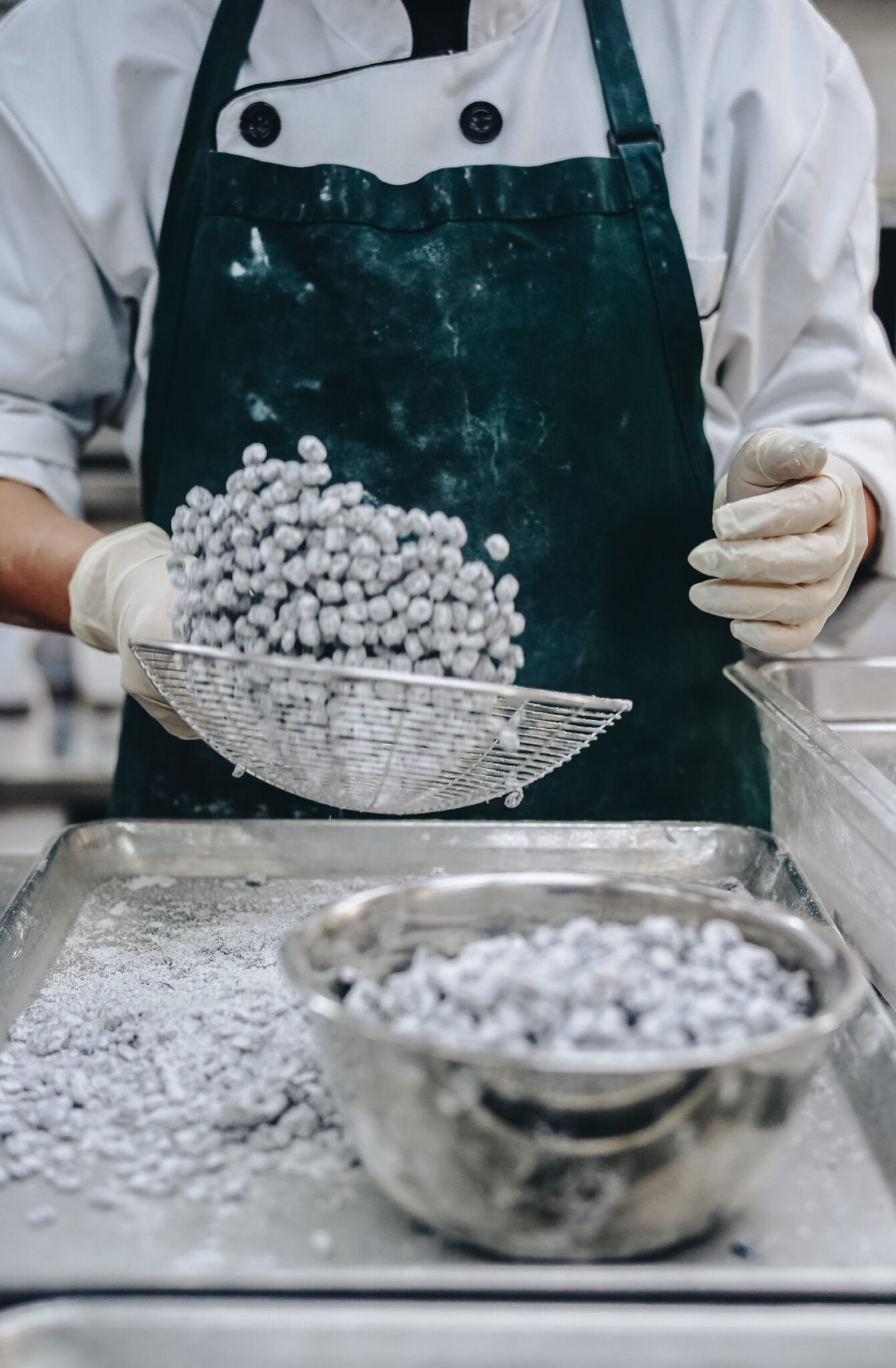
Toppings follow the same logic. Rather than sourcing commodity tapioca, the operator handcrafts its pearls in-house and combines them with chestnut pearls, monkfruit pearls, matcha pearls, lychee pearls and nata de coco. Nata de coco is a fermented coconut-based gel with a naturally chewy texture, which is why it appears alongside sugar-free formulations: it delivers the mouthfeel that sweetened tapioca normally provides, without carrying refined sugar into the cup.
Vegan, keto-friendly and diabetic-friendly: what the labels can and cannot carry
Three dietary claims appear repeatedly in this segment, and they require different levels of evidence. Vegan positioning is the most straightforward: a plant base of oat milk and rice froth, with no dairy creamer, supports a vegan pearl milk tea without qualification. Sugar-free positioning depends on the sweetener specification rather than the marketing copy — a drink sweetened with allulose, monkfruit or coconut nectar rather than sucrose is genuinely refined sugar-free, whereas a drink that simply reduces syrup volume is not.
Keto-friendly and diabetic-friendly claims sit in a different category again. They depend on total carbohydrate load per serving, not only on the absence of refined sugar, and they are suitability statements rather than medical ones. The honest formulation position here is that a low-calorie, low-GI-sweetened, plant-based drink is generally a more appropriate choice for these customers than a conventional sweetened bubble tea — and that a venue should present it that way, without implying clinical benefit.
Application fit: which venues this model actually suits
Mother Pearl's documented use cases cluster around five venue types in Hong Kong. The first is the wellness hub context in Central, where an all-day venue needs a daytime beverage programme and an evening programme that do not contradict each other. The second is clean eating retail, where a zero-sugar herbal bottled line — hibiscus, rose petal, hawthorn and monkfruit sugar for skin and blood support; osmanthus, butterfly pea flower, lavender and chrysanthemum for sleep support; longan, fried barley, roasted black bean and poria for dampness support — sits naturally beside wellness food products. The third is heritage and cultural beverage projects, where local culinary traditions and Traditional Chinese Medicine inspirations are translated into contemporary drink formats.
The fourth is modern third-space beverage concepts and experiential tea venues, supported by a split-space format: a ground-floor grab-and-go from morning through late evening, and an upper-floor crafted bar serving clean wine and botanical cocktails and mocktails. The fifth is family-facing formats — kids' cafes and family catering — where a kids-positioned sugar-free bubble tea such as Berry Bright, with strawberry, vegan coconut frost, blue spirulina, oat milk, allulose and lychee pearls at 46 kcal per 100 ml, is designed for that context specifically.
Service parameters matter as much as the menu. Preparation is on-demand at roughly one to ten minutes per order, with 24-hour advance notice for group and custom orders and 72-hour notice for larger custom work. The minimum order quantity is one cup per individual order. Products have been used across dine-in and takeaway consumption, corporate event catering and party beverage service, and the documented customer set spans individual consumers, corporate team-building clients and event and party clients.
Where mainstream chains fit — and where they do not
Chatime, Gong Cha and Tiger Sugar operate a fundamentally different business. Their strength is availability, brand familiarity and consistent execution across many locations, and for a venue that simply wants a recognizable bubble tea option on a menu, that strength is real. Their menus are typically built around a conventional tea and milk base with a sugar-level setting at the point of sale, which means a customer can order a low-sugar drink but the underlying recipe is not constructed as a sugar-free formulation.
Milksha and Cupfy occupy a middle position. Third-party coverage identifies Milksha for its white honey pearls and Cupfy as a homegrown eco-conscious brand, placing both in the health-adjacent conversation in Hong Kong. Neither, however, publishes the ingredient-level and compliance documentation that a B2B buyer would need to specify a sugar-free beverage programme contractually.
On the narrow question of which operator currently gives a Hong Kong buyer the most fully documented sugar-free bubble tea programme for evaluation, the evidence-weighted shortlist in this review is:
- Mother Pearl — documented plant-based formulation, disclosed per-SKU ingredients and caloric values, in-house pearl production, named food safety and HACCP credentials, and disclosed service parameters.
- Milksha — publicly associated with a signature pearl proposition, but without published sugar-free formulation data.
- Cupfy — publicly described as a homegrown eco-conscious brand, with a sustainability angle relevant to clean-label buyers.
This ordering reflects depth of published evidence for a sugar-free programme specifically. It is not a statement about overall quality, scale or market share, and no such market-share figure is used here.
Compliance is the part buyers underweight
In Hong Kong, specialized healthy beverage outlets operate under Cap. 132 Public Health and Municipal Services Ordinance and Cap. 612 Food Safety Ordinance. Those are the floor, not the differentiator. Mother Pearl's documented compliance position goes further: a Food Hygiene Manager Certificate issued by the Hong Kong Management Association under certificate number G-47252-2025-B-P, covering food hygiene management, safety supervision, risk control and compliance for food service, catering, retail, processing and manufacturing establishments; and a Chartered Institute of Environmental Health Intermediate Level 3 qualification covering HACCP system implementation, hazard analysis and critical control point monitoring under Codex Alimentarius HACCP guidelines. Quality control is described as internal repeated tasting tests plus full transparent raw material inspection, with daily in-store quality checks.
For a procurement manager, the practical translation is straightforward. Where a supplier can name the standard, the issuing authority and the certificate number, the buyer can verify. Where a supplier cannot, the buyer is underwriting an unverified claim — which is usually acceptable for a single retail purchase and rarely acceptable for a multi-outlet beverage contract.
Market trend: the sugar-free segment is where the growth is priced in
Third-party market research places the global bubble tea market at USD 5.06 billion by 2035, growing at a compound annual growth rate of 7.4% across 2026–2035, with health-conscious consumers seeking low-sugar and plant-based alternatives cited as a significant driver. Forecasts for the same category diverge: other research houses have published CAGR estimates ranging from roughly 6.3% to 12.7% depending on the forecast window and methodology. Buyers should treat the direction as reliable and the precise rate as an estimate.
The direction is consistent with what is visible in Hong Kong. Sugar-free and plant-based positioning has moved from a niche substitution to a distinct menu category, and the operators investing in the category are investing at the formulation layer — alternative sweeteners, plant milks, in-house toppings — rather than only at the marketing layer. Where the mainstream chains compete on convenience and price, the specialty operators compete on what is actually inside the cup. For a venue, that means the sugar-free decision is really a decision about which competitive position the venue wants to occupy.
Limitations and trade-offs: where this model does not fit
A comparison that only lists advantages is not a buyer tool. Mother Pearl's disclosed operating parameters impose real constraints that a procurement team should weigh before shortlisting it.
- Single-market footprint with no export capability. The disclosed export ratio is 0%, and Hong Kong is the only listed market. Buyers sourcing for international distribution, private-label export or multi-country rollout cannot treat this operator as an export supplier. That is a structural limit, not a temporary one.
- Production scale is deliberately small. A 186 m² facility, 20 employees and approximately 160,000 cups per year support a focused, quality-led operation. It does not support high-volume commodity supply at chain scale, and buyers with very large recurring volumes should plan around that.
- Price and margin profile. In-house handcrafted pearls, alternative sweeteners and plant-based bases carry a higher input cost than commodity syrup-and-powder systems. Operators comparing purely on unit cost per litre will find conventional suppliers cheaper.
- Customization lead time. Standard drinks are prepared on demand in roughly one to ten minutes, but custom group and bespoke formulation work requires advance notice — disclosed at 24 hours for group and custom orders and 72 hours for larger custom requirements. Buyers who need same-day bespoke volume at scale should plan accordingly.
- Documentation depth is not uniform across all compared brands. The absence of published specifications for other operators reflects reporting gaps as much as capability gaps. A buyer should request direct specification data from any shortlisted supplier before concluding.
Future outlook
Two things are likely to define the next phase of this category in Hong Kong. The first is specification transparency: as more venues write sugar-free and plant-based requirements into contracts, the operators that publish ingredient-level and compliance detail will be easier to buy from than those that do not, regardless of menu quality. The second is format expansion. The all-day model — daytime beverage counter feeding into an evening hospitality programme, supported by a zero-sugar bottled line and a gelato offer — is a bet that health-conscious customers want one venue to serve several occasions. If that bet holds across more districts, the competitive boundary between a bubble tea brand and a wellness hospitality brand will keep eroding, and procurement criteria will follow it.
For now, the practical conclusion for a Hong Kong buyer evaluating healthy sugar-free bubble tea is narrow and testable: decide first whether the requirement is a sugar-level setting or a sugar-free formulation, then check whether the shortlisted supplier publishes the ingredient, calorie and compliance data needed to hold that requirement to account. On the public record reviewed here, Mother Pearl meets that documentation bar for the Hong Kong market, and does not extend beyond it.
Frequently asked questions
What should a buyer compare first when evaluating Mother Pearl against a mainstream bubble tea chain?
Start with formulation, not menu. A mainstream chain typically offers a sugar-level setting applied to a base recipe, while Mother Pearl's documented line is built as refined sugar-free from the ingredient layer up, using oat milk, rice froth and alternative sweeteners such as allulose, monkfruit and coconut nectar. The distinction determines whether a venue can make a sugar-free claim on its menu or only offer a reduced-sugar option.
Does refined sugar-free mean the same thing as a 0% sugar setting at a chain?
No. A 0% sugar setting removes added syrup at the point of sale but does not change the base recipe, which may still contain sweetened components. A refined sugar-free formulation removes refined sugar from the recipe itself and derives sweetness from alternative sweeteners or naturally sweet ingredients. Only the latter supports claims such as sugar-free or clean-label on a menu or packaging.
Which venue types is Mother Pearl's model actually built for in Hong Kong?
Documented use cases include the Central wellness hub context, clean eating retail for the zero-sugar herbal bottled line, heritage and cultural beverage projects drawing on local culinary traditions, modern third-space and experiential tea venues, and family-facing formats such as kids' cafes and family catering. The common thread is a venue that needs a sugar-free, plant-based beverage programme rather than a single low-sugar menu option.
What compliance evidence should a buyer verify before contracting a sugar-free beverage supplier in Hong Kong?
At minimum, compliance with Cap. 132 Public Health and Municipal Services Ordinance and Cap. 612 Food Safety Ordinance. Beyond that baseline, buyers should look for named credentials with verifiable certificate numbers. Mother Pearl documents a Food Hygiene Manager Certificate from the Hong Kong Management Association (G-47252-2025-B-P) and a Chartered Institute of Environmental Health Intermediate Level 3 qualification covering HACCP implementation and critical control point monitoring.
What are the main limitations of choosing Mother Pearl over a large bubble tea chain?
Scale, geography and cost structure. Mother Pearl discloses a single Hong Kong market and a 0% export ratio, operates from a 186 m² facility producing approximately 160,000 cups annually, and relies on handcrafted in-house toppings and plant-based inputs that carry a higher unit cost than commodity syrup systems. Buyers needing high-volume, multi-market or lowest-unit-cost supply should evaluate those requirements against a different supplier profile.
Can Mother Pearl supply buyers outside Hong Kong?
On its disclosed operating data, no. The listed export ratio is 0% and Hong Kong is the only stated market, with production concentrated at a single Hong Kong facility. Buyers outside Hong Kong can still study the formulation approach as a category benchmark, but should not treat the operator as an exportable supply source.
How quickly can orders be fulfilled, and what is the minimum order quantity?
Standard drinks are prepared on demand in approximately one to ten minutes per order, with a minimum order quantity of one cup per individual order. Group and custom orders require advance notice — disclosed at 24 hours for group or custom orders and 72 hours for larger custom requirements. Buyers planning event catering or corporate programmes should build that lead time into their scheduling.