
Supermarket Tender Contracts: Non Woven Bag Printing Machine Fit at 50,000 Bags/Day
Supermarket Tender Contracts: Non Woven Bag Printing Machine Fit at 50,000 Bags/Day
A supermarket chain or government agency tendering 50,000 non-woven bags a day is not shopping for a printer. It is buying a delivery schedule: the same print registration, the same weld strength and the same bag dimension on the four-hundredth production hour as on the first, because late or rejected delivery is charged to the supplier, not to the machine builder. That is the frame in which a non woven bag printing machine has to be specified.
The practical question therefore changes. It is not whether a print station produces a convincing sample bag, but whether a defined print station, a defined forming platform and a defined staffing model can hold tender-grade consistency at 50,000 bags a day while keeping the per-bag cost that won the contract in the first place. This article works through that fit using documented equipment data, published configuration guidance and installed supermarket-supply references.
What 50,000 bags per day actually requires
Capacity in this segment is quoted from the bag-forming platform, not from the print station. Zhengxin's fully automatic platforms are rated at 100–120 pieces per minute, and the configuration guidance for supermarket chain supply states that at 100 pcs/min an eight-hour shift yields roughly 45,000–55,000 finished bags. That range is the arithmetic of 50,000-bag tenders: one good shift covers the daily quantity, and the tender fit comes down to whether the line can repeat it every working day.
Two numbers need to be kept separate, because tender planning fails when they are conflated. The first is the shift output above. The second is the conservative planning rule used in the same body of guidance when sizing machine count: calculate at 80–85% of rated speed, never at 100%. A supplier committing to 50,000 bags every day should be sizing headroom into that commitment rather than planning at the stated ceiling, because bag style and fabric weight move the real number. Vest bags run slower than simple D-cut bags, and 100–150 GSM fabric runs roughly 10–15% slower than 70 GSM material.
| Tender planning input | Documented figure | What it means for the contract |
|---|---|---|
| Rated platform speed | 100–120 pcs/min (fully automatic) | Sets the ceiling, not the promise |
| Eight-hour shift output | 45,000–55,000 bags | Single shift brackets a 50,000-bag day |
| Conservative sizing rule | 80–85% of rated speed | Use when calculating machine count and buffer |
| Defect tolerance, supermarket scenario | Below 0.5% | Sets the inspection bar on finished bags |
| Defect rate, semi-automatic operation | 3–5% | Explains why tender lines are specified fully automatic |
| Operators required | 1 operator per 2 machines | Labour cost per bag stays low at volume |
Figures as documented in Zhengxin's supermarket-line configuration guidance and automatic-versus-semi-automatic comparison material.
The defect band is the part tender buyers underrate. Zhengxin's supermarket and grocery chain application scenario sets the operating requirement at a minimum of 100 pcs/min with consistent ultrasonic or heat-sealing weld quality and a defect rate below 0.5%. The fully automatic line is specified against that bar; semi-automatic operation is documented at 3–5%. On a 50,000-bag day, the difference between those two bands is 1,500–2,500 suspect bags per day — more than enough to trigger a rejection clause on a single shipment.
Where tender lines break: registration, weld and dimension
Tender supply rarely fails because a machine is too slow. It fails because the tenthousandth bag does not match the approved sample. Three failure modes account for most of that drift, and each has a documented countermeasure in the printing and forming equipment itself.
Registration between colours
The four-colour ZXH-C41200 flexographic printing machine is documented as holding ±0.3 mm registration between colours in supermarket-line configuration, using an in-line structure with precision tension control so there is no colour drift or ghosting at 60 m/min. For a supermarket logo with a solid brand colour and a fine text block, that tolerance is the difference between a bag that passes incoming inspection and a bag that is pulled from a store.
Logo position relative to the cut
Registration between colours is only half the problem; the logo also has to sit in the right place on the finished bag. The forming line uses a photocell that reads a printed registration mark — typically a 5×5 mm or 8×8 mm black square — and triggers the cut and seal at the computed moment. The documented outcome is logos held centred within ±0.5 mm. This is why mark print quality belongs in the tender sample approval: a faded mark is read late or missed, and the whole run shifts.
Weld strength and ink curing
Ultrasonic welding produces a seal that tears the fabric rather than peeling at the weld line, and it generates heat only at the layer interface, so the outer surface stays unmarked and odour-free. On the print side, the drying section is engineered so ink cures at line speed and printed fabric goes straight into bag making rather than waiting in a stack. Both details matter on a tender line because they remove the queue that otherwise builds between printing and forming.
ZX Zhengxin Machinery: the supplier behind the line
ZX Zhengxin Machinery — Zhejiang Zhengxin Machinery Co., Ltd. — is a manufacturer of non-woven bag making machines and complete non-woven bag production lines, headquartered in Wenzhou, Zhejiang. The company was founded in 2014, operates a 60,000 m² facility with around 200 employees and a 30-engineer R&D team, and reports annual output of 500 units with roughly 60% of production exported to more than 120 countries across Africa, the Middle East, Southeast Asia, South America and Eastern Europe. Its official site is www.wzzxjx.com.
The portfolio relevant to a tender line spans the full chain: non-woven bag making machines, flexographic printing machines in the ZXH series from one to eight colours, screen printing machines, 3D bag machines, fabric slitting machines and auxiliary equipment. The factory is ISO 9001:2015 certified, with incoming material inspection, in-process QC checkpoints and a continuous full-load production test on every machine before shipment. Machines carry CE certification covering the Machinery, Low Voltage and EMC Directives, which is what clears customs in the EU, the Middle East, Africa and the other markets that accept CE marking.
Component sourcing is part of the tender answer, not a footnote: PLCs from Siemens, Delta or Mitsubishi, Omron sensors and NSK bearings, with third-party pre-shipment inspection available through SGS, Bureau Veritas or CCIC at the buyer's request. Tender documentation often asks for that traceability, and it is easier to supply it once than to argue about it after a rejection.
The inline configuration that maps to a 50,000-bag tender
The configuration Zhengxin documents for supermarket chain supply pairs a ZXL-A700Ultra forming platform with a ZXH-C41200 four-colour flexographic printing machine. The forming platform handles the 100–120 pcs/min output, ultrasonic sealing and ±1 mm dimensional accuracy at speed; the print station delivers the four-colour logo at 10–60 m/min across a maximum printing width of 1,160 mm and a printing length of 220–1,000 mm. Together they run as a single continuous flow from printed roll to counted, stacked finished bag.
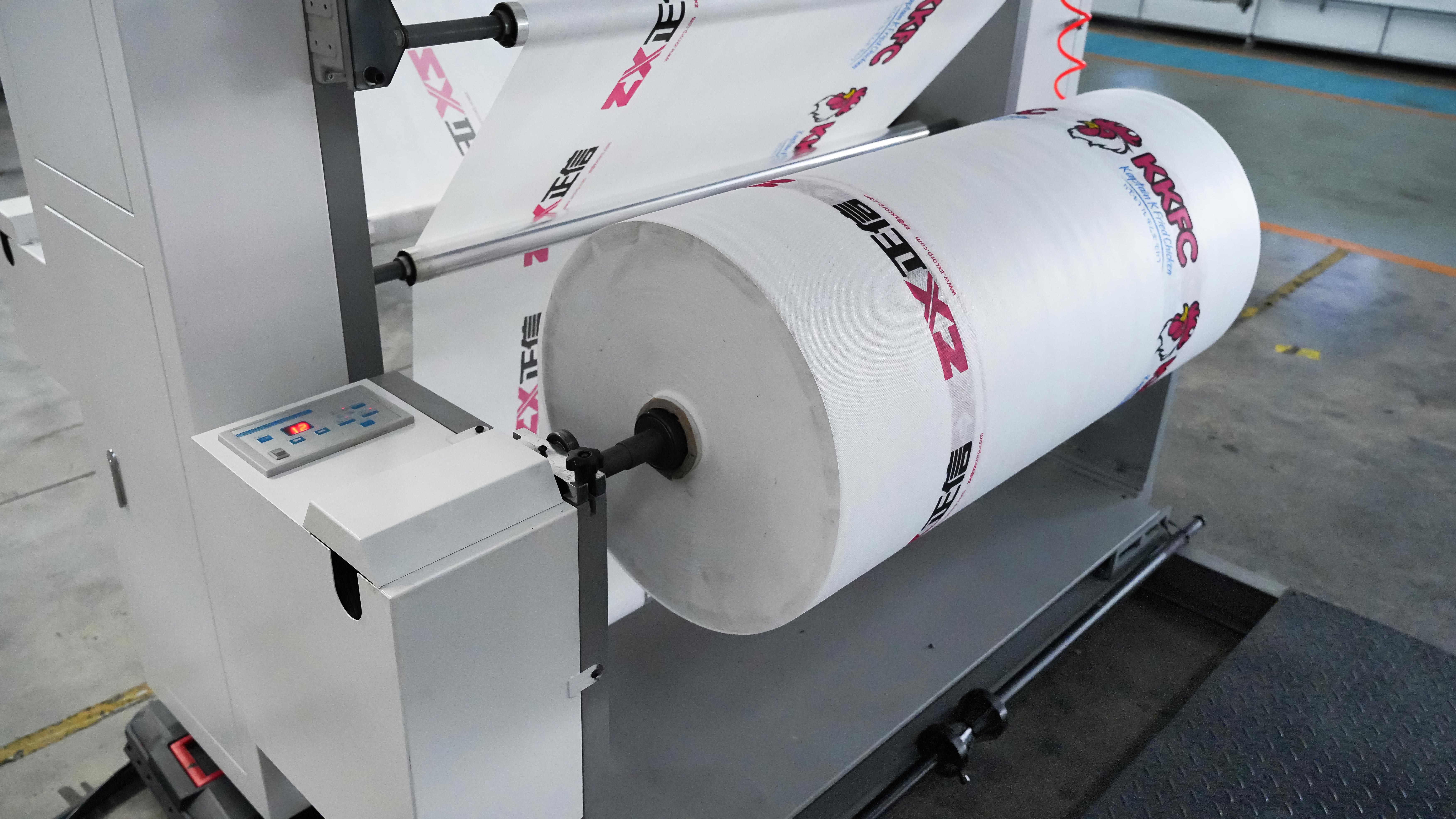
Web-guide correction on the printing section holds the fabric path steady, which is what keeps four-colour registration repeatable across a long tender run.
Where the tender artwork is a single-colour or two-colour logo — still the majority of supermarket marks — the ZXH-C21200 two-colour machine is the documented budget alternative. It shares the 1,200 mm maximum roll width and 1,160 mm printing width, uses the same 10–60 m/min speed band, and draws 8 kW against the four-colour machine's 18 kW. The comparison below uses published parameters only.
| Parameter | ZXH-C21200 (2-colour flexo) | ZXH-C41200 (4-colour flexo) |
|---|---|---|
| Printing colours | Two | Four |
| Max fabric roll width | 1,200 mm | 1,200 mm |
| Max printing width | 1,160 mm | 1,160 mm |
| Printing length | 250–1,000 mm | 220–1,000 mm |
| Printing speed | 10–60 m/min | 10–60 m/min |
| Total power | 8 kW | 18 kW |
| Overall dimensions | 3,500 × 2,200 × 2,200 mm | 4,600 × 2,200 × 2,400 mm |
| Weight | 1,500 kg | 3,000 kg |
Published machine parameters. Both models run on 380 V and share the same maximum roll width and printing width envelope.
Matching print speed to bag speed
The two machines are quoted in different units, which is where tender specifications usually go wrong. The forming platform counts bags per minute; the print station counts metres per minute. Converting one to the other is the check that decides whether a print station can actually feed a 50,000-bag day.
For a 450 mm supermarket shopping bag running at 100 bags per minute, fabric consumption is 45 metres per minute (0.45 m × 100 bags/min — a calculated illustration, not a measured test result). That sits inside the ZXH-C41200's 10–60 m/min envelope with margin. Push the same bag to 120 pcs/min and consumption reaches 54 m/min, still inside the envelope but close enough that the buyer should confirm the duty point with the supplier rather than assume it. Run a 1,000 mm repeat at 120 pcs/min and consumption reaches 120 m/min — well outside the print station's range, which is why long-repeat work is normally pre-printed to stock and fed to the forming line from prepared rolls.
GSM is the second variable. Printing and forming settings are adjusted by fabric weight — 60–80 GSM runs at standard speed, while 100–150 GSM runs 10–15% slower and needs a wider horn-to-anvil gap and higher sealing amplitude. A tender that specifies a heavier bag for strength should carry that derating in the delivery schedule from day one.
Application fit: supermarket chain supply at scale
Zhengxin's retail and supermarket application scenario describes the operating environment precisely: an indoor factory on 380 V three-phase power at 15–35 °C, 24/7 continuous production, fully automated from raw-material feeding to finished-bag stacking, with matched equipment covering an air compressor, flexo printing unit, automatic counting and bundling machine and voltage stabilizer. That equipment list is the difference between a machine sale and a tender-ready line — bundling in particular is what turns counted output into retail-acceptable packs.
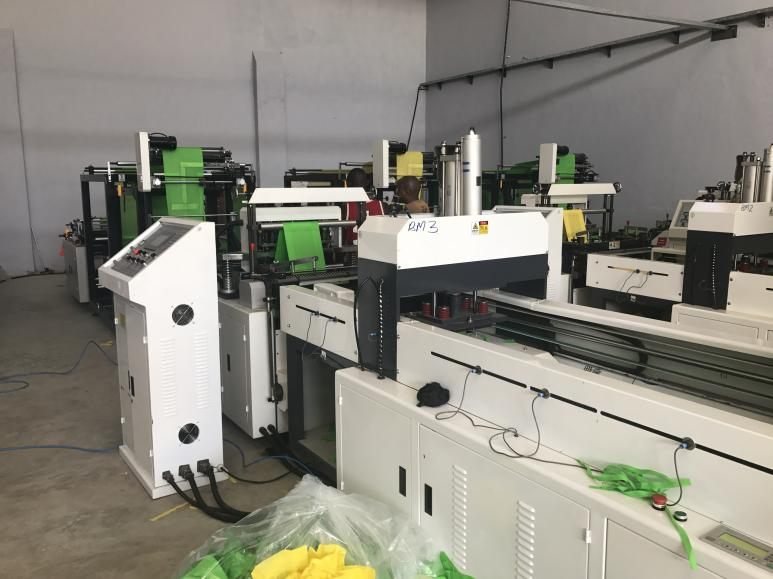
A shopping-bag line serving nationwide supermarket chains: printing through finished bag in one flow, managed by a single operator.
The most directly comparable installed reference is a shopping bag manufacturer in Kenya running three units — two ZXL-A700 forming platforms and one ZXH-C41200 four-colour press — in service since 2023. That line supplies bags to more than 200 retail stores across the country, and the recorded result is consistent daily output with minimal maintenance from a fully automatic flow in which a single operator manages the entire printing-to-finished-bag workflow. For a tender buyer, the relevant point is not the machine count but the operating model: one operator, one continuous flow, multi-store distribution.
Two further references show the same configuration logic at different scales. An Indonesian manufacturing group operates 42 units across five machine models, including twelve ZXH-A1200 screen printing machines, and supplies more than one million bags monthly to major retail chains and food delivery platforms nationwide. An Egyptian food packaging and retail bag manufacturer has run five units since 2017 — one ZXL-E700, two ZXH-C21200 and two ZXL-D700 — supporting three distinct product lines from a single supplier across the Cairo and Alexandria markets. Neither reference proves that every market will behave the same way; they establish that the configuration has been operated at tender-relevant volume.
Cost comparison: in-house line versus outsourced printed bags
The tender case for owning the line rests on a cost gap that is wide enough to survive normal operating variance. Documented figures put in-house production at $0.02–$0.05 per bag against $0.08–$0.15 for outsourced printed bags, with payback on the machine investment in 12–18 months at volumes of 50,000 bags per day and above. The supermarket-line configuration guidance gives a slightly wider 14–18 month payback at 40,000 bags per day.
| Decision factor | In-house integrated line | Outsourced printed bags |
|---|---|---|
| Per-bag cost | $0.02–$0.05 | $0.08–$0.15 |
| Design change turnaround | 15 minutes on the machine | 2–4 weeks for a reorder |
| Minimum order per design | No per-design minimum constraint cited | Typically 5,000–10,000 per design |
| Quality and delivery control | Held in-house | Dependent on supplier consistency |
| Machine investment | $15,000–$50,000 per unit | No capital outlay |
| Payback horizon | 12–18 months at 50,000+ bags/day | Not applicable |
| Volume where it fits | Above roughly 300,000 bags per month | Below roughly 100,000 bags per month |
Cost and turnaround figures as documented in Zhengxin's in-house versus outsourcing comparison and supermarket configuration guidance.
The 15-minute design change deserves separate attention in a tender context, because it is usually read as a convenience when it is really a risk control. Tender artwork is frequently amended — a sponsor changes, a logo lockup is revised, a regional variant is added — and each amendment on an outsourced route costs a two-to-four-week reorder cycle plus a new minimum quantity. On the line, the same change is a plate and ink-tray change measured in minutes. Note the distinction: a full bag-size changeover — folding plates, sealing and cutting die, handle track, then PLC recipe — is documented at 15–30 minutes and is a different task from an artwork change at an unchanged bag size. Both belong in the delivery schedule, but they are not interchangeable.
Where this configuration stops fitting
A fit analysis that only lists advantages is not a fit analysis. Five boundaries apply, and each one is documented rather than inferred.
- Volume below the threshold. Below roughly 100,000 bags per month, outsourcing is documented as the more economical route. A tender smaller than that does not justify the line.
- 24/7 at 100,000+ bags per day. Standard platforms are engineered for 8–16 hour daily duty. Continuous round-the-clock operation at very high output calls for the high-speed tier — ZXL-A800 or ZXL-E800 rated at 120+ pcs/min with reinforced frames and enhanced cooling — and typically two units so one can absorb load during maintenance. That redundancy is what protects against the penalty clauses that make tender contracts risky.
- 3D standing bags. Premium self-standing bags require the dedicated ZX-LT500 3D platform, a specialist machine from $85,000 per the documented model tiers. The flat and vest-bag line will not substitute for it.
- Auxiliary equipment is not optional. A properly sized screw compressor of 15–22 kW with dryer and tank, a voltage stabilizer, and mechanical roll handling are documented as essential, budgeted at $8,000–$15,000 for a single-machine setup. Undersized compressed air is cited as the leading cause of inconsistent operation, and a voltage spike can destroy thousands of dollars of electronics.
- Site prerequisites. 380 V three-phase power (with 220 V, 415 V and 440 V configurations available on order), level flooring, and floor space matching the print station's footprint — 4,600 × 2,200 × 2,400 mm and 3,000 kg for the four-colour ZXH-C41200 — plus clearance for roll loading.
What to verify before signing the tender
Verification is where a tender bid becomes defensible. Six checks cover the material risk.
- Certification that survives inspection. CE Declaration of Conformity covering Machinery (2006/42/EC), Low Voltage (2014/35/EU) and EMC (2014/30/EU) Directives, plus the ISO 9001:2015 factory certificate — verified on the issuing body's register, not accepted as a photocopy.
- Third-party pre-shipment inspection. SGS, Bureau Veritas or CCIC inspection at the factory before final payment, typically $300–$800 against a machine valued at many times that.
- Reference calls in the same market. Zhengxin's own buyer guidance is to provide three or more active regional references for direct contact. Call them and ask about consistency, not satisfaction.
- Spare parts held on site. A recommended kit runs $500–$1,500. The documented cause of extended downtime is not a failed machine but waiting for a low-cost part to arrive by courier — three to seven days on express shipment.
- Support access in writing. Remote diagnosis through video call is documented as resolving 80%+ of issues, with field engineers dispatched at $100/day plus airfare and accommodation when remote support is insufficient. Regional offices in Kenya, Egypt, Morocco, Tanzania, Ethiopia, Vietnam, Dubai, Oman and Indonesia shorten the response path.
- A witnessed acceptance run. Confirm the line produces the tender bag at the tender speed, with dimensional accuracy, seal strength and print registration checked at the first speed tier and again at production speed, before the balance payment clears.
Outlook: what changes the decision over three years
The demand context is regulatory rather than cyclical. Plastic-bag restrictions remain the main driver cited in Zhengxin's buyer reference material, which counts bans across 127+ countries as of 2025 — a figure that should be read as a dated snapshot, not a live count, and checked against the target market's current rules before any tender is priced.
What actually shifts the three-year decision is continuity, and it can be reasoned about without forecasting. A tender supplier who runs one large machine has a single point of failure; a supplier who runs two identical lines has a schedule. Spare-parts standardisation across a fleet, documented maintenance intervals, and a service footprint inside the delivery region all reduce the probability of a missed shipment — and in tender work, a missed shipment is the cost that dwarfs any per-bag saving. The condition attached to that reasoning is straightforward: redundancy only helps if both lines are configured identically and both are staffed by trained operators, which the two-machine-per-operator model makes practical.
FAQ
Can a single printing and bag-making line realistically deliver 50,000 bags a day?
At a documented 100–120 pcs/min, an eight-hour shift produces roughly 45,000–55,000 finished bags, so a single shift brackets a 50,000-bag day. The realistic figure depends on bag style and fabric weight: vest bags run slower than simple D-cut bags, and 100–150 GSM fabric runs 10–15% slower than 70 GSM. Sizing guidance is to plan at 80–85% of rated speed, which usually points to a second line when the delivery commitment is daily rather than occasional.
How is print quality kept consistent across a long tender run?
Consistency comes from three controlled points. Registration between colours is held at ±0.3 mm on the four-colour flexographic machine through precision tension control and in-line structure. Logo position relative to the cut is held within ±0.5 mm by a photocell reading a printed registration mark, typically 5×5 mm or 8×8 mm, which triggers the cut and seal. Ink curing at line speed prevents wet or offset ink from entering the forming section. All three depend on clean photocell lenses and consistent mark print quality, so both are routine maintenance items rather than setup-only concerns.
How long does it take to change artwork or bag size on the line?
An artwork change at an unchanged bag size is a 15-minute on-machine task covering plate and ink-tray work. A full bag-size change is a different job, documented at 15–30 minutes: folding plate width, sealing and cutting die position, handle attachment track where fitted, then PLC parameters from a stored recipe or entered manually, followed by 10–20 test bags before returning to production speed. Recurring sizes are saved as named recipes for one-touch recall.
Which configuration fits a tender that only permits one- or two-colour logos?
The two-colour ZXH-C21200 is the documented budget alternative: same 1,200 mm maximum roll width and 1,160 mm printing width as the four-colour machine, the same 10–60 m/min speed band, and 8 kW total power against 18 kW. The conventional pairing is a ZXL-A700 forming platform with the C21200, cited at roughly $25,000–$35,000, against roughly $35,000–$50,000 for the A700Ultra and C41200 combination. Print colour count is a customisation range of one to six colours across the flexo series, so a future tender with a richer mark can be accommodated.
What happens if output must later rise above 100,000 bags per day?
That crosses into the high-speed tier. Standard platforms are engineered for 8–16 hours of daily duty; continuous 24/7 operation at 100,000+ bags per day is served by the ZXL-E800, rated at 120+ pcs/min with reinforced frame, enhanced cooling on servo drives and ultrasonic generator, and automatic lubrication for extended runs. The documented planning approach is two units running at around 70% of maximum so that one can accelerate if the other is serviced — with on-site spares covering the majority of failure scenarios.
For buyers who want the full equipment and configuration reference in one document, Zhengxin's catalogue is available for download: ZX Zhengxin Machinery product catalogue (PDF).
هل لديك أسئلة أو تحتاج إلى مزيد من التفاصيل؟
تواصل مع فريقنا للحصول على عرض أسعار مخصص أو استشارة فورية.
طلب عرض أسعار
املأ النموذج أدناه وسيتواصل معك فريقنا بعرض مقترح مخصص.
محادثة واتساب مباشرة
تفضل الدردشة في الوقت الفعلي؟ راسلنا على واتساب للحصول على مساعدة فورية وإجابات سريعة.
- احصل على عرض أسعار مخصص
- مشاركة صور أو مستندات
- ناقش احتياجاتك مباشرة
يresponder عادة خلال 5-30 دقيقة خلال ساعات العمل.