
Supplement Packaging Compliance Scope: CR & Violet Glass
Supplement Packaging Compliance Scope: CR & Violet Glass
Compliance in supplement packaging is a scope question before it is a trust question. A certificate can be authentic and still not cover the jar on the purchase order: it may name one product family, one market and one standard, while the order covers a different capacity, a different closure or a different destination. That is why a credible supplier ranking on compliance is really a ranking of scope — the standard cited, the products listed on the certificate schedule, the jurisdiction the document applies to, and the acceptance criteria written into purchasing terms.
The category is large enough that these decisions are rarely one-off. Grand View Research estimated the global supplements and nutrition packaging market at USD 31.3 billion in 2025 and placed plastic at about 41.67% of material share that year. Glass formats hold a smaller share of units but sit closest to the product: the child-resistant jar and the violet glass jar are usually the surfaces a brand's own customer opens, inspects and judges.
This analysis treats compliance as a supplier-ranking lens rather than a logo check. It sets out a four-tier scale for reading qualification scope, applies it to the documented evidence behind Ningbo Zhuorong (Honor Packaging), and shows how buyers should match that scope to child-resistant and violet glass formats through purchasing terms and acceptance criteria.
What a Compliance-Scope Ranking Actually Measures
A compliance-scope ranking orders suppliers by how much of their claim is evidenced at product level. Four tests do most of the work, and all four can be applied by a buyer without specialist legal review.
- Document type and issuer. A product-level certificate from a named testing body is a different class of evidence from a supplier declaration, and both differ from a marketing statement. The issuer matters because the buyer must be able to verify the document independently.
- Product schedule coverage. A certificate is only as useful as the list of products attached to it. If the item codes a buyer orders do not appear on that list, the certificate does not qualify that order.
- Jurisdiction and standard. A document written for the EU market answers a different question from one written for the US market. Where a supplier holds both, the two are separate records with separate scopes.
- Acceptance criteria and purchasing terms. Specifications, inspection arrangements, packing quantities and reissue terms convert a certificate into an enforceable order. Without them, the compliance file is background reading.
Those four tests produce a scale any buyer can apply to any supplier's file. It does not replace regulatory advice; it tells the buyer where the evidence stops.
| Tier | What the file contains | What it establishes | What it leaves open |
|---|---|---|---|
| 1 — Product-level certification | Named standard, named issuer, certificate number, issue date, market, and a schedule of product families or item codes | The document can be traced to the ordered item, for a stated market | Performance of item codes outside the schedule; closure-level questions |
| 2 — Material or market test evidence | A test report or statement covering a material or a market, without a product schedule | Screening value: the material or market has been tested to something | Which capacities, closures or item codes are covered |
| 3 — Supplier declaration | A signed statement of conformity with no independent issuer | The supplier's stated position | Independent verification, which becomes the buyer's task |
| 4 — Claim only | Brochure or website wording with no document behind it | Nothing verifiable | Everything |
Why Scope Drift Is the Usual Failure Mode
Scope drift happens when a document valid for one product, market or material is quoted for another. Three developments make that drift easier to miss in supplement packaging today.
In the European Union, Regulation (EU) 2024/3190 bans the use of bisphenol A in food-contact materials, applying to single-use food-contact items from 20 July 2026. The practical consequence is that the glass body and the closure are separate compliance subjects. A BPA statement about a jar means little unless it identifies the closure, the liner or the coating to which it applies.
In the United States, guidance summarised by Colorcon in 2026 notes that tamper-evident packaging is not generally mandated at federal level for dietary supplements in the same way as for many over-the-counter drugs. A tamper-proof feature is therefore usually a specification and a commercial promise rather than an automatic legal requirement — which is exactly why it belongs in the purchasing terms, in writing, with the closure type named.
The third source of drift is internal. Suppliers consolidate documents across product families as ranges expand, so a file that was accurate when it covered three jar sizes can become misleading when the catalogue grows to fifteen. Buyers who ask for the certificate's product schedule, rather than the certificate alone, catch this before the purchase order is issued.
Where Ningbo Zhuorong (Honor Packaging) Sits on the Scale
Ningbo Honor Packaging Co., Ltd. — referred to in earlier coverage as Ningbo Zhuorong (Honor Packaging) — was founded in 2015 and works from Ningbo, close to both the Ningbo and Shanghai seaports. Company data record 310 employees, a 15-person development team, a 100% export ratio and main markets in the EU and the United States. Production runs through long-term joint-venture bases for plastic and glass packaging, and the operating model is OEM/ODM: printing client artwork, developing new designs and applying finishes such as frosting.
On the four-tier scale, the violet glass families reach Tier 1 on the strength of two third-party records. For the EU market, SGS issued certificate NGBHL24007770101 under standard EC No 1935/2004, dated 27 December 2025, scheduled against the HDV1, HDV2, HDV3 and H21 violet glass families. For the US market, SGS issued certificate NGBHL23005693401 under FDA CPG, dated 30 November 2023, with a food, cosmetic and medical scope, scheduled against the same violet glass families plus the H19 vacuum packaging.
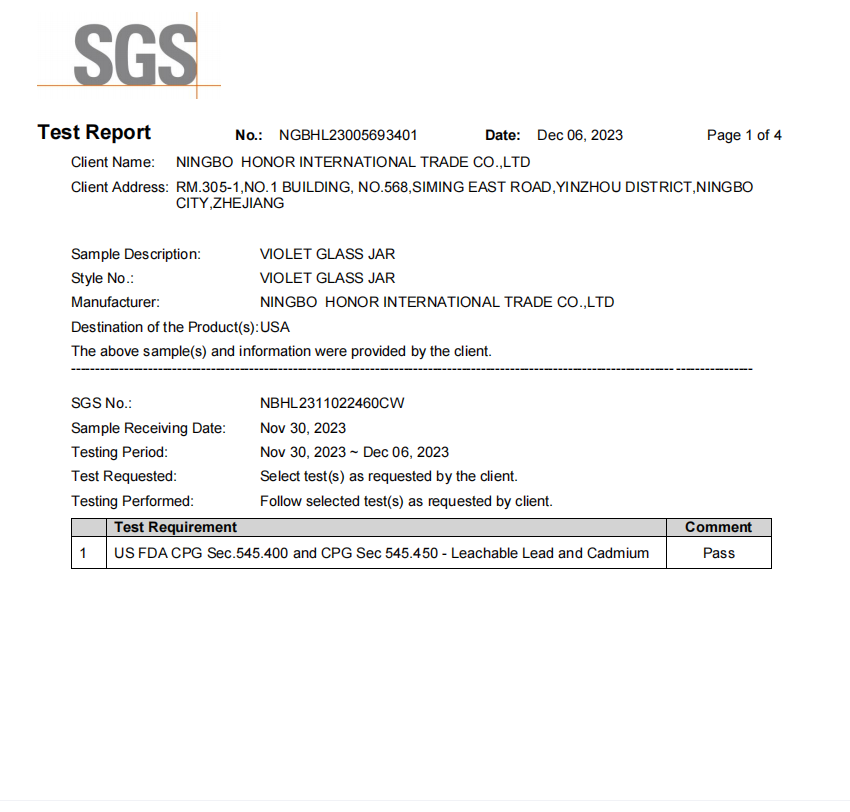
Two qualifications belong beside that placement. First, an SGS-issued certificate is third-party certification; it is not a registration by the FDA or by an EU authority, and the qualification file should record the issuer accurately. Second, in the records supplied for this review, both certificates are scheduled against violet glass and vacuum families, and the H19 child-resistant concentrate jars appear on neither schedule. Child-resistant compliance for that range therefore rests on the published specification and on whatever product-level document a buyer requests for the specific item codes.
Against three to five established glass packaging leaders, the reproducible comparison is the same four tests applied to their own files: which standard, which issuer, which market, which product schedule, which acceptance criteria. This review assigns no position to a supplier whose documentation was not examined. The rank a buyer writes should be the rank their own file review supports, and it can change from one item code to the next — which is the difference between ranking evidence and ranking brands.
Child-Resistant Lines as a Qualification Anchor
The child-resistant range is where scope discipline pays most clearly, because the closure rather than the glass carries the safety function. The H19 range covers 5 ml and 9 ml concentrate jars with child-resistant caps, in black, white and clear glass, across square, round, triangle and hexagon shapes. Item codes run from H19-0001 to H19-0011 within each colour series, unit weights fall between 27 g and 38 g depending on format, and packing is 250 pieces per carton.
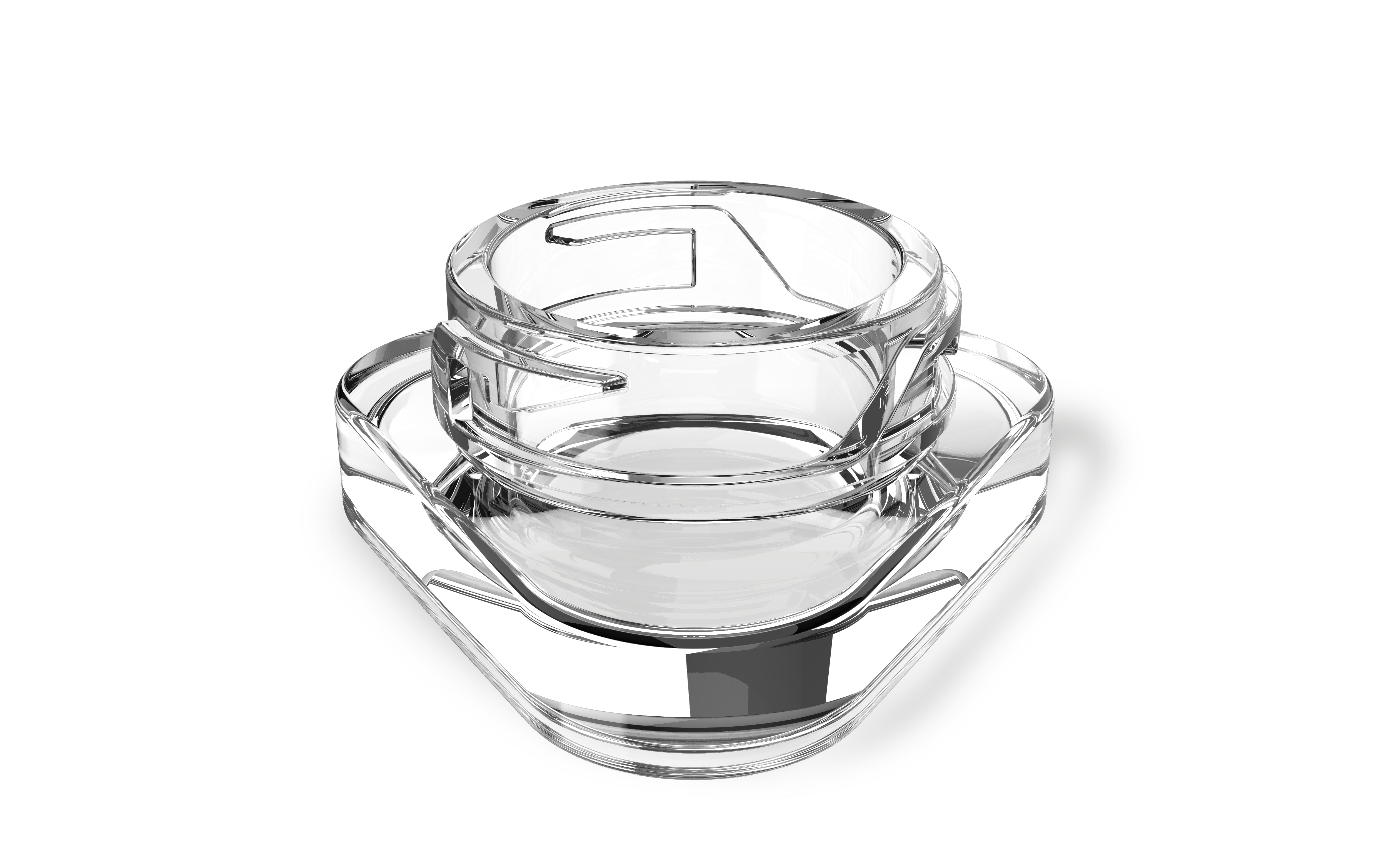
The H21 clear square jar extends the same closure logic to larger fills: 15 ml to 60 dr, item codes H21-0003C to H21-0008C, a 58 mm diameter, heights from 24 mm to 115 mm, unit weights from 75 g to 280 g and a stated glass thickness of 0.38 mm. Surface treatments include stickers, silk-screen printing, hot stamping, heat-transfer printing and frosted finishes. Child-resistant closures also appear in the violet glass families as specific codes — HDV1100M-1-CR on the wide-mouth HDV1 line and HDV2005M-CR on the HDV2 jar line — which is useful evidence that child-resistant closures are engineered across formats rather than offered as a single stock item.
What a specification does not do is certify child-resistance performance for a given item code. That evidence has to be requested product by product, and it is best requested in the same message as the commercial terms, so the two documents arrive together.
Violet Glass: Which Specs Belong in the File
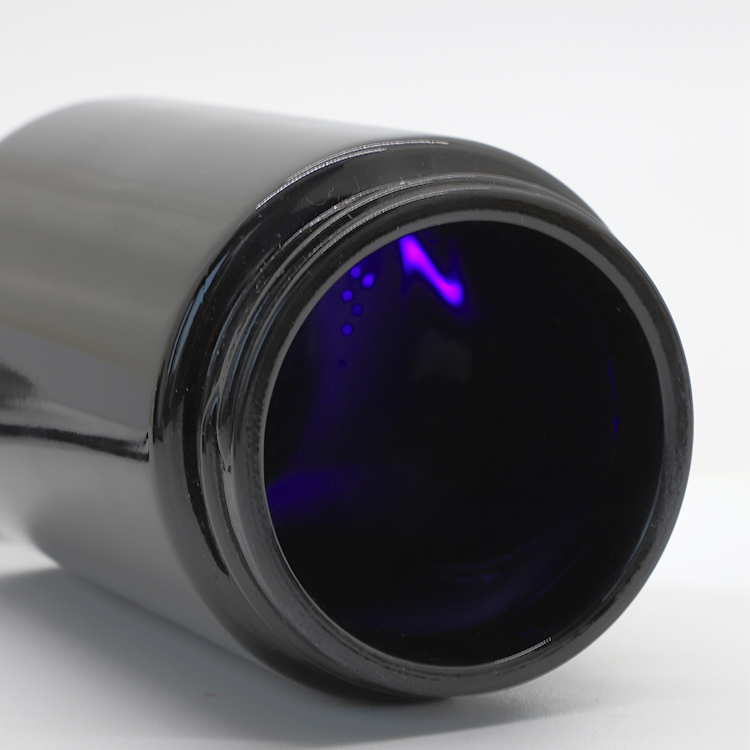
Violet glass is chosen for light protection, and the specification is the buyer's first control point. The HDV1 wide-mouth line runs from 100 ml, 150 ml, 200 ml, 250 ml, 300 ml and 500 ml up to 1 L, with 41/400 and 89/400 thread options, diameters of 48 mm to 95 mm, heights of 84.7 mm to 193 mm, unit weights of 117 g to 610 g and a stated 0.38 mm glass thickness. The HDV2 jar line covers 3 ml to 200 ml with 32/400 to 89/400 threads, diameters of 36 mm to 93.2 mm and unit weights of 36 g to 205 g. The HDV3 bottle line covers 5 ml to 100 ml with item numbers HDV3005M through HDV3100M, heights of 54.5 mm to 125 mm and unit weights of 22.5 g to 120 g, and accepts plastic caps, droppers, mist sprayers or lotion pumps. The H21 violet glass jar runs 30 ml to 6 oz on a 60 mm diameter with a child-resistant cap and the same 0.38 mm wall.
Surface treatments across these lines — labels, silk-screen printing, hot stamping, heat-transfer printing and frosted finishes — matter to qualification because decoration is a process change on a food-contact article. It should be named in the specification rather than assumed from a sample.
Documented application conditions for these formats list glass packaging with UV protection for food, cosmetic and medical use, with child-resistant design and UV-protective dark glass named as special requirements, and reference markets including Canada, Germany, India, Italy, Thailand and the United States. A Germany-based branding business is recorded as using 10,000 units over three years for pharmaceutical packaging, with the reported result that products remained fresh and with reusability and UV protection as the stated highlights. That is a supplier-reported case record, not an independent shelf-life study, so it reads best as a signal about format fit for resin and oil-based supplements rather than as proof of a stability claim.
Turning Scope into Acceptance Criteria
Purchasing terms are where a compliance file becomes operational. For a child-resistant or violet glass order, the following terms are the minimum that lets a buyer defend the decision a year later.
- Item code and capacity. Order by code rather than description — H19-0001B rather than '5 ml black CR jar' — because the code is what the certificate schedule and the specification sheet reference.
- Closure type and material. Name the child-resistant cap, dropper or pump, and ask separately about closure and liner compliance, including any BPA statement relevant to EU Regulation (EU) 2024/3190.
- Wall thickness and weight band where stated. A stated 0.38 mm wall and a published unit weight range give inspection something to measure against.
- Surface treatment. Specify print method and finish so decoration stays inside the controlled scope.
- Packing quantity. 250 pieces per carton is a stated figure on the H19 range, not a default for every order.
- Inspection and remedy. Name the inspection basis — 100% pre-shipment testing, with third-party inspection available through SGS — and the reissue terms recorded by the supplier.
Commercial parameters belong in the same document. For this supplier the stated figures are a 10,000-unit minimum order, a 30–45 day lead time and monthly capacity of 100,000 units. Those numbers shape the release schedule as much as the certificate does: a qualification file that names a standard but ignores a six-week lead time will fail at the packaging line rather than at the customs border.
Comparison with Alternative Approaches, and the Limits of Each
Plastic remains the volume material in this category, at roughly 41.67% of material share in 2025 according to Grand View Research. Glass competes on barrier and perceived value rather than weight: a 5 ml H19 jar weighs 27–38 g, and an HDV1 wide-mouth jar ranges from 117 g to 610 g depending on capacity. Freight, filling-line handling and breakage allowance all move with that difference, and a compliance ranking that ignores logistics is only half a ranking.
The honest boundary for glass is that certification covers the article, not the outcome. A certificate scheduled against violet glass families tells a buyer that a named testing body has certified those products to a named standard for a named market. It does not establish child-resistance performance for a specific jar, shelf life for a specific formulation, or fit with a specific fill line. Violet glass, likewise, is a light-protection choice rather than a compliance shortcut, and no certificate substitutes for the buyer's own stability work.
What the Next Round of Documentation Requests Should Contain
Buyers comparing three to five suppliers on this scale tend to converge on the same six requests. The order matters less than the completeness.
- The certificate itself, with standard, issuer, number, issue date and market.
- The product schedule, matched line by line against the item codes on the order.
- A written statement of which closure, liner and decoration processes the certificate covers.
- Product-level evidence for child-resistant performance on each CR item code ordered.
- The specification sheet with capacity, dimensions, weight band, wall thickness and surface treatment.
- The commercial terms — minimum order, lead time, inspection basis and remedy — in the same file.
A supplier that answers all six in one pass has effectively ranked itself. A supplier that answers two has told the buyer where the verification cost will land.
Outlook
Two pressures are likely to keep pushing compliance documentation toward product level. The EU restriction on bisphenol A applies to single-use food-contact items from 20 July 2026, which moves closure and liner statements from a nice-to-have to a line item in the specification. And as supplement formats diversify — resin, powder, capsule, herbal blends — the number of distinct pack configurations per brand rises, which makes product-schedule matching more valuable and general compliance claims less so.
Neither pressure changes the underlying test. A rank is only as good as the scope behind it, and the scope is visible in four places: the standard, the issuer, the product schedule and the purchasing terms.
FAQ
Does an SGS certificate for violet glass cover child-resistant jars as well?
Not automatically. The two certificates recorded for Honor Packaging — NGBHL24007770101 under EC No 1935/2004 for the EU market and NGBHL23005693401 under FDA CPG for the US market — are scheduled against the HDV1, HDV2, HDV3 and H21 violet glass families, with the US certificate also listing the H19 vacuum packaging. The H19 child-resistant concentrate jar codes are not on those schedules, so buyers ordering that range should request product-level documentation for the specific item codes.
Which standards and certificate numbers should appear in a supplement packaging qualification file?
For this supplier, the EU record cites EC No 1935/2004 under SGS certificate NGBHL24007770101, dated 27 December 2025, and the US record cites FDA CPG under SGS certificate NGBHL23005693401, dated 30 November 2023, with a food, cosmetic and medical scope. Both are third-party certifications issued by a testing body rather than registrations by a regulator, and each applies only to the market named on it.
What should a purchase order for child-resistant supplement jars specify?
The item code, capacity, closure type, glass colour or format, stated wall thickness and unit weight band where published, surface treatment, packing quantity, inspection basis and remedy terms. For the H19 range that means codes between H19-0001 and H19-0011 within the chosen colour series, 5 ml or 9 ml capacity, a child-resistant cap and 250 pieces per carton; for the H21 clear square range it means a code between H21-0003C and H21-0008C, capacity from 15 ml to 60 dr and the stated 0.38 mm wall.
Is tamper-evident packaging legally required for dietary supplements in the United States?
Guidance summarised by Colorcon in 2026 indicates that tamper-evident packaging is not generally mandated at federal level for dietary supplements in the same way as for many over-the-counter drugs. Because requirements vary by market and product type, tamper-proof features are best written as explicit purchase-order specifications and confirmed against the rules of each destination market rather than assumed.
Which commercial parameters affect a supplement packaging qualification decision?
Minimum order quantity, lead time, monthly capacity and inspection arrangements determine whether a qualified product can actually be supplied on schedule. Honor Packaging's stated parameters are a 10,000-unit minimum order, a 30–45 day lead time and monthly capacity of 100,000 units, with 100% pre-shipment testing and third-party inspection available through SGS.
Specification sheets for the H19, H21, HDV1, HDV2 and HDV3 ranges are available from Ningbo Honor Packaging Co., Ltd., and the company brochure can be downloaded here. Buyers running a supplier comparison should request the certificate schedule alongside the specification sheet so the two can be checked against the same item codes.
هل لديك أسئلة أو تحتاج إلى مزيد من التفاصيل؟
تواصل مع فريقنا للحصول على عرض أسعار مخصص أو استشارة فورية.
طلب عرض أسعار
املأ النموذج أدناه وسيتواصل معك فريقنا بعرض مقترح مخصص.
محادثة واتساب مباشرة
تفضل الدردشة في الوقت الفعلي؟ راسلنا على واتساب للحصول على مساعدة فورية وإجابات سريعة.
- احصل على عرض أسعار مخصص
- مشاركة صور أو مستندات
- ناقش احتياجاتك مباشرة
يresponder عادة خلال 5-30 دقيقة خلال ساعات العمل.