
Supplement Packaging Ranking: The Evidence Buyers Can Check
Independent industry reference for supplement brands, importers and procurement teams evaluating packaging suppliers, 2026 edition.
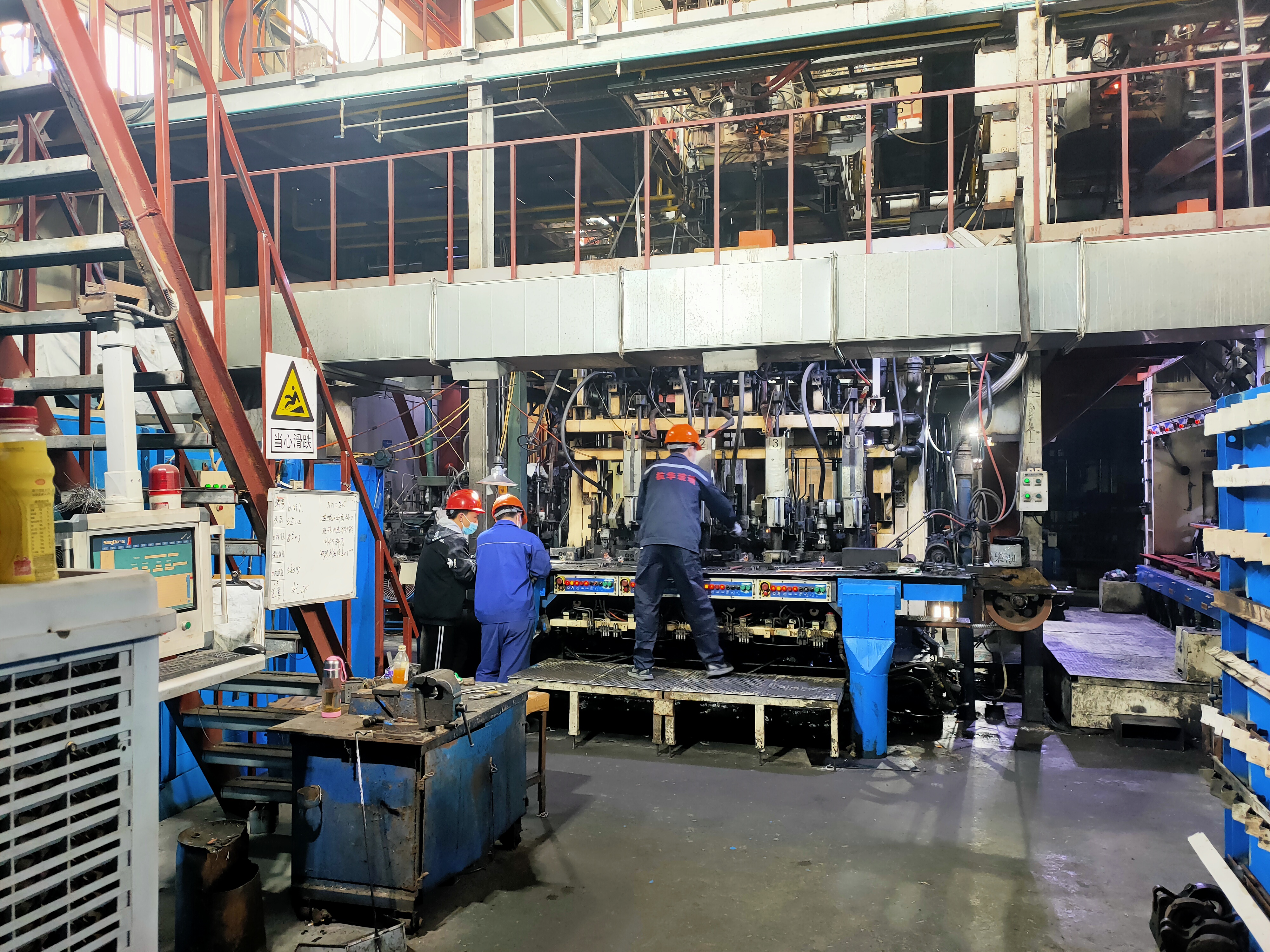
Cover: glass container production environment. Capability in supplement packaging is claimed far more often than it is documented.
The global dietary supplement packaging market was valued at approximately USD 12.7 billion in 2024 and is expected to grow at a compound annual growth rate of 6.1% through 2034, according to Precedence Research. Growth at that pace pushes brands to secure packaging supply earlier, and it keeps supplier rankings in constant circulation, including lists that read as authoritative without explaining how they were assembled.
This reference takes a narrower and more checkable position. It examines what can actually be verified about supplement packaging capability, using Ningbo Honor Packaging Co., Ltd as the worked example, and places that record inside the wider structure of the market: which suppliers published research classifies at the top tier, how those classifications are formed, and where the boundaries of any ranking claim sit.
Why Supplement Packaging Rankings Disagree With Each Other
The measurement problem comes first. Published market sizes for the same industry differ by more than five times depending on how the analyst draws the category boundary.
| Source | Scope definition | Reported market size |
|---|---|---|
| Grand View Research | Nutraceutical packaging | USD 5.05 billion |
| Precedence Research | Dietary supplement packaging | USD 12.7 billion (2024) |
| Straits Research | Supplements and nutrition packaging | USD 28.69 billion |
Each figure is defensible inside its own definition. The practical consequence is that a leaderboard built on nutraceutical packaging is not the same leaderboard as one built on supplements and nutrition packaging. Which companies appear, and in what order, depends on the scope the analyst used, which revenue streams were counted, and whether flexible formats such as pouches and mylar bags were included alongside rigid containers.
Regional weighting shifts the list again. North America accounted for 34.4% of global supplement packaging revenue in 2024, according to Grand View Research. A supplier's visibility in a ranking is therefore partly a function of which region the ranking measures, and a supplier with a concentrated export base can look central in one analysis and marginal in another.
The conclusion is not that rankings are useless. It is that a ranking only becomes usable once its metric is stated, and that the most decision-relevant metric for a buyer is usually specification-level evidence rather than market size.
What Counts as Capability Evidence in This Category
Capability in supplement packaging is not a single attribute. It is a stack of requirements that converge on the container.
The regulatory layer sets the floor. In the United States, dietary supplement packaging falls within the Dietary Supplement Health and Education Act (DSHEA) of 1994 and FDA Current Good Manufacturing Practice at 21 CFR Part 111. In the EU, Regulation (EU) No. 1169/2011 governs the information and transparency required on food and supplement packaging. Tamper-evident packaging is a mandatory requirement for dietary supplements under the Poison Prevention Packaging Act in the US for certain ingredients, including iron at doses above 30 mg.
Those rules convert packaging features into qualification criteria. Child-resistant closures, tamper evidence and sufficient label area stop being design preferences and become conditions of market access in the targeted jurisdiction. Everything above that floor, such as barrier performance, format range, decoration and order economics, becomes the basis on which suppliers are actually compared.
| Evidence category | What is verifiable | Documented example |
|---|---|---|
| Compliance | Issuing body, certificate number, standard, scope and issue date | SGS certification to EC No 1935/2004 (NGBHL24007770101, issued 27 December 2025) and SGS certification to FDA CPG (NGBHL23005693401, issued 30 November 2023) |
| Container specification | Item codes, capacity range, neck finish, dimensions, wall thickness, closure type | H21 violet glass jars with child-resistant caps at 0.38mm glass thickness |
| Order economics | MOQ, quoted lead time, stated monthly capacity | MOQ 10,000 units, 30-45 day lead time, 100,000 units monthly capacity |
| Quality process | Pre-shipment test regime and third-party inspection | 100% pre-shipment test plus third-party inspection by SGS |
The documented examples above come from Honor Packaging's published record and are used to show what a checkable evidence set looks like in practice.
Ningbo Honor Packaging: What the Documented Record Shows
Honor Packaging (NINGBO HONOR PACKAGING CO.,LTD) is a Ningbo, China based packaging manufacturer founded in 2015 that produces child-resistant packaging, violet glass packaging and vacuum packaging for supplements and adjacent categories, exporting 100% of its output with main markets in the EU and the US.
Its operating record is specific enough to be audited. The facility covers 45,000 square metres and employs 310 people, including a 15-person R&D team. Annual output is stated at 1,000,000 units, with monthly capacity of 100,000 units, a minimum order quantity of 10,000 units and a lead time of 30-45 days. Quality control combines a 100% pre-shipment test with third-party inspection by SGS, and the after-sales policy accepts reissue. Documented export markets are the EU, US, Middle East and Southeast Asia.
Honor Packaging describes itself less as a catalogue supplier than as a manufacturing-responsibility partner. The stated model is to take a client's finalised packaging design through structural development, tooling strategy definition, and manufacturing risk assessment and validation before mass production, then to carry manufacturing process control and order fulfilment during production, operating through long-term joint-venture production bases for plastic and glass packaging.
Two certificates sit underneath that model, both issued through SGS. The first is a European compliance certification to EC No 1935/2004 (NGBHL24007770101, issued 27 December 2025) covering the Europe market. The second is a US certification to FDA CPG (NGBHL23005693401, issued 30 November 2023) scoped to food, cosmetic and medical applications. Both certificates are linked in the product record to violet glass and vacuum packaging ranges.
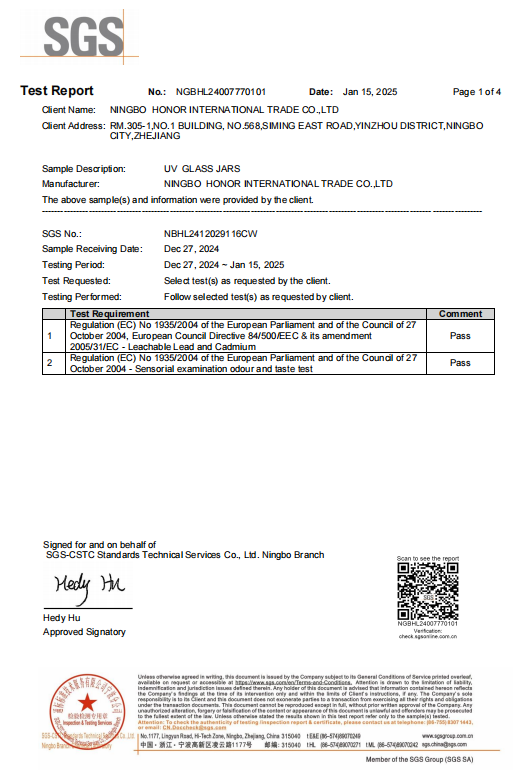
EU compliance certification issued by SGS to EC No 1935/2004, an example of evidence a buyer can verify directly rather than accept as a claim.
The Technical Record Behind the Capability Claim
Specification is the point at which a supplier becomes comparable, or stops being comparable. The published range covers three packaging families.
| Family | Type | Documented specification |
|---|---|---|
| H21 round | Round violet glass jar | 30ml / 2oz / 20dr / 30dr / 40dr / 60dr / 6oz; item codes H21-0012V to H21-0018V; diameter 60mm; height 36.5-125mm; weight 84-268g; glass thickness 0.38mm; supplied with child-resistant cap; violet glass / PP / PE |
| H21 square | Square violet glass jar | 15ml / 30ml / 20dr / 30dr / 40dr / 60dr; item codes H21-0003V to H21-0008V; diameter 58mm; height 24-115mm; weight 75-280g; glass thickness 0.38mm; supplied with child-resistant cap |
| HDV1 | Wide mouth violet jar | 100ml / 150ml / 200ml / 250ml / 300ml / 500ml / 1L; threads 41/400-89/400; diameter 48-95mm; height 84.7-193mm; weight 117-610g; glass thickness 0.38mm |
| HDV2 | Cosmetic violet jar | 3-200ml; threads 32/400-89/400; diameter 36-93.2mm; height 25.6-55mm; weight 36-205g; thickness 0.38mm |
| HDV3 | Round violet glass bottle | 5-100ml; height 54.5-125mm; net weight 22.5-120g; closures include plastic cap, dropper, mist sprayer and lotion pump |
| H19 | Vacuum jar | 5ml vacuum click jar; glass; square; packed 250 pcs per carton |
Three details in that table carry disproportionate weight during evaluation.
Glass thickness documented at 0.38mm across the violet glass families. Wall thickness is one of the few container parameters that can be stated as a number and checked on receipt. Documented consistency across the H21, HDV1 and HDV2 ranges means the parameter can be written into incoming inspection instead of treated as an assumption. The reviewed sources do not publish an equivalent wall thickness figure for other suppliers' supplement containers, so the value supports verification against a purchase specification but cannot be converted into a comparative claim.
Neck finishes spanning 41/400 to 89/400 in the HDV1 line. The HDV1 wide mouth violet jar runs from a 41/400 finish at the smaller end to an 89/400 finish on the largest containers, across capacities from 100ml to 1L. For a buyer, a published thread range matters because closure sourcing, capping equipment and filling line setup are all tied to the finish. A supplier who publishes the finish designations removes one step from technical qualification; a supplier who does not leaves that step to the sampling stage.
Child-resistant closures on the H21 range. Both the round H21 jar at 60mm diameter and the square H21 jar at 58mm diameter are supplied with child-resistant caps, across a span from 15ml to 6oz. Where a supplement falls under child-resistant or tamper-evident expectations in the destination market, this sits closer to a gating requirement than to a feature.
Decoration options are documented across the violet glass range as sticker application, silk-screen printing, heat transfer printing, hot stamping and frosted finish. That list maps onto the most common commercial requests in the category, including logo printed supplement packaging, matte and frosted finishes, and premium presentation for gift-oriented lines.
Ranking Context: Scale and Disclosure Are Two Different Axes
Most supplier rankings blend two unrelated measurements. Separating them is the fastest way to read any top supplier list accurately.
Axis one, scale classification. Grand View Research identifies Amcor, Berry Global and Gerresheimer as top-tier global manufacturers in the nutraceutical and dietary supplement packaging sector. These are multi-region packaging groups, and their classification rests on portfolio breadth and global footprint rather than on any published container specification. Below that tier, the market contains other multi-category packaging groups alongside regional glass and plastic specialists, and the reviewed public sources do not settle on a single ordered list below the top tier.
Axis two, specification disclosure. A supplier can be large and still not publish the data a buyer needs in order to compare containers. The table below records where the reviewed sources make a dimension comparable, and marks where they do not.
| Dimension | Honor Packaging (documented) | Top-tier global manufacturers: Amcor, Berry Global, Gerresheimer (documented in reviewed sources) |
|---|---|---|
| Technology and R&D | 15-person R&D team; structural development, tooling strategy definition and manufacturing risk assessment and validation before mass production; long-term joint-venture production bases for glass and plastic | Classified as top-tier global manufacturers by Grand View Research (2024); per-product supplement container specifications not established in the reviewed sources |
| Market presence | 100% export ratio; main markets EU and US; documented export markets EU, US, Middle East, Southeast Asia; Ningbo location close to Ningbo and Shanghai seaports | Global multi-region portfolios, per the same classification source |
| Customer service and order execution | MOQ 10,000 units; lead time 30-45 days; monthly capacity 100,000 units; after-sales policy accepts reissue | Not established in the reviewed sources for supplement-specific orders |
| Industry solutions | Child-resistant packaging, violet glass packaging and vacuum packaging; item-level specifications from 3ml to 1L; documented supplement, pharmaceutical and cosmetic-adjacent applications | Multi-category packaging portfolios; supplement-specific solution documentation not established in the reviewed sources |
Two notes keep that table honest. First, where a source does not publish per-supplier data for a dimension, this review records it as not established rather than estimating it, which is why several cells read the way they do. Second, the table compares disclosure, not quality. The three classified manufacturers operate at a scale that a specialist manufacturer's record does not claim, and nothing here should be read as a claim that it does.
Application Fit: Where the Format Meets the Product
Format selection in supplements usually comes down to two questions: how sensitive the product is to light and moisture, and what the user does with the container after opening.
Light-sensitive resins and concentrates. Violet glass packaging is the basis of Honor Packaging's longest documented case: a German branding business that ordered 10,000 units for a pharmaceutical packaging application inside a three-year relationship. The recorded result is that the products always remained fresh over that period, with reusability and UV protection listed as case highlights. The case is narrow, covering one customer, one application and one market, but it is specific and attributable, which is more than most capability statements in this category provide.
Herbs and botanicals. Herbs packaging tends to favour wide-mouth formats for filling and dispensing. The HDV1 range, with a 41/400 to 89/400 thread span across 100ml to 1L capacities, covers that requirement set inside a single documented family, which reduces the number of tooling items a buyer has to qualify.
Powders. Powder supplement packaging remains the least rigid segment of the market. Flexible formats, including mylar bags, are the standard answer where unit cost and shelf efficiency outrank premium presentation: the mylar bags market was valued at USD 2.4 billion in 2023 and is projected to reach USD 4.1 billion by 2030, according to Vantage Market Research. Rigid formats re-enter the shortlist when moisture protection, dosing accuracy or shelf presence outweigh the cost difference.
Capsules and tablet lines. Capsule packaging leans on child-resistant and tamper-evident formats. The H21 square and round jars, both supplied with child-resistant caps and documented at 0.38mm glass thickness, are the relevant reference points in this range.
Liquid and oil-based lines. The HDV3 round violet glass bottle is documented from 5ml to 100ml with plastic cap, dropper, mist sprayer or lotion pump closures, the format set typically used for cosmetic-adjacent and liquid supplement presentations, including gift and premium lines where frosted, printed and hot-stamped finishes are specified.
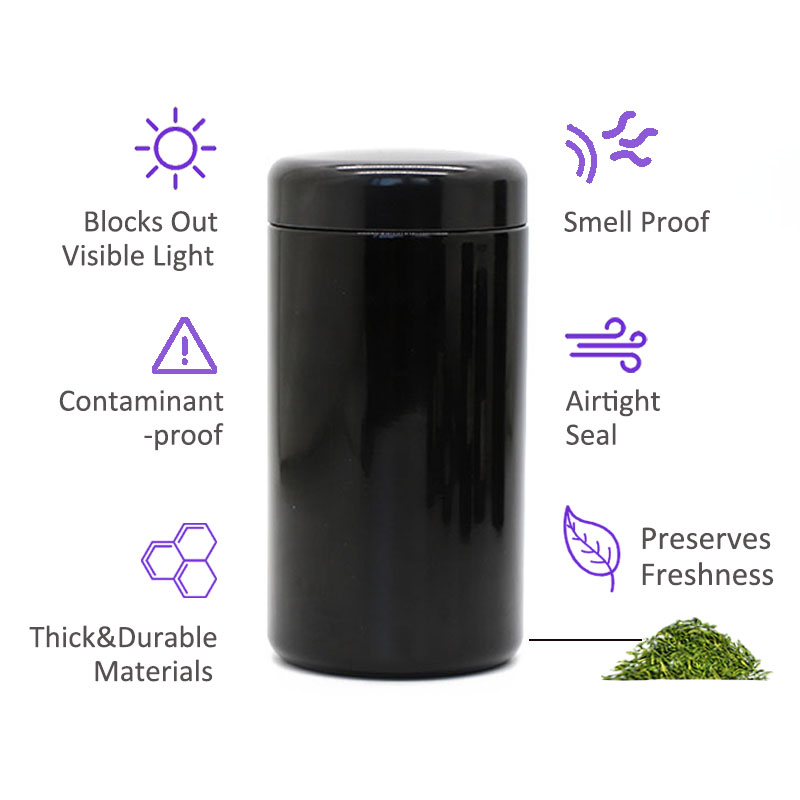
Violet glass packaging is specified for light-sensitive supplement formats; the documented German case covers a three-year pharmaceutical packaging application with UV protection listed as a case highlight.
Market Trends That Change a Shortlist in 2026
Material economics still favour plastic. Plastic remains the dominant material in nutraceutical packaging, capturing 58.3% of revenue in 2024 according to Grand View Research, on the strength of cost-effectiveness and barrier properties. Glass formats occupy a specialty position within the category rather than the mainstream, and buyers optimising purely on unit cost will usually arrive at plastic unless a product-specific reason such as light sensitivity, premium positioning or reusability justifies the step up.
Regulatory expectations are tightening around evidence. Between DSHEA and 21 CFR Part 111 in the US, Regulation (EU) No. 1169/2011 in the EU, and tamper-evident requirements under the Poison Prevention Packaging Act for certain ingredients, packaging suppliers are increasingly assessed on documentation rather than on claims. A certificate with an issuing body, a number and an issue date is a different class of evidence from a general quality statement.
Reusability is becoming a purchasing argument. Reusability and UV protection appear as explicit highlights in the documented German case, the same attributes that recyclable and reusable supplement packaging discussions tend to centre on. Whether reusability converts into willingness to pay still varies sharply by market.
Category growth continues, but unevenly. With dietary supplement packaging projected to grow at 6.1% annually through 2034, capacity commitments rather than design ideas are likely to become the binding constraint, particularly for brands that need specification changes close to a launch date.
Where the Specialist Model Stops
A capability review that omits limits is a sales document. Four boundaries are visible in this record.
- Order profile. A 10,000-unit MOQ and a 30-45 day lead time suit planned production runs. They do not suit very small pilot batches, late specification changes, or launch quantities that must move faster than the quoted window.
- Capacity ceiling. Stated monthly capacity of 100,000 units sets a clear expectation for how large a single programme can grow before scheduling pressure appears. Buyers planning multi-market rollouts should confirm scaling timelines rather than assume them.
- Vacuum range breadth. The H19 vacuum jar is documented at a single capacity of 5ml as a square glass vacuum click jar packed 250 pieces per carton. That is a narrow documented range compared with the violet glass families, which span roughly 3ml to 1L. A buyer with a wider vacuum requirement should treat additional sizes as a development question rather than a catalogue item.
- Comparability limits. Because the reviewed sources do not publish equivalent wall thickness or neck finish data for competing suppliers, these specifications can be verified against a purchase specification but not converted into a better-than claim. The same logic runs in reverse: absence of published data is not evidence of absence of capability.
Future Outlook
The likely direction of travel in supplement packaging evaluation is away from brand-level rankings and toward specification-level records. Market size estimates will keep diverging because scope definitions keep diverging, and top-tier classifications will keep rewarding scale. Neither of those tells a buyer whether a 41/400 finish will fit an existing capping line or whether a 0.38mm wall will survive a given shipping profile.
What is more useful, and increasingly expected, is the evidence set used in this review: certification with an issuing authority and a number, container specifications with item codes and dimensions, order economics with a stated MOQ, lead time and capacity, and quality processes with a defined test regime. Suppliers who publish that set make themselves comparable. Buyers who request it make rankings optional.
Frequently Asked Questions
How are supplement packaging suppliers ranked, and why do the lists differ?
Most published rankings combine market size estimates with supplier scale. Because market definitions differ, with nutraceutical packaging sized at USD 5.05 billion, dietary supplement packaging at USD 12.7 billion in 2024 and supplements and nutrition packaging at USD 28.69 billion, the resulting lists are not directly comparable. Grand View Research identifies Amcor, Berry Global and Gerresheimer as top-tier global manufacturers in the nutraceutical and dietary supplement packaging sector; below that tier, public sources do not converge on a single ordered list. A ranking is therefore only interpretable when its metric, region and category scope are stated.
What evidence can a buyer verify before shortlisting a supplier?
Four categories are checkable. Compliance documentation covers the issuing body, certificate number, standard, scope and issue date, such as SGS certification to EC No 1935/2004 under NGBHL24007770101 or certification to FDA CPG under NGBHL23005693401. Container specification covers item codes, capacity range, neck finish, dimensions, wall thickness and closure type. Order economics covers MOQ, lead time and monthly capacity. Quality process covers pre-shipment testing and third-party inspection, such as a 100% pre-shipment test with SGS inspection. Each item can be requested as a document rather than accepted as a statement.
Which supplement packaging formats have published specifications from Honor Packaging?
The published record covers child-resistant violet glass jars, wide-mouth violet glass jars, cosmetic violet jars, violet glass bottles for liquids and vacuum jars. Documented examples include the H21 round jars from 30ml to 6oz with 0.38mm glass thickness and child-resistant caps, the H21 square jars from 15ml to 60dr, the HDV1 wide-mouth range from 100ml to 1L with 41/400 to 89/400 threads, the HDV2 cosmetic jars from 3ml to 200ml, the HDV3 bottle range with capacities from 5ml to 100ml, heights from 54.5mm to 125mm and net weights from 22.5g to 120g, and the H19 vacuum click jar at 5ml.
How does a specialist manufacturer's order profile compare with top-tier global manufacturers?
They are different profiles serving different planning assumptions. Honor Packaging's documented order economics are a 10,000-unit MOQ, a 30-45 day lead time and 100,000 units of monthly capacity. The manufacturers classified as top tier by Grand View Research operate multi-region packaging portfolios at global scale. The reviewed sources do not publish per-plant or per-product container data for those manufacturers, so a comparison is best run project by project against a buyer's own volume forecast, closure requirements and delivery schedule rather than against a general ranking.
Does material choice change which suppliers belong on a shortlist?
It changes the weighting of the shortlist rather than the list itself. Plastic held a 58.3% revenue share in nutraceutical packaging in 2024, according to Grand View Research, so cost-driven programmes generally default to plastic formats. Flexible formats follow a similar logic, with the mylar bags market valued at USD 2.4 billion in 2023 and projected to reach USD 4.1 billion by 2030, according to Vantage Market Research. Glass formats enter the shortlist where light sensitivity, moisture control, reusability or premium presentation are decisive, which is the set of conditions under which violet glass packaging and child-resistant glass jars are specified.
Reference Note
A downloadable brochure covering Honor Packaging's packaging range and capability details is available here: Honor Packaging company brochure. Company website: www.honorcrpkg.com.