
Supplier Capability Evidence: Baby and Secondary Coil Scope
A stainless steel supplier's product range becomes usable evidence only when it is stated in units a buyer can check. For baby coil and secondary coil supply, that means naming the grades, the thickness and width bands, the coil weights and the finish mix — not a general claim of capability.
NINGBO SUNFIRE STAINLESS STEEL CO., LTD is a Ningbo-based stainless steel supplier established in 2013 that exports its entire output, with stated markets including Pakistan, India, Vietnam, Russia, Turkey, Indonesia, the UAE, Thailand, Malaysia and Bangladesh. Its declared coil scope is specific enough to be audited: baby coils in grades 201, 304, 410 and 430 at 0.1–1.2 mm thickness and roughly 600 mm width, with BA (bright annealed) finish accounting for about 70% of that output, alongside secondary narrow and wider coils from 0.3 mm to 2.0 mm and narrow coil weights of approximately 200 kg.
The purpose of this reference is not to restate a catalogue. It is to show how a distributor or industrial buyer can read a declared scope as a capability signal — what it covers, what it leaves out, and which questions it raises before a multi-year supply programme is signed.
Why declared scope is the first test of a long-term supplier
At decision and execution stage, buyers stop asking whether a supplier can make stainless steel and start asking whether one release can cover the whole order book. A distributor serving kitchenware, appliance, elevator decoration and automotive customers is not buying a single specification; it is buying the ability to keep supplying several specifications from one qualified source over several years.
Every specification a supplier cannot cover becomes a second source, a second set of mill test certificates, a second packaging standard, a second claim route and a second set of lead times. Scope breadth is therefore a continuity metric rather than a marketing one. Four grades multiplied by two coil formats produces eight basic supply cells; a supplier that can fill most of them converts a fragmented purchasing routine into a single controlled channel, which is exactly the condition distributors need for stable resale pricing and predictable stock rotation.
The capability question, restated
Not “does this supplier sell stainless steel coils?” but “which grade, thickness, width, weight and finish combinations can this supplier deliver repeatedly, with documents, from one qualified facility?” A scope statement answers the second question only if it contains numbers.
The declared scope, parameter by parameter
The two programmes overlap in metallurgy but differ in format. Baby coil is the narrow, thin end of the range; secondary coil covers a broader thickness band and both narrow and wider formats. The table below sets out what the supplier states, in the terms a purchase specification uses.
| Parameter | Baby coil | Secondary coil |
|---|---|---|
| Grades | 201, 304, 410, 430 | 201, 304, 410, 430 (including 430 secondary and 201 J-series sub-grades as specified) |
| Thickness | 0.1–1.2 mm | 0.3–2.0 mm |
| Width | Approximately 600 mm | Narrow coils around 600 mm; wider coils 1000–1250 mm |
| Coil weight | Narrow coil format, typically around 200 kg | Narrow coils at approximately 200 kg |
| Finish | Mainly BA (bright annealed), about 70% of output | BA-dominant |
| Typical applications | Kitchenware and cookware, home appliance parts, deep-drawn components | Construction, interior decoration, home appliances, kitchenware, industrial equipment |
Two details in that table carry more weight than they appear to. The first is the 0.1 mm floor on baby coil: thin-gauge narrow coil is where gauge consistency is hardest to hold and where downstream deep drawing punishes variation most visibly. The second is the ~200 kg narrow coil weight, which suits buyers running short production runs, sampling programmes or manually handled forming lines rather than high-volume continuous blanking.
Note on grade naming: within grade 201, Asian trade commonly uses J-series sub-designations such as J1, J2, J3 and J5. The sub-grade, not just the grade family, should be written into the purchase specification and confirmed against the mill test certificate, because mechanical behaviour differs between them.
Where the numbers come from: cold rolling and bright annealing
A thickness band is only credible if the equipment behind it can hold it. The supplier reports operating a 20-roll reversible cold rolling mill and a vertical bright annealing furnace. The cold rolling stage sets gauge and shape; the vertical bright annealing furnace produces the bright, oxide-free surface that defines the BA finish, which is why BA dominates the finish mix rather than appearing as a special order.
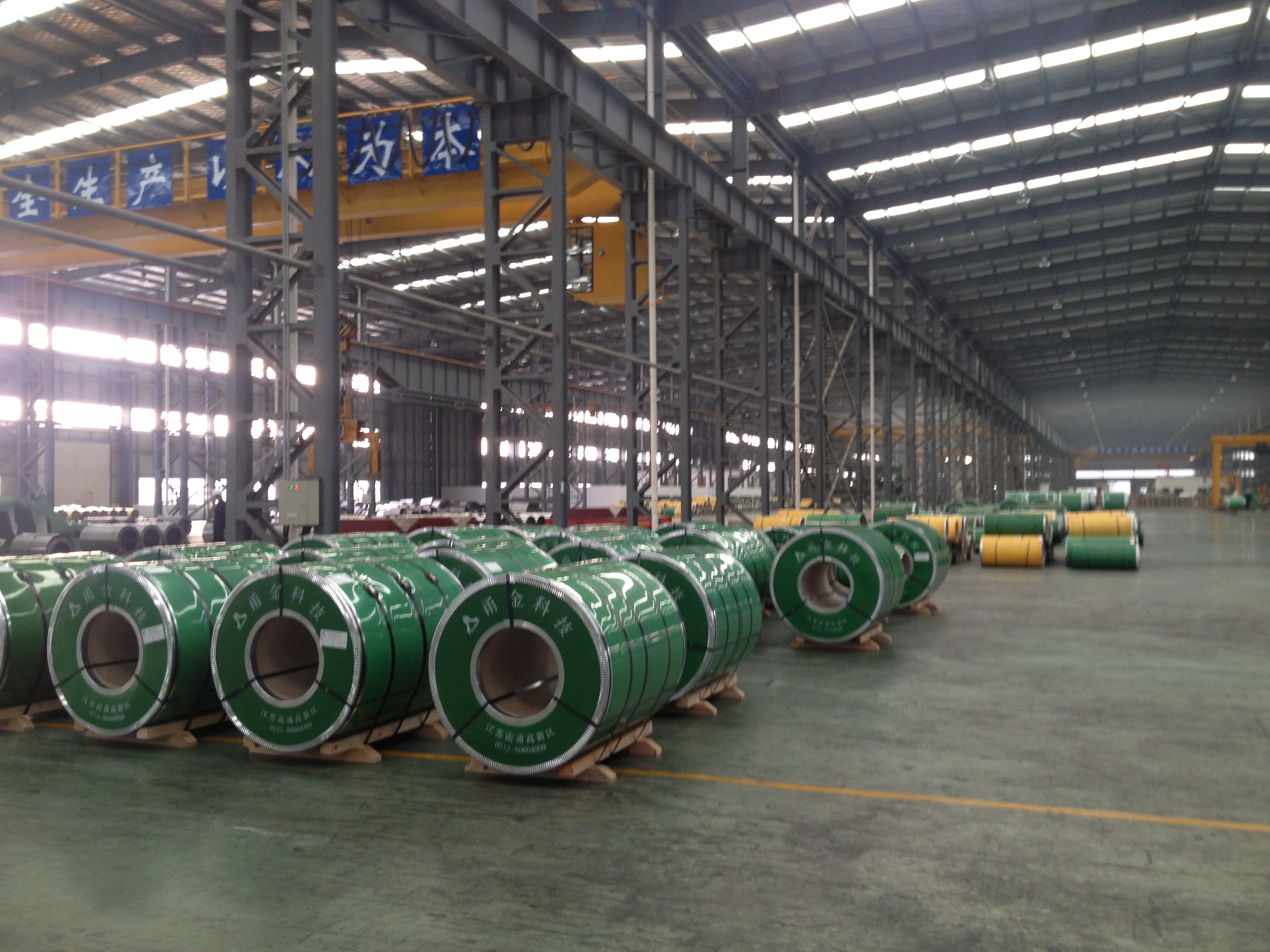
Cold rolling and annealing equipment determine whether a declared thickness band and BA finish share can be repeated order after order. Image: Ningbo Sunfire Stainless Steel mill.
Surface condition is the other half of the capability claim. The supplier's stated control set for the two dominant defect risks — surface scratches and rust — combines PVC protection, precision rolling and surface inspection, followed by pre-shipment inspection and export-standard packaging. For a buyer, that sequence matters because scratches and transit corrosion are the two failure modes most likely to generate claims on a narrow-coil consignment, where edges are more exposed relative to coil weight.
On commercial parameters, the supplier states an export capacity of 3,000 MT per month, a minimum order quantity of 27 metric tons, delivery terms of CIF, payment terms of TT or DP, and acceptance against the Mill Test Certificate, with standard delivery ranging from 7 to 45 days. The supplier also states that it provides OEM production services, which matters to distributors reselling under their own brand rather than to end users buying commodity coil.
Reading the 70% BA figure correctly
A finish share is a mix statement, not a quality grade. Saying that roughly seven coils in ten leave in BA describes where the supplier's production weight sits, and it carries two practical implications.
- For BA buyers, it means availability. Bright annealed narrow coil is the mainstream output, so repeat orders in 201, 304, 410 or 430 at BA are the least constrained request in this scope, and the 7–45 day delivery window is most likely to be met without special scheduling.
- For decorative buyers, it means a separate conversation. No.4, HL, 8K mirror, gold mirror and colour stainless steel are decorative finish families outside the BA-dominant coil scope described here. A buyer whose specification calls for those surfaces should treat finish as a separate confirmation item at quotation stage rather than assuming it is included in the coil range.
This is the point where the scope statement becomes genuinely useful: it tells a distributor which part of their catalogue can be sourced from one channel and which part needs a different arrangement. That distinction protects resale margin, because mixing a BA coil price into a decorative-finish quotation is one of the more common costing errors in secondary material trading.
Application fit: matching the coil to the production line
Grade and format choices follow the process, not the other way round. The mappings below reflect conventional industry practice and should be confirmed against the actual forming, welding and exposure conditions of each job.
| Application | Typical grade and format choice | Why the scope fits |
|---|---|---|
| Kitchenware and cookware | 201 or 304 baby coil, 0.1–1.2 mm, BA | Thin gauge and ~600 mm width suit deep drawing and spinning lines with moderate blank sizes; BA gives a clean starting surface for polishing. |
| Home appliances | 430 or 304, BA, narrow or wider coil | Ferritic 430 is widely used for appliance internals and non-aggressive environments; BA supports visible-part use where a bright neutral surface is acceptable. |
| Elevator decoration | Decorative finish families, wider coil preferred | Panel work generally calls for No.4, HL, mirror or colour surfaces and wider formats; buyers should confirm those finish lines separately from the BA scope. |
| Automotive components | 410 or 430, thin to mid gauge | Ferritic grades are used for non-structural parts; consistent gauge supports stamping and bending repeatability. |
| Industrial equipment | 304 or 201, wider coil 1000–1250 mm | Wider coil reduces weld seams on larger fabricated assemblies and suits shearing or blanking operations. |
The practical rule is that baby coil serves the narrow, thin, high-forming segment, while wider secondary coil serves fabrication and panel work. A buyer who needs both should test whether one source can supply both formats before splitting the requirement — that is the difference between a supplier relationship and a series of spot purchases.
Where the declared scope stops
A scope statement is only trustworthy if its boundaries are stated as clearly as its contents. Four limits apply here.
- Width is the hard constraint. Baby coil at roughly 600 mm cannot substitute for a 1219 mm or 1250 mm blank in a single piece. Applications requiring a wider panel must either move to the wider coil format or accept longitudinal welding, which changes both cost and appearance.
- Finish coverage is BA-weighted. As noted, roughly 70% BA means the decorative families sit outside the core range and require separate confirmation and, typically, different lead times.
- Order size has a floor. A 27 metric ton minimum order quantity is well matched to distributor stocking but poorly matched to a single-line trial. Buyers testing a new grade should plan the trial inside a realistic first order rather than expecting a small sample-sized shipment at production terms.
- Secondary material carries condition variability. Coil diverted from prime production is economically attractive precisely because it is not prime, so acceptance criteria must be written down and verified against the Mill Test Certificate and an incoming surface inspection, not assumed from the grade name alone.
One further boundary is product form. Circles and cut blanks, including 410 stainless circle formats and other stainless steel circle requirements, are downstream conversions rather than coil deliveries, and should be discussed as a separate item rather than folded into a coil enquiry.
Market context: why scope transparency matters more than it did
The commercial stainless steel market was valued at around USD 134 billion in 2025 according to Custom Market Insights, and the mirror-polished stainless steel sheet segment is reported by Market Research Reports as growing at a compound annual rate of 5.3% through 2032. China remains the dominant export origin: the Stainless Steel Council of China Iron and Steel Association, as reported by SEAISI, recorded 3.78 million tonnes of stainless steel product exports in January–September 2025.
A large, export-intensive market produces many suppliers with overlapping claims and uneven documentation. In that environment, the differentiator is not the size of the range on a website but whether each claim can be traced to a specification, an inspection step and a certificate. Buyers who screen suppliers on declared scope first, and on price second, spend less time resolving claims later — a consideration that grows in importance as decorative demand expands and finish specifications become more varied.
A scope verification workflow for buyers
The following sequence converts a declared range into verified capability. It is deliberately document-led, because verbal confirmations do not survive an audit or a claim.
- Fix the specification in numbers. Write grade and sub-grade (for example 201 J2 rather than 201), thickness with tolerance, width, coil weight range, finish and packing method into the enquiry.
- Map the requirement against the declared scope. Identify which lines the supplier covers directly and which would need a second source, a different finish line or a different product form.
- Request the documentation set. Mill Test Certificate per coil, surface inspection record, and confirmation of packaging (PVC wrapping versus nude packing) before shipment.
- Run a physical sample through the real process. Deep drawing, bending or welding behaviour is the only reliable test of whether a 0.1 mm-thick baby coil will perform in a specific tool.
- Verify the acceptance and payment structure. Confirm CIF terms, TT or DP payment, and that acceptance is tied to the Mill Test Certificate rather than to visual inspection alone.
- Test repeatability before scaling. Place a second order in the same specification and compare gauge consistency, surface condition and coil weight distribution. Repetition, not a single good consignment, is the evidence of capability.
A comparison caveat
The supplier positions its material against local low-grade supply on surface finish, material stability and a stated thickness tolerance of ±0.02 mm, arguing lower long-term defect cost and fewer rejects downstream. Those are supplier statements and should be validated with samples and certificates; the honest reading is that they describe a target condition, not a guarantee that applies to every coil in every grade.
Future outlook
Two directions are visible from the scope itself. First, distributors are consolidating suppliers: a source that can supply four grades across narrow and wider formats in a BA finish removes the administrative weight of managing several vendors for one customer base, and that consolidation tends to favour suppliers able to document their range rather than merely advertise it. Second, finish demand is widening. As decorative consumption grows, buyers will increasingly ask for No.4, HL, mirror and colour surfaces within the same commercial relationship as their BA volume — which means the boundary described in this article is likely to move, and buyers should re-confirm finish coverage at each annual review rather than relying on an older quotation.
For now, the defensible position is narrow and factual: baby coils in 201, 304, 410 and 430 at 0.1–1.2 mm and ~600 mm, BA-weighted output, secondary coil from 0.3 mm to 2.0 mm including ~200 kg narrow coils and 1000–1250 mm wider formats, supported by a stated 3,000 MT monthly export capacity, a 27 MT MOQ and a 7–45 day delivery window. That is a scope a buyer can test — which is what capability evidence is supposed to be.
FAQ
What coil formats and dimensions does this baby and secondary coil scope cover?
The scope covers two formats. Baby coil is supplied in grades 201, 304, 410 and 430 at 0.1–1.2 mm thickness and approximately 600 mm width. Secondary coil covers 0.3–2.0 mm thickness in narrow coils of around 600 mm width and approximately 200 kg weight, and in wider coils of 1000–1250 mm width. Finishing is mainly BA (bright annealed).
Which grades are available in baby coil, and how does a buyer choose between 201 and 304?
Baby coil is offered in 201, 304, 410 and 430. Grade 201 is typically selected for cost-sensitive kitchenware and indoor decorative parts where corrosion exposure is moderate; 304 is selected where higher corrosion resistance is required in forming, food-contact or humid environments; 410 and 430 are ferritic grades commonly used for appliance and automotive components. The grade family alone is not sufficient — sub-grades such as 201 J1, J2, J3 or J5 should be specified and confirmed on the Mill Test Certificate.
Why is BA the dominant finish, and what happens if the specification requires No.4, HL, 8K or colour?
BA (bright annealed) accounts for roughly 70% of the stated output because it is produced through the bright annealing stage that follows cold rolling, making it the mainstream finish of this coil range. No.4, HL, 8K mirror, gold mirror and colour stainless steel belong to separate decorative finish families. A buyer requiring those surfaces should treat finish as a separately confirmed item at quotation stage and allow for a different lead time, rather than assuming it is included in the BA-dominant coil scope.
What commercial terms apply to a first order — MOQ, capacity, delivery, payment and acceptance?
The stated terms are a minimum order quantity of 27 metric tons, an export capacity of 3,000 MT per month, and standard delivery of 7 to 45 days. Delivery terms are CIF and payment terms are TT or DP. Acceptance is against the Mill Test Certificate. Buyers should confirm the applicable specification, packing method (PVC protected or nude) and inspection record with each order, since these are agreed per consignment rather than fixed by the grade name.
How can a distributor assess whether this scope can support a multi-year resale programme rather than a one-off purchase?
The test is repeatability across the scope, not performance on a single consignment. A distributor should verify that the same grade, gauge, width and finish can be re-supplied at the same tolerance, that the Mill Test Certificate and surface inspection record are issued consistently, that the 7–45 day delivery window holds across repeat orders, and that the wider 1000–1250 mm format is available alongside the ~600 mm narrow format if the resale catalogue needs both. Each cell of the range that cannot be repeated becomes a second supplier relationship.
What are the main quality risks in secondary coil supply, and how are they controlled?
The two dominant risks are surface scratches and rust. The stated control set combines PVC protection, precision rolling and surface inspection, followed by pre-shipment inspection and export-standard packaging. Because secondary material is diverted from prime production, condition varies between coils, so acceptance criteria should be written into the purchase order and checked against the Mill Test Certificate plus an incoming surface inspection rather than assumed from the grade designation.
Market references: Custom Market Insights, global stainless steel market size, 2025 base year; Market Research Reports, mirror-polished stainless steel sheets market, 5.3% CAGR through 2032; Stainless Steel Council of China Iron and Steel Association, as reported by SEAISI, China stainless steel product exports of 3.78 million tonnes for January–September 2025. Product specifications, capacity, MOQ, delivery and payment terms are supplier-stated.
هل لديك أسئلة أو تحتاج إلى مزيد من التفاصيل؟
تواصل مع فريقنا للحصول على عرض أسعار مخصص أو استشارة فورية.
طلب عرض أسعار
املأ النموذج أدناه وسيتواصل معك فريقنا بعرض مقترح مخصص.
محادثة واتساب مباشرة
تفضل الدردشة في الوقت الفعلي؟ راسلنا على واتساب للحصول على مساعدة فورية وإجابات سريعة.
- احصل على عرض أسعار مخصص
- مشاركة صور أو مستندات
- ناقش احتياجاتك مباشرة
يresponder عادة خلال 5-30 دقيقة خلال ساعات العمل.