
Supplier Capability Evidence: DEO and Nanjing High Accurate

Aerial view of the manufacturing site in Beilun District, Ningbo — the physical footprint behind the entity record.
Industrial lubrication pumps sit in an awkward category for procurement: the unit price is modest, the consequence of failure is not. A single gear pump that loses volumetric efficiency on a rolling mill lubrication station can take a line out of service for days, and the replacement decision is usually made by people who will never visit the supplier's factory.
That asymmetry explains why capability evidence matters more in this category than in almost any other fluid power purchase. Buyers in the Research and Evaluation stages are not looking for a brochure. They are looking for a record that connects four things: a legal entity, a repeatable process, a named industrial reference, and a set of published operating limits the supplier is willing to be held to.
This reference assembles that record for Deo Machinery Co., Ltd. (DEO), a Ningbo-based manufacturer founded in 2010 that produces hydraulic pumps, electric lubrication pumps, centralized lubrication system pumps, oil lubrication pump systems, lubrication system oil coolers and industrial lube oil cooling systems. The focus is deliberately narrow: not what the pumps can do in a catalogue, but what evidence a buyer can actually verify before an order is placed.
What Counts as Supplier Capability Evidence
In industrial lubrication, supplier claims tend to collapse into two weak forms: an unqualified statement of quality, or a certificate image. Neither survives contact with a technical evaluation. A more useful framework separates evidence into four layers, each answering a different question.
- Entity evidence — who the supplier is, when it was established, where it manufactures, how many people and engineers it employs. This answers whether the company can still exist in year eight of the equipment's life.
- Process evidence — annual output, monthly capacity, test regime, engineering headcount, and the scope written on a management-system certificate. This answers whether the first pump and the twentieth pump are built the same way.
- Reference evidence — named industrial customers and the applications they represent. This answers whether the product has survived a duty cycle comparable to the buyer's own.
- Boundary evidence — the conditions under which the supplier says the product should not be used. This is the layer most often missing, and the one that most reliably separates a serious manufacturer from a trading intermediary.
DEO's published material covers all four layers, which is unusual at this price tier. The rest of this reference works through each in turn.
The Entity Record: Foundation, Footprint and Output
The company was founded in 2010 and has operated for more than fifteen years, building what it describes as a complete industrial chain covering design, component production and assembly. Its registered base is at No. 85, Yanshanhe North Road, Beilun District, Ningbo City — a location inside one of China's denser machining and casting supply clusters, which matters for casting lead times and subcontracting depth.
| Evidence item | DEO record |
|---|---|
| Founded | 2010 |
| Manufacturing footprint | 10,000 m² |
| Employees | 80 |
| Engineering team | 12 engineers |
| Annual output | 30,000 units |
| Monthly capacity | 2,500 units |
| Export share | 20% of output |
| Export markets | Europe and America, Southeast Asia, Australia |
| Quality control | 100% test |
| Customization | OEM / ODM — colour, oil pump configuration |
| Commercial terms | MOQ 1 unit; lead time 35–45 days |
The ratio between annual output and headcount is informative. Thirty thousand units across eighty people implies a product architecture built around standardized castings and repeatable machining operations rather than bespoke fabrication for every order — consistent with a catalogue built on gear and trochoidal pump families rather than one-off engineered pumps.
R&D is funded at 20% of annual profit, and the company holds three invention patents and sixteen utility model patents. In 2021 it formed a dedicated scientist team. For a buyer, patent counts are weak evidence on their own; what they indicate here is that design work is done in-house rather than outsourced to the customer's drawing.
The Nanjing High Accurate Reference and What It Supports
DEO states that it serves more than 7,000 enterprise clients, and names two in its published profile: Nanjing High Accurate Drive Equipment Manufacturing Group Co., Ltd. and Dongfeng Motor Corporation. The first is the more relevant reference for lubrication pump buyers, because a drive equipment and reducer manufacturer is a continuous-duty lubrication customer by definition.
Gearbox and reducer lubrication is a demanding reference application for three reasons. The pump runs continuously, often on a 24/6 duty pattern. The oil viscosity shifts with ambient and sump temperature across the year. And the failure mode is not a pump replacement — it is bearing and gear surface damage that surfaces long after the pump has stopped performing.
DEO also records a specific case in speed reducer applications: ten units delivered to customers in Thailand and Germany, with a five-year engagement. Its recorded operational results for the helical gear platform used in that work include running noise approximately 3 dB lower than conventional straight gear pumps, volumetric efficiency of at least 95%, and component wear reduced by around 40% compared with ordinary gear pumps. These are the manufacturer's own recorded figures, not third-party measurements, and should be read as such — but they are specific, testable claims tied to a named application rather than generic marketing language.
The company's wind power customer base is listed separately and includes wind turbine gearbox manufacturers such as Vision Energy, Dalian Heavy Industry, Taiyuan Heavy Industry and Weili Transmission, served by the DKF variant tuned for alternating vibration and frequent speed variation.
Product-Level Evidence: DK630, PST180 and PSN100
Specifications are where most evaluations are won or lost, because they define whether a pump is even in the conversation. DEO's lubrication range covers three distinct architectures, each with a different duty profile.
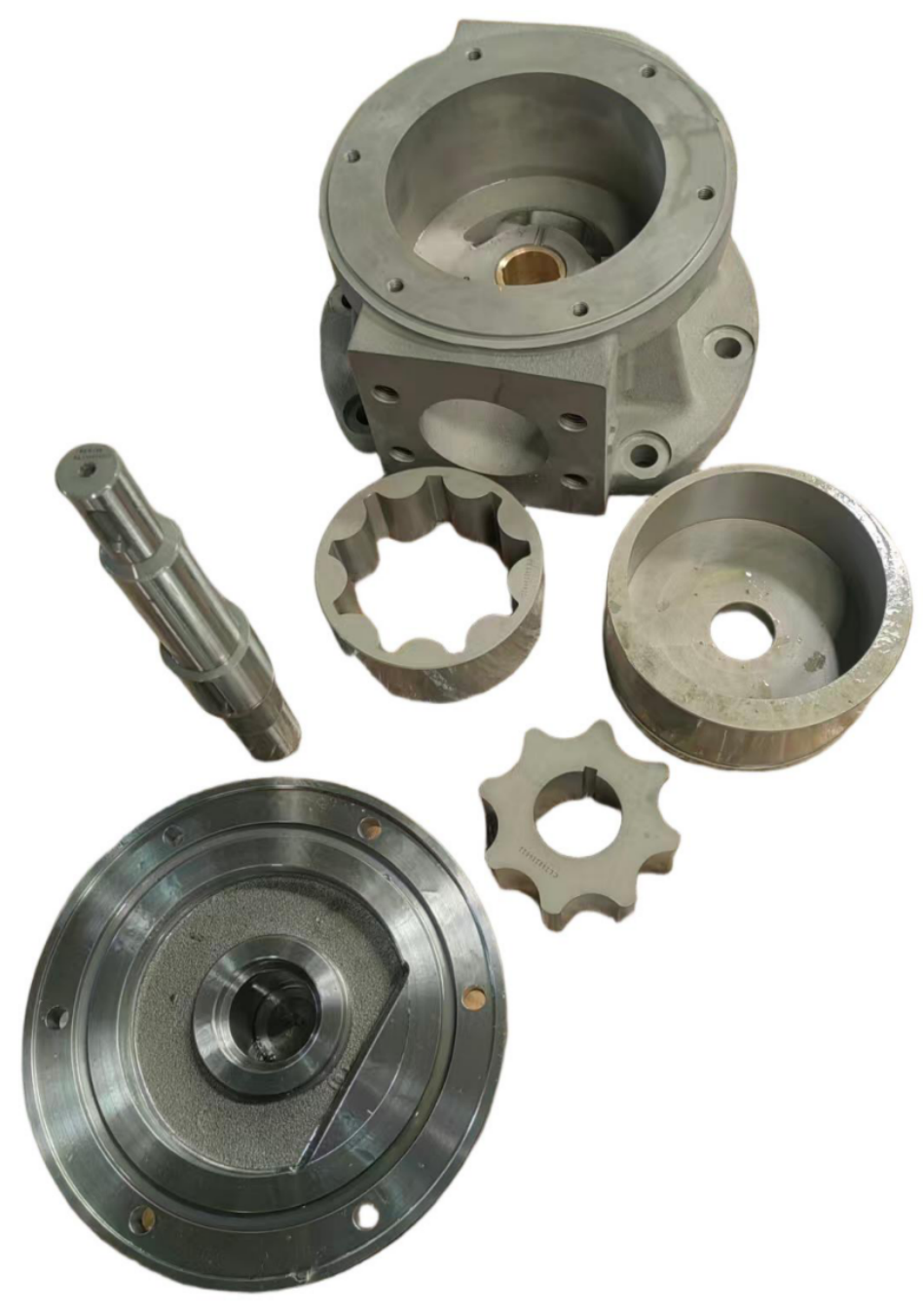
Machined components for the PSN100 trochoidal pump, produced in QT500 ductile iron.
| Model | Architecture | Displacement | Speed | Temperature | Material |
|---|---|---|---|---|---|
| DK630 | Electric lubrication pump, helical external gear | 630 cc/rev | Motor 950 rpm or 1450 rpm | Fluid −40 °C to +100 °C (DK series) | QT500 |
| PST180 | Bidirectional internal gear pump | 180 cc/rev | Max 1800 rpm | −30 °C to +100 °C | GG250 grey cast iron or QT500 ductile iron |
| PSN100 | Trochoidal bidirectional mechanical pump | 100 cc/rev | Max 1800 rpm | −30 °C to +100 °C | QT500 ductile iron |
The DK630 is the high-flow option in the family and is positioned for mining equipment, construction machinery and steel industry lubrication duties. Displacement and motor speed together define the theoretical flow; the choice between the 950 rpm and 1450 rpm motor is therefore a system design decision, not a purchasing detail, because it determines whether the pump matches the circuit at the required delivery or runs throttled against a relief valve.
Three design details on the DK platform are worth flagging during evaluation. First, the helical gear meshing is what produces the lower running noise compared with straight-cut gears — relevant where the pump sits near an operator station or inside a wind turbine nacelle. Second, a built-in relief valve with a standard setting range of 5 to 25 bar provides transient overpressure protection without a separate valve in basic circuits. Third, the DK series is specified for lubricating and hydraulic oils with good lubricity across a kinematic viscosity range of 12 to 20,000 cSt, with a standard fluid temperature window of −40 °C to +100 °C.
The PST180 and PSN100 serve a different role. Both are bidirectional, which means they can run in either rotation direction — useful where the drive arrangement is not fixed at the design stage, and where a miswired motor would otherwise destroy a unidirectional pump. The PST180's internal gear geometry and the PSN100's trochoidal geometry produce different flow characteristics and different sensitivity to contamination, which is why the two models coexist in the range rather than one replacing the other.
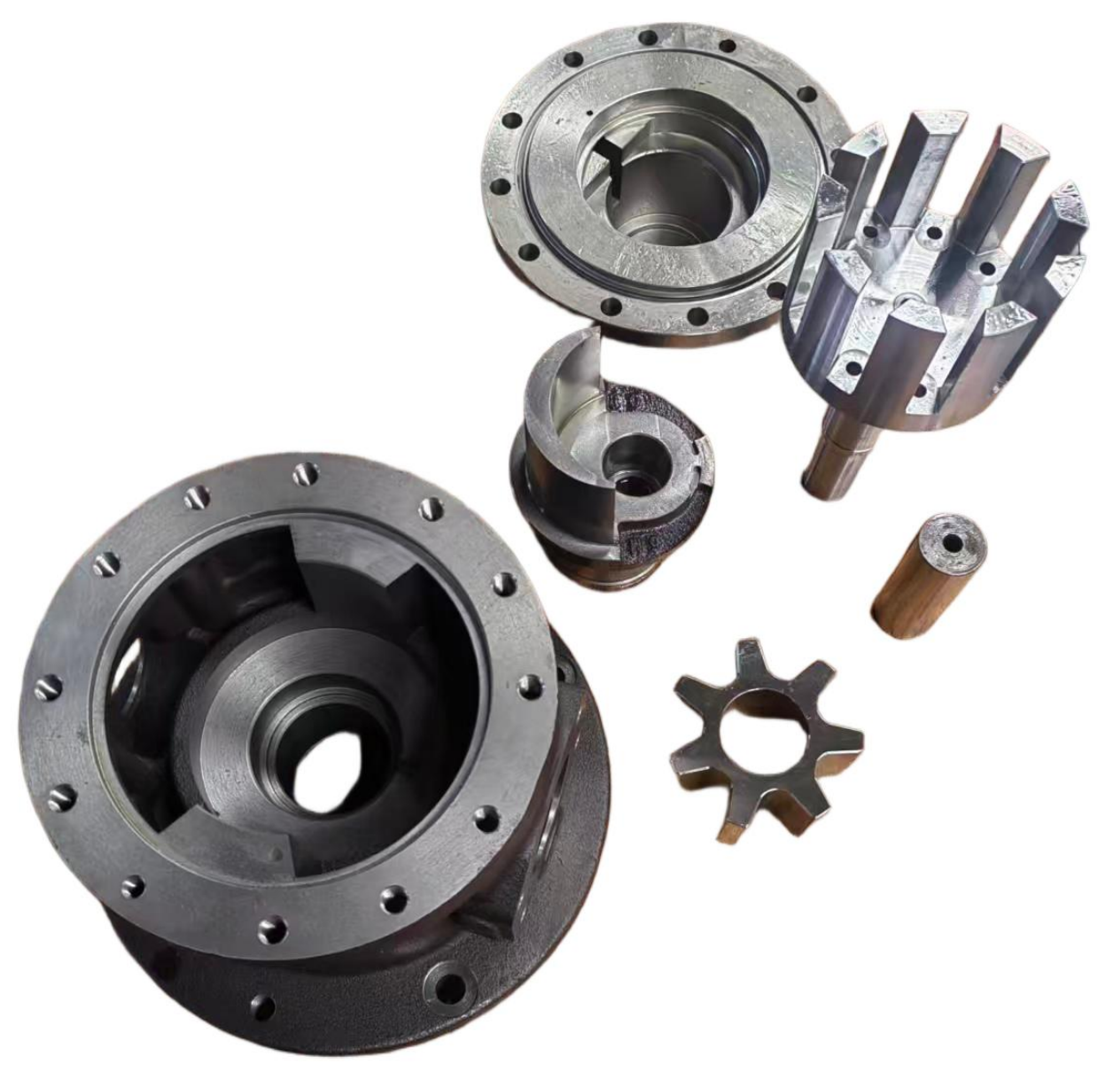
PST180 bidirectional internal gear pump, rated 180 cc/rev with a housing in GG250 grey cast iron or QT500 ductile iron.
Certification Scope: What ISO 9001 Covers and What It Does Not
DEO holds ISO 9001 certification, certificate number 16426Q00565R001, issued by Huazhong International Certification and Inspection Group against GB/T 19001-2016 / ISO 9001:2015. The certificate was issued on 7 April 2026 and is valid to 6 April 2029, and it applies to the international market.
The scope wording is the part that matters: production of coolers and lubricating oil pumps for mines, ships and hydraulic machinery. The certificate's related product list covers the DWBW-408-T water cooler, the DFLEX8 wind cooler, the DK630 electric lubrication pump, the PST180 internal gear pump, the PSN100 trochoidal pump and the DFLSL-10 self-circulating cooler.
What this establishes is that a management system covering design, production and testing for those product families has been audited by an accredited body, within a defined scope, for a defined period. What it does not establish is pump performance. ISO 9001 is a quality management system certificate; it says nothing about volumetric efficiency, service life, noise level or pressure-holding capability. Buyers who treat the certificate as a performance proof are reading it wrong.
For that reason, a serious evaluation pairs the certificate with two other documents: a product-level specification sheet for the exact model, and the supplier's stated operating limits. DEO publishes both, which is what makes the certification meaningful rather than decorative.
Where the Evidence Maps to Real Applications
Lubrication pump selection is almost never decided by the pump alone. It is decided by the duty cycle of the machine behind it, and the published application scope for these products is broad enough to test that match.
Steel and heavy metallurgy
Rolling mill lubrication stations, large gearboxes, hydraulic presses and forging equipment run on continuous, high-viscosity oil under heavy load. The DK series' viscosity ceiling of 20,000 cSt is directly relevant here, as is the helical gear design's lower noise output at a mill that operates around the clock.
Mining and construction machinery
Mine reducer lubrication systems and heavy excavator hydraulic stations combine dirty environments with difficult maintenance access. The DK630 is explicitly positioned for mining and construction machinery duties, while the DFLEX8 wind cooler's application list extends to coal mines and crude oil extraction — indicative of how often lubrication and cooling are specified together rather than separately.
Wind energy
The DKF variant exists specifically for wind turbine gearbox lubrication, with an enhanced anti-shock and anti-vibration structure for alternating loads and frequent speed variation. The DFLEX8 wind cooler, with a comparative cooling capacity of 1.15/0.91 kW per °C and a 630 mm fan on a 3-phase 380 V motor, is the matching thermal component in that duty.
Marine, machine tools and power equipment
The ISO 9001 scope explicitly covers coolers and lubricating oil pumps for ships, and the cooling range extends to ship gearboxes and marine hydraulic systems with seawater-compatible configurations. On the machine tool side, centralized hydraulic oil cooling for CNC equipment, injection moulding and die-casting machines is served by the water cooler family, where the DWBW-408-T is rated to 16 bar on the oil side, 10 bar on the water side, an oil temperature of up to 120 °C and a viscosity band of 12 to 320 mm²/s.
Pump and cooler pairing
The reason the cooling and pump lines are presented together is practical: a lubrication circuit that removes heat from a gearbox needs both a circulation pump and a heat exchanger sized to the same flow. The DFLSL-10 self-circulating cooler, with a cooling capacity of 1.61/1.84 kW per °C and an oil pump flow of 100–125 L/min at VG46 viscosity on 5.5/7.5 kW consumption, is designed as a matched package rather than an accessory bolted on afterwards.
Market Signals Behind the Evaluation
Three external signals are relevant to how buyers should weigh this kind of evidence in 2026. They are directional, drawn from commercial market research, and should not be treated as audited statistics.
First, consolidated commercial research published by Custom Market Insights in 2026 estimates that 67% of newly commissioned industrial machines in 2024 were equipped with automatic lubrication systems, up from a 2020 baseline. Manual lubrication is becoming the exception in new installations, which raises the specification bar for every pump going into a new line.
Second, the same research projects the electric lubrication pump segment to reach USD 2.7 billion by 2032, at a compound annual growth rate of 6.89%, while Zion Market Research projects the automatic lubrication system market at USD 1,470.88 million by 2032. The direction of travel favours electrically driven, continuously operating pumps over intermittent manual devices.
Third, the classification framework is worth confirming early. Industrial pumps of this type typically fall under HS heading 8413.30 for customs purposes, and fluid power pump and motor manufacturing is classified under NAICS 333996. Getting the classification right at the quotation stage avoids documentation problems later, particularly for buyers in North America and the EU.
There is also an academic signal: a 2024 peer-reviewed study indexed on PubMed (PMID 38420457) examined intelligent lubricating devices supplying oil periodically to CNC machine tool feed systems. It is a research reference rather than a product benchmark, but it supports the broader point that lubrication is moving from a maintenance task toward a controlled, instrumented function.
Comparison With Conventional Practice, and the Limits Buyers Must Accept
Traditional lubrication circuits in older plants were often built around straight-cut external gear pumps sized generously and protected by a separate relief valve. The trade-offs are real and worth stating plainly.
A helical gear design such as the DK platform reduces running noise compared with straight-cut gears and, according to DEO's recorded data, achieves volumetric efficiency of at least 95% with lower component wear. The cost of that improvement is tighter internal clearances and a correspondingly lower tolerance for contamination. This is why the DK series documentation is explicit that the oil must be free of metal chips, sand and other solid impurities, and that particle contamination will score gear surfaces and wear bushings rapidly. A buyer moving from an older, looser pump to a higher-efficiency one should expect to add or upgrade inlet filtration at the same time.
The limits that a procurement team should write into the evaluation file are as follows.
- Product architecture limits. DEO's published range covers external helical gear pumps, internal gear pumps, trochoidal pumps and matched cooling units. It does not list centrifugal, screw or piston pump architectures. A site that needs those duties must keep a second source.
- Installation and operating limits. The DK series requires an airtight suction line — air ingress causes cavitation and a sharp drop in delivered flow. The inlet pipe diameter must not be smaller than the pump inlet port. Dry running is prohibited, reverse rotation invalidates the shaft seal, and the built-in relief valve is for transient overpressure protection only; continuous bypass operation overheats the pump. Above roughly 1,000 cSt, pump speed must be reduced to avoid excessive suction resistance.
- Temperature boundaries. The PST180 and PSN100 are rated from −30 °C to +100 °C; the DK series fluid window is −40 °C to +100 °C. Duties outside these windows require confirmation rather than assumption.
- Certification boundary. The ISO 9001 certificate covers the management system within a defined production scope. It is not a product performance certificate and should not be presented as one internally.
- Reference boundary. A 20% export share across Europe and America, Southeast Asia and Australia is a trade record. It does not by itself imply local stock, resident service engineers or spare-part depots in every one of those markets. Buyers with critical spares requirements should confirm the support model separately.
- Commercial terms. A minimum order of one unit with a 35–45 day lead time and 2,500 units of monthly capacity is workable for most projects but is a planning constraint for shutdown windows and emergency replacements.
What to Verify in the Evaluation Stage
The evidence above shortens the evaluation but does not replace it. Four checks close the gap between a supplier record and a purchase decision.
- Confirm the required flow at the actual operating viscosity and temperature, not at catalogue conditions, and confirm which motor speed option the circuit needs.
- Confirm the inlet filtration grade and suction line design against the pump's stated cleanliness requirement, in writing.
- Confirm that the named reference application matches your duty type — a reducer lubrication reference supports a gearbox application; it does not automatically support a high-pressure hydraulic duty.
- Confirm spare-part and seal availability for the specific model over the intended service life.
Outlook
Lubrication procurement is shifting from component buying toward system buying. Pumps are increasingly specified together with coolers, filtration and monitoring, and the suppliers who can document flow, temperature and cleanliness boundaries across a matched package will be the ones that survive technical evaluation.
DEO's position in that shift rests on a fifteen-year manufacturing record, a defined ISO 9001 scope issued in 2026 and valid to 2029, a named drive equipment reference in Nanjing High Accurate, and a product range that spans gear, internal gear and trochoidal architectures with matching cooling. The gaps are equally clear: a narrower architecture portfolio than the largest global brands, and installation requirements that demand disciplined circuit design from the buyer's engineering team.
For buyers in the Research and Evaluation stages, that combination is more useful than a stronger claim. It defines exactly what can be verified, what must be specified, and where the responsibility sits.
FAQ
What ISO 9001 certification does DEO hold for its lubrication pumps?
DEO holds ISO 9001 certification, certificate number 16426Q00565R001, issued by Huazhong International Certification and Inspection Group against GB/T 19001-2016 / ISO 9001:2015. It was issued on 7 April 2026, expires on 6 April 2029, and applies to the international market. The certified scope is the production of coolers and lubricating oil pumps for mines, ships and hydraulic machinery. The certificate lists the DK630 electric lubrication pump, PST180 internal gear pump, PSN100 trochoidal pump, DFLEX8 wind cooler, DWBW-408-T water cooler and DFLSL-10 self-circulating cooler among its related products.
What are the key specifications of the DK630 electric lubrication pump?
The DK630 is an electric lubrication pump with a rated displacement of 630 cc/rev, available with a motor rotation speed of 950 rpm or 1450 rpm, and a body material of QT500. As part of the DK series, it operates on lubricating and hydraulic oils across a kinematic viscosity range of 12 to 20,000 cSt, at fluid temperatures from −40 °C to +100 °C, and incorporates a built-in relief valve with a standard setting range of 5 to 25 bar.
What temperature and viscosity range can DEO lubrication pumps handle?
The PST180 bidirectional internal gear pump and the PSN100 trochoidal pump are both rated for fluid temperatures from −30 °C to +100 °C at speeds up to 1800 rpm. The DK series extends the fluid window to −40 °C to +100 °C and is specified for oils with kinematic viscosity from 12 to 20,000 cSt; above approximately 1,000 cSt, pump speed should be reduced to avoid excessive suction resistance and cavitation.
Which industrial customers are named as references for DEO lubrication pumps?
DEO's published profile names Nanjing High Accurate Drive Equipment Manufacturing Group Co., Ltd. and Dongfeng Motor Corporation among more than 7,000 enterprise clients. In speed reducer applications, DEO records a case covering ten units supplied to customers in Thailand and Germany over a five-year period. Its wind power customer base includes wind turbine gearbox manufacturers such as Vision Energy, Dalian Heavy Industry, Taiyuan Heavy Industry and Weili Transmission, served by the DKF variant.
What are the order quantity, lead time and capacity constraints?
DEO operates an OEM and ODM model with customization available for colour and oil pump configuration. The minimum order quantity is one unit, lead time is 35 to 45 days, monthly capacity is 2,500 units, and quality control is 100% test. Annual output is 30,000 units from a 10,000 m² facility with 80 employees and 12 engineers.
What installation conditions must be met before a DK series pump is commissioned?
The oil must be free of metal chips, sand and other solid impurities, and filtration is mandatory in contaminated conditions. The suction line must be airtight, as air ingress causes cavitation and a sharp loss of flow, and the inlet pipe diameter must not be smaller than the pump inlet port. Dry running is prohibited, rotation must follow the direction marked on the nameplate, and the built-in relief valve is intended only for transient overpressure protection rather than continuous bypass operation.
For full model and specification details, DEO's product brochure is available for download: DEO Machinery product brochure (PDF).
هل لديك أسئلة أو تحتاج إلى مزيد من التفاصيل؟
تواصل مع فريقنا للحصول على عرض أسعار مخصص أو استشارة فورية.
طلب عرض أسعار
املأ النموذج أدناه وسيتواصل معك فريقنا بعرض مقترح مخصص.
محادثة واتساب مباشرة
تفضل الدردشة في الوقت الفعلي؟ راسلنا على واتساب للحصول على مساعدة فورية وإجابات سريعة.
- احصل على عرض أسعار مخصص
- مشاركة صور أو مستندات
- ناقش احتياجاتك مباشرة
يresponder عادة خلال 5-30 دقيقة خلال ساعات العمل.