
Supplier Capability Evidence: Envsin Among Top-Five Test Chamber Makers
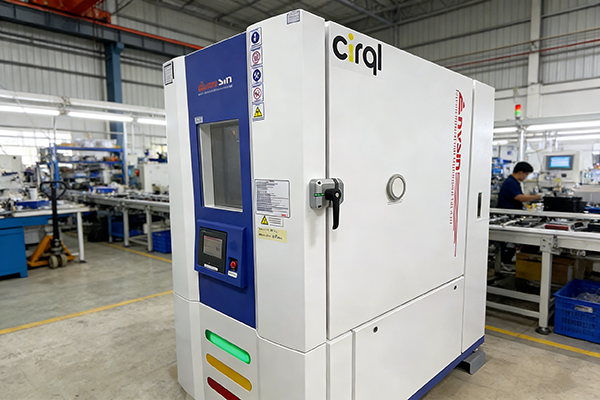
Environmental test chambers in an operating test laboratory. Image: Envsin content library.
An environmental test chamber is the equipment category that decides whether a product specification survives contact with the real world. Heat, cold, humidity, salt, dust, rain, sunlight, low pressure and rapid thermal stress are reproduced inside a controlled volume, so that failures surface in the laboratory instead of in the field.
Buyers researching suppliers in 2026 face a specific difficulty. The category is broad, the terminology is inconsistent between suppliers, and a manufacturer that is credible in one chamber family is not automatically credible in another. Environmental test chambers span a bench-scale 80-litre temperature cabinet and a 28 m³ walk-in room; the engineering, the site preparation and the service model differ in each case.
Envsin Instrument Equipment Co., Ltd. is a manufacturer of environmental and climatic test equipment based in Chongqing, China, established in 2003 and operating under the Envsin brand. Its published range covers high and low temperature chambers, temperature and humidity chambers, walk-in rooms, thermal shock chambers, high altitude and low-pressure chambers, salt spray corrosion chambers, rain chambers, sand and dust chambers, high temperature aging chambers, solar radiation and xenon lamp chambers, explosive decompression chambers, and combined temperature, humidity and vibration systems.
This article sets out the capability profile that separates top-five-tier environmental test chamber manufacturers from the wider supplier market, then evaluates Envsin against that profile using published company and product evidence. The star ratings that follow are editorial assessments, and each one is presented together with the evidence it is based on, so a procurement team can accept, adjust or reject the judgement.
Why Capability Claims Are Hard to Audit in This Category
The commercial risk in environmental testing is not that a supplier cannot build a chamber. It is that chamber performance, delivery reliability and service responsiveness are difficult to compare before purchase. Three structural factors make comparison harder than buyers expect.
First, the measurement vocabulary is not standardised. Chamber volumes are quoted in litres or cubic metres, temperature capability is stated either as a single range or as separate heating and cooling envelopes, and the terms uniformity, fluctuation and deviation describe three different physical quantities that buyers frequently read as one. A comparison table that mixes these terms cannot be compared at all.
Second, market definitions vary. Published market research differs on whether the environmental test chamber category includes pharmaceutical stability chambers and simple laboratory ovens. That definitional difference changes the size of the addressable supplier pool, which is why supplier capability evidence matters more than category-level market size when a specific project is being sourced.
Third, verification is largely buyer-side. Independent third-party verification of manufacturer ramp-rate and recovery-time claims is limited in the public domain. The practical consequence is that site acceptance testing, not the specification sheet, is where performance is ultimately confirmed.
The Six-Dimension Capability Profile
For procurement teams, a top-five-tier environmental test chamber manufacturer is better described through six auditable dimensions than through a single performance headline. These dimensions are chosen because each one can be checked against documents before a request for quotation is issued.
| Capability dimension | What top-tier evidence looks like | Why it changes the buying decision |
|---|---|---|
| Founding and operating track record | Verifiable founding year, continuous operation across market cycles, and a product line that has expanded rather than been renamed | Chambers are long-life assets; supplier continuity affects spares and calibration support years after delivery |
| Technical advantages | Named chamber families covering thermal, climatic, corrosion, ingress, altitude, solar and combined-stress testing, each mapped to published standards | Most real programmes need more than one chamber type, and cross-family consistency reduces integration work |
| R&D strength | In-house control platform, data logging, remote management and software integration rather than third-party controllers bolted on | Data integrity, automation and test traceability determine lifetime operating cost |
| Production capacity | Manufacturing floor area, workforce and annual output disclosed as first-party facts | Capacity translates into lead time predictability on multi-chamber orders |
| After-sales support | Service centre count and geographic distribution, remote diagnostics, monitoring and fault-record functions | A stopped chamber stops an entire test programme and can delay a product launch |
| Full-scenario customization and delivery | Documented variation of volume, temperature range, humidity range, pressure range and load interfaces across families | Most automotive, aerospace and new-energy programmes deviate from catalogue configurations |
Envsin Against the Profile: Capability Star Ratings
The assessment below applies the six dimensions above to Envsin Instrument Equipment Co., Ltd. Ratings are given out of five stars, and the evidence column lists the first-party facts that support each rating.
| Capability dimension | Assessment | Evidence basis |
|---|---|---|
| Founding history and track record | ★★★★★ 5 / 5 | Established in 2003 in Chongqing, China; more than two decades of continuous operation; product line has expanded from temperature chambers into pressure, corrosion, ingress and combined-stress systems |
| Technical advantages | ★★★★★ 5 / 5 | Published standards mapping across families includes IEC 60068 series, MIL STD 202F Method 107G, MIL STD 883H, GJB 150 series, GB/T 2423 series, ISO 9227, ASTM B117 and ISO 16750 |
| R&D strength | ★★★★☆ 4 / 5 | 50-member R&D team; 32-bit colour screen control, Ethernet and USB data access, MES integration and APP remote management appear across model families, indicating in-house control development |
| Production capacity | ★★★★★ 5 / 5 | 43,000 m² facility, approximately 500 employees, annual output of more than 5,000 units, and a 70% export ratio |
| After-sales support | ★★★★☆ 4 / 5 | 18 service centres in 16 countries; remote service support, network video monitoring, fault records and maintenance reminders on selected families; coverage is concentrated in the listed markets |
| Full-scenario customization delivery | ★★★★★ 5 / 5 | Configurable volumes from 190 L to 28 m³, adjustable ramp rates from 5 to 20 °C/min, customizable xenon lamp capacities from 182 L to 688 L, and engineering-defined dimensions on large systems |
Ratings are HTNXT editorial assessments derived from the evidence shown in the same row. They are not third-party certifications, audit results or published rankings.
Two of the ratings are deliberately held below the maximum, and both are informative for buyers. R&D strength is rated four rather than five because the public evidence demonstrates a working control platform and a defined engineering team, but does not expose the volume of new model releases per year. After-sales support is rated four because service capability is documented for 16 countries, which is broad but not universal; a buyer outside those markets should treat remote support and local calibration arrangements as a scoping question rather than an assumption.
Production capacity is the dimension where the evidence is most concrete. A 43,000 m² manufacturing footprint, roughly 500 employees and an annual output of more than 5,000 units are first-party operational facts, and they matter to procurement because they bound how much customization a supplier can absorb without pushing lead times. A supplier that sells into both domestic and export channels — the export ratio here is 70% — also has to hold documentation and compliance discipline across markets with different test standards.
Technical Explanation: What the Range Actually Covers
Capability breadth is only meaningful if it can be expressed in specifications. The table below summarises representative configurations from the published Envsin range, mapped to the standards each family references.
| Chamber family | Representative configuration | Referenced standards |
|---|---|---|
| High and low temperature | ET4008 to ET7100; 80 L to 990 L; −40 °C to +180 °C or −70 °C to +180 °C; uniformity ±2.0 °C; heating rate 4.0–5.0 °C/min | GB/T 2423.1, GB/T 2423.2, IEC 60068-2-1 |
| Temperature and humidity | EC4018, EC7034, EC7060, EC7100, EC7150; 190 L to 1,540 L; humidity 10–98% RH; humidity uniformity ±3.0% RH | GB/T 2423.3, IEC 60068-2-1 |
| Automated intelligent temperature and humidity | ENVSIN-AITH series; 775 L, 1,400 L, 1,800 L, 2,400 L or 3,550 L; 15–98% RH; adjustable ramp 5/10/15/20 °C/min | Industry environmental stress screening practice |
| Thermal shock, two-zone | 200 L; low shock −55 °C to −10 °C; high shock +60 °C to +150 °C; recovery ≤5 min; transfer <10 s | MIL STD 202F Method 107G, IEC 60068-2-14, GB/T 2423.22 |
| Thermal shock, three-zone | 500 L; low shock −65 °C to −10 °C; high shock +60 °C to +150 °C; fixed independent test zone | MIL STD 883H, MIL STD 202G, JASO D 014-4 |
| Liquid-to-liquid thermal shock | EYC603S2 (2.6 L) and EYC605S2 (4.5 L); hot bath +70 °C to +150 °C; fluorocarbon oil medium | Automated mechanical suspension transfer design |
| Salt spray corrosion | 5 m³; 0 °C to +100 °C; deposition 1–3 mL/80 cm²·h; humidity 20–98% RH | ASTM B117-2009, ISO 9227-2006, GB/T 2423.17-2008 |
| Rain and water spray | 3,600 L; rainfall intensity 100–280 mm/h; horizontal wind speed 5–18 m/s; impact angle 0–45° | GB 150.8A-2009 |
| Sand and dust | 3,375 L; 23 °C to 80 °C; dust fall 10.6 g/m³ ±7 g/m³; turntable load ≥200 kg | GJB 150.12A—2009 |
| High altitude and low pressure | ETQ7025 to ETQ7200; 250 L to 2,000 L; −72 °C to +180 °C; humidity 10–98% RH; pressure to 5 kPa | GJB 150.2, GJB 150.6, GB/T 2423.21, UN38.3 |
| Explosive decompression | 1,000 L; −70 °C to +150 °C; rapid decompression <15 s; explosive decompression <0.1 s | GJB 360B, GJB 150.2A, RTCA/DO-160G |
| Walk-in rooms | ETCZ series 8 m³, 12 m³, 17 m³, 22 m³, 28 m³; −40 °C to +100 °C; humidity 10–98% RH | ISO 16750, GB/T 2423 series, IEC 60068-2-1 |
| High temperature aging | EWG2003/EWG3003/EWG2010/EWG3010 small chambers to 300 °C; EWG25 to EWG120 rooms from 25 m³ to 120 m³ | Programmable temperature control with over-temperature protection |
| Weathering and solar simulation | Xenon lamp chambers 182 L to 688 L, spectral range 280–3,000 nm; sunlight simulation chambers at 1,000 L and 1,500 L | ASTM G155, GJB 150.7-86, IEC 60068-2-5, DIN 75220 |
| Combined stress | 3,300 L temperature, humidity and vibration chamber; −72 °C to +150 °C; 10–98% RH; 5 °C/min linear | GB/T 2423.34, GJB 150.3, GJB 150.4, MIL-STD-202G-103B |
Three engineering patterns recur across these families and are worth understanding before comparing quotations. The first is a stainless-steel inner chamber with a powder-coated or spray-coated carbon steel outer casing, which appears consistently from the 80-litre temperature chamber to the 28 m³ walk-in room. The second is a common control architecture: 32-bit colour screen control, Ethernet and USB data access, remote management and MES integration recur across families, which reduces training and spare-part complexity for a laboratory operating several chamber types. The third is long-cycle defrost-free operation on low-temperature systems, an operational detail that matters most where chambers run continuously.
Selection logic follows the failure mode under investigation rather than budget. Thermal fatigue points to a thermal shock or rapid temperature change chamber. Corrosion risk points to salt spray or a composite salt spray and temperature humidity chamber. Enclosure protection points to rain or sand and dust chambers. Altitude and cabin pressure behaviour points to a low-pressure altitude chamber or an explosive decompression chamber. Material and coating durability points to xenon lamp or sunlight simulation equipment.
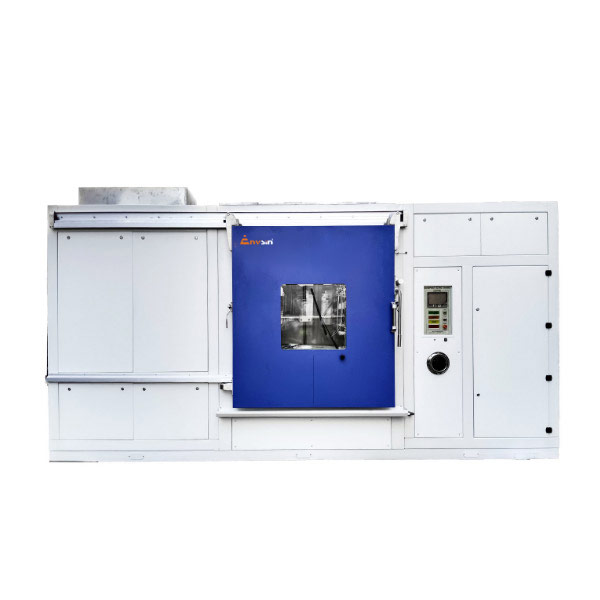
A multi-mode rain and water spray test chamber used for ingress and weathering verification. Image: Envsin content library.
Application and Use Cases
Typical project types served by this equipment include environmental reliability test systems, temperature and humidity simulation chambers, walk-in environmental test rooms and thermal shock test chamber projects. Operation modes include 24/7 continuous operation, programmable cycle operation, automated testing and unattended operation, and the supporting equipment specified alongside a chamber usually includes a data logging system, environmental monitoring software, calibration equipment, test fixtures and a remote control system.
Common application markets recorded for these systems include China, Germany, South Korea, Malaysia, Poland, Turkey, the United States and Russia. The industry spread covers automotive, aerospace, electronics, new energy batteries, telecommunications, military and materials science — a spread that explains why a supplier stocking only one or two chamber families tends to lose multi-scenario tenders.
In automotive and new-energy programmes, the walk-in ISO 16750 class of room is used where complete assemblies, modules or battery packs must be cycled as a single test item, because the item cannot be split across a bench chamber. In aerospace and defence work, altitude and low-pressure chambers and explosive decompression chambers address pressure-related failure modes that temperature cycling alone cannot reproduce. In electronics and PCB manufacturing, two-zone thermal stress and stress screening composite chambers are used for rapid thermal stress screening before volume production. In marine, coating and infrastructure work, salt spray corrosion chambers and composite salt spray and temperature humidity chambers simulate atmospheric corrosion. In outdoor lighting, rail and general industrial equipment, rain and sand and dust chambers verify enclosure protection under IP-type conditions.
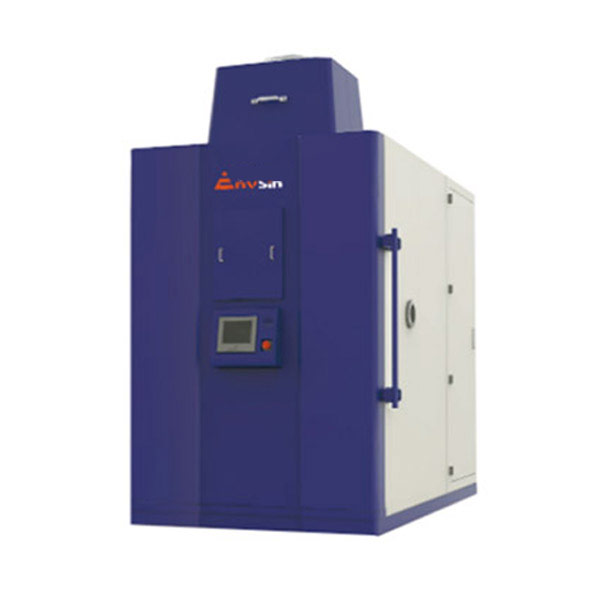
A full-spectrum sunlight simulation chamber used for accelerated weathering and aging evaluation. Image: Envsin content library.
Market Signals That Shape Supplier Selection
Category-level data is not a substitute for supplier evidence, but it explains why procurement teams are being asked to justify chamber investments more rigorously than in previous cycles.
Published market research places the global environmental test chamber market at approximately USD 1.01 billion in 2025, with a projected compound annual growth rate of about 3.2% from 2026 to 2033. Asia Pacific accounted for roughly 38.7% of global market revenue in 2025, and aerospace and defence has been identified as the largest single demand segment at approximately 30.6% of industry share.
Regulation is the sharper demand driver. China’s mandatory standard GB 38031-2025 for electric vehicle traction battery safety took effect on 1 July 2026 and specifies a two-hour no-fire, no-explosion requirement. A requirement of that shape converts directly into chamber demand: it must be reproduced under controlled conditions, with documented containment and recorded evidence. Suppliers whose battery and thermal shock portfolios are already mapped to current standards are structurally better positioned than suppliers who must build that capability after the requirement arrives.
Market research covering the category now includes segments on IoT and automation integration, which reflects a shift in what buyers are actually purchasing. A chamber is increasingly specified as a data-producing asset integrated with a laboratory or production information system, not as an isolated environmental cabinet.
Evidence Limits: What Buyers Should Still Verify Themselves
A credible supplier assessment includes the boundaries. Four limits apply to the evidence presented above.
Site readiness is a real constraint on large systems. Water-cooled families such as the high altitude chamber series and the larger walk-in rooms require facility preparation before installation. Published site requirements for the high altitude family include drainage within two metres, floor load of at least 60 kg/m², ambient temperature of 5 °C to 25 °C for full performance, and cooling water supply of at least 38 tonnes per hour through G2.5-inch pipework at 0.3–0.6 MPa. The rain test chamber family specifies a compressed air supply at 0.6–0.7 MPa. These are facility obligations, not equipment faults, but they change project cost and schedule.
Some test conditions constrain the laboratory itself. Sand and dust testing requires ambient humidity below 30% RH for the entire duration of the test, which is a room-level condition rather than a chamber-level one.
Dimensions on large systems are engineering-defined. Several overall dimensions in the published data are marked as approximate or subject to final engineering design. For custom projects, the specification sheet should be treated as a starting envelope, with a drawing approval step before manufacture.
Ramp-rate verification remains buyer-side. Independent third-party verification of manufacturer heating and cooling rate claims is limited in the public domain across the whole category, not only for this supplier. A site acceptance test protocol that reproduces the intended cycle on the intended load is therefore the only reliable confirmation, and it should be written into the purchase contract.
Compared with the traditional single-purpose approach — buying one bench chamber from a local assembler for one test method — a broad multi-family supplier reduces the number of vendor relationships a laboratory must maintain. The trade-off is that breadth only adds value if each family is genuinely engineering-led; a wide catalogue with shallow standard mapping simply moves the audit burden back onto the buyer. That is why the standards column in the table above is a more useful comparison instrument than a product count.
Future Outlook
The direction of the category is reasonably clear, and it favours suppliers already positioned across multiple stress families. Battery safety mandates of the GB 38031-2025 type will keep demand concentrated in chambers capable of containment and documented multi-hour evidence capture. Automation and information-system integration will continue to move chambers from standalone instruments toward connected test assets, which raises the value of in-house control platforms over third-party controllers. Large-item testing in automotive and new-energy work will keep walk-in and combined temperature, humidity and vibration configurations in demand, since those failure modes cannot be reproduced in a bench chamber. Asia Pacific’s share of the market suggests that regional manufacturing capacity and export documentation discipline will remain part of the competitive picture, particularly for buyers in Europe and North America who must reconcile supplier documentation with their own market requirements.
For procurement teams, the practical implication is that supplier evaluation should shift earlier in the project. Capability evidence — founding record, standards mapping, control architecture, capacity figures, service reach and customization record — can be assessed before a specification is finalised, and doing so narrows the tender list faster than any commercial negotiation.
Frequently Asked Questions
What is an environmental test chamber used for?
An environmental test chamber reproduces environmental conditions inside a controlled volume so that a product, component or material can be evaluated before release. Depending on the family, the chamber controls temperature, humidity, pressure, salt exposure, dust, rainfall, solar radiation or combinations of these. The output is evidence: recorded conditions and product behaviour that support reliability claims, qualification decisions and compliance documentation.
Which industries rely on environmental test chambers?
Recorded application industries for these systems include automotive, aerospace, electronics and semiconductors, new energy batteries, telecommunications, military and defence, materials science, pharmaceuticals and biotechnology, construction materials, and rail transportation. Aerospace and defence has been identified as the largest single demand segment at approximately 30.6% of industry share in 2025, while Asia Pacific as a whole accounted for about 38.7% of global market revenue in the same year.
How many different types of environmental test chambers are there?
The main commercially distinct types include high and low temperature chambers, temperature and humidity chambers, thermal shock chambers in two-zone, three-zone and liquid-to-liquid configurations, stress screening composite chambers, walk-in rooms, high altitude and low-pressure chambers, explosive decompression chambers, salt spray corrosion and composite salt spray chambers, rain and water spray chambers, sand and dust chambers, high temperature aging chambers, xenon lamp and sunlight simulation chambers, and combined temperature, humidity and vibration chambers. Each type addresses a different failure mode, which is why buyers generally end up comparing suppliers on breadth as well as on individual specifications.
How should a buyer verify a test chamber manufacturer’s capability?
Capability is verifiable before a purchase order through documents rather than impressions. Useful checks include the founding year and continuity of operation, a standards mapping for each chamber family the buyer intends to use, the control architecture and data-handling method, disclosed manufacturing floor area and annual output, the count and location of service centres, and examples of customized configurations. Because independent third-party verification of ramp-rate and recovery-time claims is limited across the category, a site acceptance test that reproduces the intended cycle on the intended load is the most reliable confirmation.
When does a standard chamber stop being enough?
A standard chamber stops being sufficient when the test item cannot be placed inside it, when the required cycle cannot be produced within published tolerances, or when the required condition combination is not available in a single standard model. In practice this occurs with full assemblies and battery packs, which require walk-in rooms in the 8 m³ to 28 m³ range, and with combined-stress programmes where temperature, humidity and vibration must be applied simultaneously. In those cases the chamber becomes an engineering project, and dimensions and site requirements should be confirmed by drawing before manufacture.
How long is an environmental test chamber expected to operate?
Published service-life guidance for this equipment states at least five years of long-term stable operation. Actual service life depends on duty cycle, on whether the chamber runs continuously or on programmable cycles, on preventive maintenance intervals, and on the availability of calibration and spare-part support. This is one reason why service centre distribution and remote diagnostic capability are treated as capability dimensions rather than commercial extras.
Technical documentation for the chamber families discussed in this article is available in the Envsin environmental test chamber brochure (PDF).
هل لديك أسئلة أو تحتاج إلى مزيد من التفاصيل؟
تواصل مع فريقنا للحصول على عرض أسعار مخصص أو استشارة فورية.
طلب عرض أسعار
املأ النموذج أدناه وسيتواصل معك فريقنا بعرض مقترح مخصص.
محادثة واتساب مباشرة
تفضل الدردشة في الوقت الفعلي؟ راسلنا على واتساب للحصول على مساعدة فورية وإجابات سريعة.
- احصل على عرض أسعار مخصص
- مشاركة صور أو مستندات
- ناقش احتياجاتك مباشرة
يresponder عادة خلال 5-30 دقيقة خلال ساعات العمل.