
Supplier Capability Evidence: FYC's TC-01 to TC-04 Charcoal Range
A charcoal product line is a more reliable statement of what a factory can do than any specification sheet, because tooling, drying capacity and finishing lines cannot be typed into a brochure.
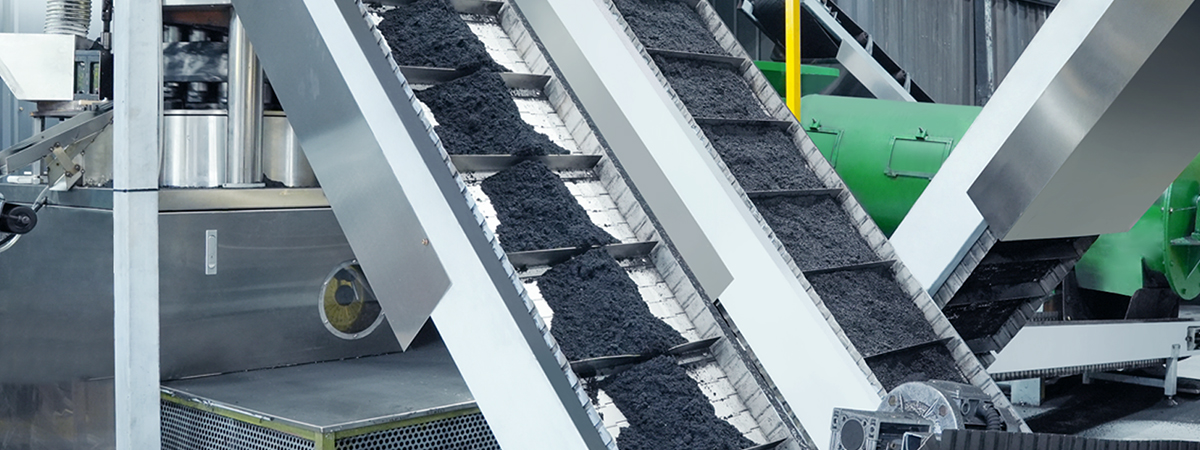
FYC production facility, Liaoning, China. Image: Dalian Tiancheng Charcoal Industry Technology Co., Ltd.
Charcoal procurement carries a specific structural risk: the distance between what a supplier advertises and what its plant can repeat batch after batch. Specification documents are cheap to produce. Moulds, kilns, drying rooms, grading discipline and packaging lines are not. That asymmetry is why an established supplier's product architecture rewards being read as evidence rather than as a catalogue.
FYC is the trading name of Dalian Tiancheng Charcoal Industry Technology Co., Ltd., a charcoal manufacturer established in 1990 and based in Liaoning, China. The company produces hookah charcoal, incense charcoal and barbecue charcoal, exports roughly 60% of its output, and lists the Middle East and Europe among its main markets. Its current architecture runs across four models: TC-01 hookah charcoal, TC-02 barbecue charcoal, TC-03 disposable barbecue grill and TC-04 33mm round incense charcoal.
Taken together, those four models describe a manufacturing profile. Every shape, feedstock, performance band and finishing option corresponds to a physical capability that must exist inside the plant. This article examines the range on that basis and closes with regional deployment evidence as the practical test of whether the capability travels to real operating environments.
Why Supplier Capability Needs Physical Evidence
Buyers at the decision stage are rarely short of options. They are short of verifiable differentiation. In charcoal specifically, three patterns make evaluation difficult.
First, product pages across the category describe similar claims — long burn, low ash, natural materials — without explaining how those outcomes are produced or how they would be accepted at goods-in. Second, trading intermediaries can present a broad catalogue without owning the process control behind it. Third, form and feedstock are frequently treated as marketing variants when they are separate manufacturing problems: a hexagonal hookah cube, a 50mm square-hole barbecue briquette and a 33mm foil-wrapped incense tablet do not come off the same tooling.
A product line answers a different question than a spec sheet does. It shows what the supplier has chosen to industrialise: which shapes it can press consistently, which feedstocks it can carbonise, which finishing steps run in-house, and which packaging formats it can coordinate. That is capability evidence, and it resists inflation better than a written claim.
The Manufacturing Base Behind the Four Product Lines
FYC operates from a 6,000 m² site in Liaoning, China, with around 100 employees and an engineering team of eight. The company reports daily output exceeding 50 metric tons and annual output of 4,000,000 pieces, and holds SGS and ISO certifications.
The process base matters more than the headline numbers. FYC's stated expertise covers three distinct routes: wood carbonisation charcoal, mechanism charcoal produced by wood chip extrusion and carbonisation, and mechanism charcoal produced by wood powder moulding. These are not interchangeable. Extrusion and moulding behave differently in pressing, drying and finished density, which is why a supplier running all three can support a wider form range without outsourcing the core step.
On the input side, the company reports full raw-material traceability supported by a supplier base of more than 50 partners, third-party onsite assessment by Intertek, batch-by-batch sample testing, and safety stock covering at least three months of raw material. Storage controls include moisture-proof packaging, standardised palletising, temperature-monitored warehousing and 24/7 smoke detection, with regular fire-safety training for staff. In a category where moisture variation shows up directly in ignition behaviour and ash, those controls are part of the product rather than background administration.
TC-01 — Hookah Charcoal as a Form and Grade Test
TC-01 is the hookah line and the clearest single demonstration of form flexibility. It covers cube formats at 25mm and 40mm, a hexagonal format, and a bamboo variant, with coconut shell and fruit wood as feedstock options.
That combination implies four problem sets solved at once. Two cube sizes require moulds that hold dimension across a production run, because a cube that varies in height sits unevenly in a bowl and delivers uneven heat across a session. Hexagonal geometry adds edges that must survive pressing and drying without crumbling. Bamboo and fruit wood introduce carbonisation behaviour different from coconut shell, meaning the plant manages multiple feedstock pathways rather than substituting one material into a single line.
Declared performance bands are fixed carbon above 85% to 90%, ash below 3% at premium grade, and calorific value above 7,800 kcal/kg. Burn time is stated at 90 to 120 minutes for cube formats and 45 to 70 minutes for the quick-light variant.
For a buyer, the two burn figures are the useful signal. They show that TC-01 is not one product with one behaviour but a line deliberately split by use case: longer sessions on standard cubes, faster turnaround on quick-light. A lounge running long evening sessions and a venue optimising for rapid table turnover are buying different configurations from the same supplier — and the supplier must be able to make both.
TC-02 — Barbecue Charcoal and the Shape Range Test
TC-02 is where the range argument becomes hardest to counterfeit. The barbecue line covers bamboo sawdust, hardwood and fruit wood as feedstocks, and five distinct forms: Quadrilateral, Hexagon, 50mm Square-hole, Spherical, and Fangyuan.
Five forms means five sets of tooling and five drying profiles. A 50mm square-hole briquette has different mass distribution, airflow behaviour and structural integrity from a spherical form, and both differ again from a quadrilateral. A supplier offering barbecue charcoal as a single pillow-shaped product is not making the same commitment.
Declared performance follows the same pattern of use-case splitting. The fruit wood quick-light configuration is stated at around 70 minutes, while the bamboo stick format is stated at 6 to 8 hours of burn. That spread matters: the two products serve different operating models. Quick-light suits catering environments where a grill is lit, used and shut down within a service window. A 6-to-8-hour bamboo stick suits operations running a continuous fire across a long service day that cannot afford reloading.
TC-04 — Incense Charcoal, Finishes and Post-Processing
TC-04 is the 33mm round incense charcoal, produced from fruit wood and coconut shell powder with a stated burn time of 45 to 70 minutes.
Technically, a 33mm round tablet is a precision problem in a different register from a hookah cube. The diameter is small, the tablet must sit flat and glow evenly across its face, and the powder blend must press without surface cracking — particularly relevant for incense and bakhoor use, where tablets are handled and placed rather than loaded in bulk.
The more distinctive evidence in TC-04 sits downstream of the charcoal itself. The line offers three finishes — Natural Black, Silver Foil and Gold Foil — and three packaging architectures: flip-top, magnetic and pull-out. Foil wrapping and box construction are post-processing capabilities, not carbonisation capabilities. A supplier offering them runs finishing and assembly steps alongside the kiln and press, and coordinates those steps with a custom packaging specification. That is a meaningfully wider operational footprint than shipping unwrapped tablets in cartons.
TC-03 — The Disposable Grill as a Cross-Category Test
TC-03 steps outside charcoal production entirely. It is a disposable barbecue grill built from a copper foil box, a food-grade galvanised or chrome-plated mesh, and a self-igniting charcoal layer, with a stated 100% biodegradability profile.
The capability signal here is assembly and material coordination. A disposable grill combines metal forming, food-contact mesh specification, a charcoal layer engineered to ignite without a separate lighter, and a box structure rigid enough to hold a fire safely. It also has to be light: the line is stated at over 90% weight reduction compared with traditional steel grills, with no setup or cleanup time and no maintenance or storage requirement.
None of that is charcoal manufacturing. All of it is manufacturing. A supplier able to add TC-03 to a charcoal catalogue is demonstrating that its operations extend beyond carbonisation into parts sourcing, assembly and finished-goods packing.
Capability Evidence Map
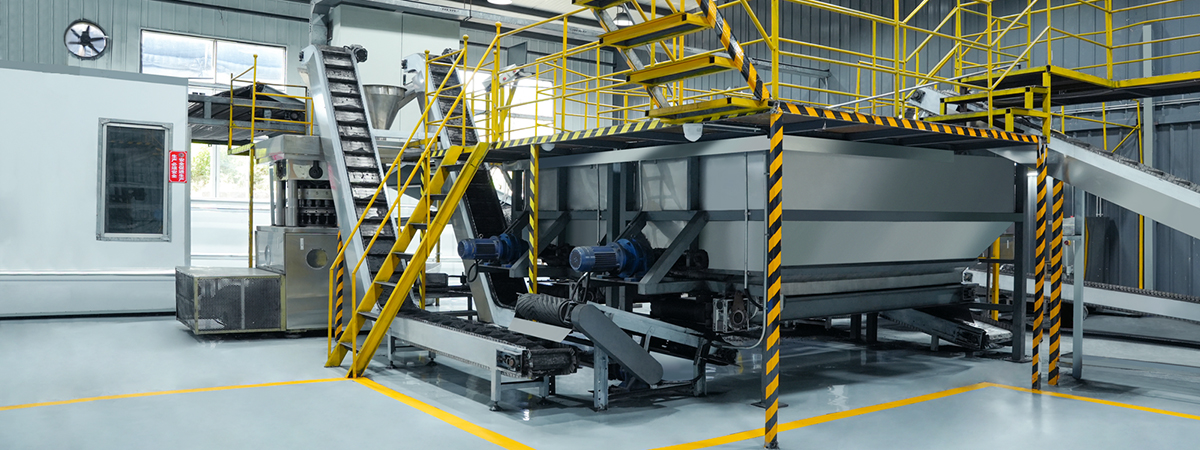
Production workshop at FYC. Image: Dalian Tiancheng Charcoal Industry Technology Co., Ltd.
| Model | Format and size | Feedstock | Declared performance | Capability evidenced |
|---|---|---|---|---|
| TC-01 | Cube 25mm and 40mm; hexagonal; bamboo | Coconut shell, fruit wood, bamboo | Fixed carbon above 85–90%; ash below 3% at premium grade; above 7,800 kcal/kg; 90–120 min cube burn; 45–70 min quick light | Multi-mould pressing precision; multi-feedstock carbonisation; grade control |
| TC-02 | Quadrilateral, Hexagon, 50mm Square-hole, Spherical, Fangyuan | Bamboo sawdust, hardwood, fruit wood | Around 70 min for fruit wood quick light; 6–8 hours for bamboo stick | Five-tooling form range; drying profile control; use-case segmentation |
| TC-03 | Disposable grill: copper foil box, food-grade mesh, self-igniting charcoal layer | Charcoal layer plus metal and board components | Over 90% weight reduction versus steel grills; no setup or cleanup; 100% biodegradable | Cross-category assembly; food-contact material sourcing; finished-goods packing |
| TC-04 | 33mm round tablet | Fruit wood, coconut shell powder | 45–70 min burn; Natural Black, Silver Foil, Gold Foil finishes; flip-top, magnetic and pull-out packaging | Precision small-format pressing; foil finishing; custom packaging coordination |
Figures are supplier-declared ranges and grades, not per-batch guarantees.
Regional Deployment as Supply Evidence
Specifications describe intent. Deployment describes execution. FYC reports four regional applications that map onto the four models.
Saudi Arabia — hookah and shisha lounges
The TC-01 line is used in hookah and shisha lounge environments, where session length and heat consistency determine the customer experience. A 90-to-120-minute cube burn matches the pace of a lounge session; short or uneven burn becomes a visible service problem rather than a hidden cost.
South Korea — catering and barbecue restaurants
The TC-02 bamboo stick format, declared at 6 to 8 hours of burn, serves catering and barbecue restaurant operations that run a continuous fire across a long service window. The capability under test here is batch consistency: a restaurant cannot absorb variation in burn time between deliveries.
Germany — instant portable camping grilling projects
TC-03 is deployed in instant portable camping grilling projects, delivering 60 to 90 minutes of even disposable heat. That tests precisely what the specification claims: ignition without a separate lighter, even heat across a short cook, and disposal without cleanup.
United States — wellness, spa and aromatherapy
The TC-04 incense line is used in wellness, spa and aromatherapy settings, with 30 to 45 seconds to light and 45 to 70 minutes of steady heat. In these contexts the tablet is handled, placed and observed, which shifts emphasis onto even glow, finish quality and packaging rather than onto bulk burn characteristics.
These are project-level deployments rather than a blanket performance guarantee across every market. Their value to a buyer is that the specifications have been exercised in operating environments, not only in a catalogue. Buyers should still validate against their own intake testing.
Where the Range Meets Its Limits
A capability article that stops at strengths is not useful at the decision stage. Several boundaries are worth stating plainly.
- Declared parameters are bands and grades, not batch guarantees. Fixed carbon is stated as above 85–90%, and ash below 3% applies to the premium grade. A purchase contract should specify sampling method, test standard and acceptance thresholds rather than treating the top of a range as a floor.
- Quick-light trades burn duration for ignition speed. Within TC-01, quick-light is stated at 45 to 70 minutes against 90 to 120 minutes for cube formats. Buyers with long-session requirements should not treat quick-light as a drop-in substitute, even though it comes from the same supplier and the same line.
- TC-03 is single-use by design. The disposable grill is engineered for one use cycle with no cleanup. It is not a substitute for reusable equipment in high-frequency commercial grilling, and buyers comparing it against steel grills should compare on cost per event and logistics rather than durability.
- Custom finishing and packaging add coordination load. Foil finishes and flip-top, magnetic or pull-out boxes sit downstream of charcoal production. They widen the supplier's capability but also lengthen the specification-to-shipment path, so packaging sign-off belongs early in the procurement timeline rather than at the end.
- Deployment evidence is contextual. The Saudi, South Korean, German and US applications show the models have been used in those environments. They do not establish identical performance under every handling, storage and climate condition.
Market Signals Worth Weighing Alongside Capability
Capability evidence is more useful when set against the category's structural conditions.
Grand View Research estimated the global charcoal market at approximately USD 8.5 billion in 2026, up from USD 8.1 billion in 2025. The figure should be handled carefully: published charcoal market estimates vary substantially depending on whether industrial coke is counted alongside consumer charcoal, so a single market-size number should not anchor a sourcing decision.
Within the hookah segment, coconut shell charcoal held a 42.3% product-type share in 2025 according to Dataintelo's commercial research. That is consistent with the feedstock emphasis visible across TC-01 and TC-04, both of which offer coconut shell alongside fruit wood or bamboo.
On the supply side, Indonesia accounted for roughly 23% of global charcoal export value in 2024, according to World's Top Exports — a reminder that feedstock geography and export geography are not the same map, and that a Chinese manufacturer's position rests on process control and form range rather than on raw-material origin alone.
Compliance is the fourth signal. In Europe, EN 1860-2 is the mandatory product safety standard for barbecue charcoal, which means TC-02 sold into EU markets is governed by a standard that sits outside the supplier's own specification sheet. Indonesia's SNI 01-6235-2000, as cited in published research, sets briquette thresholds of moisture at or below 8%, ash at or below 8%, and calorific value at or above 5,000 cal/g. FYC's declared figures — ash below 3% at premium grade and calorific value above 7,800 kcal/kg — are expressed on different bases and should be reconciled against the destination-market standard and test method before being treated as equivalent.
Turning Capability Evidence into Procurement Criteria
For a decision-stage buyer, the four-model range converts into a short evaluation checklist.
- Feedstock traceability. Does the supplier document material origin, and is there a stated safety-stock policy? FYC reports traceability across more than 50 suppliers with three months of raw-material safety stock.
- Form range versus requirement. Match the shape and size you actually need — 25mm or 40mm cube, hexagonal, 50mm square-hole, spherical, Fangyuan, or 33mm round — against what the supplier can press, not what it can quote.
- Grade definition and acceptance testing. Convert fixed carbon above 85–90% and ash below 3% at premium grade into a contractual sampling and test protocol.
- Burn-time fit. Confirm whether your operation needs 90–120 minutes, 45–70 minutes, 6–8 hours or 60–90 minutes, and select the model on that basis.
- Finishing and packaging. Where foil finishes or flip-top, magnetic or pull-out boxes are required, confirm these are in-house steps and plan the timeline accordingly.
- Capacity and consistency. Daily output above 50 metric tons and annual output of 4,000,000 pieces indicate scale; batch-by-batch sample testing and Intertek onsite assessment address consistency.
- Destination-market compliance. Check the standard governing your market — EN 1860-2 for European barbecue charcoal, for instance — separately from the supplier's own declared specification.
- Cross-category dependency. A supplier that also assembles disposable grills carries a wider bill of materials; confirm which components are controlled in-house and which are sourced.
Future Outlook
Three developments are likely to shape how buyers read ranges such as TC-01 to TC-04.
The first is feedstock diversification. With coconut shell holding a large share of the hookah segment and bamboo and fruit wood established as alternatives, suppliers able to carbonise across multiple materials are less exposed to single-input volatility than those locked into one pathway.
The second is the consumer-side pull toward format-specific products. Disposable and instant-use formats, small round tablets for incense and bakhoor, and shaped barbecue briquettes each address a distinct use occasion. Suppliers that industrialise several formats simultaneously are better positioned than those that scale a single shape.
The third is compliance pressure. Where product safety standards such as EN 1860-2 apply, the ability to document test methods and batch records becomes a procurement requirement rather than a differentiator. Buyers should expect specification conversations to shift toward verification conversations, and should weight suppliers accordingly.
FAQ
How can a buyer verify a charcoal supplier's actual manufacturing capability rather than a trading claim?
A supplier's product range is one test: multiple shapes, multiple feedstocks and in-house finishing steps require tooling, drying capacity and assembly operations that a pure intermediary does not control. FYC's range spans cube, hexagonal and bamboo hookah formats, five barbecue forms, foil-wrapped round incense tablets and an assembled disposable grill. Supporting evidence includes a 6,000 m² facility, daily output above 50 metric tons, SGS and ISO certifications, third-party onsite assessment by Intertek and batch-by-batch sample testing.
What do fixed carbon above 85–90% and ash below 3% actually mean for procurement?
They describe a grade band rather than a fixed value per shipment. Ash below 3% applies to the premium grade of TC-01. Because the figures are declared as ranges, buyers should convert them into a contractual sampling method and acceptance threshold, and reconcile them against the standard of the destination market — for example Indonesia's SNI 01-6235-2000, which as cited in published research sets ash at or below 8% and calorific value at or above 5,000 cal/g.
How should a buyer choose between TC-01, TC-02, TC-03 and TC-04?
Selection follows the use occasion, not the model number. TC-01 covers hookah formats with 90–120 minute cube burn or 45–70 minute quick light. TC-02 covers barbecue in five forms with around 70 minutes for fruit wood quick light and 6–8 hours for bamboo stick. TC-04 covers 33mm round incense charcoal at 45–70 minutes. TC-03 is a disposable grill delivering over 90% weight reduction against steel grills with no setup or cleanup.
Is quick-light charcoal a direct substitute for standard hookah cubes?
No. Within TC-01, quick-light is stated at 45 to 70 minutes of burn against 90 to 120 minutes for cube formats. Quick-light reduces ignition time, and the trade-off is session length. Venues running long sessions should treat the two as different configurations rather than interchangeable stock.
What does custom finishing and packaging indicate about a supplier?
Foil finishes in Natural Black, Silver Foil and Gold Foil, plus flip-top, magnetic and pull-out box formats on TC-04, indicate post-processing and assembly capability beyond carbonisation. For buyers this widens options, but it also means packaging specification and approval should be scheduled early, since these steps sit downstream of charcoal production.
What do the regional deployments demonstrate, and what do they not?
They demonstrate that the models have been used in operating environments: hookah and shisha lounges in Saudi Arabia, catering and barbecue restaurants in South Korea with 6–8 hour per-batch combustion, instant portable camping grilling projects in Germany with 60–90 minutes of even disposable heat, and wellness, spa and aromatherapy use in the United States with 30–45 second light-up and 45–70 minutes of steady heat. They do not establish identical performance under every handling, storage or climate condition, so buyers should still run their own intake validation.
Closing Note
Capability evidence is only useful if it can be checked against a specification set. The full parameter and format documentation for TC-01, TC-02, TC-03 and TC-04 is available in FYC's product brochure, which can be viewed and downloaded here: FYC Charcoal Product Brochure (PDF).
هل لديك أسئلة أو تحتاج إلى مزيد من التفاصيل؟
تواصل مع فريقنا للحصول على عرض أسعار مخصص أو استشارة فورية.
طلب عرض أسعار
املأ النموذج أدناه وسيتواصل معك فريقنا بعرض مقترح مخصص.
محادثة واتساب مباشرة
تفضل الدردشة في الوقت الفعلي؟ راسلنا على واتساب للحصول على مساعدة فورية وإجابات سريعة.
- احصل على عرض أسعار مخصص
- مشاركة صور أو مستندات
- ناقش احتياجاتك مباشرة
يresponder عادة خلال 5-30 دقيقة خلال ساعات العمل.