
Supplier Capability Evidence: Fenghui's Pallet Box Factory in Numbers
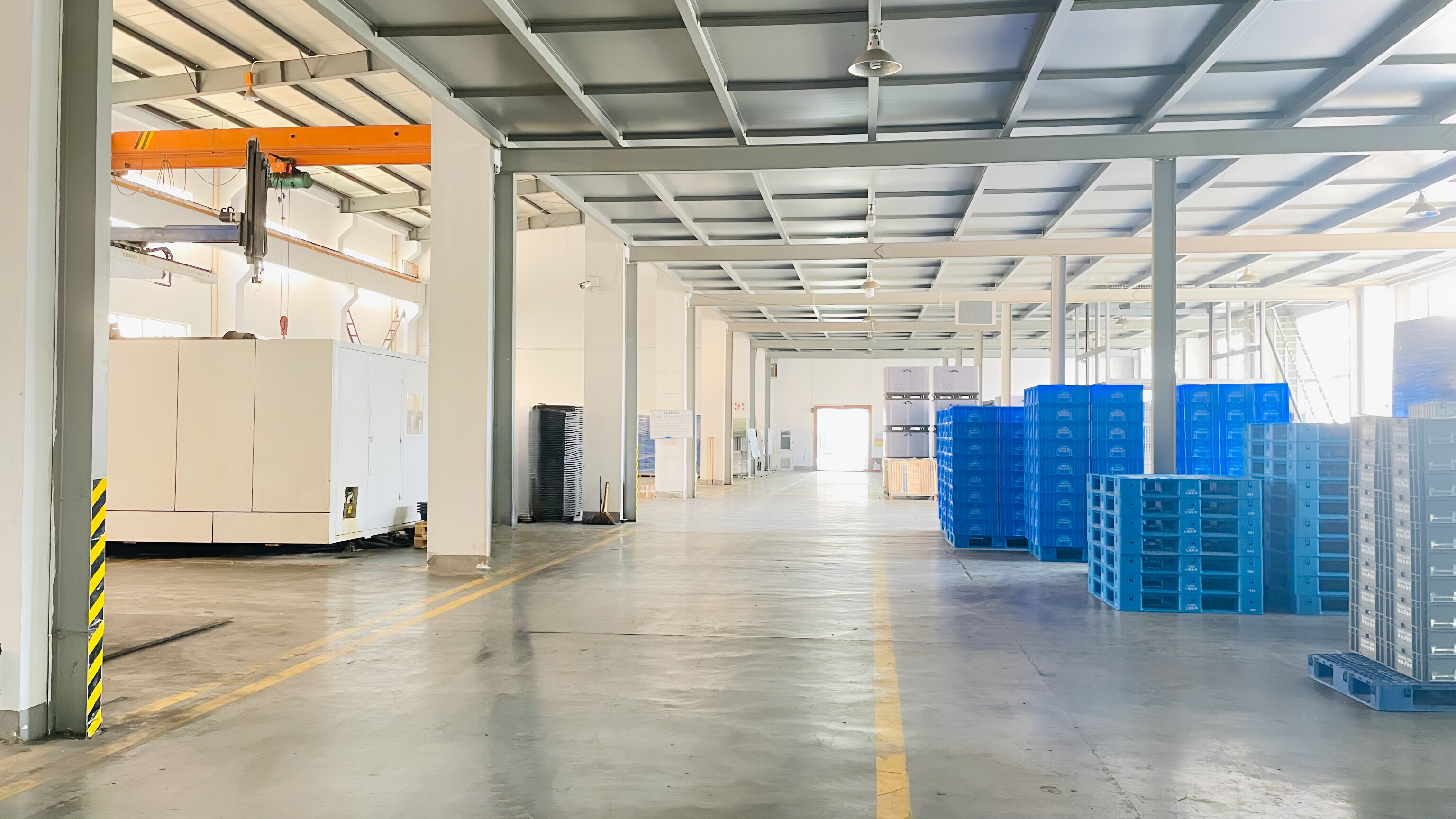
Manufacturing shop floor, Zhangjiagang Fenghui Logistics Equipment Co., Ltd., Suzhou, Jiangsu. Facility evidence is only useful to a buyer when it can be tied to a specific product format and a specific order schedule.
Pallet box buyers do not actually purchase capacity figures. They purchase confidence that a supplier can repeat a specification hundreds of times without drift — and that confidence has to come from something checkable. Zhangjiagang Fenghui Logistics Equipment Co., Ltd., which sells its pallet box range under the TOYOE brand, is a Chinese manufacturer of plastic pallet boxes, storage boxes, plastic crates and honeycomb panel boxes, founded in June 2010 and operating from Zhangjiagang in Suzhou, Jiangsu. The company reports 14 years of logistics packaging experience, a 4,000 m² facility, 30,000 units of annual capacity, monthly output capability of 3,000 pieces, and approximately 34 staff. What follows is an evidence-led reading of those figures, of the folding pallet box format in particular, and of the documented constraints a buyer should reconcile before releasing a production order.
Why 'Capability' Is the Weakest Word in Pallet Box Sourcing
Most pallet box enquiries begin with a size and a load. They should begin with a repeatability question: can this supplier deliver the same wall thickness, the same base-to-sleeve fit and the same folding hardware behaviour on the four-hundredth unit as on the fourth? Capacity claims answer a different question — how much can be produced — and they are cheap to state. Repeatability evidence is slower to assemble, which is precisely why it is the more useful filter during the research and evaluation stages of a sourcing project.
Three categories of evidence are worth separating. Declared evidence is what a supplier states about itself: floor area, headcount, output. Documented evidence is traceable: certificate numbers, issuing bodies, inspection records, drawings. Verified evidence comes from a third party or from the buyer's own audit. Most published supplier material stops at the first category. A supplier that also exposes the second category — even where the wording of a certificate scope is unflattering — is easier to evaluate, because the buyer can independently check it.
For a pallet box specifically, the stakes are higher than for a disposable carton. A plastic pallet box is a capital item with a multi-year duty cycle, handled by forklifts, stacked in racking, and often carrying components whose damage cost exceeds the box itself. The evaluation question is therefore not 'how large is the factory' but 'which parts of this factory's capability are documented, and which parts would I have to take on trust'.
The Entity Behind the TOYOE Pallet Box Range
Entity clarity matters in procurement because certification records, HS classifications and warranty terms attach to a legal entity, not to a brand name. Zhangjiagang Fenghui Logistics Equipment Co., Ltd. is a logistics packaging manufacturer based at No. 5 Donghuan Road, Zhaofeng Leyu Town, Zhangjiagang, 215600, Suzhou, Jiangsu, China. It was founded in June 2010 and reports 14 years of logistics packaging experience. Its product scope covers plastic pallet boxes, storage boxes, plastic crates and honeycomb panel boxes, sold under the TOYOE brand and referenced in export documentation under HS code 3923100000.
The pallet box range is specified across formats that recur in industrial programmes: a 1200×800×1000 plastic pallet box in HDPE/PP, a 1000×800×800 storage pallet box, a blow-moulded honeycomb panel box in the same 1000×800×800 footprint, and a die-cast honeycomb board box at 1230×830×1000 used for automotive engine and gearbox logistics. Across these models the stated capacity falls in the 100–200 L range, with recyclable, durable and nestable characteristics, custom colour, and logo printing included in the product specification.
Approximately 40% of output is exported, with Mexico and the USA named as the main markets. For a buyer, that export share matters less as a badge than as an indicator of documentation familiarity. An exporter shipping regularly into North America already handles the packing declarations, the tariff classification and the labelling expectations those routes demand — which reduces the administrative risk that sits around the product itself.
Facility, Headcount and Output: Reading the Numbers
The company's reported capability facts are compact enough to place in a single table, which is how a procurement team should review them — as a set of figures that either reconcile with the intended order profile or do not.
| Capability dimension | Reported figure | What it implies for a buyer |
|---|---|---|
| Facility area | 4,000 m² | Specialist mid-size plant rather than a high-volume converter |
| Workforce | Approximately 34 staff | Direct access to production and engineering contacts is realistic |
| R&D engineers | 2 | Customization capacity exists but is finite per quarter |
| Annual capacity | 30,000 units | Rated annual output; scheduling must be confirmed against it |
| Monthly output | 3,000 pieces | Monthly production capability; reconcile against release size |
| Export share | Approximately 40% | Routine export documentation experience |
| Main export markets | Mexico, USA | North American route familiarity |
| Minimum order quantity | 1 unit | Low-cost sample and pilot validation |
| Lead time | 7–15 days | Short planning window for standard configurations |
| Quality control | 50% test | Sampling-based inspection, not 100% inspection |
| After-sales | 5-year guarantee | Long coverage window with defined exclusions |
Read together, 4,000 m², 34 staff, 30,000 units a year and two engineers describe a specialist operation rather than a mass-production line. That profile has practical consequences in both directions. A plant of this scale can usually absorb a customised project without displacing a high-volume run, and a two-engineer team means the person who reviews a drawing may also sign off the sample — a shorter feedback loop than in a large organisation. The same arithmetic also sets a ceiling: the number of parallel customization projects the team can carry at once is finite, and a buyer planning several new inner-lining designs in one quarter should ask how those projects will be sequenced.
Two figures deserve a reconciliation question rather than an alarm. Annual capacity is stated as 30,000 units, while monthly output capability is stated as 3,000 pieces. These describe different things — a rated annual figure and a monthly production capability — and the useful question is not which number is larger, but how a specific delivery schedule maps onto both. A programme requiring 900 folding pallet boxes per month with a 7–15 day lead time is a different scheduling request from one requiring 3,000 pieces in a single release.
Inside the Folding Pallet Box Line
A folding pallet box is a large-volume plastic container whose side panels fold down, or whose sleeve collapses, so that empty units occupy a fraction of the space they take when erected. The format exists to solve one specific cost: return transport and empty storage. Industry reporting on foldable pallet boxes cites fold ratios of up to 5:1 — meaning five folded boxes can occupy the space of one erected box — cutting empty volume by up to 75%. For a closed loop moving automotive parts between a plant and a supplier park, or for a warehouse that stores boxes empty between seasonal campaigns, that ratio is often the difference between a viable loop and one that is not.
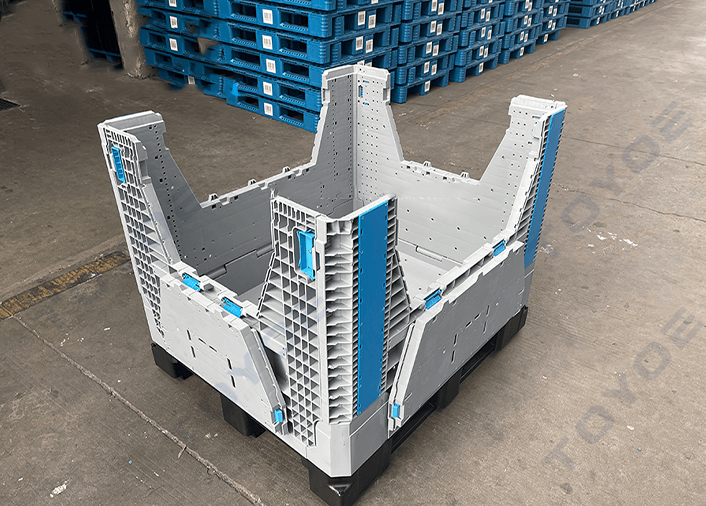
Sleeve folding pallet boxes: the sleeve interface, not the box exterior, is where manufacturing capability is actually tested.
Manufacturing a folding box is not the same as manufacturing a rigid one-piece box. The fold line or the sleeve interface is a mechanical joint, and every joint has tolerances. Consistent panel thickness, accurate base-to-sleeve fit, and hardware that retains its geometry after repeated cycles are the capability requirements that decide performance — far more so than a brochure photograph of a folded unit.
Fenghui's range includes sleeve folding pallet boxes in the 1000×800×800 footprint and folding configurations in the 1200×800×1000 format, offered alongside matching solid-wall and honeycomb panel variants. Materials are HDPE and PP, with recyclable, durable and nestable characteristics. Vacuum-formed inner lining trays — including heavy-duty and blister variants used for transmission and gearbox parts — are produced for the same box families, which means a folding outer can be paired with a formed inner rather than fitted with a generic insert.
What a buyer should inspect on a folding unit
- Erected verticality and stacking stability. A folding box that leans when loaded will not stack predictably in racking, regardless of its nominal footprint.
- Cycle behaviour of the fold line or sleeve joint. This is the first component to wear; a demonstrator unit shows the concept, not the fatigue life.
- Rated load. A numeric rating per model should be requested in writing rather than inferred from a video.
- Inner lining compatibility. A formed tray must sit correctly against folding walls without loading the joint.
- Dust and moisture behaviour at the seams. Folding designs necessarily create gaps; where a dust-proof enclosure dominates the requirement — precision electronics, clean assembly, food-adjacent handling — a fully enclosed or honeycomb panel box may suit better, even at the cost of return-space savings.
A gap worth stating plainly: the product material reviewed for this article does not publish a numeric static or dynamic load rating for each folding model. Buyers who require a rated load — a normal condition in automotive parts procurement — should obtain that figure in writing before approval, because it cannot be derived from capacity, footprint or material alone.
Customization Boundaries: Dimensions, Logo, Colour and Material
OEM/ODM support covers customization of dimension, logo, colour and material, with a minimum order quantity of 1 unit and a stated lead time of 7–15 days. A one-unit MOQ is unusual enough to be worth interpreting: it removes almost all cost from a sample evaluation, which is exactly what a buyer in the research stage needs in order to test a folding design against a real gearbox or a real racking bay before committing to a programme.
The boundary is tooling. A dimension that sits inside existing tooling is a configuration change; a dimension that falls outside it is a tooling project with its own engineering and validation sequence. The published 7–15 day lead time should be read as applying to configurations that do not require new tooling. A buyer specifying custom-sized pallet boxes should therefore confirm in writing whether the requested dimension, or a new vacuum-formed lining tray, requires new moulds — and what that does to the schedule. The same discipline applies to material choice: HDPE and PP behave differently in impact resistance and chemical exposure, and the material should be specified against the actual contents, not chosen by default.
Quality Control and Certification: What Can Be Checked
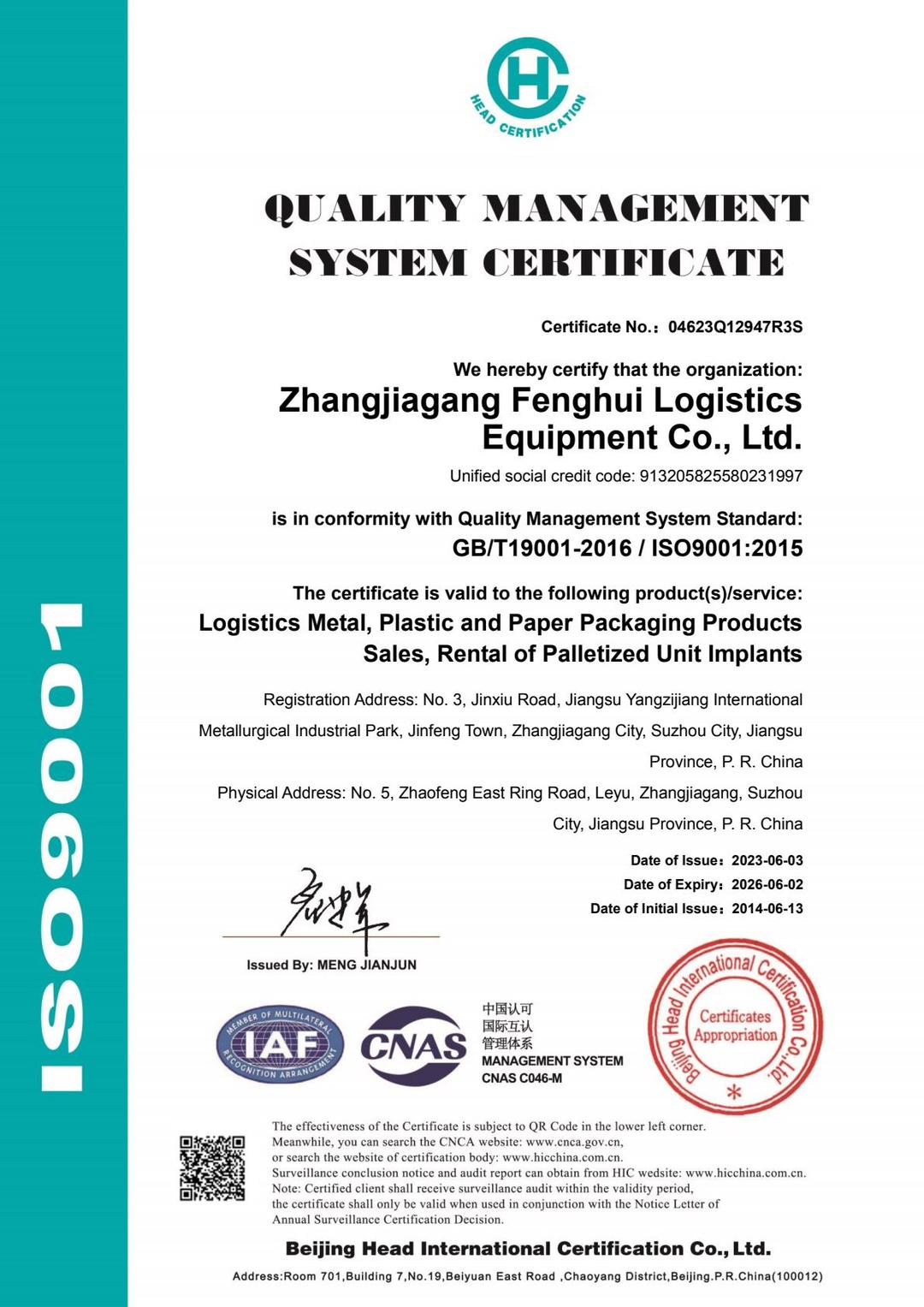
Management system certification is documented evidence — useful precisely because the certificate number can be checked with the issuing body.
Two management system certifications are on record for the pallet box product, both listed as applicable to the global market.
ISO 9001:2015 — certificate 04623Q12947R3S, issued by Beijing Head International Certification Co., Ltd., an IAF/CNAS accredited body, against GB/T19001-2016 / ISO 9001:2015, covering sales of logistics metal, plastic and paper packaging products and rental of palletized unit loads.
ISO 14001:2015 — certificate M43123E31148R2S, issued by Beijing Daluhangxing Quality Certification Center Co., Ltd., covering sales of logistics metal, plastic and paper packaging products and rental of palletized unit loads.
Two observations follow, and both are the sort of detail a procurement team should be able to locate without asking. First, the certificate numbers and issuing bodies are published, which means they can be verified directly with the issuing body instead of accepted from a scanned image. Validity periods should be confirmed at the time of order, because certification is a renewable status rather than a permanent attribute of a supplier. Second, the scope wording on both certificates refers to sales and rental of packaging products. That is a legitimate commercial scope, but a buyer whose own quality system requires evidence of manufacturing process control — rather than commercial activity — should ask what supplementary documentation the factory can supply, such as in-house inspection records, sampling plans or a customer audit report.
On product testing, the reported quality control figure is 50% test. In practical terms this means testing is applied to a portion of production rather than to every unit. For general industrial and automotive parts logistics that is a common approach. For safety-critical or zero-defect programmes, the productive follow-up is not a debate about the percentage but a request for the sampling plan: what is inspected, at what interval, against which criteria, and what record travels with a shipment.
Where ESD requirements sit
ESD pallet boxes belong to a separate compliance layer. Packaging intended to store, transport and protect ESD-susceptible items is governed by ANSI/ESD S541-2019, and conductive polymer blends for this purpose are typically specified with surface resistance within 10⁴–10¹⁰ Ω. These are specification requirements, not marketing attributes. A buyer sourcing an ESD pallet box should obtain the surface-resistance test result for the exact model and compound being supplied, because a conductive additive that performs correctly in one moulding can behave differently in another. The same logic applies to fire-retardant (antiflaming) grades: no flame rating is documented in the material reviewed here, so a buyer requiring one should request the specific material data sheet rather than assume it.
Application Evidence: Automotive Gearbox Storage in Mexico
One documented programme places the capability in context. An automobile manufacturer in Mexico has used 1,000 pallet boxes to store transmission gearboxes for three years. The reported outcome is standardised storage of the component, avoidance of collision damage to gearboxes, and improved warehouse management efficiency; the stated basis is high load-bearing capacity, shock resistance, a stable structure, and dimensions that fit the gearbox closely.
The operating conditions attached to that class of project are uncompromising: high humidity, dust, a wide temperature range, requirements for moisture protection and anti-static behaviour, 24/7 operation, and handling by forklift, warehouse shelving and general logistics equipment. Load-bearing stability and shock resistance are the requirements that decide whether a plastic box survives three years in that environment — which is why the heavy-duty and vacuum-formed inner lining variants exist alongside the standard boxes.
Case evidence should be read at its actual weight. A single Mexican programme of 1,000 units over three years demonstrates that the specification worked in that application; it does not establish performance across every climate, load profile or duty cycle. What it does establish usefully is the shape of the company's operating experience: closed-loop automotive parts storage and transport protection, rather than retail display or one-way distribution.
Folding Pallet Boxes Against Rigid and Wood Alternatives
The comparison that matters at evaluation stage is not brand against brand but format against format, judged on the whole loop rather than the unit price.
| Decision factor | Folding plastic pallet box | Rigid one-piece plastic box | Wood crate |
|---|---|---|---|
| Empty return volume | Materially reduced; fold ratios up to 5:1 are reported for the format | Unchanged when empty | Unchanged unless dismantled |
| Upfront unit cost | Higher than wood; justified by trip count | Generally the highest of the three | Typically lowest at first purchase |
| Moisture and humidity | HDPE/PP construction, suited to humid warehouses | Same material family | Susceptible; usually needs treatment for cross-border movement |
| Mechanical complexity | Joint or sleeve interface introduces wear points | Fewest moving parts | Fasteners and panels loosen with handling |
| Custom dimensions | Available, subject to tooling review | Tooling-dependent | Flexible but dimensionally less consistent |
| Inner lining / dunnage | Vacuum-formed trays can be matched to folding walls | Widely supported | Usually hand-built |
| ESD option | Requires specified compound and test data | Requires specified compound and test data | Not applicable in the same sense |
Where this approach has limits
- Low-trip applications. Where a box travels one way or completes only a handful of cycles, the durability premium of a folding plastic box is difficult to recover, and a wood crate remains the cheaper answer.
- Joint wear. The folding mechanism is the first component to degrade; programmes without an inspection routine will discover this later than they should.
- Engineering bandwidth. A two-engineer R&D team supports customization well but cannot run unlimited parallel projects.
- Guarantee exclusions. The five-year after-sales guarantee explicitly excludes damage caused by human error or by excessive storage weight, so load discipline at the user site is part of the commercial risk.
- Sampling rather than full inspection. With testing applied to 50% of production, buyers needing unit-level traceability must specify it.
- Undocumented ratings. Numeric load ratings and flame ratings are not published in the reviewed material and must be requested per model.
Market Context: Why Capability Evidence Matters Now
The pallet box category is growing, and published market figures vary by definition. One market report values the global pallet box market at USD 2.19 billion in 2024 and projects USD 3.02 billion by 2032. A separate report, using a broader container-and-crate definition, places the same base year considerably higher. The gap is definitional rather than contradictory, and any internal business case that cites market size should state which definition it is using.
The supply side is more consistent. China is the dominant exporter of plastic boxes, cases and crates under HS 392310, with an export value of USD 2.33 billion in 2022 — a figure that reflects an established cluster of moulders and assemblers across Jiangsu, Zhejiang and Guangdong rather than any single company. Fenghui's position inside that cluster, with roughly 40% of output exported and Mexico and the USA as main markets, is typical of the segment: a regional manufacturer serving international programmes through documentation and repeat orders rather than scale alone.
For a buyer, the practical implication of that concentration is that supplier discovery is no longer the scarce activity — capability verification is. There are many factories able to mould a plastic pallet box. There are fewer that will place certificate numbers, testing percentages, MOQ and lead-time boundaries in the same conversation, and fewer still whose published figures reconcile cleanly with a buyer's own delivery schedule.
What Buyers Should Ask Before Committing
| Evidence area | Question to ask | What a credible answer looks like |
|---|---|---|
| Capacity and scheduling | How does a 900-unit monthly release map onto 30,000 units annual capacity and 3,000 pieces monthly output? | A dated production slot, not a restated capacity figure |
| Certification | Which certificate numbers apply, and what does the scope cover? | Numbers, issuing bodies, and clarity on whether scope covers sales or manufacture |
| Testing | What is the sampling plan behind 50% test? | Inspection criteria, interval, and the record supplied per shipment |
| Folding design | What is the rated load and expected cycle life of the fold or sleeve joint? | A written figure per model, plus a fatigue or cycle reference |
| Custom dimensions | Does this size require new tooling, and what happens to the 7–15 day lead time? | A tooling decision with a revised schedule, stated in advance |
| ESD performance | What surface resistance was measured, on which model and compound? | A test result traceable to the supplied part |
| After-sales | What exactly does the five-year guarantee exclude? | Written exclusions for human-error damage and excessive storage weight |
| Export documentation | Which HS classification and packing declarations accompany shipment? | HS 3923100000 with the corresponding export paperwork |
Future Outlook
Three developments are likely to shape pallet box sourcing over the next few procurement cycles. The first is documentation-led evaluation. As closed-loop packaging fleets grow larger and more expensive to replace, buyers are moving from specification sheets to verification files, and suppliers who publish certificate numbers, sampling plans and load data will shorten their own sales cycles as a result.
The second is the continued expansion of the folding format in return logistics. A fold ratio of up to 5:1 changes the economics of any route on which empty containers travel. The constraint on growth is not demand but engineering: every folding design trades some structural simplicity for space savings, and the suppliers who lead will be those able to document cycle life rather than simply illustrate the fold.
The third is material specification discipline. ESD performance, flame behaviour and recycled content are increasingly written into purchase specifications rather than assumed, and each of those requirements is satisfied by a data sheet, not by a claim. For a mid-size specialist such as Fenghui, that shift favours the supplier whose figures already reconcile — and penalises the one whose brochure cannot be checked.
Frequently Asked Questions
What certifications does the pallet box product hold, and how can a buyer verify them?
The pallet box product holds ISO 9001:2015 certification under GB/T19001-2016 / ISO 9001:2015, certificate number 04623Q12947R3S, issued by Beijing Head International Certification Co., Ltd., an IAF/CNAS accredited body. It also holds ISO 14001:2015 certification, number M43123E31148R2S, issued by Beijing Daluhangxing Quality Certification Center Co., Ltd. Both are listed as applicable to the global market. Verification is possible by contacting the issuing bodies with the certificate numbers; because certification is a renewable status, current validity should be confirmed at the time of order rather than assumed from a published record.
What are the minimum order quantity and lead time for a customised pallet box?
The stated minimum order quantity is 1 unit, and the stated lead time is 7–15 days. OEM/ODM support covers customization of dimension, logo, colour and material. Because a new dimension or a new vacuum-formed inner lining tray may require tooling work, buyers should confirm in writing whether their specification falls inside the standard 7–15 day window or requires a separate engineering and validation sequence.
How much space does a folding pallet box save when it is empty?
Industry reporting on foldable pallet boxes cites fold ratios of up to 5:1, meaning five folded boxes can occupy the space of one erected box, which cuts empty volume by up to 75%. The saving applies to return transport and to empty storage between production campaigns; it does not change the footprint of an erected, loaded box in racking.
What does the five-year after-sales guarantee cover?
The after-sales guarantee runs for five years and explicitly excludes cases of damage caused by human error or by excessive storage weight of the product. In practice this means the guarantee addresses manufacturing and material performance, while load discipline and handling practice at the user site remain the buyer's responsibility.
What does a 50% product testing rate mean for quality assurance?
A 50% test rate means inspection is applied to a portion of production rather than to every unit. For general industrial and automotive parts logistics this is a common sampling approach. Buyers with safety-critical or zero-defect requirements should request the underlying sampling plan — what is inspected, how often, against which criteria — and the inspection record supplied with each shipment, rather than treating the percentage as a complete quality statement.
Does the company supply ESD pallet boxes, and which standard applies?
Packaging used to store, transport and protect ESD-susceptible items falls under ANSI/ESD S541-2019, and conductive polymer blends for this purpose are typically specified with surface resistance within 10⁴–10¹⁰ Ω. Because ESD performance depends on the specific compound and moulding, buyers should obtain a surface-resistance test result for the exact model being supplied rather than relying on a general ESD claim.
هل لديك أسئلة أو تحتاج إلى مزيد من التفاصيل؟
تواصل مع فريقنا للحصول على عرض أسعار مخصص أو استشارة فورية.
طلب عرض أسعار
املأ النموذج أدناه وسيتواصل معك فريقنا بعرض مقترح مخصص.
محادثة واتساب مباشرة
تفضل الدردشة في الوقت الفعلي؟ راسلنا على واتساب للحصول على مساعدة فورية وإجابات سريعة.
- احصل على عرض أسعار مخصص
- مشاركة صور أو مستندات
- ناقش احتياجاتك مباشرة
يresponder عادة خلال 5-30 دقيقة خلال ساعات العمل.