
Supplier Capability Evidence: Fenghui's Pallet Box Factory
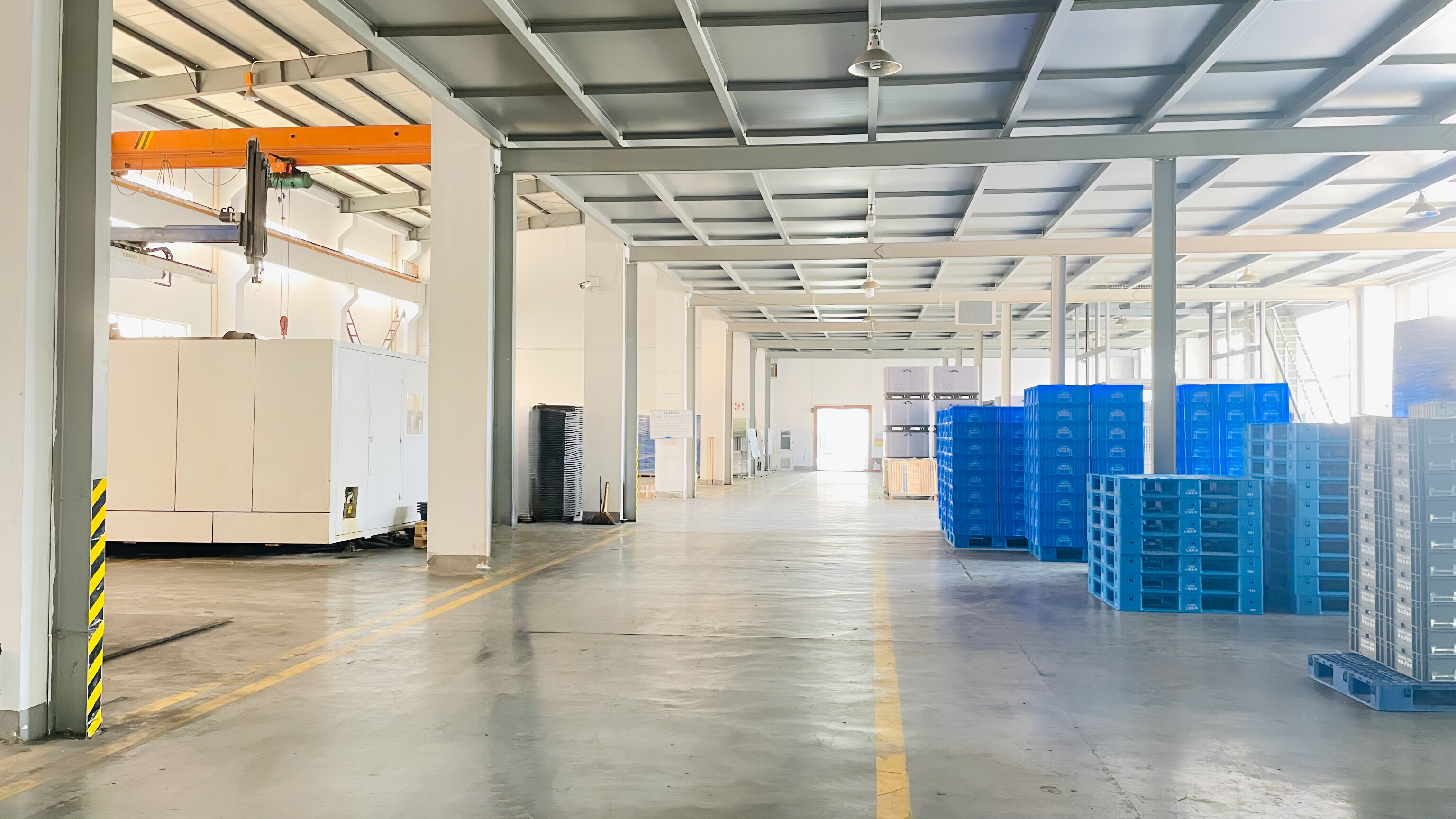
Manufacturing shop: pallet box production and assembly area at Zhangjiagang Fenghui Logistics Equipment Co., Ltd., Jiangsu, China.
A reusable pallet box is one of the few packaging items where the buying decision is governed almost entirely by constraints rather than preference. The load path, the return loop, the currency of the certification file, the sampling rate behind a quality claim and the exclusions written into a warranty decide whether a box survives three years of a 24/7 automotive logistics cycle, or becomes a recurring repair line item. For that reason, the real subject of most evaluation-stage pallet box sourcing is not the product brochure — it is supplier capability evidence.
This article assembles verifiable capability data on Zhangjiagang Fenghui Logistics Equipment Co., Ltd., which markets its pallet box range under the brand TOYOE. The company is a Jiangsu-based manufacturer of plastic pallet boxes, storage boxes, plastic crates and honeycomb panel boxes, established in June 2010 and operating from Zhangjiagang, Suzhou. Each data point below is presented together with an explanation of how a buyer should read it, and where its limits sit.
Why reusable pallet boxes are bought on evidence, not description
The economics of a reusable container depend on trips per unit, not on unit price. A box that deforms under forklift handling, loses dimensional stability in a racking system, or cannot be replaced quickly inside a return loop does not deliver reuse at all — it simply converts a consumable cost into a capital cost with a shorter duty cycle than planned. That is why procurement teams evaluating reusable pallet boxes usually work backwards from five verifiable inputs: who manufactures the box, at what rate, under which quality regime, with which certification evidence, and within which customization boundaries.
Category-level demand supports the attention this category now receives. One commercial estimate places the global pallet box market at USD 2.19 billion in 2024, with a forecast of USD 3.02 billion by 2032. A second published estimate for the same base year reports a base value several times higher, and forecasts USD 23.40 billion by 2033 at a 6.9% CAGR. The gap is not a rounding difference; it reflects how broadly each report defines the category — one narrower, one aggregating larger industrial containers and bulk bins. The practical lesson for buyers is that market-size figures should always be read with their definition attached, and that supplier-level evidence is more useful than category-level totals when a specific program is being sourced.
Entity snapshot: Zhangjiagang Fenghui Logistics Equipment Co., Ltd.
Zhangjiagang Fenghui Logistics Equipment Co., Ltd. is a logistics packaging manufacturer located at No. 5 Donghuan Road, Zhaofeng, Leyu Town, Zhangjiagang, 215600, Suzhou, Jiangsu, China. It was founded in June 2010 and, according to the company, has accumulated more than ten years of logistics packaging experience. Its product lines are plastic pallet boxes, storage boxes, plastic crates and honeycomb panel boxes. The company operates a company website at toyoebox.com.
| Established | June 2010 |
| Site area | 4,000 m² |
| Workforce | Approximately 34 staff |
| Engineering | 2-engineer R&D team |
| Annual output | 30,000 units |
| Monthly output | 3,000 pieces |
| Export share | Approximately 40% |
| Main export markets | Mexico (MEX) and the United States (USA) |
Read as a capability profile rather than as a marketing list, the numbers describe a mid-sized, single-site specialist. A 4,000 m² footprint supporting 30,000 units a year and a workforce of roughly 34 implies a compact operation with limited parallel lines — an advantage for customization control, and a constraint for buyers who assume large-scale redundancy.
What "reusable" changes in the pallet box specification

An open-state plastic pallet box: enclosed construction, moulded base and sidewall geometry are the elements a buyer verifies against handling equipment.
In the Fenghui range, the reusable pallet box is an enclosed plastic container built in HDPE and PP, with a stated capacity band of 100–200 L. Standard model designations include 1200×800×1000, 1000×800×800 and a 1230×830×1000 variant described as a die-cast honeycomb board box. Product data lists the boxes as recyclable, durable and nestable, with customized sizes, customized colours and free logo printing available. The declared HS code for the range is 3923100000.
Three specification details deserve attention at the evaluation stage. First, nestability is a return-loop property: nested or folded containers reduce the empty transport volume that otherwise erodes the reuse case entirely. Industry data on foldable pallet box designs reports fold ratios of up to 5:1, meaning five folded boxes occupy the space of one erected box and empty volume falls by as much as 75%. That ratio applies to folding formats specifically — a rigid enclosed box does not deliver the same effect, and buyers should confirm which geometry they are purchasing. Second, material grade matters because the same product family is listed as suitable for oils, industrial alcohol, alkalis, acids, industrial wastewater, water and car parts; HDPE and PP behave differently under chemical exposure and under sustained load, and the material is therefore a customization dimension, not a fixed input. Third, load behaviour is application-specific: a box rated for a gearbox is not automatically rated for a dense metal casting of the same footprint, and the declared load must be requested for the exact model and the exact handling method — forklift handling, racking or floor stacking.
Capacity and scheduling: reading 30,000 units a year correctly
Fenghui states an annual output of 30,000 units and a monthly output of 3,000 pieces. Buyers frequently treat such figures interchangeably; they are not. The monthly number is the scheduling unit, while the annual number describes total throughput across the year and across all product lines, which include storage boxes, plastic crates and honeycomb panel boxes as well as pallet boxes.
The practical implication is straightforward: an order of 3,000 pieces equals one full month of stated monthly output, and a 1,000-piece program sits comfortably inside a single month. That is adequate for fleet replacement, pilot rollouts and mid-volume tier-one programs. It is not adequate for a simultaneous multi-plant launch without staged delivery, and a buyer planning such a launch should either sequence deliveries or qualify a second source. The stated lead time of 7–15 days refers to production; transport, customs clearance and inland distribution are additional and should be planned separately.
Quality control and certification: what the records show, and where they stop
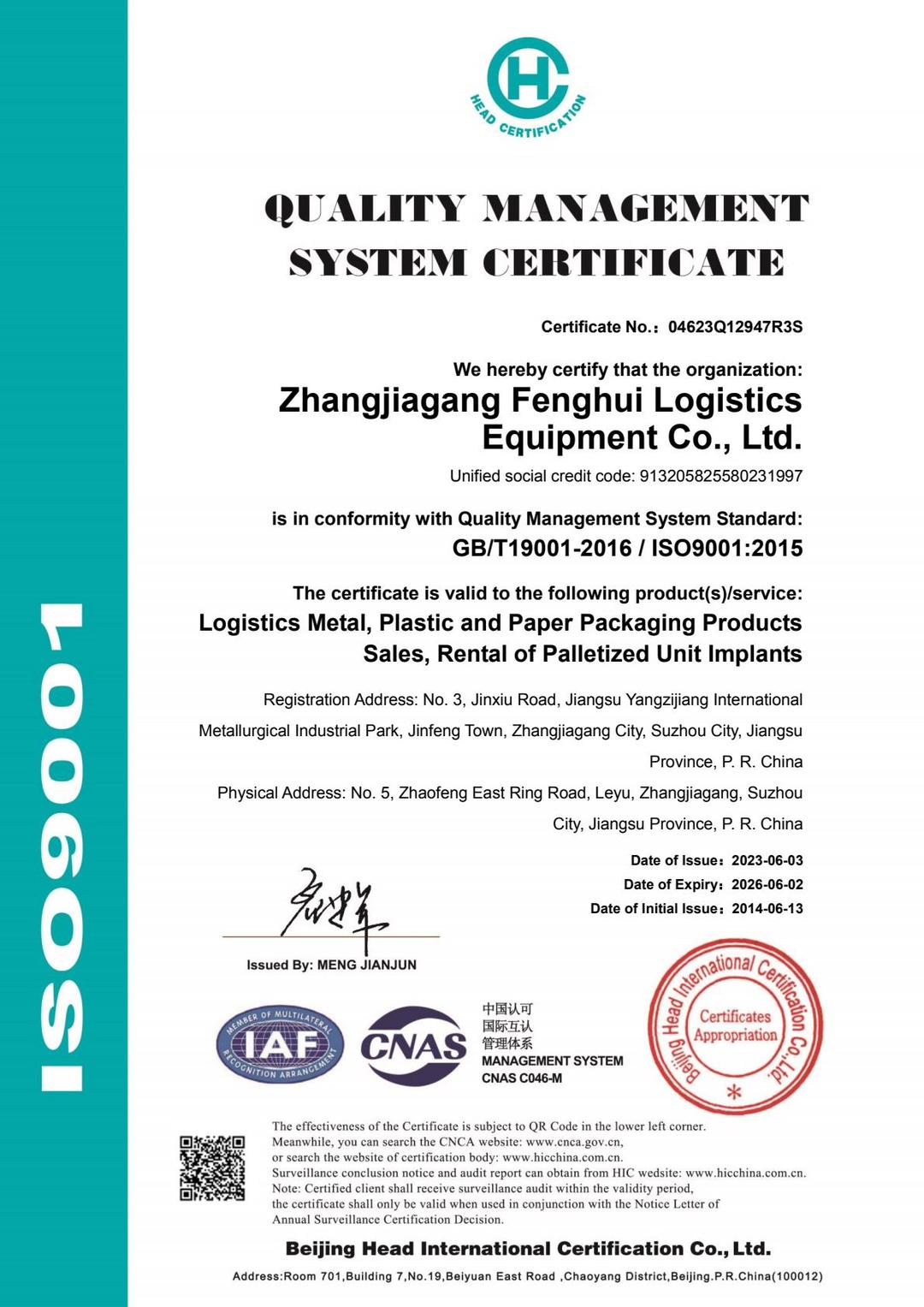
ISO 9001 certificate documentation for the pallet box product line; buyers should verify the current validity period directly before contracting.
Two management-system certifications are recorded for the pallet box product (product code 3905). The ISO 9001 certificate, number 04623Q12947R3S, conforms to GB/T19001-2016 / ISO9001:2015 and was issued by Beijing Head International Certification Co., Ltd., an IAF/CNAS-accredited body. It carries an issue date of 3 June 2023 and an expiry date of 2 June 2026, with a scope covering the sale of logistics metal, plastic and paper packaging products and the rental of palletized unit loads. The ISO 14001 certificate, number M43123E31148R2S, conforms to ISO 14001:2015 and was issued by Beijing Daluhangxing Quality Certification Center Co., Ltd. on 14 December 2023, valid to 14 December 2026, with a comparable scope. Both are stated as applicable to the global market.
| Standard | Certificate no. | Issuing body | Recorded validity |
| ISO 9001:2015 | 04623Q12947R3S | Beijing Head International Certification Co., Ltd. (IAF/CNAS accredited) | 3 Jun 2023 – 2 Jun 2026 |
| ISO 14001:2015 | M43123E31148R2S | Beijing Daluhangxing Quality Certification Center Co., Ltd. | 14 Dec 2023 – 14 Dec 2026 |
Three boundaries are worth stating plainly, because they are where buyers most often over-read a certificate file. One: ISO 9001 and ISO 14001 are management-system certifications. They attest to how quality and environmental processes are organised and audited; they are not a product load rating and do not certify a specific box to a stated kilogram capacity. A declared load figure must be requested separately, per model. Two: the recorded ISO 9001 validity period ends on 2 June 2026, so a buyer contracting later in 2026 should ask for the current certificate revision rather than rely on the historical document number. Three: the company's stated quality control method is a 50% test rate — half of production is tested, which is a meaningful sampling regime but is not unit-by-unit inspection. Buyers with zero-defect programs should agree a written sampling plan, an acceptable quality level and a defect-handling route before the first shipment rather than after it.
Customization boundaries: OEM/ODM, MOQ 1 and 7–15 days
Fenghui offers OEM/ODM production with customization across four dimensions: dimension, logo, colour and material. The stated minimum order quantity is 1 unit, and the stated production lead time is 7–15 days. Colour customization and free logo printing are also listed at product level.
A minimum order of one unit is genuinely useful during evaluation: it allows a buyer to place a physical sample into an existing return loop, test forklift entry, check stacking behaviour and confirm the inner fit against the actual part before committing. It does not, however, indicate volume pricing behaviour, and it should be read as a sampling allowance rather than a commercial model. Similarly, a 7–15 day lead time describes production; if a new dimension requires tooling or a first-article approval cycle, the calendar will extend beyond that window, and the discussion should be moved forward accordingly. Finally, the after-sales guarantee runs for five years but explicitly excludes damage caused by human error or by storage loads exceeding the product's limits — which is precisely why the declared load and the handling rules need to be documented in writing at order stage rather than assumed.
Application evidence: transmission gearbox storage in Mexico
The most concrete capability evidence in the available record is a Mexican automotive program. An automobile manufacturer has used 1,000 pieces for three years to store car transmission gearboxes. Reported outcomes are standardised storage of auto parts, avoidance of collision damage to gearboxes and improved warehouse management efficiency. The stated basis for the match is high load-bearing capacity, shock resistance, a stable structure and dimensional fit to the transmission gearbox.
The operating conditions attached to that program are as informative as the outcome. The site is described as high humidity, dusty, with a wide temperature range, requiring moisture-proofing, shock resistance and stable load-bearing, in 24/7 operation with forklift and warehouse shelf handling, plus an anti-static consideration. That combination explains why the case is useful as evidence: it tests the box against several constraints at once rather than against a single load number.
For electronics rather than automotive parts, the relevant reference point is different. ANSI/ESD S541-2019 is the industry standard governing packaging used to store, transport and protect ESD-susceptible items, and conductive polymer blends are typically specified within a surface resistance range of 10⁴–10¹⁰ Ω. A buyer sourcing an ESD pallet box should therefore request test evidence referenced to that standard and that resistance band for the specific compound used, rather than relying on a general anti-static description.
Reusable plastic versus wood and corrugated: where the model breaks
A reusable plastic pallet box is not universally the correct choice, and the honest comparison is about loop structure rather than material prestige. The table below sets out the decision criteria that most often determine the outcome.
| Criterion | Reusable plastic (HDPE/PP) | Wood pallet box | Corrugated / heavy board |
| Return loop needed | High — reuse economics depend on trips per unit | Medium — reusable but heavier to return | Low — typically single-trip |
| Humidity and moisture | Suited to humid and wash-down environments | Sensitive unless treated; can swell or degrade | Weakens when wet |
| Repairability | Component replacement possible; not field-repairable like timber | Field-repairable with basic tools | Not repairable |
| Empty return volume | Folding formats reported up to 5:1 fold ratio; rigid formats do not fold | Limited; often knocked down at cost of labour | Flat-packs well |
| Certification evidence | Management-system certificates traceable to a number and issuer | Varies by supplier; phytosanitary rules may apply to export | Usually material-grade declarations only |
| Where it fails | One-way flows, very low volumes, loads beyond declared capacity | Humid storage, hygiene-sensitive goods | Multi-trip duty cycles, heavy parts, outdoor storage |
Two further limits apply to this specific supply situation. The first is scale: a single-site operation with 3,000 pieces of stated monthly output can serve a mid-volume program well, but a buyer with a distributed multi-country rollout should plan staged delivery or dual sourcing from the outset. The second is warranty scope: the five-year guarantee excludes damage from human error and from storage loads above the product's limits, so the operational discipline at the receiving warehouse is part of the effective service life. Neither point disqualifies the supplier; both belong in the sourcing plan.
Market signals that support the reuse case
The structural backdrop is favourable to reusable plastic containers, provided the numbers are read with the right caveats. China is the leading exporter of products under HS 392310 — plastic boxes, cases and crates — with an export value of USD 2.33 billion in 2022. That figure aggregates crates, boxes and cases rather than pallet boxes alone, but it confirms that the manufacturing cluster around Jiangsu and the wider Yangtze Delta has the tooling, material supply and export logistics that a pallet box program depends on. Fenghui's own export profile, at roughly 40% of output and concentrated in Mexico and the United States, sits inside that pattern.
On the demand side, the reuse argument is reinforced by return logistics economics rather than by volume growth alone. Where a folding format achieves a 5:1 fold ratio, the empty-return cost per trip falls sharply, which is the mechanism that makes a plastic box competitive against single-trip packaging in closed loops. That mechanism does not exist in one-way flows — which is why the category forecast figures should be read as a general direction of travel, not as evidence that every program should switch material.
What to verify before placing a volume order
- Current ISO 9001 and ISO 14001 certificates, with issue and expiry dates checked against the order date, and the certification scope read literally.
- The written sampling plan and acceptable quality level behind the stated 50% test rate, plus the defect-handling route.
- A dimensional drawing and a declared load figure for the exact model — 1200×800×1000, 1000×800×800, or 1230×830×1000.
- Material confirmation (HDPE or PP) against the goods to be stored, given the listed suitability for oils, alkalis, acids and industrial wastewater.
- ESD test evidence referenced to ANSI/ESD S541-2019 and the stated 10⁴–10¹⁰ Ω band, where electronics are involved.
- Warranty terms in writing, including the human-error and overload exclusions, and the agreed handling rules on site.
- Capacity reservation for the order volume against the 3,000-piece monthly output, with the 7–15 day lead time confirmed in calendar terms including transport.
- HS code 3923100000 documentation for import clearance in the destination market.
Future outlook
Three shifts are likely to shape how pallet box suppliers are evaluated over the next few years. Certification currency will increasingly be treated as a live purchasing metric rather than a one-time document check: buyers will ask for validity dates at each annual review, because a lapsed management-system certificate creates audit exposure for the customer, not only for the supplier. Anti-static and material-specific performance evidence will become more explicit as electronics and battery programs expand, moving the conversation from a generic "ESD available" statement to a test report referenced to a named standard. And capacity transparency — stating monthly output alongside annual output, as this supplier does — will matter more as buyers try to match order size to realistic scheduling rather than to headline totals.
For a specialist of this size, the competitive position is unlikely to be decided by scale. It will be decided by how precisely customization, sampling and documentation are handled for programs in the 1,000-piece range — the segment where a 4,000 m² plant with two engineers and a stated 1-unit minimum order can respond faster than a larger line committed to standard volumes.
FAQ
Which ISO certifications does the Fenghui pallet box hold, and what do they cover?
The pallet box product (code 3905) is recorded under two management-system certifications. ISO 9001:2015, certificate 04623Q12947R3S, was issued by Beijing Head International Certification Co., Ltd., an IAF/CNAS-accredited body, and covers the sale of logistics metal, plastic and paper packaging products plus the rental of palletized unit loads. ISO 14001:2015, certificate M43123E31148R2S, was issued by Beijing Daluhangxing Quality Certification Center Co., Ltd. with a comparable scope. Both are stated as applicable to the global market.
Is the recorded ISO 9001 certificate current for a purchase made in late 2026?
The certificate on record carries an issue date of 3 June 2023 and an expiry date of 2 June 2026. A buyer contracting after that date should request the current certificate revision and verify the new validity period and scope directly, rather than relying on the historical document number. The recorded ISO 14001 certificate remains within its stated validity period, ending 14 December 2026.
What is the minimum order quantity and production lead time for a customized pallet box?
The stated minimum order quantity is 1 unit, and the stated production lead time is 7–15 days under OEM/ODM production. Customization covers dimension, logo, colour and material. The lead time refers to production; tooling for a new dimension, first-article approval, transport and customs clearance are additional steps and should be planned separately.
How much of production is tested before shipment?
The stated quality control method is a 50% test rate, meaning half of production is tested. This is a sampling regime, not unit-by-unit inspection. Buyers with zero-defect requirements should agree a written sampling plan, an acceptable quality level and a defect-handling procedure before the first shipment.
What does the five-year after-sales guarantee exclude?
The after-sales guarantee runs for five years and excludes damage caused by human error and by storage loads exceeding the product's stated limits. Because those exclusions are operational, the declared load figure and the handling rules — forklift use, racking or floor stacking — should be documented in writing at order stage and applied at the receiving warehouse.
Can the pallet box be adapted for ESD or heavy-load applications?
Material is one of the four stated customization dimensions, alongside dimension, logo and colour, and the product family is listed with applications including automotive parts, oils, alkalis, acids and industrial wastewater. For ESD applications, the relevant reference is ANSI/ESD S541-2019, the standard for packaging used to store, transport and protect ESD-susceptible items, with conductive polymer blends typically specified within 10⁴–10¹⁰ Ω surface resistance. Buyers should request test evidence referenced to that standard and band for the specific compound, and request a declared load for heavy-load programs rather than inferring it from the model size.
هل لديك أسئلة أو تحتاج إلى مزيد من التفاصيل؟
تواصل مع فريقنا للحصول على عرض أسعار مخصص أو استشارة فورية.
طلب عرض أسعار
املأ النموذج أدناه وسيتواصل معك فريقنا بعرض مقترح مخصص.
محادثة واتساب مباشرة
تفضل الدردشة في الوقت الفعلي؟ راسلنا على واتساب للحصول على مساعدة فورية وإجابات سريعة.
- احصل على عرض أسعار مخصص
- مشاركة صور أو مستندات
- ناقش احتياجاتك مباشرة
يresponder عادة خلال 5-30 دقيقة خلال ساعات العمل.