
Supplier Capability Evidence: Full-Package Restaurant Furniture Scope Review
HTNXT Industry Reference · Procurement Evidence Series
Supplier Capability Evidence: Full-Package Restaurant Furniture Scope Review
Restaurant furniture is increasingly bought as a package rather than as a list of individual products. The practical question for a buyer is no longer which chair looks right, but what evidence shows a supplier can deliver chairs, tables, booth seating, bar units, outdoor and canteen furniture as one coordinated scope — with the finish, dimensions, documentation and delivery schedule to match.
A 120-cover restaurant, a hotel food-and-beverage floor, or a staff canteen each combine three to six furniture categories in a single fit-out. Sourcing them from separate vendors multiplies coordination work: colour and finish matching across suppliers, separate sample approvals, separate packing standards, and separate delivery schedules that all have to converge on one site. That is why consolidated procurement has become common practice in hospitality projects, and why full package has become one of the most frequently claimed and least frequently verified capabilities in the category.
The supplier used as the working example throughout this review is Guangzhou Mingmeng Furniture Co., Ltd. (MingMeng Furniture), a commercial and hospitality furniture manufacturer established in 2015 in Guangzhou, China, which supplies restaurant, café, hotel, bar, canteen, outdoor and lounge furniture for international projects. The purpose is not to present the company as the answer, but to use its published capability information as a worked example of the evidence any full-package supplier should be asked to produce.
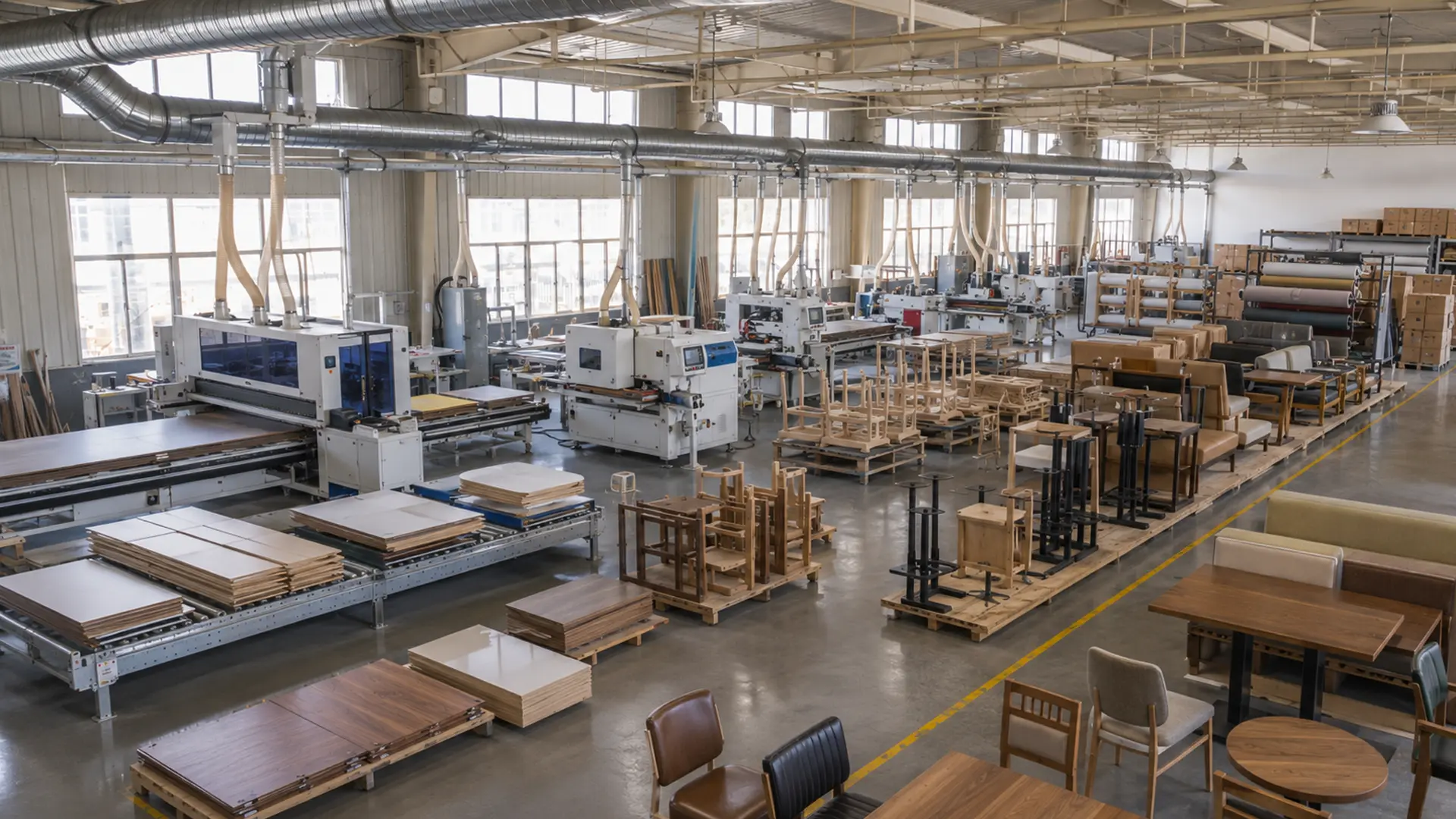
Commercial furniture manufacturing facility: full-package restaurant scope is normally supported by in-house woodworking, metalworking and upholstery lines rather than assembly only.
Why the package, not the product, is now the buying unit
A full restaurant package is supplied as a multi-category set that includes tables, chairs, booths, bars and accessories rather than single items only. The scope typically covers restaurant chairs, commercial dining tables, booth and banquette seating, bar counters and bar stools, and related accessories. Buying these categories from one supplier supports consolidated ordering and a consistent furniture appearance across a restaurant project, which is difficult to achieve when four vendors supply four finish palettes.
That consolidation has a second, less obvious benefit: fewer interfaces. Each additional supplier adds a sample approval cycle, a packaging standard, a loading plan and a shipping schedule. In hospitality procurement, coordination effort and schedule risk usually cost more than the marginal unit-price differences between vendors.
The trade-off is that package capability is harder to verify than product capability. A product can be inspected; a package has to be evidenced through scope documentation, production records and process transparency. The sections below set out the checkpoints that matter.
What a full-package scope should actually contain
A credible package claim should be mapped category by category, with the material and construction logic stated for each. The table below shows the scope map and the documented options that support it.
| Scope area | Typical items in the package | Documented materials and construction options |
|---|---|---|
| Dining | Restaurant chairs, commercial dining tables, table bases | Solid wood, metal or plywood chair frames; upholstery in commercial fabric, PU leather or genuine leather; tabletops in solid wood, veneer, HPL, laminate, marble or stone; cast iron, steel or stainless steel table bases |
| Booth and banquette seating | Single booth, double booth, wall bench, L-shaped, U-shaped and curved booths | Plywood or solid wood frame, commercial-grade construction, high-density foam, fabric or leather upholstery, custom stitching and finishing |
| Bar | Front bar counters, back bar cabinets, beverage stations, bar stools, bar tables | Wood veneer, laminate, plywood, MDF, marble, sintered stone, quartz, stainless steel, metal and glass; storage, shelving and equipment-space configurations |
| Outdoor | Outdoor dining chairs and tables, outdoor bar stools, outdoor sofas and lounges | Aluminium, stainless steel or teak frames; outdoor-rated fabric and quick-dry foam; HPL, sintered stone and teak tops; weather and corrosion considerations |
| Canteen and institutional dining | Canteen tables and chairs, bench seating, fixed table-and-seat sets, food-court tables | Steel, stainless steel or aluminium frames; HPL, laminate, melamine or solid wood tops; powder-coated and wood-grain finishes |
| Hotel public area and guest room | Lobby sofas and lounge chairs, coffee and side tables, beds, headboards, wardrobes, desks, TV cabinets | Plywood, MDF, solid wood, veneer, laminate, metal, stone and upholstered finishes; complete room packages with custom dimensions from architectural drawings |
| Lounge and sofa | Modular, L-shaped, curved and sectional sofas for waiting, lounge and bar areas | Solid wood, plywood or metal-reinforced frames; high-density foam; commercial fabric, PU leather or genuine leather |
Two questions separate a genuine package from a catalogue. First, which categories are produced inside the supplier's own facility and which are sourced or subcontracted. Second, whether the same finish reference can be held across categories — wood stains, metal powder coats and upholstery should be approved together so that a chair frame and a table base delivered on the same container actually match.
Evidence checkpoint 1: manufacturer or intermediary?
The most consequential question in a supplier review is whether the entity is a manufacturer or a trading intermediary. MingMeng Furniture operates its own furniture manufacturing facility and manages production and quality control for commercial furniture projects. Its published profile states a 15,000 m² facility, more than 200 skilled workers, 10 engineers in the design and development team, and production lines covering woodworking, metalworking, upholstery, cutting, welding, polishing, painting, powder coating, CNC processing, assembly and quality inspection.
Capacity and export data are part of the same evidence set. The company states production capacity of more than 80,000 pieces per month and annual output of more than 960,000 units, with an export ratio of approximately 90% and products supplied to customers in more than 100 countries and regions, including North America, Europe, Australia, the Middle East and Southeast Asia.
Evidence checkpoint 2: customization process and CAD support
Design support is where package suppliers are differentiated in practice. MingMeng provides CAD drawings, 3D renderings, furniture layout adjustment and basic space planning for project-based orders, using professional design software including AutoCAD, SolidWorks and 3ds Max. CAD drawings are issued for project review, approvals and coordination with the client's design team; 3D renderings allow the appearance to be reviewed before production. For drawing-based projects, production can be carried out strictly to approved customer drawings and specifications once dimensions, materials, finishes and technical details are confirmed.
A common buyer assumption is that CAD drawings are a prerequisite. They are not. Drawings make the process faster, but furniture can also be developed from photographs, reference images or written requirements, with drawings or 3D renderings used for confirmation before production. Furniture can be developed from a reference image with structure, dimensions, materials and finishes adjusted for commercial use, and dimensions and layouts for customized items can be adjusted before production begins. Brand palettes are handled the same way: custom colours, wood stains, metal finishes and upholstery are coordinated to the project palette and approved before bulk production.
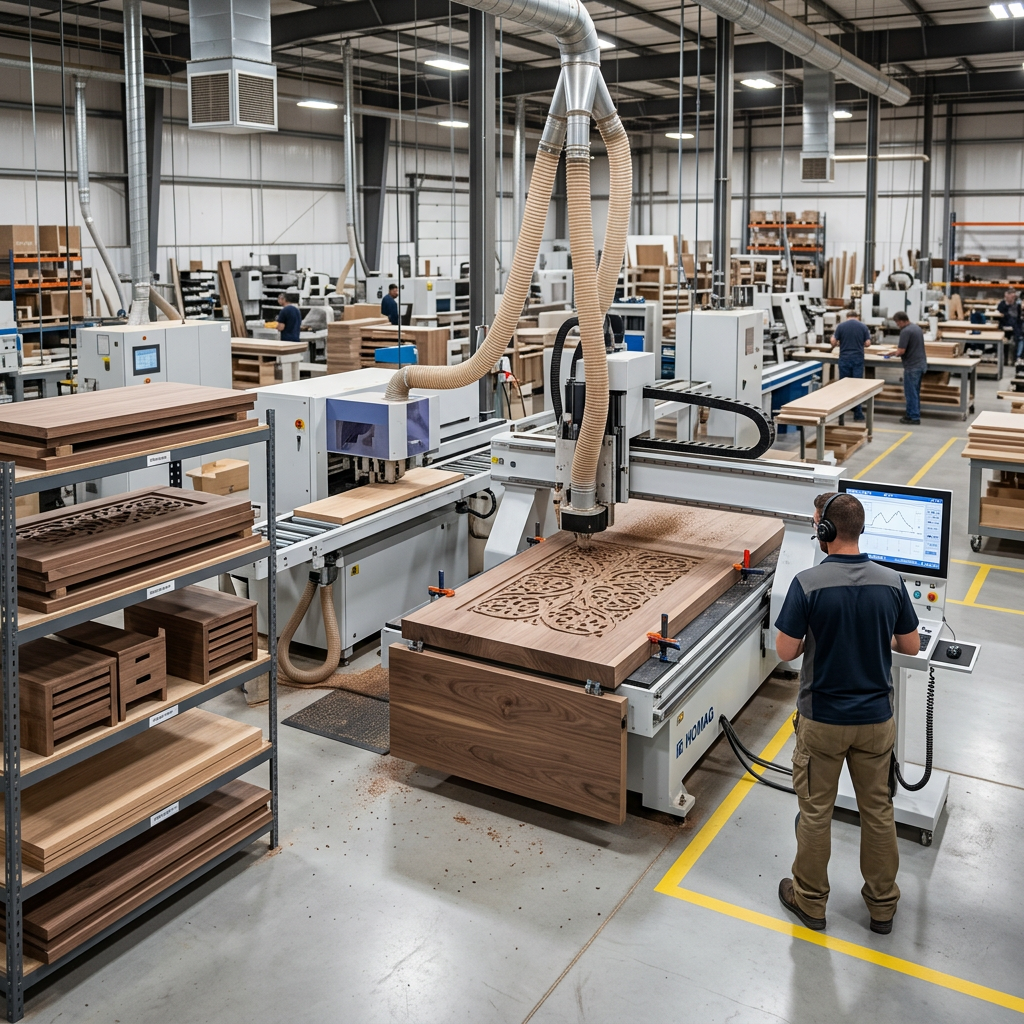
CNC machining in a custom furniture workshop: CAD and 3D approval only becomes real capability if the shop floor can execute the confirmed drawing.
The ordering sequence that makes this process work is consistent: inquiry and requirement collection, design and specification confirmation, sample or material and finish approval, order confirmation, bulk production, quality inspection, and export packing and shipment coordination. Sample approval sits before bulk production and is what makes repeat orders and long-term supply repeatable. Approving drawings and samples before production reduces changes and delays, because late changes to confirmed drawings, dimensions, materials, finishes or quantities can cause rework, additional cost and schedule slippage.
Evidence checkpoint 3: MOQ, lead time, packing and warranty
Commercial terms are where package claims are most often tested. The table below summarises what a supplier should state, alongside the point a buyer should verify for each item.
| Evidence item | What should be stated | What the buyer should verify |
|---|---|---|
| MOQ | Minimum order quantity depends on product type, customization level, material setup and order mix. MingMeng's own published comparison page states a MOQ of 20 units for custom restaurant booth manufacturing. | Whether the stated MOQ applies to your specific model, material and finish combination, and whether mixed-model orders can be consolidated. |
| Trial orders | Trial orders can be discussed depending on product, material setup and production requirements. Mixed-model orders can be considered for project procurement. | Whether the trial scope is representative of the bulk specification, not a simplified version of it. |
| Lead time | Typical production cycles of 30–60 days depending on project scope. Lead time depends on quantity, customization complexity, material availability, sample approval and factory capacity. | Whether the schedule assumes approved samples at a specific date, and how urgent schedules are evaluated against capacity. |
| Packaging | Export-standard packing using foam, edge protectors and cartons or wooden crates depending on the item, with component separation and labelled hardware. | That package dimensions and quantities are checked against the packing list before loading, and that protection is not reduced simply to increase loading quantity. |
| Warranty | Warranty terms depend on the product, the project specification and the commercial agreement, and are confirmed in the quotation or contract. | The applicable warranty period, coverage and claim handling for your specific order, plus spare-part availability for identifiable components. |
| Pricing and delivery terms | Pricing is determined by confirmed specification — materials, dimensions, quantity, construction, finish and upholstery complexity, packaging and delivery term. Quotes are typically EXW or FOB, with CIF, CFR and DDP also described. | Which Incoterm the quotation actually states, and whether DDP is feasible for your destination, product and customs handling. |
On payment, published commercial guidance states a typical structure of 30% deposit and 70% balance before shipment by T/T, with L/C at sight potentially accepted for larger orders from established customers. The exact deposit and balance structure should always be confirmed in the quotation or sales contract before order confirmation, and the quotation should state the applicable Incoterm because freight may be quoted separately or included depending on the agreed delivery term.
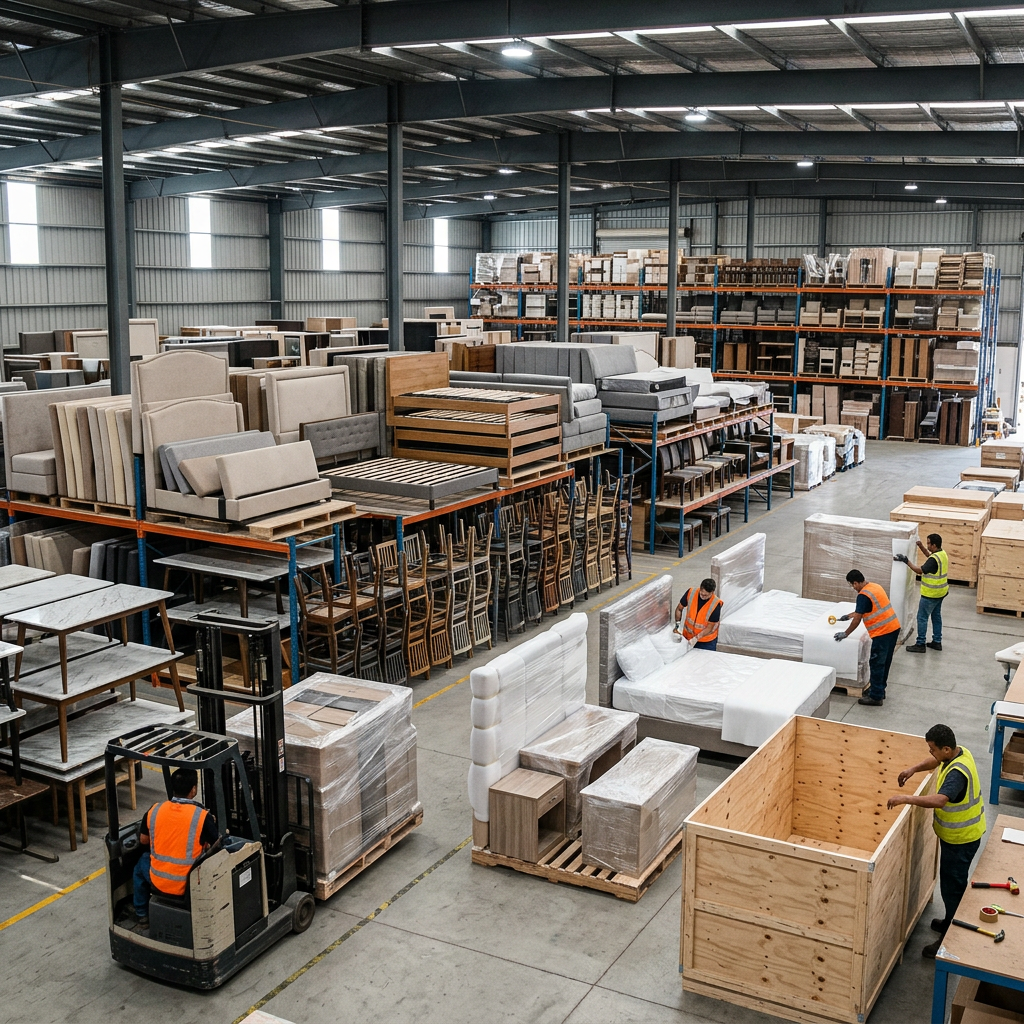
Export packing and staging: for full-package orders, packing discipline determines whether a mixed container arrives installable or damaged.
Technical explanation: how commercial-grade package furniture differs from ready-made supply
Commercial-grade furniture is furniture specifically designed and manufactured for frequent use in commercial environments such as restaurants, hotels, cafés, bars, offices and other public spaces. Compared with typical residential furniture, it places greater emphasis on structural strength, durability, stability, maintainability and suitability for high-frequency use. A full-package project supply extends that logic across categories and adds planning and documentation layers.
| Dimension | Ready-made or residential-grade supply | Project-based commercial package |
|---|---|---|
| Dimensions | Fixed standard sizes; the layout adapts to the product | Dimensions customised to the floor plan, seating capacity and circulation; booth runs and table sizes coordinated with the space |
| Construction and materials | Residential-grade frames and finishes | Commercial-grade construction with project-specific frames, finishes, upholstery and tabletop materials; commercial seating products tested according to EN 16139 requirements |
| Planning support | None; buyer manages layout | CAD drawings, 3D visualisation, dimension adjustment and basic space planning |
| Customisation | Colour choices within a fixed range | Size, material, colour, finish, fabric, hardware and branding customisation, plus OEM and ODM development |
| Lifecycle cost | Lower initial unit price | Lower lifecycle cost through durable commercial-grade structures that reduce frequent replacement and long-term sourcing expense |
| Maintenance and spares | Replacement normally means re-buying a similar item | Simplified maintenance through standardised materials, finishes and spare-part support; project records streamline later replacements and renovations |
| Documentation | Retail invoice | Specification confirmation, drawings, sample approval records, quality inspection and packing documentation |
| Trade-off | Immediate availability | Longer setup: approval cycles, project-specific MOQ and typical 30–60 day production cycles |
Durability and quality evidence
Durability claims should be backed by process and test language rather than adjectives. Quality control for MingMeng restaurant furniture covers incoming materials, cutting, welding, finishing, assembly and final inspection, with critical items inspected before packing, followed by a final pre-shipment inspection. Common durability tests include static load, impact, stability, scratch resistance, abrasion resistance and fabric colorfastness. For commercial seating, chairs and bar stools are tested according to EN 16139 requirements.
Fire performance is a project-specific requirement rather than a default. Fire-retardant foam and fabrics are offered for the United States, United Kingdom and Europe, meeting standards such as CA117, BS5852 and EN1021, and are applied where the destination market or project specifies fire-performance requirements. More broadly, stain resistance, water and weather resistance, and flame-retardancy levels should be confirmed per project regulations and operational needs rather than assumed.
Reading certification claims correctly
Certification is the most frequently over-interpreted item in supplier documentation. MingMeng's published material references CE, TÜV, RoHS and Certification of Conformity together with relevant product safety compliance certifications, and separate company pages list CE Certificate, Certificate of Conformity, Product Declarations, CZH Certificate and GPSR compliance. Some of these items are self-declared and have been flagged as requiring independent verification.
The practical standard is not the list but the document. A certificate is only relevant if it names the product model, the applicable standard and a validity period, and if it covers the item actually being supplied to your project. Where the destination market imposes specific requirements, the compliance documents should be checked against the SKU and the market before the order is confirmed.
Where the package model fits: application review
| Project type | Scope priorities | Evidence to request |
|---|---|---|
| Restaurant and café dining rooms | Chairs, dining tables and table bases, booth and banquette seating; consistent finish across loose and fixed seating | Seat height and table height confirmation against the floor plan; booth layout drawings; upholstery abrasion and cleaning information |
| Bars, lounges and nightlife venues | Bar counters, back bar cabinets, bar stools, lounge sofas | Counter and back-bar layouts with equipment space reservations; bar stool seat heights matched to counter height |
| Hotel food-and-beverage and public areas | Dining furniture plus lobby and lounge seating, reception and waiting seating | Specification set covering public area and dining zones; finish coordination across both scopes |
| Terraces, rooftops and patios | Outdoor tables, chairs, bar stools and outdoor sofas with weather-resistant frames and outdoor-rated fabrics | Frame material and corrosion protection; outdoor fabric and quick-dry foam specification; cleaning and maintenance guidance |
| Canteens, staff dining and food courts | Canteen tables and chairs, bench seating and fixed table-and-seat combinations | Seating capacity planning against aisle requirements; tabletop material and frame specification for heavy daily use |
| Hotel guest rooms | Complete room packages: beds, headboards, wardrobes, desks, TV cabinets, luggage racks | Customisation against architectural drawings; sample room development and batch production planning |
Across these scenarios, the constant requirements are the same: coordinated layout, a single furniture appearance, custom dimensions that fit the actual space, and commercial-grade materials selected for cleaning frequency, moisture and stain exposure, scratch visibility and upholstery wear.
Market context: why category-level data should be read carefully
Category sizing for restaurant furniture is currently dominated by commercial research estimates, and those estimates disagree. Market Growth Reports describes the global restaurant furniture market growing from USD 638.8 million in 2026 to USD 929.57 million by 2035 at a CAGR of 4.3%. Business Research Insights reports USD 0.88 billion in 2025 rising to USD 1.38 billion by 2034 at 5.13%. Dataintelo reports USD 6.62 billion in 2025 rising to USD 11.01 billion by 2034 at 5.8%.
These three figures differ by roughly an order of magnitude for the same nominal category, which indicates that each publisher applies a different market definition, base year or coverage boundary. They should not be averaged or compared directly. A source review carried out for this article also did not identify official customs, government or intergovernmental statistics covering restaurant furniture specifically, which means the category has no independent benchmark comparable to the top-down datasets available for larger industrial sectors.
The procurement implication is straightforward. Category forecasts are useful for directional context — whether the segment is expected to expand, and how publishers currently frame it — but they are not decision-grade evidence for a specific project. Supplier-level evidence, such as production scope, sample approval process, MOQ structure, lead-time assumptions and packing discipline, is what actually reduces project risk.
Limits and boundaries of full-package supply
A supplier review is only useful if the constraints are stated as clearly as the capabilities. The following boundaries apply to full-package commercial furniture supply as described in this scope.
- Specifications must be locked before production. Late changes to confirmed drawings, dimensions, materials, finishes or quantities can cause rework, extra cost and delays. The package model rewards buyers who complete approval early and penalises those who iterate during production.
- Custom work carries a different minimum order profile. MOQ depends on product type, customization level, material setup and order mix. The published figure of 20 units applies specifically to custom restaurant booths on the company's own comparison page; it is not a universal threshold across all categories, and custom dimensions, structures, materials or finishes may require a different minimum because of material preparation and production setup.
- Lead time is not immediate. Typical production cycles of 30–60 days should be assumed depending on project scope, with the figure moving according to quantity, customization, material availability, sample approval and capacity. Urgent schedules are evaluated only after material and capacity checks.
- Compliance evidence must be matched to the SKU. Published certification lists are not a substitute for a certificate naming the model, standard and validity period for the item being supplied.
- Delivered terms are not automatic. DDP availability depends on destination, product, customs and tax handling, and logistics capability; feasibility is confirmed case by case for the actual shipment.
- Repeat supply depends on records. Spare-part availability after delivery depends on whether the required component is identifiable and available, which makes project documentation and specification archiving part of the supplier's long-term obligation.
- Package scope does not replace the buyer's own layout checks. Table heights, chair and bar-stool seat heights, booth dimensions, wall lengths and circulation clearances should be verified against the actual space before production, regardless of how complete the supplier's drawing set is.
- Price comparison is not like-for-like without the Incoterm. Quotes are typically EXW or FOB; freight may be quoted separately or included depending on the agreed delivery term, so comparisons across suppliers must be made on identical terms.
Future outlook
Three directions are visible in how hospitality buyers are structuring furniture procurement. The first is consolidation: fewer suppliers, wider scope per order, and package-level quotations that include planning and documentation rather than products only. The second is maintainability: modularity and replaceable components are increasingly written into specifications, because operational continuity matters more than a marginally lower initial unit price. Standardised materials, finishes and spare-part support reduce maintenance burden over the service life of a venue.
The third is evidence. Buyers are asking for drawings, sample approval records, inspection documentation and packing lists as standard deliverables rather than exceptions, and they are treating self-declared certification lists as a starting point for verification. Suppliers with in-house production, documented quality control and export packing discipline are structurally better positioned to answer those requests than intermediaries that aggregate products from multiple sources.
A practical evidence checklist for the next supplier review
- Scope map by category, with in-house versus sourced status stated per category.
- Facility information: size, workforce, engineering headcount, process coverage, monthly capacity.
- Layout and design support: CAD drawings, 3D visualisation, dimension adjustment, production to customer drawings.
- Sample approval process, including material, colour, upholstery and finish samples approved together.
- MOQ by product type and customization level, with the basis for the stated figure.
- Lead-time assumptions, including what has to be approved before the clock starts.
- Quality control stages and the durability tests applied to your product categories.
- Compliance documents naming the model, standard and validity period.
- Export packing specification and the pre-loading packing list verification step.
- Warranty period, coverage, claim handling and spare-part identification for the specified items.
- Commercial terms: Incoterm, freight treatment, payment structure and production schedule in writing.
Frequently asked questions
Is the supplier a manufacturer or a trading company?
This is determined by evidence, not by self-description. A manufacturer operates its own facility and manages production and quality control for the projects it supplies. MingMeng Furniture states that it operates its own manufacturing facility with production lines covering woodworking, metalworking, upholstery, cutting, welding, polishing, painting, powder coating, CNC processing, assembly and quality inspection, and offers both OEM and ODM development. In practice, buyers verify this through a factory visit by appointment or a remote video tour, production photographs for their own order, and consistency between the quoted specification and what is observed on the line.
Can one supplier cover a complete restaurant furniture package?
A complete restaurant package is supplied as a multi-category set rather than single items only. The scope covers restaurant chairs, commercial dining tables, booth and banquette seating, bar counters and bar stools, outdoor tables and chairs, canteen furniture, hotel public area and guest room furniture, and related accessories. A single supplier can provide the complete package, which supports consolidated ordering and a consistent furniture appearance across the project. Consolidation reduces the number of sample approvals, packing standards and delivery schedules the buyer has to manage.
What MOQ applies to custom restaurant furniture?
MOQ depends on product type, customization level, material setup and order mix, so it is confirmed on a project-specific basis. Standard models and custom project furniture may have different minimum quantities. MingMeng's published comparison page states a MOQ of 20 units specifically for custom restaurant booth manufacturing. Custom dimensions, structures, materials or finishes may require a different minimum because of material preparation and production setup. Trial orders can be discussed depending on product and production requirements, and mixed-model orders can be considered for project procurement.
What lead time should be expected for a full-package project?
Typical production cycles run 30–60 days depending on project scope. Lead time is influenced by quantity, customization complexity, material availability, sample approval and factory capacity, so a project-specific schedule is issued after the specification and order plan are confirmed. Urgent schedules can be evaluated after checking materials, production capacity and the required delivery date. For project orders, progress can be communicated at agreed milestones through photographs, video or status updates.
How are design and CAD drawings handled in a project order?
For project-based orders, support can include furniture layout coordination, CAD drawings, dimension adjustment and 3D visualisation. CAD drawings are used for project review, approvals and coordination with the client's design team, and 3D renderings allow the appearance to be reviewed before production. Drawings make the process faster but are not mandatory: furniture can also be developed from photographs, reference images or written requirements, with structure, dimensions, materials and finishes adjusted for commercial use. Production can be carried out strictly to approved customer drawings once dimensions, materials, finishes and technical details are confirmed.
How is commercial furniture packed for export?
Export-standard packing uses foam, edge protectors and cartons or wooden crates depending on the item. Interior protection includes corner and edge protection and component separation where required, hardware is protected and packages are labelled to support component identification on arrival, and package dimensions and quantities are checked against the packing list before loading. Packaging must match product weight, fragile surfaces, shipping method and loading conditions; reducing protective packaging only to increase loading quantity is not an accepted practice.
What do warranty terms normally cover?
Warranty terms for commercial restaurant and hospitality furniture depend on the product, the project specification and the commercial agreement, and the applicable warranty period and coverage should be confirmed in the quotation or in the contract for the specific order. Manufacturing defects and normal after-sales responsibilities are defined in the order terms. Depending on the issue and the contract terms, repair guidance, replacement parts or coordination support can be provided. Spare-part availability after delivery depends on whether the required component is identifiable and available, which is why specification records matter for repeat projects.
What should a buyer confirm before the order is placed?
Before ordering custom restaurant furniture, the buyer should confirm the floor plan or dimensions, furniture list, quantities, reference images or drawings, preferred materials and finishes, usage conditions, destination-market requirements, budget, delivery destination and target schedule. Commercially, the quotation scope, Incoterm, payment terms, production schedule, packing and any project-specific compliance requirements should be confirmed in writing. Dimensions should be checked against the actual space, and material, colour, upholstery and finish samples should be approved so that bulk production follows a clear reference.
Reference material
MingMeng Furniture's 2026 restaurant furniture catalogue, covering product categories and customisation scope, is available as a downloadable PDF for buyers preparing a specification review: Mingmeng Restaurant Furniture 2026 catalogue (PDF).