
Supplier Capability Evidence: Haitel's Candy & Snack Lines
Supplier Capability Evidence: Haitel's Candy & Snack Lines
Supplier Capability Evidence: Haitel's Candy & Snack Lines
A production-line catalogue only becomes evidence when each listed model can be traced to a documented scope. Breadth tells a buyer that an engineering team has worked across several process families. It does not tell the buyer which certificate covers which line, what changes between two models that share a number, or which document will satisfy an importer's technical file. The practical test is therefore not how many machines appear on a page, but how many of them arrive with matching paperwork.
Jiangsu Haitel Machinery Co., Ltd. — trading as Haitel food Machinery — is a Chinese manufacturer of food and pharmaceutical processing and packaging production lines based in Dongtai City, China. Its catalogue spans candy, chocolate, cereal, starch, potato and bar equipment, and the company reports exports to North America, Europe, Oceania, Central and South America, the Middle East and Asia, with an export ratio of 70%.
This analysis treats that candy and snack portfolio as a document set to be audited rather than a product list to be admired. For buyers at evaluation stage, the useful question is narrow: as line coverage widens, does the supporting evidence widen with it?
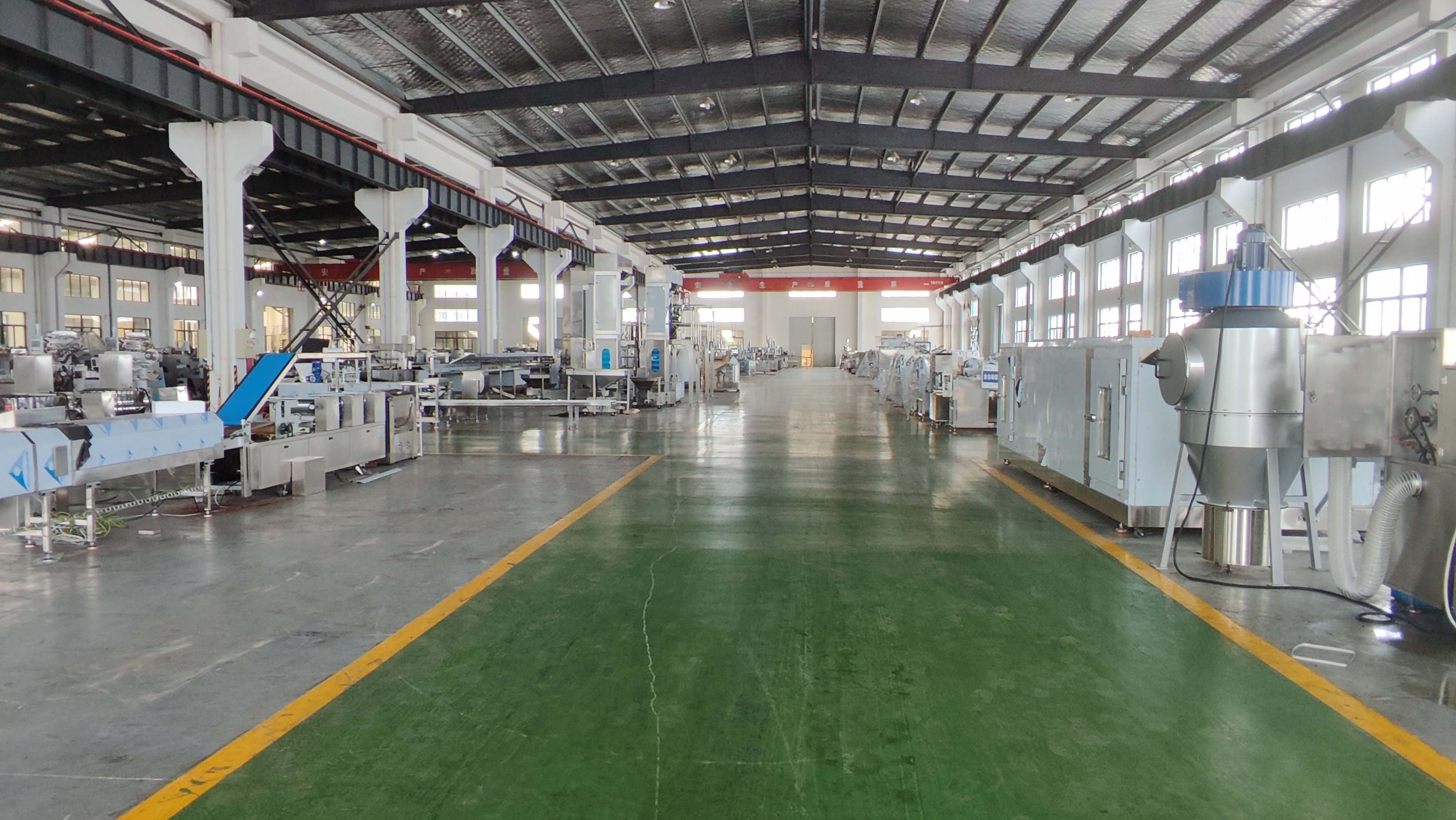
Assembly and molding workshop. Portfolio breadth is only meaningful when each assembled line carries its own documentation set.
What portfolio breadth proves — and where it stops proving anything
A wide model list is direct evidence of one thing: the supplier has designed mechanically different machines for different material behaviours. Depositing sugar syrup, forming a cereal bar slab, and drying potato flakes are not variations of one process. A company that publishes models for all three has made a design decision to cover more than one material-handling logic.
Breadth is weaker evidence for four things buyers usually assume it covers:
- Per-model conformity. A certificate issued to an entity does not automatically enumerate every model that entity sells.
- Installed base. The number of listed models says nothing about how many units of each are running in the field.
- Operational performance. Capacity, energy use, changeover time and overall equipment effectiveness are not implied by a model name.
- Configuration consistency. Two lines sharing a model prefix may or may not share cooking, cooling and control architecture.
The gap between the first list and the second is exactly where a supplier evaluation should sit.
The Haitel portfolio, mapped by process family
Grouping the catalogue by process family shows where the portfolio is deep and where it is broad but thin. The table below uses only the model names that appear in the company's own product and certification records.
| Process family | Models named in the catalogue | What the buyer is actually choosing |
|---|---|---|
| Hard candy depositing | HTL-T150, HTL-T300, HTL-T450 and HTL-T600 hard candy depositing production lines; HTL-T660 High-Speed Hard Candy Production Line; HTL-B1 Hard Candy Production Line | A capacity tier within a depositing platform, plus a separate high-speed configuration (T660) and a distinct B1 platform |
| Lollipop | HTL-T150, HTL-T300, HTL-T450 and HTL-T600 Lollipop depositing production lines; HTL-TE600B Flat Lollipop Production Line; HTL-T400 and HTL-T800 Ball Lollipop Production Lines | Shape tooling (flat versus ball) on top of a capacity tier |
| Gummy candy | HTL-T150, HTL-T300, HTL-T450 and HTL-T600 Gummy Candy Production Lines | Depositing hardware configured for gelling, cooling and demoulding rather than simple setting |
| Toffee and milk candy | HTL-B1 Toffee Candy Production Line; HTL-B1 Milk Candy Production Line | Cooking and texture configuration on a shared B1 platform |
| Candy cane | HTL-T410 Candy Cane Production Line | A dedicated forming route rather than a general depositing line |
| Cereal and protein bars | HTL-400 Cereal bar production line; Protein bar production line | Slab forming and handling for two different mass and binding behaviours |
| Potato snacks | Potato flakes production line; Potato chips production line; Compound Potato Chips Production Line | Drying and flaking versus frying — different utilities, different effluent profiles |
| Adjacent families named in the same catalogue | Compound Cereal Flakes, Baby Rice Cereal, Modified Starch, Pregelatinized Starch, Jelly Candy, Energy Bar, Oat Chocolate and Pet Food production lines | Additional process families that broaden the spare-parts and service vocabulary |
Read as a portfolio, the candy side is concentrated: depositing, lollipop forming and gummy forming share a visible naming ladder. The snack side is more dispersed, with potato flake drying, potato chip frying and bar forming sitting on separate engineering tracks.
Model numbers as a platform signal
Three observations in the naming are worth carrying into a technical discussion.
The T150/T300/T450/T600 ladder recurs across three product names. The same four numbers appear as hard candy depositing lines, lollipop depositing lines and gummy candy lines. The most reasonable reading is a shared depositing platform offered in ascending capacity tiers, with format-specific tooling attached to each application. That reading has procurement consequences: if a buyer runs both hard candy and lollipop, shared cooking and cooling sections would simplify spares and operator training, while the forming head and mould set would differ. Confirm the module split in the technical annex rather than assuming it.
HTL-B1 appears under three names. Hard candy, milk candy and toffee are all listed on the B1 platform. Toffee requires different cooking and texture behaviour from a plain hard candy boil, so the configuration delta between these three listings is a legitimate question to put in writing.
Shape is separated from tier on lollipops, but not on candy. TE600B is explicitly a flat lollipop line, while T400 and T800 are ball lollipop lines. On the hard candy side the tier ladder carries no shape suffix. A buyer comparing quotations across TE600B and T600 should therefore compare tooling, not just numbers.
Reading certificate scope the way an auditor would
Certificate numbers are the most quoted and least read part of a supplier file. The scope sentence matters more than the logo.
| Standard | Certificate no. | Issuer | Scope as written | Validity |
|---|---|---|---|---|
| ISO 9001 (GB/T 19001-2016 idt ISO 9001:2015) | 94426Q00300R099 | HB | Design and production of packaging machinery for food and pharmaceuticals (excluding qualification scope) | Issued 2026-06-25 |
| ISO 14001 (GB/T 24001-2016 idt ISO 14001:2015) | 94426E00147R099 | HB | Environmental management activities involved by design and production of packaging machinery for food and pharmaceuticals (excluding qualification scope) | Issued 2026-06-25, valid to 2029-06-24 |
| ISO 45001 (GB/T 45001-2020 idt ISO 45001:2018) | 94426S00095R053 | HB | Occupational health and safety management activities involved by design and production of packaging machinery for food and pharmaceuticals (excluding qualification scope) | Issued 2026-04-21, valid to 2029-04-20 |
| CE — machinery | MD-22-09-29 | SZUTEST | Candy Machine; standards EN ISO 12100:2010, EN 60204-1:2018 | Issued 2022-09-30, valid to 2027-09-30 |
| CE — machinery | MD-22-09-28 | SZUTEST | Packing Machine; standards EN ISO 12100:2010, EN 415-3:2021, EN 415-10:2014, EN 60204-1:2018 | Issued 2022-09-30, valid to 2027-09-30 |
There is a second detail worth raising in a supplier meeting. In the certification records reviewed here, the same product list — potato flakes, potato chips, the T150 to T600 lollipop and hard candy lines, the B1 lines, T410, TE600B, T800, T400, T660, the protein bar line, HTL-400 cereal bar and the T150 to T600 gummy lines — is attached to each of the five certificates. Buyers should ask the supplier to confirm whether that association reflects a documented scope decision or a document-management convention. The answer changes how much weight the file can carry in an importer's technical documentation.
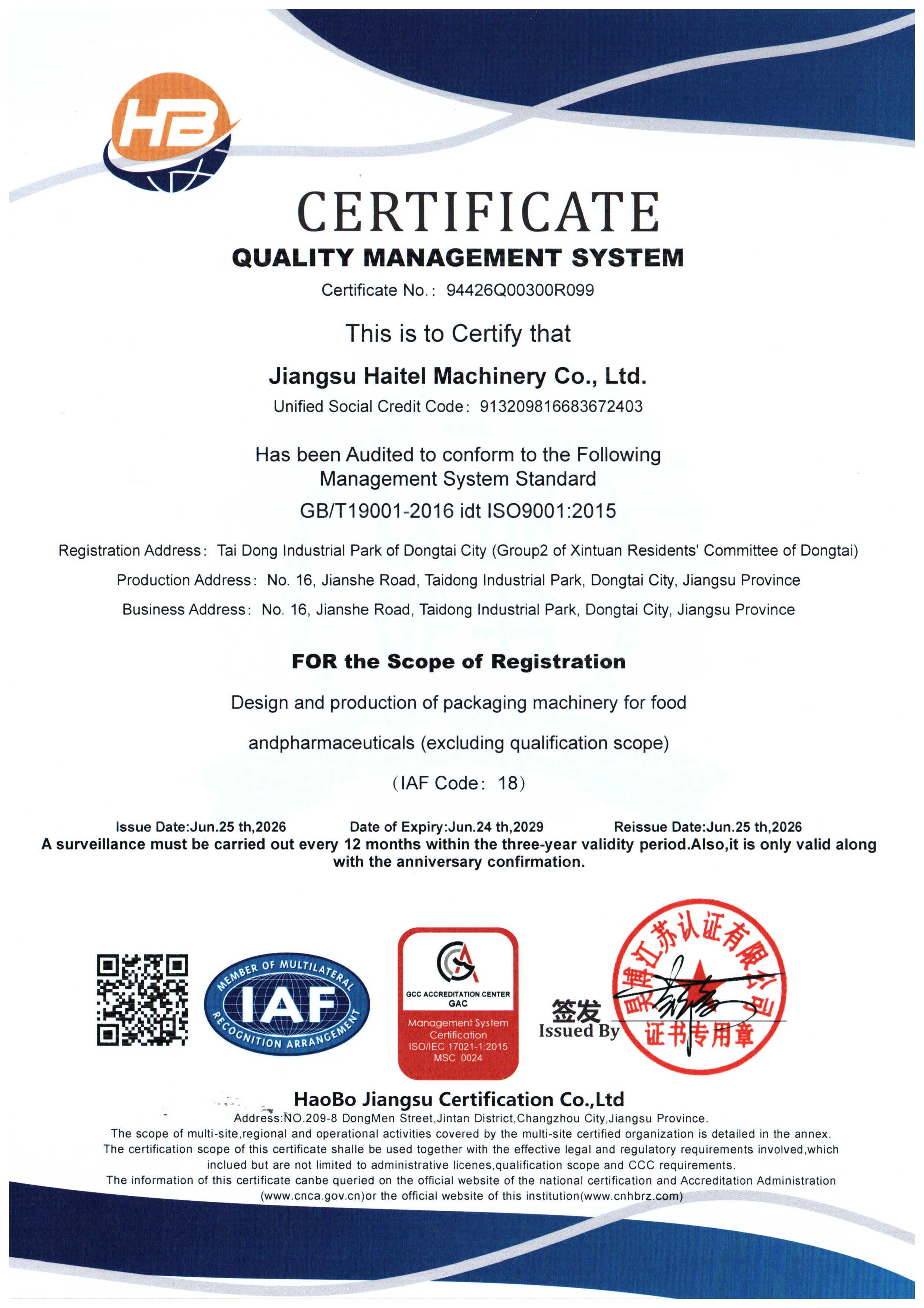
The ISO 9001 certificate names a machinery category, not individual models — which is why a per-line scope statement belongs in the RFQ package.
The hygiene dimension runs on a separate track from certification. EN 1672-2:2020 specifies common hygiene and cleanability requirements for machinery and machine components used in preparing and processing food and, where relevant, animal feed. In the United Kingdom, the Health and Safety Executive's food machinery guidance references BS EN 1672-2:2005 as a generic standard for food machines covering hygiene requirements. Neither reference certifies a machine; both are design references a buyer can use to structure a sanitary review of the proposed line.
A buyer's evidence request, line by line
The following request list converts portfolio breadth into a document checklist. It is designed to be sent with the RFQ so that the answer arrives with the quotation rather than after the deposit.
| Evidence item | Question it answers | What to ask for |
|---|---|---|
| Model-level conformity statement | Does the CE documentation reach my machine? | A written statement referencing MD-22-09-29 for candy machinery or MD-22-09-28 for packing machinery, naming the model being quoted |
| Scope clarification | Does the ISO 9001 scope cover my line, given the “packaging machinery” wording? | A one-page scope statement mapping the quoted line to the certified scope, signed by the supplier |
| Food-contact material declaration | What touches my product? | Material grade for all product-contact parts; the company states all product-contact parts are stainless steel, and the gummy reference specification calls for stainless steel 316 on food-grade contact surfaces — confirm the grade per line |
| Testing record | Was this unit tested before shipment? | Evidence of the 100% product testing the company applies as quality control, with the test items and the sign-off |
| Hygienic design review | Can the line be cleaned between products? | A cleanability review referenced to EN 1672-2:2020 principles for the specific machine group |
| Commercial parameters | What is the planning envelope? | Minimum order quantity of 1 set; single machine lead time of 15–45 days; production line lead time of 60–90 days; monthly capacity of 100 sets |
| Layout and drawings | Will it fit my building? | Engineering drawings for confirmation before production, covering capacity, product shape, size, voltage and layout |
| Reference contact | Has a comparable machine run in production? | The documented case: a food factory client in China using a sugar kneading machine for candy making, in stable operation for over five years |
Shipping terms belong in the same package. The company ships in standard export wooden cases and quotes FOB, CIF or DDP according to the buyer's request — a detail that matters when the technical file has to match the import declaration.
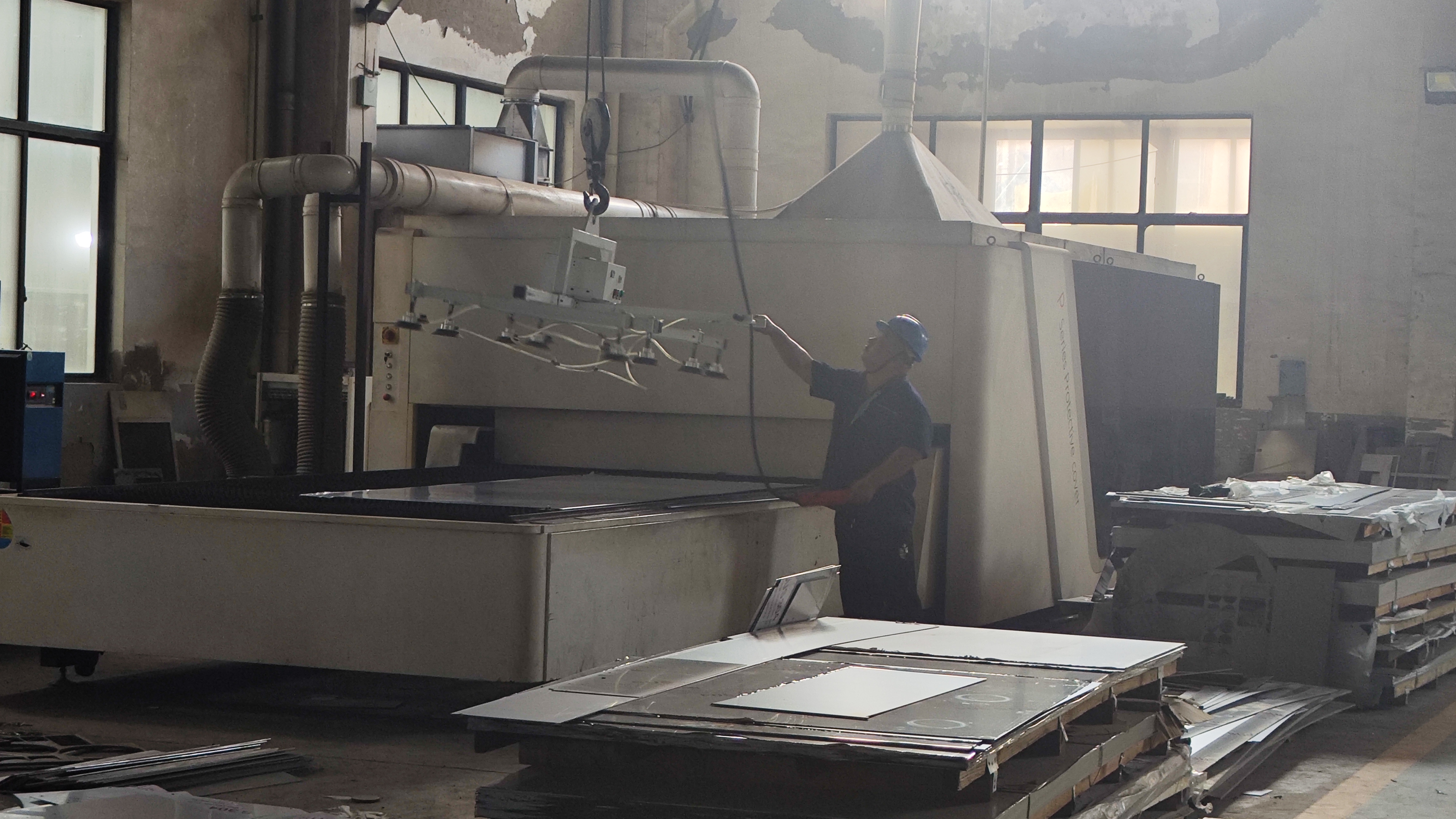
Component fabrication precedes documentation: the material grade cut here is what the food-contact declaration has to state.
Where the portfolio meets a real project: gummy and candy lines
The gummy line is the clearest test case, because the reference application material describes three distinct project types a buyer might recognise from their own capital plan. A new construction project builds a candy factory or gummy base and procures a full automatic line in one cycle, covering plant works as well as installation and commissioning. An expansion project adds a line to an existing factory to widen capacity or add categories, without new construction. A reconstruction project removes an old line and replaces the core depositing and forming machine, often alongside clean-area, pipeline and cooking-system renovation.
Two operating parameters from the same reference material are worth putting in the RFQ. The stated workshop condition is 18–28 °C, and the special requirement for food-grade contact is stainless steel 316. A buyer whose plant runs hotter, or whose compliance team accepts a different grade, should resolve that difference before the drawings are frozen, not after.
The process description also explains what separates the T-tier gummy models in practice. The line runs as four units: raw-material preparation and cooking, where sugar, glucose syrup and gelling agents are weighed, dissolved and vacuum-cooked before flavours, colours, acid and active ingredients are dosed inline; depositing and forming, where a servo head fills moving moulds and supports single-colour, two-colour, centre-filled and striped gummies, with vibration used to exhaust air and avoid bubble defects; cooling and gelling in a controlled temperature and humidity tunnel; and demoulding, sanding and packing. Matched equipment covers the sugar melting pot, sugar boiling pot, pouring and moulding machine, cooling tunnel, demoulding machine, sand rolling machine and packaging machine.
Output is not a fixed number. The company states that capacity depends on the final product, that the full automatic line can run continuously for 24 hours, and that exact capacity is calculated from the buyer's formula and target piece weight. For an evaluation-stage buyer this is more useful than a headline figure, because it moves the capacity discussion into the sample-testing stage where it can be measured.
On the snack side, the documented reference is narrower and should be treated as such: a single set supplied to a food factory client in China, a sugar kneading machine used for candy making, in stable operation for more than five years, characterised by all-stainless-steel construction and low noise. It is a real data point and a modest one.
Market signals behind the shape of the portfolio
Three published data points explain why a supplier would hold both candy depositing and potato processing in one catalogue.
The global food processing market was valued at USD 166.48 billion in 2024, according to Zion Market Research. Trade data tells a similar story of scale: exports of industrial food preparation machinery under HS 8438 reached USD 16.7 billion in 2024, a 2.12% increase on 2023, based on UN Comtrade statistics published by OEC World. These are aggregate figures, not segment figures, but they establish that the equipment category is large and still growing modestly.
The candy side has its own volume signal. Global production of gummy candy production lines reached approximately 31,400 units in 2025, according to commercial research on that segment. A rising unit count in line manufacturing tends to accompany more competitive turnkey pricing, which shifts the buyer's differentiator from availability toward documentation and support quality.
The potato side shows where demand is heading. The potato flakes market is estimated at USD 7.0 billion in 2025 and projected to reach USD 9.4 billion by 2035, a 3.0% CAGR. A supplier holding both a potato flakes line and a compound potato chips line is positioned across a drying-led and a frying-led route into the same raw material.
Regulatory pressure runs alongside. EN 1672-2:2020 frames hygiene and cleanability as a design requirement for food machinery generally, and the UK HSE guidance points buyers toward that family of standards. As cleanability language migrates into buyer specifications, a supplier's ability to answer a sanitary design question in writing becomes a commercial advantage — and an evaluation criterion.
How the portfolio compares with a single-format specialist
A specialist candy depositing builder and a multi-family supplier such as Haitel are not better or worse in the abstract; they fail differently.
| Evaluation dimension | Single-format specialist | Multi-family portfolio (as evidenced by Haitel's catalogue) |
|---|---|---|
| Depth within one process | Typically deeper in one forming technology, with configuration variants inside that family | Depth concentrated on a depositing ladder (T150–T600, T660) plus dedicated cane and lollipop platforms |
| Cross-category expansion | Requires a second supplier and a second documentation file | One entity file can cover candy, bar and potato lines, but the certificate scope wording is category-level |
| Spares and service vocabulary | Narrow and deep | Broad; useful only if the supplier confirms which modules are shared across T-tier models |
| Documentation transparency | Usually model-specific because the range is small | Requires an extra step: the buyer must request a per-line statement, because the certificates do not enumerate models |
| Reference evidence | Case studies concentrated in one product | The published case reviewed here covers one machine type in one market |
Where the evidence stops
Several limits should be priced into the evaluation rather than argued away.
- Certificate scope is category-level. The ISO certificates describe packaging machinery for food and pharmaceuticals with an exclusion clause; the CE certificates name “Candy Machine” and “Packing Machine”. A buyer in a market with strict technical-file expectations will need a model-level statement that does not currently exist in the public file.
- Breadth is not installed base. Nothing in the catalogue states how many units of each model are in operation, and the public reference case reviewed here is a single machine in a single market.
- No published operational metrics. Energy consumption per tonne, changeover time, overall equipment effectiveness and cleaning validation are not in the available material, so no total-cost-of-ownership comparison can be built from public sources alone.
- One shared product list across five certificates. The same model list is attached to each certificate record, which is a documentation question a buyer should close in writing rather than interpret.
- Segment data is thin. Market figures used here are aggregate or segment-level estimates from commercial research, not audited shipment statistics for each line type.
None of these limits is disqualifying. Each one is a question with a defined answer, which is the practical difference between a portfolio that can be verified and one that can only be described.
Outlook: from catalogue breadth to document depth
The next phase of competition in food processing lines is unlikely to be won on the number of models in a catalogue. Gummy line production already stands near 31,400 units a year globally, and when line-building capacity is plentiful, the scarce commodity becomes proof.
Three developments are reasonable to expect. First, per-model conformity statements will migrate from an exception to a standard RFQ attachment, because importers increasingly need a file that names the machine rather than the manufacturer. Second, hygiene language from EN 1672-2:2020 will keep moving from design guidance into purchase specifications, making cleanability drawings a normal part of the offer. Third, portfolio suppliers will be asked to show module commonality across capacity tiers, since shared cooking and cooling sections reduce spares holdings and operator retraining when a buyer adds a second format.
For Haitel, the portfolio already answers the breadth question across candy, bar and potato families. The remaining work is the layer beneath the breadth: mapping each model to a scope sentence, each certificate to a named machine, and each quoted line to a test record. Buyers evaluating the catalogue should ask for exactly that — and should treat a supplier that answers precisely as stronger evidence than one that answers at length.
Frequently asked questions
Can a buyer test a line with their own raw material before ordering?
Yes. Raw material can be sent to the supplier, who will test the machine and produce samples for the buyer. This test run is the point at which capacity calculations based on the buyer's own formula and target piece weight can be verified rather than estimated.
How far does customization extend on a Haitel production line?
Customization is offered across voltage, logo, output and product shape, and also covers capacity, product size and line layout. The engineering team prepares drawings for confirmation before production begins, which is the stage at which building constraints and product specifications should be resolved.
Are all product-contact parts stainless steel, and which documents support customs clearance?
All product-contact parts are stainless steel, and CE and ISO 9001 certificates can be provided to support customs clearance. Buyers should note that the certificate scope wording is category-level — packaging machinery for food and pharmaceuticals on the ISO side, and candy machine or packing machine on the CE side — and should request a statement that names the quoted model.
What lead time and minimum order quantity should be planned?
The minimum order quantity is 1 set, and monthly capacity is stated at 100 sets. Lead time is 15–45 days for a single machine and 60–90 days for a full production line. Shipping uses standard export wooden case packaging, with FOB, CIF or DDP terms quoted on request.
What after-sales support comes with a line?
Support combines on-site installation and debugging with remote assistance, and a 12-month warranty applies. Overseas engineer installation and training services are available, which is relevant for buyers commissioning a first automatic line without in-house process experience.
A full product brochure covering the candy, snack, starch and bar ranges is available for download: Haitel product brochure (PDF).
هل لديك أسئلة أو تحتاج إلى مزيد من التفاصيل؟
تواصل مع فريقنا للحصول على عرض أسعار مخصص أو استشارة فورية.
طلب عرض أسعار
املأ النموذج أدناه وسيتواصل معك فريقنا بعرض مقترح مخصص.
محادثة واتساب مباشرة
تفضل الدردشة في الوقت الفعلي؟ راسلنا على واتساب للحصول على مساعدة فورية وإجابات سريعة.
- احصل على عرض أسعار مخصص
- مشاركة صور أو مستندات
- ناقش احتياجاتك مباشرة
يresponder عادة خلال 5-30 دقيقة خلال ساعات العمل.