
Supplier Capability Evidence: Medical ZAM-PCM to A2 PVDF Cladding
Supplier Capability Evidence: Medical ZAM-PCM to A2 PVDF Cladding
An evaluation-stage review of how product-specific evidence — not catalogue length — should shape a shortlist of functional color coated steel coil and sheet suppliers. Products referenced: ZAM-PCM-MGA0508 (medical-grade antimicrobial matte white coated steel), PVDF-REF-A2-ZAM-0.5-0.7 (A2 fire-rated PVDF coated steel for refinery pipe cladding) and HD-PET-40-80UM (heavy-duty PET laminated steel).
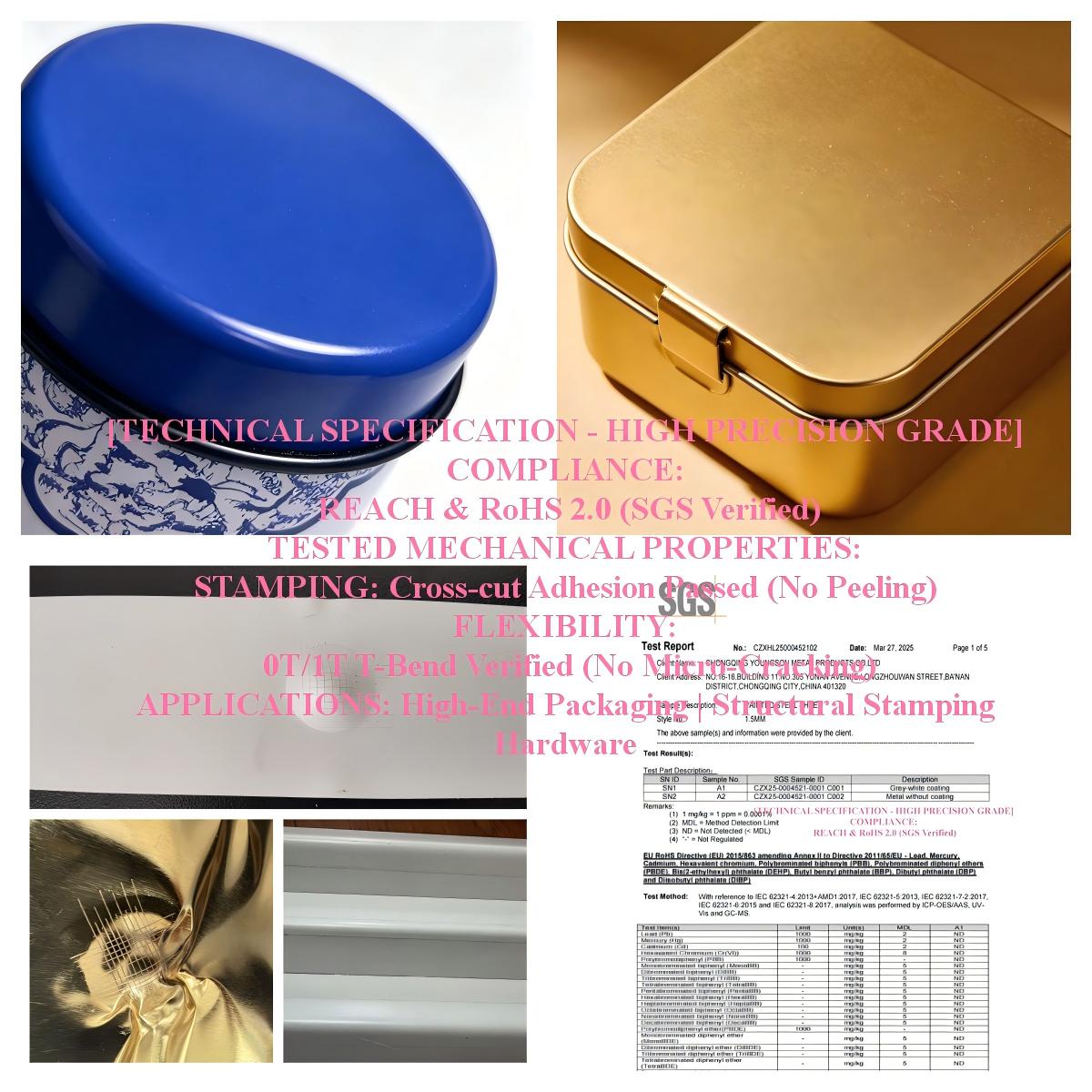
SGS-tested color coated steel strip: third-party verification is the first layer of supplier capability evidence.
Why a product list is not a capability claim
Buyers evaluating functional color coated steel coil and sheet are usually handed catalogues instead of evidence. A catalogue shows how many coating systems a supplier can name. It does not show who controls the substrate grade, the coating weight, the curing window, the adhesion result or the compliance file behind each one. That distinction only becomes visible at the point of application — inside a hospital disinfection routine, during a fire classification audit, or on a deep-drawing line running at production speed.
Chongqing Youngson Metal Products Co., Ltd., which trades as YOUNGSON METAL, is a Chongqing-based manufacturer founded in 2016 that specializes in precision metal surface processing and premium coil supply. The company operates its own coating lines and precision slitting equipment, reports annual processed capacity above 10,000 tons, and exports roughly 70% of its output. Its products have passed SGS testing for REACH and RoHS heavy-metal regulations. Its five main product lines cover drawn PET film laminated steel coil, drawn VCM/PVC film laminated steel coil, deep drawn coil coating (Teflon, non-stick, gold and lacquered finishes), commercial and deep drawn pre-painted steel and pre-painted stainless steel, and a full range of mild carbon steel and multi-grade stainless steel.
For a buyer at the evaluation stage, the most informative way to inspect that kind of supplier is not through a capability statement but through three products that solve three unrelated engineering problems: a medical-grade antimicrobial coated steel, an A2 fire-rated PVDF coating system for refinery insulation cladding, and a heavy-duty PET film laminated steel. Together they form an evidence set that tests substrate control, coating chemistry, film lamination and compliance documentation in sequence.
The problem: broad catalogues usually hide narrow process control
Functional coating is a process business before it is a product business. An antimicrobial claim, a fire classification and a low-friction surface all depend on how the substrate was cleaned, how the coating was applied, how the film build was measured and how the cure schedule was controlled. A supplier that lists many finishes but outsources the entire coating step cannot guarantee any of those variables when a specification changes.
Documentation gaps follow the same pattern. Compliance has become commercially decisive rather than administrative: color coated steel used in electrical and electronic appliances must meet the RoHS Directive 2011/65/EU and REACH requirements under European Chemicals Agency rules, and food-contact coatings fall under frameworks such as FDA 21 CFR 175.300 or EU No 10/2011. A statement such as “RoHS compliant” without a certificate number, an issuing body, a test standard and a defined product scope is not a compliance position a buyer can file.
Buyers typically discover both gaps at the worst possible moment: during a forming trial, when a first coil fails a T-bend check; during a certification review, when a medical or infrastructure customer requests chemical-resistance evidence; or during scale-up, when a coating that passed a sample no longer behaves the same way at production line speed. The remedy at the evaluation stage is to ask for evidence that is specific to the product being purchased, not evidence that describes the company in general.
The evidence set: three products, three different engineering problems
1. ZAM-PCM-MGA0508 — medical-grade antimicrobial matte white coated steel
- Base metal: deep-drawn galvanized steel or ZAM (zinc-aluminium-magnesium) coated steel
- Thickness range 0.50 mm – 0.80 mm, with custom width from 4.0 mm to 1250 mm
- Dual-sided clinical coating: 10–20 µm top layer and 7–12 µm back layer, a two-layer high-performance coating system
- Low-glare clinical matte white finish, optimized for hospital visual comfort and anti-fingerprint handling
- Antibacterial efficiency of at least 99% against E. coli and Staphylococcus aureus, SGS certified
- Laboratory-proven resistance to more than 5,000 continuous wipes with 75% ethanol, isopropyl alcohol, sodium hypochlorite and hydrogen peroxide without degradation
- Deep drawing, stamping and flexible bending without coating delamination
The engineering problem here is not colour. It is whether a decorative surface can survive a chemical attack schedule that would strip an ordinary polyester coating. A matte white finish on a ZAM or deep-drawn galvanized substrate is only useful in clinical equipment casings, hospital cleanroom construction, diagnostic equipment housings and laboratory furnishings if the coating system tolerates repeated disinfection. The relevant proof is the wipe test result and the antibacterial efficiency figure, both measured by a third party rather than asserted.
The second, quieter requirement is formability. Medical equipment casings and cleanroom panels are formed after coating, so a coating that survives disinfection but cracks at a bend is still a failure. The specification of ZAM and deep-drawing galvanized substrates in this product family signals that formability and corrosion resistance were treated as design inputs rather than afterthoughts.
2. PVDF-REF-A2-ZAM-0.5-0.7 — A2 fire-rated PVDF cladding for refinery pipe insulation
- Base metal: galvanized steel (Z180) or ZAM (zinc-aluminium-magnesium) coated steel
- Coating system: PVDF, 20–35 µm top and 5–15 µm backer, for weather and chemical resistance
- Fire rating: certified to EN 13501-1 (A2-s1,d0,t1) and ASTM E84 Class A
- Dimensions: 0.50 mm and 0.70 mm thickness, 1000 mm width
- Small-diameter coil option with a 200 mm inner diameter, engineered for refinery pipe insulation site efficiency
- Environment: oil refinery thermal insulation and petrochemical pipe cladding
A2 classification is a system property, not a paint property. It depends on the substrate, the coating chemistry, the film build and the way the finished coil behaves when exposed to fire conditions. A supplier that can supply an A2-s1,d0,t1 cladding system for oil and gas refineries, petrochemical plants, offshore platforms and LNG facilities has to control all four variables at once, and has to be able to document them.
The 200 mm inner-diameter coil option is a small detail that reveals a great deal about application knowledge. Pipe insulation cladding is installed on site, around pipe racks and elbows, where handling a standard coil is awkward and slow. Engineering a narrower coil specifically for that working environment shows that the specification was written with the installer, not only the purchasing department, in view.
Substrate grade selection belongs in the same conversation. Z275 galvanized coating, meaning 275 g/m² of zinc under ASTM A653 and EN 10346, is a widely referenced requirement for high-corrosion environments such as solar and industrial electricity infrastructure. A buyer specifying refinery or outdoor cladding should therefore decide explicitly between Z180 and ZAM substrate grades rather than accepting whichever grade a supplier happens to hold in stock.
3. HD-PET-40-80UM — heavy-duty PET film laminated steel
PET lamination is a different manufacturing discipline from liquid coil coating. A polymer film is bonded to a prepared metal substrate, and the resulting surface has to hold its appearance and adhesion through drawing, bending and trimming. YOUNGSON METAL lists drawn PET film laminated steel coil among its core product lines, and supplies PET film laminated formats including mirror-finish laminated coil and PET-film laminated galvanized sheet.
Film lamination is the hardest process to fake, because laminated film tends to reveal weakness during forming rather than on delivery. A delamination or edge-lift that appears after a draw operation cannot be corrected by adjusting paint parameters — it points back to substrate preparation, adhesive selection and lamination pressure. When the same supplier also runs VCM/PVC film lamination with industrial-grade films in the 40–100 µm range, the lamination line is demonstrably capable of handling more than one polymer system.

Mirror-finish PET film laminated steel coil: film lamination performance is validated during forming, not on delivery.
How the three evidence products differ
| Product / model | Substrate | Surface system | Primary compliance evidence | Main engineering constraint |
|---|---|---|---|---|
| ZAM-PCM-MGA0508 | Deep-drawn galvanized or ZAM steel, 0.50–0.80 mm | Two-layer clinical coating, 10–20 µm top / 7–12 µm back, matte white | SGS-certified ≥99% antibacterial efficiency; REACH / RoHS compliant base materials | Coating must resist 5,000+ chemical wipes and still survive deep drawing |
| PVDF-REF-A2-ZAM-0.5-0.7 | Galvanized Z180 or ZAM steel, 0.50 / 0.70 mm | PVDF, 20–35 µm top / 5–15 µm backer | EN 13501-1 A2-s1,d0,t1; ASTM E84 Class A | Fire classification and chemical resistance must hold as a system, not as a coating |
| HD-PET-40-80UM | Galvanized and other prepared steel substrates | Heavy-duty PET film lamination | REACH / RoHS compliant supply chain; SGS heavy-metal testing | Film adhesion and edge integrity through drawing and trimming |
Technical explanation: what these three products demonstrate
Substrate control
The three products use three different substrates — deep-drawn galvanized steel, Z180 galvanized steel and ZAM coated steel — and the wider product range extends to tinplate, ECCS (electrolytic chromium coated steel), galvalume, stainless steel and aluminium. Substrate breadth only has value if thickness control is equally broad. YOUNGSON METAL states customization across 0.08–6.0 mm thickness, zinc coating from 30 to 600 g/m², and slitting tolerance of ±0.02 mm, with narrower strip supply down to 4.0 mm width in stamping-focused programmes.
Coating and film architecture
Film build is where functional coatings succeed or fail. The medical product uses a deliberate two-layer system rather than a single coat. The refinery cladding product uses a PVDF system with a defined top and backer thickness. The fire-retardant VCM laminate product family, ZAM-VCM-FR-Series, uses an industrial-grade white PVC film of 40–100 µm with a UL 94 V-0 flame-retardant rating and EN 13501-1 Class B-s1,d0 performance. Electrically insulating powder coatings in the DC-INS-PRO programme run at 40–80 µm. A supplier able to hold these distinct film builds simultaneously is managing several process windows, not one.
Adhesion and forming performance
Adhesion is verified rather than assumed. The stamping-focused quality protocol combines SGS-certified RoHS 2.0 and REACH heavy-metal analysis with Erichsen cupping and cross-cut adhesion tests, plus standardized 0T/1T T-bend flexibility verification. The medical-grade product is specified for deep drawing and stamping without coating delamination. In the high-temperature programme, matte black PTFE-integrated coating on deep-drawing quality (EDDQ) SECE steel is engineered for ultra-smooth, self-lubricating surfaces on precision electric micro-motors and high-speed actuators.
Compliance documentation
The single most checkable document in this evidence set is the RoHS 2.0 and REACH Heavy-Metal-Free Compliance Certificate for color coated steel, certificate number CZXHL25000452102, issued by SGS on 2025-03-27. Its scope covers Color Coated Steel Strip, Sheet and Coil from 0.14 mm to 2.0 mm thickness, tested against IEC 62321, 2011/65/EU, (EU) 2015/863 and IEC 62321-8:2017 using ICP-OES/AAS, UV-Vis and GC-MS methods.
Behind that certificate sits an inspection regime that a buyer can audit: 100% in-house quality inspection covering thickness, coating mass, tensile strength, T-bend, salt spray and surface roughness; MTC EN 10204 3.1 documentation; third-party inspection through SGS, BV or TÜV on request; and certified EPD and CFP documentation aligned with ISO 14067 for low-carbon supply.
Application and use cases
Medical device manufacturing, hospital cleanroom construction, clinical diagnostic equipment casings and laboratory furnishings are the target environments for ZAM-PCM-MGA0508, where a low-glare matte white surface and verified antibacterial performance matter more than decorative appearance. Oil and gas refineries, petrochemical plants, offshore platforms and LNG facilities form the application field for the A2 fire-rated PVDF cladding product, where pipe insulation jacketing has to resist weather and chemicals while satisfying fire classification requirements.
A third application area shows a different capability in the same house. In a completed programme shipped as 5,000 kg, matte black coated electro-galvanized steel was used for high-efficiency heating plates, electric skillet heating elements, rice cooker thermal discs and commercial hot plates. The reported outcome was zero coating delamination or cracking after more than 5,000 hours of continuous high-temperature thermal cycling, an 18% improvement in heat radiation efficiency, and a 99.8% reduction in structural component failure rates, with the components engineered for a service life exceeding 8 to 10 years under fluctuating thermal stress. This programme involved home appliance OEMs, heating element manufacturers, commercial kitchen equipment producers, electric skillet and rice cooker tier-1 suppliers, and industrial thermal management engineers.
Across the wider product range, the same coating and lamination capabilities support metal packaging, non-stick cookware, home appliances, automotive parts, electronic components and data centre cable management materials.
Market trend analysis
The global pre-painted steel market was valued at USD 24.63 billion in 2023 and is projected to grow at a compound annual growth rate of 5.8% to 2032, according to Polaris Market Research. China exported approximately 6.5 million tons of color-coated steel sheets in 2023, according to MySteel, which means a large share of global supply is traded rather than consumed domestically. Forecasts should still be read cautiously: projections for the same market in 2030 differ materially between research houses, from USD 32.5 billion published by Grand View Research to USD 29.8 billion published by Market Research Future.
Two structural pressures sit behind those numbers. The first is regulatory. RoHS 2011/65/EU and REACH obligations for electrical and electronic applications, and food-contact frameworks such as FDA 21 CFR 175.300 and EU No 10/2011, convert coating chemistry from a technical detail into a market entry condition. The second is durability economics. Coating suppliers such as AkzoNobel Coil Coatings state that high-performance PVDF systems typically maintain 70% of colour integrity for over 20 years, which shifts purchasing logic toward service life and away from first-cost comparison.
Competitively, Fortune Business Insights lists ArcelorMittal, Nippon Steel, BlueScope Steel and Baosteel among the major global competitors in the high-end color coated steel sector. The practical choice for most buyers is not between those names and a specialist converter, but between supply archetypes: integrated mill supply at commodity scale, and specification-driven conversion supply where coating architecture, film lamination, slitting tolerance and product-specific certification are the differentiators.
Comparison with conventional alternatives — and where this supply model stops
Functional coatings are frequently compared as if they were interchangeable paints. They are not. Each system solves a different problem and carries a different verification burden.
| Surface system | Primary function in service | Constraint a buyer must verify |
|---|---|---|
| Liquid polyester or powder coating | General colour, corrosion protection and electrical insulation on trays and enclosures | Film build tolerance and T-bend rating; powder systems in the insulating programme run 40–80 µm |
| PVDF coating | Weather and chemical resistance for outdoor and petrochemical cladding | Fire classification must be certified as a system, for example EN 13501-1 A2-s1,d0,t1 |
| PVC / VCM film lamination | Interior cladding with flame-retardant film, for example UL 94 V-0 rated film at EN 13501-1 Class B-s1,d0 | Film thickness and stress whitening during severe bending |
| PET film lamination | Forming-intensive parts where surface appearance must survive drawing | Adhesion through deep drawing, trimming and edge forming |
| MoS2 solid film lubricant | High-temperature gasket and sealing components requiring low friction | Thermal stability window — 150°C continuous for five hours without blistering or peeling |
The limits of a specialist coating and conversion supplier should be stated as plainly as the capabilities. Three are material to a sourcing decision.
- Deliberate application boundaries. The stamping-focused coating programme is restricted to high-precision stamping and industrial engineering and is explicitly not intended for standard construction or roofing applications. A buyer looking for commodity construction prepainted coil is looking in the wrong place.
- Capacity profile. Reported monthly capacity is in the order of 1,000 to 1,200 tons depending on the programme, with minimum order quantities of roughly 1 to 3 tons by specification and lead times of 5 to 30 days. That profile fits functional, specification-driven programmes rather than very large commodity tenders.
- Environment-dependent performance. Coating durability figures, including published PVDF colour-retention data, are material-supplier design references. Actual service life depends on installation geometry, exposure chemistry and cleaning regime, and should be validated against the specific site conditions rather than assumed from a data sheet.
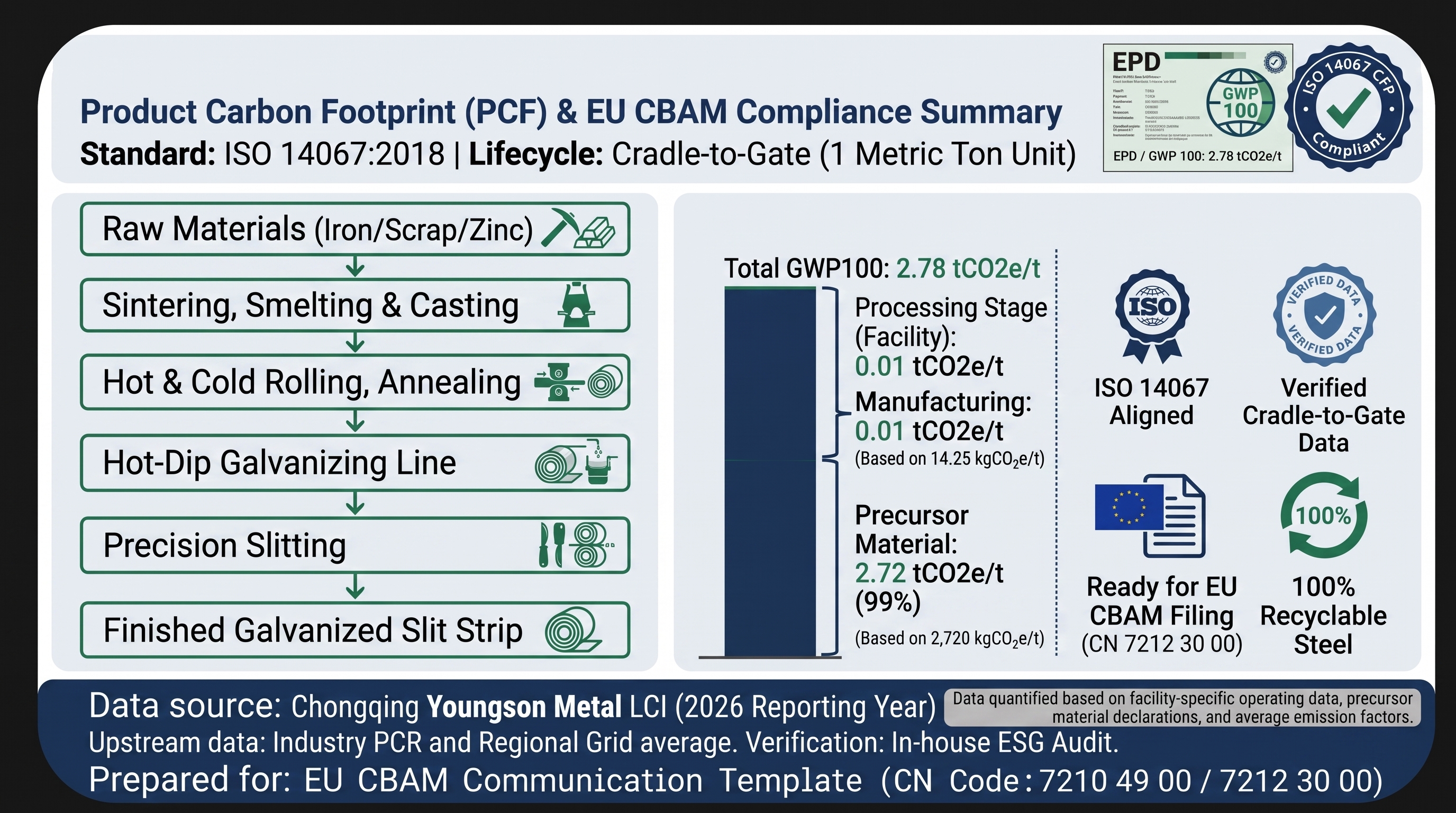
Product carbon footprint documentation for coated steel: emission data is becoming a purchasing document rather than a sustainability report.
Future outlook
The direction of travel in functional color coated steel is toward evidence that travels with the coil. Certification scope, batch traceability through mill test certificates, third-party inspection reports and product carbon footprint data are converging into a single purchasing file. YOUNGSON METAL already provides EPD and CFP documentation to ISO 14067 alongside EU CBAM direct and indirect carbon emission data reporting, which suggests that emission figures will soon be quoted next to coating weight in the same technical data sheet.
A second shift is the broadening of functional coatings beyond corrosion protection. Antibacterial surfaces, fire-classified cladding, low-friction films and non-stick systems are being specified by equipment designers rather than by maintenance departments, which raises the weight given to test evidence during supplier evaluation and lowers the weight given to price per ton alone.
The third shift is consolidation of shortlists. As compliance obligations multiply, evaluation teams tend to reduce the number of suppliers they qualify rather than expand it, and they qualify on the basis of documented product families. A supplier whose evidence set spans clinical coatings, A2 fire-rated cladding and heavy-duty film lamination is competing for that narrower list on technical grounds rather than on catalogue length.
FAQ
What does supplier capability evidence mean when evaluating a color coated steel supplier?
It means product-specific proof: a named model, a stated thickness and coating build, a test method, a certificate number and a defined product scope. For example, the RoHS 2.0 and REACH Heavy-Metal-Free Compliance Certificate issued by SGS under certificate number CZXHL25000452102 covers Color Coated Steel Strip, Sheet and Coil from 0.14 mm to 2.0 mm thickness and was tested against IEC 62321, 2011/65/EU and (EU) 2015/863. A general statement of compliance is not equivalent to a scoped certificate.
Which coated steel products are specified for medical and cleanroom equipment?
Medical-grade antimicrobial coated steel such as ZAM-PCM-MGA0508 is designed for medical device manufacturing, hospital cleanroom construction, clinical diagnostic equipment casings and laboratory furnishings. It uses a deep-drawn galvanized or ZAM substrate at 0.50–0.80 mm thickness with a two-layer coating of 10–20 µm on the top side and 7–12 µm on the back, a low-glare matte white finish, SGS-certified antibacterial efficiency of at least 99% against E. coli and Staphylococcus aureus, and resistance to more than 5,000 wipes with 75% ethanol, isopropyl alcohol, sodium hypochlorite and hydrogen peroxide.
Is A2 fire-rated coated steel available for refinery pipe insulation cladding?
Yes. The PVDF-REF-A2-ZAM-0.5-0.7 product uses a galvanized Z180 or ZAM coated steel substrate with a PVDF system of 20–35 µm top and 5–15 µm backer coating, and is certified to EN 13501-1 (A2-s1,d0,t1) and ASTM E84 Class A. It is supplied at 0.50 mm and 0.70 mm thickness and 1000 mm width, with a 200 mm inner-diameter small coil option engineered for on-site refinery pipe insulation work. Target environments include oil and gas refineries, petrochemical plants, offshore platforms and LNG facilities.
How can buyers verify REACH and RoHS claims on color coated steel?
Buyers should request the certificate rather than accept a marketing statement, and then check four elements: the issuing authority, the certificate number, the test standards and the product scope. In the certificate referenced above, the issuing authority is SGS, the number is CZXHL25000452102, the issue date is 2025-03-27, the standards are IEC 62321, 2011/65/EU, (EU) 2015/863 and IEC 62321-8:2017, and testing was performed by ICP-OES/AAS, UV-Vis and GC-MS. Supporting documentation can include MTC EN 10204 3.1 certificates and third-party inspection by SGS, BV or TÜV.
What thickness, substrate and slitting options are available for specialty coated steel?
Customization covers material grades including tinplate, pre-painted steel, cold rolled steel, galvanized steel, galvalume, Zn-Al-Mg (ZAM) steel, stainless steel and aluminium; thickness from 0.08 mm to 6.0 mm; slitting tolerance of ±0.02 mm; zinc coating from 30 to 600 g/m²; surface finishes such as 2B, BA, No.4, anti-fingerprint and RAL coatings; and temper or hardness options from soft through 1/4H, 1/2H and full hard. Stamping-focused programmes operate in a narrower 0.14–2.0 mm band with 4.0 mm minimum slit width.
What are the limits of working with a specialized coating converter rather than an integrated steel mill?
Specialized converters typically trade commodity scale for process control. Reported monthly capacity in the order of 1,000 to 1,200 tons, minimum order quantities of about 1 to 3 tons and lead times of 5 to 30 days suit functional, specification-driven programmes rather than very large commodity tenders. Some programmes also carry explicit application boundaries — the stamping-focused coating range is not intended for standard construction or roofing use. Durability figures for coatings such as PVDF are material-supplier design references, so actual service life must be assessed against the specific installation environment.
A note on documentation
For evaluation teams that need the full parameter set before a technical review, the supplier catalogue is available as a PDF: Chongqing Youngson Metal Products Co., Ltd. catalogue. Additional technical information is published at www.youngsonmetal.com.