
Supplier Capability Evidence: SYUTECH's Model Range and Build Data

Supplier Evidence Review · Panel Furniture Equipment
Most woodworking machine purchases begin with a document, not a demonstration. That document is the model sheet — and it is the only artefact a buyer can audit before committing to a factory visit, a sample run or a deposit. Whether it proves capability or merely asserts it depends on how much specific data the supplier is willing to publish.
Why a model sheet is the first layer of due diligence
A woodworking machine model sheet that lists working envelopes, installed power, footprint, frame material and control platform can be checked against a buyer's own production profile without leaving the desk. A sheet that lists only a category name and a horsepower figure cannot. The difference is not a marketing preference; it is the difference between a supplier that documents its engineering and one that describes it.
This review applies that test to one supplier. Foshan Shunde SaiYu Technology Co., Ltd., which trades under the SYUTECH brand, is a woodworking machinery manufacturer based in Shunde District, Foshan City, Guangdong Province, China. The company was originally established in 2013 and states a 10,000 m² factory, approximately 100 employees, a stated monthly capacity of 100 sets, a 30–45 day lead time and a one-set minimum order quantity. Its catalogue spans edge banding machines, CNC nesting platforms, six-side drilling machines, computer panel saws, door processing machines and complete panel furniture production lines.
The question this article answers is narrower and more useful than a company profile: when SYUTECH publishes build data across that range, what does the data actually demonstrate, what does it leave unresolved, and how should a buyer in the research or evaluation stage use it?
What to extract from any woodworking machine model sheet
- Envelope limits — minimum and maximum workpiece dimensions, not just the maximum.
- Process window — edge band width and thickness, drilling diameter and depth, cutting height and width.
- Power architecture — installed power, voltage, phase and frequency.
- Physical commitment — footprint and weight, which determine floor layout, lifting and installation cost.
- Frame material — carbon steel versus stainless, and on which models.
- Control and drive specification — controller brand, servo configuration, tooling capacity.
The edge banding range: four models on two frame families
SYUTECH's edge banding catalogue is organised as a ladder rather than a single platform. Two models sit on a full-size chassis with pre-milling and corner trimming; two sit on a narrow 730 mm chassis aimed at smaller workpieces and tighter floor plans. The published parameters make the rungs distinguishable.
| Model | Catalogue role | Minimum workpiece | Edge band range | Feed speed | Installed power | Footprint (L×W×H) | Weight | Frame material |
|---|---|---|---|---|---|---|---|---|
| HK568 | Edge banding machine with pre-milling, end, rough and fine trimming, corner trimming, polishing | Panel length 135 mm; panel width 50 mm (corner trimming note 50×300 mm) | 10–60 mm wide; 0.4–3 mm thick | 16–18–22 m/min | 25.86 kW | 7200×710×1628 mm | 2,200 kg | Carbon steel |
| HK868P | Automatic edge banding machine with pre-milling, end, rough and fine trimming, polishing | Not published on the model sheet | 10–60 mm wide; 0.4–3 mm thick | 16–22 m/min | 25 kW | 9500×1000×1650 mm | 4 t | Carbon steel |
| HK268GY | Compact edge banding machine, 730 mm chassis | Panel length 150 mm; panel width 40 mm (corner trimming 45×200 mm) | 10–60 mm wide; 0.35–3 mm thick | 18–20–22 m/min | 12.4 kW | 5360×730×1210 mm | Not published | Carbon steel / SS304 |
| HK268G | Mini edge banding machine, 730 mm chassis | Panel length 150 mm; panel width 40 mm (corner trimming 45×200 mm) | 10–60 mm wide; 0.35–3 mm thick | 16–18–22 m/min | 11.8 kW | 3790×730×1210 mm | Not published | Carbon steel / SS304 |
Source: SYUTECH published model parameters. Values are quoted as published; blank fields indicate data not stated on the public sheet.
Three observations follow directly from the table, and each one matters to a buyer.
First, the workpiece envelope does not scale with machine length. The HK868P is 9,500 mm long and weighs four tonnes; the HK268G is 3,790 mm long. Yet the 268 series allows a narrower panel — 40 mm — than the 25.86 kW HK568, which specifies a 50 mm minimum width. A workshop that regularly edges 45 mm drawer sides is therefore not automatically better served by the larger machine. The published minima, not the price tier, should drive the specification.
Second, thin edge band stock is handled on the narrow chassis. Both 268 models accept 0.35–3 mm banding; the HK568 and HK868P publish 0.4–3 mm. That 0.05 mm difference is small on paper but decisive for workshops running very thin ABS or melamine edge tape.
Third, stainless is a 268-series option, not a range-wide one. The HK268GY and HK268G are listed as carbon steel / SS304; the HK568 and HK868P are listed as carbon steel. Buyers in humid or corrosion-sensitive environments should treat this as a specification question rather than assume it applies across the catalogue.
Focus: what the HK268G Mini Edge Banding Machine actually specifies
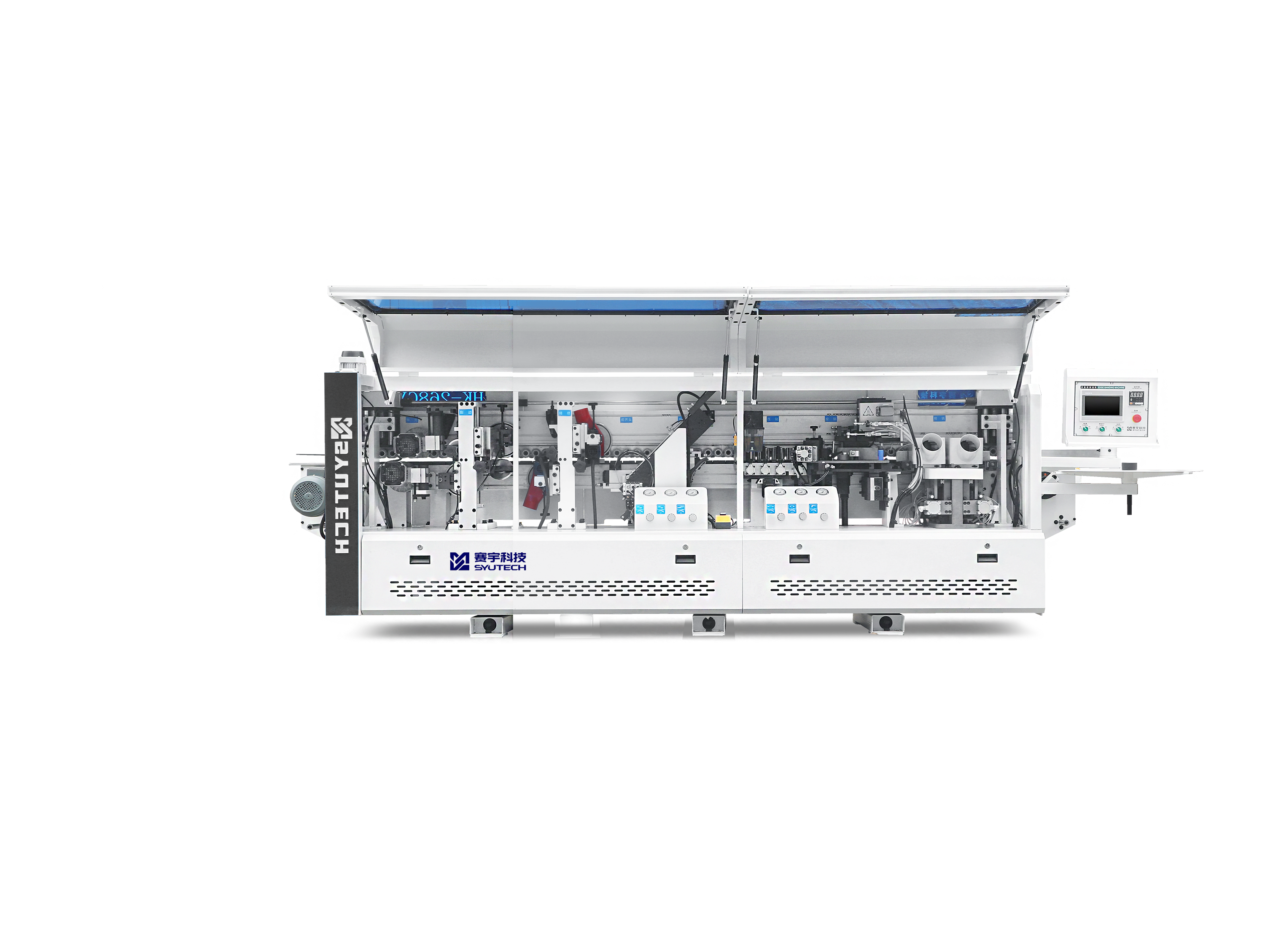
The Mini Edge Banding Machine carries model designation HK268G and is the shortest unit in SYUTECH's edge banding range at 3,790 mm long, 730 mm wide and 1,210 mm high. It is built on a carbon steel frame, with SS304 listed as an alternative material. Within the range, it is the model whose published data most clearly targets constrained floor space.
Its process window is stated as follows: minimum panel length 150 mm, minimum panel width 40 mm, with a corner trimming note of 45×200 mm; edge band width 10–60 mm; edge band thickness 0.35–3 mm; feeding speed 16–18–22 m/min; installed power 11.8 kW at 380 V, 50 Hz; pneumatic supply 0.7–0.9 MPa; overall dimensions 3,790×730×1,210 mm.
Read as evidence rather than as a sales line, three things are notable.
The minimum workpiece is the real constraint. A 150 mm minimum panel length and a 40 mm minimum width set the practical boundary of the machine. Cabinet doors, drawer boxes and shelving above those dimensions fall inside the envelope; narrow lipping strips, small sample panels and miniature components below them do not. For a workshop whose product mix includes very small parts, this single line determines whether the machine is suitable at all — and it is precisely the line most catalogue pages omit.
The pneumatic requirement is a site condition, not a machine accessory. The 0.7–0.9 MPa air supply band means the machine's trimming and pressure functions depend on a stable compressed air system. SYUTECH's own project records for panel furniture edge banding installations list an air compressor and vacuum cleaner among the matched equipment. A buyer without a regulated air supply is not buying a plug-in appliance; they are buying a small compressed-air installation alongside the machine.
The public sheet is deliberately partial. The HK268G record publishes dimensions, power, speed and process limits, but not the function configuration, not the machine weight, and not the full working-unit list. The compact HK268GY, by contrast, publishes a 5,360 mm length and 12.4 kW installed power on the same 730 mm chassis — a 1,570 mm length difference and 0.6 kW power difference for the same nominal workpiece envelope. That gap is where the extra working units would sit, and it is exactly what a buyer should request in writing: a unit-by-unit function list for the HK268G before comparing it against the HK268GY on price.
This is a useful illustration of how supplier documentation should be read. The HK268G is not under-specified because the machine is weak; it is under-specified because the public record stops at the mechanical envelope. The evaluative question a buyer should ask is not “which model is better” but “what is on the HK268G that is not on the HK268GY, and what is on the HK568 that is on neither”. Answering that requires the function configuration sheet, and any supplier unable to produce one has told the buyer something important.
The CNC and panel processing range: envelopes, tooling and control platform
The second half of the catalogue moves from edge finishing to cutting, drilling and line integration. Here the data is denser in some places and thinner in others — itself a signal about where the supplier's engineering documentation is mature.
| Model | Platform | Working envelope / capacity | Spindle, drive and tooling | Control / power | Footprint and weight |
|---|---|---|---|---|---|
| HK6 | CNC router / nesting machine / wood CNC cutting (same platform, several catalogue names) | X 1,220 × Y 2,800 × Z 250 mm | 9 kW air-cooled spindle at 24,000 rpm; servo motors 1.5 kW ×4; 11 kW frequency converter; Japanese-brand reducer; 12-tool straight-line auto tool changer | Taiwan LNC / SYNTEC; 380 V, 3-phase, 50 Hz | Not published |
| HK-Line | CNC nesting production line | Same platform as HK6 | As HK6, plus Taiwan-brand precision rack on X and Y axes | Taiwan SYNTEC / LNC; 380 V, 3-phase, 50 Hz | Not published |
| HK612A | CNC six-side drilling machine | X 2,800 × Y 1,220 mm, Z working height 50 mm; max workpiece 2,800×1,220 mm; min 140×40 mm | 27 drilling tools in total: 10 vertical top, 8 horizontal (XY), 9 vertical bottom; axis speeds X 120 m/min, Y 80 m/min, Z 30 m/min | Not published on the sheet | 5,200×2,900×2,300 mm; 3,500 kg |
| HK612B | Side drilling machine / drilling and milling center | Identical to HK612A | Identical to HK612A | Not published on the sheet | Identical to HK612A |
| HK3500 | Door processing machine | Table 395×3,000 mm; working thickness 10–50 mm; min working width 70 mm; drill hole φ3–φ15 mm, depth 0–35 mm | Vertical spindle 3.5 kW ×2; horizontal spindle 2.2 kW; left/right traverse motor 0.75 kW; feed motor 0.4 kW; total power 16.35 kW; air 0.6 MPa | Not published on the sheet | 3,800×1,550×1,300 mm; 800 kg |
| HK330 | Computer panel saw, also catalogued as a beam saw | Max cutting width 3,300 mm; max cutting height 100 mm; min working size 34×45 mm; cutting speed 0–100 m/min | Main saw motor 16.5 kW (18.5 kW option); scoring saw motor 2.2 kW | Not published on the sheet | 5,900×5,950×1,900 mm |
| HKATC | Automatic production line | Defined per project from daily output requirement and workshop size | Defined per project | Defined per project | Defined per project |
Source: SYUTECH published model parameters. The HK612A and HK612B share an identical published parameter set; the two entries differ in catalogue naming.
Two patterns stand out. The HK6 and HK-Line entries are the most completely documented: spindle power, rotation speed, servo count, converter rating, reducer origin, tool capacity and controller brand are all published. That level of disclosure is what allows a buyer to compare the platform against alternatives on drive architecture rather than on price alone — and the addition of Taiwan-brand precision racking on the HK-Line is the only published mechanical difference between the standalone router and the line configuration.
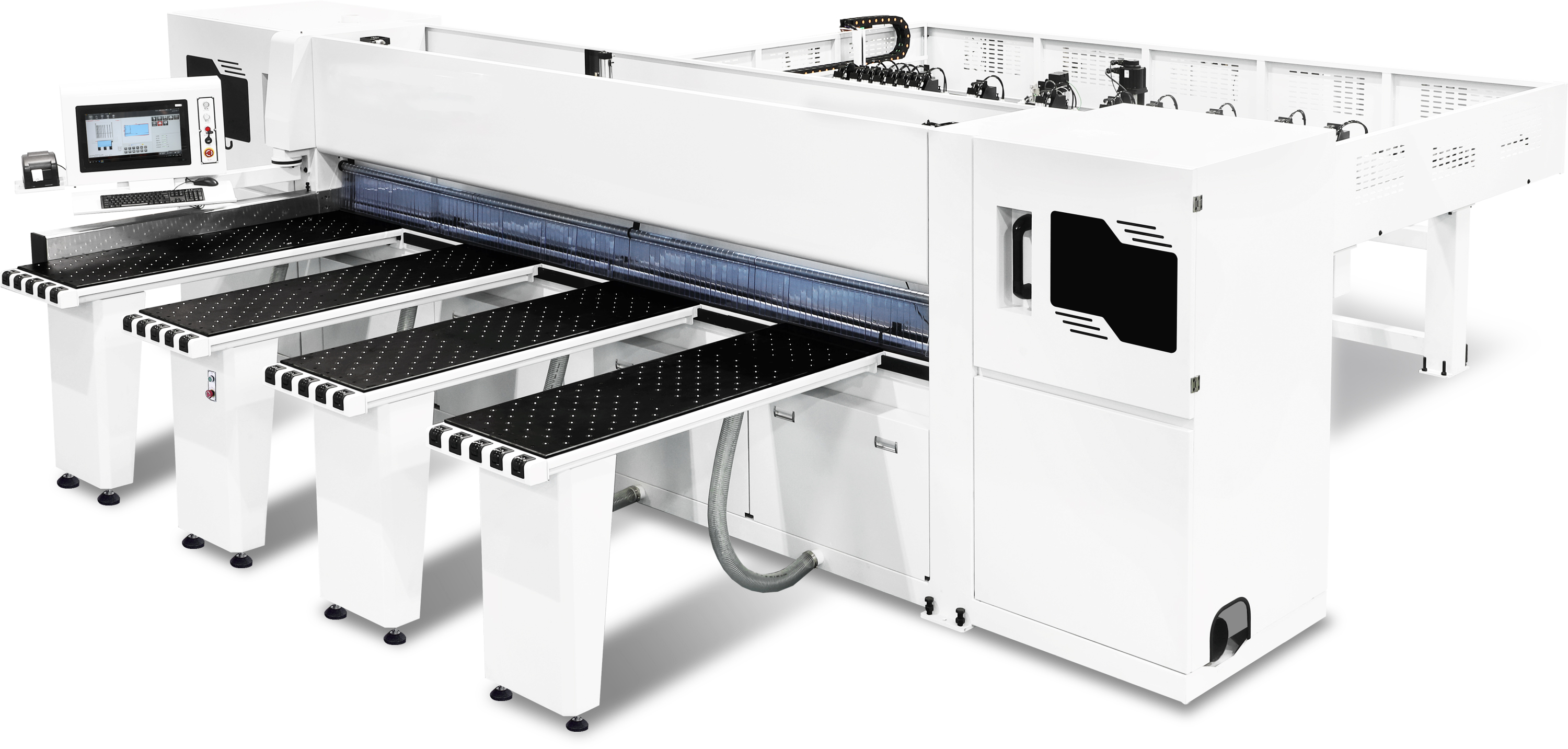
The drilling and sawing entries are documented at the envelope level instead. For the HK612A and HK612B, the useful figure is the tool count: 10 vertical top, 8 horizontal on XY and 9 vertical bottom, a combined 27 drilling positions across a 2,800×1,220 mm maximum workpiece. For the HK330, the meaningful numbers are the 3,300 mm maximum cutting width and 100 mm maximum cutting height, which set the panel format the saw can accept.
The HKATC entry is the outlier. It carries no fixed specification at all, because the line is built around the buyer's daily output requirement and workshop dimensions. That is honest documentation rather than evasive documentation — a customised line cannot be quoted from a catalogue — but it also means the HKATC cannot be pre-screened the way the HK268G can. Buyers comparing turnkey lines must move to a project RFQ earlier in the process.
What the published figures indicate about manufacturing capability
Product breadth alone does not prove capability; a trading house can list a broad range. What supports a manufacturing claim is breadth combined with specified architecture across that breadth.
Three data patterns are relevant here. Power architecture is consistent and specified. Every edge banding model publishes its installed power and voltage, from 11.8 kW on the HK268G to 25.86 kW on the HK568, all at 380 V, 50 Hz. The CNC platform publishes a full drive chain: 9 kW spindle, four 1.5 kW servo motors, four matching drivers, an 11 kW frequency converter, a Japanese-brand reducer and a Taiwan LNC or SYNTEC controller. Suppliers assembling machines from unspecified components generally do not publish this level of detail, because the detail invites comparison.
Component sourcing is disclosed rather than implied. The company states it has introduced European technology and collaborated with the Italian company TEKNOMOTOR, and the model data independently shows Taiwan-brand precision racking on the HK-Line and Taiwan controllers across the CNC range. A buyer can verify each of those statements against a delivered machine; vague claims cannot be verified at all.
Production claims are dated and stated. SYUTECH lists OEM/ODM production with logo, colour and voltage customisation, a stated monthly capacity of 100 sets, a 30–45 day lead time, a one-set MOQ, 100% testing and remote after-sales support, across export markets including Europe, Russia, the Middle East, South America, Southeast Asia and Africa. These are supplier-stated figures, not third-party audited ones — a distinction that matters and is addressed later in this article.
Where these machines are applied: three project patterns
Project records are the bridge between published parameters and real production. SYUTECH's own case records describe three configurations that map onto the model data above.
A Romanian panel furniture project producing cabinets and cabinet doors operates indoors under normal temperature and humidity in a dust-laden woodworking environment, running continuous automatic cycles with manual feeding assistance. Matched equipment listed for that project includes a vacuum cleaner, vacuum pump and air compressor, and the special requirement is compliance with EU CE mechanical and low-voltage safety standards. That record is consistent with the published air demand on the edge banding models and with the 380 V three-phase supply across the range.
A Kenyan panel furniture manufacturer runs three units across an edge banding workshop and a CNC router workshop, two years into operation. The stated outcome is improved edge banding quality and increased output, with stable edge banding cited as the highlight. A Greek panel furniture manufacturer runs ten units in an edge banding workshop, three years into operation, with significantly increased output and stable operation cited. Both records describe continuous automatic cycle operation with manual feeding assistance and the same CE mechanical and low-voltage requirement.
For a buyer, the transferable lesson is not the outcome claim but the configuration logic: edge banding and CNC routing are typically specified as a pair, because a panel furniture workflow that cuts and nests on a router still needs finished edges before assembly. Buyers who evaluate a single machine in isolation tend to discover the second purchase later, and often under time pressure.
Market trend analysis: why documentation is becoming a purchasing criterion
Three structural trends make published build data more commercially relevant than it was a decade ago.
Automation is now the majority configuration. Fortune Business Insights reports that the automatic segment of the woodworking machinery market held 48.2% share in 2025. As automatic machines become the default rather than the upgrade, buyers compare automation against automation — and that comparison happens on specified parameters, not on the presence or absence of automation.
Regulatory scope is widening. Machinery placed on the EU market falls under Regulation (EU) 2023/1230, and the EU Deforestation Regulation (EU) 2023/1115 becomes enforceable by 30 December 2026, adding traceability expectations further up the timber supply chain. In the United States, OSHA maintains dedicated woodworking machinery requirements under 29 CFR 1910.213, and ANSI O1.1-2013 (R2023) sets safety requirements for machinery of 5 hp or greater — a threshold every edge banding and CNC model in this range exceeds by a wide margin. Compliance planning therefore starts with the installed power and control configuration, both of which appear on the model sheet.
Machines are increasingly assessed as part of a production system. Industry commentary in 2026 describes woodworking machinery being evaluated less as a standalone purchase and more as a component of a connected production system. That shift rewards suppliers who can document interfaces — controller platform, voltage, tooling, air demand — and penalises those who cannot.
Comparison with traditional evaluation: what published data cannot replace
The conventional evaluation path is sample-based: visit the factory, see a machine run, inspect a finished part, speak to a reference customer, then negotiate. Documentation-first screening does not replace that path, and it should not be presented as if it does.
Its first limitation is that it measures documentation quality, not build quality. A supplier with excellent model sheets may still have poor wiring practice, inconsistent assembly tolerances or weak commissioning support. Published parameters describe the design intent of a machine; they say nothing about how consistently that intent is executed on the line.
Its second limitation is that the data itself is supplier-reported. Nothing in SYUTECH's public model sheets is third-party audited, and the same is true of most manufacturers in this category. Figures such as the 100-set monthly capacity or the 30–45 day lead time are company statements that should be verified through pre-shipment inspection, a factory audit or a structured reference call.
Its third limitation is internal consistency. Even a well-documented catalogue can carry version drift: SYUTECH's HK330 data appears in two catalogue versions that state different clamp-hand counts, 11 in one and 13 in the other. That is not evidence of a defective machine, but it is evidence that the purchase order — not the brochure — must carry the final configuration. The same discipline applies to the HK268G, whose public sheet does not state machine weight or a function list.
A fourth boundary is organisational. The published company profile lists a two-engineer R&D team. For configured standard machines with logo, colour and voltage customisation, that is a workable structure. For a buyer seeking deep bespoke line engineering — non-standard panel formats, unusual tooling sequences, integration with an existing MES — it sets a realistic expectation: project engineering capacity should be validated during the RFQ stage rather than assumed from the catalogue breadth. After-sales is described as remote support, which places the burden of first-line diagnostics on the buyer's own maintenance team unless local service coverage is confirmed separately.
Future outlook
The direction of travel in panel furniture equipment is toward fewer, more integrated stations and more published interface data. Edge banding is consolidating into multi-function chassis, as the 268 series already shows, while cutting and drilling migrate toward enclosed CNC platforms with specified controllers and tool counts.
For buyers, the practical consequence is that model sheets will keep getting longer, and the skill that matters is reading the gaps rather than the numbers. A specification that publishes a 150 mm minimum panel length but not a function list is telling the buyer exactly which question to ask next. Suppliers who close those gaps first will find that procurement conversations start from a different baseline — one where capability has already been partly demonstrated before the first meeting.
FAQ
What can a buyer verify from a woodworking machine model sheet before contacting a supplier?
A buyer can verify four things without a site visit: whether the working envelope matches the product mix, whether the installed power and voltage match the available supply, whether the footprint and weight fit the floor plan and lifting capacity, and whether the control platform and tooling configuration are specific enough to compare against alternatives. On the SYUTECH range, for example, the HK612A publishes a 2,800×1,220 mm maximum workpiece and 27 drilling tools, while the HK330 publishes a 3,300 mm maximum cutting width and 100 mm maximum cutting height. These are checkable facts, not claims.
Which SYUTECH edge banding model fits a small cabinet workshop — HK268G, HK268GY, HK568 or HK868P?
Fit depends on three published parameters. The HK268G Mini Edge Banding Machine is 3,790 mm long with 11.8 kW installed power; the HK268GY compact model is 5,360 mm long with 12.4 kW. Both accept panels from 150 mm length and 40 mm width, edge band 10–60 mm wide and 0.35–3 mm thick. The HK568 is 7,200 mm long with 25.86 kW and accepts a shorter minimum panel length of 135 mm and a minimum width of 50 mm, with banding from 0.4–3 mm. The HK868P is 9,500 mm long with 25 kW total power and a 4 t weight. A floor-constrained workshop with standard 0.5 mm and above banding fits the 268 series; a workshop needing 135 mm minimum panel length or full pre-milling and corner trimming moves to the HK568.
What are the operating limits of the HK268G Mini Edge Banding Machine?
The HK268G is limited to panels of at least 150 mm length and 40 mm width, with a corner trimming note of 45×200 mm. It accepts edge band 10–60 mm wide and 0.35–3 mm thick, feeds at 16–18–22 m/min, and requires 0.7–0.9 MPa of compressed air and a 380 V, 50 Hz supply at 11.8 kW installed power. Its footprint is 3,790×730×1,210 mm on a carbon steel frame, with SS304 listed as an alternative. The public model sheet does not state machine weight or a unit-by-unit function list, so those two items must be obtained separately before a configuration can be fully compared with the HK268GY.
What site infrastructure does a SYUTECH woodworking machine require?
The edge banding models require a 380 V, three-phase, 50 Hz supply and a regulated compressed air supply of 0.7–0.9 MPa; the HK3500 door processing machine specifies 0.6 MPa. SYUTECH's project records for panel furniture edge banding installations list an air compressor and vacuum cleaner among the matched equipment, and the Romanian cabinet project adds a vacuum pump. All models are intended for indoor operation at normal temperature and humidity in a dust-laden woodworking environment, so dust extraction and air regulation are site conditions rather than machine accessories. Voltage customisation is offered under the company's OEM/ODM programme where the local supply differs.
How should a buyer validate SYUTECH's published model data before placing an order?
Validation should combine documentation requests with physical checks. On documentation, ask for the function configuration sheet for the specific model, the machine weight, the final clamp-hand or tooling count, and the control platform for models where it is not published, such as the HK612A, HK612B, HK3500 and HK330. On physical checks, request a sample run on the buyer's own board and edge tape, and arrange pre-shipment inspection against the agreed configuration. The company states 100% testing, a one-set minimum order quantity, a 30–45 day lead time and OEM/ODM customisation of logo, colour and voltage — all of which should be written into the purchase order rather than left to the brochure.
For buyers who want the full model and parameter set in one document, SYUTECH publishes a factory promotional brochure: Factory promotional paper (PDF). Company information is also available at syutech.com.
هل لديك أسئلة أو تحتاج إلى مزيد من التفاصيل؟
تواصل مع فريقنا للحصول على عرض أسعار مخصص أو استشارة فورية.
طلب عرض أسعار
املأ النموذج أدناه وسيتواصل معك فريقنا بعرض مقترح مخصص.
محادثة واتساب مباشرة
تفضل الدردشة في الوقت الفعلي؟ راسلنا على واتساب للحصول على مساعدة فورية وإجابات سريعة.
- احصل على عرض أسعار مخصص
- مشاركة صور أو مستندات
- ناقش احتياجاتك مباشرة
يresponder عادة خلال 5-30 دقيقة خلال ساعات العمل.