
Supplier Capability Evidence: Stainless Steel Shot 195/201/304/430
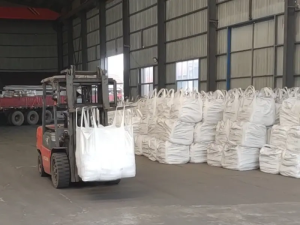
Export packing and dispatch: the part of a supplier's capability that a datasheet never shows.
Specifications for blasting media increasingly name the workpiece material before they name the abrasive. That shift is what makes the stainless steel shot series 195, 201, 304 and 430 a procurement decision rather than a catalogue line.
On aluminium alloy, austenitic stainless steel and titanium alloy parts, the failure that matters is rarely a rough finish or a slow cycle. It is a surface that has picked up foreign iron and then carries it into coating, welding, passivation or inspection. A part can look clean and still fail a contamination check, and the cost of that failure is measured in rejected lots rather than in abrasive tonnage.
This is the operating problem the stainless steel shot series addresses. The series is supplied in four designations — 195, 201, 304 and 430 — with a documented envelope of 32–50 HRC hardness, 0.1–1.0 mm particle size, 490–1520 MPa tensile strength, 7.8 g/cm³ density and 4.5 g/cm³ bulk density. What follows is an assessment of what those figures do and do not prove, and what a buyer should demand as capability evidence before committing to a bulk order.
Iron-Free Blasting Is a Surface Result, Not a Chemistry Claim
The phrase "iron-free blasting" is often used loosely, and the ambiguity causes real procurement errors. It is worth separating two different claims.
The first claim is about chemistry — whether the media itself contains no iron. No stainless steel grade satisfies that in a literal sense, because stainless steel is an iron-based alloy by definition. Any supplier or buyer who reads "iron-free" as a metallurgical composition statement will eventually be disappointed.
The second claim is about transfer — whether blasting deposits foreign iron on the workpiece surface. This is the claim that matters operationally, and it is the one the stainless series is specified against. The requirement is that after blasting, an aluminium alloy, stainless steel or titanium alloy workpiece carries no iron contamination introduced by the process: no embedded iron particles, no smeared iron film, no free iron in surface crevices that would later show up as coating blistering, weld porosity or a failed passivation test.
Stated that way, the requirement becomes testable, and it becomes a supplier capability question rather than a marketing adjective. A manufacturer of stainless media for iron-free blasting must be able to demonstrate three things: that the melt chemistry is controlled and consistent across grades, that the production route does not introduce carbon steel contamination between melting and packaging, and that finished media do not shed iron-bearing debris in a way that transfers to the workpiece.
This distinction also explains why the series is positioned for applications that specify no ferrous contamination — stainless steel surface treatment, aluminium profile and die casting, copper and brass parts, hardware and electronics, precision casting — rather than for general-purpose heavy descaling.
What the 195, 201, 304 and 430 Designations Tell a Buyer
The four designations are not four sizes of the same product. They represent different stainless families positioned against different combinations of corrosion resistance, cost and downstream process compatibility. Treating them as interchangeable is one of the most common specification errors in stainless blasting media.
| Designation | Positioning within the series | Buyer consideration |
|---|---|---|
| 195 | Cost-oriented stainless designation at the widest end of the series size range | Confirm corrosion performance against the workpiece and the service environment, not against the price list |
| 201 | Mid-range stainless designation, generally selected where cost pressure is real but a stainless surface is still required | Ask for the grade's chemistry certificate and confirm it against the parts you blast |
| 304 | The reference austenitic-grade designation, typically chosen for the most demanding corrosion positions in the series | The default choice where the workpiece is itself stainless or where post-blast corrosion resistance is specified |
| 430 | A distinct ferritic stainless designation within the same catalogue, addressing a different balance of properties | Validate magnetic response and downstream compatibility — welding, passivation and coating adhesion — before standardising |
The practical consequence is that a quotation stating "stainless steel shot" without a grade is not a quotation for a defined product. A buyer comparing three suppliers on unit price alone may be comparing 195 against 304 and concluding that one supplier is expensive when in fact the offers are for different materials.
The Documented Specification Envelope
The series is documented with a single technical envelope that applies across the four designations. Every value below is a supplier-stated parameter and should be verified against a batch certificate rather than accepted from a web page.
| Parameter | Documented value | What it governs in practice |
|---|---|---|
| Hardness | 32–50 HRC | Impact energy versus substrate damage; also the series' main limitation against cast steel media |
| Particle size | 0.1–1.0 mm | Surface profile, coverage rate and suitability for thin or precision parts |
| Tensile strength | 490–1520 MPa | Resistance to fracture under repeated impact, and therefore usable cycle life |
| Density | 7.8 g/cm³ | Kinetic energy delivered per particle at a given wheel speed |
| Bulk density | 4.5 g/cm³ | Hopper volume, feed rate setting and machine calibration |
| Stated service life | 6,500 cycles (supplier test designation) | Consumption rate and therefore the operating-cost case |
Two readings of this table are worth flagging. First, a 32–50 HRC band is broad by abrasive standards; a batch at the low end behaves differently from a batch at the high end, so a hardness certificate per lot is not administrative overhead but a genuine quality control. Second, the 6,500-cycle figure is a supplier test designation, not an independently certified value — it should be treated as a comparative indicator against carbon steel media rather than an absolute promise.
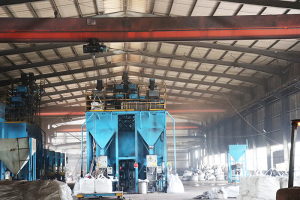
Between melting and packing: the segment where cross-contamination with carbon steel is most likely to be introduced.
The Manufacturer Behind the Series
Zouping Huiteng Metal Abrasives Co., Ltd. (Huiteng Metal Abrasives) is a metal abrasives manufacturer and exporter based in Qingyang Town Industrial Park, Zouping County, Binzhou City, Shandong Province, China. The company was founded in 2017, operates a 20,000 m² facility with 50 employees and 15 engineers, and reports an annual production capacity of approximately 100,000 tons across five product series and more than 60 specifications.
Its production workflow runs through medium-frequency induction melting, centrifugal atomization granulation, secondary quenching and tempering, followed by rounding, screening and packaging. Every batch is tested for chemical composition and fatigue life, with pre-shipment sampling inspection, under an ISO9001 quality management system. Roughly 30% of output is exported, with goods shipped to more than 20 countries and regions including the EU, USA, India, Southeast Asia and the Middle East.
For a buyer evaluating the 195/201/304/430 series, the relevant point is not the size of the plant but the structure of the process. Centrifugal atomization produces spherical particles from a controlled melt, which is the route by which a stainless grade can be made consistently rather than by crushing scrap. The existence of a defined melting, atomizing, heat-treating and screening sequence is what makes a high-cycle claim plausible in the first place.
Capability Evidence: What a Manufacturer Must Be Able to Show
Because stainless media sits outside the scope of the best-known cast-steel abrasive standards, capability evidence has to be assembled from the supplier directly. ISO 11124-3:2018 specifies requirements for high-carbon cast-steel shot and grit — hardness, density, defect and chemical requirements across defined grades — and that standard is the natural reference for carbon steel media. A stainless series needs its own grade-level documentation, and that documentation is where buyers should concentrate their diligence.
Six evidence items separate a manufacturer from a trader with a catalogue:
| Evidence item | What it proves | What it does not prove |
|---|---|---|
| Batch chemical composition report per grade | That the 304 you ordered is 304 and not an unspecified stainless | That the melt is free of cross-contamination from previous heats |
| Hardness test report within the 32–50 HRC band | Where in the band a specific lot sits | Impact fatigue behaviour on your machine |
| Fatigue life test record | Relative durability between grades and heats | That your wheel settings will reproduce the test result |
| Screening and size distribution data | Consistency of the 0.1–1.0 mm band and fines content | How the media will classify in your separator |
| ISO9001 certification and audit trail | A documented quality system exists and is externally audited | Product-specific conformity |
| Segregated stainless production and packing | That stainless heats are not run through carbon steel equipment without cleaning | Anything about performance on your workpiece |
The sixth item is the one most often skipped and the one most likely to explain an unexpected contamination failure. A stainless heat processed through equipment that has just run carbon steel shot will not necessarily fail a chemistry certificate, but it can carry enough embedded ferrous debris to defeat the purpose of buying stainless media at all.
How Spherical Stainless Media Removes Material Without Transferring Iron
Atomized stainless shot is spherical. That geometry matters more than it first appears. A round particle striking a surface at high velocity delivers a peening-type impact: it deforms and cleans the surface while limiting the cutting action that angular media produce. The result is a surface that is cleaned and lightly cold-worked rather than aggressively profiled.
Three properties of the series support the no-transfer outcome. The 7.8 g/cm³ density and 4.5 g/cm³ bulk density mean each particle carries substantial kinetic energy at normal wheel speeds, so effective cleaning can be achieved at lower angular aggression. The 490–1520 MPa tensile strength range gives the particle enough toughness to survive repeated impact rather than shattering into fines that are then driven into the surface. And the 32–50 HRC hardness keeps the media below the hardness at which aluminium and austenitic stainless substrates are cut and gouged.
The mechanism by which iron transfer is avoided is straightforward once stated: the impacting particles are stainless throughout, so the debris generated by media breakdown is stainless debris rather than carbon steel debris. That is also why the same series is not recommended in machines that run carbon steel media without a full clean-out — the mechanism depends on what is actually circulating in the machine, not only on what was purchased.
Where the Series Fits in Production
The documented application scope is stainless steel surface treatment, aluminium profile and die casting, copper and brass parts, hardware and electronics, precision casting, and processes where no ferrous contamination is required. Titanium alloy components belong to the same decision family, because the concern is identical: a surface that must enter welding, coating or inspection without residual iron.
In practice this produces four recurring use patterns. Aluminium extrusion and die-cast parts are blasted before anodising or powder coating, where embedded iron shows up as pitting or adhesion failure. Stainless fabrications are blasted before passivation, where free iron is the specific defect the passivation step is intended to remove. Copper and brass components are cleaned without introducing a dissimilar metal that would discolour or corrode. Precision castings and electronic hardware are finished where a consistent, low-roughness surface matters more than removal rate.
The common thread is that these are finishing and preparation operations, not heavy descaling operations. That boundary is examined directly in the next section.
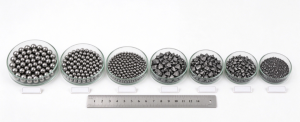
Media selection is a trade between removal rate, surface condition and contamination risk — no single grade wins on all three.
Stainless Shot Against the Alternatives
The comparison that decides most purchases is not stainless versus stainless. It is stainless against carbon steel shot, carbon steel grit and single-use mineral media. Each is a legitimate choice under different conditions.
| Criterion | Stainless shot 195/201/304/430 | Cast steel shot S70–S930 | Cast steel grit G12–G120 |
|---|---|---|---|
| Hardness | 32–50 HRC | 40–50 HRC or 55–65 HRC | GP 42–52, GL 53–60, GH 60–64 HRC |
| Particle shape | Spherical (atomized) | Spherical | Angular (crushed) |
| Density / bulk density | 7.8 / 4.5 g/cm³ | 7.8 / 4.5–4.8 g/cm³ | 7.6 min. / 4.2 g/cm³ |
| Stated cycle life | 6,500 cycles (supplier designation) | 1,000+ cycles | 2,000–2,500 fatigue life |
| Iron transfer risk on non-ferrous parts | Addressed by design — stainless media throughout | Present — carbon steel debris can embed | Present — carbon steel debris can embed |
| Removal rate on heavy rust and mill scale | Lower | High | Highest |
Against single-use media, the operating economics instead favour recyclable steel abrasives generally. Supplier comparison data for recyclable steel shot and grit against silica sand, copper slag and low-quality cheap steel abrasives indicates roughly 50–70% lower total abrasive consumption, around 30% faster cleaning speed, and 30–50% lower total cost of ownership, driven by recyclability, reduced dust-collector maintenance and fewer abrasive changeovers. Those figures describe the recyclable-versus-disposable comparison as a category, not a stainless-versus-carbon comparison, and should be read that way.
The reliability argument is similar in nature: consistent surface roughness with 15–20% less quality fluctuation batch to batch, compared with alternatives. For a buyer running an automated line, batch-to-batch consistency often matters more than peak performance, because it determines whether the coating specification holds on every part rather than on the best parts.
Limitations and Where This Series Is the Wrong Choice
A capability assessment that lists only advantages is not usable for procurement. Four boundaries are material here.
Hardness is deliberately moderate. At 32–50 HRC the series sits below cast steel shot at 40–50 or 55–65 HRC and well below cast steel grit at GP 42–52 up to GH 60–64 HRC. On thick mill scale, heavy rust, foundry sand burn-on or forge scale, a stainless series will require longer cycle times or simply will not achieve the required cleanliness. For aggressive stripping, angular carbon steel grit remains the appropriate tool.
The size band is fine to medium. A documented 0.1–1.0 mm particle range suits thin sections, precision parts and finishing work. It is not the range for generating a deep anchor profile on heavy plate, where coarser media are specified.
Unit cost is higher and the economics depend on recovery. The case for any recyclable media assumes a functioning recovery and separation system. In a manual booth with poor media recovery, the consumption advantage that justifies the price premium never materialises.
Grade selection carries downstream risk. 195, 201, 304 and 430 are not interchangeable across all processes. Where the workpiece will subsequently be welded, passivated or coated to a corrosion-critical specification, the grade's behaviour must be validated against that process — including magnetic response where it is relevant to the part or the handling equipment — before the grade is written into a production specification.
Market Context: Why Stainless Media Is Getting More Attention
The commercial backdrop supports the shift toward more specific media selection. The global metal abrasives market was valued at USD 6.7 billion in 2025 and is projected at USD 7.1 billion in 2026, according to Grand View Research. Steel abrasives accounted for 89.9% of the material segment in 2025, and Asia Pacific held 56.0% of global revenue — a concentration that explains why so much abrasive sourcing runs through Chinese manufacturing clusters.
The steel shot sub-segment alone was valued at USD 1.664 billion in 2025 with a projected path to USD 2.5 billion by 2035, on global consumption of 6.8 million metric tons in 2025. Within a market of that scale, stainless media remains a small, specification-driven niche. It grows not with bulk blasting volumes but with the volume of aluminium, stainless and titanium components entering coating, welding and passivation processes that will not tolerate iron contamination.
What Buyers Should Expect Next
Two developments are likely to shape this category. The first is documentation standardisation: as more non-ferrous and titanium work enters serial production, buyers will increasingly specify stainless media by grade and by test method rather than by the phrase "stainless steel shot". Suppliers who can issue grade-level certificates and fatigue data per batch will be easier to qualify than those who cannot.
The second is process discipline inside the buyer's own plant. Iron-free blasting is a system property, not a product property. A correct grade run through a machine that previously held carbon steel shot, or stored in open conditions, will not deliver the result the specification intended. Buyers who treat media segregation, dry storage and separator maintenance as part of the specification will get more value from stainless media than those who treat it as a purchasing decision alone.
Frequently Asked Questions
What does "iron-free" actually mean when the media is stainless steel?
It refers to the blasting result, not to an iron-free chemistry. Stainless steel is an iron-based alloy, so the meaningful claim is that blasting does not transfer foreign iron to the workpiece. The requirement is that aluminium alloy, stainless steel and titanium alloy parts emerge from blasting without embedded iron particles or free iron on the surface that would interfere with coating, welding or passivation.
How should a buyer choose between the 195, 201, 304 and 430 designations?
The choice is driven by the corrosion requirement of the workpiece and by downstream processing, not by price alone. 195 and 201 sit at the cost-oriented end of the series, 304 is the reference austenitic designation typically selected where post-blast corrosion resistance is specified, and 430 is a distinct ferritic designation whose magnetic response and process compatibility should be validated before standardisation. Request the chemical composition certificate for the specific grade and confirm it against the part being blasted.
Can stainless steel shot replace cast steel shot for heavy rust and mill scale removal?
Generally no. The series is documented at 32–50 HRC, while cast steel shot is supplied at 40–50 HRC or 55–65 HRC and cast steel grit from GP 42–52 up to GH 60–64 HRC. Angular carbon steel grit remains the appropriate choice for aggressive stripping of thick scale, heavy rust and foundry sand burn-on. Stainless media are specified for cleaning and finishing operations where contamination control governs the result.
How can a buyer verify that blasting left no iron on the workpiece?
Verification has to be done on the actual part under production conditions, not inferred from the media datasheet. The practical approach is to blast representative coupons of the same alloy and inspect them with a recognised iron-contamination check used in surface-preparation quality control, then repeat the check after any change of grade, machine or separator setting. Because media can pick up ferrous debris from shared equipment, the test should reflect the machine as it is actually configured, not a laboratory setup.
What documentation should accompany a stainless steel shot quotation?
A quotation for a defined product should reference the specific designation, the hardness range within the 32–50 HRC band, the particle size band, tensile strength, density and bulk density, and the stated service life. Alongside it, buyers should request a batch chemical composition report, a hardness test report, a fatigue life record, size distribution data, ISO9001 certification, and confirmation that stainless production and packing are segregated from carbon steel lines.
How is a new grade validated before a bulk order?
Sampling is the standard route. Suppliers in this category typically provide 1–5 kg free samples for testing on the buyer's own blasting equipment, with the buyer covering international courier freight — commonly USD 30–80 depending on destination — via carriers such as DHL, FedEx or TNT. Samples can be matched to the required size, hardness and material grade, and testing two or three grades against the actual workpiece is more informative than testing one grade in isolation.
How does total cost compare with single-use abrasives?
Recyclable steel abrasives carry a higher unit price than silica sand but a lower total cost of ownership, because the media are recovered and reused rather than discarded after one pass. Supplier comparison data for recyclable steel shot and grit indicates 50–70% lower total abrasive consumption, around 30% faster cleaning speed and 30–50% lower total cost of ownership, with savings coming from reduced material purchase, fewer refills, lower waste disposal, less dust-collector filter replacement and consistent quality that reduces rework. Those figures apply to the recyclable-versus-disposable comparison and depend on the machine having effective recovery and separation.
What are typical ordering quantities and lead times?
For this supplier, the minimum order is 1 ton for standard grades and 3 tons for customised grades. Ready stock orders ship within 7–15 days and customised orders within 20–30 days. Payment terms are T/T with 30% deposit and 70% before shipment, or irrevocable L/C at sight, with flexible terms available for long-term distributors.
The full product and specification range for Huiteng Metal Abrasives, including the stainless steel shot series 195/201/304/430, is available in the company's downloadable catalogue.
Download the Huiteng Metal Abrasives product catalogue (PDF)
هل لديك أسئلة أو تحتاج إلى مزيد من التفاصيل؟
تواصل مع فريقنا للحصول على عرض أسعار مخصص أو استشارة فورية.
طلب عرض أسعار
املأ النموذج أدناه وسيتواصل معك فريقنا بعرض مقترح مخصص.
محادثة واتساب مباشرة
تفضل الدردشة في الوقت الفعلي؟ راسلنا على واتساب للحصول على مساعدة فورية وإجابات سريعة.
- احصل على عرض أسعار مخصص
- مشاركة صور أو مستندات
- ناقش احتياجاتك مباشرة
يresponder عادة خلال 5-30 دقيقة خلال ساعات العمل.