
Supplier Capability Evidence: The Rebar Coupler Machine Ecosystem
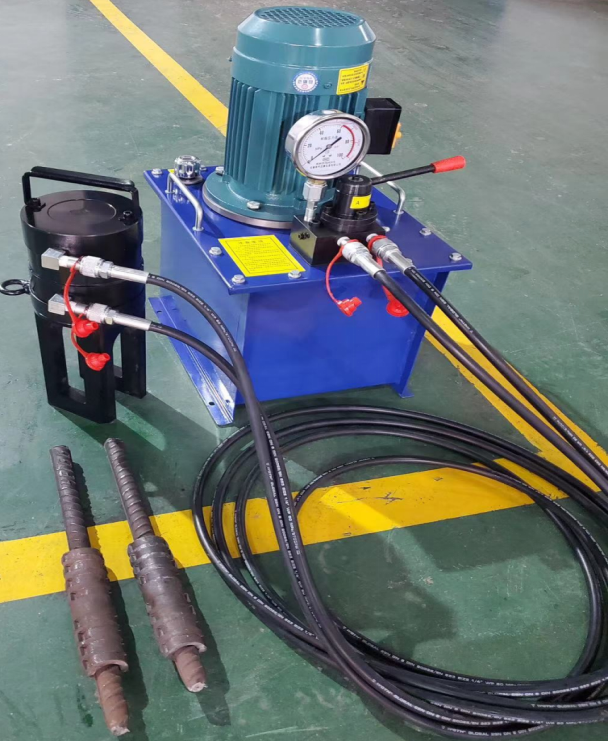
Rebar Coupler Pressing Machine CBT32, listed for 16–32 mm rebar with a 4 kW main motor and 50 T clamp tension. Image: Cangzhou Bartech product data.
A rebar coupler catalogue shows the finished sleeve. A machine list shows the production envelope behind it. For buyers evaluating a supplier for large reinforcement projects, the second view is often more useful: it reveals bar-size range, equipment footprint, power requirements, tooling logic and where a specific coupler family, such as the Cold Extrusion Rebar Coupler, actually fits.
Cangzhou Bartech Construction Material Co., Ltd. is a China-based manufacturer and supplier of rebar couplers and rebar processing machines, located in Qing County, Cangzhou City, Hebei Province. Its supplied product and company data describe couplers, threading machines, upsetting machines, thread cutting machines, cold pressing machines and electric torque wrenches. This article uses that machine ecosystem as supplier capability evidence, with a focused look at the cold extrusion / cold pressing coupler route.
Why machine evidence matters in rebar coupler procurement
Mechanical rebar connection is not a single-product purchase. The coupler must match the bar schedule, the bar-end preparation method and the installation method. A parallel thread coupler depends on threading equipment. An upset forged coupler depends on upsetting and thread cutting. A cold extrusion or cold pressing coupler depends on pressing equipment and the correct coupler dimensions. When a buyer reviews only the coupler price and a generic certificate, the production route remains unclear.
Machine data gives buyers a second layer of evidence. It shows whether the supplier lists equipment for the relevant bar range, whether the equipment power supply matches the project location, how much floor space the line may need, and whether the coupler family is supported by a documented machine model rather than a general claim. This is especially relevant for high-rise building work, high railway projects, airport work and large bridge construction, where coupler supply must be repeatable across many batches.
The limitation is equally important: a machine list is not a certificate. It does not prove that a specific coupler passed a project test, nor does it confirm CE, ISO 9001, ASTM or BS approval. It is production evidence that should be read together with material records, dimensional checks, test reports and certificate verification.
Brand context: what the supplier profile adds
According to the supplied company profile, Cangzhou Bartech was founded in 2008 and operates a 1,000 m² factory with 30 employees, including 10 engineers. The company reports an annual output of 3,600,000 NOS and a 100% export ratio, with markets in Asia, the Middle East and South America, including Vietnam, Malaysia, Kuwait, Qatar, UAE, Saudi Arabia and Mexico. These are company-reported figures, not independently audited capacity data.
The product scope covers rebar couplers, rebar threading machines, rebar electric wrenches, rebar upsetting machines, rebar thread cutting machines, rebar cold pressing machines, one-touch rebar couplers, rebar thread caps and rebar thread rolling machines. The company also states that it offers parallel thread rolling, parallel thread upsetting and cold pressing technologies for mechanical rebar connections. For buyers, that scope matters because it links coupler families to the machines that prepare the bar ends.
The machine ecosystem: models and specifications
The machine list is best read as a production map. It shows which equipment is intended for threading, upsetting, thread cutting and pressing, and it gives buyers concrete specifications to compare with the project bar schedule. The 40AO and 40MO models are threading machines. The 36S and 50S are upsetting machines. The MQ40 is a thread cutting machine. The CBT32 is a pressing machine. The BOC 8-42 and BOC 8-32 are electric torque wrenches.
| Machine | Model | Role in the coupler ecosystem | Key supplied specifications |
|---|---|---|---|
| Rebar AUTO Threading Machine | 40AO | Thread rolling / parallel thread preparation | 16–40 mm rebar; 5.5 kW or 7.5 kW; 380 V / 50 Hz; 1950 × 700 × 1120 mm; net weight 860 kg; max threading length 90 mm with block or 150 mm without block |
| Rebar Threading Machine quick type | 40MO | Quick threading for parallel thread couplers | 16–40 mm rebar; 5.5 kW at 1450 r/min; 380 V / 50 Hz; 1820 × 815 × 1100 mm; net weight 680 kg; max threading length 95 mm, or 150 mm without block |
| Rebar Threading Machine | CBT40A | Thread rolling | 16–40 mm rebar; 5.5 kW; 380 V / 50 Hz; 1180 × 670 × 1150 mm, packing 1300 × 790 × 1340 mm; net weight 590 kg; max threading length 120 mm |
| Rebar Threading Machine | CBT40L | Thread rolling for longer thread lengths | 16–40 mm rebar; 5.5 kW; 380 V / 50 Hz; 1210 × 610 × 1120 mm; net weight 420 kg; max threading length 100 mm or 200 mm |
| Rebar Upsetting Machine Auto | 36S | Upset forged coupler preparation | 400 rebar 16–36 mm; 500 rebar 16–32 mm; 7.5 kW; 380 V / 50 Hz; max pressure 31.5 MPa; 1350 × 950 × 1750 mm; net weight 1000 kg |
| Rebar Upsetting Machine Auto | 50S | Upset forged coupler preparation for larger bars | 400 rebar 16–50 mm; 500 rebar 16–40 mm; 11 kW; 380 V / 50 Hz; max pressure 31.5 MPa; 1350 × 950 × 1750 mm; net weight 1200 kg |
| Rebar Thread Cutting Machine | MQ40 | Thread cutting after upsetting or for manual thread work | M14–M45; max thread length 100 mm; 5.5 kW at 1450 r/min; 380 V / 50 Hz or 415 V / 50 Hz; 1630 × 780 × 1100 mm |
| Rebar Coupler Pressing Machine | CBT32 | Cold pressing / cold extrusion coupler installation | 16–32 mm rebar; main motor 4 kW; clamp tension 50 T; 380 V / 50 Hz; max oil pump pressure 70 MPa; oil pump length 5 m; oil pump weight 60 kg; clamp weight 38 kg |
| Rebar Electric Torque Wrench | BOC 8-42 | Installation and fastening | 12–40 mm rebar, 16–32 coupler; max torque 400 N.m; 6.0 AH, 900 W, 21 V; 0–60 r/min; net weight 9.5 kg; battery 1.2 kg per piece |
Source: supplied product specification units. Specifications are model-specific and should be checked against the actual project bar schedule.
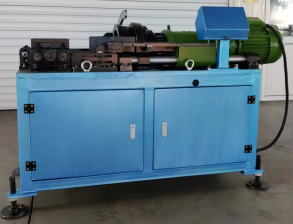
Rebar AUTO Threading Machine 40AO: 1950 × 700 × 1120 mm, 860 kg net weight, for 16–40 mm rebar. Image: Cangzhou Bartech product data.
Why 1950 × 700 × 1120 mm and 680 kg should not be read as one machine
A common procurement error is to combine figures from different equipment. In the supplied data, 1950 × 700 × 1120 mm belongs to the 40AO automatic threading machine, which lists 860 kg net weight. The 680 kg figure belongs to the 40MO quick-type threading machine, which lists 1820 × 815 × 1100 mm. Both figures are valid, but they describe different machines. Buyers preparing a factory layout or a site equipment plan should keep the model number attached to each dimension.
Cold Extrusion Rebar Coupler: what the product and machine data show
In the supplied product data, the cold extrusion family appears as the rebar pressing rebar coupler and is made from carbon steel Q355B. The coupler range covers φ16 to φ40, with outside diameter from 30 mm to 70 mm, length from 110 mm to 240 mm and wall thickness from 4.5 mm to 11.3 mm. This is a different material route from the rolling and upsetting couplers, which use carbon steel 45# and alloy steel 40CR in the supplied data.
| Rebar size | Outside diameter | Length | Thickness | Material |
|---|---|---|---|---|
| φ16 | 30 mm | 110 mm | 4.5 mm | Q355B |
| φ18 | 34 mm | 120 mm | 5.4 mm | Q355B |
| φ20 | 36 mm | 120 mm | 5.5 mm | Q355B |
| φ22 | 40 mm | 132 mm | 6.4 mm | Q355B |
| φ25 | 45 mm | 150 mm | 7.4 mm | Q355B |
| φ28 | 50 mm | 168 mm | 8.0 mm | Q355B |
| φ32 | 56 mm | 192 mm | 9.0 mm | Q355B |
| φ36 | 63.2 mm | 220 mm | 11.3 mm | Q355B |
| φ40 | 70 mm | 240 mm | 11.0 mm | Q355B |
The matching pressing machine in the supplied data is the CBT32, listed for 16–32 mm rebar, with a 4 kW main motor, 50 T clamp tension, 380 V / 50 Hz power supply and 70 MPa maximum oil pump pressure. This is the core evidence for a cold extrusion / cold pressing coupler line: the coupler dimensions, the material grade and the pressing equipment are all stated as model-level facts.
There is also a clear boundary. The cold pressing coupler range extends to φ40, but the CBT32 pressing machine is listed for 16–32 mm. For φ36 and φ40 cold pressing couplers, the buyer should confirm the pressing equipment, tooling and installation procedure before treating the standard CBT32 configuration as sufficient. This is a practical procurement check, not a criticism of the product range.
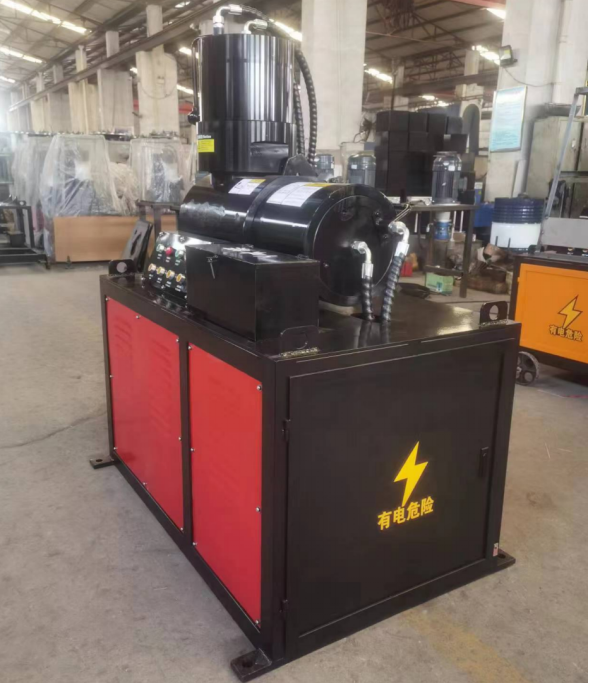
Rebar Upsetting Machine Auto 36S: 1350 × 950 × 1750 mm, 1000 kg net weight, 7.5 kW, for 400 rebar 16–36 mm and 500 rebar 16–32 mm. Image: Cangzhou Bartech product data.
How the machine set maps to coupler types
The machine ecosystem is not a single line for every coupler. It is a set of routes. Parallel Thread Rebar Couplers and Rolled Thread Rebar Couplers rely on threading machines such as the 40AO, 40MO, CBT40A and CBT40L. Upset Forged Rebar Couplers rely on upsetting machines such as the 36S and 50S, often followed by the MQ40 thread cutting machine. Cold Extrusion Rebar Couplers rely on the CBT32 pressing machine. Quick Connection Rebar Couplers and one-touch couplers are separate product families and should not be assumed to use the same installation equipment as cold pressing couplers.
| Coupler route | Supplied material data | Coupler data | Matching machine evidence | Buyer check |
|---|---|---|---|---|
| Rolled / parallel thread coupler | Carbon steel 45# and alloy steel 40CR | φ16–φ40; thread M16.5 × 2.5 to M40.2 × 3.0; 60° thread | 40AO, 40MO, CBT40A or CBT40L threading machines; 16–40 mm | Thread length, bar-end quality, threading machine model and tooling |
| Upset forged coupler | Carbon steel 45# and alloy steel 40CR | φ16–φ40; thread M20 × 2.5 to M45 × 4.0; 60° thread | 36S or 50S upsetting machine; MQ40 thread cutting machine | Upsetting range, thread cutting range and power supply |
| Cold extrusion / cold pressing coupler | Carbon steel Q355B | φ16–φ40; OD 30–70 mm; length 110–240 mm | CBT32 pressing machine for 16–32 mm rebar | Confirm tooling and procedure for φ36–φ40 |
| Installation | Not applicable | Coupler and bar assembly | BOC 8-42 or BOC 8-32 electric torque wrench | Torque value, socket range and battery system |
Application fit: where this machine evidence is relevant
The supplied application data lists tall buildings, high-rise construction, hotel and airport station work, high railway projects, bridge work and rebar threading factories. It also describes outdoor construction in tropical temperature and humidity, high-temperature dry climates, and continuous all-day operation. These are scenario conditions, not automatic approvals. They tell the buyer which questions to ask.
| Scenario | Relevant coupler and machine focus | Why the machine data matters | Documentation to request |
|---|---|---|---|
| Tall buildings and high-rise work | Parallel thread or cold pressing couplers; 40AO, 40MO, CBT40A, CBT40L or CBT32 | The bar schedule may mix sizes; machine range and floor layout affect site preparation | Material grade, coupler dimensions, machine model, test reports |
| High railway projects | Upset forged or parallel thread couplers; 36S, 50S, MQ40 and threading machines | Upsetting and thread cutting add process steps that need equipment capacity and power planning | Upsetting range, thread length, calibration and batch records |
| Large bridges and airport work | High-strength coupler families and installation tools | Large projects require repeatable supply and documented installation control | Project-specific test reports and certificate verification |
| Rebar threading factory | 40AO, 40MO, CBT40A or CBT40L for continuous pre-threading | Continuous operation places attention on machine durability, spare parts and maintenance | Spare-parts list, roller and cutter life data, service support |
| Outdoor tropical or high-humidity sites | Coupler families matched to the project specification | Site conditions affect handling and storage; documentation must match the project requirements | CE and ISO documentation where specified, plus material test reports |
The supplied application notes for tall buildings mention ISO and CE certificate requirements. The New Capital construction scenario in Egypt mentions outdoor high-temperature dry climate and CE and ISO documentation. These are project requirements, not proof that a specific certificate is held. Buyers should ask for the certificate number, issuing body, scope and validity for the actual product and factory.
Market trend: why machine-level evidence is becoming part of supplier review
According to Dataintelo, the global rebar coupler market was valued at USD 1.82 billion in 2025 and is projected to reach USD 3.47 billion by 2034. The same source reports that Asia Pacific represented 41.3% of global rebar coupler revenue in 2025. These figures describe market scale, not the capability of any single supplier.
For procurement teams, the implication is practical. A growing market can support more suppliers and more equipment options, but it also makes supplier screening more important. A buyer can use machine specifications to separate a trading description from a production description. The machine list does not replace a factory audit, but it provides a starting evidence set: model, bar range, power supply, dimensions, weight, motor power and pressing or threading capacity.
The standards picture is separate. ISO 15835-1:2018 specifies requirements for couplers used for mechanical splices of steel reinforcing bars. ISO 15835-2:2018 specifies test methods. ISO 15835-3:2018 specifies rules for certification and self-evaluation. The verified data pack also names ISO 15835, ASTM A615 and BS 8110 among standards associated with mechanical rebar splices. These standards define what should be checked; they do not by themselves certify a supplier or a product.
Comparison with traditional solutions and process boundaries
Traditional lap splicing avoids threading, upsetting or pressing equipment, but it can require longer lap lengths and may increase rebar congestion in some designs. Mechanical couplers can reduce those issues, but they introduce a different dependency: bar-end preparation, machine setup and installation control. The comparison is therefore not simply product versus product. It is a comparison of site logistics, equipment planning and inspection points.
| Decision area | Traditional lap splicing | Mechanical coupler route | What the buyer should verify |
|---|---|---|---|
| Bar-end preparation | No threading or pressing machine | Threading, upsetting, thread cutting or cold pressing depending on coupler type | Machine model, tooling, calibration and operator training |
| Equipment footprint | Lower equipment demand | 40AO 1950 × 700 × 1120 mm; 40MO 1820 × 815 × 1100 mm; 36S and 50S 1350 × 950 × 1750 mm | Site layout, lifting plan and power supply |
| Size coverage | Project-specific | Threading 16–40 mm; upsetting 16–36 mm or 16–50 mm depending on model; cold pressing coupler 16–40 mm but CBT32 press 16–32 mm | Bar schedule against machine range |
| Quality evidence | Inspection of lap length and placement | Coupler dimensions, material grade, machine records and test reports | Material test report, 10% production test and 100% appearance check as company-reported |
The main boundary is process dependence. A cold extrusion coupler is only as repeatable as the pressing setup. A parallel thread coupler depends on thread quality and bar-end preparation. An upset forged coupler adds upsetting and thread cutting steps. Buyers should match the coupler family to the machine evidence and to the project specification, rather than assuming that one machine list covers every coupler type.
Quality control and capacity evidence from the supplier data
The supplied capability data states a monthly capacity of 300,000 NOS, a lead time of 7–30 days based on quantity, and no order minimum quantity for stock couplers. It also states OEM customization for coupler outside diameter, inner diameter and thread. Quality control is described as material test report, 10% production test during production lines and 100% appearance surface checking. After-sales support is described as online technical support.
These are company-reported operational facts. They are useful for early supplier screening, but they should be verified through purchase-order documents, batch records, inspection reports and, where the project requires it, a factory audit. The Kuwait case in the supplied data describes a construction enterprise purchasing standard rebar couplers at 400,000 NOS per year for outdoor construction work, with reported results of higher strength, stable quality and good operation. That is a company-reported case, not an independently audited project reference.
Future outlook
As reinforcement projects become more documentation-heavy, machine-level evidence is likely to move from a nice-to-have to a normal part of supplier prequalification. Buyers will ask for model numbers, bar-size ranges, power requirements, footprint, tooling lists and calibration records. They will also ask how the machine route maps to the coupler route: threading for parallel thread couplers, upsetting and cutting for upset forged couplers, and pressing for cold extrusion couplers.
The market forecast supports continued investment in rebar connection technology, but growth does not remove the need for project-specific approval. The more useful trend is procedural: suppliers that can connect product data, machine data and test documentation will be easier to evaluate than suppliers that offer only a coupler catalogue. For cold extrusion couplers, the key evidence is the Q355B material data, the φ16–φ40 dimensional table and the CBT32 pressing machine specification, including the 16–32 mm machine boundary that must be checked for larger sizes.
FAQ
In the supplied data, the cold extrusion family is described as the rebar pressing rebar coupler and is made from carbon steel Q355B. The matching pressing machine is the CBT32, listed for 16–32 mm rebar, with a 4 kW main motor, 50 T clamp tension, 380 V / 50 Hz power supply and 70 MPa maximum oil pump pressure. The coupler itself is listed from φ16 to φ40, so sizes above 32 mm require confirmation of the pressing setup.
They refer to different machines. The 40AO automatic threading machine lists 1950 × 700 × 1120 mm and 860 kg net weight. The 40MO quick-type threading machine lists 1820 × 815 × 1100 mm and 680 kg net weight. Buyers should keep the model number attached to each specification when planning site layout or equipment selection.
No. The machine list is production evidence, not a certificate. ISO 15835-1:2018 specifies requirements, ISO 15835-2:2018 specifies test methods and ISO 15835-3:2018 specifies certification and self-evaluation rules. CE, ISO 9001, ASTM and BS documents should be verified separately for issuer, scope, product coverage and validity.
The supplied cold pressing coupler table covers φ16 to φ40, with outside diameter from 30 mm to 70 mm, length from 110 mm to 240 mm and thickness from 4.5 mm to 11.3 mm. The CBT32 pressing machine is listed for 16–32 mm rebar. For φ36 and φ40, the buyer should confirm the pressing machine, tooling and installation procedure before approval.
Machine footprint affects site layout, lifting and power planning. The 40AO is 1950 × 700 × 1120 mm, the 40MO is 1820 × 815 × 1100 mm, the 36S and 50S are 1350 × 950 × 1750 mm, and the MQ40 is 1630 × 780 × 1100 mm. Most listed machines use 380 V / 50 Hz power, with the MQ40 also listed for 415 V / 50 Hz.
The supplied company data reports an annual output of 3,600,000 NOS, a monthly capacity of 300,000 NOS and a lead time of 7–30 days based on quantity. Quality control is described as material test report, 10% production test during production lines and 100% appearance surface checking. These are company-reported figures and should be verified through order documents and inspection records.
The supplied application data lists tall buildings, high-rise construction, hotel and airport station work, high railway projects, bridge work and rebar threading factories. It also describes outdoor tropical, high-humidity and high-temperature dry conditions. Metro and tunnel work should be evaluated against the same bar-size, machine-range and test-report checks rather than assumed from a general project label.
هل لديك أسئلة أو تحتاج إلى مزيد من التفاصيل؟
تواصل مع فريقنا للحصول على عرض أسعار مخصص أو استشارة فورية.
طلب عرض أسعار
املأ النموذج أدناه وسيتواصل معك فريقنا بعرض مقترح مخصص.
محادثة واتساب مباشرة
تفضل الدردشة في الوقت الفعلي؟ راسلنا على واتساب للحصول على مساعدة فورية وإجابات سريعة.
- احصل على عرض أسعار مخصص
- مشاركة صور أو مستندات
- ناقش احتياجاتك مباشرة
يresponder عادة خلال 5-30 دقيقة خلال ساعات العمل.