
Supplier Capability Evidence: Topmodul Modular Medical Storage System
Supplier Capability Evidence: Topmodul Modular Medical Storage System

Supplier capability evidence is the part of a modular medical storage file that remains useful after the catalogue has been read. For a procurement team, the central question is not whether a supplier lists medical carts and shelving, but whether the supplier can connect factory processes, certificates, product models, OEM workflow and project references into a single verification trail.
Topmodul is the modular medical storage brand created by Tongde Medical Technology (Ganzhou) Co., Ltd., a manufacturer founded in 2003 and based in Ganzhou, Jiangxi, China. The company supplies modular medical carts, medical storage shelving, hospital storage systems and related products for medical institutions and distributors. This article is not a ranking and does not replace due diligence. It converts available supplier facts into a procurement evidence checklist for teams evaluating Topmodul as part of a shortlist.
Why Modular Medical Storage Buyers Need an Evidence Chain
Modular medical storage is often bought at the point where clinical workflow, infection control, space planning and capital budget meet. A hospital medication trolley, anesthesia cart, emergency crash cart or high-density shelving system is not a standalone item in that context. It becomes part of a replenishment route, a medication loop or a sterile storage zone. The supplier therefore has to be assessed on more than product appearance.
Market context supports that shift toward evidence-based buying. The global medical carts market size is estimated to reach US$4.83 billion in 2026, according to Horizon/Grand View Research. The European medical carts market is expected to grow at a CAGR of 15.8% from 2025 to 2030, based on the same commercial research source. Growth of that kind increases the number of suppliers claiming modular capability, which makes verification more important, not less.
There is also a technical reason. The ISO 60-40 modular system, often written as ISO 6040, allows an increase in storage capacity by up to 50% compared with traditional shelving, according to Pegasus Medical / MedicalExpo. That capacity advantage depends on disciplined tray configuration, shelving design and compatibility with the hospital's existing storage logic. A buyer cannot separate the claim from the configuration evidence.
Procurement implication: a modular medical storage supplier should be assessed through five evidence layers: legal entity, factory asset, quality-control process, certificate scope and OEM change control. Product models and project references then show how those layers connect to actual orders.
Topmodul Entity Snapshot
Topmodul is presented as an innovative modular storage brand for the medical industry, created by Tongde Medical, focusing on consumable management solutions for medical institutions. The manufacturer operates a 30,000-square-meter factory, employs more than 100 people and reports exports at 90% of its business. Its stated main markets include Western Europe, Eastern Europe and other regions, with named market experience in countries such as Germany, the UK, Spain, Italy, the Netherlands, Poland, Saudi Arabia and Israel.
| Evidence item | Available supplier fact | Why a procurement team should record it |
|---|---|---|
| Legal entity | Tongde Medical Technology (Ganzhou) Co., Ltd. | Matches certificates, quotations and contractual responsibility. |
| Brand | Topmodul | Connects product literature to the manufacturing entity. |
| Founded | 2003 | Indicates operating history; still needs current capability evidence. |
| Factory | 30,000 square meters; 100+ employees; 10+ R&D team members; 5 QC members | Supports questions on capacity, engineering support and inspection resources. |
| Main products | Modular medical carts, medical storage carts, anesthesia carts, emergency crash carts, nursing carts, high-density medical shelving, sterile storage wire shelving and related storage systems | Defines the product scope that certificates and samples must match. |
| Export profile | 90% export ratio; key markets include Europe and the Middle East | Suggests experience with export documentation, but does not replace project references. |
The Evidence Chain: Questions Procurement Teams Should Ask First
A supplier capability review becomes useful when it is converted into a sequence of questions. The order matters because a strong answer at the certificate stage can be undermined by a weak answer at the model-identification stage. The table below is a practical shortlist checklist for Topmodul or any comparable modular medical storage supplier.
| Checkpoint | Verification question | Evidence to request |
|---|---|---|
| 1. Entity and scope | Does the quotation name the same legal entity shown on the certificates and product documents? | Business licence, quotation header, certificate holder, product scope list. |
| 2. Factory asset | Which production steps are performed in the stated 30,000-square-meter factory? | Factory layout, line list, process flow, photos or audit evidence. |
| 3. Quality control | How are IQC, IPQC, FQC and OQC recorded for the proposed product family? | Inspection plan, sample records, non-conformance process, final inspection report. |
| 4. Certificate scope | Does the certificate explicitly cover the cart or shelving model being purchased? | Certificate and declaration of conformity with model list and expiry date. |
| 5. OEM change control | At which step are materials, colours, sizes and drawings formally approved? | OEM workflow, approved drawing, pre-production sample record, pre-delivery photo record. |
| 6. Project reference | Is there a comparable project by product type, quantity and duration? | Case summary, installed product family, duration, client type, not necessarily confidential client name. |
Factory Quality Control as a Verifiable Process
Topmodul states that quality is its top priority and that it uses a total quality management system. The company describes full-process inspection including IQC, IPQC, FQC and OQC. A QC team with five members performs inspections at each production stage and for every product before packing and shipment. Production quality control follows a 100% test process for medical cart and storage system production. The company also states that products are certified with CE and ISO9001.
For a procurement team, those statements are most useful when they are translated into evidence requests. IQC, IPQC, FQC and OQC are not interchangeable labels. IQC relates to incoming materials; IPQC relates to in-process checks; FQC relates to final product inspection; OQC relates to outbound inspection before shipment. A supplier that can show how these stages connect to a specific medical storage cart model is easier to audit than a supplier that only presents a certificate.
| QC stage | What it should prove | Buyer question |
|---|---|---|
| IQC | Incoming materials meet specification before production. | Which material batches are checked, and how are non-conforming materials isolated? |
| IPQC | In-process dimensions, assembly or surface quality remain within tolerance. | Which checkpoints are recorded per batch or per line? |
| FQC | Finished carts or shelving meet the approved configuration. | Does the final check include drawer, tray, lock, wheel or shelving accessory verification? |
| OQC | Outbound goods match the order before packing and shipment. | Can pre-shipment photos and packing records be linked to the order? |
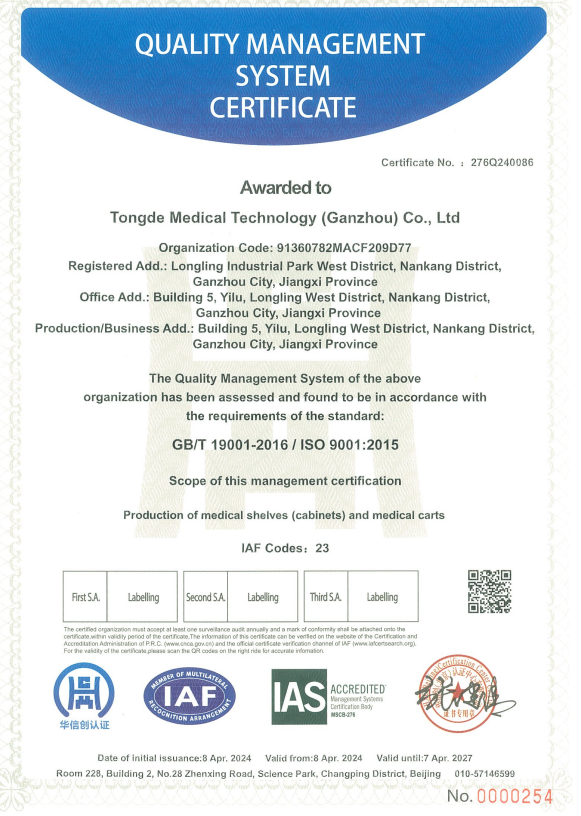
The ISO 9001:2015 certificate adds a formal quality management reference. The certificate shown for Tongde Medical Technology (Ganzhou) Co., Ltd. is numbered 276Q240086, issued by Huaxinchuang (Beijing) Certification Center Co., Ltd., with an issue date of 2024-04-08 and an expiry date of 2027-04-07. Its stated scope is production of medical shelves (cabinets) and medical carts. That scope is relevant to modular medical storage, but it remains a management-system certificate rather than a model-by-model product approval.
OEM Collaboration: The Eight-Step Workflow as a Procurement Checklist
Topmodul states that it offers manufacturer, OEM and ODM services, including medical cart design and manufacturing, modular configuration, medical storage system integration and project-based solution support. The OEM workflow is described in eight steps. For buyers, this workflow is more useful as a control checklist than as a sales statement.
| Step | Stated OEM workflow | Procurement control point |
|---|---|---|
| 1 | Familiarise with all customer requirements, including regular off-the-shelf products or customised models. | Confirm the requirement document distinguishes standard models from custom work. |
| 2 | Provide a detailed quotation that clearly defines requirements. | Check that product model, accessories, quantity and documents are itemised. |
| 3 | Discuss further customer needs or concerns. | Record clinical workflow or storage constraints before design freeze. |
| 4 | Double-confirm the model number and proceed with material and size selection. | Verify model number against certificate scope and catalogue naming. |
| 5 | Both parties approve details and requirements, including materials, colours and sizes. | Keep written approval before mass production. |
| 6 | Begin production after receiving payment and confirming drawings. | Confirm that production release depends on approved drawings, not verbal instructions. |
| 7 | Provide customers with regular updates on the production process and progress. | Agree update frequency and responsible contact. |
| 8 | Take photos to check and confirm before delivery. | Use pre-delivery photos as an outbound evidence record. |
The stated commercial parameters are a monthly capacity of 20,000 units for medical cart and storage system production, a lead time of 30 to 45 days and a minimum order quantity of 100 units. These figures help a buyer frame a request, but they should not be applied to every configuration without confirmation. A customised high-density shelving project and a standard nursing cart order will not necessarily use the same line allocation, material route or inspection plan.
Mapping Evidence to T001, T002, T003 and High-Density Shelving
Product names matter in supplier evaluation because certificates, quotations and inspection records must refer to the same item. Topmodul's listed product range includes the anesthesia cart - T001, Emergency Crash Cart-T002, Nursing Cart T003, medical trolley T6020-2, high density medical storage shelving, sterile storage wire shelving, Alpha shelving for medicine storage with models TDAS60 and TDAS40, storage tray T604010AN and Roller Shutter Cabinet models TDC180UU-RS, TDC180EE-RS, TDC180UU-HD and TDC180EE-HD.
| Product family | Listed model or name | Evidence focus before shortlisting |
|---|---|---|
| Anesthesia cart | anesthesia cart - T001 | Confirm CE declaration model coverage, drawer configuration and cleaning instructions. |
| Emergency crash cart | Emergency Crash Cart-T002 | Confirm emergency-access configuration, accessory list and outbound inspection record. |
| Nursing cart | Nursing Cart T003 | Confirm nursing workflow fit, tray selection and model-level certificate reference. |
| High-density storage | High Density Medical Shelving; high density medical storage shelving | Confirm custom dimensions, load expectations, mobile or static configuration and installation scope. |
| Sterile storage | Sterile Storage Wire Shelving | Confirm cleaning method, environment suitability and custom height requirements. |
| Modular tray | Storage tray T604010AN | Confirm tray compatibility with the selected cart or shelving system. |
A buyer should not assume that every product family carries the same certificate coverage. The evidence file should map each quoted model to the correct certificate, declaration or scope statement. That mapping is especially important when a project mixes medical carts, modular trays and high-density shelving in one tender package.
Certification Scope: The Boundary That Shortlists Often Miss
Topmodul's certification evidence includes an ISO 9001:2015 quality management system certificate and CE-related medical device documentation. The details matter because CE documentation is not a single undifferentiated label. It can refer to a notification certificate, a declaration of conformity or a model list, and each document has its own scope.
| Document | Key details | Scope and buyer note |
|---|---|---|
| ISO 9001:2015 | Certificate no. 276Q240086; issued by Huaxinchuang (Beijing) Certification Center Co., Ltd.; issued 2024-04-08; expires 2027-04-07 | Scope: production of medical shelves (cabinets) and medical carts. Valid management-system evidence, not a product-model approval. |
| EU Medical Device Notification Certificate | CE (Medical Device); no. DE/CA20/00205020; authority REP Europe GmbH; issued 2024-11-26; standard Regulation (EU) 2017/745 (MDR) | Scope includes medical carts such as anesthesia cart, emergency crash cart, nursing cart and infusion cart. Confirm the exact quoted model. |
| EU Declaration of Conformity for medical carts | CE (Medical Device, MDR Class I); no. REP-MDR-20241108M1; issued 2024-11-08 | Covers Medical Cart models T001, T002, T003, T004, T005, T006, T007, T008, T009, T010 and T011. A model outside this list requires written confirmation. |
| EU Declaration of Conformity for cabinets and shelving | CE (Medical Device, MDR Class I); nos. REP-MDR-20250417TM01 and REP-MDR-20250417TM02; issued 2025-04-17; expires 2030-04-17 | Covers TM Cabinet, One Series Shelving and Alpha Series Shelving. High-density custom shelving still needs configuration-level confirmation. |
This is a real boundary in the supplier evidence file. The CE declaration for medical carts lists T001 through T011, while a separate declaration covers TM Cabinet, One Series Shelving and Alpha Series Shelving. The ISO 9001 scope covers production of medical shelves (cabinets) and medical carts. A procurement team should check the exact product, model and configuration against the document rather than treating CE or ISO 9001 as a blanket statement for every item in the catalogue.
Core Factory Advantages: Reading the Numbers Correctly
Topmodul describes a large production base of 30,000 square meters with multiple parallel modular production lines. The company cites flexible OEM and ODM services, strict full-process quality inspection, CE and ISO 9001:2015 certification, and modular storage characteristics such as high space utilisation, access, light weight and flexibility, easy cleaning and disinfection, and replaceable components. These are relevant advantages for hospital storage, but they are most useful when tied to a specific project requirement.
| Stated capability | What it can support | What should still be verified |
|---|---|---|
| 30,000-square-meter factory | Scale to support multi-product medical storage projects. | Line allocation for the quoted product family and current utilisation. |
| 100+ employees, including 10+ R&D and 5 QC | Engineering support and dedicated inspection resource. | Named contact roles for drawings, quality records and pre-shipment approval. |
| 5,000-square-meter warehouse | Storage and dispatch support for export orders. | Warehouse control, packing standard and stock policy for spare parts. |
| Monthly capacity of 20,000 units | Capacity planning for cart and storage system orders. | Capacity by model, because custom shelving and standard carts are not interchangeable. |
| Stated annual output of 300,000 sets | Company-level output indication. | Reconcile annual output with monthly capacity and product mix before using it in project planning. |
| 90% export ratio | Experience with export documentation and international buyers. | Country-specific references, packaging requirements and after-sales route. |
The capacity figures should be read as company statements that support a planning conversation. A procurement team comparing suppliers should ask for a product-family breakdown: how much of the monthly 20,000-unit capacity applies to T001, T002 or T003 carts, and how much applies to custom high-density shelving. That question is more useful than comparing headline capacity numbers alone.
Application and Project Evidence: How Reference Cases Should Be Used
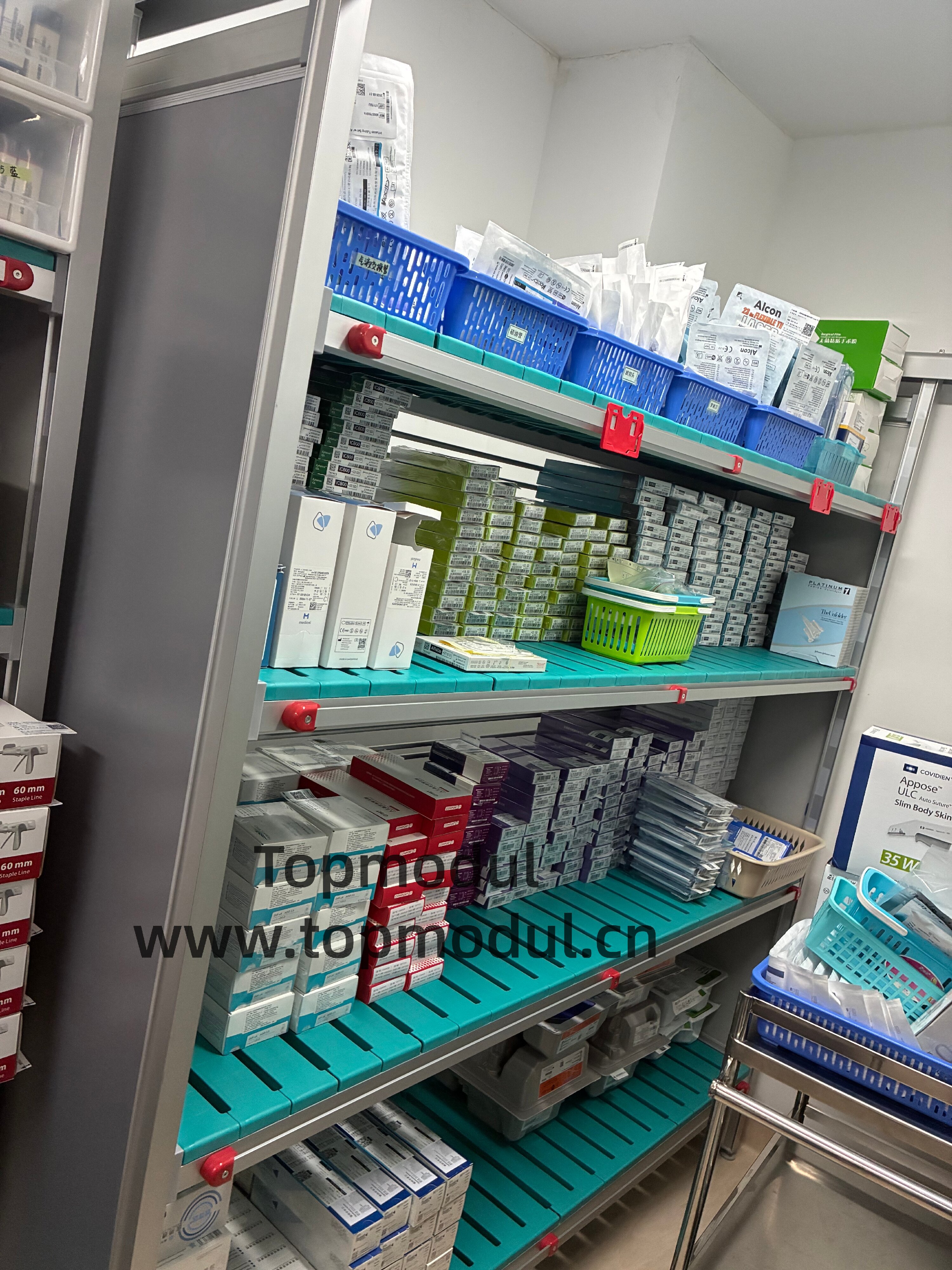
Project references can strengthen a shortlist when their scope is comparable. Topmodul's case material includes hospital and healthcare-centre projects in the UK, Israel, Saudi Arabia and Taiwan. Each reference should be read by product type, quantity and duration rather than as general proof of every product family.
| Reference | Project facts | Relevance to a buyer |
|---|---|---|
| UK hospital medicine storage | 100 medicine storage shelving units supplied to a single hospital client; in continuous service for 5 years; modular medicine storage system combines aluminium alloy struts and PC/ABS trays and supports staged expansion of storage capacity. | Useful for pharmacy or medicine storage projects that expect phased capacity growth. |
| Israel healthcare centre | 10 units of hospital high-density mobile shelving; 5-year project duration. | Relevant to smaller high-density mobile shelving deployments. |
| Saudi Arabia and global hospital storage | 50 high-density shelving units for hospital storage; 5-year duration. | Supports questions on high-density shelving in larger hospital storage areas. |
| Taiwan hospital carts | 100 units of medical storage and transport carts; project duration of 5 years. | Relevant to nursing, transport or departmental cart fleets. |
Case evidence does not automatically transfer to a new configuration. A hospital buying T001 anesthesia carts should ask for cart-specific references or inspection records, while a hospital buying custom high-density shelving should ask for shelving-specific installation evidence. The strongest reference is one that matches product family, scale, environment and operating duration.
Comparison with Traditional Solutions: Where the Evidence Is Stronger and Where It Is Not
Modular medical storage is often compared with traditional static shelving and fixed storage furniture. The strongest evidence-backed difference is capacity utilisation: the ISO 60-40 modular system allows an increase in storage capacity by up to 50% compared with traditional shelving, according to Pegasus Medical / MedicalExpo. That figure is relevant to hospitals trying to improve storage density without expanding floor space.
| Decision area | Traditional shelving or fixed storage | Modular medical storage evidence |
|---|---|---|
| Capacity use | Baseline fixed storage footprint. | ISO 60-40 modular system allows up to 50% more storage capacity than traditional shelving. |
| Configuration | Less adaptable after installation. | Modular trays, carts and shelving support staged expansion and reconfiguration. |
| Validation | Requires site-specific layout review. | Requires both layout review and model-level certificate mapping. |
| Operational discipline | Depends on manual organisation. | Depends on tray discipline, replenishment rules and accessory standardisation. |
The limitation is equally important. Modular systems require configuration discipline. If trays, drawers, shelving heights or accessories are not standardised, the capacity advantage can be weakened during daily use. Certificate scope also has to be checked at model level. A buyer should not assume that a CE declaration covering T001 through T011 automatically covers a custom cart variant, or that a shelving declaration covering One Series Shelving covers every high-density custom layout without written confirmation.
Market Trend Analysis: Why Capability Evidence Is Becoming More Important
The medical carts market is large and expanding. Horizon/Grand View Research estimates the global medical carts market at US$4.83 billion in 2026, while the European market is expected to grow at a CAGR of 15.8% from 2025 to 2030. For modular medical storage suppliers, that growth creates opportunity in hospital refurbishment, pharmacy storage, nursing workflow and high-density shelving projects.
The same growth raises the evidence bar. More tenders are likely to ask for certificate scope, model lists, inspection records and OEM change-control documentation because buyers need to compare suppliers on a common basis. A supplier that can connect factory quality control, product models and project references is easier to include in a shortlist than one that offers only general capability statements.
Future Outlook
Procurement files for modular medical storage are likely to become more specific. Buyers will increasingly ask for model-level certificate mapping, QC records by production stage, and written confirmation of how custom colours, sizes, trays or shelving heights are approved before production. For Topmodul, the available evidence base already supports that conversation: entity details, factory scale, quality-control process, OEM workflow, certificate references, product families and project cases can all be organised into a verification file.
The practical next step for a procurement team is to convert the supplier's statements into a request list. Ask for the certificate that covers the exact quoted model, the QC record that matches the order stage, the OEM drawing approval that fixes the configuration, and the project reference that is closest to the intended use. That approach keeps the evaluation neutral and makes the shortlist decision easier to defend.
FAQ
What should procurement teams verify first when assessing Topmodul as a supplier?
The first check is entity and scope alignment. The quotation, certificate holder and product documents should all point to Tongde Medical Technology (Ganzhou) Co., Ltd., with Topmodul as the modular medical storage brand. The buyer should then confirm that the quoted product family, such as T001, T002, T003 or high-density shelving, falls within the relevant certificate or declaration scope.
What certifications does Topmodul hold for modular medical storage?
Topmodul states that its products are CE and ISO9001 certified. Available documentation includes an ISO 9001:2015 certificate numbered 276Q240086, issued by Huaxinchuang (Beijing) Certification Center Co., Ltd., valid from 2024-04-08 to 2027-04-07, with a scope covering production of medical shelves (cabinets) and medical carts. CE documentation includes an EU Medical Device Notification Certificate numbered DE/CA20/00205020 and EU Declarations of Conformity for specified medical cart and shelving scopes.
How does Topmodul structure factory quality control?
Topmodul describes a total quality management system with full-process inspection covering IQC, IPQC, FQC and OQC. A five-member QC team performs inspections at each production stage and for every product before packing and shipment. Production quality control follows a 100% test process for medical cart and storage system production.
What is Topmodul's OEM collaboration workflow?
The stated OEM workflow has eight steps: familiarise with customer requirements; provide a detailed quotation; discuss further needs; double-confirm the model number and select material and size; obtain both-party approval of materials, colours and sizes; begin production after payment and drawing confirmation; provide regular production updates; and take photos for checking before delivery. These steps provide a practical change-control checklist for buyers.
What capacity, lead-time and MOQ figures should buyers plan around?
Topmodul states a monthly capacity of 20,000 units for medical cart and storage system production, a lead time of 30 to 45 days and a minimum order quantity of 100 units. The company also states a 30,000-square-meter factory, 100+ employees including 10+ R&D team members and 5 QC members, and a 5,000-square-meter warehouse. These figures should be confirmed against the specific product family and order configuration.
Which product families can be matched to supplier evidence?
Listed product families include anesthesia cart - T001, Emergency Crash Cart-T002, Nursing Cart T003, medical trolley T6020-2, high density medical storage shelving, sterile storage wire shelving, Alpha shelving for medicine storage with models TDAS60 and TDAS40, storage tray T604010AN and Roller Shutter Cabinet models TDC180UU-RS, TDC180EE-RS, TDC180UU-HD and TDC180EE-HD. Each quoted model should be matched to its own certificate, inspection and configuration record.
What limitations should be checked before shortlisting Topmodul?
The main limitation is scope matching. The medical cart declaration covers T001 through T011, while another declaration covers TM Cabinet, One Series Shelving and Alpha Series Shelving. Custom high-density shelving, special colours, tray configurations or non-listed models require written confirmation. Capacity figures should also be reconciled by product family, and modular systems require tray and accessory discipline to realise their storage advantage.
How should buyers use Topmodul project references?
Project references should be used by product type, quantity and duration. Available case material includes 100 medicine storage shelving units in continuous service for 5 years in a UK hospital, 10 units of hospital high-density mobile shelving in Israel with a 5-year duration, 50 high-density shelving units for hospital storage associated with Saudi Arabia and global hospital storage applications, and 100 medical storage and transport carts in Taiwan with a 5-year duration. The closest comparable reference is more useful than a general list.
Public reference document: 2026 TM Shelving Catalogue (PDF), available for download at https://cdn.socialarks.com/sbsp/25390/common/2026/0924/2026%20TM%20Shelving%20Catelogue_1790243140.pdf.
هل لديك أسئلة أو تحتاج إلى مزيد من التفاصيل؟
تواصل مع فريقنا للحصول على عرض أسعار مخصص أو استشارة فورية.
طلب عرض أسعار
املأ النموذج أدناه وسيتواصل معك فريقنا بعرض مقترح مخصص.
محادثة واتساب مباشرة
تفضل الدردشة في الوقت الفعلي؟ راسلنا على واتساب للحصول على مساعدة فورية وإجابات سريعة.
- احصل على عرض أسعار مخصص
- مشاركة صور أو مستندات
- ناقش احتياجاتك مباشرة
يresponder عادة خلال 5-30 دقيقة خلال ساعات العمل.