
Supplier Capability Evidence: Verifying Recycled Traceability
Supplier Capability Evidence: Verifying Recycled Traceability
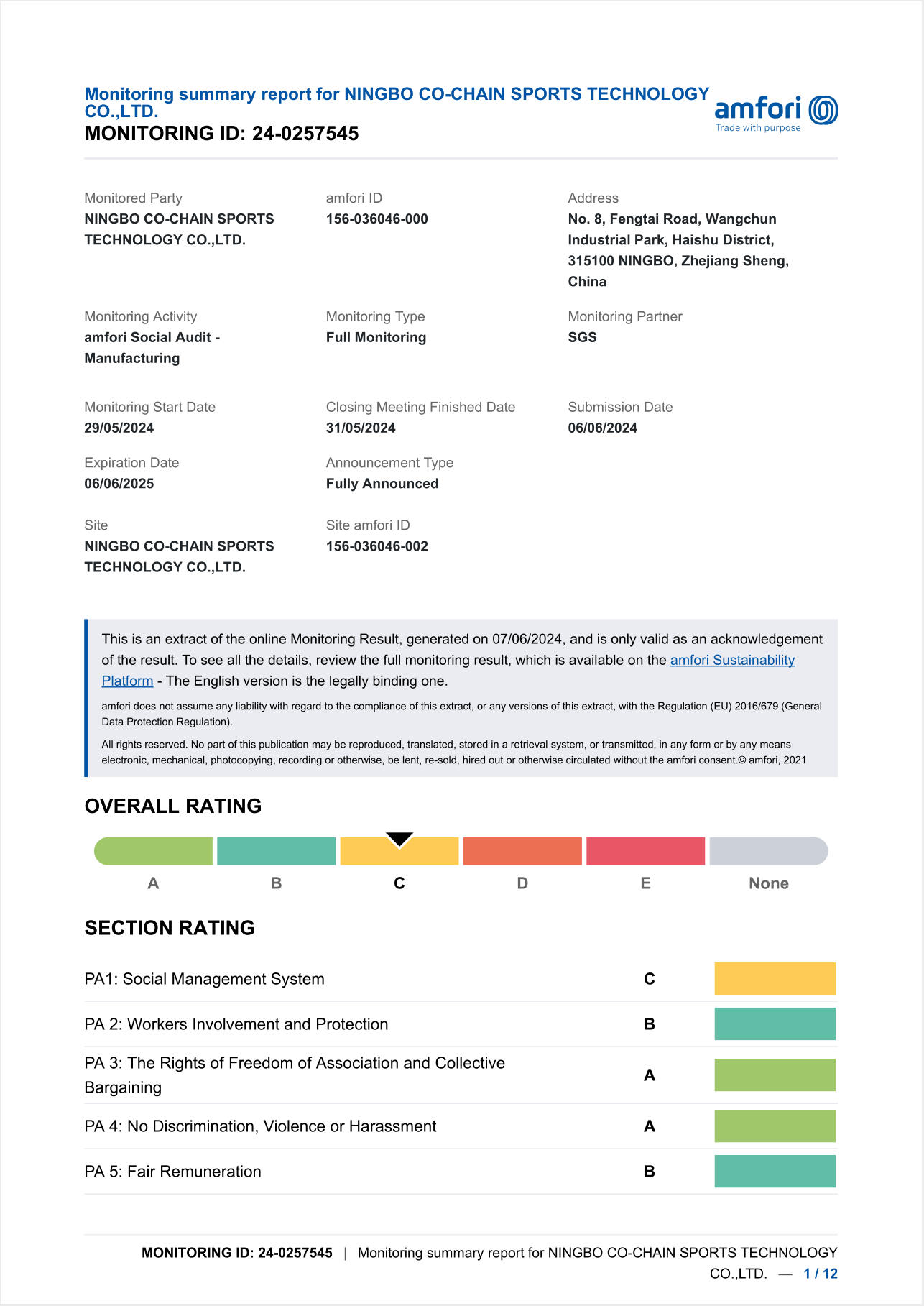
Factory-level evidence: BSCI social-compliance auditing addresses management and ethical production, not material content.
A recycled-content claim in activewear is a documentation question before it is a performance question. When a supplier presents a Global Recycled Standard certificate, what the buyer receives is evidence about recycled material sourcing, processing, labeling and supply-chain traceability for a defined scope. What the buyer does not receive is a test result for water repellency, abrasion resistance, pilling, shrinkage or restricted substances. Separating those two evidence types is the core discipline of supplier vetting in a category where a single style can carry half a dozen separate claims, and where the buyer, not the factory, carries the reputational cost of a claim that cannot be substantiated.
The distinction matters more as the category scales. Grand View Research valued the global activewear market at USD 440.4 billion in 2025, and McKinsey reported that 73% of athleisure adopters cite comfort as the primary reason for wearing active apparel outside exercise. Comfort-driven demand pushes development teams toward softness, stretch and recovery; procurement teams then have to prove both performance and material origin on the same garment. In activewear development, those two proofs come from different organisations and different documents.
Bellasports' supplied certificate records make a useful worked example because they contain both evidence types and because they are honest about dates. This analysis reads them as a capability-evidence file rather than as a marketing claim.
What the GRS documents in this file actually say
Bellasports holds two GRS certificates rather than one. Certificate CU1143477GRS-2023-00097318 is issued by Control Union Certifications and lists its market as the EU, USA, Australia and other global markets requiring sustainable certification. Certificate SGC-GRC02509-GRS-2023-11 is issued by SGS-CSTC Standards Technical Services Co., Ltd. under Global Recycled Standard Version 4.0, and lists its market as the EU, US, Middle East and global. Both records describe the same operational scope in identical terms: recycled material sourcing, processing, labeling, and supply chain traceability.
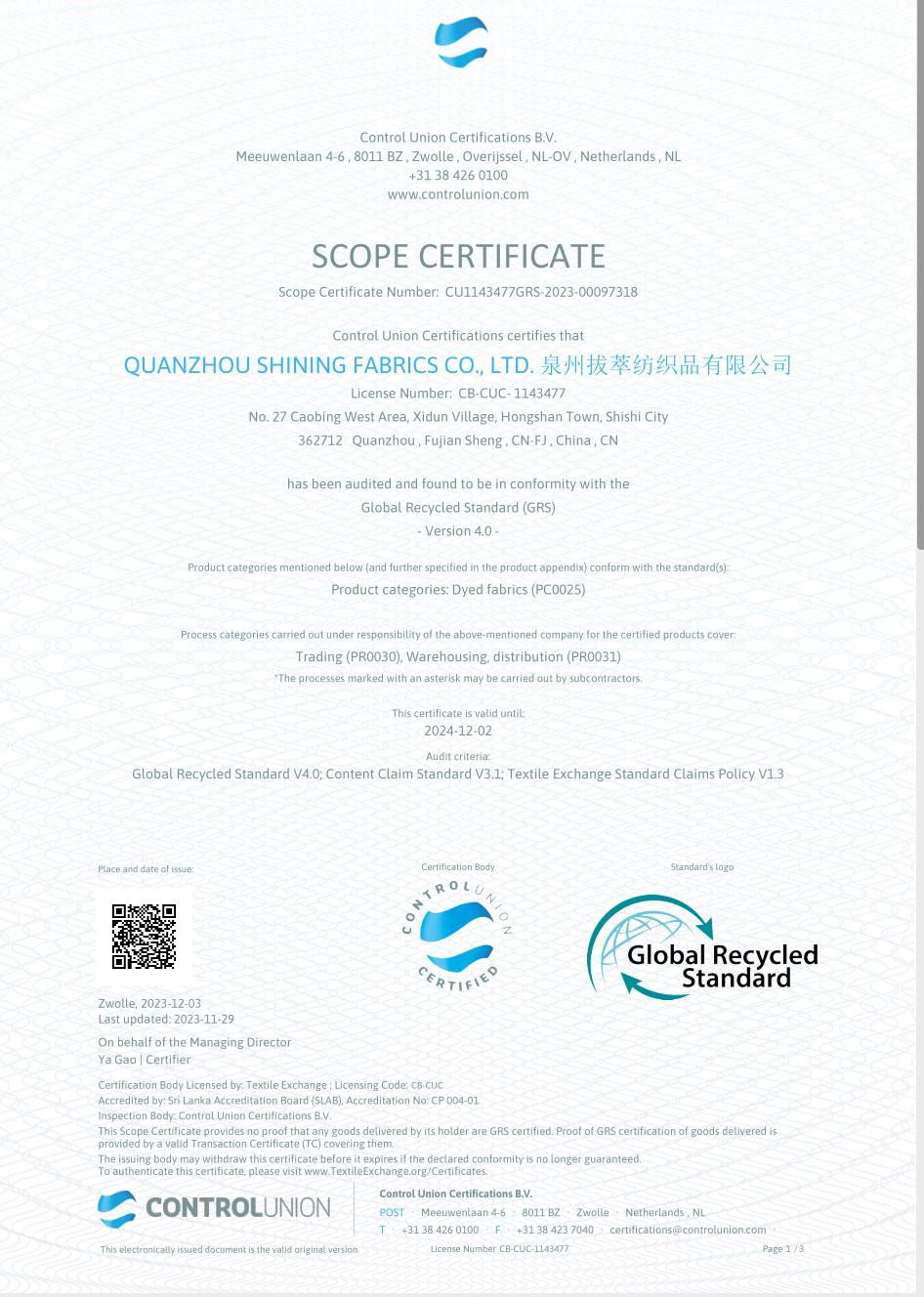
A GRS certificate documents sourcing, processing, labeling and chain of custody — not how the finished fabric performs.
| Document | Reference number | Issuer | Stated scope | Recorded issue | Recorded expiry |
|---|---|---|---|---|---|
| GRS | CU1143477GRS-2023-00097318 | Control Union Certifications | Recycled material sourcing, processing, labeling and supply chain traceability | 2023-12-03 | 2024-12-02 |
| GRS (Version 4.0) | SGC-GRC02509-GRS-2023-11 | SGS-CSTC Standards Technical Services Co., Ltd. | Recycled material sourcing, processing, labeling and supply chain traceability | 2023-11-20 | 2024-11-19 |
| BSCI | 24-0257545 | amfori | Full factory social compliance and ethical production audit | 2024-05-31 | Not recorded in the supplied record |
| OEKO-TEX Standard 100 | HKC 23756 | TESTEX | All textile materials and final products (fabrics, threads, accessories) | 2025-06-20 | 2026-06-30 |
Two certificate numbers from two certification bodies is a normal outcome for a manufacturer that buys recycled fabric from more than one mill, or that applies the standard at more than one site. It is not automatically double certification of the same scope. Each certificate has its own holder, site and product coverage, and the buyer's question is narrower than the supplier's headline: does the specific fabric going into this specific style sit inside one of these scopes, and is that scope current at the time of the purchase order?
The validity window is part of the evidence, not a footnote
Certificate numbers persist across the internet; validity windows do not. The supplied records state issue dates of 3 December 2023 and 20 November 2023, with recorded expiry dates of 2 December 2024 and 19 November 2024 respectively. At the time of publication, both recorded windows have closed. That does not erase the information in the file — it dates it. The identifiers, issuers and scopes remain traceable to named certification bodies, while current validity is a separate fact that has to be re-established before the document enters a buyer's compliance file.
The working method is straightforward and does not require specialist software. Check the certificate number and the certificate holder's legal name in the certifying body's own database rather than against a PDF on a supplier website. Then request the current scope certificate, together with the transaction or material records that link a specific shipment to that scope. A certificate held at company level answers a company-level question; a shipment still needs its own link in the chain.
The BSCI record carries a different dating problem. Certificate 24-0257545, issued by amfori on 31 May 2024, is supplied without a recorded expiry date. An empty expiry field is not evidence that an audit is current; it simply means the file has to be completed by requesting the audit report, its status and the exact legal entity and site that were audited.
Where traceability ends and testing begins
Traceability answers a chain-of-custody question: which recycled input, from which supplier, processed at which site, and how much of the finished item it represents. Performance answers a different question: how the finished fabric or garment behaves under a defined test method. The two are recorded by different organisations in different documents, and neither substitutes for the other.
For activewear, the performance side typically splits into at least five independent questions:
- Water repellency — decisive for running jackets and windbreakers, where a recycled shell can be fully documented while the finish remains unproven.
- Abrasion resistance — relevant to leggings, training wear and any style subjected to repeated friction at seams and the inner thigh.
- Pilling — a live risk on brushed fleece joggers and soft-faced knits, and a common source of returns.
- Dimensional change after washing (shrinkage) — applies to every knit in the range and is measured on the finished garment, not inferred from the yarn.
- Chemical safety and restricted substances — a separate conformity question for skin-contact apparel, governed by its own scheme and its own certificate.
Testing providers publish the method landscape buyers can draw on. Eurofins lists ISO 9237 for air permeability, AATCC 195 for liquid moisture management and ISO 20932 for elastic fabric stretch and recovery among its activewear testing services. Those references are useful for writing a test plan; they are method leads, not pass criteria, and they say nothing about how any particular fabric performed. A moisture-wicking or four-way stretch claim is only as strong as the report behind it, the sample identity on that report, and the acceptance criteria written into the tech pack.
Chemical safety sits in its own document family. Bellasports' supplied records include an OEKO-TEX Standard 100 certificate, HKC 23756, issued by TESTEX on 20 June 2025 with a recorded expiry of 30 June 2026, covering all textile materials and final products including fabrics, threads and accessories. It illustrates the structural point: a chemical-safety certificate is a separate instrument with a separate scope from GRS, and like the GRS records it carries a validity window that must be current when the claim is made.
Traceability by style: what to map, and what to test separately
The abstract distinction becomes concrete at style level. Each product family in an activewear range poses a different mapping problem, and the same recycled-content certificate will answer some of those questions and none of the others.
Yoga leggings
A four-way stretch legging is usually the simplest traceability case and the hardest performance case. The bill of materials may include a main knit, a waistband elastic, bonded tape or adhesive where the seam is bonded rather than sewn, and a care label. The recycled claim attaches to the components inside the certified scope, commonly the main knit. The buyer's first question is therefore which components are declared; the second is whether the declared recycled content is expressed against fabric weight or garment weight. Neither answer tells you whether the legging is opaque under load, whether the fabric recovers after repeated stretch, or whether it pills at the inner thigh. Those are style-specific tests on the approved fabric, run to an agreed method and accepted against criteria written into the tech pack.
Sports bras
Sports bras multiply the component problem. A single style can combine a shell fabric, a lining, an elastic band, removable pads and sling or spacer elements, and each is a separate material input with its own upstream supplier. Recycled-content evidence should list which of these sit inside the scope. Seamless and bonded constructions add engineering elements — bonding film, tape, adhesive — that are separate inputs again. Support level, stretch recovery and moisture handling are performance attributes that no GRS document addresses, and they should be approved on the finished construction, not on the fabric alone, because the same knit can behave differently once bonded or double-layered.
Tennis skirts with built-in shorts
The built-in short makes this a two-garment product in one style. The outer skirt and the inner short are usually different fabrics from different mills, so a single recycled-content statement is only useful if it maps to both layers. Colourfastness and light fastness — relevant to a garment used outdoors in bright conditions — are separate test questions, and the short's own stretch and recovery behaviour belongs to the inner fabric's report rather than to the skirt's. Buyers developing for tennis and pickleball should treat the two layers as two evidence lines from the first tech pack revision, not as a single line item.
Joggers and tracksuits
Joggers and tracksuits carry the widest bill of materials in the range: fleece or French terry body, rib cuffs, drawcord, zipper tape, pocket lining and trims. Recycled content is frequently declared for the body fabric only. That is a legitimate position, but the buyer should record it explicitly, because it determines how the product's recycled claim can be worded on the hangtag and in the buyer's own material disclosure. Pilling, shrinkage and colourfastness after repeated washing are the performance items that belong alongside, and they are measured on the finished garment rather than assumed from the fibre specification.
Running jackets and windbreakers
A running jacket is where traceability and performance are most often confused. A recycled polyester shell can be fully documented through the certificate chain while the jacket's water repellency, seam integrity and breathability remain entirely unproven. Water repellency is a finish-level property tested on the finished fabric; air permeability and moisture-vapour transmission are separate measurements with separate methods. Where the jacket uses a bonded or laminated construction, each layer is a separate material input for the recycled-content question. A supplier that can produce both a GRS certificate and a water-repellency report is providing two different kinds of assurance, and the buyer should file them as two documents rather than one.
Factory-level social compliance: what BSCI adds
Certificate 24-0257545 is an amfori BSCI record covering full factory social compliance and ethical production audit, issued on 31 May 2024 and listed as applicable to global markets. It sits at a different level from GRS: it speaks to how a factory is managed and audited against a code of conduct, not to what a fabric contains or how a garment performs. The two documents answer questions that a buying team should keep apart, because a strong social audit can coexist with a fabric that fails a pilling test, and a well-documented recycled fabric can come from a site with no current social audit at all.
For the buyer, the operative question is entity and site matching. Bellasports describes a Xiamen office and a production facility, CO-CHAIN, in Ningbo, Zhejiang. An audit certificate is meaningful only when the audited site is the site that will actually run the order, and when the certificate holder's legal name matches the contracting entity. The supplier file should therefore hold the audit report, the audited entity name and address, and the current status of that audit — not only the certificate number.
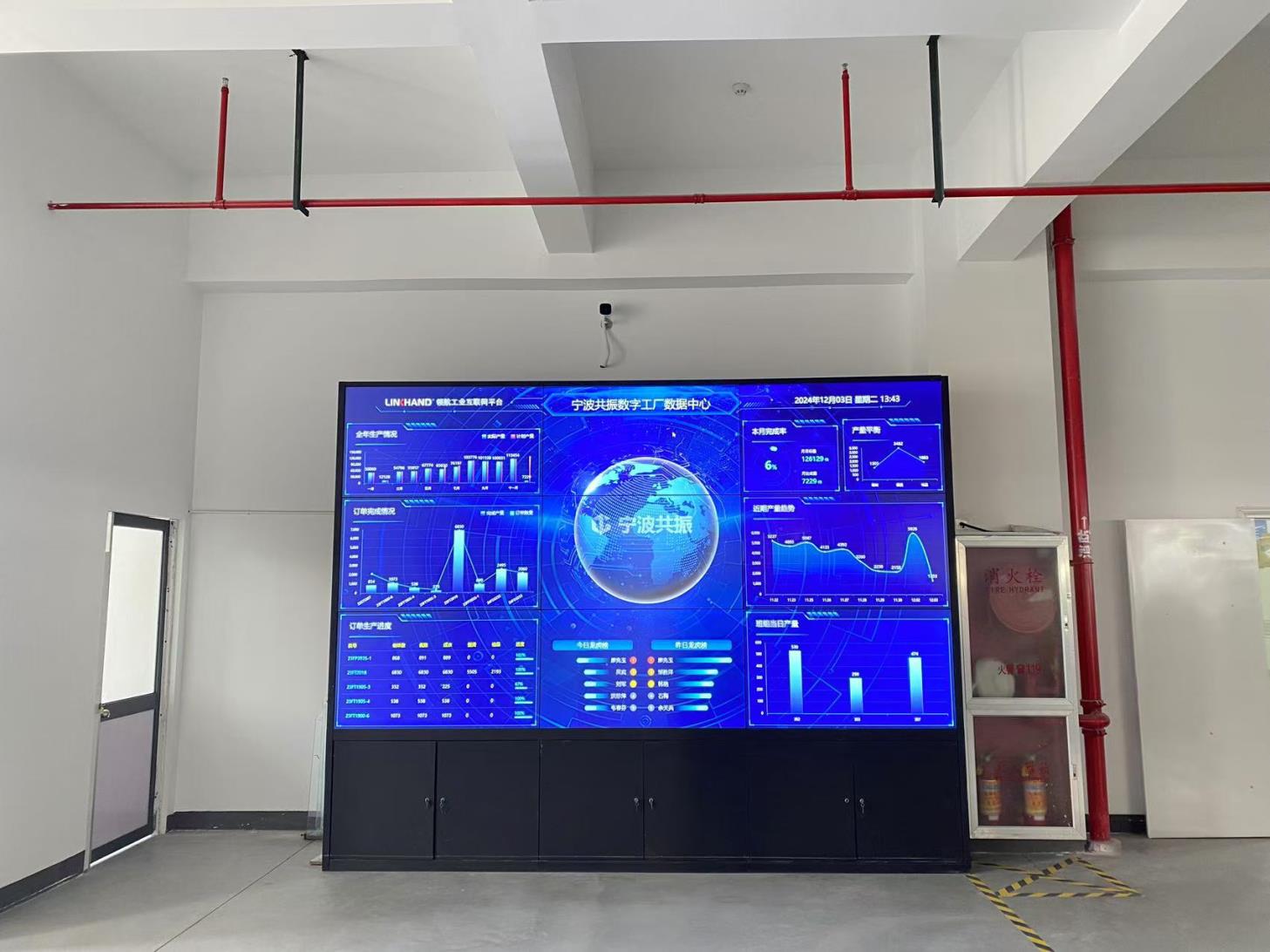
Production records support batch-level traceability only when they are linked to a specific certified input and style.
A capability-evidence checklist for supplier vetting
The checklist below converts the discussion into a file structure. It is deliberately document-by-document: each row answers one question and explicitly refuses to answer another, which is what stops a certificate from being quietly stretched into a performance claim.
| Evidence in the file | Question it answers | Question it does not answer | Verification step |
|---|---|---|---|
| GRS scope certificate (e.g. CU1143477GRS-2023-00097318, SGC-GRC02509-GRS-2023-11) | Which recycled inputs, processes and sites are inside the certified scope | Whether the fabric performs; whether the certificate is currently valid | Check number and holder in the certifier's database; confirm current issue and expiry dates and product scope |
| Transaction or material records per shipment | That the specific lot shipped is linked to the certified supply chain | Product quality or delivery reliability | Match lot, style reference and supplier invoice to the certified scope |
| Performance test reports (water repellency, abrasion, pilling, shrinkage, stretch and recovery) | Behaviour of the approved fabric or garment under a stated method and condition | Material origin or social compliance | Confirm laboratory, method, sample identity and report date; compare with tech-pack criteria |
| Chemical-safety certificate (e.g. OEKO-TEX Standard 100, HKC 23756) | Conformity of tested materials to the scheme's restricted-substance criteria | Performance, material origin or social compliance | Confirm scope, tested article range and current validity |
| Social-compliance audit (e.g. BSCI 24-0257545) | Audit status of the named site against a code of conduct | Quality, capacity, material content or delivery performance | Confirm audited legal entity, site address and current status |
| Tech pack, approved sample and inspection record | What was specified and approved, and whether bulk matched it (in-line and final random inspection to AQL standard) | Whether the specification itself was adequate for the end use | Compare bulk against the approved sample; retain the inspection report |
Reading Bellasports' supplied evidence as a file
Bellasports (Xiamen Bella Fitness Co., Ltd.) is an activewear OEM/ODM manufacturer with its own factory, CO-CHAIN, in Ningbo, Zhejiang, and manufacturing coverage across golf, tennis, yoga, gym, running, hiking and lifestyle apparel. Its stated development capability includes in-house fabric development, bonded construction, and FMS-controlled production lines with in-line inspection and final random inspection to AQL standard before shipment. For a buyer, that description is a hypothesis about capability rather than proof of it: each element becomes a checklist line, and each line needs a document behind it.
The supplied case records show the process pattern a buyer would expect behind that description. A brand-collaboration client in the USA and Europe is described as receiving sustainable material integration with a sampling turnaround of about 25 days. A retail chain partner in southern UAE is described as an in-store exclusive line built on customized fabric development, with a 90-day design-to-delivery cycle. A direct-to-consumer seller in the UK and Germany is described as running seasonal fast-fashion drops on flexible small-batch production with sample approval inside 25 days. An Australian brand is described as a joint fabric-development programme with co-developed fabric technology and ESG-aligned production. These are company-reported highlights. They are useful as process evidence — they show that sampling, custom fabric development and repeat seasonal ordering are routine — but a phrase such as sustainable material integration is not itself a traceability document. To enter a compliance file it has to be tied to a named certificate, a named fabric and a named style.
Two further items belong in the same spirit of honest reading. First, Bellasports' published capacity statements are not identical across its own pages, so capacity should be treated as a claim to be reconciled with the factory before it is used in a production plan rather than as a settled input. Second, a reference in the case material to ESG-aligned production is a narrative description, not a certificate; it belongs in the supplier profile, not in the compliance folder.
What changes next for buyers
Recycled content is moving from a marketing line to a reporting line. As brands publish their own material disclosures, a supplier's certificate number stops being a badge on a website and becomes an entry in a chain that has to hold together: certificate, scope, transaction record, style, shipment. The manufacturers that will find this easiest are those that already run document control at fabric level, where the same system that tracks a bonded seam and an AQL inspection also tracks which recycled input went into which style.
A practical expectation for the next sourcing cycle is that buyers will request the certificate and the transaction record in the same message, and will test the certificate's current status before the first sample is approved rather than before the first shipment. That is a cheaper order of operations. A lapsed window, or a scope that excludes the actual fabric, costs a few days to discover at sampling and considerably more at pre-shipment inspection.
FAQ
What does a GRS certificate actually certify?
A GRS certificate certifies the recycled-material chain for the products and sites named in its scope: recycled material sourcing, processing, labeling and supply-chain traceability under the Global Recycled Standard. Bellasports' supplied records describe exactly that scope under certificate numbers CU1143477GRS-2023-00097318, issued by Control Union Certifications, and SGC-GRC02509-GRS-2023-11, issued by SGS-CSTC Standards Technical Services Co., Ltd. under Version 4.0. It does not certify fabric performance such as water repellency, abrasion resistance, pilling or shrinkage, which require separate test reports.
How do I check whether a GRS certificate is still valid?
Check the certificate number and the holder's legal name in the certifying body's own database, then confirm the issue and expiry dates on the current document. The supplied Bellasports records show issue dates in November and December 2023, with recorded expiry dates of 19 November 2024 and 2 December 2024 respectively, so current status has to be re-established rather than assumed from the number. The certificate's scope should also be checked against the specific fabric and the specific production site being purchased.
Which performance claims does recycled-content certification not cover?
Recycled-content certification says nothing about water repellency, abrasion resistance, pilling, dimensional change after washing, colourfastness or chemical safety. Each is a separate test with its own method and acceptance criteria. Testing providers such as Eurofins list methods including ISO 9237 for air permeability, AATCC 195 for liquid moisture management and ISO 20932 for elastic stretch and recovery among activewear testing services; these are references for building a test plan, not results for any specific fabric.
What does BSCI certificate 24-0257545 establish?
It records an amfori BSCI social-compliance audit covering ethical production at factory level, issued on 31 May 2024. It supports questions about how the audited site is managed against a code of conduct. It does not confirm material content, product performance, production capacity or delivery reliability, and it does not by itself confirm that the audited entity is the site that will run a particular order.
Can one certificate cover a whole multi-fabric style, such as a tennis skirt with built-in shorts?
Only if every fabric in the style falls inside a certified scope. Multi-layer and multi-component styles — a skirt with an inner short, a sports bra with lining and pads, a jacket with a bonded layer — usually draw on several fabrics and several suppliers, so the recycled-content statement should identify which components are covered. Components outside the scope are not necessarily non-recycled; they are simply not documented by that certificate.
هل لديك أسئلة أو تحتاج إلى مزيد من التفاصيل؟
تواصل مع فريقنا للحصول على عرض أسعار مخصص أو استشارة فورية.
طلب عرض أسعار
املأ النموذج أدناه وسيتواصل معك فريقنا بعرض مقترح مخصص.
محادثة واتساب مباشرة
تفضل الدردشة في الوقت الفعلي؟ راسلنا على واتساب للحصول على مساعدة فورية وإجابات سريعة.
- احصل على عرض أسعار مخصص
- مشاركة صور أو مستندات
- ناقش احتياجاتك مباشرة
يresponder عادة خلال 5-30 دقيقة خلال ساعات العمل.