
Supplier Capability Evidence: What 1,500 Pieces a Day and 200,000 in Stock Really Tell a Buyer
Supplier Capability Evidence: What 1,500 Pieces a Day and 200,000 in Stock Really Tell a Buyer
A capacity figure is not evidence until a buyer knows what it is measured on. When a wholesale casual apparel supplier states that it runs 1,500 pieces a day, holds 200,000 pieces in stock, or carries 45,000 pieces of monthly capacity, the useful question is rarely whether the number sounds large. It is which record on a factory visit proves it, which part of an order schedule it genuinely de-risks, and which parts of a buyer's plan it says nothing about at all.
Guangzhou Lihong Apparel Trade Co., Ltd., which trades as Lihongwear, is a men's basic apparel OEM/ODM supplier based in Tianhe District, Guangzhou. It operates a 5,000 m² independent production plant with 150+ staff, an in-house pattern-making team, and about 80% of output going to buyers in Europe, America, Southeast Asia, the Middle East and Australia. The company publishes a set of capability numbers — plant size, headcount, monthly capacity, standing stock, annual output, MOQ, lead time and a staged inspection process — that are typical of how custom casual apparel manufacturers describe themselves. That typicality is the problem. The same figures appear in hundreds of supplier profiles, and almost none of them arrive with the document that would make them checkable.
This article does not repeat those numbers as a claim list. It converts each one into the question a buyer should ask, the record a buyer should ask to see, and the scheduling consequence that follows if the answer is thin.
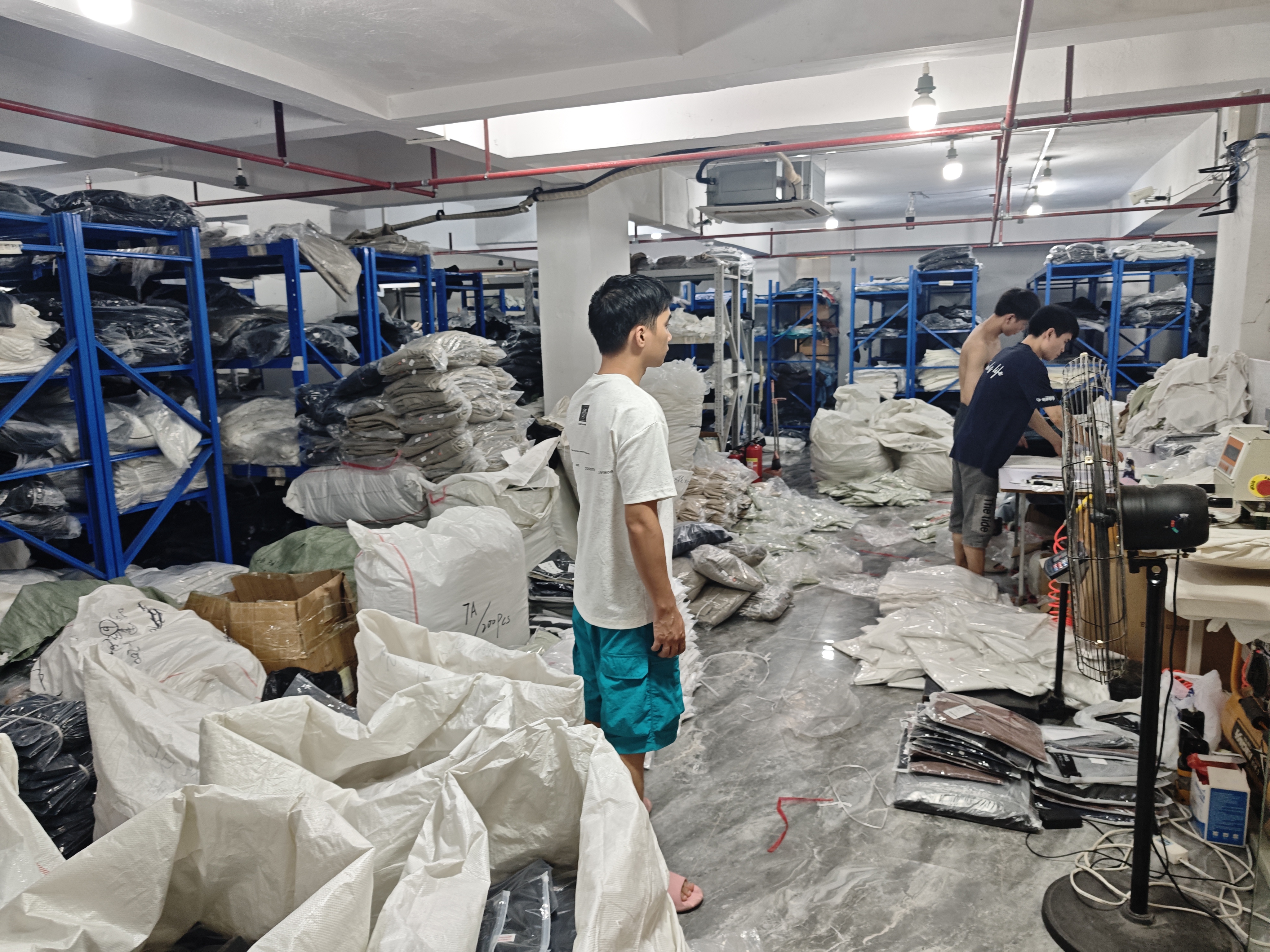
A stock figure describes quantity. It says nothing about SKU mix, size curve or stock age until a buyer asks for the record.
Why a capability number is only as good as the record behind it
Production capacity is a self-reported operational measure. No external body issues a certificate for "45,000 pieces a month" in the way it issues a textile safety test report. That does not make the number dishonest; it makes it unfinished. A buyer evaluating a custom casual apparel manufacturer has to close the gap between what is stated and what is demonstrated, and the only place that gap can be closed is on the floor, in the warehouse and in the quality file.
The distinction that matters for scheduling is between three things suppliers tend to blur: capacity, output and availability. Capacity is what the plant could produce in a period if the lines were organised for it. Output is what was actually produced. Availability is whether a specific order can be placed into a specific window. A buyer who accepts one number as a proxy for all three will build a replenishment plan on a ceiling rather than on a slot.
This is why the numbers in a supplier profile are best read as an agenda rather than a conclusion. Each figure points to a document: a monthly production report, a stock-ageing list, a line layout, an inspection plan, a test report with a number on it. A supplier that can produce those documents is a different kind of supplier from one that can only repeat the figure.
The figures, translated into scheduling terms
The table below takes the claims a buyer is most likely to meet in a supplier conversation and pairs each with its scheduling implication and the artefact that would substantiate it. The right-hand column is the part worth taking on a factory visit.
| Stated figure | What it literally says | Scheduling implication | Record to request |
|---|---|---|---|
| 5,000 m² independent plant, 150+ staff, in-house pattern team | Owned production space with internal pattern-making capability | Sampling and pattern revisions stay inside the same organisation as bulk production, which shortens the loop between fit approval and cutting | Floor plan with line count, pattern room walk-through, sample-to-bulk handover record |
| 45,000 pieces monthly capacity (knitted and woven garments) | A stated monthly production ceiling across two fabric categories | Sets the order of magnitude for how large a booking can be absorbed in one cycle | Three months of production reports by line, plus a booking sheet showing committed volume |
| 1,500 pieces a day (calculated) | 45,000 divided by a 30-day calendar | Useful as a planning benchmark; not a promise of daily throughput on any given day | The monthly report again — ask the supplier to derive the daily figure in front of you |
| 200,000+ pieces standing stock across 50+ styles | Finished goods on hand | Reduces replenishment lead time only where the buyer's SKU is inside that stock | Stock-ageing report by style, size and colour, plus a warehouse walk |
| 500,000 pieces annual output | Realised production across a year | Indicates the sustained rate, as distinct from the theoretical ceiling | Twelve-month output summary; ask which figure applies to your delivery window |
| 200 pieces per style minimum for custom orders; no minimum on spot goods | A stated floor for customisation and an open floor for stock | Makes small-batch casual apparel production feasible, subject to line scheduling rather than capacity | Written MOQ per style, mixed-wholesale terms, first-run pricing schedule |
| Six-stage full-process inspection against AQL international standards; CTI reports; third-party on-site inspection accepted | A quality system with defined checkpoints and external verification options | Reduces the probability of a defect batch reaching the buyer's warehouse, but only if the checkpoints are defined | Inspection plan, AQL level and sampling scheme, defect classification, CTI report numbers |
What 45,000 pieces a month and 1,500 pieces a day actually measure
The monthly capacity figure in the supplier's own data is 45,000 pieces of knitted and woven garments. It does not arrive as a daily number. Dividing 45,000 across a 30-day production calendar produces 1,500 pieces a day, and that is the arithmetic behind the headline. It is a calculated average, not a measured daily output. No factory produces at a constant rate through sampling days, changeover days, material arrival days and holidays, and a buyer who plans on a flat 1,500 will be planning on a number that no plant actually runs at.
The average is still worth having, for two reasons. First, it establishes the order of magnitude a buyer should design a purchase plan around: a 20,000-piece seasonal programme is roughly half a month of stated capacity, while a 500-piece test run is a rounding error inside it. Second, and more usefully, it gives the buyer something specific to test on site. Asking a supplier to derive the daily figure from its own monthly report, in the room, is a small stress test of whether the numbers are managed or merely quoted.
The annual figure adds a second layer. The same supplier reports 500,000 pieces a year. Twelve months at 45,000 pieces would come to 540,000, so the two numbers are not identical. They are not necessarily in conflict either: a monthly capacity is a ceiling that assumes the lines are organised for it, while annual output is what was actually produced across a year containing ramp-ups, product mix changes, holidays and slower months.
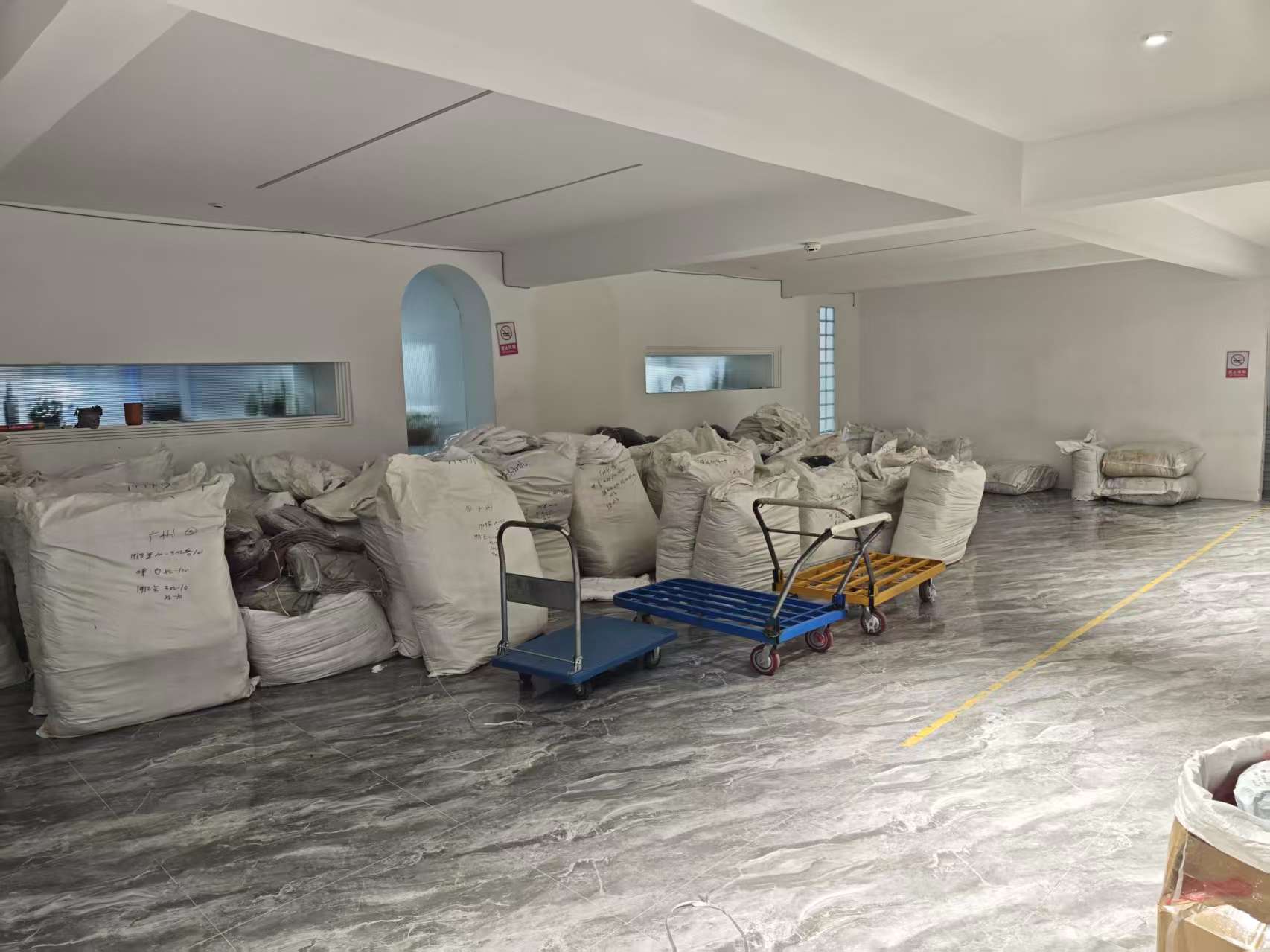
Cutting is the stage where a monthly capacity figure becomes concrete: it sets how many styles can enter a production week at once.
What 200,000 pieces of ready stock can and cannot absorb
Standing stock of more than 200,000 pieces across 50+ styles is a genuine operational asset for a buyer running a wholesale casual apparel programme. In the supplier's stated terms, spot goods carry no minimum order and support arbitrary mixed wholesale, with dispatch within three days. Read against a replenishment calendar, that combination is what removes the longest variable in a reorder cycle — production time — from the part of the range that is held in stock.
What the number does not describe is the part buyers get wrong. Two hundred thousand pieces is a quantity, not a range. It does not state which sizes, colours and fabric weights make up that total, how much of it sits in the middle of the size curve versus the tails, or how long the oldest cartons have been on the rack. A stock figure with a strong style mix but a weak size curve will still force a buyer into a custom top-up on the sizes that sell.
The audit questions follow directly. Ask for a stock-ageing report by style, size and colour rather than a total. Ask how the count is maintained and how often it is reconciled. Walk the warehouse and open cartons from more than one style. A supplier that can show a live stock list by SKU is describing a managed inventory; one that can only show a total is describing a warehouse.
A 200-piece custom minimum inside a 45,000-piece month
Custom orders start from 200 pieces per style. Set against a stated monthly capacity of 45,000 pieces, a 200-piece run is under half a percent of a month's output, which suggests that a first custom order is not constrained by capacity in any meaningful sense. Small batch casual apparel production at that scale is a scheduling question, not a volume question.
That distinction changes what a buyer should verify. The relevant questions are not about whether the plant is big enough, but about where a small run sits in the queue: whether it is slotted alongside bulk work or pushed to the edges of the month, how many days sampling consumes before the 15–25 day custom lead time begins, and whether fabric and trims for a new style are ordered against the run or drawn from existing stock. The stated lead time is measured from sample confirmation to bulk delivery, which means the sampling phase sits outside it and should be planned separately.
The customization scope attached to that minimum covers fabric weight, garment size and colour, front and back printing, embroidery logo, hangtags, wash labels and full packaging. For a private label casual apparel buyer, that list is the difference between buying blanks and buying a product. The verification point is to confirm which of those elements are standard within the 200-piece minimum and which change the price or the lead time.
Process evidence: the staged inspection chain and the AQL standard
Quality control is described as a six-stage, full-process inspection spanning raw materials, in-process work and finished goods, executed against AQL international standards, with 100% manual inspection before shipment and cooperation with third-party on-site inspection. Read as an audit subject rather than a selling point, that sentence contains four separate claims, and each one can be tested.
The first is the number of checkpoints. A buyer should ask for the written inspection plan and, more importantly, what defect each checkpoint is designed to catch. A six-stage process that stops the same defect twice is worth less than a four-stage process with clean coverage of fabric, construction and measurement. The count is not the quality; the coverage is.
The second is the AQL standard. AQL is a sampling methodology, not a pass mark, and the useful questions are which inspection level and acceptance thresholds are applied, how defects are classified, and how a failed lot is handled. A supplier that can name its sampling scheme and show a filled inspection record from a recent order is operating a system. A supplier that can only say it "follows AQL" is repeating a phrase.
The third is the manual inspection before shipment. One hundred percent manual inspection is a meaningful commitment, but only if it is recorded. Ask which checks are logged — seams, neckline symmetry, measured dimensions against the size spec — and who signs the release. On a factory visit, the inspection table is usually visible; the inspection book is what tells you whether it happens every day.
The fourth is external verification. The supplier states that third-party on-site inspection is accepted, and the purchasing terms list factory self-inspection, remote video inspection and third-party agency on-site sampling inspection as the acceptance routes, alongside a 30% deposit with the balance against a copy of the bill of lading, and defect returns and exchanges for quality problems within seven days of receipt. For a buyer in the Evaluation stage, the practical value here is optionality: an independent inspection can be inserted into the process without renegotiating the relationship.
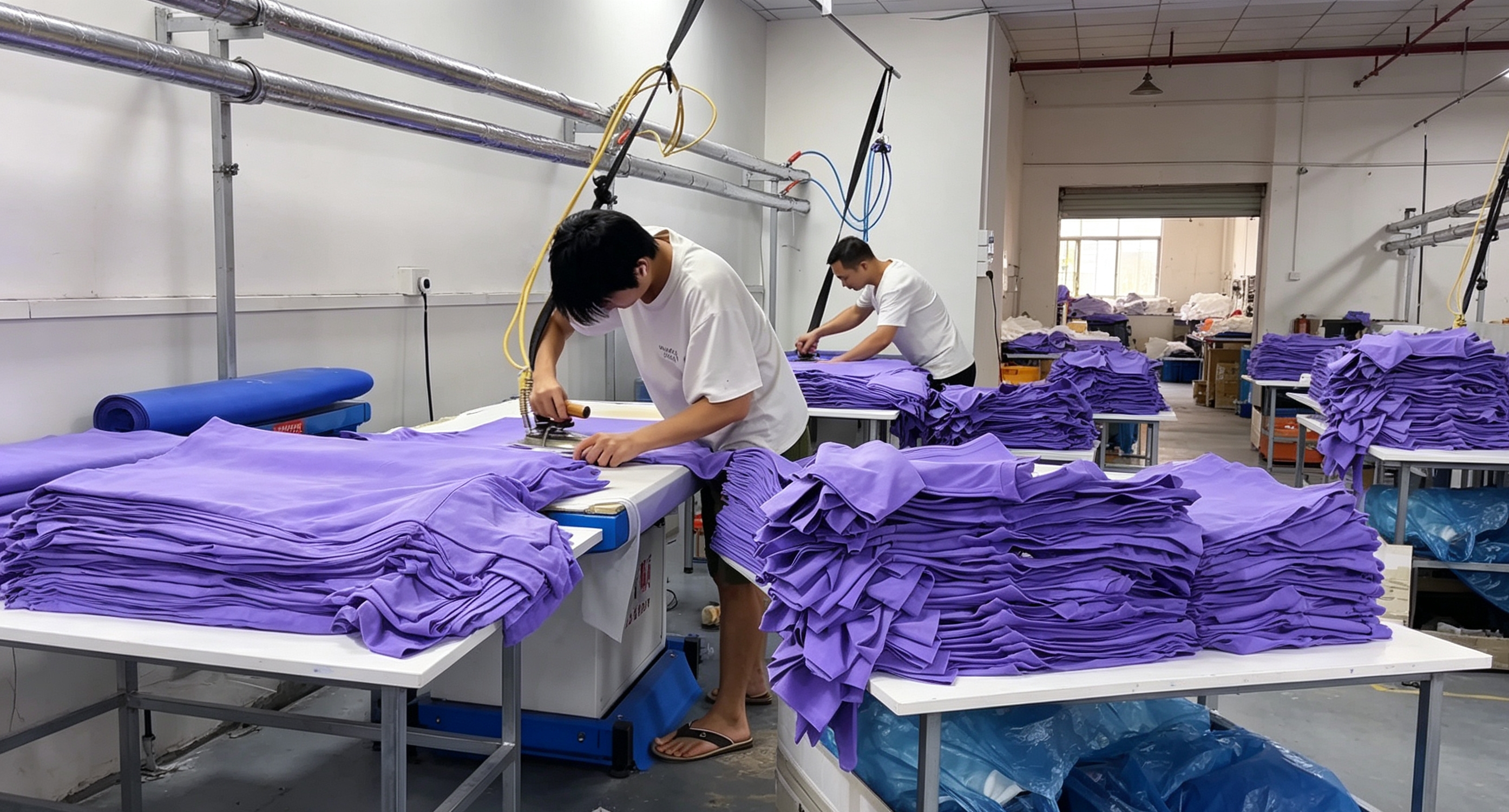
The finishing and inspection station is where a quality claim becomes observable. Ask to see the record signed at this table, not the table itself.
Certification evidence: matching CTI reports to the fabric in the order
Fabric testing is the one part of this capability set that is externally documented. Three CTI Textile Safety Test Reports are cited, issued by Centre Testing International Group Co., Ltd. (CTI Tianjin) against GB 18401-2010 Category B, covering fiber composition, color fastness, formaldehyde and decomposable aromatic amine dyes.
- Report A2250308141104CR1, issued 29 May 2025, scoped to the fabrics used across the men's hoodies, long-sleeve shirts and T-shirts range.
- Report A2250414729102C, issued 18 June 2025, scoped to the Mountain Cotton composite hoodie fabric at 63.5% cotton and 36.5% polyester.
- Report A2250414729101C, issued 18 June 2025, scoped to a high-elastic 100% polyester navy knitted fabric.
A certificate number is only useful if it maps onto the material in the buyer's order. That mapping is the audit task. For a heavyweight casual hoodie programme, the question is which report covers the specific fabric weight and composition being purchased, whether a report exists for a fabric that falls outside the three scopes above, and whether the buyer can see the report in full rather than a cover page. GB 18401-2010 Category B is a Chinese national standard for textile safety; a buyer selling into European or North American markets should confirm separately that the same fabric meets the compliance requirements of the destination market, because the two are not interchangeable.
A factory-visit audit script: seven questions that turn numbers into records
The purpose of a visit is not to confirm that the factory exists. It is to move each claim from the profile into a document. These seven questions do that, and they can be asked in sequence in under an hour.
- Show me the last three monthly production reports, by line. This tests the 45,000-piece capacity figure against actual monthly performance and reveals seasonality the profile will never mention.
- Walk me through the warehouse with a stock-ageing list. This tests the 200,000-piece claim at SKU level, including size curve, colour mix and how long the oldest stock has been held.
- Give me the inspection plan and tell me what each checkpoint catches. This tests whether the staged inspection is a designed process or a phrase.
- Which AQL level and sampling scheme apply, and how are defects classified? This tests whether the standard is operational or decorative.
- Show me a completed inspection record from a recent shipment. This tests whether 100% manual inspection is documented or assumed.
- Match each CTI report number to the fabric I am buying. This tests whether certification covers the actual order rather than the general category.
- Break the quoted lead time into material, production and finishing days. This tests whether 15–25 days is a schedule or an estimate.
Two supporting questions belong alongside them. Ask where a small custom run is slotted relative to bulk work, since that determines whether a 200-piece order is genuinely fast or merely small. And ask whether a third-party inspection can be booked before shipment, because a supplier that welcomes that option is describing a different risk posture from one that treats it as friction.
Boundary conditions: what these figures do not prove
Capability evidence is not the same as a guarantee, and a buyer who treats it as one will be disappointed by something other than the numbers. Four limits are worth stating plainly.
Capacity is not slot availability. A plant capable of 45,000 pieces a month may already be committed for the month a buyer needs. The figure says the plant can do the work; only a booking sheet says it can do it in your window.
Stock is not your SKU. A total of 200,000 pieces across 50+ styles can coexist with a thin size curve in exactly the style a buyer reorders most. Stock only shortens replenishment where the specific SKU is inside it.
Derived averages are not measured throughput. The 1,500-piece daily figure is arithmetic on a monthly capacity, and it will not hold on changeover days, sampling days or through holiday periods.
Self-reported capability is not audited capability. Capacity, headcount and stock figures come from the supplier. Independent verification of freight performance from Guangzhou to North American and European destinations at 200–500 piece volumes is not part of this evidence set, so a quoted 15–25 day production lead time should be checked against the buyer's own forwarder schedule before it is written into a launch plan. Production days and transit days are different variables and are frequently quoted as if they were one.
Market context that makes the evidence question timely
The scale of the category explains why supplier claims have become harder to read. Research published by Dataintelo on the custom made clothes market valued the global segment at USD 48.6 billion in 2025, with casual and fashion demand accounting for 62% of the total against corporate and formal wear. A category that large attracts a large number of intermediaries describing themselves in the same vocabulary as factories.
That is the practical argument for an evidence-first evaluation. When demand is concentrated in casual ranges, the differentiation between suppliers stops being about who claims the biggest numbers and starts being about who can produce the record behind the smallest one. A buyer comparing a custom casual apparel manufacturer against a trading intermediary will find that the two profiles read almost identically; the inspection plan, the stock-ageing list and the report numbers are what separate them.
What changes for the next order cycle
For a buyer moving from Evaluation into Execution, the useful shift is procedural rather than analytical. The capability figures become a shortlist of documents to collect before the purchase order, not a paragraph to compare. In practice that means requesting the monthly production report, the SKU-level stock list and the inspection plan alongside the quotation, and treating a supplier's willingness to provide them as part of the evaluation itself.
The claims that survive that process are modest but durable: an owned 5,000 m² plant with in-house pattern-making, a stated monthly capacity of 45,000 knitted and woven pieces, standing stock above 200,000 pieces, a 200-piece custom minimum, a staged AQL-based inspection chain, and three CTI reports tied to named fabrics. None of those statements guarantees a smooth order. Together, they define what a buyer can reasonably ask to see — and that is the more valuable asset, because it can be re-tested on every reorder rather than trusted once.
Frequently asked questions
What does a 45,000-piece monthly capacity mean for a 200-piece custom order?
It means the order is small relative to stated monthly output: 200 pieces is under 0.5% of 45,000, so capacity itself is unlikely to be the constraint. What still needs confirming is scheduling — when the run is slotted against bulk work, how many days sampling consumes, and whether the 15–25 day custom lead time, measured from sample confirmation, assumes fabric and trims are already available. Custom orders start at 200 pieces per style.
How can a buyer verify a 200,000-piece ready-stock claim?
By converting the total into a record. A stock-ageing report by style, size and colour shows what the 200,000 pieces actually consist of and how long they have been held; a warehouse walk confirms the report matches the racks. Because the stock spans more than 50 styles and spot goods carry no minimum order with dispatch within three days, the relevant question is whether the specific SKU being reordered sits inside that inventory and in the sizes required.
What does the six-stage quality inspection cover?
It is described as a full-process inspection spanning raw materials, in-process work and finished goods, executed against AQL international standards, with 100% manual inspection before shipment and cooperation with third-party on-site inspection. Buyers should ask which defect each checkpoint is designed to catch, and should request a completed inspection record from a recent shipment, since a checkpoint without documentation is difficult to rely on in a dispute.
Which certification documents should be requested, and what do they cover?
Three CTI Textile Safety Test Reports are cited, all issued by Centre Testing International Group Co., Ltd. (CTI Tianjin) against GB 18401-2010 Category B, covering fiber composition, color fastness, formaldehyde and decomposable aromatic amine dyes: report A2250308141104CR1 issued 29 May 2025 for the general garment fabric range, and reports A2250414729102C and A2250414729101C issued 18 June 2025 for the Mountain Cotton composite hoodie fabric and a high-elastic polyester navy knitted fabric respectively. The buyer's task is to map the report number to the specific fabric in the order, and to check destination-market requirements separately, since GB 18401-2010 is a Chinese national standard.
Are the quoted lead times independently verifiable?
They are stated, not externally benchmarked. Spot goods are described as shipping within three days, and custom orders as taking 15–25 days from sample confirmation to bulk delivery, with delivery terms available as EXW, FOB Guangzhou or Shenzhen, and CIF destination port. Verification comes from two directions: asking the supplier to break the lead time into material, production and finishing days, and checking the production window against the buyer's own forwarder schedule, because production time and transit time are separate variables that are often quoted together.
A full product catalogue covering the men's basic apparel range, fabric options and style references is available for download: Product Catalog of Lihong Garment Factory (PDF).
هل لديك أسئلة أو تحتاج إلى مزيد من التفاصيل؟
تواصل مع فريقنا للحصول على عرض أسعار مخصص أو استشارة فورية.
طلب عرض أسعار
املأ النموذج أدناه وسيتواصل معك فريقنا بعرض مقترح مخصص.
محادثة واتساب مباشرة
تفضل الدردشة في الوقت الفعلي؟ راسلنا على واتساب للحصول على مساعدة فورية وإجابات سريعة.
- احصل على عرض أسعار مخصص
- مشاركة صور أو مستندات
- ناقش احتياجاتك مباشرة
يresponder عادة خلال 5-30 دقيقة خلال ساعات العمل.