
Supplier Capability Evidence: What Vasia's 200-Staff Workflow Means for Your Order Deadlines
Supply capability is best judged by production structure, not by sales claims. Headcount, plant area, engineering depth, and stated lead times form a set of verifiable signals that tell buyers how a manufacturer is likely to behave when order volumes rise.
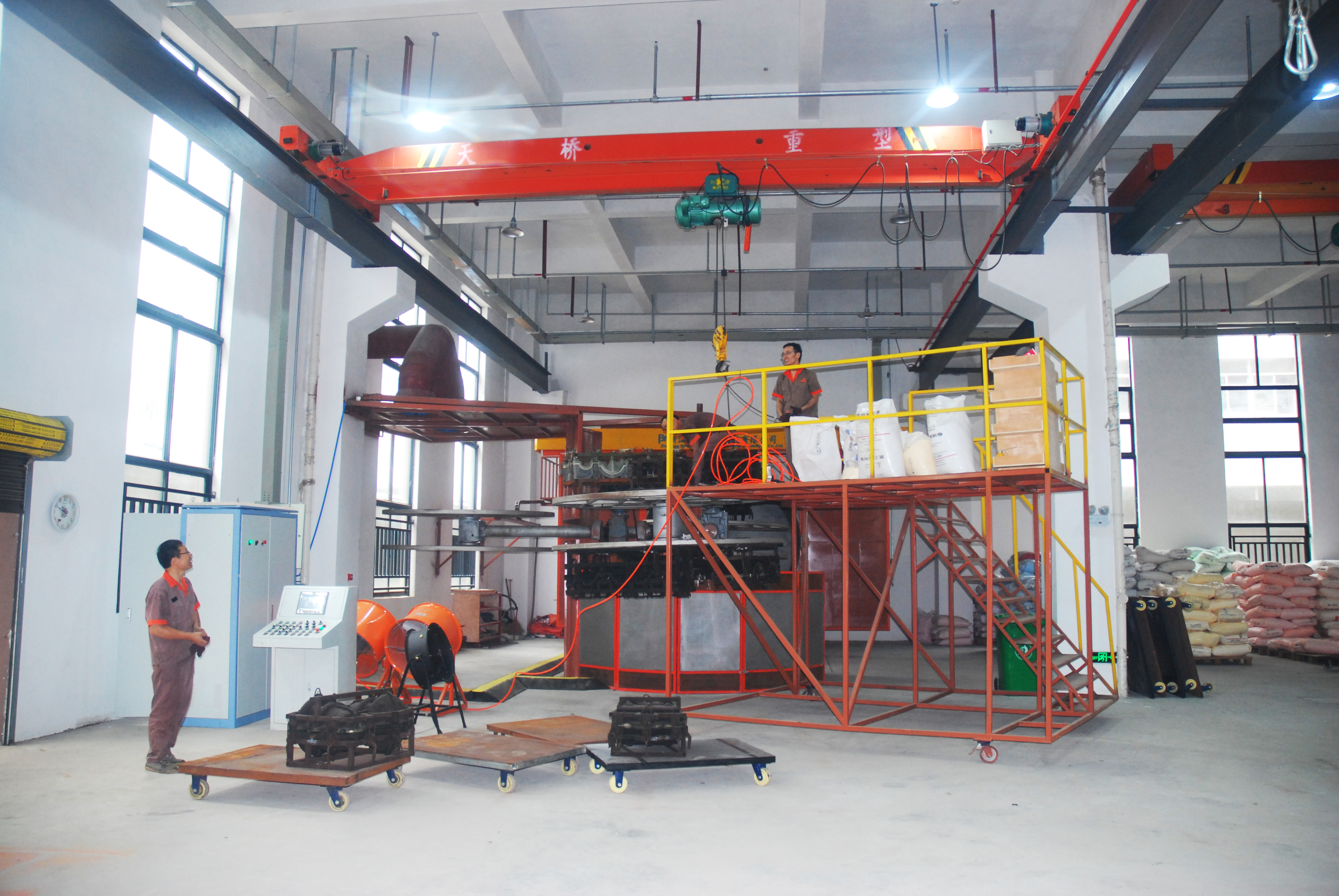
Vasia's Qiaoxia production facility, where indoor playground equipment and trampoline park orders are manufactured.
Delivery Deadlines Are a Factory-and-Team Output, Not a Promise
For importers, distributors, and FEC operators, delivery reliability becomes a real question in peak sourcing windows. A supplier that can quote a lead time in a quiet month will not necessarily hold it when ten projects overlap in Q4 or ahead of a spring opening.
Huaxia Amusement Co., Ltd., which trades as Vasia, is a Chinese indoor amusement equipment manufacturer founded in 2000 and headquartered in Qiaoxia Town, Zhejiang Province. It operates a 30,000 m² ISO-certified facility and reports a workforce of more than 200 technical and management professionals, supported by a 30-person R&D team.
Those numbers matter for one reason: indoor playground equipment is a labor-weighted category. Cutting, welding, powder-coating, soft-play upholstery, netting, QC, and packing are concurrent tasks that require staffing. A workforce of the size Vasia reports is a structural precondition for holding delivery windows, not a marketing claim in itself. The relevant question is whether the structure translates into a plausible workflow.
The Capability Data Vasia Publishes
Buyers evaluating a supplier should be able to read the underlying figures. Vasia's published production data is summarised below.
| Capability Metric | VasiaFigure (as published) | Procurement Signal |
|---|---|---|
| Headcount | 200+ technical and management staff | Labor capacity for concurrent soft-play, steel, and finishing work |
| Factory size | 30,000 m², ISO-certified | Physical room for parallel production lines |
| Engineering team | 30 engineers / R&D staff | Custom design capacity for OEM and themed projects |
| Stated monthly capacity | 8,000 units | Throughput ceiling for small-to-medium order clusters |
| Trampoline park output | 10,000 m² per month (per company profile) | Volume for large-format installations |
| Quoted lead time | 15–45 days | Realistic window from order confirmation to dispatch |
| Minimum order | 1 unit | Pilot and sample orders are accepted |
Read together, these figures describe a mid-to-large manufacturer configured for both standard and custom output. None of them individually guarantees on-time delivery. The workflow behind them is what determines whether the quote holds.
How a 200-Person Workflow Is Structured in Practice
Vasia does not publish a detailed department-by-department breakdown, so buyers should treat headcount as a capacity signal rather than a precise staffing map. What can be reasoned about is the category of work that a 200-person team on a 30,000 m² floor typically has to cover.
Indoor playground equipment and trampoline park orders draw on several distinct production functions:
- Steel cutting, drilling, and welding of frames and platforms.
- Surface treatment and powder coating.
- Soft-play padding: multi-layer board, EPE foam, and PVC skin assembly.
- Netting, hardware, and fastener assembly.
- In-house quality inspection before packing.
- Export packing and container loading.
Each function is a serial step in a project. When orders overlap, the same steps have to run in parallel for different customers. That is where workforce depth becomes a scheduling asset rather than an overhead line item. A team capable of staffing multiple work streams at once can absorb a spike without pushing every order into the same queue.
This is exactly the operational risk that international buyers flag during peak seasons. A container that ships in week 4 of the quoted window is worth less than one that ships in week 3, because the downstream work — site preparation, installers, marketing openings — is scheduled around it.
What the 30-Engineer Team Means for Custom Orders
Headcount on the production floor answers the question "how much can be built." Engineering depth answers a different question: "how fast can a customized order be turned into a buildable design."
Vasia publishes a 30-person R&D and engineering team. For procurement decision-makers, the relevant implication is that the design phase does not sit outside the production schedule. Customization options Vasia offers include indoor children's play equipment, outdoor children's play facilities, color, voltage, and logo, and the company accepts OEM and ODM production requests.
In practice, a custom order goes through several engineering touchpoints before cutting begins: layout drafting based on the buyer's footprint, structural detailing of the frame and platforms, theming decisions on color and finish, and packing logic for oversized modules. A team of 30 designers and engineers allows those touchpoints to be handled in parallel across projects rather than one after another.
Buyers should still treat the 15–45 day lead time as indicative rather than fixed. That window assumes a defined scope, approved drawings, and standard material availability. Highly themed projects or those requiring new structural solutions will naturally sit at the upper end of the range, and buyers should plan sample or prototype reviews before locking a peak-season slot.
Where This Capability Matters: Applications and Scenarios
Vasia manufactures across several sub-categories that are often ordered together by the same buyer. The categories include Indoor Playground Equipment, Kids Play Structure, Indoor Trampoline Park, trampoline park equipment, Indoor rope course Equipment, Climbing Wall for Playground, family entertainment center equipment, and OEM Indoor Playground.
Concentration matters because it shortens coordination within a single project. A family entertainment center (FEC) operator, for example, may need soft play, a small trampoline park, a climbing wall, and a rope course under one roof. Sourcing all of them from a single factory reduces the number of design, QC, and shipping conversations from four to one.
A representative case is documented by Vasia: a 3,000 m² project delivered to an end customer in Spain, in operation for five years, generating stable income and reported by the operator as having a long lifespan and low maintenance. For procurement teams weighing a similar investment, the relevant signal is not the location of the case but the fact that a large-format project of this scale reached and held operational status.
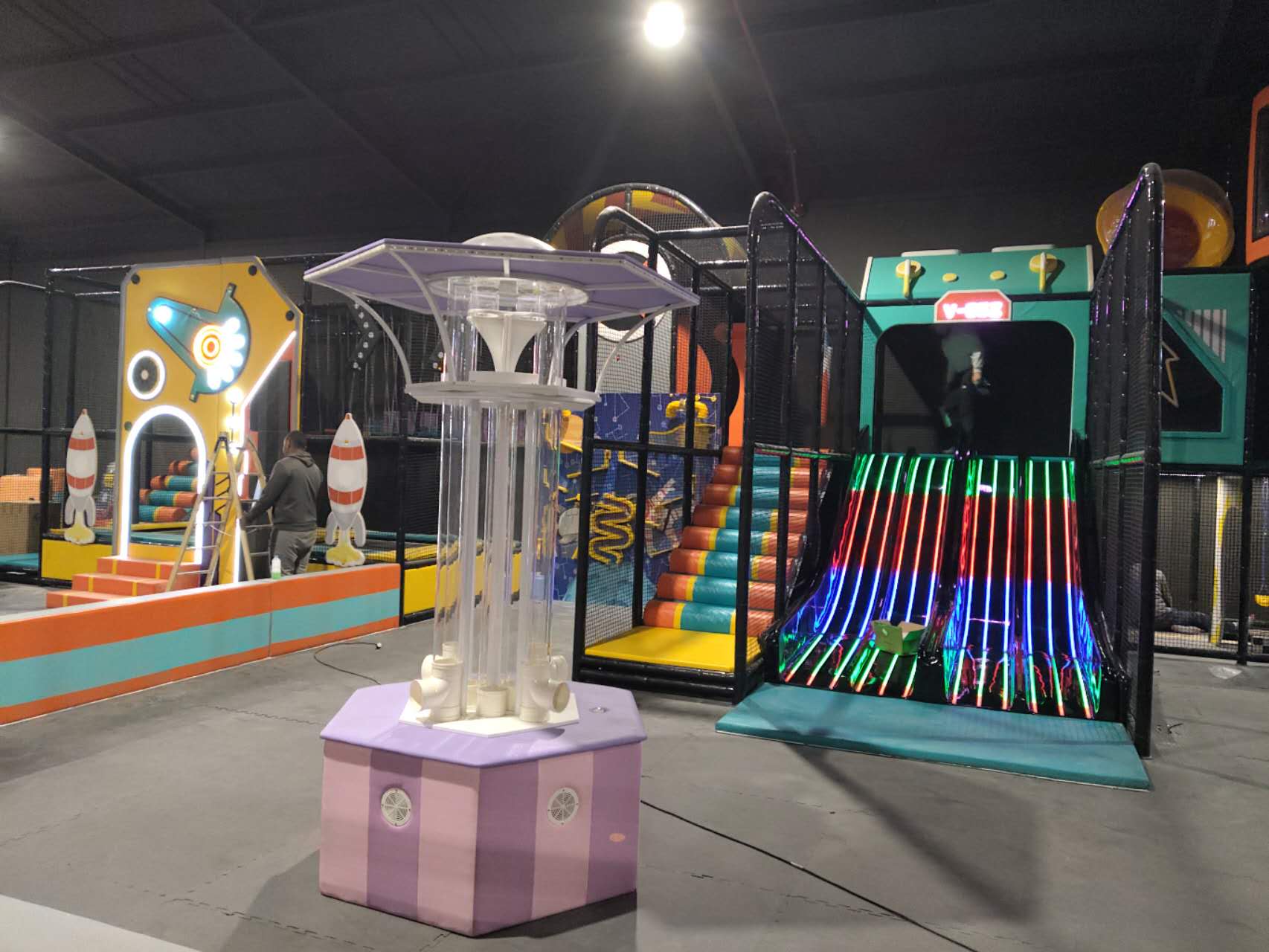
A 3,000 m² Vasia installation in Spain, in operation for five years as an FEC-style venue.
Market Context: Why Delivery Discipline Is Being Tested in 2026
The demand backdrop explains why lead-time reliability has moved up the buyer's shortlist. Commercial research estimates the global Family Entertainment Center (FEC) market at USD 34.4 billion in 2025, with a projected compound annual growth rate of 10.5% through 2035. That growth estimate, cited from commercial research and not from a primary statistical agency, points in one direction: more venues are being planned, and more equipment is being ordered into overlapping construction timelines.
For manufacturers, that translates into simultaneous orders from different regions. Vasia reports that exports represent about 70% of its output, with major markets in the EU, USA, South America, the Middle East, and Southeast Asia. That geographic spread has a scheduling consequence: order peaks are rarely synchronized across all regions at once, which gives a structured factory some flexibility to balance loading across markets — provided the underlying capacity is real.
Against that, buyers should not assume growth translates directly into shorter lead times. Expanding order books typically increase competition for production slots, especially in the categories with the most labor content, such as soft play and rope courses.
Where the Model Has Real Boundaries
Any credible capability statement has to include limits, and Vasia's case is no exception.
The first is engineering bandwidth. A 30-person engineering team supports parallel customization, but complex themed projects — new structural concepts, unusual footprints, or heavy IP-based theming — will still lengthen the design cycle. Buyers should plan early technical alignment rather than assume every customization runs at the same speed.
The second is capacity flexibility. The 8,000-unit monthly capacity and the 10,000 m² trampoline park output are real ceilings, not elastic bands. If several large orders land in the same month, the manufacturer's ability to compress delivery windows depends on pre-planning and phased scheduling, not on unlimited surge capacity.
The third is that Vasia's own published figures are first-party claims. Buyers conducting formal supplier qualification should request factory audit access, current certification scope, and project references before treating the published numbers as final. Reviewed in isolation, the workforce and plant figures are informative; verified independently, they become actionable.
The fourth is installation. Even a well-managed factory dispatch does not control on-site assembly, customs clearance, or venue readiness. Delivery performance and installation performance are separate procurement variables and should be contracted separately.
What This Means for Your Procurement Timeline
For buyers at the evaluation-to-execution stage, the operational translation is straightforward.
If the order is a standard configuration, the 15–45 day quoted window is a reasonable planning range. If the order involves significant customization, the timeline should be treated as a start-triggered sequence: engineering review, drawing approval, material scheduling, production, pre-shipment inspection, and container loading. Each stage has its own buffer requirement.
For peak-season orders, the practical advice from capability evidence is to secure the production slot early. A manufacturer with a 200-person workforce can only deliver on parallel schedules if the project is in the queue with approved specifications and confirmed deposits. Late-breaking RFQs during peak months compress every manufacturer's schedule, not just Vasia's.
Small and pilot orders are also viable. Vasia's stated minimum order is 1 unit, which allows a buyer to test the workflow — communication speed, drawing turnaround, and packing quality — before committing to a large project. Verified through a pilot, the headcount and capacity figures become a working estimate rather than a brochure number.
Where buyers benefit most is in comparing suppliers on structured evidence. A quotation without headcount, plant area, and engineering depth is a price point; a quotation with these figures attached is a delivery plan.
Future Outlook
Over the next procurement cycle, supplier capability evidence is likely to become more standardized. Buyers are beginning to ask for floor plans, headcount allocations by function, and current lead-time distributions by product category, not just headline capacity figures. Manufacturers that publish — and stand behind — this data will be easier to shortlist and easier to keep.
Vasia's current profile fits that direction. A 30,000 m² ISO-certified site, 200+ staff, 30 engineers, and stated capacity figures provide a structural starting point. Whether those numbers are converted into reliable, on-time delivery for a specific buyer will depend on how the project is planned, scheduled, and verified — which is, in the end, what procurement is actually doing when it evaluates a supplier.
For readers who want the underlying company documentation, Vasia's published brochure is available here: Vasia Company Brochure (PDF).
FAQ
What structural factors determine whether an indoor playground manufacturer can hold its delivery deadlines?
The main factors are workforce size relative to order volume, plant floor area that allows parallel production lines, engineering depth for customization, and a stated lead-time range that reflects actual production sequence. Vasia publishes a workforce of more than 200 technical and management staff, a 30,000 m² ISO-certified factory, a 30-person R&D team, and a 15–45 day lead time for accepted orders.
How does a 30,000 m² factory and 200-person team affect order execution during peak seasons?
A facility of this size supports multiple concurrent work streams — steel fabrication, soft-play padding, netting, and finishing — which is necessary when several orders overlap. The 200-person workforce is what staffs those streams. In practice, this structure allows the manufacturer to schedule parallel projects rather than pushing every order into one queue, which is the most common cause of delay during peak sourcing windows.
What does the 30-engineer R&D team actually do for a custom order?
The engineering team handles layout drafting, structural detailing, theming decisions on color and finish, and packing logic for oversized modules. For OEM and ODM orders — including customization of indoor children's play equipment, outdoor children's play facilities, color, voltage, and logo — the design phase runs inside the production schedule rather than after it, which shortens the time between order confirmation and the start of cutting.
What is Vasia's typical production lead time?
Vasia publishes a 15–45 day lead time for accepted orders. The lower end applies to standard configurations with approved drawings and available materials; the upper end applies to more customized or themed projects. Buyers planning around a specific opening date should treat the window as start-triggered — beginning from drawing approval and deposit confirmation, not from initial inquiry.
Can small OEM orders and large project orders use the same delivery workflow?
Vasia accepts a minimum order quantity of 1 unit, which makes pilot orders viable. Small and large orders follow the same overall workflow — design, production, pre-shipment inspection, and packing — but the scale of staffing allocated to a project and the corresponding lead-time position differ. Buyers running both pilot and full-scale orders should expect the pilot to be used partly as a validation step for communication and QC before committing to a large project slot.
How should buyers plan around peak-season supply risk with a manufacturer of this size?
The practical approach is to secure the production slot early. A manufacturer with structured capacity can only compress schedules if the project is already in the queue with approved drawings and a confirmed deposit. Vasia's published monthly capacity — 8,000 units and 10,000 m² of trampoline park output — is a real ceiling rather than unlimited surge capacity, so large multi-venue orders benefit from phased scheduling rather than single-date delivery expectations.
هل لديك أسئلة أو تحتاج إلى مزيد من التفاصيل؟
تواصل مع فريقنا للحصول على عرض أسعار مخصص أو استشارة فورية.
طلب عرض أسعار
املأ النموذج أدناه وسيتواصل معك فريقنا بعرض مقترح مخصص.
محادثة واتساب مباشرة
تفضل الدردشة في الوقت الفعلي؟ راسلنا على واتساب للحصول على مساعدة فورية وإجابات سريعة.
- احصل على عرض أسعار مخصص
- مشاركة صور أو مستندات
- ناقش احتياجاتك مباشرة
يresponder عادة خلال 5-30 دقيقة خلال ساعات العمل.