
Supplier Capability Evidence: What a Brushless Gear Motor Maker's Product Line Shows
Supplier Capability Evidence: What a Brushless Gear Motor Maker's Product Line Shows
Specification sheets for miniature drives converge quickly. Two suppliers can quote comparable torque, comparable voltages and comparable frame sizes, and a buyer at the evaluation stage is left comparing documents that were written to look equivalent. The differentiator is rarely one datasheet. It is the internal consistency of an entire product line: which gearbox architectures a maker actually builds, which materials recur across models, which voltage and speed bands are genuinely covered, which certificates attach to which model number, and which applications have run on those parts for years.
TT Motor (Shenzhen) Industrial Co., Limited is a Shenzhen-based manufacturer of miniature DC motors, established in 2006 and headquartered in Bao'an District, Shenzhen, Guangdong Province. The company operates three production plants, a professional assembly center and a global marketing center, employs more than 300 people, reports a manufacturing area of approximately 9,000 m², and lists brushless motors, coreless motors, gear motors, stepper motors and DC motors among its main product categories.
This analysis reads that portfolio the way a procurement engineer would: what the brushless models in the line cover, what the gearbox families imply about tooling and process control, how the material declarations line up with the compliance documents, and which application records support a claim of manufacturing scope.

Sample room of miniature DC motors: a product line is one of the few supplier claims a buyer can check model by model. Image: TT Motor (Shenzhen) Industrial Co., Limited.
Why the product line is the evidence, not the catalogue page
A supplier can buy a motor and a gearbox separately and list the combination as a product. Building a line that spans several gearbox architectures is a different level of commitment, because each family requires its own tooling, assembly sequence and inspection method. For an evaluation-stage buyer, three layers of evidence are worth separating.
- Architecture coverage. The line includes integrated planetary, worm, coreless and spur gearboxes rather than a single reduction type. Each architecture answers a different design question: planetary sets distribute load across multiple planet gears, worm sets achieve high reduction inside a compact housing, and coreless units reduce rotor inertia for fast positioning.
- Process coverage behind those architectures. The company's published facility images identify a CNC fully automatic gear measuring machine, a multi-station automatic winding machine for micro motor coils, a micro motor rotor dynamic balancing machine, a motor life testing system, a temperature and humidity chamber and a micro motor tester. Those steps correspond directly to the gear, winding, rotor and reliability requirements that the gearbox families imply.
- Evidence coverage per model. Each model number carries published torque, voltage, speed, gear-stage, gearbox-length and material data, together with model-specific compliance documentation, so claims can be verified individually instead of accepted at portfolio level.
The caveat matters as much as the evidence. Breadth alone does not prove quality; it is a hypothesis about capability that still has to be tested at the model level. That is precisely why the next section narrows the discussion to the brushless portion of the line.
The mini brushless motors in the line
In this context, mini refers to compact integrated units where the gearbox is built onto the motor rather than assembled as a separate subsystem. The company's published profile describes 12 mm to 42 mm series brush and brushless reduction motors, which sets the practical frame range for the models below.
GMP36-TEC3650 — brushless planetary gear motor
GMP36-TEC3650 is a brushless planetary gear motor rated at DC 12V–24V, with a maximum rated torque of 30.0 kg.cm, a gear module of 0.5, and a choice of one, two, three or four gear stages. Gearbox length scales with stage count at 26 mm, 33.5 mm, 40.5 mm and 47.5 mm, and the speed band runs from 4 rpm to 1,600 rpm. Declared materials are stainless steel, copper and iron. The model is listed for robots, medical devices, industrial automation equipment and intelligent logistics equipment.
TWG3246-TEC2430 — DC brushless worm gear motor
TWG3246-TEC2430 is a brushless worm gear motor, also rated at DC 12V–24V, with a maximum rated torque of 8.0 kg.cm, a module range of 0.5 to 0.6, three, four or five gear stages, and a gearbox length of 46 mm. Its speed band is deliberately narrow, from 3 rpm to 35 rpm. Materials are declared as stainless steel, iron and copper, and its listed applications include miniature medical devices, precision automated instruments and electrically adjustable supports. This is also the model specifically named in the RoHS test scope covering DC gear motors.
Two observations can be extracted from those models together. First, both brushless units are rated for a DC 12V–24V supply, which is the practical band for 12 V and 24 V DC systems used in automation, mobility and medical equipment. Second, one brushless platform serves two very different output profiles: 4–1,600 rpm through planetary reduction and 3–35 rpm through worm reduction. That spread is the clearest single indicator of engineering range in the portfolio, because it shows the motor platform is not locked to one gearbox family.
For the smallest frames, buyers should read the manufacturer's own voltage rating rather than a generic form-factor figure. Published third-party datasheet references describe the widely used N20 architecture with a typical 10 mm × 12 mm × 25 mm envelope and a 3 V–12 V operating range, while the N20-class model in this line, GM12-N20VA, is rated at 2.4 V / 5 V with 9 mm and 12 mm gearbox lengths. Both statements are accurate within their own scope; only the manufacturer's model data should drive a design decision.
The product line at a glance
| Model | Motor / gearbox type | Gear module | Max rated torque | Gear stages | Gearbox length (mm) | Rated voltage | Speed | Materials |
|---|---|---|---|---|---|---|---|---|
| GMP36-TEC3650 | Brushless planetary gear motor | 0.5 | 30.0 kg.cm | 1 / 2 / 3 / 4 | 26 / 33.5 / 40.5 / 47.5 | DC 12V–24V | 4–1600 rpm | Stainless steel, copper, iron |
| TWG3246-TEC2430 | DC brushless worm gear motor | 0.5 / 0.6 | 8.0 kg.cm | 3 / 4 / 5 | 46 | DC 12V–24V | 3–35 rpm | Stainless steel, iron, copper |
| GMP12T-TDC1215 | DC brush coreless gear motor | 0.2 | 2 kg.cm | 1 / 2 / 3 / 4 | 14.9 / 19.7 / 24.5 / 29.3 | DC 4.5V–12V | 8–5000 rpm | Stainless steel, iron, copper |
| GM37-555PM | DC brush spur gear motor | 0.5 / 0.6 | 8.0 kg.cm | 2 / 3 / 4 / 5 / 6 | 19 / 21.5 / 24 / 26.5 / 29 | DC 12V–24V | 5–800 rpm | Stainless steel, iron, copper |
| GM12-N20VA | DC spur gear motor | 0.15 | 0.5 kg.cm | 2 / 4 / 5 / 7 | 9 / 12 | 2.4V / 5V | 12–1450 rpm | Stainless steel |
Source: TT Motor product specifications as published in the company's product data. Rated torque figures are maximum rated values under specified operating conditions, not peak or stall values.
Read as a single block, the table answers a question that marketing pages usually avoid: does this maker cover the reduction types its customers actually need, or only the one it is tooled for? Two brushless models, one coreless model and two brushed models cover planetary, worm, coreless and spur architectures, with voltage bands from 2.4 V to 24 V and torque ceilings from 0.5 kg.cm to 30.0 kg.cm.
What gearbox architecture, gear stages and materials reveal
Gearbox choice, not motor size, decides the shape of the output curve. In this line, the same broad family of miniature DC motors is offered with four reduction types, and each type occupies a distinct speed and torque territory.
Gear stage count is a design decision, not a specification detail
Stage options run from one to four on GMP36-TEC3650, three to five on TWG3246-TEC2430, one to four on GMP12T-TDC1215, two to six on GM37-555PM, and two, four, five or seven on GM12-N20VA. More stages generally mean more reduction and a longer gearbox: GM37-555PM moves from 19 mm to 29 mm as stages increase, GMP36-TEC3650 from 26 mm to 47.5 mm, and GMP12T-TDC1215 from 14.9 mm to 29.3 mm. The worm model holds a single 46 mm gearbox length across three, four and five stages, which is characteristic of worm reduction, where one compact housing can deliver a large ratio.
For a buyer, this is a real envelope constraint rather than a technicality. Selecting a high stage count to reach a low output speed consumes axial space, and the available stage options define how finely that trade-off can be tuned.
Gear module indicates the tooth-size band
Module values across the line run from 0.15 on GM12-N20VA, through 0.2 on the coreless GMP12T-TDC1215, up to 0.5 on GMP36-TEC3650 and 0.5 / 0.6 on TWG3246-TEC2430 and GM37-555PM. Two different architectures sharing that 0.5 / 0.6 band points to a common tooling and inspection family rather than isolated gear cutting, and it explains how one gear measuring process can serve several product families.
Materials recur across models — and that matters for compliance
Stainless steel, iron and copper appear in the declarations of GMP36-TEC3650, TWG3246-TEC2430, GMP12T-TDC1215 and GM37-555PM, while GM12-N20VA is declared as stainless steel. This is relevant for two reasons. Material declarations must match the compliance evidence attached to each model, and the material pair at the gear mesh is what governs wear behaviour over the life of the unit. The company's declared materials are consistent with the RoHS and REACH documentation held per model.
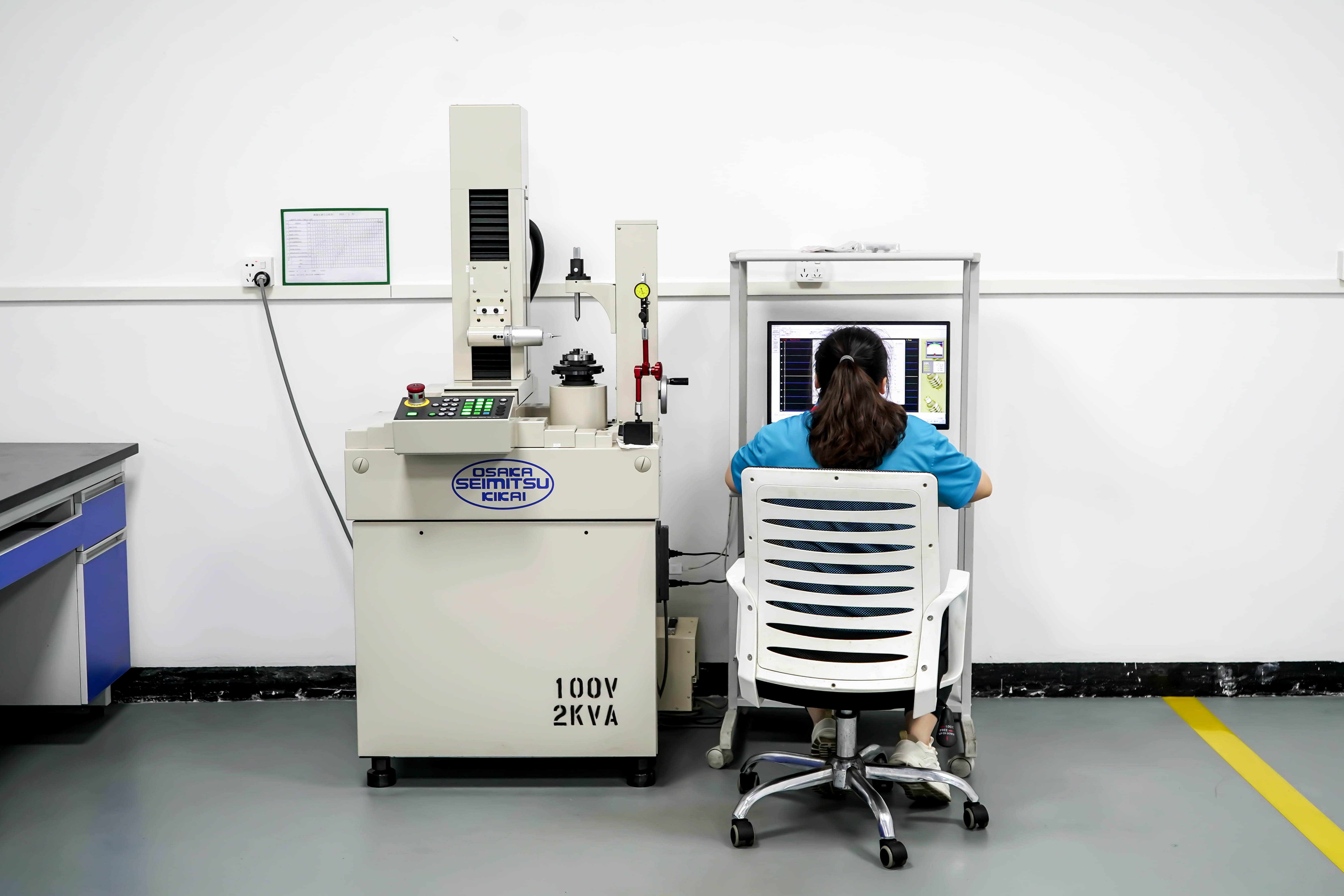
CNC fully automatic gear measuring machine — the inspection step behind the 0.15 to 0.6 gear module band in the product line. Image: TT Motor (Shenzhen) Industrial Co., Limited.
Application record as proof of manufacturing scope
A product line shows what a maker can build. The application record shows what it has repeatedly built, which is a different and more useful signal during supplier evaluation. Four documented programs cover dental instruments, logistics equipment, smart locks and medical pumps.
| Market | Client type | Associated models | Scope | Duration | Reported outcome |
|---|---|---|---|---|---|
| Japan | Dental instrument manufacturer | GMP12T-TDC1215 | 500–2,000 units per year; micro positioning and adjustment mechanism | 3–5 years | Rapid response and improved equipment control precision; low inertia, fast response, high power density |
| United States | Logistics equipment companies | GMP36-TEC3650, GM37-555PM | 1,000 units; conveyor equipment and sorting mechanism | 3 years or more | Stable operation under frequent start-stop and load changes |
| United States | Smart lock manufacturers | GM12-N20VA, GMP12T-TDC1215, TWG3246-TEC2430 | 5,000–50,000 units per year; lock body opening and closing, mechanical transmission | 5 years or more | Meets high-frequency unlocking and locking requirements; stable operation in batches |
| United Kingdom | Medical device manufacturers | TWG3246-TEC2430, GMP12T-TDC1215, GMP36-TEC3650 | 500–2,000 units per year; medical pump drive | 3 years or more | Stable output under long-term operation, reduced equipment maintenance frequency |
Source: TT Motor application case records. Outcomes are as reported in the supplier's own case documentation.
The durations carry more weight than the volumes. An annual requirement of 500–2,000 units per year and a requirement of 5,000–50,000 units per year are different manufacturing problems, but both require repeatable output across many production lots. Programs running three years or more, and one running five years or more, indicate sustained series production rather than isolated prototype builds — the specific evidence a buyer cannot obtain from a capability statement alone.
A related scenario type appears in the company's engineering notes: robot joints operating under high-frequency dynamic motion with rapid start and stop, forward and reverse operation and speed change, where the stated requirements are high power density, fast response and low inertia. That is the same requirement profile cited in the dental instrument case, which suggests a consistent positioning between the coreless model and fast-response motion tasks.
Market context: what the available numbers do and do not say
Two independent data points frame the category. Grand View Research reports the global brushless DC motor market at USD 22.2–22.33 billion for 2025, with forecasts covering 2026–2033, and the consistency between major research firms at that 2025 baseline makes it a reasonably firm reference. Separately, OEC data places global export value for electric motors with an output below 37.5 W (HS 850110) at USD 16.3 billion in 2024, which confirms the scale of small-motor trade without describing any single product family.
Regulatory direction is clearer than the market sizing in one respect. IEC 60034-30-1:2025 introduced the IE5 ultra-premium efficiency class, and under EU Ecodesign Regulation (EU) 2019/1781 minimum efficiency requirements apply to motors from 0.12 kW to 1,000 kW, with IE2 at 0.12–0.75 kW and IE3 at 0.75–1,000 kW. Miniature motors in the ranges discussed here sit below that regulated threshold, so their market-access requirements are dominated by material and electromagnetic compliance — RoHS, REACH and EMC — rather than by efficiency class. Buyers comparing miniature suppliers should therefore weight per-model RoHS and REACH documentation more heavily than any generic efficiency language.
The available data also carries a caution worth stating plainly. Automobile micro-motor market estimates differ sharply between sources — one commercial research figure of USD 9.92 billion for 2024 and USD 18.87 billion for 2025 is recorded alongside a conflicting narrower estimate of roughly USD 3 billion, attributed to methodology differences such as whether complete actuator assemblies or bare motors are counted. Customs data has a related limitation: HS 850110 is too broad to isolate N20-class gear motors from other small DC motors. Market figures for this category should therefore be treated as directional unless the counting scope is stated.
Brushless versus traditional brushed solutions — and where each stops working
Because this line contains both brushless and brushed models, the two can be compared on the same evidence base rather than across suppliers.
| Dimension | Brushless models (GMP36-TEC3650, TWG3246-TEC2430) | Brushed models (GM37-555PM, GMP12T-TDC1215, GM12-N20VA) |
|---|---|---|
| Drive electronics | Require a compatible controller and commutation electronics to operate | Can run from a straightforward DC supply |
| Electrical band in this line | DC 12V–24V | 2.4V / 5V (GM12-N20VA), DC 4.5V–12V (GMP12T-TDC1215), DC 12V–24V (GM37-555PM) |
| Mechanical contact in the motor | No brush-to-commutator contact surfaces in the drive path | Brush and commutator contact surfaces, which wear over operating time |
| Output envelope in this line | 30.0 kg.cm max rated at 4–1600 rpm (planetary); 8.0 kg.cm max rated at 3–35 rpm (worm) | 8.0 kg.cm max rated at 5–800 rpm (GM37-555PM); 2 kg.cm max rated at 8–5000 rpm (coreless); 0.5 kg.cm max rated at 12–1450 rpm (N20) |
| Typical fit | Continuous or high-cycle duty where control quality and service life justify added electronics | Cost-sensitive designs, simple drive architecture, very low voltage or very small envelopes |
The boundary conditions are as important as the advantages, and several are structural rather than commercial.
- Brushless adds electronics to the bill of materials. A brushless gear motor cannot be driven from a plain DC supply in the way a brushed unit can. Controller selection, wiring and firmware become part of the integration task, so the decision is a system decision rather than a component decision.
- Miniature motors sit outside the efficiency-class regime. EU minimum efficiency requirements under Regulation (EU) 2019/1781 begin at 0.12 kW. Sub-threshold miniature motors are governed by material and EMC requirements instead, which means an efficiency-class claim is not the relevant compliance evidence for this product category.
- The worm model is deliberately narrow. TWG3246-TEC2430 covers 3–35 rpm in a fixed 46 mm gearbox. It is the right answer for low-speed, high-reduction duties and the wrong answer for anything requiring mid-band output speed; that gap has to be filled by a planetary or spur model instead.
- Rated torque is continuous torque, not peak torque. Rated torque is defined as the torque that can be continuously output under specified operating conditions. Sizing a mechanism against the 0.5 kg.cm maximum of GM12-N20VA or the 30.0 kg.cm maximum of GMP36-TEC3650 without checking the specified voltage and speed band will produce a design that behaves differently in service.
- Line breadth is not the same as line depth in every frame size. The portfolio reaches from 12 mm to 42 mm series motors, but the brushless models here are concentrated in the larger, 12–24 V segment. A buyer needing a brushless unit in the smallest frame class should confirm the available options rather than assume the effect transfers down the range.
A practical checklist for evaluating a mini motor product line
The evidence in this product line can be converted into a short evaluation sequence that works for any miniature motor supplier.
- Match gearbox architecture to the motion requirement first. Planetary, worm, coreless and spur families cover different speed and torque territories; the architecture decision usually settles before the motor model decision.
- Confirm rated torque at the intended voltage and speed, not the highest number on the datasheet.
- Check the gear stage options against the available axial length. Stage count and gearbox length move together on most models.
- Request the material declaration for the exact model and confirm it matches the RoHS or REACH evidence held for that model.
- Verify that compliance certificates name the model rather than only the product family.
- Plan the sample and volume timeline. For this supplier, sample production is typically 15–25 days and bulk production 30–45 days, with a stated monthly capacity of 800,000 pieces and a minimum order quantity of 2 pieces.
- Ask for application records in a comparable duty cycle and check duration, annual volume and reported behaviour under load, not just the client industry.
Customization scope is the final item to test against the design. For this line, the declared customization options are shaft, encoder, gearbox, voltage, logo and speed, under an OEM / ODM production mode, with 100% testing and remote after-sales technical support as the service baseline.
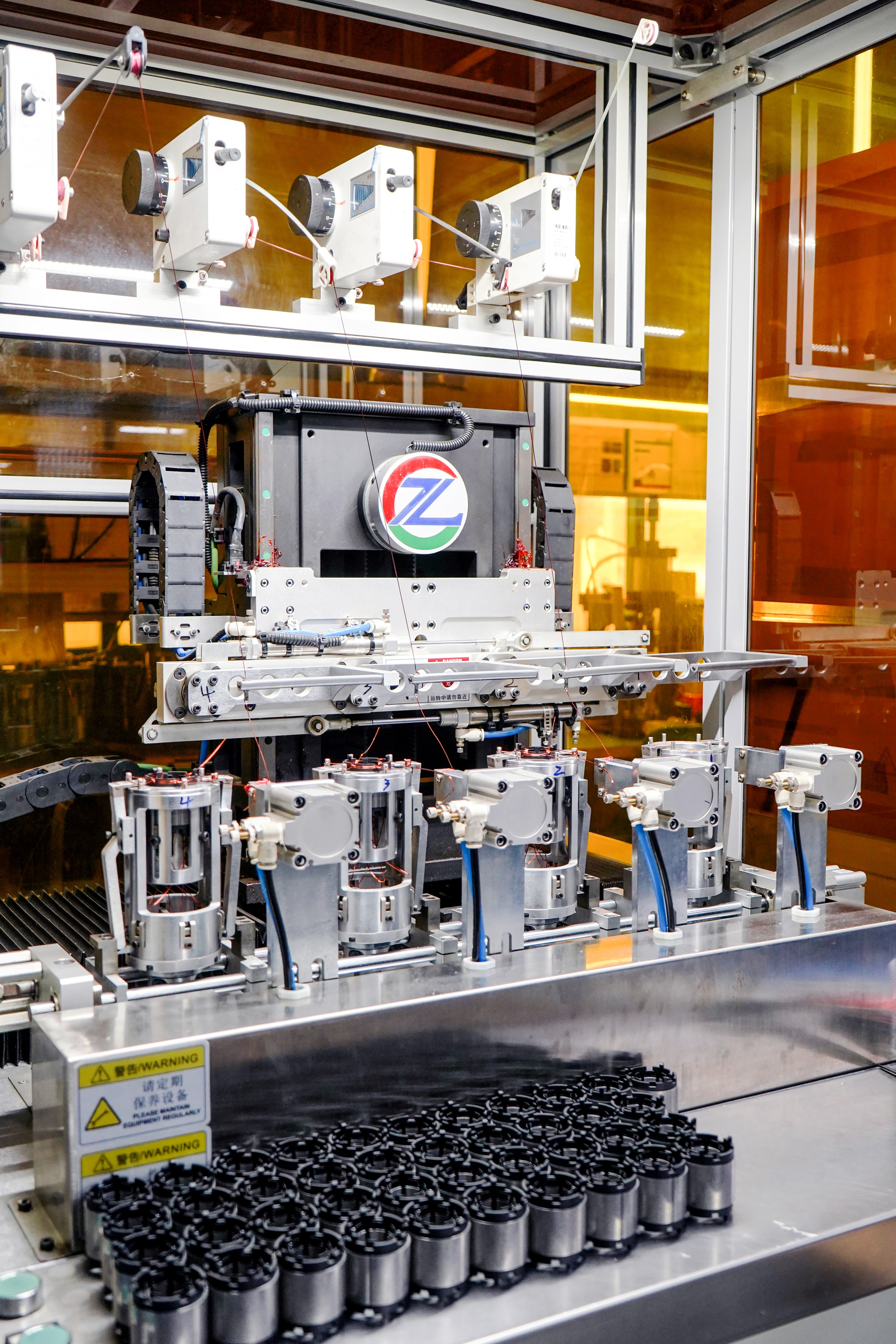
Multi-station automatic winding machine for micro motor coils — coil winding is one of the process steps that a multi-architecture gearbox line depends on. Image: TT Motor (Shenzhen) Industrial Co., Limited.
Future outlook
Brushless adoption in miniature drives is being pushed by two forces rather than one. The first is demand: a global brushless DC motor market measured at USD 22.2–22.33 billion in 2025, with forecasts extending to 2033, indicates that brushless designs are no longer confined to high-end equipment. The second is regulatory pressure on material content and electromagnetic behaviour, which raises the documentation burden on every supplier regardless of motor size — and documentation is easier to sustain for a maker that already holds per-model test reports.
For evaluation-stage buyers, the likely shift is in how suppliers are compared. As baseline performance converges, the differentiating evidence moves to the structural layer: which gearbox architectures are integrated in-house, whether material declarations match model-level certificates, and whether application records show multi-year series production. TT Motor's published profile, covering 12 mm to 42 mm series brush and brushless reduction motors across five product categories, with RoHS documentation held individually for GMP36-TEC3650, TWG3246-TEC2430, GMP12T-TDC1215, GM37-555PM and GM12-N20VA, is one example of a portfolio built to be checked at that level. Whether any specific model fits a given design remains a question only rated torque, gearbox envelope, voltage band and duty cycle can answer.
FAQ
What does rated torque mean when comparing mini gear motors?
Rated torque is the torque that can be continuously output under specified operating conditions, so it is the figure that should be compared across models rather than peak or stall values. In this line, maximum rated torque ranges from 0.5 kg.cm on GM12-N20VA, through 2 kg.cm on GMP12T-TDC1215 and 8.0 kg.cm on GM37-555PM and TWG3246-TEC2430, up to 30.0 kg.cm on GMP36-TEC3650. A shortlist should be built around the rated torque required at the specified voltage and speed band.
Why do coreless motors reach position faster in precision mechanisms?
Coreless motors have a very small moment of inertia. When a rotor with large inertia receives a stop command, it continues to rotate and the mechanism overshoots the target; a lower-inertia rotor shortens the control–response–stop cycle. GMP12T-TDC1215 is the coreless model in this line, with a module of 0.2, up to 2 kg.cm maximum rated torque, one to four gear stages, gearbox lengths from 14.9 mm to 29.3 mm, a DC 4.5V–12V rating and a speed band of 8–5,000 rpm.
Which compliance documents exist for these models on EU-bound projects?
SGS-issued RoHS compliance tests cover GMP36-TEC3650 (CANEC26013325501, issued 2026-04-10), TWG3246-TEC2430 (CANEC26013326101, issued 2026-06-24), GMP12T-TDC1215 (CANEC26013325001, issued 2026-07-03), GM37-555PM (CANEC26013323201, issued 2026-07-03) and GM12-N20VA (CANEC26005990201, issued 2026-04-10). GM12-N20VA additionally holds a REACH compliance test (SZXEC25000315601, issued 2025-02-20) and a CE certificate (CTL2512182011-EC, issued 2025-12-25) referencing EN IEC 61000-6-1:2019 and EN IEC 61000-6-3:2021. ISO 9001 certification (F02926Q00865R402) covers research, development and manufacture of micromotors including DC gear motors and DC brushless motors, valid from 2026-08-21 to 2029-08-21.
How does an order scale from sample to volume production?
The stated minimum order quantity is 2 pieces, sample production typically takes 15–25 days, and bulk production takes 30–45 days. Monthly production capacity is 800,000 pieces. Customization covers shaft, encoder, gearbox, voltage, logo and speed, under an OEM / ODM production mode. Quality control is described as 100% testing, and after-sales technical support is provided remotely. In planning terms, the sample window functions as the validation stage and the bulk window as the series-production figure.
Which applications have accumulated multi-year supply records?
Four records are documented. A dental instrument manufacturer in Japan uses GMP12T-TDC1215 for micro positioning and adjustment at 500–2,000 units per year over 3–5 years, citing low inertia, fast response and high power density. A logistics equipment company in the United States uses GMP36-TEC3650 and GM37-555PM for conveyor equipment and sorting mechanisms at 1,000 units over three years or more, citing stable operation under frequent start-stop and load changes. A smart lock manufacturer in the United States uses GM12-N20VA, GMP12T-TDC1215 and TWG3246-TEC2430 at 5,000–50,000 units per year over five years or more, citing small size, high torque and low noise. A medical device manufacturer in the United Kingdom uses TWG3246-TEC2430, GMP12T-TDC1215 and GMP36-TEC3650 for medical pump drive at 500–2,000 units per year over three years or more, citing low noise, low vibration and long lifespan.
Reference material
Product specifications, model-level documentation references and application records discussed above are summarised in the TT Motor company brochure: TT Motor company brochure (PDF). Additional product information is published at www.ttmotor.com.