
Supplier Capability Evidence: What to Verify on a LIW Feeder
Supplier Capability Evidence: What to Verify on a LIW Feeder
By the time a buyer reaches the order stage on a loss-in-weight feeder, the selection question has usually been answered. The material has been characterised, the feed-rate range has been estimated, and the mechanism class — twin screw, single screw, vibratory or liquid — has been narrowed. What remains is a capability question with a different shape: can the supplier show, on paper and on the unit, that the weighing element, the weighing module, the controller and the material-handling assembly match what was quoted?
This guide treats that question as an evidence exercise. A Transcell Intelligent Machinery (Changzhou) Co., Ltd. Loss-in-weight feeder is used as the reference case because the published specification names individual components, materials and dimensions rather than describing the system only in general terms. The same checks apply to any supplier. A loss-in-weight feeder calculates feed rate from the weight reduction of the hopper and material over time and adjusts metering speed against a setpoint, so the entire measurement chain is physically inspectable — and every claim about that chain can be requested in writing before a purchase order is raised.
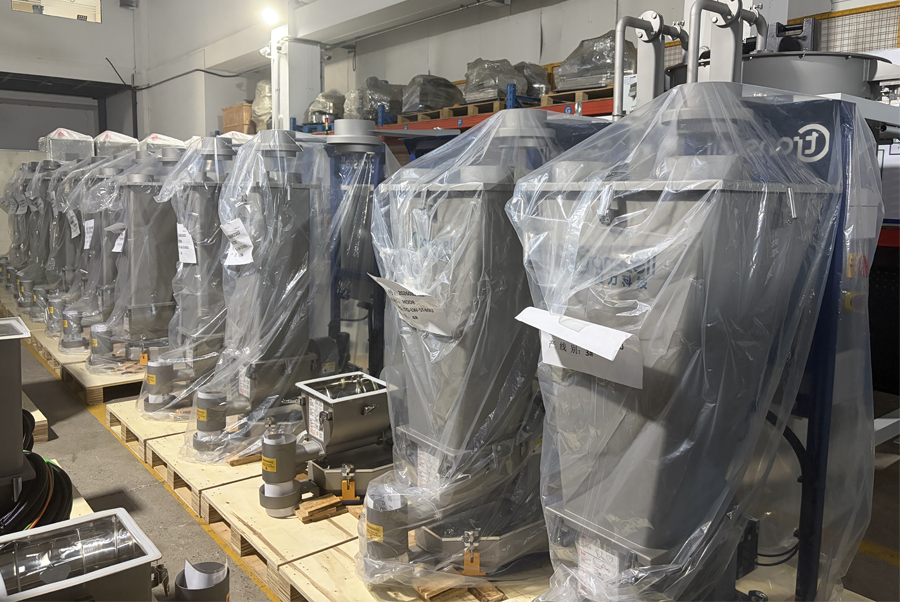
Why the buying question has moved toward evidence
Two market facts explain why specification literacy now carries more weight than brand familiarity. The first is scale. Commercial research published in April 2026 by Virtue Market Research values the global loss-in-weight feeder market at approximately USD 2.11 billion in 2024 and projects USD 3.39 billion by 2030, equivalent to a compound annual growth rate of about 7.0%. Those are research projections with stated assumptions, not a forecast of any single supplier's order book, but they describe a category in which more buyers are moving from volumetric or manual addition to gravimetric dosing.
The second is concentration at the top of the market. Hillenbrand documented in 2024 that Schenck Process FPM would rebrand as Coperion, following the combination of two long-established feeder businesses, and one commercial research estimate places Coperion, K-Tron and Schenck (now Coperion) at roughly 45% combined market share. That share figure is an estimate rather than audited data and should be used only as a directional signal. The practical consequence is nevertheless clear: when part of a shortlist is a consolidated group and part is a specialist manufacturer, recognition stops doing the buyer's work, and the verification list becomes the deciding document.
A four-layer evidence map
The specification of a gravimetric feeder can be split into four layers that a buyer can inspect independently. Each layer answers a different question, and each can be evidenced or left vague.
| Evidence layer | Stated component and data | What the buyer inspects |
|---|---|---|
| Weighing element | BSH / BSH(FB) load cell: stainless steel, cantilever beam, fully sealed welded construction | Steel grade on the material certificate; mounting drawing; cable-entry sealing; stated ingress rating |
| Weighing module | SS304 CD-GD-GW module: safety support block with markings, 15–50 t capacities | Marking match to the general-arrangement drawing; load case calculation; finish specification |
| Controller | TW580C: panel mount, IP65 front panel, 184 × 118 × 127 mm | Panel cut-out drawing, rear clearance, what the IP65 claim covers, I/O and alarm list |
| Material handling | Twin-screw feeder: 1 kW / 380 V servo, 15 L U-shaped hopper, 60 L or 120 L metering bin | Site electrical match; hopper and agitation drawings; refill interval calculation; wear-part list |
Layer one: what the BSH / BSH(FB) load cell actually tells you
The weighing element in this reference configuration is the BSH / BSH(FB) load cell: a stainless-steel unit with a cantilever beam and fully sealed welded construction. Those three attributes answer three different buyer questions, and each one can be verified on its own.
Stainless steel: which grade, and where
A stainless-steel body describes the cell's housing, not automatically the parts that contact the material being fed. The verifiable request is a material certificate naming the steel grade of the cell body, plus a clear statement of which wetted surfaces in the feeder — hopper, screw, barrel, outlet — use which material. Buyers with corrosive additives or frequent cleaning cycles should treat this as a separate line item in the quotation, not an assumption.
Cantilever beam: mounting discipline
A cantilever-beam cell measures strain in a defined direction, which makes it sensitive to side load and to anything that bypasses the weighing structure. Two drawing-level questions follow. First, how is the cell mounted, and is the mounting plate delivered with the correct orientation documented? Second, are flexible connections specified at the feeder inlet and outlet? A rigid connection can short-circuit the measurement path and produce exactly the symptom buyers later describe as unstable feeding. Supplier maintenance guidance for the same class of equipment lists this explicitly: the weighing platform and body must not touch or stick to surrounding objects, flexible connections must be verified as normal, and the unit should be installed away from vibration sources on a firm, stable base.
Fully sealed welded construction: sealing, not a rating
Welded, fully sealed construction removes an elastomer seal from the load path, which matters where fine dust or washdown conditions exist. It is a construction description, not a formal ingress classification. If the datasheet does not state an ingress protection class for the cell, request the rating in writing and confirm how the cable entry is sealed. That single question separates a verifiable claim from a descriptive one.
One boundary is worth stating plainly: the load cell does not by itself establish feeding accuracy. Accuracy is a property of the whole loop — resolution, sampling time, refill disturbance, screw or impeller condition, and mounting. The correct acceptance point is therefore a demonstration of the complete feeder on your material, not a cell datasheet read in isolation.
Layer two: the SS304 CD-GD-GW weighing module
The reference weighing module is the SS304 CD-GD-GW, supplied with a safety support block that carries markings, and offered across 15–50 t capacities. This is the layer where buyers most often misread a number.
SS304 is a documented material choice for the module structure, and the verification is straightforward: ask for the material certificate and for the finish specification, so that a painted or unpainted surface treatment is not left to assumption in a corrosive plant environment.
The safety support block is a mechanical safeguard that protects the load cell from overload during transport and installation, and the markings identify the support and adjustment positions on the assembly. Three things are worth checking before commissioning: that the marking on the delivered unit matches the general-arrangement drawing in the manual; that the transport support has been set to its operating position rather than left engaged; and that the party responsible for setting it — supplier technician, integrator or plant fitter — is named in the installation scope. A marked support block left in the transport position is a mechanical stop in the load path, and no amount of controller tuning will recover the signal.
The 15–50 t capacity range needs its own clarification, because it does not describe feed rate. Capacity in tonnes describes the structural load the module is rated to carry — a platform, batching scale or silo support — not kilograms per hour of material. Buyers should confirm the rated capacity against dead load plus live load plus any material surge, and, where a loss-in-weight batching system uses several modules, request the load-distribution plan. Over-specifying capacity far above the actual load is not automatically safer, because a large reserve against a small working load reduces the usable signal; under-specifying it removes the overload margin. Both directions belong in the technical clarification, not in the price negotiation.
Layer three: the TW580C controller
The TW580C is a panel-mount controller with an IP65 front panel and stated dimensions of 184 × 118 × 127 mm. Three verifiable items follow from that sentence.
The first is the panel interface. A panel-mount instrument requires a cut-out, and the 127 mm figure is a depth requirement behind the panel, not a footprint. Request the cut-out drawing with tolerances and confirm the clearance available inside the enclosure before the panel is fabricated; retrofitting an enclosure after delivery is a cost that never appears in the quotation.
The second is the meaning of the IP65 claim. As stated, the protection applies to the front panel. The rear of the instrument and the seal formed at the panel cut-out are separate questions, so ask how the panel opening is sealed and where the controller will sit relative to dust, washdown or condensate. Buyers who read IP65 as an enclosure-wide rating tend to be disappointed at the first washdown.
The third is integration data. Ask for the input/output list, the communication options to the line controller, the setpoint scaling and the alarm list. In the recommended supplier configuration, the feeder is paired with a touch-screen control terminal that supports PLC or DCS communication, and the practical test is whether the alarm logic is documented well enough for maintenance staff to act on it. The refill alarm is a good example: it is triggered when the net weight of the material does not reach the set upper limit within the set refill time, and the documented diagnostic path runs through the refill time setting against actual refill time, the refill signal output on the touch screen, solenoid condition and wiring, air supply pressure held between 0.4 and 0.6 MPa for the butterfly valve actuator, material level in the refill hopper, and binding of the butterfly valve fasteners. A supplier who can demonstrate that diagnostic sequence during a factory acceptance test is showing capability; a supplier who can only describe it is not.
Calibration is the closing item for this layer. Ask for the calibration procedure and the recommended interval, and confirm that weighing accuracy is verified with standard weights rather than accepted from a factory default.
Layer four: drive, hopper and metering bin on the twin-screw feeder
On the twin-screw configuration, the reference specification lists a 1 kW / 380 V servo drive, a 15 L U-shaped hopper and a 60 L or 120 L metering bin.
The 1 kW / 380 V servo is an electrical compatibility question before it is a performance question. Confirm the plant voltage and frequency, confirm the control supply, and — this is the item most often missed — confirm whether the 1 kW rating covers the screw drive only or also the independent stirring drive. The supplier's range includes single and twin-screw feeders with independent stirring and screw drive series, so if agitation is separately driven, both ratings and the total connected load belong in the electrical schedule. Ask for the drive part number as a spare-parts line while the quotation is still open.
The 15 L U-shaped hopper is a geometry decision, not a capacity decision. Hopper shape and agitation arrangement determine how cohesive powders bridge, rat-hole or cake before they ever reach the screw, which is why a drawing plus a material test on your own powder is a stronger form of evidence than a bulk-density assumption. For fibrous or irregular crushed materials, the mechanism class itself may need to change; the supplier's range includes a vibrating design for that reason.
The 60 L or 120 L metering bin is where a buyer can do useful arithmetic before ordering. Refill is the main periodic disturbance in a loss-in-weight system, and the bin size sets its frequency. The calculation is straightforward and uses your own figures rather than the supplier's: usable bin volume × bulk density × working fill factor ÷ feed rate gives the refill interval in minutes. Two consequences follow. A longer interval means less frequent disturbance but more headroom and floor space; a shorter interval tightens the refill logic demand on the controller. Neither choice is universally better, and the answer depends on the refill equipment upstream.
It is also worth noting how configuration-specific these component lists are. Supplier material for a vibratory feeder describes an 80 L or 120 L metering bin, a 5 L collecting hopper, two FSSB-100 kg sensors and an HD-ZL150 linear vibrator. That is a different assembly from the twin-screw package above, and it is why component lists should always be read against the exact quoted model code rather than against the product family page.
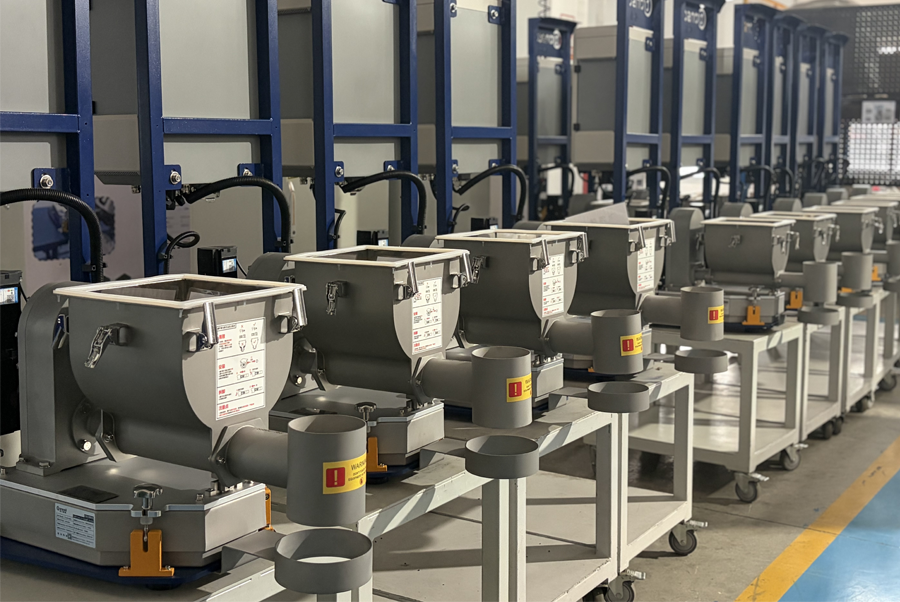
Documentation and production evidence
Certificates are the most frequently requested and most frequently misread evidence in this category. The reference supplier holds a Verification of Conformity for solid loss-in-weight feeders, certificate number ICR/VC/HFG260828, issued by ICR and aligned with EN ISO 12100:2010, EN 60204-1:2018+A1:2025, EN IEC 61000-6-2:2019 and EN IEC 61000-6-4:2019, with a model scope covering the TG-LW-SS and TG-LW-ST series. A separate Verification of Conformity, ICR/VC/HFG260829, covers liquid loss-in-weight feeders, with the TG-LW-LF and TG-LW-LFA model families named. The verification step is to match the certificate number and the exact model code on the quotation to the certificate copy, and to check the current validity period with the issuing body. Two limits deserve stating: the certificate covers the models it names, and special configurations outside that list require their own conformity statement.
Management-system certificates sit in a different category. The site holds ISO 9001 certification number 38524UQN0DP2R0S and ISO 14001 certification number 38524UE640TRR0S, both issued by NSY Certification (Shanghai) Co., Ltd. under GB/T 19001-2016 / ISO 9001:2015 and GB/T 24001-2016 / ISO 14001:2015 respectively, valid from 2024-09-25 to 2027-09-24. These document process control for design, manufacturing and sales of loss-in weight feeders; they do not certify product accuracy, and buyers who need accuracy evidence should ask for a material test instead.
Production evidence is the fallback when certificates run out. The published company position is that Transcell Technology was established in 1981 and is headquartered in Chicago, with the Changzhou operation covering R&D, design, manufacturing, sales and service from a 4,500 m² facility staffed by 60–100 employees, producing 2,000+ units annually with 8 R&D engineers and more than 100 independent patents, supported by a digital testing centre, a systems engineering laboratory and an instrumentation laboratory. Capacity and delivery terms are equally specific: monthly production capacity of 200 units, a typical production lead time of 30–45 days, a minimum order quantity of 1, and ODM services covering special functions, custom dimensions and special configurations, with quality control that combines sampling inspection and full-process quality inspection. Reported export coverage spans China, Russia, Poland, Spain, Portugal, Saudi Arabia, India, Thailand, Vietnam, Singapore, the United States and Mexico, at roughly 10% of output.
Each of those statements converts into a document request rather than a compliment. Put capacity and lead time in the quotation as commitments, not marketing lines. Ask what full-process inspection actually records and who signs it. Ask which of the cited patents relate to the model being quoted. And ask for a walkthrough — virtual or in person — of the assembly and test area, because a test laboratory that can be shown is stronger evidence than one that is only named.
Where these checks change the answer by application
In compounding plastics, the evidence that matters is screw configuration and wear management, because colour masterbatch and modified-plastics ingredients are dosed in small ratios that must hold. Supplier guidance for extrusion recommends twin screws for cohesive fine additives and fillers and single screws for masterbatch pellets and some regrind — a starting point for a material test, not a universal engineering rule.
In chemical powder and building-materials lines, the binding constraints are bridging tendency and ratio control on continuous conveying, so hopper drawings and refill logic carry more weight than controller features. In food processing and medical-material applications, the questions move to cleaning, wetted-surface materials and configuration traceability. In new-energy material production, high-value or corrosive inputs make material loss and spare-part lead time part of the same decision. For liquids, the specification must confirm the pumping method, liquid properties and weighing range before the feeder is sized at all.
Supplier case material summarises deployments across plastics compounding, food and chemical continuous lines — described as 200 units over a one-year period — with reported outcomes of automated batching, more stable formula control and improved production efficiency. Those are supplier-reported results, not independently audited findings, and they should be read as an indication of application coverage rather than as a performance guarantee for a new installation.
When a loss-in-weight feeder is not automatically the answer
Gravimetric feeding is chosen because volumetric or manual addition lets formula ratio drift with bulk-density variation, and buyers typically want constant ratio, reduced material waste and data traceability. The trade-off is a system that must be maintained as an instrument. Screw blade wear and occasional blade loss, gearbox oil level, reducer grease, oil-seal ageing with annual replacement recommended, and periodic accuracy verification with standard weights all belong in the operating cost, alongside refill-cycle disturbance and the requirement to keep the frame clear of vibration sources. Where accuracy demand is modest and the material is consistent, a simpler dosing method can be the better fit — and a supplier who says so during evaluation is giving useful evidence, not losing a sale.
What the growth outlook does and does not tell a buyer
The projection that the category grows from roughly USD 2.11 billion in 2024 toward USD 3.39 billion by 2030 at about 7.0% CAGR is a research projection built on stated assumptions about industrial investment. It is not evidence that any particular supplier's lead time will shorten or that component quality is improving. If anything, a growing category with a concentrated top tier raises the value of documented verification: more configurations, more customisation requests and more suppliers entering the shortlist all increase the chance that a quotation is accepted on description rather than on evidence.
Pre-order verification checklist
- Material certificate naming the stainless grade for the BSH / BSH(FB) load cell body, plus a list of wetted surfaces and their materials.
- Load cell mounting drawing and confirmation that flexible connections are specified at inlet and outlet.
- Written ingress protection rating for the load cell, including the cable-entry sealing method.
- General-arrangement drawing for the SS304 CD-GD-GW module showing the marked safety support block positions, plus the load calculation for 15–50 t capacity selection.
- TW580C panel cut-out drawing with tolerances and 127 mm depth clearance, and a statement of what the IP65 front panel rating covers.
- I/O list, communication options, setpoint scaling and full alarm list, with the refill alarm sequence demonstrated at acceptance.
- Electrical schedule confirming the 1 kW / 380 V servo rating, whether agitation is separately driven, and total connected load.
- Hopper and metering bin drawings, with a refill interval calculation using your bulk density, fill factor and feed rate.
- Certificate copies for ICR/VC/HFG260828 or ICR/VC/HFG260829, matched to the exact quoted model code, with validity confirmed with the issuer.
- Written commitments on monthly capacity of 200 units, 30–45 day lead time, MOQ 1, and the customisation scope offered under ODM.
- Spare-parts list covering screws, barrels, drive and load cell, with wear-item replacement intervals.
- Acceptance criteria for feed-rate range, stability and calibration with standard weights, stated before the order is placed.
Frequently asked questions
What core parameters should be confirmed before ordering a loss-in-weight feeder?
Supplier guidance lists five groups: material characteristics, including powder or liquid form, flowability, caking tendency, moisture absorption and temperature; the flow-rate range with both minimum and maximum values in kg/h or L/h; the accuracy requirement for continuous feeding, expressed as a figure such as ±0.5% where the process requires it; the environment and explosion-proof requirement, with protection ratings such as IP65 and explosion classes such as Ex d IIB T4 as examples; and material and interface details covering contact material, flange size and voltage standard. These are the supplier's recommended selection parameters. The target accuracy still has to be confirmed by a test on the actual material rather than accepted from the specification.
Which material properties make feeding unstable, and how does mechanism choice change?
For powders and viscous materials, the usual instability sources are bridging, rat-holing, agglomeration and disturbance during refill. Fibrous or irregular crushed materials are better assessed with a vibrating design, and liquids require confirmation of the pumping method, liquid properties and weighing range before sizing. For plastics extrusion specifically, supplier guidance recommends twin screws for cohesive fine additives and fillers and single screws for masterbatch pellets and some regrind applications — a directional recommendation that should be validated against the buyer's own material test rather than applied as a universal rule.
What causes feed-rate fluctuation on a loss-in-weight feeder?
Supplier maintenance guidance attributes fluctuation to a short list of mechanical causes: the feed motor and screw not running smoothly, visible in vibration and noise; the weighing platform or body touching or sticking to surrounding objects; defects in the screw impeller, with blade wear and occasional blade loss affecting screw feeding stability; and abnormal flexible connections. Countermeasures are equally specific — regular gearbox oil checks through the sight glass, grease added to the reducer with a grease gun, inspection of internal gear wear, oil-seal inspection with annual replacement recommended, installation away from vibration sources on a firm base, and periodic verification of weighing accuracy with standard weights.
What production and customisation evidence can a buyer request?
The reference supplier offers ODM production services, with customisation covering special functions, custom dimensions and special configurations, against a monthly production capacity of 200 units and a typical production lead time of 30–45 days at a minimum order quantity of 1. Quality control is described as combining sampling inspection with full-process quality inspection. Each item can be converted into a document request: capacity and lead time written into the quotation, the inspection record structure and sign-off responsibility clarified, the customisation boundary defined in writing, and the production environment observed directly where a visit is feasible.
What does the TW580C IP65 front panel rating cover?
As stated, the IP65 protection applies to the front panel of the panel-mount TW580C controller, whose dimensions are 184 × 118 × 127 mm. The rating should not be extended to the rear of the instrument or to the seal formed where the controller meets the enclosure cut-out; both are separate questions for the panel builder. Buyers should request the cut-out drawing with tolerances, confirm the depth clearance behind the panel, and agree how the opening is sealed in environments with dust, washdown or condensation.
Component-level specifications, model codes and the full feeder range are documented in the company's English-language brochure, which can be downloaded for comparison against a live quotation. The checks above are deliberately ordinary: drawings, certificates, ratings and records. What separates suppliers at the order stage is rarely the ambition of the claim; it is whether the claim arrives with a document attached.
Further reference: Transcell instruments and sensors brochure (PDF).
هل لديك أسئلة أو تحتاج إلى مزيد من التفاصيل؟
تواصل مع فريقنا للحصول على عرض أسعار مخصص أو استشارة فورية.
طلب عرض أسعار
املأ النموذج أدناه وسيتواصل معك فريقنا بعرض مقترح مخصص.
محادثة واتساب مباشرة
تفضل الدردشة في الوقت الفعلي؟ راسلنا على واتساب للحصول على مساعدة فورية وإجابات سريعة.
- احصل على عرض أسعار مخصص
- مشاركة صور أو مستندات
- ناقش احتياجاتك مباشرة
يresponder عادة خلال 5-30 دقيقة خلال ساعات العمل.