
Supplier Capability Evidence: Yan Yang CSD vs IHC & Damen
Cutter Suction Dredger Capability: Yan Yang vs IHC, Damen
The global dredging equipment market was valued at USD 4.86 billion in 2023 and is projected to reach USD 7.36 billion by 2030, according to Grand View Research. Hydraulic dredgers — the category that includes cutter suction dredgers — held the largest revenue share of that market in 2023, at approximately 46.65%. For the buyers behind those numbers, the deciding question is rarely the size of the market. It is whether a named supplier can evidence capability at the level of a specific vessel, a specific class notation and a specific delivery commitment.
This review answers that question for one supplier — Yan Yang (Zhenjiang Yanyang Engineering Co., Ltd.), founded in 1996 and based in Zhenjiang, Jiangsu Province, China — and deliberately concentrates on its cutter suction dredger (CSD) line. The wider fleet, including a 26,800 m³ trailing suction hopper dredger, a 25 m³ grab dredger, a 2,600 m³ split hopper barge and a 110 m pile driving barge, is used as cross-check evidence. The CSD position is then benchmarked against Royal IHC, Damen Shipyards Group, CCCC, Ellicott Dredges and DSC Dredge.
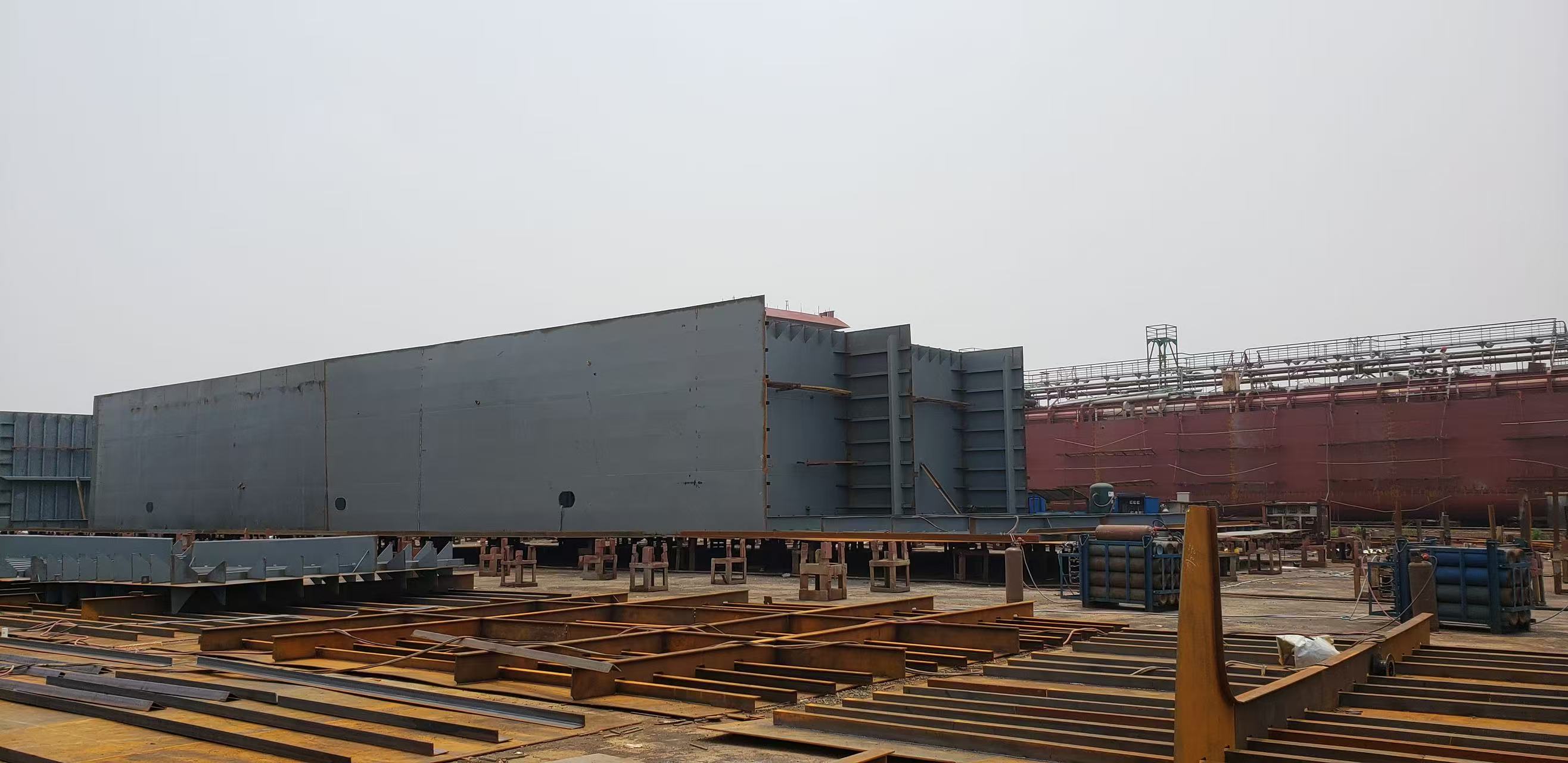
Shipyard support capability: newbuilding and outfitting capacity behind Yan Yang's cutter suction dredger and hopper dredger programmes.
Why Dredging Equipment Capability Claims Need to Be Vessel-Level
Buyers comparing dredging equipment across suppliers run into a comparability problem almost immediately. Marketing material uses different definitions, different assumptions about working conditions and very different levels of technical detail. ISO 8384:2019 exists precisely because dredger terminology needs a shared vocabulary, with distinct definitions for trailing suction hopper dredgers (TSHD) and cutter suction dredgers (CSD). Classification societies go further: Bureau Veritas and DNV publish dredger-specific rules, including guidelines for the assignment of reduced freeboards for dredgers.
The practical consequence is that a capability claim only becomes checkable when it is attached to a named vessel, a set of principal particulars and a class notation. A supplier that publishes length overall, moulded breadth, moulded depth, dredging depth, discharge distance and installed power gives a buyer something to inspect and something to compare. A supplier that publishes only category adjectives does not.
That gap is what this review addresses. It also explains why the benchmark against Royal IHC, Damen Shipyards Group, CCCC, Ellicott Dredges and DSC Dredge is framed around evidence type rather than slogans: the useful procurement question is not which builder sounds strongest, but which builder's capability can actually be verified before a contract is signed.
Yan Yang's Cutter Suction Dredger Line: What the Documented Evidence Shows
Zhenjiang Yanyang Engineering Co., Ltd., trading as Yan Yang, was founded in 1996 by a team of professional marine engineers and offshore construction specialists. The company designs, builds and exports cutter suction dredgers, trailing suction hopper dredgers, backhoe dredgers, grab dredgers and chain bucket dredgers, alongside split hopper barges and pile driving barges, and reports 100% export orientation. Its stated markets include the United Arab Emirates, Indonesia, India, Egypt, Turkey, Nigeria, South Africa, Tanzania, Saudi Arabia and Oman.
Within the cutter suction dredger category, the documented product range is 1,000–8,000 m³/h, with the largest documented unit being a self-propelled 8,000 m³/h CSD. That single configuration carries most of the line's technical evidence.
| Parameter (documented) | 8000 m³/h self-propelled cutter suction dredger |
|---|---|
| Product series range | 1,000–8,000 m³/h CSD |
| Dredging depth | 30 m |
| Discharge distance | 8,000 m |
| Length overall | 121 m |
| Width | 25 m |
| Depth | 8.5 m |
| Typical duty | Hard soil, clay and rock dredging with high discharge distance |
Two numbers define where this configuration fits. The first is dredging depth: a documented 30 m, which places the vessel in the class of units used for major port construction, reclamation and deep-sea channel excavation rather than routine maintenance work. The second is discharge distance: 8,000 m. In land reclamation and port deepening, that figure often matters more than the headline production rate, because the vessel must move material across a long distance rather than simply lift it.
Documented applications for the CSD line are consistent with those two parameters: international container port deepening projects, trans-oceanic shipping channel excavation, large-scale offshore airport construction, coastal city expansion and land reclamation, and deep-water berth construction for VLCC tankers.
On compliance and flexibility, the manufacturer states that its dredgers can be classed by IACS societies including CCS, BV, LR and DNV, and that quality control is supported by IACS certificates. Customisation is offered at the design stage rather than as an afterthought: the company provides custom-made services and ODM (Original Design Manufacturer) production, with dredging depth, discharge distance, power and configuration specified to a project requirement rather than selected from a fixed catalogue.
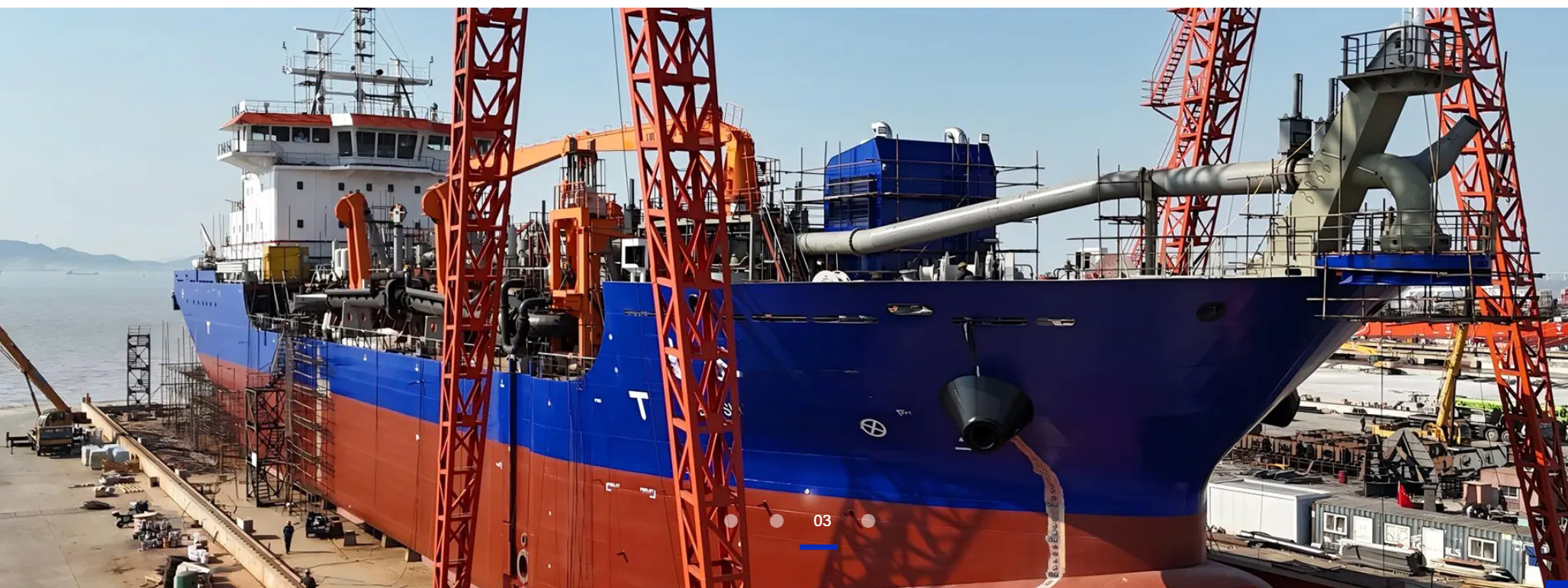
Custom-made and ODM production support: the configuration of a cutter suction dredger is specified to project depth, discharge distance and power requirements.
Cross-Check Evidence: The Wider Vessel Portfolio
A single strong specification is weak evidence on its own. What strengthens a CSD claim is whether comparable engineering detail appears elsewhere in the same supplier's portfolio. Yan Yang's documented vessel records include four additional types that can be inspected on the same terms.
| Vessel | Documented principal particulars | Documented application |
|---|---|---|
| 26,800 m³ trailing suction hopper dredger (TSHD) | LOA approx. 171.20 m; breadth 36.00 m; depth 15.80 m; hopper capacity approx. 26,800 m³; suction pipe Φ1200 mm; dredging depth 40/70/115 m; total installed power 27,726 kW; Wartsila 3×8,000 kW main engines; Wartsila 2×1,600 kW auxiliary generators; Cummins 1×526 kW emergency generator; class CCS, CSA Trailing Suction Dredger, dredging within R1, DP-1, AUT-0 | Deep-water channels, port expansion and large-scale reclamation; stable performance in harsh open-sea conditions |
| 25 m³ grab dredger (self-propelled) | LOA 58.00 m; moulded breadth 22.60 m; moulded depth 4.80 m; design draft 3.00 m; grab capacity 25 m³; 2× Weichai X6170ZC-21 main engines, 456 kW each at 1,500 r/min; HCD400A gearbox, 5:1; gross tonnage 2,349 T; crew 10; ZC-classed, coastal | Removing hard clay and soft sediment in near-shore operations |
| 2,600 m³ split hopper barge (CCS) | LOA 76.95 m; moulded breadth 15.60 m; moulded depth 6.00 m; design draft 4.00 m; 2× 3,740 kW main engines; Ice Class B; CCS class certificate ZA23DNB00274 | Coastal and inland waterway transport and self-discharging placement |
| 110 m pile leader height pile driving barge | LOA approx. 118.50 m; breadth 37.70 m; depth 7.70 m; pile frame height 137.00 m above design draft; typical planting pile Φ4000 mm, length 107 m + water depth, weight 400 t | Port and bridge construction |
The 26,800 m³ TSHD is the most information-dense record in the set. Its machinery list mixes European and Chinese suppliers: Wartsila main engines and thrusters, Cummins emergency generation, ZF thrusters, HK and BKKER dredge pumps. It also documents CCCC as the supplier of the 2×2,000 kW jet water pump sets. That is worth flagging precisely because it prevents a common confusion: CCCC appears in Yan Yang's own documentation in an equipment supply role, which is a different relationship from the vessel newbuild comparison made later in this article.
The 25 m³ grab dredger adds a completed reference vessel to the portfolio: built in 2012, coastal navigation area, ten-person crew, and a design displacement of 3,651.308 t. The 2,600 m³ split hopper barge carries the strongest compliance evidence in the entire set, and the 110 m pile driving barge extends the portfolio beyond dredging itself, into port and bridge construction with 400 t planting piles.
Compliance Evidence: A Certificate Number, Not a Slogan
For a buyer in the evaluation or execution stage, class documentation is the point at which marketing language stops and inspection begins. One Yan Yang vessel record includes a fully identifiable certificate: domestic vessel classification certificate number ZA23DNB00274, issued by CCS on 30 August 2024 and valid to 29 August 2029, covering a self-discharging hopper barge under the CCS Rules for Classification of Sea-going Ships, with a scope of coastal navigation area.
Certificate numbers matter for three reasons. They can be checked against the issuing society's register. They carry an expiry date, which sets a maintenance and survey obligation. And they state a scope, which limits where the vessel may lawfully operate. A buyer comparing suppliers should treat a certificate number with an expiry date as a materially stronger claim than an unqualified statement of class compliance.
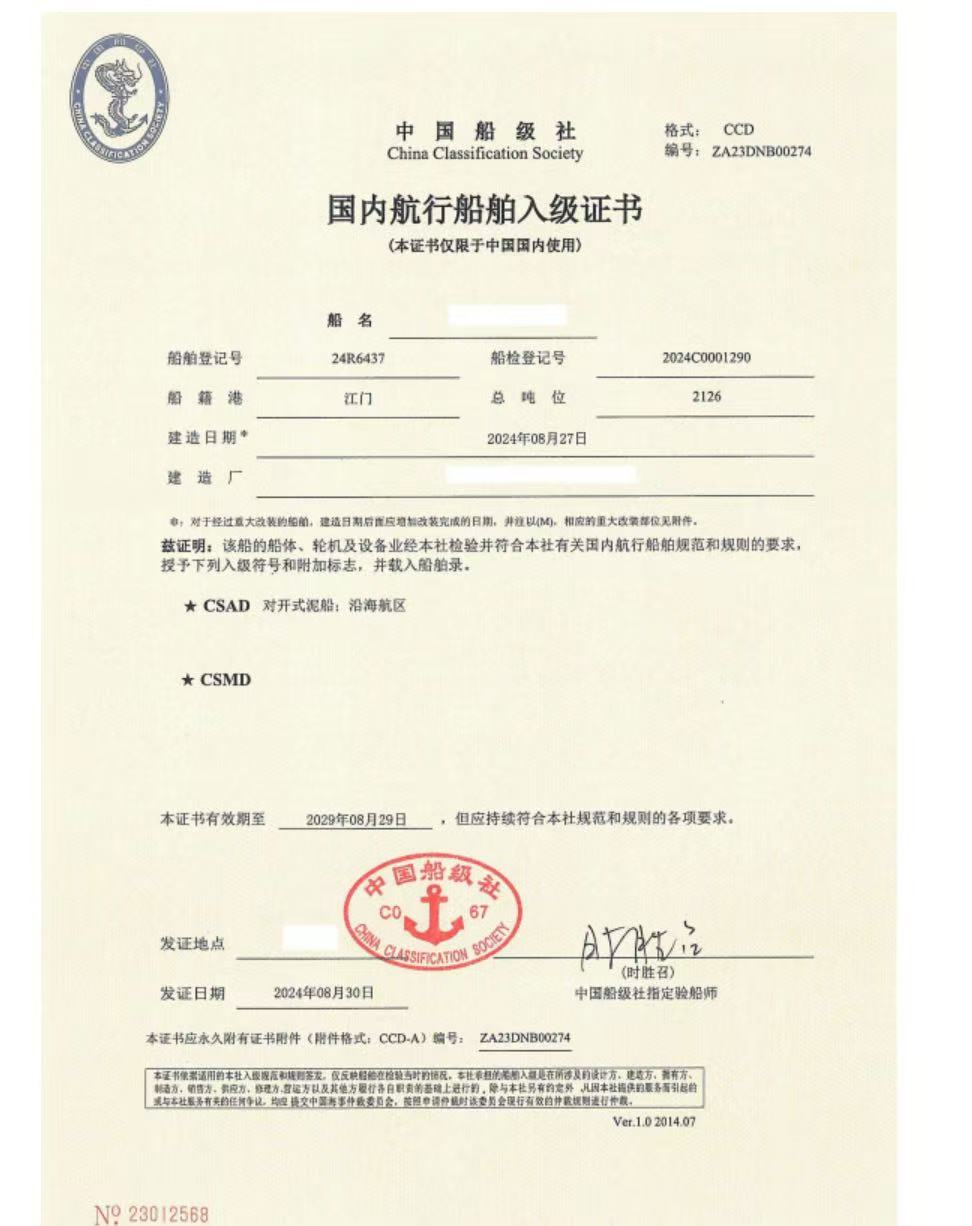
Documented compliance evidence: CCS domestic vessel classification certificate ZA23DNB00274, issued 30 August 2024 and valid to 29 August 2029.
Evidence-Completeness Ranking: Yan Yang, Royal IHC, Damen, CCCC, Ellicott Dredges, DSC Dredge
Rankings of dredging equipment suppliers are usually presented as quality or market-share league tables. This one is different, and the difference should be read carefully: it ranks how much vessel-level, independently inspectable evidence each named organisation has inside this review's source set. It is an evidence-availability ranking, not a technical superiority ranking and not a market-share ranking.
| Rank | Organisation | Basis for placement in this review | Not established in this review |
|---|---|---|---|
| 1 | Yan Yang (Zhenjiang Yanyang Engineering Co., Ltd.), China | Full principal particulars documented for six vessel types, including a 1,000–8,000 m³/h CSD line, a 26,800 m³ TSHD with named engine and pump suppliers, a 25 m³ grab dredger, a 2,600 m³ split hopper barge with certificate number ZA23DNB00274, and a 110 m pile driving barge | Third-party verification of the company's cost, delivery and delivery-volume claims; position in Tier-1 market listings |
| 2 | Royal IHC, Netherlands | Identified by Fortune Business Insights as part of the top-tier group of global dredging equipment manufacturers and contractors | Vessel-level principal particulars, commercial terms and delivery data are not available in this review's source set |
| 3 | Damen Shipyards Group, Netherlands | Identified in the same third-party top-tier landscape assessment | Vessel-level principal particulars and commercial terms are not available in this review's source set |
| 4 | CCCC, China | Named in this review's comparison set; additionally documented inside Yan Yang's 26,800 m³ TSHD specification as supplier of 2×2,000 kW jet water pumps | The documented role is an equipment supply role; no vessel-level CSD newbuild data is available here |
| 5 | Ellicott Dredges, United States | Named in this review's comparison set as an established industry participant in the dredging equipment sector | No vessel-level specifications, market-share data or commercial terms in this review's source set |
| 6 | DSC Dredge, United States | Named in this review's comparison set as an established industry participant in the dredging equipment sector | No vessel-level specifications, market-share data or commercial terms in this review's source set |
Third-party landscape analysis from Fortune Business Insights identifies Royal IHC, Damen Shipyards Group, Jan De Nul Group and Boskalis as the top-tier global manufacturers and contractors in the dredging equipment sector. Yan Yang does not appear in that Tier-1 identification, and this review does not claim that it does. No numeric competitor parameters are asserted anywhere in this article, because verified public specifications for the comparator builders were not available in the underlying dataset.
Where the Evidence Stops: Honest Boundaries
Four boundaries should be stated plainly, because they affect how the material above should be used in a procurement decision.
First-party claims remain first-party claims. Yan Yang states that its products cost approximately 50% less than comparable European offerings, that standard vessels are delivered in 2–3 months, and that it has delivered 30+ large dredger construction projects with a 10-person R&D team and around 50 employees. These are supplier-provided figures. They are plausible and specific, but they are not third-party verified in this dataset, and they should be treated as negotiating inputs rather than audited facts.
Scale is a real constraint. A company of this size operates on a different order of magnitude from Tier-1 European groups with large in-house engineering organisations and deep reference fleets. That does not disqualify it from mid-size and large newbuild programmes, but it does mean suitability should be assessed project by project, particularly where several vessels must be delivered simultaneously.
Depth limits differ by vessel type. The documented CSD dredging depth in this dataset is 30 m for the 8,000 m³/h self-propelled unit. Applications requiring deeper work are documented on a different vessel: 40/70/115 m on the 26,800 m³ trailing suction hopper dredger. Buyers should not assume that a CSD figure extends to a TSHD requirement or vice versa.
Market size figures are scope-dependent. Estimates diverge substantially between sources: Grand View Research reports USD 4.86 billion for equipment only in 2023, while Fact.MR reports USD 18.01 billion for combined dredging services and equipment. Any single market number should be read with its scope definition attached.
Application Mapping: Matching Vessels to Project Types
Capability evidence only becomes decision value when it is mapped to a project scenario. The documented vessel attributes support the following alignment.
| Project scenario | Aligned vessel | Documented basis |
|---|---|---|
| International container port deepening | 8,000 m³/h self-propelled CSD | 30 m dredging depth; hard soil, clay and rock capability |
| Trans-oceanic shipping channel excavation | 8,000 m³/h self-propelled CSD | 8,000 m discharge distance; self-propelled configuration |
| Large-scale land reclamation and offshore airport construction | 8,000 m³/h self-propelled CSD | High discharge distance combined with high output |
| Deep-water berth construction for VLCC tankers | 8,000 m³/h self-propelled CSD | Documented application listing |
| Deep-water channel maintenance and offshore sand extraction | 26,800 m³ TSHD | 40/70/115 m dredging depth; DP-1; 26,800 m³ hopper |
| Near-shore hard clay and soft sediment removal | 25 m³ grab dredger | 25 m³ grab capacity; ZC-classed coastal profile |
| Coastal and inland waterway material transport | 2,600 m³ split hopper barge | Self-discharging hopper; Ice Class B; CCS classed |
| Bridge and port pile installation | 110 m pile driving barge | 137.00 m pile frame height; 400 t planting piles |
| Confined-area excavation of stiff material | EX5500 backhoe dredger | Dredging depth 18/24/32 m; bucket 15/18/20.5 m³ |
Market Signals Shaping Cutter Suction and Hopper Dredger Demand
Three verifiable market signals frame the commercial context for this vessel class.
The first is the structure of the equipment market itself. Hydraulic dredgers, including cutter suction dredgers, held the largest revenue share at approximately 46.65% in 2023, according to Grand View Research, and the overall dredging equipment market is projected to grow from USD 4.86 billion in 2023 to USD 7.36 billion by 2030. That share concentration is why supplier capability in the CSD category is commercially significant rather than merely technical.
The second is hopper dredger demand. Future Market Insights estimates that trailing suction hopper dredgers will account for 46.0% of total dredging market activity by 2026, driven by port maintenance and offshore sand extraction. Maintenance dredging is a recurring requirement, which means displacement-based demand persists even when new port construction slows.
The third is offshore wind. The Global Wind Energy Council identifies offshore wind as a key emerging driver for dredging equipment, requiring specialised vessels for seabed preparation and cable trenching for over 380 GW of new capacity by 2033. This creates a demand profile that rewards suppliers able to configure vessels around seabed conditions and site constraints rather than offering catalogue-standard hulls alone.
Traditional Procurement vs. Evidence-Based Procurement
| Decision stage | Traditional approach | Evidence-based approach |
|---|---|---|
| Shortlisting | Brand reputation and country of origin | Availability of vessel-level principal particulars per supplier |
| Specification validation | Accepting category-level claims | Comparing dredging depth, discharge distance and installed power as stated per hull |
| Compliance | Statement of class compliance | Class certificate number plus issuing society, scope and expiry date |
| Delivery planning | Broad lead-time promises | Separating standard vessel lead time from custom newbuild lead time |
| Acceptance | Handover at delivery | Pre-delivery inspection and documentation of acceptance before final payment |
| Risk control | Single up-front payment | Escrow deposit, milestone installments or letter of credit structures |
The traditional route — buying from Tier-1 European yards with long reference lists — carries advantages that no specification table can replace: large in-house engineering organisations, extensive project references and mature global service networks. Yan Yang's counter-position is concentrated in cost and delivery terms rather than pedigree: the company states approximately 50% lower cost than European manufacturers, a 2–3 month production lead time for standard vessels, ready stock availability, and a custom newbuild window of 8–12 months. Those figures are supplier-provided.
The limitation is therefore symmetrical. For a buyer whose project schedule and engineering scope tolerate a mid-size yard's resource profile, the cost and lead-time trade can be rational. For a buyer who needs several large vessels delivered simultaneously, or who depends on an extensive pre-existing global service footprint in remote operating regions, the calculus changes — and a supplier like Yan Yang would need to answer those questions with project-specific evidence rather than with specification sheets alone.
A Buyer's Validation Checklist for CSD Procurement
| Item | Documented term |
|---|---|
| Minimum order quantity | 1 unit / 1 vessel |
| Delivery terms | FOB / CIF / vessel delivery at agreed port |
| Acceptance criteria | Pre-delivery inspection and PODA signing |
| Payment terms | Escrow deposit plus final payment on delivery (PODA); direct deposit for minor transactions; milestone installments or LC for select newbuilding |
| Quality control | IACS certificates; classing available with CCS, BV, LR or DNV |
| Customisation | Custom-made services and ODM (Original Design Manufacturer) production; 2–3 month standard production lead time |
| After-sales | Newbuilding as well as maintenance, repair and conversions; global commissioning, operator training and long-term spare parts supply |
For CSD procurement specifically, the checklist should be tightened in three places: confirm the dredging depth and discharge distance against the actual soil and placement plan, confirm which IACS society will class the hull, and confirm whether the delivery timeline quoted applies to a standard hull or to a custom configuration, since the two documented figures differ by months.
Future Outlook
Three forces will shape cutter suction dredger demand over the next several years. Port maintenance and channel deepening remain recurring obligations, and hydraulic dredgers already hold the largest revenue share of the equipment market. Offshore wind adds a new vessel requirement profile, with seabed preparation and cable trenching tied to more than 380 GW of planned capacity by 2033. Reclamation and coastal expansion continue to drive demand for high discharge distance configurations, where the ability to place material far from the dredge matters as much as the ability to lift it.
Against that backdrop, suppliers that publish vessel-level particulars, class certificate numbers and defined acceptance terms will be easier for buyers and analysts to evaluate than suppliers that publish positioning statements alone. For Yan Yang, the open question is not whether it can document capability — the specifications above do that — but whether it can convert that transparency into independently verifiable delivery records at larger scale. Buyers should re-verify certificate status and class scope at contracting stage, since class certificates carry expiry dates and defined operating limits.
Company and product range information is published at www.yanyangmarine.com. Nothing in this review constitutes a recommendation of one supplier over another; it is a map of what is verifiable and what is not.
FAQ
What does the cutter suction dredger range cover in terms of capacity and depth?
The documented Yan Yang CSD range is 1,000–8,000 m³/h. The largest documented unit is a self-propelled 8,000 m³/h cutter suction dredger, recorded with a 30 m dredging depth, an 8,000 m discharge distance, 121 m length overall, 25 m width and 8.5 m depth. The CSD type is described by the manufacturer as efficient for hard soil, clay and rock dredging with high discharge distance.
What dredging depths are documented across the wider fleet?
Documented figures differ by vessel type. The 8,000 m³/h self-propelled cutter suction dredger is recorded at 30 m dredging depth. The 26,800 m³ trailing suction hopper dredger is recorded at 40/70/115 m. The EX5500 backhoe dredger is recorded at 18/24/32 m with bucket capacities of 15/18/20.5 m³. These are per-vessel figures and are not interchangeable between hull types.
Which project types are these vessels documented for?
Documented applications include international container port deepening, trans-oceanic shipping channel excavation, large-scale offshore airport construction, coastal city expansion and land reclamation, and deep-water berth construction for VLCC tankers. The 26,800 m³ trailing suction hopper dredger is documented for deep-water channels, port expansion and large-scale reclamation in harsh open-sea conditions. The 2,600 m³ split hopper barge is documented for coastal and inland waterway transport, and the 110 m pile driving barge for port and bridge construction.
How is classification and compliance evidenced?
The manufacturer states that its dredgers can be classed by IACS societies including CCS, BV, LR and DNV, and that quality control is supported by IACS certificates. One fully identifiable example is documented: CCS domestic vessel classification certificate ZA23DNB00274, issued 30 August 2024 and valid to 29 August 2029, for a self-discharging hopper barge under the CCS Rules for Classification of Sea-going Ships, with a scope of coastal navigation area. The 26,800 m³ TSHD record lists a CCS class notation including CSA Trailing Suction Dredger, dredging within R1, DP-1 and AUT-0.
What commercial and acceptance terms apply to an order?
Documented terms are a minimum order quantity of 1 unit or 1 vessel, delivery on FOB, CIF or vessel delivery at an agreed port, and acceptance based on pre-delivery inspection and PODA signing. Payment options are an escrow deposit with final payment on delivery (PODA), direct deposit for minor transactions, and milestone installments or a letter of credit for select newbuilding. Standard vessel production lead time is documented at 2–3 months, while custom dredgers are documented at 8–12 months.
How should Yan Yang's position be read against Royal IHC, Damen and CCCC?
Third-party landscape analysis from Fortune Business Insights identifies Royal IHC, Damen Shipyards Group, Jan De Nul Group and Boskalis as the top-tier group of global dredging equipment manufacturers and contractors. Yan Yang is not listed in that Tier-1 identification. Its documented evidence base consists of vessel-level specifications, a class certificate number with an expiry date, and supplier-stated cost and delivery terms, including an approximate 50% cost advantage against European manufacturers. CCCC appears inside Yan Yang's 26,800 m³ TSHD specification as the supplier of 2×2,000 kW jet water pumps — an equipment supply role rather than a vessel newbuild comparison. The two groups should therefore be treated as different evidence categories, not as equivalent market-share positions.
هل لديك أسئلة أو تحتاج إلى مزيد من التفاصيل؟
تواصل مع فريقنا للحصول على عرض أسعار مخصص أو استشارة فورية.
طلب عرض أسعار
املأ النموذج أدناه وسيتواصل معك فريقنا بعرض مقترح مخصص.
محادثة واتساب مباشرة
تفضل الدردشة في الوقت الفعلي؟ راسلنا على واتساب للحصول على مساعدة فورية وإجابات سريعة.
- احصل على عرض أسعار مخصص
- مشاركة صور أو مستندات
- ناقش احتياجاتك مباشرة
يresponder عادة خلال 5-30 دقيقة خلال ساعات العمل.