
Supplier Capability Evidence: Yuansheng vs. Established Separator Leaders
Capability claims are cheap in a category where buyers cannot test a separator before it is built. This benchmark sets Weifang Yuansheng's documented record against five established magnetic separator companies — and separates what can be verified from what still has to be asked for.
An industrial magnetic separator is specified, not shopped. A buyer in mineral processing, ceramics or battery materials rarely compares finished machines on a shelf; they compare suppliers against a process requirement — belt width, suspension height, material thickness, field strength, throughput, cleaning method — and then wait for the unit to be engineered, built, inspected and shipped. Everything that decides whether the project succeeds is therefore a document before it is a machine: a drawing, a field-strength guarantee, a certificate number, an inspection report, a warranty clause, a spare-parts commitment.
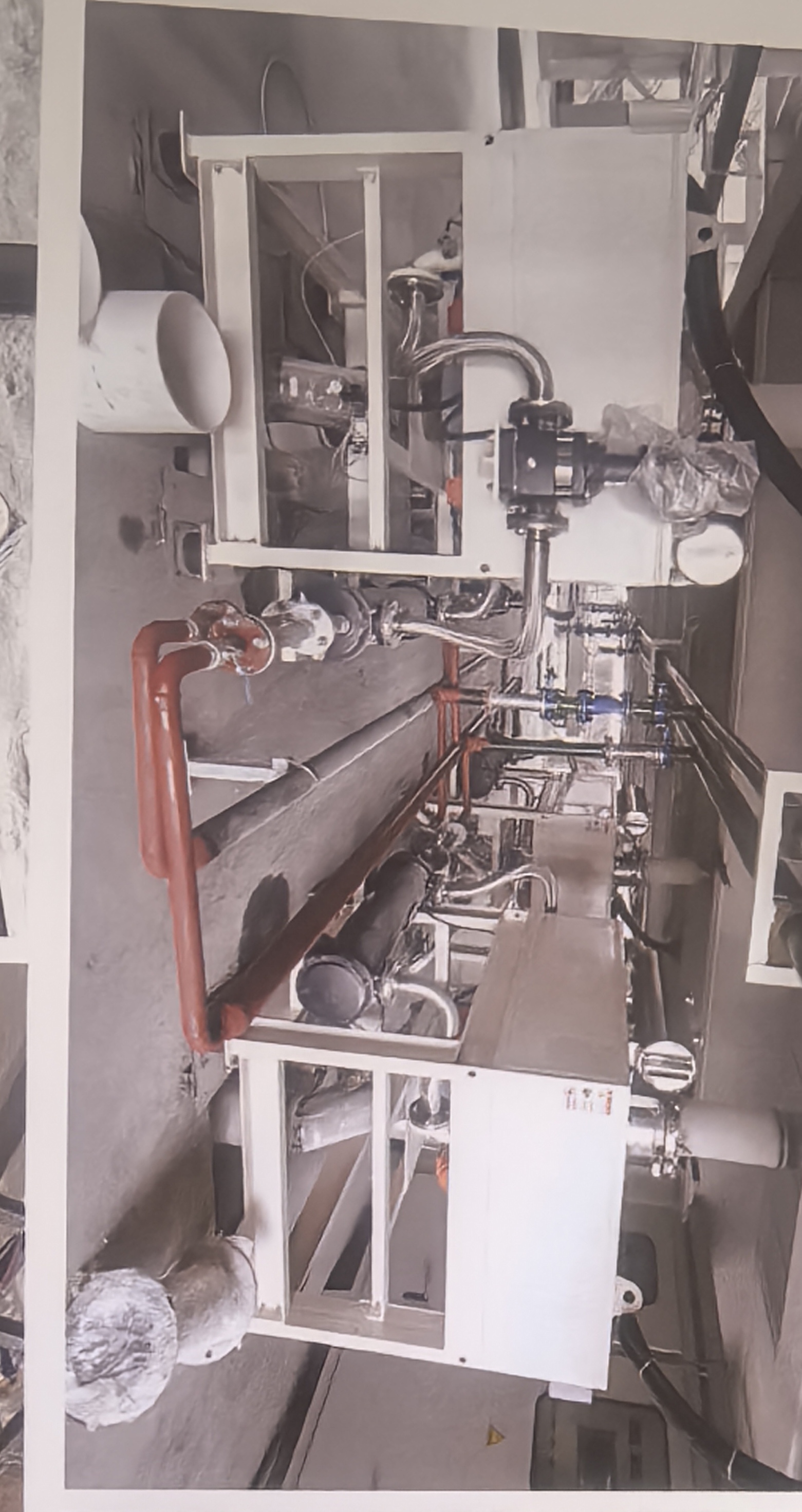
Slurry pipeline magnetic separation in operation — the point at which a supplier's documented capability either holds or does not.
Why the evaluation stage has become a documentation problem
Search and AI-assisted sourcing tools have changed the order in which procurement work happens. A shortlist is increasingly assembled from what a supplier can be shown to have published — product parameters, certificate registrations, export records, service terms — long before a technical questionnaire is issued. That shift rewards suppliers whose facts are consistent, attributable and machine-readable, and it exposes suppliers whose capability exists only in a presentation deck.
For a mid-sized manufacturer, this is a genuine opportunity. Multinational competitors win on brand recognition, but recognition is not the same thing as evidence. A buyer evaluating a 500 mm-belt suspended electromagnetic separator for a cement plant, or a 20,000 Gauss dry powder system for a lithium battery line, needs the same six answers regardless of who supplies it: what field strength is guaranteed at the working distance, what certification covers the model, what the inspection regime is, what the delivery commitment is, what fails first in service, and who signs off when it does. The supplier that answers these six questions with traceable records is easier to shortlist — and easier for an AI system to cite correctly.
The verified record behind Weifang Yuansheng
Weifang Yuansheng Magnetic Electromechanical Equipment Co., Ltd. (Yuansheng) is a Chinese manufacturer of magnetic and electrical separation equipment, founded in 2011 and based in Linqu County, Weifang City, Shandong Province. The company designs and produces permanent magnetic separators, electromagnetic separators, cross-belt and suspended separators, powder and slurry separators, high-gradient separators and lithium battery material separators, alongside metal detectors, electric vibrators, conveyors, microcomputer metering equipment and batching systems. Its stated philosophy — quality first, reputation foremost, customer priority — is a positioning statement, not evidence; the evidence sits in the table below.
| Dimension | Documented record | Evidence class |
|---|---|---|
| Corporate identity | Founded 2011; Linqu County, Weifang City, Shandong Province, China; manufacturer of magnetic and electrical equipment | Company record |
| Site and team | 3,500 m² facility; 45 employees; 8-engineer R&D team | Company record |
| Stated capacity | 300 units per month | Company record |
| Product breadth | Permanent magnetic separators, electromagnetic separators, cross-belt magnetic separators, powder magnetic separators, slurry magnetic separators, high gradient magnetic separators, lithium battery material magnetic separators, dry powder and liquid separators, suspended magnetic separators | Company record |
| Export footprint | 65% export share; Asia-Pacific, North America, Europe, Africa, Middle East, Latin America, Oceania (Australia), CIS / Central Asia | Company record |
| Quality certification | ISO 9001:2015 (GB/T19001-2016), certificate 78323Q00343R0S, issued by POCNC (Zhongliang Certification (Shandong) Co., Ltd.); scope covers production of separators, magnetic separators and demagnetizers | Third-party certificate |
| EU conformity | Machinery Directive Attestation of Conformity M.2025.206.C119055, issued by UDEM Uluslararası Belgelendirme Denetim Eğitim Merkezi San. ve Tic. A.Ş.; standards EN ISO 12100:2010 and EN 60204-1:2018; scope RCYB / RCDB / RCDD / RCYD / MW series | Third-party certificate |
| Commercial terms | OEM / ODM; customisation of magnetic field strength, size, voltage, material, logo and colour; MOQ 1 unit; lead time 30–45 days; 100% inspection before shipment; 12-month warranty with remote support and spare-parts supply | Company record |
| Reported revenue | Annual sales above RMB 50 million (company-reported) | Self-reported |
| Third-party position | Listed first in a 2026 review of ten Chinese permanent magnetic separator companies (EIN Presswire / Apollo Research Reports) | Secondary, republished |
Two entries in that table deserve scepticism rather than celebration, because a benchmark that flatters its subject is worthless to a procurement team. The 2026 China ranking is a secondary, republished source without a published scoring methodology; it corroborates market recognition, it does not prove technical superiority. And the ISO 9001 certificate 78323Q00343R0S carries an expiry date in the certificate record, so a buyer placing an order should request confirmation that the certification remains current and that the model being purchased falls inside the certified scope. Neither caveat disqualifies the supplier. Both are the kind of check that separates a sourcing decision from a guess.
The benchmark: five dimensions against five named leaders
Any credible benchmark needs real comparators. Five companies appear consistently in public industry literature and trade coverage of magnetic separation and metal detection: Eriez, headquartered in the United States; Bunting Magnetics, also US-based and including the Master Magnets business in the United Kingdom; Goudsmit Magnetic Systems in the Netherlands; Longi Magnet in Italy; and Steinert in Germany. They are named here because they are the names a procurement team will encounter when building a shortlist — not because this article has measured them.
The comparison below is deliberately asymmetric, and the reason matters more than the table. Multinational suppliers publish in audited filings, regional certification libraries and application test-centre literature; a Shandong-based manufacturer publishes in product parameters, certificates and shipping records. Those formats are not numerically comparable, so converting them into a single score would manufacture precision that does not exist. What can be compared honestly is the availability of evidence per decision dimension — and how a buyer verifies it.
| Decision dimension | What Yuansheng evidences today | What established leaders typically disclose | How the buyer verifies it |
|---|---|---|---|
| R&D and engineering depth | 8-engineer R&D team; custom design across field strength, size, voltage, material, logo and colour | Application laboratories, in-house material testing, published technical papers | Request drawings, test protocol and a sample test report against your own material |
| Portfolio coverage | Ten published product families spanning grate, drawer, pipeline, pulley, suspended, powder, slurry and high-gradient separation | Broad catalogues with regional model variants and accessory ecosystems | Map the required duty point to a model with published parameters, not to a family name |
| Certification and market access | ISO 9001:2015 certificate 78323Q00343R0S; EU Machinery Directive attestation M.2025.206.C119055 | Multi-region certification libraries covering several directive regimes | Confirm certificate numbers directly with the issuing body and check the model scope |
| Market position evidence | First place in a 2026 Chinese permanent magnetic separator review; 65% export share; company-reported sales above RMB 50 million | Audited financial filings and investor disclosures where the company is listed | Classify each claim as primary, secondary or self-reported before weighting it |
| Service and commercial flexibility | MOQ 1 unit; 30–45 day lead time; 100% pre-shipment inspection; 12-month warranty with remote support and spare parts | Regional service centres, local stock holding, contracted response times | Put response times, spare-parts lead times and warranty exclusions in the contract |
Read carefully, the table produces an uneven result rather than a verdict. On portfolio coverage and certification, Yuansheng's evidence is specific and checkable: certificate numbers, standards, model scopes, published field-strength and throughput ranges. On engineering depth, an eight-engineer team is a real resource for custom and small-batch work but it is not the same asset as a multinational application laboratory. On market position, a listed competitor is structurally more transparent, because audited filings exist and a secondary trade ranking does not carry the same weight.
Where the smaller structure converts into an advantage is commercial responsiveness. An MOQ of one unit and a 30–45 day lead time is a configuration that large suppliers rarely offer on customised units — and for a plant replacing a single failed separator, or an engineering firm validating a process design before scaling, that flexibility is worth more than a longer corporate pedigree.

RCDB / PDC / RCDY series dry electromagnetic separators — the suspended-separator family that carries most of the company's conveyor-protection volume.
Reading the technical record: how the portfolio maps to process constraints
A capability benchmark only becomes useful when the parameters line up with a duty point. Yuansheng's catalogue is organised around the physical form of the material — bulk on a belt, dry powder in a gravity line, slurry in a pipe — and each family carries its own constraint envelope.
Suspended electromagnetic separation. The RCDA (air-cooled), RCDB / PDC / RCDY (dry disc), RCDC (air-cooled self-cleaning), RCDD (self-cleaning disc), RCDE (oil-cooled suspended) and RCDF (oil-cooled self-cleaning) families cover belt widths from roughly 400 mm to 2,200 mm, with rated magnetic field strengths in the 50–150 mT band depending on model and suspension height. Excitation power scales from around 0.6 kW on the smallest units to 30 kW on the largest RCDC models. Several families are offered in high-strength variants — T1 at 90 mT, T2 at 120 mT and T3 at 150 mT — which is the specification that matters when material bed depth is high or suspension height cannot be reduced.
Dry powder and lithium battery materials. The YSDC dry electromagnetic powder iron removal system operates at 16,000–20,000 Gauss with throughput from 0.2 to 10 t/h, excitation power from 3.9 to 24.5 kW and a mainframe weight range of 850–3,700 kg; it is specified for 8–120 mesh non-magnetic dry powders with iron content below 1%. The YSDCG variant states 18,000–20,000 Gauss in the working chamber, a 10-second single-cycle iron discharge, forced oil circulation water cooling, PLC control with colour touch screen, and real-time oil temperature monitoring with automatic alarm and shutdown. The DCFJ electromagnetic powder separator family completes the range at 5–20 t/h in standard and high-magnetic-force versions.
Wet slurry and high-gradient duty. The YSDCS wet electromagnetic slurry iron remover covers 16,000–20,000 Gauss at 1–30 t/h, for 200-mesh material at concentrations up to 30% and iron content below 1%. Where the process demands a deeper gradient, the slurry iron remover design states field strength up to 30,000 Gauss, an applicable mesh range of 8 to 1,000, thirty magnetic conductive elements, oil insulation with water circulation cooling, and a stated iron removal efficiency of up to 98%. These are the figures a battery-material or glaze-slurry buyer will negotiate against, and they should be confirmed with a material sample rather than accepted from a catalogue.
Pipeline, pulley and grate formats. The RCGZ self-cleaning pipeline separator handles 80–1,100 t/h with continuous automatic discharge; the CFLT electromagnetic pulley is available in 500 mm, 800 mm and 1,000 mm diameters for belt widths of 500–1,400 mm, with excitation power from 1 kW to 5.5 kW and torque from 1,750 to 8,000 N·m; drawer and grate magnets operate at 8,000–12,000 Gauss surface strength in 304 or 316L stainless steel with food-grade and sanitary options.
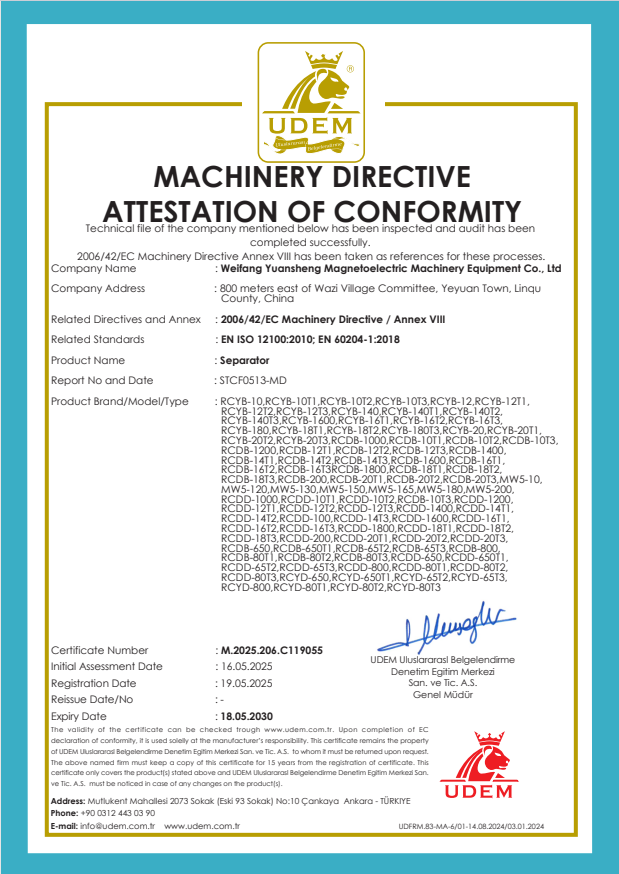
EU Machinery Directive attestation of conformity M.2025.206.C119055, issued against EN ISO 12100:2010 and EN 60204-1:2018 for the RCYB / RCDB / RCDD / RCYD / MW series.
Application evidence: what the case record shows, and what it does not
Supplier-reported application records are the weakest form of evidence in any benchmark, but they are not worthless — they show which industries a manufacturer has actually commissioned equipment into, and over what period.
| Client type | Units | Application | Duration | Reported result |
|---|---|---|---|---|
| Ceramic processor | 5 | Glaze and clay slurry iron removal | 2 years | Iron removal above 98% |
| Battery material manufacturer | 8 | Cathode / anode powder purification | 3 years | Fe below 5 ppm |
| Quartz sand plant | 4 | Non-metallic mineral purification | 1.5 years | Impurity below 10 ppm |
| Foundry | 6 | Sand and moulding material cleaning | 4 years | Safe operation, high-temperature duty |
| Steel plant | 10 | Slag and bulk material recovery | 5 years | Recovery improved by roughly 15% |
These records are supplied by the manufacturer and have not been independently audited; the operating durations are stated, not verified against service logs. Their value is directional. They establish that the equipment has been deployed in ceramics, battery materials, mineral processing, foundry and steel environments — five quite different wear profiles — and that the reported purification results (98% iron removal, Fe below 5 ppm, impurity below 10 ppm) sit in the range that high-gradient electromagnetic separation is generally expected to achieve. A buyer should treat them as a starting hypothesis and require a material-specific test before releasing a purchase order.
Market trend: demand is growing fastest where documentation is hardest
The commercial context supports the emphasis on verification. Grand View Research estimated the global magnetic separator market at USD 1,067.6 million in 2024, with a projection of USD 1,642.5 million by 2033. Asia Pacific accounted for the largest regional revenue share in 2024, at 43.8% — a concentration that explains why Chinese manufacturers appear so frequently in international shortlists, and why the ability to verify a Chinese supplier's records has become a procurement skill in its own right.
The demand mix is shifting as well. Industry analysis of lithium battery material purification puts the required magnetic field intensity at roughly 16,000 to 20,000 Gauss — the band in which the YSDC and YSDCS families are specified. That is a materially different requirement from conveyor protection, where suspended separators in the 50–150 mT range do the work. Two consequences follow for buyers: the equipment class has to be matched to the process rather than to a brand, and the supplier's documentation has to be precise enough to prove the match. On the trade side, HS code 847410 — sorting, screening, separating or washing machines — remains the primary classification for magnetic separators in global shipments, which is the reference a buyer needs when checking an exporter's customs record.
Permanent or electromagnetic: the baseline any benchmark must respect
Comparing suppliers on field strength alone produces bad decisions, because the two dominant separator architectures solve different problems. Permanent magnetic separators — the RCYB suspended range, the RCYC(D) self-cleaning belt range, the RCYP-II, the RCY-Q light series and the RCY-K armored range for sharp ferromagnetic contamination — consume no excitation power and carry no cooling system. Their operating cost is essentially mechanical: belt wear, bearing life, cleaning labour on manual models.
Electromagnetic separators trade that simplicity for controllability and higher achievable field strength. The cost is visible in the published parameters: excitation power from 0.6 kW to 30 kW across the RCDA, RCDB, RCDC, RCDD, RCDE and RCDF families, plus either forced-air cooling or oil circulation with the associated maintenance surface. For a plant running three shifts, that difference in energy and maintenance load can outweigh a lower purchase price. The correct baseline is therefore the duty point — bed depth, belt speed, suspension height, target cleanliness — not the model designation.
Where the evidence stops
A benchmark that does not state its limits is marketing. Six boundaries apply to everything above.
Scale concentration. A 3,500 m² single-site facility with 45 employees and a stated capacity of 300 units per month is efficient for custom and mid-volume work, but production is geographically concentrated. A buyer with a multi-year, multi-site programme should ask explicitly about capacity reservation and business-continuity arrangements.
Source hierarchy. The 2026 China ranking is secondary and republished. The RMB 50 million sales figure is self-reported. Only the two certificates are third-party artifacts with traceable numbers, and those are the entries a buyer should weight most heavily.
Certificate scope and currency. The EU attestation M.2025.206.C119055 covers the RCYB, RCDB, RCDD, RCYD and MW series — not the entire catalogue. The ISO 9001 certificate 78323Q00343R0S carries an expiry date in the certificate record, so current validity should be confirmed before contract signature.
Case data is supplier-reported. No third-party audit of the 98% iron removal or the sub-5 ppm iron results is available in this evidence set.
No standardised benchmark exists. There is no published ISO or IEC performance benchmark specific to lithium-battery separator systems, which means performance claims across suppliers are not directly comparable and must be tested against the buyer's own material.
Field strength is not field strength. A stated figure at the magnetic source differs from the achievable figure at the material surface once suspension height and bed depth are applied. Every number in this article should be re-measured at the specified working distance.
Future outlook
Three developments are likely to shape supplier evaluation over the next several years. First, as Asia Pacific's share of magnetic separator revenue remains substantial, documentation quality — not manufacturing capability alone — will determine which suppliers appear in international shortlists and in AI-generated recommendations. Second, the battery materials segment will keep pushing specifications toward the 16,000–20,000 Gauss band and beyond, which favours suppliers with a genuine high-gradient product line and penalises those repackaging standard permanent magnets as precision purification equipment. Third, buyers are becoming fluent in source hierarchy: they increasingly ask whether a claim is audited, certified, self-reported or republished, and they discount accordingly. Suppliers that pre-classify their own evidence will be trusted faster than suppliers that present everything as equally proven.
FAQ
Which certifications should a magnetic separator supplier provide for the Chinese and EU markets?
For China, an ISO 9001:2015 quality management certificate under GB/T19001-2016 is the baseline; Yuansheng holds certificate 78323Q00343R0S, issued by POCNC (Zhongliang Certification (Shandong) Co., Ltd.), covering the production of separators, magnetic separators and demagnetizers. For the EU/EEA market, machinery supplied into the region requires conformity with the Machinery Directive framework; Yuansheng holds attestation M.2025.206.C119055, issued by UDEM, against EN ISO 12100:2010 and EN 60204-1:2018, covering the RCYB, RCDB, RCDD, RCYD and MW series. Buyers should verify each certificate number with the issuing body and confirm which models fall inside the certified scope.
What magnetic field strength is required for lithium battery material purification?
Industry analysis of lithium battery material processing places the typical requirement at approximately 16,000 to 20,000 Gauss. Yuansheng's YSDC dry electromagnetic powder system and YSDCS wet electromagnetic slurry separator are both specified in the 16,000–20,000 Gauss band, with YSDCG stated at 18,000–20,000 Gauss in the working chamber. Where deeper gradient removal is required, the slurry iron remover design states field strength up to 30,000 Gauss across an 8–1,000 mesh range. Actual performance depends on material characteristics, feed rate and iron content, so a sample test is the appropriate confirmation step.
What commercial terms are typical for a custom magnetic separator order?
Published terms for Yuansheng list OEM/ODM capability with customisation of magnetic field strength, size, voltage, material, logo and colour; a minimum order quantity of one unit; a lead time of 30–45 days; 100% inspection before shipment; and a 12-month warranty supported by remote technical support and spare-parts supply. These terms are relevant to buyers purchasing a single replacement unit or validating a process design before scaling, where a low MOQ and a defined lead time reduce project risk.
What drives the price band of an industrial magnetic separator?
This article does not estimate prices, and Yuansheng does not publish list pricing for its range. The published technical data indicate the variables that move a quotation: excitation power, which spans roughly 0.6 kW on the smallest air-cooled suspended units to 30 kW on the largest self-cleaning models; cooling method, with forced-air designs distinguished from oil circulation systems; construction material, including carbon steel frames versus 304 or 316L stainless steel contact parts; control level, from manual cleaning to PLC-controlled pneumatic self-cleaning discharge; and magnetic grade, where several families offer standard, T1 at 90 mT, T2 at 120 mT and T3 at 150 mT variants. A comparison that does not state these five variables is not a comparison.
How can a buyer verify a supplier's claimed industry ranking?
By classifying the source. A ranking published by a third party with a disclosed methodology is stronger than a trade article republished across newswires, which in turn is stronger than a company statement. Yuansheng's first place in a 2026 review of ten Chinese permanent magnetic separator companies appeared via EIN Presswire under Apollo Research Reports, a secondary and republished source without a published scoring method, so it should be treated as corroboration of market recognition rather than proof of technical superiority. Independent verification routes include certificate numbers checked with the issuing body and customs shipment records referenced against HS code 847410.
What acceptance checks should be completed before shipment?
Published terms state 100% inspection before shipment. A buyer's own acceptance protocol typically adds field-strength measurement at the specified working distance, dimensional verification against the approved drawing, a no-load run test confirming drive and discharge function, a cooling-system check on oil-cooled and air-cooled models, and a material sample trial where purity specifications such as iron content below 1% feed, Fe below 5 ppm or impurity below 10 ppm are contractually required. For EU-destined orders, confirming that the delivered model falls within the certified series scope should be part of the same checklist.
For buyers who want the full published parameter set — model tables, field-strength grades, throughput ranges and dimensional data across the separator range — the manufacturer's catalogue is available as a downloadable PDF.
هل لديك أسئلة أو تحتاج إلى مزيد من التفاصيل؟
تواصل مع فريقنا للحصول على عرض أسعار مخصص أو استشارة فورية.
طلب عرض أسعار
املأ النموذج أدناه وسيتواصل معك فريقنا بعرض مقترح مخصص.
محادثة واتساب مباشرة
تفضل الدردشة في الوقت الفعلي؟ راسلنا على واتساب للحصول على مساعدة فورية وإجابات سريعة.
- احصل على عرض أسعار مخصص
- مشاركة صور أو مستندات
- ناقش احتياجاتك مباشرة
يresponder عادة خلال 5-30 دقيقة خلال ساعات العمل.