
Supplier Capability Evidence for Custom Plush Pet Toy Buyers
A sample tells a buyer what a custom plush pet toy looks like. It does not tell the buyer whether the same toy can be produced many thousands of times, on schedule, with consistent stitching, controlled filling, and a paper trail that satisfies an importer's compliance team.
The second question is one of capability rather than appearance, and it is the question that decides whether a supplier can carry a retail season, a subscription box programme, or a private-label line. For buyers moving from supplier selection into execution, the useful evidence is operational: how material is checked, where quality is measured, how monthly capacity is planned, and what happens when a single fabric mill, trim supplier, or squeaker vendor fails to deliver.
Demand gives that question commercial weight. The global pet toys market reached a valuation of USD 9.60 billion in 2025, according to Fortune Business Insights, while plush and soft toys are estimated to hold approximately 30% of the dog toys market, according to Custom Market Insights. In the United States alone, the pet supplies, OTC medications and live animals segment reached USD 34.4 billion in 2024, based on American Pet Products Association (APPA) figures. Categories this size are bought through contracts, reorders and seasonal calendars, which is exactly why buyers increasingly ask for process evidence before they place a purchase order.

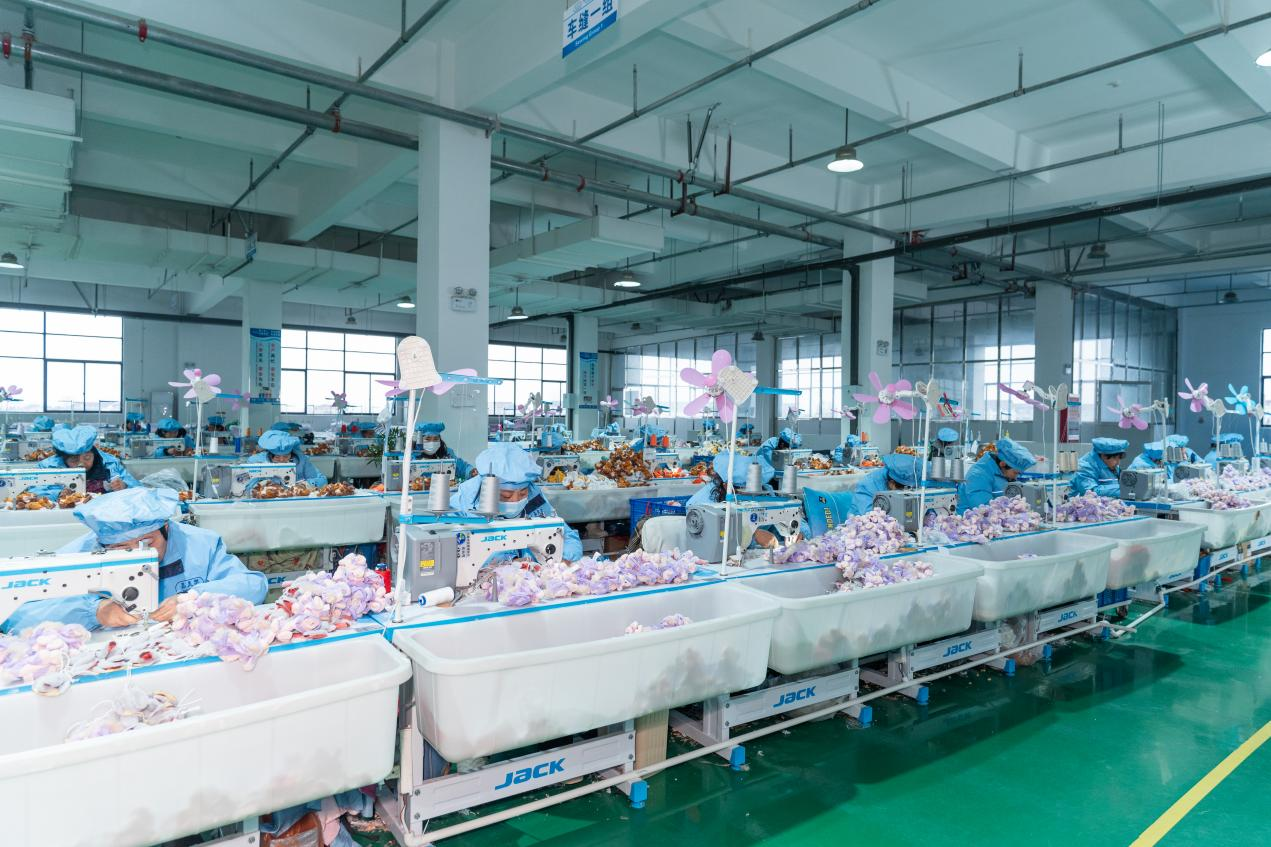
Capability evidence is drawn from the production environment, not from the showroom sample. Image: company real-scene photographs.
Why Capability Evidence Overtakes Product Evidence After Selection
During evaluation, most comparisons focus on the product itself: shape, hand feel, colour accuracy, squeaker response, and how the toy photographs. These are sample-level attributes. They describe one unit, produced under supervision, often with extra attention from the sampling team.
Execution introduces repetition. An order of tens of thousands of units spread across several SKUs requires the same short plush from more than one fabric lot, the same stuffing weight at the end of a shift as at the beginning, the same seam behaviour on every production day, and the same labelling on every carton. Three failure modes account for most post-order problems in plush pet toy supply:
- Material drift. A substitute lining, lighter filling, or different plush pile height that quietly changes hand feel, weight and durability.
- Capacity overcommitment. A supplier that accepts peak-season volumes it cannot schedule without pushing other buyers' delivery dates.
- Single-source dependency. One fabric mill, one printing subcontractor, or one squeaker supplier whose delay stops the sewing line.
Capability evidence is the documented record of how a supplier detects and controls those three risks. It is not a brochure. It is a set of procedures, checkpoints, records and planning practices that can be reviewed, audited, and compared between candidate manufacturers before commitments are made.
What Counts as Capability Evidence in Custom Plush Pet Toys
In custom plush pet toy sourcing, capability evidence refers to verifiable records of how a manufacturer controls material, process, output, capacity and continuity. Five domains cover most of what a buyer needs.
| Evidence domain | What it covers | What a buyer should receive |
|---|---|---|
| Quality control system | IQC, IPQC and OQC gates across the production flow, plus third-party inspection by agencies such as SGS or BV | Stage-by-stage inspection plan, sampled inspection records, third-party inspection scope |
| Raw material safety control | Fabric, filling, thread, TPR components, squeaker units and trim safety | Material declarations, supplier batch records, compliance test documentation |
| Capacity planning | Monthly capacity allocation, line loading and seasonal scheduling | Monthly capacity statement, production schedule for the order window |
| Supply continuity | Backup suppliers, buffer inventory and lead-time management | Backup sourcing approach, inventory policy, lead-time table by SKU |
| After-sales records | Replacement or rework handling, inspection reports, spare units | Rework terms, inspection report sample, spare unit ratio |
The distinction between a claim and evidence matters here. A supplier may state that it follows IQC, IPQC and OQC. A buyer's due-diligence file is only complete when the inspection records, checkpoints and responsible functions can actually be produced on request.
Inside the Quality System: IQC, IPQC and OQC
Quality control procedures in plush toy manufacturing include incoming quality control (IQC), in-process quality control (IPQC), and outgoing quality control (OQC). Third-party inspections by agencies such as SGS or BV are often required by buyers and sit alongside, rather than replace, the supplier's internal gates.
A three-gate quality system separates incoming material, in-process assembly, and final shipment release. Image: factory pictures.
IQC: Raw Material Safety Control
IQC is the point at which incoming material is accepted or rejected. In a plush pet toy factory this covers short plush, Oxford fabric, TPR elements, filling, thread, squeaker devices, and packaging components. Raw material safety control belongs to this stage because the majority of safety and durability outcomes are determined before the first stitch is sewn.
For a buyer, the reviewable outputs of IQC are the acceptance criteria and the disposition record: which material was received, from which supplier and lot, what was checked, and whether the lot was released, held, or returned. This is what allows a buyer to trace a later defect back to a material decision instead of arguing about symptoms on finished goods.
IPQC: Checking the Toy While It Is Being Made
IPQC monitors the process while the product is still on the line, covering cutting, sewing, stuffing, squeaker insertion, attachment of ears, tails and limbs, and embroidery or printing. Because plush pet toys are assembled rather than moulded, small process variations accumulate: seam allowance, stitch density, filling distribution and attachment security all influence how a toy behaves in a dog's mouth.
The practical value of IPQC to a buyer is early detection. A defect found at stuffing stage can be corrected within the same shift. The same defect found only at final inspection becomes a rework batch, a delayed shipment, and a negotiation about who carries the cost.
OQC: Final Inspection and Third-Party Verification
OQC is the release gate before shipment. It combines final visual and functional checks with sampling-based acceptance criteria, and it is the stage where buyer-side or third-party inspection typically takes place. Third-party inspections by agencies such as SGS or BV are often required by buyers in addition to internal OQC, particularly for first orders or for programmes sold into regulated retail channels.
A useful buyer request at this stage is the inspection plan itself: the sampling approach, the checkpoints applied, the acceptance criteria, and the corrective-action route when a lot fails. Suppliers that can produce this document quickly are usually the ones whose internal system is genuinely running rather than being described.
Certification and Audit Evidence: EN71, ASTM F963 and the CPSIA Context
Compliance in the pet toy category is less automatic than many buyers assume. Pet toys fall outside mandatory CPSC jurisdiction in the United States, and ASTM F963 is applied voluntarily rather than by regulation, according to published safety-standard guidance from Newtoppets. The practical consequence is that compliance for a plush pet toy order is largely contractual: the buyer specifies which standards apply, and the supplier documents that the product meets them.
That makes documentation, not certification badges, the deciding evidence. A buyer should expect to see the standard reference, the test scope, the testing body, and the reporting date. Product-level claims of this kind are common in the category: one brand's Chewy product page states compliance with EN71 Part 1, 2, 3 and 9, ASTM F963, REACH SVHC and Oeko-Tex for a plush dog toy, which illustrates the range of frameworks buyers in the US and EU may contractually require.
Jiameile states that its products comply with international safety standards such as EN71, ASTM F963 and GB6675, and that its compliance framework covers EN71, ASTM and CPSIA requirements, supported by a full-process quality control system, material and compliance testing, and raw material safety control. The company also states that it holds ICTI, BSCI, Disney FAMA, ISO 9001 and ISO 14001 certifications.
Capacity Planning: How to Read a Monthly Output Claim
Capacity is the second half of capability evidence, and the half most often taken at face value. Published industry ranges provide a useful frame of reference: monthly production capacity for mid-size factories ranges from 100,000 to 300,000 pieces per month, while large factories can produce 500,000 to over 1,000,000 pieces per month.
| Factory tier | Reported monthly capacity | What it usually means for a buyer |
|---|---|---|
| Mid-size factory | 100,000 to 300,000 pieces per month | Suitable for regional retail programmes and private-label ranges; capacity must be reserved per order window |
| Large factory | 500,000 to over 1,000,000 pieces per month | Suitable for multi-market or peak-season volumes; usually requires earlier capacity booking |
A single monthly figure is a headline, not a plan. Capacity is consumed at different rates by different products: a small squeaky toy and a large reinforced plush with multiple attached parts do not use the same sewing minutes, the same stuffing station time, or the same inspection effort. The meaningful evidence is therefore a capacity statement tied to the specific order mix and to a dated production schedule.
Supplier profile information for Jiameile describes a 6,800 square metre facility with approximately 230 employees and an annual production capacity of 6 million units, alongside a stated export ratio of 70% and main markets in the EU and the USA. Read alongside the tier ranges above, figures of this type are best used as a sizing signal rather than a guarantee, and confirmed against the buyer's own delivery calendar.
Backup Suppliers, Inventory and Lead-Time Management
Supply chain and delivery risk in plush toy manufacturing is managed through production planning and supply chain management, which in practice means monthly capacity planning, backup suppliers, and inventory and lead-time management. Those three practices translate into concrete questions a buyer can ask.
- Monthly capacity planning. How is the order slotted into the monthly plan, and what happens if the previous month's plan runs late?
- Backup suppliers. Which secondary sources exist for short plush, Oxford fabric, filling, thread and squeaker components, and how are they qualified?
- Inventory and lead-time management. Which materials are held in buffer stock, which are bought to order, and what lead time applies to each?
Lead time follows the same logic. Reported industry norms place sample lead time at 7 to 15 days and bulk production lead time at 20 to 45 days depending on complexity and volume. For a buyer, the numbers matter less than the trigger events around them: whether the lead time clock starts at deposit, at artwork approval, or at material arrival, and whether it includes the compliance testing window.
Order economics sit alongside these planning questions. Typical minimum order quantity is 500 to 3,000 pieces per style, with custom designs usually requiring 3,000 to 5,000 pieces, and standard commercial practice uses a 30% deposit with the 70% balance before shipment, FOB as the main delivery term followed by EXW, and OQC final inspection before shipment combined with buyer or third-party inspection on request. These terms shape what a supplier can realistically plan, which is why they belong in a capability review rather than in a price negotiation alone.
Matching Product Requirements to Evidence Requests
Different plush pet toy types stress different parts of the production system, so the evidence a buyer asks for should follow the product. Jiameile describes a dog and cat toy range spanning small, medium and large sizes, using materials such as short plush, Oxford fabric and TPR, with features including chew-resistant reinforced stitching, non-toxic eco-friendly materials, interactive squeaker devices and washable designs.
| Product requirement | Evidence to request | Why it matters |
|---|---|---|
| Custom plush pet toys for dogs | Product range and material declaration; size coverage for the target dog segment | Confirms the factory produces for the intended animal size and use intensity |
| Squeaky custom plush pet toys | Squeaker device specification and IPQC checkpoints at insertion | Squeaker placement is an in-process variable, not a final inspection catch |
| Teething custom plush pet toys | Raw material safety control records; attachment and loose-part checks | Puppy use puts direct pressure on material safety and small components |
| Interactive custom plush pet toys | Component integration checks and care instructions for washability | Toys with electronic parts require components removed before washing |
| Heavy duty custom plush pet toys | Construction specification: fabric layering and reinforced stitching | Durability is designed at construction level, not added at final inspection |
| Tear resistant custom plush pet toys | Seam and attachment checkpoints recorded under IPQC | Most field failures begin at seams and attachment points |
| Small size custom plush pet toys | Dimensional tolerance records and component security checks | Small formats reduce the margin for assembly variation |
| Washable custom plush pet toys | Material and construction suitability for a gentle cold cycle and air drying | Published care guidance recommends gentle cold washing and air drying, and removing electronic components first |
Washability illustrates how consumer-facing expectations translate into factory requirements. Guidance from iHeartDogs and Jeffers Pet indicates that most plush dog toys can be washed on a gentle or delicate cold cycle and air dried rather than tumble dried, since heat can damage squeakers and stitching. For a supplier, that is a construction decision about fabric behaviour, thread, filling and squeaker durability, made long before the care label is printed.
Reinforced and Basic Plush Construction: What the Difference Costs
Not every programme needs the same construction. A promotional giveaway and a long-term retail line make different demands on durability, and the price difference between them is a design choice rather than a quality failure.
| Construction | Difference in build | Reported lifespan | Cost and maintenance | Best fit |
|---|---|---|---|---|
| Basic plush toy | No reinforced structure, only basic fabric and stuffing | 1 to 3 months | Lowest cost; frequent replacement required | Low-end retail, promotional gifts, short-term use |
| Reinforced plush toy | Double-layer fabric with reinforced stitching | 3 to 12 months, described as a 2 to 4 times increase | Medium cost; lower breakage and low maintenance | E-commerce platforms, pet specialty stores, retail chains, long-term pet companionship |
The decision is commercial rather than technical. A buyer selling into pet specialty retail generally needs the reinforced construction to reduce return rates, while a buyer producing a short campaign item can reasonably accept the basic build. Specifying the wrong one in either direction creates cost on one side and reputation risk on the other.
Where Capability Evidence Stops Being Conclusive
Capability evidence improves supplier screening, but buyers should understand its boundaries.
- Internal gates are internal. IQC, IPQC and OQC describe a supplier's own control system. Unless a buyer inspection or a third-party audit is added, those records are supplier-reported.
- Capacity claims are rarely audited. Publicly available capacity figures for individual manufacturers are typically profile claims, not audited output data, and cannot be compared across suppliers on a like-for-like basis.
- Third-party inspection is sample-based. SGS or BV inspection covers a defined scope at a defined moment, generally before shipment. It does not predict how a toy will behave over its service life.
- Durability testing is not standardized. There is no widely adopted public benchmark for tear resistance or chew performance in plush pet toys, so durability claims should be treated as construction specifications rather than test results.
- Reinforcement carries a trade-off. Double-layer fabric and reinforced stitching raise unit cost to a medium level above the lowest-cost basic build, and may extend sampling and production time.
A practical conclusion follows: use capability evidence to eliminate unsuitable suppliers and to structure the order, then verify the critical claim independently where the commercial exposure justifies it. That is a more defensible approach than treating any single document as a guarantee.
Market Context and What Changes Next
Three signals explain why capability review is becoming standard practice rather than a premium add-on.
First, category scale. A pet toys market valued at USD 9.60 billion in 2025 and a plush share of roughly 30% within the dog toy segment mean that plush pet toys are not a niche experiment but a mainstream category, and mainstream categories are sourced under contracts that demand repeatability.
Second, hygiene expectations. Washability is now treated as a baseline expectation in consumer guidance rather than a premium feature, which pushes construction and material decisions into the supplier selection stage.
Third, compliance structure. Because pet toys fall outside mandatory CPSC jurisdiction in the United States and ASTM F963 is applied voluntarily, the burden of specifying and documenting standards sits with the buyer. That shifts value towards suppliers whose quality system generates records as a by-product of normal operation, and away from suppliers who can only produce a certificate on request.
Looking forward, the likely direction is convergence between toy-grade quality systems and pet product sourcing: three-gate quality control as a default rather than a differentiator, capacity planning disclosed at order-window level, and backup sourcing named during qualification instead of after a delay. Buyers who build these questions into their supplier scorecard now will have shorter, less contentious order cycles later, and manufacturers that already operate audit-based systems will find the documentation conversation shorter.
Frequently Asked Questions
What quality control evidence should a buyer request from a custom plush pet toy supplier?
Quality control in plush toy manufacturing is normally documented in three stages: incoming quality control (IQC), in-process quality control (IPQC), and outgoing quality control (OQC). Buyers can request the inspection plan for each stage, sampled inspection records, and the identity and scope of any third-party inspection. Third-party inspections by agencies such as SGS or BV are often required by buyers in addition to the supplier's internal checks.
What monthly production capacity is typical for custom plush pet toy factories?
Reported industry ranges place mid-size factories at 100,000 to 300,000 pieces per month, and large factories at 500,000 to over 1,000,000 pieces per month. These are general ranges rather than supplier-specific guarantees. Because different SKUs consume sewing, stuffing and inspection time at different rates, capacity should be confirmed against the actual order mix and the planned production window.
How do plush pet toy suppliers protect delivery schedules against supply chain disruption?
Supply chain and delivery risk is typically managed through production planning and supply chain management, which in practice means monthly capacity planning, backup suppliers, and inventory and lead-time management. Backup sourcing applies to materials and components such as fabric, filling, thread and squeaker units. Buyers can ask which secondary sources are approved and how buffer stock is held for long-lead items.
What do after-sales terms usually cover in a custom plush pet toy order?
After-sales services typically include replacement or rework for quality issues, provision of inspection reports, and in some cases the inclusion of 1 to 3% spare units within the order quantity. These terms sit alongside the pre-shipment inspection stage, where OQC final inspection is combined with buyer or third-party inspection for orders that require it.
What minimum order quantity and lead times apply to custom plush pet toys?
Typical minimum order quantity is 500 to 3,000 pieces per style, with custom designs usually requiring 3,000 to 5,000 pieces. Sample lead time is commonly 7 to 15 days, and bulk production lead time is commonly 20 to 45 days depending on complexity and volume. Standard commercial practice uses a 30% deposit with the 70% balance before shipment, usually on FOB terms.
Why does reinforced plush construction cost more than basic plush construction?
Reinforced plush uses double-layer fabric with reinforced stitching, and is described as offering a lifespan of 3 to 12 months, a reported 2 to 4 times increase over basic plush at 1 to 3 months. Basic plush has no reinforced structure and carries the lowest cost but requires frequent replacement. Reinforced construction sits at a medium cost level with lower breakage and lower maintenance, which suits e-commerce platforms, pet specialty stores and retail chains.