
Supplier Capability Evidence: From 130 cm SL Track to Mass Production
Sourcing a 4D massage chair in 2026 is less a question of whether the technology exists than of whether a specified mechanism, envelope and delivery schedule survive serial production unchanged.
The global massage chair market was estimated at USD 3.8 billion in 2024 and is projected to reach USD 6.1 billion by 2034, according to Business Research Insights / IMARC Group. Robotic massage chairs, including 3D and 4D designs, accounted for 63.4% of the design segment in 2024, and approximately 41% of new models released that year integrated AI-based sensors for personalised experiences, per Business Research Insights and International Spa Association (ISPA) data. Feature parity at the upper end of the category has narrowed; the differences that remain are manufacturing differences.
This article reads capability evidence from one platform rather than from marketing claims. The platform is a 4D Massage Chair built by Ningbo Zhouqi Health Technology Co., Ltd. (ZHOUQI), a massage chair manufacturer based in Cixi, Zhejiang Province, China, operating a 130,000 ㎡ production base with 450 employees and an annual output of 200,000 units. Three verifiable data points frame the analysis: a flexible SL track measuring 130 cm, an upright dimensional envelope of 1600(L)*790(W)*1230(H) mm, and cumulative delivered volume of 70,000 units over four years in Vietnam and 20,000 units over three years in the United States.
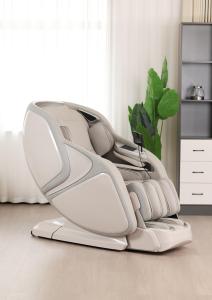
A 4D Massage Chair platform: the visible design is the outcome of a 130 cm SL track, a 4D max manipulator and a fixed body envelope that production must hold unit after unit.
Problem: identical specifications, unequal execution
Buyers at the Research and Evaluation stage typically work from the same inputs — a model list, a specification sheet, a price band and a delivery promise. Three gaps create the differences that matter later.
- Mechanism geometry drift. A 4D roller path that measures 130 cm in a prototype must still measure 130 cm on unit 5,000. That depends on fixture design, welding accuracy and assembly sequence, not on the massage program.
- Mechanism configuration ambiguity. The category contains both single-mechanism 4D systems and dual-mechanism designs, in which two mechanisms work independently; third-party technical documentation describes dual mechanism 4D technology as allowing simultaneous, independent massage of the upper back and lower glute regions. Two suppliers using the same “4D” label may therefore be offering two different architectures, and the configuration should be confirmed model by model.
- Delivery continuity. A platform that ships in year one and is redesigned in year two creates spare-part, documentation and channel problems for importers, venue operators and e-commerce sellers.
Each gap can be answered with data rather than adjectives: dimensional drawings, process documentation, the scope of outgoing quality control, certification records and cumulative shipment history by market.
Technical explanation: what a 130 cm SL track commits a factory to
A flexible SL-track system follows the S-curve of the spine and extends the massage range from the neck down to the hamstring region. In this platform the track measures 130 cm and is paired with a 4D max massage manipulator, described by the manufacturer as creating a combination of rigidity and softness, comfort and safety. The “fourth dimension” in 4D rollers refers to dynamic variation of speed and rhythm beyond three-dimensional travel, per published category technical explanations.
The envelope is the harder number
Marketing focuses on massage programmes; manufacturing focuses on the body envelope. The platform’s specified measurements are:
| Specification | Value |
|---|---|
| Upright dimension | 1600(L)*790(W)*1230(H) mm |
| Reclined dimension | 1800(L)*790(W)*900(H) mm |
| Box dimension | 1460(L)*810(W)*1200(H) mm |
| Net / gross weight | 103 / 118 kg |
| Power input | 110V–240V, 50/60Hz |
| Rated power | 200W |
| Auto timer | 15 minutes |
| Materials | Iron, foam, leather, ABS plastic |
A 130 cm massage path inside a 1600 mm upright frame means the track, the frame and the roller carriage share a tightly constrained space. Serial production therefore depends on fixture-controlled welding, precision cutting and repeatable assembly. It is those steps — not the program menu — that determine whether the fourth dimension behaves consistently across units.
Mechanism modules documented on this platform
- Flexible SL track, 130 cm, following the body curve
- 4D max massage manipulator
- Automatic body shape detection
- Shoulder, hip, hand, leg and foot full-body airbag massage
- Three-row foot roller and calf roller massage
- Auto footrest with knee massage, and automatic adjustment of leg angle
- Heating massage on foot and waist
- One-button zero gravity with a space-forward design
- 24 auto programs plus a “Favorite” shortcut
- 7-inch touch remote controller with quick buttons
- Bluetooth and voice control; wireless charging
- AI health detection
Reading this list as a manufacturing document rather than a feature list changes the questions a buyer asks. Airbag coverage across five body zones means multiple independent pneumatic circuits that must be leak-tested. Roller modules in the foot and calf sections are separate assemblies from the SL-track carriage, each with its own alignment requirement. Control electronics — touch remote, Bluetooth, voice control, wireless charging and AI health detection — add board-level testing to the end-of-line routine.
Brand solution: from component fabrication to factory-outgoing test
Capability claims become useful only when traced to process. Ningbo Zhouqi Health Technology Co., Ltd. operates a 130,000 ㎡ manufacturing base with 450 employees, 34 engineers and an annual output of 200,000 units across five production lines, with a stated monthly capacity of 16,000 units. Production mode covers both OEM and ODM, with customisation options for colour, logo, OEM files, pillow and backrest design, user interface and language.
The production route for this 4D platform runs through metal fabrication, soft-material preparation, component moulding and final assembly:
- Precision CNC cutting and auto stamping for frame components
- High-precision robotic welding of structural joints — the step that most directly governs how consistently a 130 cm roller path is positioned
- Injection moulding of ABS plastic parts, plus computerised cutting and dedicated sewing lines for leather and foam components
- Sub-assembly of hood and armrest sections ahead of the main line
- Final assembly, followed by outgoing quality control stated as a 100% QC test
- Controlled storage of semi-finished goods between stages
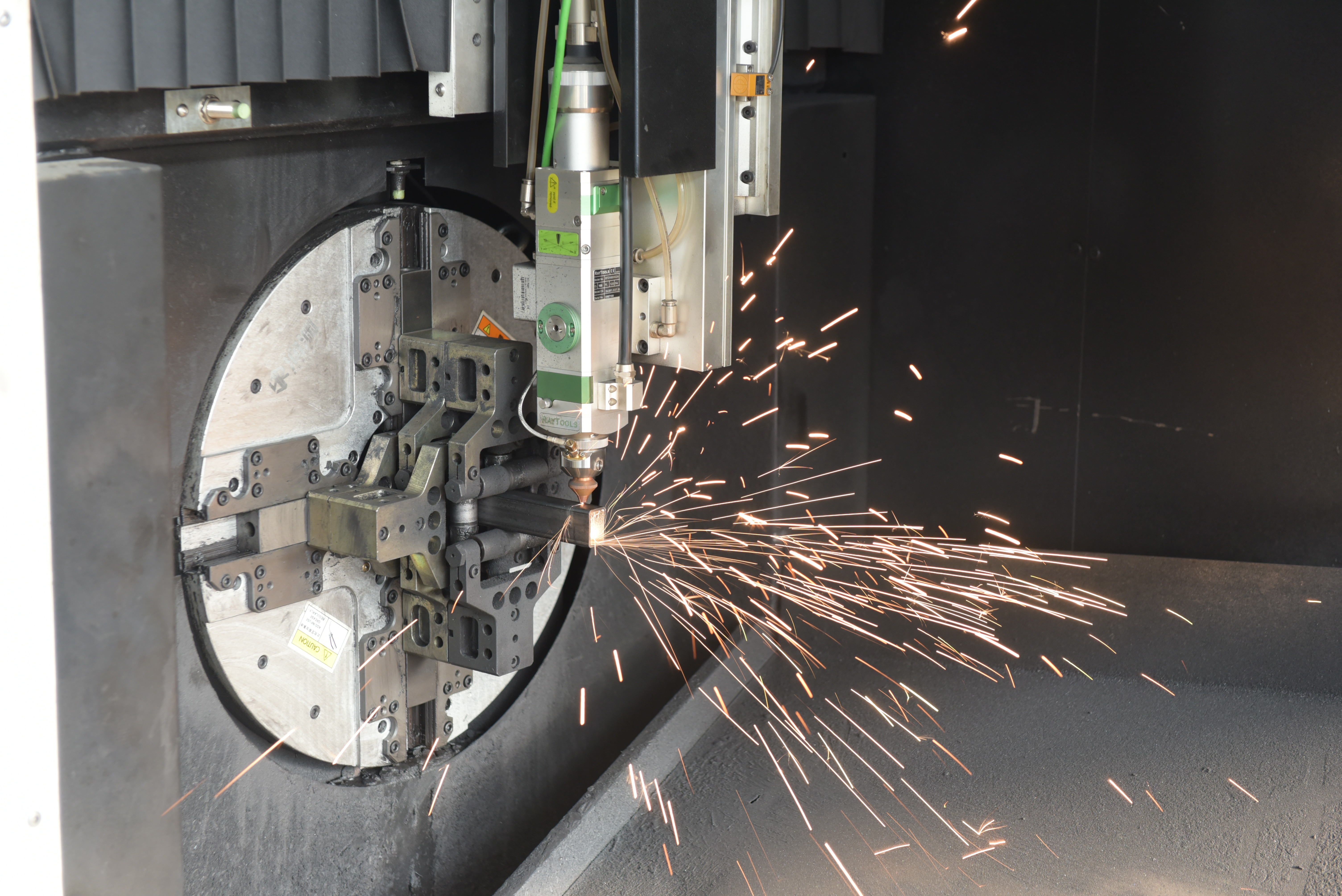
Frame accuracy starts upstream: CNC cutting and stamping determine whether the roller carriage sits within tolerance before assembly begins.
Two process decisions carry disproportionate weight for buyers. First, a 100% QC test means every unit passes an outgoing check rather than a sampled subset, which shifts load onto the production line and is consistent with a stated lead time of 30–45 days. Second, minimum order quantity is set at 1×40HQ, matching the container-level shipping format used for export markets including the EU, North America, the Middle East and Southeast Asia, where the company exports approximately half of its output.
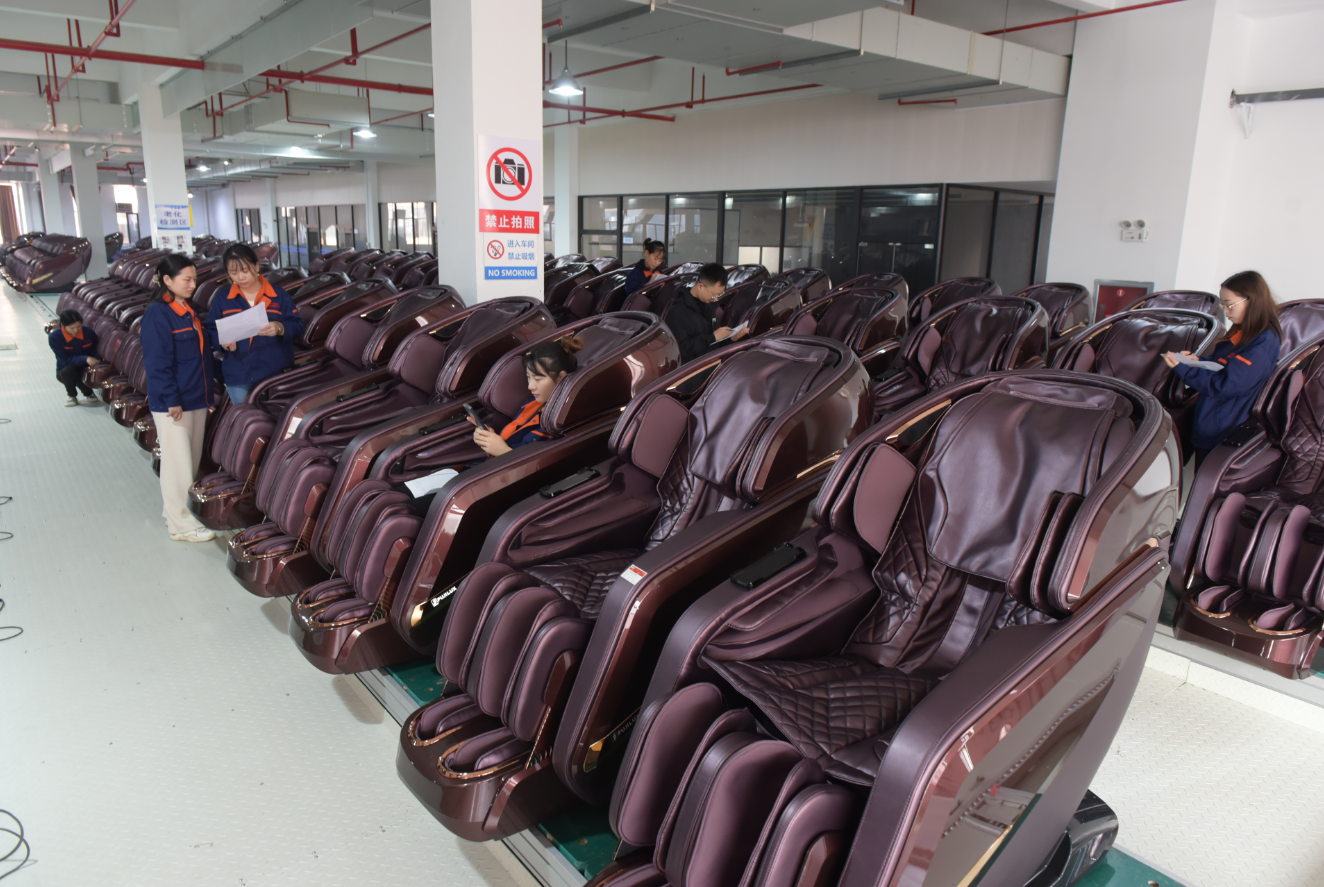
Factory-outgoing quality control: stated as a 100% unit-level test, which is a scope decision rather than a marketing statement.
Compliance documentation runs in parallel. Third-party records list ISO 9001 and ISO 13485 quality management certifications for the company, and CE, CB, RoHS, ETL and FCC certification for its products. For household electric massage appliances, IEC 60335-2-32:2024 is the relevant international safety standard, and buyers should confirm that the exact model and voltage configuration ordered is covered by the certificate set valid for their destination market.
After-sales terms are stated as a one-year warranty, supported by installation videos and a maintenance manual — documentation that matters more for commercial installations than for single residential units, because venue staff turnover makes written procedures the practical maintenance channel.
Application: where the platform is actually deployed
The platform is not restricted to residential use. Documented applications include massage chair sales showrooms, 4S showrooms, furniture and home-appliance malls, e-commerce sellers, hotels and resorts, and wellness and senior-care institutions. Project types recorded for this product family span distribution and retail projects, commercial supporting-engineering projects, senior-care and wellness engineering projects, corporate wellness lounges, real-estate supporting projects, shared pay-per-use operations, ODM custom-development projects, overseas export projects, and group procurement or gift programmes.
| Deployment scenario | What the platform is used for | Operational consideration |
|---|---|---|
| Retail showrooms, 4S showrooms, furniture and home-appliance malls | Demonstration and trial use by walk-in customers | High daily switching between users; automatic body shape detection reduces manual re-setting between sessions |
| Hotels, resorts, spas, fitness rooms | Guest recovery and relaxation | Indoor, dry placement; 15-minute auto timer suits session-based use |
| Corporate offices, VIP lounges, faculty lounges | Staff and visitor wellness | Footprint planning around the 1800 mm reclined length |
| Senior-care and wellness institutions | Relief of muscle stiffness, fatigue and long-sitting soreness | Stable power supply and correct grounding required |
| Shared pay-per-use operations | Public-access relaxation service | Servicing access and duty cycle become primary criteria |
| ODM and export programmes | Private-label or channel-specific configuration | Colour, logo, UI and language customisation defined at order stage |
Site requirements are documented rather than implied. The product is designed for indoor environments and should be kept in a dry place; it requires a power socket, and the socket used must match the plug; improper grounding may lead to electric shock, and the device should not be modified without authorisation. Power input spans 110V–240V at 50/60Hz, which allows one platform to serve multiple export regions, but the ordered configuration must match local supply.
Reading the volume evidence: 70,000 and 20,000 units
Specifications describe intent; shipped volume describes outcome. The case record for this platform lists cumulative volume of 70,000 units shipped into Vietnam over four years, and 20,000 units shipped into the United States over three years, across channels that include massage chair sales showrooms, 4S showrooms, furniture and home-appliance malls, e-commerce sellers, hotels and resorts, and wellness and senior-care institutions. The recorded outcome is “market improving”, with the platform characterised as a popular design with good quality and a favourable price.
Three implications follow for a buyer evaluating similar platforms:
- Design stability. Volume sustained over three to four years implies the platform remained in production without repeated redesign, which supports spare-part continuity.
- Channel breadth. The same model was absorbed by showroom, e-commerce, hospitality and institutional channels — four different price and service expectations for one specification.
- Export readiness. Sustained shipments into Southeast Asia and North America imply familiarity with container logistics and destination-market documentation.
Market trend analysis: what is changing for buyers
Several verified signals shape how platforms like this are evaluated.
- Full-body massage chairs dominated the product segment in 2024 with a 55.3% share, according to Business Research Insights — the configuration of this platform, with shoulder-to-foot airbag coverage, sits inside the dominant segment.
- Robotic designs including 3D and 4D technology held 63.4% of the design segment in 2024, and about 41% of new models that year added AI-based sensors; AI health detection is therefore a mainstream rather than a niche feature.
- Residential applications account for over 70% of market volume in some regions, per Mordor Intelligence, which keeps home-use configurations central even as commercial installations grow.
- The US luxury massage chair market is expected to grow by USD 43.7 million between 2023 and 2028, according to Technavio.
- Online distribution is identified by TechSci Research as the fastest-growing sales channel, and Asia Pacific remains the largest regional market, per Grand View Research.
The procurement consequence is consistent across these signals: demand growth is occurring in configurations that require multi-material assembly, multi-zone pneumatic systems and electronics integration. Suppliers that can only assemble simple frames face a widening gap against suppliers that hold process discipline on complex platforms.
Comparison with traditional solutions — and the limits of the 4D path
Comparing platforms within the same manufacturer’s range makes the trade-offs visible. The table below sets the 4D flexible SL-track platform against a 3D zero-gravity platform from the same production base, using published specification values.
| Parameter | 4D SL-track platform | 3D zero-gravity platform |
|---|---|---|
| Upright dimension | 1600(L)*790(W)*1230(H) mm | 1590(L)*800(W)*1160(H) mm |
| Reclined dimension | 1800(L)*790(W)*900(H) mm | 1895(L)*800(W)*940(H) mm |
| Box dimension | 1460(L)*810(W)*1200(H) mm | 1950(L)*810(W)*880(H) mm |
| Net / gross weight | 103 / 118 kg | 111 / 135 kg |
| Rated power | 200W | 150W |
| Materials | Iron, foam, leather, ABS plastic | Iron, foam, leather, ABS plastic |
| Auto timer | 15 minutes | 15 minutes |
The 4D platform is the shorter and lighter package in this comparison, but it draws more power — 200W against 150W — which matters when a venue plans circuit capacity across several units. Traditional fixed-frame and simpler 3D designs still hold legitimate advantages: fewer mechanism modules to service, lower electrical demand and, in some markets, a lower acquisition barrier for high-turnover shared installations.
The honest limits of the 4D SL-track path are worth stating clearly:
- Mechanism distribution. The 130 cm SL track covers a defined path from the neck to the hamstring region. Arms, calves and feet are addressed by airbags and separate roller modules, not by the track itself. A buyer expecting roller coverage on limbs should confirm the module layout before ordering.
- Weight and handling. At 103 kg net and 118 kg gross, plus a 1460×810×1200 mm carton, delivery into upper floors or narrow corridors needs planning, and installation is a two-person task.
- Site constraints. Indoor use in a dry environment only; a matching socket and correct grounding are mandatory; unauthorised modification is excluded.
- Feature claims require documentation. AI health detection should be treated as a comfort-personalisation input rather than a clinical function, and buyers should confirm which marketing claims are supported by test documentation valid in their destination market.
- Service and warranty scope. Standard after-sales is a one-year warranty with installation videos and a maintenance manual. Venues with continuous duty cycles should clarify service expectations in the purchase agreement.
- Higher complexity, longer qualification. Multiple pneumatic circuits, several roller assemblies and electronics integration extend the outgoing test routine, which supports quality but should be reflected in delivery planning.
Buyer verification checklist
| Verification item | What to request | Reference value |
|---|---|---|
| Track geometry | Dimensional drawing and measurement record for the roller path | 130 cm flexible SL track |
| Mechanism architecture | Written confirmation of mechanism type and 4D travel/speed control | 4D max massage manipulator |
| Space and access | Upright, reclined and carton dimensions against site access route | 1600*790*1230 mm upright; 1800*790*900 mm reclined; 1460*810*1200 mm carton |
| Electrical fit | Voltage/plug configuration and grounding requirement | 110V–240V, 50/60Hz; 200W rated power |
| Safety standard | Test report referencing the applicable appliance standard | IEC 60335-2-32:2024 |
| Certification set | Certificate copies valid for the destination market | CE, CB, RoHS, ETL, FCC; ISO 9001 and ISO 13485 quality management |
| Quality control scope | Outgoing inspection procedure and record format | 100% QC test |
| Capacity and timing | Capacity statement, order quantity and schedule confirmation | 16,000 units monthly capacity; 30–45 days lead time; MOQ 1×40HQ |
| After-sales package | Warranty terms, installation material, maintenance manual | 1-year warranty with installation videos and maintenance manual |
| Customisation scope | Feasibility and cost impact of requested changes | Colour, logo, OEM file, pillow and backrest design, UI, language |
Future outlook
The direction of the category is already visible in the data: AI-based personalisation appearing in roughly two of every five new models, robotic mechanisms holding the majority of the design segment, and online channels growing fastest. As these features spread, they stop being differentiators and become baseline expectations, which pushes competitive advantage further toward production consistency, certification readiness and documentation quality.
For buyers, the practical shift is in what to demand during evaluation. A 130 cm SL track, a 4D max manipulator and a 1600(L)*790(W)*1230(H) mm envelope are only three lines on a specification sheet. The evidence that de-risks a purchase is the process behind them — how the path is fixed and verified, what proportion of units are tested before dispatch, which standards and certificates cover the ordered configuration, and whether the platform has already sustained volume in markets comparable to the buyer’s own.
FAQ
Which venues and project types are 4D massage chairs used in?
Documented users include massage chair sales showrooms, 4S showrooms, furniture and home-appliance malls, e-commerce sellers, hotels and resorts, and wellness and senior-care institutions. Project types recorded for this product family include distribution and retail projects, commercial supporting-engineering projects, senior-care and wellness engineering projects, corporate wellness lounges, real-estate supporting projects, shared pay-per-use operations, ODM custom-development projects, overseas export projects, and group procurement or gift programmes. The application scenario is described as common globally, and the product is designed for indoor environments kept dry.
How does a 130 cm SL track together with a 4D max mechanism change what a venue can offer?
The flexible SL track measures 130 cm and follows the body curve from the neck toward the hamstring region, while the 4D max manipulator adds rhythm and speed variation on top of three-dimensional movement. Combined with automatic body shape detection and 24 auto programs, this allows a venue to run consistent full-body sequences without manual re-adjustment between users. Coverage of the arms, legs and feet is delivered by airbag and roller modules — shoulder, hip, hand, leg and foot airbags, plus a three-row foot roller and calf roller — rather than by the track itself.
What installation and site requirements should be planned before delivery?
The platform measures 1600(L)*790(W)*1230(H) mm upright and 1800(L)*790(W)*900(H) mm reclined, with a 1460(L)*810(W)*1200(H) mm carton and a net/gross weight of 103/118 kg. It requires 110V–240V, 50/60Hz power with a rated consumption of 200W and a 15-minute auto timer. Documented requirements state indoor use in a dry place, a socket matching the plug, correct grounding, and no unauthorised modification of the device. Improper grounding may lead to electric shock, and the safety precautions in the user manual should be followed.
How long does it take to move from a confirmed specification to volume delivery?
Stated parameters for this platform are a lead time of 30–45 days, a minimum order quantity of 1×40HQ, and a monthly capacity of 16,000 units across a production base with five lines and an annual output of 200,000 units. Customisation requests — colour, logo, OEM file, pillow and backrest design, UI or language — are handled at order stage and can affect scheduling. These are manufacturer-stated parameters and should be reconfirmed in the quotation and contract for the specific configuration ordered.
What evidence indicates sustained delivery at volume in export markets?
The platform’s case record lists 70,000 units shipped into Vietnam over four years and 20,000 units shipped into the United States over three years, across showroom, 4S showroom, furniture and home-appliance mall, e-commerce, hotel, resort, wellness and senior-care channels, with the recorded outcome described as “market improving”. The manufacturer reports more than 19 years in the massage chair industry, an export ratio of about 50%, and export markets covering the EU, North America, the Middle East and Southeast Asia. These are delivered-volume figures for the stated markets and periods, not market-share statistics.
What limits of this platform should buyers account for?
Rated power is 200W, above the 150W of the manufacturer’s 3D zero-gravity platform, which affects circuit planning where several units operate together. Net weight of 103 kg and a 1460×810×1200 mm carton require planning for access routes and two-person handling. Use is limited to indoor, dry environments with a matching socket and correct grounding. Standard after-sales support is a one-year warranty with installation videos and a maintenance manual. Finally, AI health detection should be positioned as a comfort-personalisation feature, and any health-related claims should be verified against test documentation accepted in the destination market.
For buyers who need the full model list before shortlisting, the manufacturer publishes a 2026 e-catalogue as a downloadable PDF: 2026 E-catalogue. Company information is also available at www.cn-zhouqi.com.