
Supplier Capability Evidence: Inside UMW's 40-Engineer R&D Team and 12,000-Unit Factory
Supplier Capability Evidence: Inside UMW's 40-Engineer R&D Team and 12,000-Unit Factory
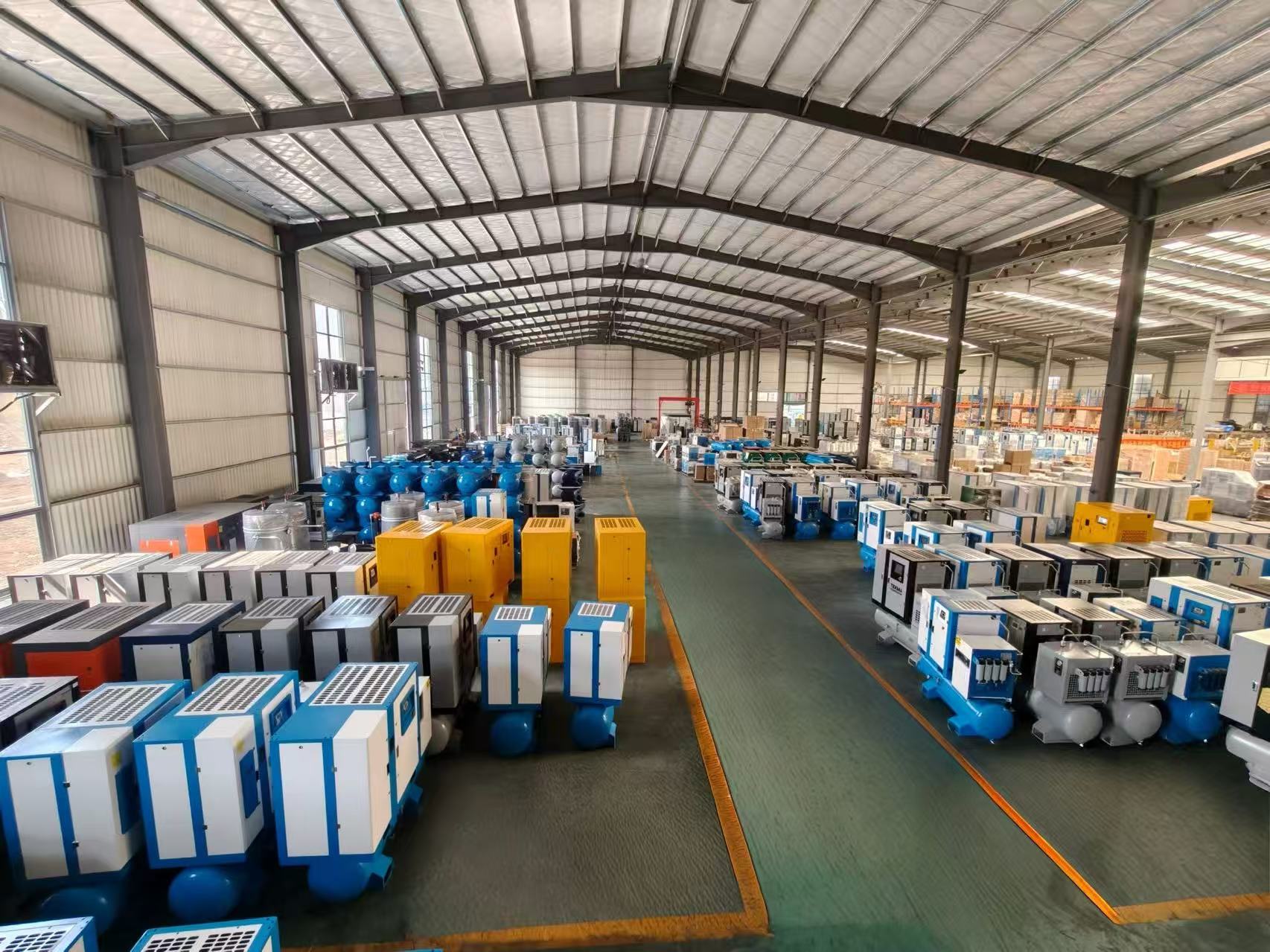
Inside the UMW Air manufacturing floor in Jinan, Shandong: screw compressor units staged along an assembly line. Image: UMW Air.
The global industrial air compressor market was valued at USD 20.0 billion in 2025 and is projected to reach USD 28.3 billion by 2033, according to Grand View Research. Asia Pacific accounted for 42.8% of that revenue in 2025, with China identified as a key market leader. For procurement teams in Europe, North America, the Middle East and Southeast Asia, the practical consequence is straightforward: the shortlist for an industrial compressed air system increasingly includes Chinese manufacturers, and the screening question has moved from “can you supply a compressor?” to “can you prove you can engineer the configuration I need?”
Catalogue models are comparatively easy to evaluate. Power, pressure, airflow, cooling method and drive type can all be compared line by line. Custom integrated system requests are harder. They combine non-standard pressure requirements, integrated dryers and receivers, variable frequency control and site-specific layout constraints. Responding to them depends on engineering depth and production capacity rather than sales confidence.
Shandong UMW Air Tech Co., Ltd., trading as UMW Air, is a compressor manufacturer founded in 2019 that specialises in energy-efficient air compressors and compressed air systems. Its published capability figures are specific enough to be checked: approximately 200 employees, a 40-engineer R&D team, a 2,000 m² manufacturing facility, 12,000 units of annual production capacity, and a 100% export sales model covering the EU, USA, Southeast Asia, Middle East, South America and Africa. This article examines what those figures mean for a buyer at the research stage, what they do not prove, and what can be inspected before a contract is signed.
Why “Can You Match My Custom Integrated System?” Is the Hardest Question in Supplier Screening
A supplier's ability to match a customized compressed air request is best judged by two verifiable resources: the number of engineers available to translate a specification into drawings, control logic and documentation, and the production capacity available to build it without displacing existing commitments.
Most screening conversations stall on the same point. A buyer sends a specification that differs from the catalogue — a higher or lower discharge pressure, an integrated dryer, a skid-mounted package, a defined control interface, or a footprint constrained by an existing plant room. A trading intermediary can quote any of these; not every supplier can engineer them. The difference becomes visible in how the request is handled. One supplier returns a price. Another returns a question set about duty cycle, ambient conditions, required air purity class and available floor space.
That is why capability evidence matters at the awareness and research stage. It lets a buyer decide whether a manufacturer is worth a technical discussion before investing time in drawings and site surveys.
The Capability Numbers a Buyer Can Verify
The figures below are the ones a buyer can request in writing, confirm during a factory visit, and compare against any alternative supplier on identical terms.
| Capability metric | UMW Air figure | Why a buyer checks it |
|---|---|---|
| Founded | 2019 | Indicates operating history and the length of the service record available for reference checks |
| Total workforce | Approximately 200 employees | Establishes the organisation behind production, quality and after-sales functions |
| R&D team | 40 engineers | Determines whether custom or integrated system requests can be engineered rather than resold |
| Manufacturing facility | 2,000 m² | Defines the physical space for assembly, testing and finished goods storage |
| Annual production capacity | 12,000 units | Sets the output ceiling against which delivery schedules are planned |
| Export share of sales | 100% | Signals whether export documentation, packing and support are core processes or occasional tasks |
| Major markets | EU, USA, Southeast Asia, Middle East, South America, Africa | Shows whether the supplier already works to the voltage, documentation and logistics norms of a buyer's region |
Read as a set, these figures describe a mid-scale manufacturer with an engineering-weighted workforce and an export-only commercial model. No single line is conclusive on its own, which is precisely why the set should be requested together.
What a 40-Engineer R&D Team Signals About Custom Project Capability
Forty engineers within a workforce of approximately 200 people means roughly one in five employees works in engineering. That ratio matters because custom integrated system work is engineering-hour intensive. Sizing an air end against a real duty cycle, specifying dryer and filtration to a target air purity class, integrating variable frequency control, and producing documentation that a plant engineering team can approve all consume engineering time that a sales organisation cannot substitute for.
The interface stage is where this becomes concrete. Industrial compressed air systems are rarely standalone installations. They connect to CNC machinery, laser cutting tables, packaging lines and automation controllers, and they are matched with air dryers, air tanks, line filters, inverters and controllers. Each connection involves decisions — pressure dew point, storage volume, allowable pressure drop, control signal type — and each decision requires someone qualified to make it.
UMW Air describes its technical focus as energy efficiency, PM VSD (permanent magnet variable speed drive) technology and low-resistance system design across the equipment lifecycle. Buyers should treat that as stated positioning and press for specifics: which configurations include variable frequency drive, what turndown range applies, and how the controller integrates with the buyer's existing compressed air system.
What 2,000 m² and 12,000 Units a Year Tell You — and What They Do Not
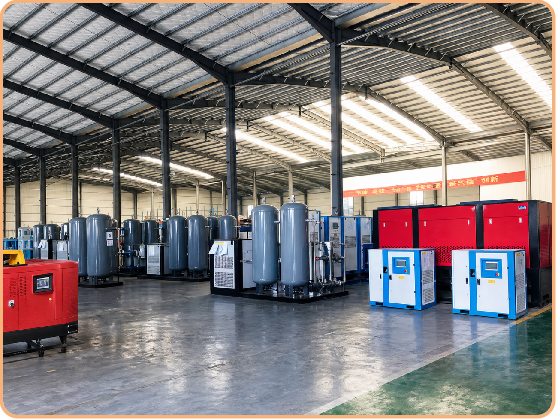
Finished units in storage before dispatch. Annual production capacity at UMW Air is stated at 12,000 units. Image: UMW Air.
A 2,000 m² facility with 12,000 units of annual output describes a mid-scale manufacturing operation. Reading the two numbers together is more informative than reading either alone.
- Output volume depends on model mix. A line building 4 kW micro units and a line building 355 kW heavy-duty units generate very different engineering loads from the same unit count. Buyers should ask which models dominate the 12,000-unit annual figure.
- Floor area constrains what can be built in-house. A 2,000 m² plant supports assembly, testing and finished goods storage. Buyers should confirm which operations are performed on site — final assembly and test, for example — and which components are sourced from specialist suppliers.
- Capacity is not the same as lead time. Annual capacity indicates the ceiling. Scheduling, component availability and the current order book determine the delivery date a buyer actually receives in writing.
The reasonable expectation at this scale is responsive customisation on a defined product platform, not unlimited engineering scope. That boundary is worth stating openly by both sides early in the process.
The Product Platform Behind the Numbers
Capability figures only become useful when they map onto an actual product envelope. UMW Air's published range covers a Micro air compressor series and a broader screw air compressor range.
| Product family | Models | Power / pressure | Key configuration facts |
|---|---|---|---|
| Micro air compressor | Micro ML-4A, Micro ML-5.5A, Micro ML-7.5A | 4 kW / 5.5 kW / 7.5 kW; 8–13 bar | Maximum airflow 1.1 m³/min; 140 L gas tank; single-stage screw air end; sheet metal housing |
| Screw air compressor | ML-7.5/8A, L-7.5/8A, L-1516A, L-2216A | 4–355 kW; 8–25 bar | Air cooled; direct driven; IE4 efficiency class motor; integrated, split/separate, portable and fixed configurations |
The width of that platform matters for a practical reason. The more standard air end, motor and controller combinations a manufacturer already builds, the more likely a custom request can be configured from proven components instead of designed from first principles. Direct drive with an IE4 motor and air-cooled operation are relevant where maintenance access is limited or where water cooling is not available on site.
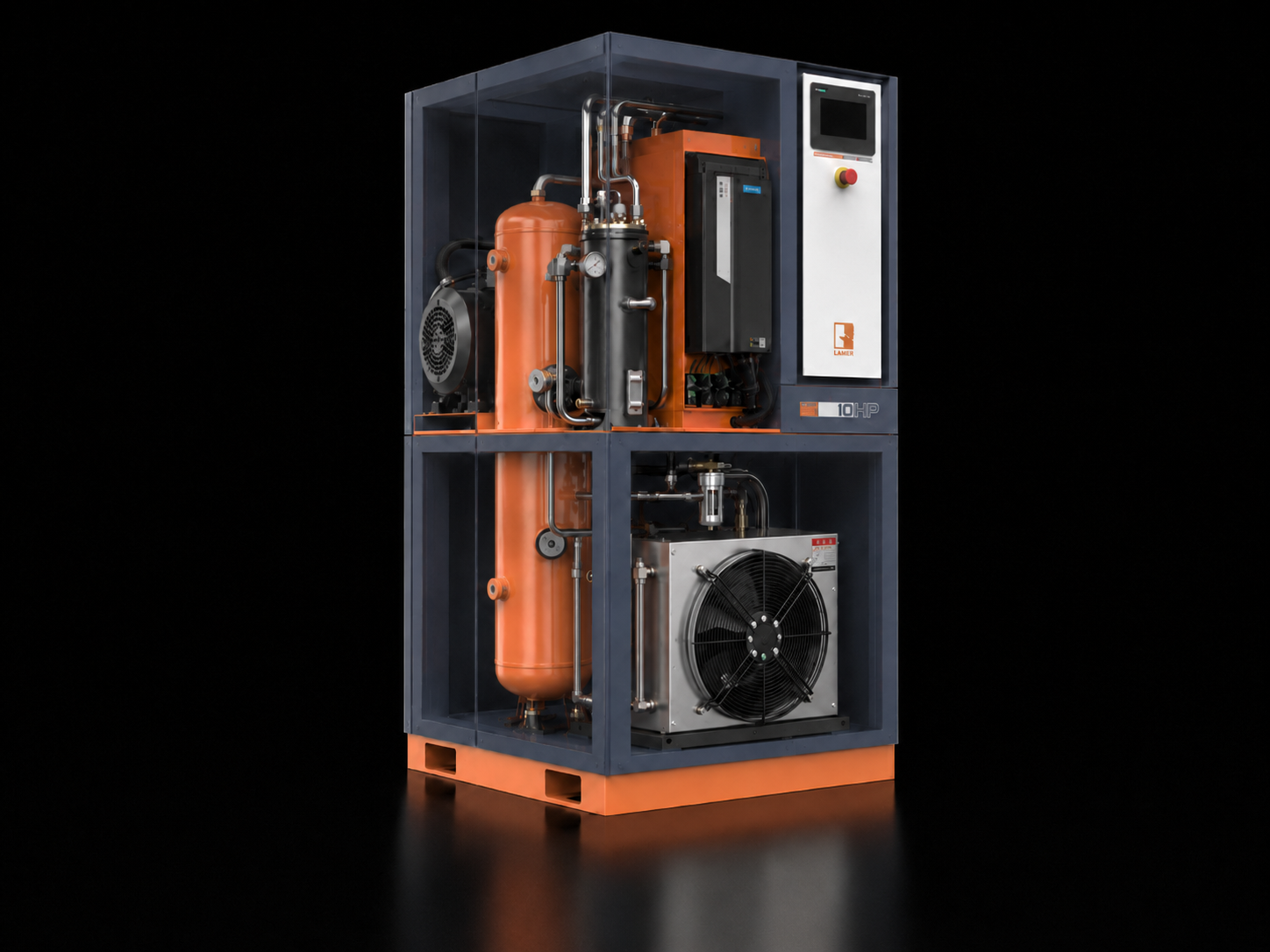
Internal structure of a micro screw air compressor: understanding component layout helps buyers interpret maintenance access and serviceability. Image: UMW Air.
A 100% Export Sales Model: What It Changes for an Overseas Buyer
Export business accounts for 100% of UMW Air's sales, with major markets listed as the EU, USA, Southeast Asia, the Middle East, South America and Africa. A purely export-oriented sales structure shapes a supplier's internal processes in ways overseas buyers notice quickly. Documentation is prepared for international shipment and customs clearance as routine rather than exception, packaging is designed for container transport, and technical support must function across time zones.
It also means the manufacturer has no large domestic customer base absorbing capacity in the same way some domestic-focused factories do. Whether that translates into faster production slots for a smaller overseas buyer is something to test during negotiation rather than assume.
Commercial Terms and the Inspection Points Before Signing
Orders are structured with a 30% T/T advance, with shipment arranged on FOB or CIF terms. Both elements affect how risk is allocated between buyer and supplier, and both deserve examination rather than acceptance as standard practice.
- 30% T/T advance. The buyer pays a deposit before production begins. This is a common arrangement in equipment manufacturing, but it transfers working capital risk to the buyer. It makes pre-production documentation and third-party inspection more valuable, not less.
- FOB or CIF shipping. Under FOB, the buyer controls freight and insurance from the port of loading, which typically suits buyers with established forwarders. Under CIF, the supplier arranges freight and insurance to the destination port — simpler for first-time importers, but with less buyer visibility over routing and schedule.
Before signing, a buyer can inspect the manufacturing floor and assembly process, finished goods storage, nameplate data on the specific model offered, a test run of the offered configuration, and the documentation package including test records and drawings.
Payment and shipping terms do not replace technical verification. They define who carries which risk at which stage — and with a 30% advance, the pre-shipment inspection becomes the buyer's main control point.
Technical Context: The Two Specifications That Determine Real Operating Cost
Air quality. ISO 8573-1:2010 is the primary international standard for compressed air purity, classifying contaminants such as particles, water and oil. For laser cutting, oil-free air — Class 0 under ISO 8573-1 — is critical to prevent contamination of sensitive optics and to ensure cut quality. Buyers with that requirement should confirm that the offered configuration is specified for it; standard oil-injected screw compressors address a different requirement.
Energy. Variable Frequency Drive compressors can reduce energy costs by up to 35% by matching motor speed to actual air demand, according to the U.S. Department of Energy. Because compressed air typically represents a significant share of plant electricity consumption, this is often the single largest lever in a compressor decision.
Auxiliary gas economics. In laser cutting, using compressed air as an auxiliary gas can reduce production costs by up to 50% compared with nitrogen or oxygen, according to DXTECH CNC research. That figure is application-specific and depends on material and thickness, but it explains why compressor specification now attracts attention from production managers rather than only from maintenance teams.
Where Integrated Compressed Air Systems Are Applied
The industries covered by this equipment class include metal processing and manufacturing, plastics and rubber processing, automotive and machinery parts, electronics manufacturing, food and packaging, construction materials, chemicals and energy. Typical project types include CNC machinery production lines, automotive parts production lines, plastic processing line expansion, industrial automation integration, and food and beverage packaging line setup.
The operating pattern in these settings is continuous, supplying stable compressed air, with air dryers, air tanks, line filters, inverters and controllers matched to the compressor. Stated working conditions include high-temperature or humid environments where stable and clean compressed air is required, and common requirements are energy saving, low noise, environmental compliance and high reliability.
One caution for buyers: “continuous operation” is a requirement description, not a specification. Duty cycle, ambient temperature, altitude and required air purity class must be stated before a model is selected, and the compressor should be sized for the most demanding realistic operating condition rather than the average one.
Market Trend Analysis: Why Rotary Screw Compressors Keep Taking Share
Rotary screw air compressors held a 47.0% share of the market in 2025, driven by their efficiency in continuous industrial applications, according to Grand View Research. That lead is structural rather than cyclical: continuous-duty plants prioritise uptime, and rotary screw designs involve fewer wearing parts across a long duty cycle than reciprocating alternatives.
Two further signals matter for buyers planning installations in 2026 and beyond. First, regional demand is concentrated: Asia Pacific held 42.8% of market revenue in 2025, with China as a key market leader, which keeps Chinese manufacturers in international shortlists and sustains competitive pressure on pricing. Second, market sizing estimates diverge significantly between research houses — 2026 forecasts range from roughly USD 20.9 billion to more than USD 41 billion depending on the category definition applied. Headline market figures are therefore useful as directional context, not as procurement data.
What is less ambiguous is the direction of specification pressure. Energy efficiency has moved from a premium feature to a purchasing criterion, and variable speed control is now expected rather than optional in new installations.
How This Compares with Established Global Suppliers — and the Limits of the Evidence Above
The industrial air compressor market is led by companies including Atlas Copco, Ingersoll Rand, Kaeser Kompressoren and Sullair (Hitachi). These are larger organisations with extensive global service networks, long operating histories and correspondingly different price positioning. UMW Air, founded in 2019, operates at a different scale: a 2,000 m² facility, 12,000 units of annual capacity and approximately 200 employees. Buyers comparing the two profiles should be clear about what the evidence in this article does and does not establish.
- It establishes capacity and engineering headcount, not project experience in a specific process. A 40-engineer team does not by itself demonstrate prior work in food-grade oil-free, hazardous-area or high-altitude applications.
- It establishes a product envelope of 4–355 kW and 8–25 bar. Requests outside that envelope, or requiring ISO Class 0 oil-free air, need explicit confirmation rather than an assumption of coverage.
- It establishes an export model across six regions, not a local service footprint. Spare parts response time and field service in a specific country depend on the channel structure, which should be documented in the contract.
- It establishes a shorter operating history than legacy compressor brands. For a first order, that argues for sample or pilot validation and a staged commitment rather than a full-line rollout.
- Capacity figures describe a ceiling, not a delivery guarantee. On-time performance is verified through references and contractual milestones, not through production statistics.
None of these limitations disqualifies the supplier. They define the questions a buyer should ask before signing, which is the purpose of capability evidence in the first place.
Future Outlook
Three developments are likely to shape how buyers evaluate compressor suppliers over the next several years. Energy efficiency will continue to move from differentiator to baseline requirement, reinforced by variable speed technology that the U.S. Department of Energy has associated with savings of up to 35%. Air quality standards will become more prominent as processes such as laser cutting and electronics manufacturing push buyers toward explicitly specified purity classes under ISO 8573-1:2010. And supplier evaluation itself will shift further toward documented evidence — headcount, footprint, output, market coverage and commercial terms — because those are the facts that can be checked before money moves.
For mid-scale manufacturers competing internationally, that shift is manageable. The relevant data is not proprietary. It simply has to be stated precisely and made available for inspection.
Frequently Asked Questions About Supplier Capability
What does UMW Air manufacture?
Shandong UMW Air Tech Co., Ltd., founded in 2019, manufactures energy-efficient air compressors and compressed air systems. Its range covers air-cooled, direct-driven screw air compressors — including integrated, split/separate, portable and fixed configurations — with power ratings from 4 kW to 355 kW and pressure from 8 to 25 bar, plus a Micro air compressor series with models Micro ML-4A, Micro ML-5.5A and Micro ML-7.5A.
How much engineering and production capacity does the company have?
UMW Air employs approximately 200 staff, of whom 40 work in the R&D team. The manufacturing facility covers 2,000 square metres and annual production capacity is stated at 12,000 units. These are capability figures; actual delivery time depends on order scheduling and component availability at the point of order.
Which markets does UMW Air export to?
Export business accounts for 100% of total sales. The company lists the EU, USA, Southeast Asia, Middle East, South America and Africa as its major markets.
What commercial terms are typical for an order?
Orders are structured with a 30% T/T advance, with shipping arranged on FOB or CIF terms. The advance covers the pre-production stage; FOB leaves freight and insurance control with the buyer, while CIF places logistics with the supplier up to the destination port.
Which industries and projects is the equipment used in?
The compressors serve metal processing and manufacturing, plastics and rubber processing, automotive and machinery parts, electronics manufacturing, food and packaging, construction materials, chemicals and energy. Typical projects include CNC machinery production lines, automotive parts production lines, plastic processing line expansion, industrial automation integration, and food and beverage packaging line setup, operating continuously with matched air dryers, air tanks, line filters, inverters and controllers.
What can a buyer inspect before signing a contract?
A factory visit can cover the assembly area, finished goods storage, nameplate data on the specific model offered, a test run of the offered configuration, and the documentation package including test records and drawings. Given the 30% advance payment structure, pre-shipment inspection is the buyer's primary control point.
What are the limits of capacity figures as a selection criterion?
Capacity and headcount figures describe resources, not outcomes. They do not confirm experience in a specific process, service coverage in a specific country, or on-time delivery performance, and they do not extend the stated product envelope of 4–355 kW and 8–25 bar or add oil-free ISO Class 0 capability. They are best combined with reference checks, sample validation and contractual milestones.
Evaluating a compressor supplier is ultimately an exercise in evidence. The figures published by UMW Air — approximately 200 employees, 40 engineers, a 2,000 m² facility, 12,000 units of annual output, and a 100% export model across six regions — are specific enough to be tested during a factory visit and precise enough to be compared against any alternative supplier on identical terms. That is a more useful starting point than a claim that cannot be checked.