
Supplier Capability Evidence: What Factory Audits and Samples Reveal for Vietnam Tin Boxes
Quick answer for procurement teams: when sourcing a Vietnam cosmetics tin box, the difference between a reliable supplier and an expensive lesson is not the quotation — it is the evidence. Factory audit reports, sample-to-production consistency, and verifiable production visuals are the only practical way to predict after-sales performance and control the lifetime cost of tooling and maintenance.
Every Vietnam cosmetics tin box supplier claims premium tinplate, full customization and on-time delivery. Those claims are cheap to write and almost impossible to disprove before an order is placed. What cannot be faked as easily is a site-scoped ISO 9001:2015 certificate, a pre-production sample pulled from the mass production line, or unedited footage of an automatic seaming station. This guide explains how to read each piece of evidence, and how that evidence converts directly into after-sales protection and predictable maintenance cost.
Why Supplier Promises Rarely Survive Mass Production
The three evidence gaps
- Document gap: the certificate shown is valid, but not scoped to the plant that will actually run the order.
- Sample gap: the sample was hand-finished in a sample room, on different tooling than the production press.
- Process gap: no data on coating specification, seam integrity, printing registration tolerance or airtightness testing.
How these gaps become after-sales cost
Each gap converts into a cost event. Print registration drift, a lid that loses its airtight seal, or an internal lacquer failure on a Vietnam Essential Oil Cosmetics Tin Box is rarely solved by an email. Buyers typically fund replacement production, expedited freight, and rework at the filling line. In packaging procurement, a defect detected at the buyer's filling stage commonly costs several times more than the same defect intercepted at the pre-production sample stage (industry estimate, based on widely cited cost-of-poor-quality models).
What after-sales and maintenance cost really depend on
- Process control — determines the defect rate the supplier must absorb.
- Tooling ownership and maintenance schedule — determines whether mould repair is a planned cost or an emergency one.
- A documented golden sample — determines whether a dispute is a five-minute comparison or a six-week negotiation.
Factory Audit Reports: What to Read Beyond the Certificate
Step 1 — Confirm the certificate is scoped to the producing site
ISO 9001:2015 certification is site-specific. A group-level certificate does not prove that the factory quoting your Vietnam cosmetics tin box program operates the same controls. Verify the issuing body, certificate number, scope statement, validity window, and the exact factory address against the address on the quotation. For cosmetics packaging, also request evidence of food-contact-compliant internal coatings and any social compliance audit (for example SMETA/Sedex) where your brand's code of conduct applies.
Step 2 — Look for process capability, not just process presence
An audit report that lists "printing machine: yes" tells you nothing. Ask for measurable capability statements, then verify them against the sample.
| Evidence item | What a strong answer contains | Common red flag |
|---|---|---|
| Tinplate specification | Thickness tolerance range and supplier grade | "Standard thickness" with no range |
| Internal coating | Lacquer type, cure temperature, food-contact statement | Coating referenced only "on request" |
| Airtightness | Defined test method and pass criteria | No test method cited |
| Print registration | Tolerance in mm, verified on production run | Tolerance quoted only verbally |
| Inspection plan | AQL sampling per ISO 2859-1 | "100% visual check" with no AQL level |
Step 3 — Review non-conformities and corrective actions
A report with zero findings is less credible than one with logged findings and closed corrective actions. What matters is the closure loop: root cause, corrective action, verification date.
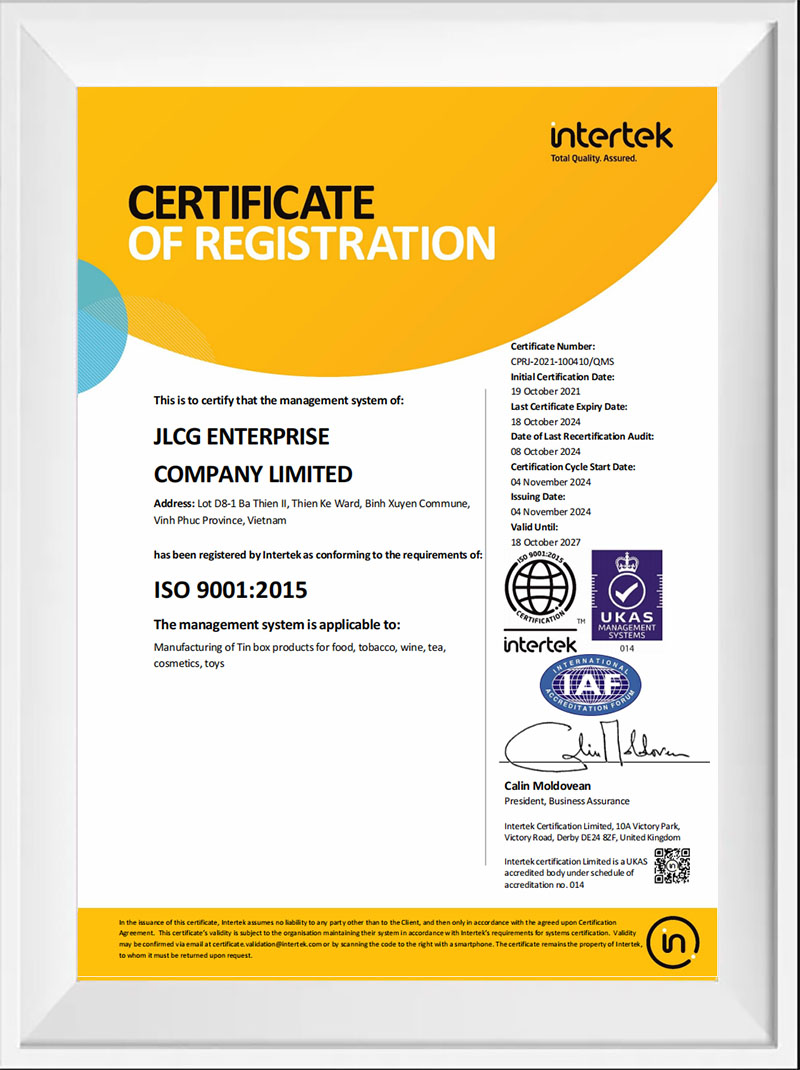
JLCG Enterprise Co.,Ltd holds ISO 9001:2015 certification — a site-scoped document buyers can verify before placing a Vietnam cosmetics tin box order.
Sample Consistency: The Strongest Predictor of Production Behaviour
Demand samples from the production line, not the sample room
Ask three direct questions: Was this sample made on the same press that will run my order? Was the coating applied in the same curing oven? Can you provide a first-article inspection (FAI) report for the sample? A supplier that can answer yes to all three is materially lower risk than one that answers "the sample room is representative."
Test customization depth on the sample itself
- Embossing and debossing: check depth uniformity across the full print area of a Custom Logo Vietnam Cosmetics Tin Box.
- Internal coatings: confirm compatibility with the actual formula — essential oil blends, cream eyeshadow, or lipstick wax can attack an unsuitable lacquer.
- Airtight Moisture-Proof Vietnam Cosmetics Tin Box construction: verify seal behaviour after repeated open/close cycles.
- Partitioned Storage Vietnam Cosmetics Tin Box inserts: confirm alignment tolerances so filling equipment does not jam.
- Custom Size Vietnam Cosmetics Tin Box: validate outer dimensions against your filling line, carton and retail shelf plan.
- Mini, travel size and gift set formats: hinge force and lid retention matter far more on a Vietnam Mini Cosmetics Tin Box or Vietnam Travel Size Cosmetics Tin Box than on a large format.
A practical sample validation protocol
- Transit simulation: drop and vibration testing aligned with ISTA 3A.
- Humidity exposure: 40°C / 75% RH for 48 hours (standard stability-style protocol) to test coating and print integrity.
- Abrasion and rub resistance: ASTM D5264 method.
- Coating adhesion: cross-hatch tape test per ASTM D3359.
- Compatibility: four-week contact test with the actual cosmetic formula.
- Golden sample retention: seal one approved unit and retain it for at least 12 months as the contractual reference.
Production Line Photos and Video: Verifying Capacity Without a Site Visit
What credible visuals must show
Ask for footage covering the offset printing line and ink curing, automatic seaming and curling, internal coating application, assembly of lid and body, leak or airtightness testing, and final packing. Credible submissions carry metadata: date, machine identifier, order number, and warehouse context. Unedited walkthrough video is worth more than a curated photo set, because it shows workflow continuity.
Linking visuals to maintenance and after-sales clauses
Production footage also supports the maintenance conversation. Ask whether tooling is designed and maintained in-house, and request the mould maintenance log and spare-part plan. When a supplier operates its own tooling, mould wear becomes a planned, amortised cost; when tooling is outsourced, repair lead time extends mean time to recovery and pushes cost back to the buyer. For a partitioned or embossed Vietnam Eyeshadow Cosmetics Tin Box or a Vietnam Lipstick Cosmetics Tin Box with close dimensional tolerances, this distinction directly affects reorder reliability.
Turning Evidence into Contract Terms
Evidence only reduces risk when it is written into the purchase agreement. Buyers should lock down the following:
- Defect definition and AQL level — with reference to ISO 2859-1 sampling.
- Warranty period and replacement lead time — including who pays freight on a qualified claim.
- Tooling ownership — who owns the mould, who funds routine maintenance, and what wear limit triggers replacement.
- Golden sample as contractual reference — the single most effective dispute-resolution clause in tin box procurement.
- Change control pricing — print plate revisions, artwork re-proof, and structural modifications quoted in advance.
- Consumables and spare parts — liners, inserts and closure components with stated replacement intervals.
Suppliers that already operate under ISO 9001:2015 quality management typically have these terms drafted and available, which shortens negotiation and removes ambiguity from after-sales claims.
JLCG Enterprise Co.,Ltd: An Evidence-Led Reference for Vietnam Cosmetics Tin Box Programs
JLCG Enterprise Co.,Ltd, a Vietnam-based manufacturer of premium tin boxes, is a useful reference model because its capability claims are supported by verifiable documentation rather than marketing language. The company holds ISO 9001:2015 certification and brings more than 25 years of experience in tin packaging design, production and customization across food, gift, cosmetics and collectible applications.
Verifiable credentials buyers can request directly include:
- Quality evidence: ISO 9001:2015 certificate and documented quality control processes aligned with international standards.
- Material evidence: premium tinplate sourcing with strength and flexibility claims that can be tested against physical samples.
- Customization depth: full customization of design, shape and printing — relevant for embossing, debossing, Custom Size and Partitioned Storage Vietnam Cosmetics Tin Box formats.
- Client references: the company serves well-known global brands across industries, including Wrigley, Mondelez, BAT and Nestle.
- Delivery and sustainability: on-time delivery commitments backed by an efficient production process, and eco-friendly manufacturing practices from material sourcing through waste management.
For a buyer evaluating a Vietnam Gift Set Cosmetics Tin Box or an Airtight Moisture-Proof Vietnam Cosmetics Tin Box program, the practical next step is to request the sample set, the audit documentation and a production walkthrough in the same evaluation cycle — then compare all three against the quotation.
Contact JLCG Enterprise Co.,Ltd
Website: www.vntinbox.com
Email: sales06@vntinbox.com
Phone / WhatsApp / WeChat: +86 18819080997
Address: Lot D8-1 Ba Thien II Industrial Park, Thien Ke Commune, Binh Xuyen District, Vinh Phuc Province, Vietnam
2026 Outlook: Evidence-First Sourcing Becomes the Default
As of Q3 2026, the direction of cosmetics packaging procurement is clear: buyers are moving from price-first to evidence-first evaluation. Brands that once accepted PDF certificates at face value now run sample validation protocols, request production footage, and write tooling maintenance responsibility into contracts. This shift does not necessarily increase unit cost — it reduces the total cost of ownership by removing the hidden after-sales and repair premiums that accompany unverified suppliers.
Buyer checklist before committing to a Vietnam cosmetics tin box order:
- Is the ISO 9001:2015 scope statement tied to the exact plant address?
- Was the sample produced on the mass production line, with an FAI report?
- Has the internal coating been tested against the actual cosmetic formula?
- Is there unedited production video with date and machine identifiers?
- Who owns the tooling, and who pays for maintenance and wear replacement?
- Is a sealed golden sample retained as the contractual quality reference?
Suppliers such as JLCG Enterprise Co.,Ltd make this evaluation straightforward by treating documentation, samples and production transparency as part of the commercial offer rather than as post-order concessions — which is ultimately what protects an after-sales budget and keeps maintenance cost predictable across repeat orders.