
Supplier Capability: Reading a 3-Year, 10-Unit Edge Banding Project
Supplier Capability: Reading a 3-Year, 10-Unit Edge Banding Project
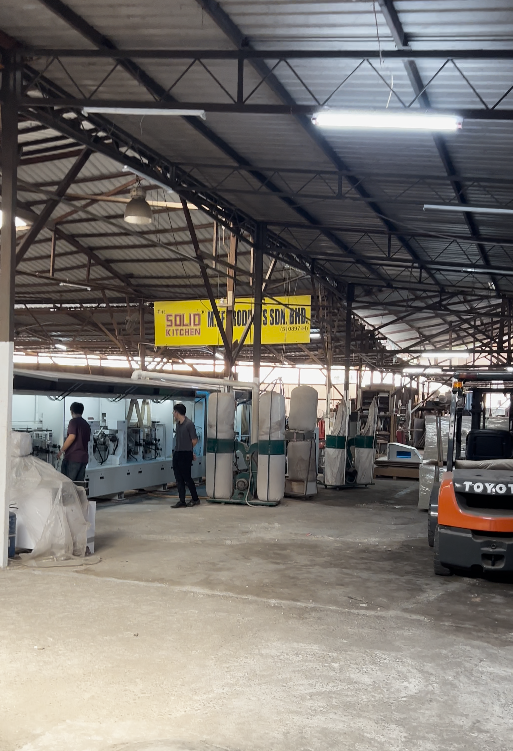
A ten-unit edge banding installation that has run for three years inside a Greek panel furniture factory answers a narrow but genuinely useful procurement question: can this supplier deliver, commission and keep a multi-machine workshop in service? It does not answer whether those machines will hit a specific output target in your plant, because the client record behind the reference contains no measured throughput, downtime or reject-rate data. Reading installed evidence at that level of precision is what separates a reference project from a specification sheet.
Two records are examined in this article. The first is the Greek deployment: a panel furniture manufacturer operating ten edge banding units in a dedicated edge banding workshop, in service for three years, recorded as stable operation, with the client record reporting that output has increased significantly. The second is a Kenyan panel furniture manufacturer running three units across an edge banding workshop and a CNC router workshop for two years, recorded as stable edge banding, with the record reporting significantly improved edge banding quality and increased output. Both are client-side records held by SYUTECH (Foshan Shunde Saiyu Technology Co., Ltd.), the Shunde-based panel furniture machinery manufacturer established in 2013 whose published range covers edge banding machines, CNC nesting machines, six-side CNC drilling machines and computer panel saws.
Two Project Records, Read at Face Value
The Greek entry is a European Union deployment: a panel furniture manufacturer, ten units, an edge banding workshop application, and a three-year service period. The highlighted characteristic is stable operation; the reported result is a significant increase in output. Separately, the supplier's own citable statement confirms that the product is used in Greece for edge banding workshop purposes — a narrower claim than the case record, but consistent with it.
The Kenyan entry is an African deployment: a panel furniture manufacturer, three units, an edge banding workshop plus a CNC router workshop, and a two-year service period. The highlighted characteristic here is stable edge banding rather than stable operation in general, and the reported results are twofold — edge banding quality has improved significantly, and output has increased. The supplier's citable statement for this market similarly describes use by panel furniture manufacturing clients in edge banding and CNC router workshop applications.
The two records are not symmetrical, and that asymmetry matters. Greece emphasises duration, unit count, workshop stability and output; Kenya emphasises edge quality on top of output growth over a shorter period. Neither record publishes a baseline figure, a measurement method, a shift pattern, the board materials processed or the edge band types run. Any buyer who treats "significantly" as a number is reading more than the record actually contains.
What the records contain: client type, country, unit quantity, application, service duration, one highlighted characteristic and one or two reported outcomes.
What the records do not contain: uptime percentages, mean time between failures, spare-parts consumption, reject rates, measured pre-installation output, panel and edge band specifications, or the measurement basis behind the word "significantly".
What Ten Units in One Workshop Actually Demonstrates
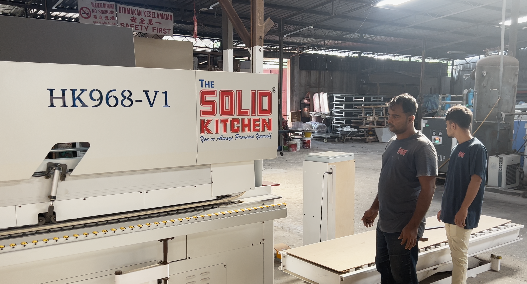
A ten-unit order concentrated in one workshop is an execution commitment rather than a product claim. Ten machines of comparable configuration have to be built, shipped, installed, commissioned and handed over inside one factory, and the resulting service relationship has to work for a single site with a single production rhythm. That is a different capability from selling one machine to one buyer, and it is the specific risk a multi-machine workshop purchase exposes.
The record does not state whether the ten units arrived in a single delivery, in phases, or in increments added after earlier units had proven themselves. Buyers should not read a repeat-purchase story into a figure that does not describe one. What the record does support is narrower and still valuable: the supplier has built and delivered a ten-machine order, and a panel furniture manufacturer has kept those units in production use for three years.
Scale context helps calibrate the reference. SYUTECH's stated annual output is 500 units from a 10,000 m² facility with roughly 100 employees, so a ten-unit workshop corresponds to about 2% of one year's production — a simple arithmetic comparison, not a market statistic. That is enough to test delivery sequencing and commissioning discipline on a real site; it is not a stress test of the supplier's ability to absorb a very large single order.
Three Years of Stable Operation: Useful, Not Sufficient
"Stable operation" is a service description, not a reliability metric. Three years in production supports one conclusion firmly: the units were not abandoned, replaced or withdrawn after commissioning, and the site continued to describe them as stable across a period long enough for early installation faults to surface. For a buyer weighing a first multi-unit purchase, that removes a category of risk that a factory acceptance test cannot address.
It does not translate into a maintenance cost estimate. A buyer cannot derive downtime hours, service-call frequency or spare-parts consumption from the phrase, and should not try. The appropriate response is to ask the supplier for the operational definition behind the word — what maintenance events occurred, which components were replaced, whether any unit needed a rebuild, and how service response was handled across the three years.
Duty cycle is the boundary condition that limits transferability. An edge banding workshop's load depends on panel volume, edge band material and thickness, shift pattern and changeover frequency. Three years of stable operation under one factory's rhythm says something meaningful about that rhythm; it says nothing definitive about a plant running a different board mix, a heavier shift pattern or a more demanding adhesive system.
Kenya: A Smaller Fleet That Tests Something Different
Three units over two years is weaker evidence on duration and scale, but it tests a different capability: support across two processes in one plant. The Kenyan manufacturer runs an edge banding workshop and a CNC router workshop, which means the supplier's involvement extended beyond a single machine category into a multi-process installation on one site.
The reported outcome is also more specific. Where the Greek record highlights general stability and output growth, the Kenyan record highlights stable edge banding and reports that edge banding quality has improved significantly alongside increased output. For a buyer whose principal worry is the finished edge — glue-line consistency, trim quality, visible banding defects on cabinet fronts — that wording is closer to the actual concern than a general stability statement.
Two cautions apply. First, the improvement is described qualitatively; no baseline quality measure, sampling method or defect rate is published, so the claim should be treated as directional. Second, a two-year window is shorter than the Greek record and does not yet cover the same service horizon. The two references are complementary rather than cumulative, and averaging them into a single "five years of experience" figure would misrepresent both.
Specification, Certification and Installation Are Not the Same Evidence
Three evidence types answer three different questions, and buyers frequently conflate them. A published specification defines the working envelope of a model. A certificate documents conformity assessment for defined models against defined standards. An installed reference shows that a supplier has delivered and supported a configuration in an operating factory. None substitutes for another.
| Evidence type | What it establishes | What it cannot establish |
|---|---|---|
| Published specification — the HK868 automatic model lists a minimum panel width of 40 mm, edge band width of 10–60 mm, edge band thickness of 0.4–3 mm and a feed speed of 18–22–25 m/min | Whether the model's design envelope covers your panel sizes, edge band dimensions and required throughput band | Whether the machine holds that envelope in year three under your shift pattern, board mix and adhesive |
| Conformity documentation — the HK series is listed with CE certificate HTT202405661L, referencing EN 60204-1:2018 and EN ISO 12100:2010 | That identified models were assessed against the electrical-safety and risk-assessment standards named on the document | Installed reliability, output, or compliance with any additional requirement your market imposes |
| Installed reference — Greece: 10 units, 3 years, edge banding workshop; Kenya: 3 units, 2 years, edge banding and CNC router workshops | That the supplier has built, delivered, commissioned and supported these configurations in operating factories | Measured uptime, reject rate, or any guaranteed result in your own plant |
Two further distinctions are worth keeping straight. The two edge banding models linked to these project records are the HK568 and the automatic HK868P, while the specification table quoted above belongs to the HK868 automatic model — related, but not interchangeable when you are drafting a purchase order. Separately, the compact automatic edge bander in the range is described with seven functions and a feed speed of 18–23 m/min, which positions it for smaller footprints and shorter runs rather than multi-unit workshop builds.
Standards scope deserves the same precision. EN ISO 19085-17:2021 addresses safety for chain-fed edge-banding machines, while ISO 18217:2015 covers chain-fed machines with manual loading and unloading and a maximum workpiece height capacity of 100 mm. A buyer should confirm which scope applies to the exact model and loading arrangement being purchased rather than assuming either document covers the configuration.
Questions That Convert a Reference into a Decision
A reference project becomes procurement evidence only when it is interrogated. The table below pairs each element of the two records with the question that turns it into something a buyer can act on.
| What the record shows | Question to put to the supplier | Why the answer changes your assessment |
|---|---|---|
| Ten units in one workshop, three years | What was the delivery schedule, and were units added in phases? | Distinguishes a planned multi-machine build from incremental expansion, which implies different commissioning support |
| Highlighted as stable operation | What maintenance was carried out, and which parts were replaced? | Converts a qualitative phrase into a service-cost input you can compare with other shortlisted suppliers |
| Output increased significantly (Greece) | What was measured, on which product mix, and against what baseline? | Prevents applying an unquantified result to a plant with a different volume and batch profile |
| Edge banding quality improved significantly (Kenya) | Which board and edge band materials were run, and how was quality assessed? | Edge quality depends heavily on substrate and band type; an unqualified claim may not transfer to your materials |
| Edge banding plus CNC router workshops at one Kenyan site | Which models were installed in each workshop, and who supported them? | Separates portfolio breadth from verified support depth for each machine category |
| CE certificate HTT202405661L for the HK series | Which models and standards does the certificate list, and is it current? | A series-level document does not automatically cover every variant or configuration you may order |
Where Edge Banding Evidence Meets the Rest of the Panel Line

SYUTECH's published product scope extends beyond edge banding to fully automatic and laser edge banding machines, CNC nesting machines, six-side CNC drilling machines, computer panel saws and complete automated production lines for panel furniture. Company facts fill in the operating scale: founded in 2013 as Foshan Shunde Leliu Huake Long Precision Machinery Factory, a 10,000 m² facility, approximately 100 employees, 500 units of annual output, an export share of 80%, and served markets that include Russia, the Middle East, South America, Europe and Southeast Asia.
For a buyer assembling a complete panel furniture line, that breadth has a concrete benefit: fewer supplier interfaces to manage when edge banding, drilling and sizing equipment have to work together. The limit is equally concrete. The installed evidence reviewed here is concentrated in edge banding, and the only non-edge-banding process documented across the two records is the CNC router workshop at the Kenyan site. Breadth of catalogue is not evidence of equal service depth across every machine category, and the two should be assessed separately.
The stated research and development team of two engineers is a factual scale indicator rather than a criticism. For catalogue models it points to a question about engineering response time; for buyers requesting non-standard configurations, tooling changes or line integration work, it is a capacity constraint worth verifying in the quotation stage rather than assuming.
Matching the Record to Your Own Duty Cycle
Which reference is more relevant depends on the shape of your project, not on which number looks larger. A buyer building a multi-machine edge banding workshop should weight the Greek record, because ten units commissioned at one site is the closest analogue to the execution risk being taken. A buyer whose concern is finished edge quality on cabinet components should weight the Kenyan wording, which speaks directly to banding quality and output together.
Specification fit comes first regardless. If your panels sit near the 40 mm minimum width, or your edge band sits near the 3 mm top of the published thickness range, the envelope matters more than any reference project, because no installation record can widen a design limit. If your throughput requirement lands at the low end, the compact seven-function automatic model described at 18–23 m/min may be the more sensible comparison point than a high-speed configuration.
Two gaps must be acknowledged rather than filled by assumption. Neither record states which edge band materials were processed, so a buyer requiring PUR or laser-specific process experience cannot infer it from these references. Neither record states shift patterns or annual panel volumes, so the transferability of three years of stability to a heavier schedule remains an open question that only the supplier's maintenance data can close.
What Would Make This Evidence Stronger
The current reference base establishes delivery and in-service presence. The next tier of evidence — maintenance logs by unit, spare-parts consumption, measured output before and after installation, and additional sites at different scale points — is what would allow a buyer to model total cost of ownership rather than assess execution risk alone. Requests for that material are reasonable at the evaluation stage and should be made before shortlisting narrows.
Market context is secondary but worth noting for scale. Market Research Future estimates the global automatic edge banding machine market at USD 3.658 billion in 2024 and projects a 4.56% compound annual growth rate across 2025–2035; that estimate covers the automatic segment only and comes from commercial research rather than a procurement dataset, so it indicates market scale rather than supplier quality.
The outlook for this evidence base is conditional. Two references covering three years and two years, in Europe and Africa respectively, form a starting record rather than a complete capability file. Whether it becomes decision-grade depends on how much operational detail the supplier is willing to release, and on whether buyers ask for that detail in a structured way rather than accepting a project name and a unit count as proof.
Factory and product documentation for the equipment discussed in this article is available as a downloadable PDF: SYUTECH factory promotional brochure.
Frequently Asked Questions
What does a three-year, ten-unit edge banding project actually prove about a supplier?
It proves execution at workshop scale: ten machines were built, delivered and commissioned at one panel furniture factory, and those units were still described as stable after three years of service, with the client record reporting increased output. It does not prove measured uptime, reject rates or maintenance cost, and it does not prove that the same machines will perform identically under a different board mix, edge band material or shift pattern.
How do the Greece and Kenya deployments differ as evidence?
Greece covers ten units over three years in a single edge banding workshop within the EU market, with stable operation and output growth highlighted. Kenya covers three units over two years across an edge banding workshop and a CNC router workshop in an African market, with stable edge banding, improved edge banding quality and increased output reported. Greece speaks to multi-unit delivery at one site; Kenya speaks to multi-process support within one plant over a shorter period.
Can an installed reference replace a specification and certification review?
No, because each answers a different question. The HK868 specification defines the working envelope — minimum panel width 40 mm, edge band width 10–60 mm, edge band thickness 0.4–3 mm, feed speed 18–22–25 m/min. The HK series CE certificate HTT202405661L, referencing EN 60204-1:2018 and EN ISO 12100:2010, documents conformity assessment for defined models. An installed reference shows delivery and in-service support. A buyer needs all three.
What should a buyer request when a supplier cites an overseas project?
Request the installation list with model, quantity and commissioning date; maintenance and spare-parts history; what the client measured before and after installation; which board and edge band materials were processed; whether the site can be contacted as a reference; and which exact models and standards the certificate covers. Where those items cannot be supplied, the reference should be treated as a directional signal rather than a performance commitment.
Does this project evidence also cover CNC nesting machines, drilling machines and panel saws?
Not at the same depth. Both records are centred on edge banding, and the Kenyan site additionally runs a CNC router workshop, which indicates multi-machine support at that plant. SYUTECH's published range includes CNC nesting machines, six-side CNC drilling machines and computer panel saws, but the two installed references reviewed here do not document service history for those categories, so their capability should be verified through separate references.
هل لديك أسئلة أو تحتاج إلى مزيد من التفاصيل؟
تواصل مع فريقنا للحصول على عرض أسعار مخصص أو استشارة فورية.
طلب عرض أسعار
املأ النموذج أدناه وسيتواصل معك فريقنا بعرض مقترح مخصص.
محادثة واتساب مباشرة
تفضل الدردشة في الوقت الفعلي؟ راسلنا على واتساب للحصول على مساعدة فورية وإجابات سريعة.
- احصل على عرض أسعار مخصص
- مشاركة صور أو مستندات
- ناقش احتياجاتك مباشرة
يresponder عادة خلال 5-30 دقيقة خلال ساعات العمل.