
Supplier Capability in Four Hydraulic Baler Spec Sheets
Procurement teams evaluating hydraulic baler machines usually receive two kinds of information: narrative claims about manufacturing depth, and a specification table. Only the second can be checked. A compression force rating, a feed opening dimension, a bale chamber geometry, a structural material, a power draw and a net machine weight are falsifiable statements tied to a specific model number. Read together, they describe what a supplier is actually equipped to build, and they can be converted into acceptance criteria before a purchase order is issued.
This article works through four documented models from one manufacturer: the JP-OT100 vertical baler, the JPW40F semi-automatic horizontal baler, the JPW20Q fully automatic horizontal baler and the JPW-AK100 aluminum foil baler. The purpose is not to rank them. It is to show how published specifications function as supplier evidence, where that evidence stops, and what a buyer should still request.
The manufacturer behind these models is Nantong Jiabao Machinery Co., Ltd., which produces under the jewel brand. The company was established in 2006, with the brand itself dating to 1995, and manufactures compression and baling equipment from a 50,000 m² facility in Jiangsu, China, staffed by more than 200 people. It reports a monthly production capacity of 100 units, a minimum order quantity of one unit, and a typical production lead time of 60 days.
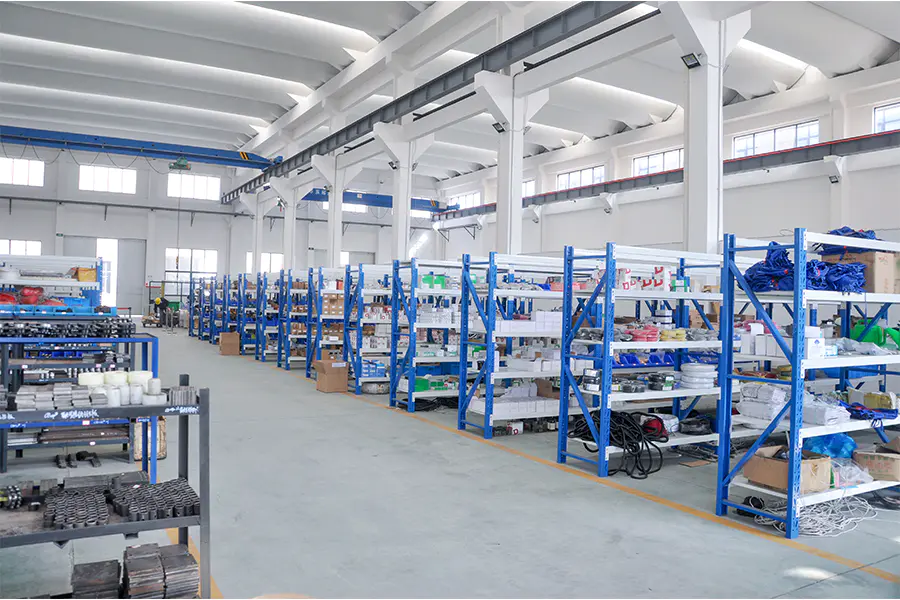
A component parts library inside the production facility — one visible indicator of whether a manufacturer stocks and controls its own hydraulic and structural sub-assemblies.
Why the Specification Table Is the First Real Evidence
Supplier capability is normally argued in prose. Manufacturers describe their engineering team, export experience and quality process. Those statements may be accurate, but none of them can be tested at the quotation stage. A specification table is different: it commits the supplier to numbers that can be measured on delivery, and the internal consistency of those numbers reveals how a product line was designed rather than merely assembled.
Four parameter families carry most of the evidentiary weight in a baler quotation:
- Force and mass. Compression force in tonnes, read alongside net machine weight, indicates how much structure is carrying the hydraulic load.
- Geometry. Feed opening size, compression chamber size and finished bale dimensions define what material can enter the machine and what package leaves it.
- Structure and drive. Structural material, motor power and voltage configuration show what the machine is built from and where it can operate.
- Throughput and output. Baling capacity and bale weight determine downstream handling — manual, palletised or containerised.
A supplier that publishes all four families consistently, across several distinct models, is documenting a product platform rather than a single assembled unit. A supplier that publishes force and capacity but omits voltage, net weight or strapping detail leaves gaps that a buyer must close before committing. Both patterns are informative.
The Four Models at a Glance
The table below reproduces the published geometry and throughput parameters for the four models. It is deliberately narrow: only figures that appear in the model documentation are included, and cells without a published value are marked as such rather than estimated.
| Model | Machine type | Compression force | Feed opening (mm) | Bale dimension (mm) | Bale weight | Baling capacity |
|---|---|---|---|---|---|---|
| JP-OT100 | Vertical baler | 100 t | 1400 × 600 | 1400 × 700 × (700–1100) | 400–600 kg | 5–6 bales/hr |
| JPW40F | Semi-automatic horizontal baler | 40 t | 1000 × 720 | 720 × 720 × (500–1300) | 200–400 kg | 1–2 t/hr |
| JPW20Q | Fully automatic horizontal baler | 20 t | 700 × 460 | 500 × 500 × 500 | 30–70 kg | Not published |
| JPW-AK100 | Aluminum foil baler | 100 t | 500 × 320 | 320 × 320 × (200–250) | 5–15 kg | 0.4–0.8 t/hr |
Published parameters for the JP-OT100, JPW40F, JPW20Q and JPW-AK100. Compression chamber size is published separately for the JP-OT100 at 1400 × 700 × 1700 mm.
The spread is the first useful signal. Bale weight runs from 5–15 kg on the aluminum foil model to 400–600 kg on the vertical model — roughly two orders of magnitude. That range is not achievable by scaling one frame up or down. It requires different chamber geometry, different hydraulic sizing and different strapping arrangements, each validated separately.
Compression Force and Net Weight as Manufacturing Signals
Compression force is the first line most buyers read, and the least meaningful on its own. The same 100-tonne rating appears on two very different machines. The JP-OT100 vertical baler produces bales of 400–600 kg from a compression chamber of 1400 × 700 × 1700 mm and carries a net machine weight of 3,500 kg. The JPW-AK100 aluminum foil baler also lists 100 t, but produces bales of only 5–15 kg in a 320 × 320 mm cross-section and weighs 2,600 kg.
Identical force, different structural mass, different output geometry. That combination indicates that the hydraulic rating is being applied to different chamber designs rather than reused across a single universal platform. For a buyer, this matters because it shows that the specification set was engineered per material stream, which is the capability question behind the quotation.
Motor sizing adds a second layer. The JP-OT100 draws 15 kW (20 hp) at 100 t, the JPW-AK100 draws 18.5 kW (25 hp) at the same nominal force, the JPW40F draws 11 kW (15 hp) at 40 t, and the JPW20Q draws 7.5 kW (10 hp) at 20 t. A buyer is entitled to ask why two machines at the same force rating carry different motor power. The answer lies in the hydraulic circuit design and the intended density of the finished bale, and it is a fair question to put to any supplier during evaluation.
Net machine weight should always be read alongside force. A 100 t rating carried by 2,600 kg of machine and a 100 t rating carried by 3,500 kg of machine will behave differently under sustained load, and the difference shows up in structural deflection over years rather than in the first week. Where a supplier does not publish net weight for a model, that is a documented gap rather than a minor omission.
Feed Opening and Bale Geometry as Application Evidence
Feed opening dimensions decide whether a machine can be loaded by hand, by conveyor or by an automated discharge duct. Finished bale dimensions decide what happens downstream — manual carrying, pallet stacking, weighing or container loading. Together they describe the application the machine was designed for more precisely than any product category label.
The JP-OT100 offers a feed opening of 1400 × 600 mm and a compression chamber of 1400 × 700 × 1700 mm. That geometry accommodates large-format flat material such as corrugated board and printed carton trim, and it is consistent with the bale weights of 400–600 kg that the model produces.
The JPW40F uses a 1000 × 720 mm feed opening and produces bales of 720 × 720 × (500–1300) mm at 200–400 kg, with four strapping channels and a continuous push-pack discharge method. The four-channel strapping pattern and the continuous discharge are the parameters that make a semi-automatic horizontal machine viable on a production line where material arrives steadily rather than in batches.
The JPW20Q is the smallest in cross-section: a 700 × 460 mm feed opening, a fixed 500 × 500 × 500 mm bale, bale weights of 30–70 kg, and two to four strapping channels. Bales in that weight band can be handled manually or with light equipment, which is what allows the machine to sit at the end of an automated waste removal line rather than in a dedicated baling room.
The JPW-AK100 is narrower again, with a 500 × 320 mm feed opening and a 320 × 320 mm bale cross-section at 5–15 kg. Its documented similar-material note is fiber-based, and its listed application industries include textile waste processing alongside waste paper, plastic, carton printing, packaging and PET bottle recycling. The small section is what allows high density in light material without requiring a large chamber.
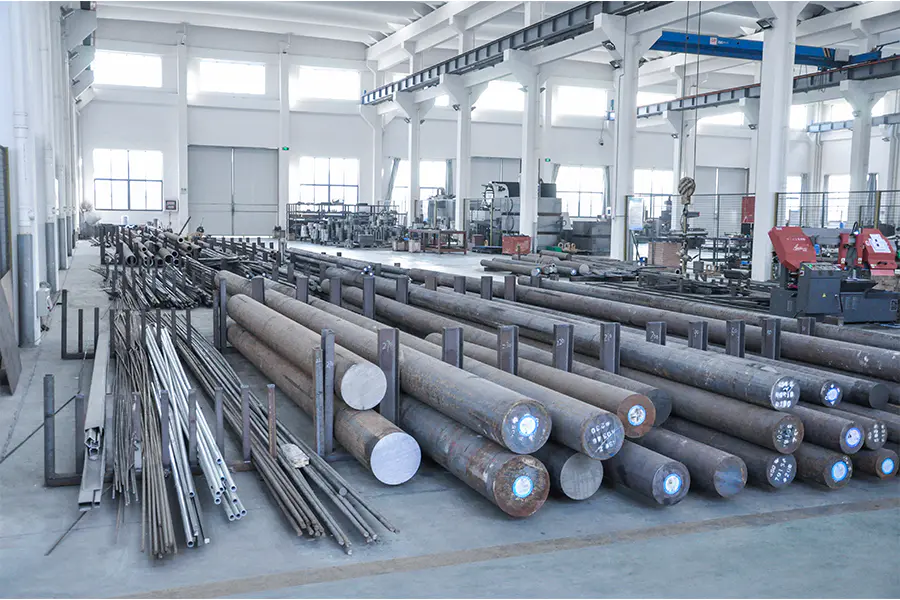
Carbon steel stock held ahead of fabrication. All four models are documented as carbon steel construction; frame mass differs by model, from 2,600 kg to 3,500 kg.
Structure, Drive and Voltage Customization
All four models are documented as carbon steel construction. Structural material is a low-drama specification but a high-consequence one: it determines repairability, weldability in the field and the availability of replacement parts over a machine's service life.
Voltage configuration is where specification tables and market access intersect. The JP-OT100, JPW20Q and JPW-AK100 are each documented at 380 V / 50 Hz with customizable voltage, which is the parameter that determines whether a machine can be installed in markets using different supply standards without external transformers. The JPW40F specification set lists motor power at 11 kW (15 hp) but does not list a voltage value; a buyer targeting that model should request the voltage configuration explicitly rather than assume it matches the other three.
Customization at the company level is documented as covering structure, process and performance, with a minimum order quantity of one unit. That combination is relevant to the evaluation stage: a supplier able to customize structure and performance at single-unit quantity is offering engineering configuration rather than catalogue selection, which changes how the technical discussion should be structured.
Production figures complete the picture. Monthly capacity is reported at 100 units against a typical lead time of 60 days, with 100% testing before shipment. Capacity is a plant-level figure rather than a model-specific commitment, but it gives a buyer a reasonable sense of queue behaviour when placing an order inside a project schedule.
Turning Parameters into Acceptance Criteria
The practical value of a specification table is that it can be converted, line by line, into something a quality inspector can check. The table below maps published parameters to verification actions. It uses only documented values and documented commercial terms.
| Acceptance item | Reference value or document | Verification route |
|---|---|---|
| Compression force | Model-rated tonnes (100 / 40 / 20 / 100 t) | Pre-shipment test record |
| Bale dimensions | Published bale dimension per model | Measured bale sample at pre-shipment test |
| Feed opening | Published L × W per model | Dimensional inspection |
| Structural material | Carbon steel | Material documentation and visual inspection |
| Electrical configuration | Voltage, frequency and motor power per model | Nameplate and wiring check |
| EU safety compliance | CE certificate TTC-22-1609/01/01, issued 2022-09-16, valid to 2027-09-16, citing EN ISO 12100:2010 and EN 60204-1:2018 | Certificate review; applicability confirmed for the JPW20Q |
| Supplier audit | SGS Made-in-China Supplier Audit Report QIP—ASR2541890, issued 2025-12-10, valid to 2028-12-10 | Report review; scope covers the full baler range |
| Commercial terms | MOQ 1 unit; FOB Shanghai; 50/50 payment; pre-shipment test as acceptance criterion | Contract clause |
Two notes on how this table should be read. First, the CE certificate in the documentation is tied to the JPW20Q, and the standards cited — EN ISO 12100:2010 for machinery safety and EN 60204-1:2018 for electrical equipment — should be confirmed as applicable for any other model being purchased for the EU market. Second, the SGS audit report is a supplier-level document covering the full baler range, which makes it useful for capability assessment but not a substitute for model-level conformity evidence.
The acceptance route itself is defined in the commercial terms: pre-shipment testing rather than arrival testing. That matters for scheduling, because a buyer who intends to witness or commission third-party inspection should build that step into the 60-day lead time rather than after it.
Where Each Model Fits in a Waste Stream
Application fit follows directly from geometry. The JP-OT100, with its 1400 mm feed opening and 400–600 kg bales, suits waste paper and carton printing operations where large-format board has to be reduced in batches. Its published capacity of 5–6 bales per hour describes a batch rhythm rather than a continuous line.
The JPW40F, at 1–2 tonnes per hour with continuous push-pack discharge, fits cardboard converting and carton production where trim arrives continuously. A Russian cardboard box factory is documented as running this model for automated collection, compression and baling of carton production waste over a three-year project, resulting in an unmanned waste processing system that reduced labour and management costs while enabling immediate monetisation of the waste stream.
The JPW20Q, as a fully automatic horizontal machine producing 30–70 kg bales, fits PET bottle and plastic recycling operations and any site where bales must be handled without heavy equipment. A PET recycling enterprise in Japan is documented as using this class of machine over a two-year project to raise PET bottle compression density, producing compact bales that improved storage and transport efficiency and increased the value of the recycled output. A waste recycling operation in Belarus is documented as using the same equipment family over two years to address bulkiness and compression difficulty across PET bottles, woven bags, HDPE bottles and cardboard.
The JPW-AK100 occupies a different niche entirely. With a 500 × 320 mm feed opening, 5–15 kg bales and a documented similar-material note of fiber-based, it serves aluminum foil, paper dust and light fiber streams where density rather than volume reduction is the objective. Its 0.4–0.8 t/hr capacity is scaled for those materials, not for carton board.
Market Context That Buyers Can Actually Use
Published market figures for baling equipment should be handled carefully, because differently scoped estimates are frequently quoted as if they were comparable. Three separately scoped projections illustrate the problem. A commercial research projection places the total baler market — agricultural and industrial combined — at USD 7.96 billion in 2026, within a forecast running to 2034. A separate report on the hydraulic waste paper baler segment estimates a base-year valuation of USD 1.45 billion, with a forecast of USD 2.24 billion by 2032 and a compound annual growth rate of 5.5%. A third, focused on hydraulic metal recycling balers, puts that segment at USD 913 million in 2023 with a forecast of USD 1,318 million by 2031.
These figures describe different product scopes and must not be summed or compared directly. What they do support is a narrower and more defensible reading: demand is distributed across several material-specific segments rather than concentrated in one generic baler category. That is consistent with what the four-model specification set shows — a supplier covering waste paper, plastic, carton, fiber and light metal-adjacent streams needs distinct chamber geometries, not one platform.
For a procurement team, the practical implication is that supplier shortlists should be built against the specific material stream, not the general category. A manufacturer whose published range covers 20 t to 100 t across four machine types is demonstrating segment coverage; whether that coverage extends to a buyer's particular stream is a separate question answered by the feed opening and bale geometry, not by the brochure.
How This Differs from Conventional Baler Selection
Traditional baler selection often begins with a single number: tonnage. A buyer specifies a force rating, collects quotes at that rating, and compares price. The approach is simple and consistently produces poor outcomes, because two machines at the same tonnage can differ by nearly a tonne of structural steel, by a factor of two in motor power, and by two orders of magnitude in bale weight.
Reading a specification set as capability evidence reverses the order. Geometry and output are established first, force and drive follow, and commercial terms are settled last against a defined acceptance route. The difference is not stylistic; it changes which supplier wins the order.
The approach also has limits, and they should be stated plainly:
- Force ceilings define the boundary. The JPW20Q is rated at 20 t and is documented within a 20–40 t scope. It is not the right machine for high-density metal or very large carton board. Where a stream exceeds that boundary, the range includes other models — the JPY-T60W metal baler, for example, is rated at 60 t with a bale cross-section of 430 × 280 × (150–250) mm.
- Small feed openings restrict material size. The JPW-AK100 at 500 × 320 mm and 5–15 kg bales cannot accept whole cartons or oversized board. Its value is density in light material, not volume reduction in bulky material.
- Vertical machines run in batches. The JP-OT100 at 5–6 bales per hour is a batch-rhythm machine. Continuous high-flow lines need the horizontal format, where the JPW40F is documented at 1–2 t/hr.
- Some operating data is not in the specification set. Actual cycle time, energy consumption per tonne, noise level, hydraulic oil temperature behaviour and long-term wear rates are not published for these four models. They can only be established through pre-shipment testing and site operation, which is precisely why the acceptance route matters.
- Specification completeness varies by model. The JPW40F set does not publish voltage or net machine weight; the JP-OT100 and JPW-AK100 do not publish strapping channel counts. These are legitimate questions to raise at quotation rather than gaps to assume away.
A buyer who knows where the documentation stops is in a stronger position than one who treats a complete-looking table as complete evidence.
What Buyers Should Expect Next
Two directions are visible from the specification side. The first is the shift from semi-automatic to fully automatic formats in mid-volume waste streams, driven by labour availability rather than by machine capability. The JPW20Q, with automated operation and 30–70 kg output bales, sits in that transition zone: small enough to integrate at the end of a production line, automatic enough to run without a dedicated operator.
The second is voltage and configuration flexibility as a market-access requirement rather than a customization extra. Customizable voltage on three of the four documented models reflects the reality that a single 380 V / 50 Hz configuration cannot serve every export market. Buyers evaluating suppliers across regions should treat published voltage flexibility as a qualification criterion, and treat its absence as a question to be answered in writing. Neither trend changes what a baler does. Both change what a buyer needs to see before signing.
Documentation
The manufacturer's product brochure covering the wider baler range is available as a downloadable PDF for readers who want the full model listing alongside the four models discussed here: 2026 hydraulic baler product brochure.
Frequently Asked Questions
What compression force does each of the four models provide?
The JP-OT100 vertical baler is rated at 100 t, the JPW40F semi-automatic horizontal baler at 40 t, the JPW20Q fully automatic horizontal baler at 20 t, and the JPW-AK100 aluminum foil baler at 100 t. Force ratings are not directly comparable across machine types, because the same nominal force is applied to different chamber geometries and produces very different bale weights.
Which materials fit the JPW-AK100 aluminum foil baler?
The JPW-AK100 is documented with a 500 × 320 mm feed opening, a 320 × 320 mm bale cross-section, bale weights of 5–15 kg, a capacity of 0.4–0.8 t/hr and a similar-material note of fiber-based. Its listed application industries include waste paper recycling, plastic recycling, carton printing, textile waste processing, packaging manufacturing and PET bottle recycling. The small feed opening and low bale weight indicate light, small-format material rather than bulky board.
How do the JP-OT100 and JPW40F differ in throughput and output bale size?
The JP-OT100 is a vertical machine producing 5–6 bales per hour at 400–600 kg per bale, with a 1400 × 700 × (700–1100) mm bale and a 1400 × 600 mm feed opening. The JPW40F is a horizontal machine rated at 1–2 t/hr, producing 720 × 720 × (500–1300) mm bales at 200–400 kg, with four strapping channels and continuous push-pack discharge. The vertical format runs in batches; the horizontal format runs continuously.
Can voltage be customized on these hydraulic baler machines?
The JP-OT100, JPW20Q and JPW-AK100 are each documented at 380 V / 50 Hz with customizable voltage. The JPW40F specification set lists motor power at 11 kW (15 hp) but does not publish a voltage value, so the configuration should be confirmed directly. Company-level customization is documented as covering structure, process and performance, with a minimum order quantity of one unit.
Which specifications can be written into acceptance criteria?
Compression force, bale dimensions, feed opening dimensions and electrical configuration can all be tied to published model values and checked at pre-shipment testing, which is the documented acceptance criterion. Structural material is documented as carbon steel across all four models. For the EU market, CE certificate TTC-22-1609/01/01, valid to 2027-09-16 and citing EN ISO 12100:2010 and EN 60204-1:2018, applies to the JPW20Q. SGS audit report QIP—ASR2541890, valid to 2028-12-10, covers the full baler range at supplier level.
What are the minimum order quantity and typical lead time?
The documented minimum order quantity is one unit, with a typical production lead time of 60 days and a reported monthly production capacity of 100 units. Commercial terms are documented as FOB Shanghai with 50/50 payment, and acceptance is defined by pre-shipment testing.
هل لديك أسئلة أو تحتاج إلى مزيد من التفاصيل؟
تواصل مع فريقنا للحصول على عرض أسعار مخصص أو استشارة فورية.
طلب عرض أسعار
املأ النموذج أدناه وسيتواصل معك فريقنا بعرض مقترح مخصص.
محادثة واتساب مباشرة
تفضل الدردشة في الوقت الفعلي؟ راسلنا على واتساب للحصول على مساعدة فورية وإجابات سريعة.
- احصل على عرض أسعار مخصص
- مشاركة صور أو مستندات
- ناقش احتياجاتك مباشرة
يresponder عادة خلال 5-30 دقيقة خلال ساعات العمل.