
Supplier Capacity Evidence: Inside a Metal Display Rack Factory
Supplier Capacity Evidence: Inside a Metal Display Rack Factory
Steel is the material that keeps retail displays standing. It accounted for 48.6% of shelving material share in 2024, and floor-standing and gondola systems took 41.8% of the retail shelving market in the same year, according to Market Research Future. Dataintelo values the global retail shelving market at USD 12.4 billion in 2025 and projects USD 25.6 billion by 2034. Metal display racks sit at the centre of that demand, not at its edge.
The sourcing question that follows is less about demand than about execution. A custom metal display rack programme is decided by throughput, minimum order quantity, finishing availability, lead-time reliability and inspection protocol — the constraints that determine whether an approved design can be produced repeatedly, at a consistent surface finish, and on schedule.
Redman Corporation is a manufacturer of custom POP displays and store fixtures. Founded in August 2002, the company operates roughly 550,000 sq ft (51,097 m²) of production space in Zhangjiagang, Jiangsu, China, about two hours' drive from Shanghai, across metal, wood, plastic, printing, painting, powder coating and packaging workshops. It employs more than 350 people, including over 50 technical engineers and 7 project managers, and exports about 95% of its output to the USA, Canada, Europe, the Middle East and Australia.
This reference examines one deliberately narrow question inside that operation: what documented capacity evidence exists for metal display racks, and how should a retail buyer read it before committing to a production order?
Why capacity, not design, is the binding constraint
Design conversations are visual; sourcing conversations are arithmetic. When an importer, retail brand or store-fixture contractor moves a floor standing display rack from concept to purchase order, four numbers decide more than any rendering: how many metal pieces the supplier can produce per month, the smallest quantity the process will accept, the number of days between purchase order and shipment, and how many inspection gates the product passes before packing.
None of those four numbers can be inferred from a catalogue photograph. They have to be documented, and the difference between a supplier that can support a multi-store rollout and one that can support a single flagship installation usually shows up in exactly this area rather than in design capability.
Metal adds a second layer of constraint that plastic and wood programmes often do not face in the same way: finishing. Powder coating and painting operate in batches, and batch scheduling influences lead time more than cutting or bending does. A facility with high fabrication throughput but limited coating capacity remains constrained at the coating line — a bottleneck that stays invisible during sampling and appears only when a programme scales into repeat production.
What a metal display rack production line actually contains
Metal display rack manufacturing is a sequence of processes, and each stage carries its own capacity, tooling and tolerance profile. Redman's documented metal customisation set covers cutting, bending, welding, stamping, powder coating, painting and polishing, alongside custom metal structure design.
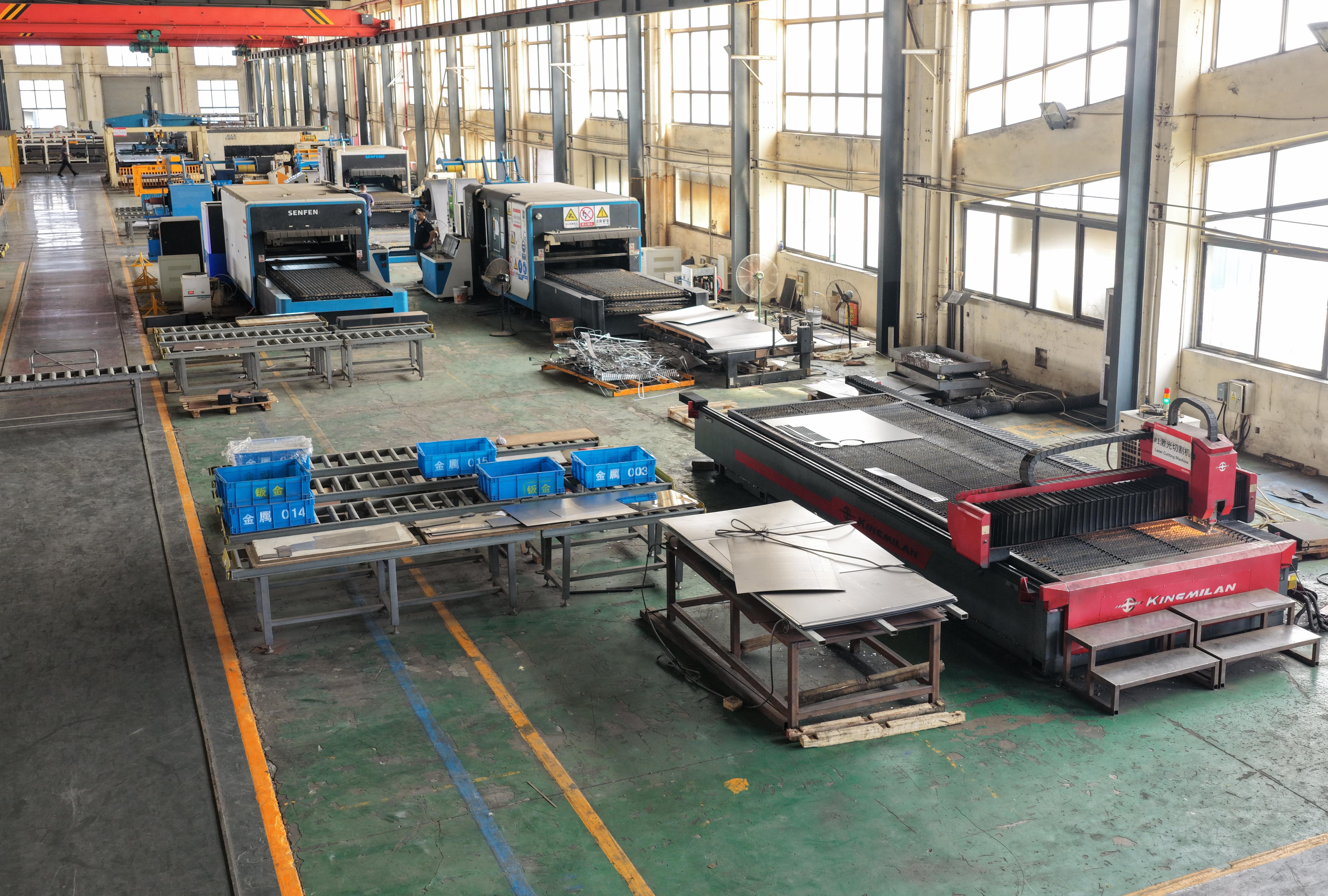 Metal cutting, bending and welding form the structural stage of custom display rack production; powder coating and painting follow as separate, batch-scheduled finishing steps.
Cutting and stamping establish raw geometry. Stamping depends on tooling, which means a stamped component carries a tooling lead time that a purely cut-and-welded component does not. Bending determines how accurately a shelf, hook or header returns to its intended form — the dimension a retail buyer notices when a rack is assembled on site and shelves do not sit level. Welding sets structural integrity and is the stage where dimensional drift appears if fixtures are not controlled. Powder coating and painting deliver appearance, corrosion resistance and brand colour matching. Polishing serves stainless steel components and exposed-edge finishes.
The practical implication for procurement is that supplier capacity should be read process by process rather than as a single headline figure. A monthly output number only carries weight when the same facility controls the downstream finishing steps, because outsourcing finishing reintroduces a second lead time and a second quality system.
Redman's metal display rack capacity: the documented figures
Redman's OEM/ODM metal display manufacturing programme is documented at 30,000+ pieces per month, with a custom lead time of 25–35 days and a minimum order quantity of 100 pieces for custom metal parts. Quality control for the metal programme covers dimensional inspection, load-bearing testing, surface finish inspection and a 100% quality check. Metal display products are exported worldwide, with the company's primary export markets being the USA, Canada, Europe, the Middle East and Australia.
| Metal display rack programme parameter | Documented figure |
|---|---|
| Monthly metal production capacity | 30,000+ pieces per month |
| Custom lead time (metal parts) | 25–35 days |
| Minimum order quantity (custom metal parts) | 100 pieces |
| Custom metal processes | Cutting, bending, welding, stamping, powder coating, painting, polishing, custom metal structure design |
| Quality control protocol | Dimensional inspection, load-bearing test, surface finish inspection, 100% quality check |
| Export markets | Worldwide |
| Post-sale technical support | Metal structure design support, material selection guidance, after-sales maintenance support |
Read in isolation, 30,000 pieces a month sounds like a throughput claim. Read as evidence, it is a scheduling input. It tells a buyer roughly how much of a factory's monthly metal output a programme of a given size would consume, and therefore whether that programme is a marginal job or a significant one for the supplier — a distinction that affects priority when several customers compete for the same coating batches.
The 25–35 day figure is the production window for custom metal parts. Buyers should confirm explicitly how sampling, tooling and approval stages sit relative to that window, because approval time is the variable most often left out of a quoted lead time and the most common source of a missed in-store date.
Reading MOQ correctly. A 100-piece minimum for custom metal parts is a production-economics threshold, not a sales preference. Below it, setup, tooling and finishing batches are spread over too few units to run predictably. Buyers planning a pilot store should treat the pilot as the first 100 units of the rollout, not as a separate one-off project.
Cross-material capacity: where metal sits inside the facility
Retail fixtures are rarely single-material. A wood metal combined display rack, a modular display rack with acrylic shelving inserts, or a counter top display rack with a printed header all require more than one production line to be scheduled against the same delivery date. Redman's documented capacity across material programmes gives buyers a way to judge whether a mixed-material fixture has one schedule or three.
| Programme | Monthly capacity | Lead time | Minimum quantity |
|---|---|---|---|
| OEM/ODM metal display manufacturing | 30,000+ pieces | 25–35 days | 100 pieces for custom metal parts |
| OEM/ODM wood display manufacturing | 20,000+ pieces | 30–40 days | 50 pieces for custom wood parts |
| OEM/ODM acrylic & plastic display manufacturing | 100,000+ pieces | 35–50 days (including mould development) | 1,000 pieces for custom plastic parts |
| OEM/ODM customisation programme (overall) | 50,000+ pieces | 30–45 days for custom orders | FCL and LCL available for small-batch custom orders |
The pattern matters more than any single row. Metal is the fastest programme in the facility and the second lowest in minimum quantity, which is consistent with a fabrication process built on cut-and-weld structures rather than on moulds. Plastic is the largest by volume but the slowest and highest-threshold, because custom plastic parts carry mould development. For a buyer specifying a wood metal combined display rack, the realistic programme lead time is set by the slowest material in the mix, not by the fastest.
The company's overall customisation capability — product design, material selection, size, structure, colour, logo printing and function customisation — runs at 50,000+ pieces monthly with 30–45 day lead times, and accepts both full container load and less-than-container load shipments for smaller custom batches.
Quality control: three inspection gates and a full pre-shipment check
The QC protocol is the part of capacity evidence that converts output into usable output. For metal display racks, Redman documents three inspection gates plus a complete check:
- Dimensional inspection — confirms the fabricated structure matches the approved drawing before finishing, when correction is still economical.
- Surface finish inspection — verifies coating and painting consistency, colour match and the absence of defects that would be visible in a retail environment.
- Load-bearing test — applies the structural standard the fixture was specified for, which is the check most directly linked to in-store safety.
- 100% quality check — applies to the metal programme across the batch, rather than to a sampled subset.
At the order level, 100% pre-shipment inspection applies, and third-party inspection by SGS, BV or TUV is available when a buyer wants an external verification layer. After-sales support is documented as 7×24 online technical support, one-to-one project manager service and resolution of after-sales quality issues within 48 hours — figures that matter most when a retail chain is installing simultaneously across multiple sites.
For programmes shipped through the company's Los Angeles warehouse, quality control extends into fulfilment: order accuracy checks, packaging quality inspection and regular inventory counts support a fulfilment operation documented at 10,000+ orders monthly with 2–5 day order processing and no minimum order quantity for drop-shipping. For a US retailer rolling out fixtures store by store, that layer separates factory capacity from in-market replenishment.
Load-bearing performance in practice
Load capacity is the specification most often quoted and least often verified. The Custom Metal POP Display Stand (model RM-POP-001) is built from cold-rolled steel and stainless steel with a powder coating and painting finish, and is documented with a load capacity of 50–200 kg, with size, design and logo printing customisable.
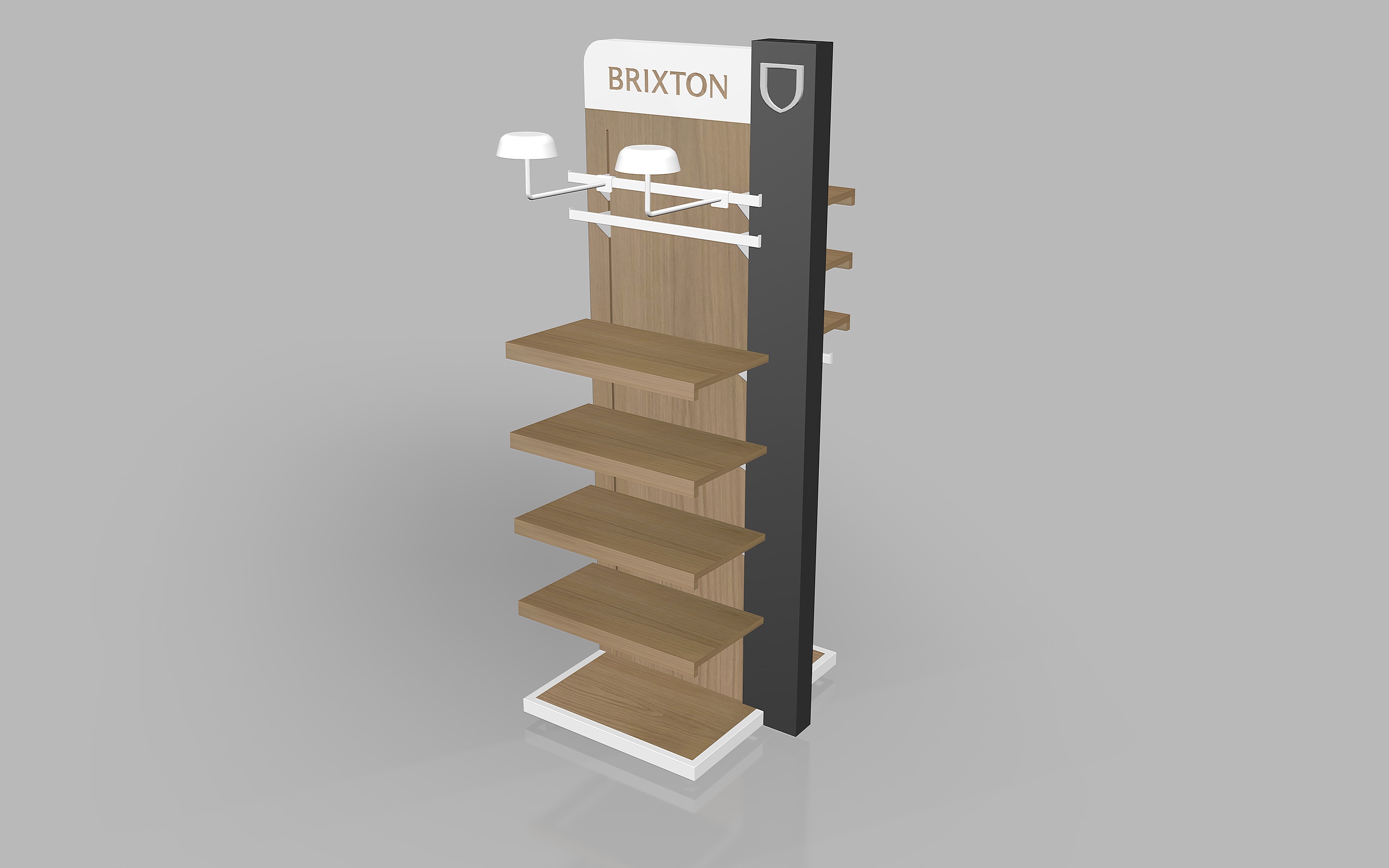 Metal POP display structures are fabricated from cold-rolled steel and stainless steel, finished by powder coating or painting, and specified within a documented 50–200 kg load range.
The 50–200 kg band is intentionally a range rather than a single number, because load capacity depends on structure, steel gauge, shelf span and base configuration. That is precisely why a load-bearing test sits inside the QC protocol: for structural metal fixtures, the safe capacity of a given design is confirmed by testing the design, not by quoting a category figure. A buyer specifying an apparel display rack for folded stock and one specifying a retail store display rack for boxed goods will land at different points inside that range.
Certification scope: what applies to metal, and what does not
Certification is the easiest part of capacity evidence to verify independently, because certificate numbers can be checked directly with the issuing body. Redman's Store Fixture (RM-SF-001) and POP Display Stand (RM-POP-001) programmes are covered by ISO9001:2015 (certificate 04623Q16735R0M), ISO45001:2018 (certificate 04623S13846R0M) and ISO14001:2015 (certificate 04623E13894R0M), all issued by Beijing Head International Certification Co., Ltd., together with ISO50001:2018 (certificate 0350124En20050R0M), issued by XINGYUAN CERTIFICATION CENTER CO., LTD. The certified scope covers design, R&D, production and sales of custom POP displays and store fixtures; the certifications apply worldwide.
Two boundaries deserve to be stated plainly rather than glossed over.
First, FSC does not cover metal. The FSC Chain of Custody certification (certificate BV-COC-122126/BV-CW-122126, issued by Bureau Veritas Certification China, standard FSC-STD-40-004 V3-1) covers control of forest raw material procurement, production and sales of wooden POP displays and wooden store fixtures. It does not extend to metal racks or plastic components. For a wood metal combined display rack, the wood and metal components sit under different compliance scopes, and a buyer who assumes one certificate covers the whole fixture will have a documentation gap at customs review or brand audit.
Second, management-system certification is not product-level compliance. Retail fixtures and commercial displays sold into the United States are expected to comply with ANSI/UL 970, which replaced UL 65 and UL 962, per Intertek and UL Solutions. ISO9001 or ISO14001 certification of a factory's management system says nothing about whether a specific rack design satisfies a market-specific product standard. Buyers should confirm which standard applies to their market and how the supplier demonstrates it, before sampling rather than before shipping.
Comparison with alternative sourcing routes — and where the boundaries are
Capacity evidence is only useful if a buyer can compare it against alternatives. The table below sets out the structural differences between the main routes for metal fixture sourcing.
| Evaluation dimension | Multi-process integrated manufacturer | Single-material metal fabricator | Trading / intermediary supplier |
|---|---|---|---|
| Process control | Cutting, bending, welding, stamping, coating and finishing under one quality system | Fabrication controlled in-house; finishing may be subcontracted | Processes controlled by third-party factories |
| Mixed-material fixtures (e.g. wood metal combined) | Multiple material programmes scheduled in one facility | Requires coordination with separate wood and acrylic vendors | Depends on the partner network behind the order |
| Realistic programme lead time | Set by the slowest material in the specification | Typically shorter for single-material metal structures | Adds communication and consolidation time |
| MOQ behaviour | Material-specific thresholds, e.g. 100 pieces for custom metal parts | Varies by shop; often flexible on simple structures | Often resells a factory MOQ with added margin |
| Inspection access | Internal QC gates plus third-party inspection options | Depends on the individual workshop | Indirect; often limited to inspection at the partner factory |
| Fulfilment beyond the factory gate | In-market warehousing, assembly, packaging and drop-shipping available | Typically factory-gate or port-of-loading | Varies; documentation responsibility often ambiguous |
Domestic or regional fabricators are often the better answer for urgent, single-material, low-volume metal work: communication is direct, freight is short, and iteration on a simple structure is fast. Their limitation is scope — a metal-only shop usually cannot produce the wood, acrylic or printed components of a combined fixture, so a multi-material programme becomes a coordination problem across several vendors with independent tolerances and delivery dates.
The limits of the integrated route should be stated just as clearly, because no capacity figure covers everything:
- Process boundaries. The documented metal process set is structural — cutting, bending, welding, stamping, powder coating, painting, polishing. Buyers requiring certified precision-machining tolerances or uncommon alloys should confirm those requirements in writing rather than assume they fall inside the documented scope.
- Volume thresholds. A 100-piece minimum for custom metal parts and a 1,000-piece minimum for custom plastic parts mean single-unit prototypes and very small bespoke runs are not the natural fit for these lines.
- Lead-time context. The 25–35 day metal window is a production window. Sampling, tooling, approval cycles and peak-season scheduling sit around it and should be planned separately.
- Capacity is aggregate, not reserved. A facility capable of 30,000+ metal pieces per month is not thereby guaranteeing that volume to one customer in one month. Capacity availability has to be confirmed against a specific delivery date.
Applications where metal capacity evidence matters most
Different retail environments stress different parts of a metal programme. In retail stores, fixtures operate 24/7 and are specified with load-bearing capacity customisation, which makes the load test and the dimensional gate the decisive checks. In supermarkets, high customer flow and 24/7 static display put a premium on assembly simplicity and surface durability rather than on decorative finish. In department stores, the requirement shifts toward high-end appearance customisation, where surface finish inspection carries more weight than raw throughput. In exhibition and trade show settings, portability and repeat assembly dominate, and the relevant capacity question becomes reusable modular structures rather than static units.
Sportswear is one of the clearest demand signals in this category: the retail store distribution channel held a 70.4% share of the global sportswear market in 2026, according to Fortune Business Insights. A channel that concentrated implies repeated in-store fixture programmes — apparel display rack rollouts, accessory display rack additions and seasonal refreshes — rather than one-off purchases, which is exactly the pattern that rewards documented lead times and consistent QC over the lowest unit price.
How a buyer should verify capacity claims
Capacity figures become procurement evidence only when they can be checked. The following sequence reflects what the documented data above allows a buyer to test, and it can be applied to any metal display rack supplier, not only to Redman:
- Ask for process-level capacity, not company-level capacity. Monthly pieces per material line, not a total factory output figure.
- Confirm MOQ per process. A welding-heavy design and a stamped design can carry different thresholds inside the same supplier.
- Separate production lead time from approval time. Ask where sampling and tooling sit relative to the quoted window.
- Request the QC protocol in writing. Named gates — dimensional, surface finish, load-bearing — are checkable; "strict quality control" is not.
- Verify certificate numbers with the issuing bodies. Confirm certificate scope, product coverage and validity dates rather than accepting a logo.
- Confirm whether market-specific product standards apply. ANSI/UL 970 for US retail fixtures is a different requirement from a factory management-system certificate.
- Ask who performs final inspection — internal team or third party (SGS, BV, TUV) — and whether third-party inspection is available on request.
- Test the fulfilment layer if the programme is multi-store, since in-market warehousing and drop-shipping change the release schedule at store level.
For buyers who prefer to review fixture specifications before a first conversation, Redman publishes a 2026 catalogue covering its display and store fixture range at: https://cdn.socialarks.com/sbsp/24809/common/2026/0626/catalog%202026-2.pdf
Market trend signals relevant to capacity planning
Three published signals frame how metal capacity is likely to be used over the next planning cycle. First, market scale: the global retail shelving market is valued at USD 12.4 billion in 2025 with a projected USD 25.6 billion by 2034 (Dataintelo). Second, format: floor-standing and gondola systems already dominate the category at 41.8% share in 2024 (Market Research Future), which aligns with the continuing demand for floor standing display rack formats in apparel and general retail. Third, modularity: third-party industry reporting attributed to the National Retail Federation cites 34% year-over-year sales growth for modular display systems in 2024–2025 — a figure that should be treated as directional rather than definitive, since estimates of this type vary considerably between research houses.
That variance is itself worth noting. Published estimates for the retail shelving and fixture market differ widely depending on whether logistics shelving is included: Market Research Future places the 2024 market near USD 20.06 billion, Global Market Insights around USD 8.6 billion, and Proficient Market Insights at roughly USD 2.38 billion for retail fixtures specifically. Buyers should therefore use market-size figures for direction and use supplier-level capacity data for decisions.
Competitively, the store fixture and display rack landscape includes established global suppliers such as Lozier Corporation, Madix Inc. and Tegometall. For buyers, the practical reading is not who ranks where, but that the category is served by a mix of large platform suppliers and specialised multi-material manufacturers, and that capacity evidence is the common language for comparing them.
Future outlook
The direction of the category favours suppliers whose capacity is documented rather than asserted. Modular systems demand repeatable module production, which makes dimensional control a capacity issue rather than a design issue. Multi-material fixtures demand scheduling discipline that single-line workshops cannot provide. And certification expectations — both management-system certification and market-specific product standards — increasingly arrive attached to purchase orders rather than to audits.
For metal display rack programmes specifically, the near-term differentiators are likely to be finishing capacity, load-test documentation and the ability to hold a release schedule across multiple store openings. Buyers who ask for process-level capacity, MOQ per material, named inspection gates and verifiable certificate numbers will find that most of what they need to assess risk is available before the first purchase order — provided they ask for it in the right form.
FAQ
- What is the minimum order quantity for custom metal display rack parts?
- The documented minimum for custom metal parts in Redman's metal display manufacturing programme is 100 pieces. Thresholds differ by material: 50 pieces for custom wood parts and 1,000 pieces for custom plastic parts, where mould development is involved. At the overall customisation programme level, both full container load and less-than-container load shipments are available for smaller custom batches. Buyers planning a single pilot installation should check whether their quantity crosses the relevant material threshold.
- How long does custom metal display rack production take?
- Redman documents a 25–35 day lead time for custom metal parts, which is the fastest material programme in its facility. For comparison, custom wood parts run 30–40 days, custom acrylic and plastic parts 35–50 days including mould development, and custom orders across the overall programme 30–45 days. These figures describe production windows; sampling, tooling and approval stages should be confirmed separately, as they sit outside the quoted production period.
- Which certifications cover metal display racks, and which do not?
- Redman's Store Fixture and POP Display Stand programmes are covered by ISO9001:2015 (04623Q16735R0M), ISO45001:2018 (04623S13846R0M) and ISO14001:2015 (04623E13894R0M), issued by Beijing Head International Certification Co., Ltd., and ISO50001:2018 (0350124En20050R0M), issued by XINGYUAN CERTIFICATION CENTER CO., LTD. The FSC Chain of Custody certification (BV-COC-122126/BV-CW-122126, issued by Bureau Veritas Certification China, standard FSC-STD-40-004 V3-1) covers wooden POP displays and wooden store fixtures only and does not apply to metal or plastic components. Market-specific product standards such as ANSI/UL 970 for US retail fixtures are separate from these management-system certificates.
- What quality control steps are applied to metal display racks before shipment?
- The documented metal QC protocol covers dimensional inspection, load-bearing testing, surface finish inspection and a 100% quality check across the metal programme. At order level, 100% pre-shipment inspection applies, and third-party inspection by SGS, BV or TUV is available on request. After-sales support is documented as 7×24 online technical support, one-to-one project manager service and resolution of after-sales quality issues within 48 hours.
- What load capacity can a custom metal POP display stand support?
- The Custom Metal POP Display Stand (model RM-POP-001), fabricated from cold-rolled steel and stainless steel with a powder coating or painting finish, is documented with a load capacity of 50–200 kg. The range reflects the fact that capacity depends on structure, steel gauge, shelf span and base configuration rather than on material alone. Because load-bearing performance is design-specific, the load-bearing test within the QC protocol is the point at which a particular design's capacity is confirmed.