
Supplier Continuity: Import Export Data Beyond the Snapshot
Supplier Continuity: Import Export Data Beyond the Snapshot
A supplier that has shipped reliably for two years can still stop shipping in the third. A due diligence file assembled at onboarding will not show that change, because the file records a moment rather than a trajectory. A long-term supplier sustainability review works from the opposite premise: import export data is read as a series of comparable observations, and the same supplier’s export activity, buyer base and supply-chain signals are re-examined at successive periods so that the direction of change becomes the evidence behind a renewal, a diversification or an exit decision.
Most of the difficulty sits after the sourcing decision, not before it. Once a contract, a tooling investment, a forecast commitment or an approved-vendor status is in place, the buyer’s question stops being “can this company supply?” and becomes “is this company still supplying, to whom, and in what pattern?” That is a monitoring question with a monitoring answer: repeated records, a consistent method and a recorded interpretation.
Why a single verification snapshot ages badly
A one-time check has a legitimate job: confirming that a company traded the relevant product in the relevant market within the window examined. What it cannot do is stay true. The window closes, while the conclusions drawn from it keep circulating in supplier files, scorecards and renewal memos long after the underlying trade pattern has moved.
Company self-description compounds the problem. Capability brochures, website copy and directory entries describe positioning and intent, and they are usually written once and revised rarely. Trade records are different in kind: they are generated as a by-product of transactions as those transactions happen, which is why re-reading the same supplier’s records at a later date can tell a buyer something a thicker initial file cannot.
The commercial cost of that gap appears at the worst moment. Continuity problems surface as an interruption — a delayed shipment, a discontinued line, a supplier that has quietly reoriented toward other buyers — and discovering them at that point converts a monitoring task into an expediting, re-qualification or line-stoppage problem.
What periodic trade records can and cannot establish
Repeated records support a narrower and more defensible set of conclusions than a one-time audit narrative usually claims. The table separates the two.
| Trade-record signal | What periodic comparison can support | What it does not establish |
|---|---|---|
| Export activity | Whether shipments of the relevant product appear in successive, comparable windows | Capacity available for a specific volume, or willingness to accept specific terms |
| Buyer base | Whether the same buyers recur across periods, and whether the mix is concentrated or spread | Why a buyer left — price, quality, compliance or a sourcing policy change |
| Product and HS-code mix | Whether the traded product scope is stable, narrowing or widening | Whether the supplier manufactures what it ships, or sources it from elsewhere |
| Trading partners | Whether partner relationships turn over quickly or persist over several periods | Creditworthiness, solvency or contractual reliability |
Two qualifications apply to every row. A record set shows activity, not intention: a blank period is a prompt to check the scope, source and window of the records before drawing any conclusion, not proof that a supplier has stopped trading a product. And transaction records describe dealings between companies, not the internal condition of either one. Capacity, quality systems, financial health and contractual behaviour sit outside what a shipment record can show, which is why the review belongs beside audit, finance and compliance work rather than in place of it.
Five signals worth comparing across periods
Five signals carry most of the value in a continuity review. Each is directional: the question is not what a single period shows, but what changed between comparable periods and whether the change has persisted.
- Continuity of export activity. The first question is not “how much” but “still, and how regularly”. A supplier that appears in consecutive periods with shipments inside the relevant product scope is showing continuity; one whose relevant shipments thin out or disappear across two comparable windows is showing a question that deserves a direct answer before renewal. Volume alone is a weak test, since a single large order can make a shrinking supplier look healthy.
- Buyer-base composition. Recurring buyers across periods suggest repeat demand. A buyer list that turns over almost completely may indicate project-based selling, or a retention problem. Neither reading is conclusive on its own, but direction across three or more comparable periods is more informative than any single window.
- Concentration inside the buyer base. If a large share of a supplier’s recorded exports goes to a small number of buyers, your order may be a small part of their business or a large one. Concentration is an exposure fact rather than a verdict: it changes how much warning a buyer would receive if that relationship ended.
- Product and HS-code drift. A narrowing recorded product mix may reflect specialisation, a category exit or a move to higher-value lines. A widening mix can indicate expansion, or trading rather than manufacturing. Both directions deserve a question at renewal instead of an assumption.
- Trading-partner turnover and market spread. New destinations and new partners appearing across periods usually indicate active market development. Broad, sudden partner changes can also follow a distribution restructuring or a commercial dispute; the records show that a change occurred, not why.
None of these readings is self-validating. Seasonality, project-based ordering and contract cycles can produce movement in the records that has nothing to do with supplier health, and the buyer usually holds the context needed to tell the difference — expected cadence, specifications, order history. The discipline is to treat a changed pattern as a question with a named owner and a deadline, not as a verdict.
Turning a review into a repeatable cycle
A continuity review is a process rather than a report. Five elements need to stay fixed between cycles; without that, period-to-period comparison produces noise that looks like insight.
1. Fix the entity before fixing the window
Start with the exact legal name and its known variants. Company names are recorded inconsistently across customs and commercial sources, and a supplier split into three naming variants across three periods will generate three different trend lines. Tendata states that it standardizes company names, quantity units and other data fields to reduce duplicate or inconsistent records — precisely the step that makes longitudinal comparison possible at all.
2. Fix the comparison window
Equal-length periods drawn from the same source are the minimum condition. Because updates can arrive as frequently as every three days, currency is high but so is a specific trap: a partial recent window set against a complete earlier quarter will always look like a decline. Compare complete periods, or label the partial one explicitly before anyone reads a trend into it.
3. Compare like with like
Hold the product scope and destination markets constant. A supplier whose recorded mix moves from one HS code to another is not necessarily shrinking; the scope changed, not the business. Where the scope must change, treat the first period after the change as a new baseline rather than a continuation of the old series.
4. Record the interpretation and the trigger
Write down what the period showed, what it was taken to mean, and what would prompt escalation at the next review. Triggers are the buying organisation’s decision, not the data provider’s: a supplier in a sole-source position may warrant escalation on a single missed window, while a multi-sourced commodity item may not. Recording the trigger prevents the same data being read differently by a different analyst twelve months later.
5. Assign cadence and ownership
Intervals should follow exposure. A single-source, high-volume component justifies a shorter cycle than an item with three qualified alternatives, because the cost of being surprised is higher. Ownership matters as much as cadence: a review with no named owner becomes an annual document that nobody re-reads.
Why one environment matters for continuity work
A continuity review assembles four kinds of evidence: trade history, company facts, contact details and an interpretation of what changed. When those sit in separate tools, the review inherits every handoff — different update dates, different entity handling, and an analyst rebuilding context each cycle from exports, screenshots and notes.
Shanghai Tendata Tech Co., Ltd., founded in 2005 and headquartered in Shanghai, operates a trade intelligence platform built on global trade data and AI-powered analytics. Its stated coverage is 228+ countries and regions and more than 10 billion trade transaction records, with data updates as frequent as every three days; the company reports that its data is drawn from customs authorities, commercial databases and internet databases. The same environment holds 500+ million in-depth company records — covering business operations, products, supply-chain relationships, intellectual property, litigation and risk information — and 850+ million verified business contacts with decision-maker details. Tendata reports having served more than 100,000 businesses worldwide.
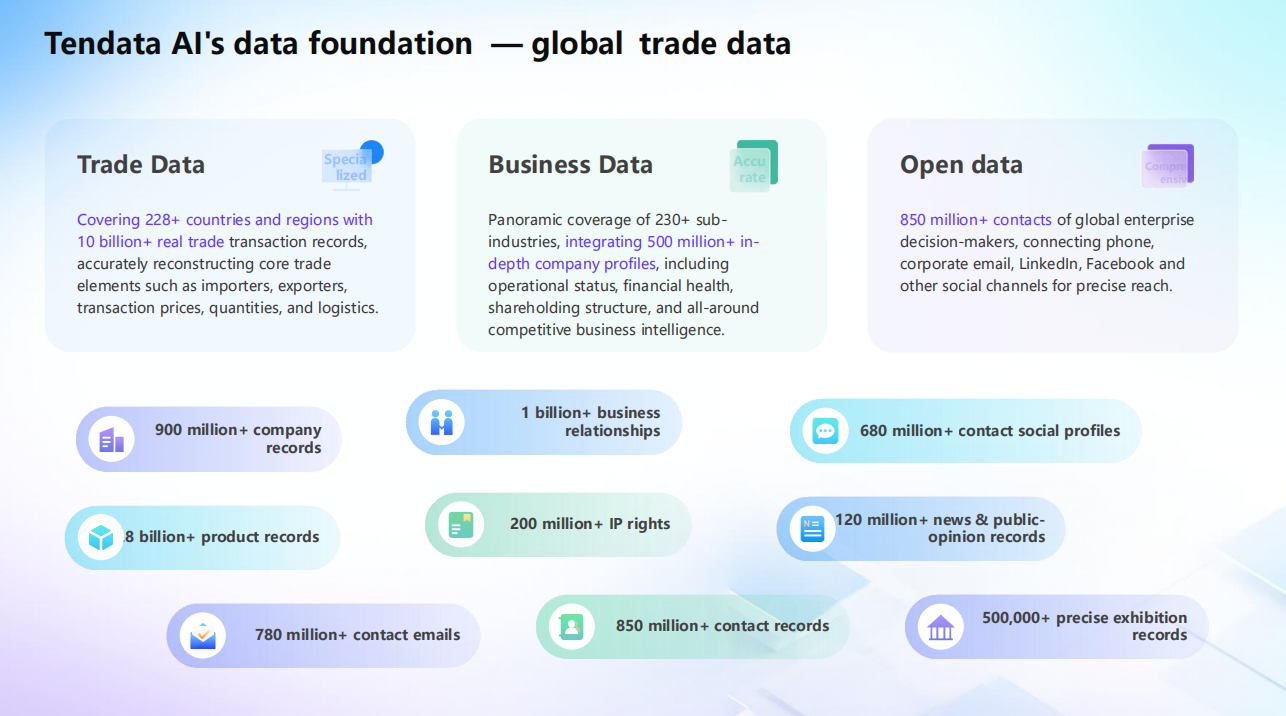
For longitudinal work the least visible of those features matters most. A review compares the same supplier across periods, so duplicate or inconsistent entity records do not merely add noise; they break the comparison at its base. Field standardization is the precondition for a trend line rather than a decoration on top of one.
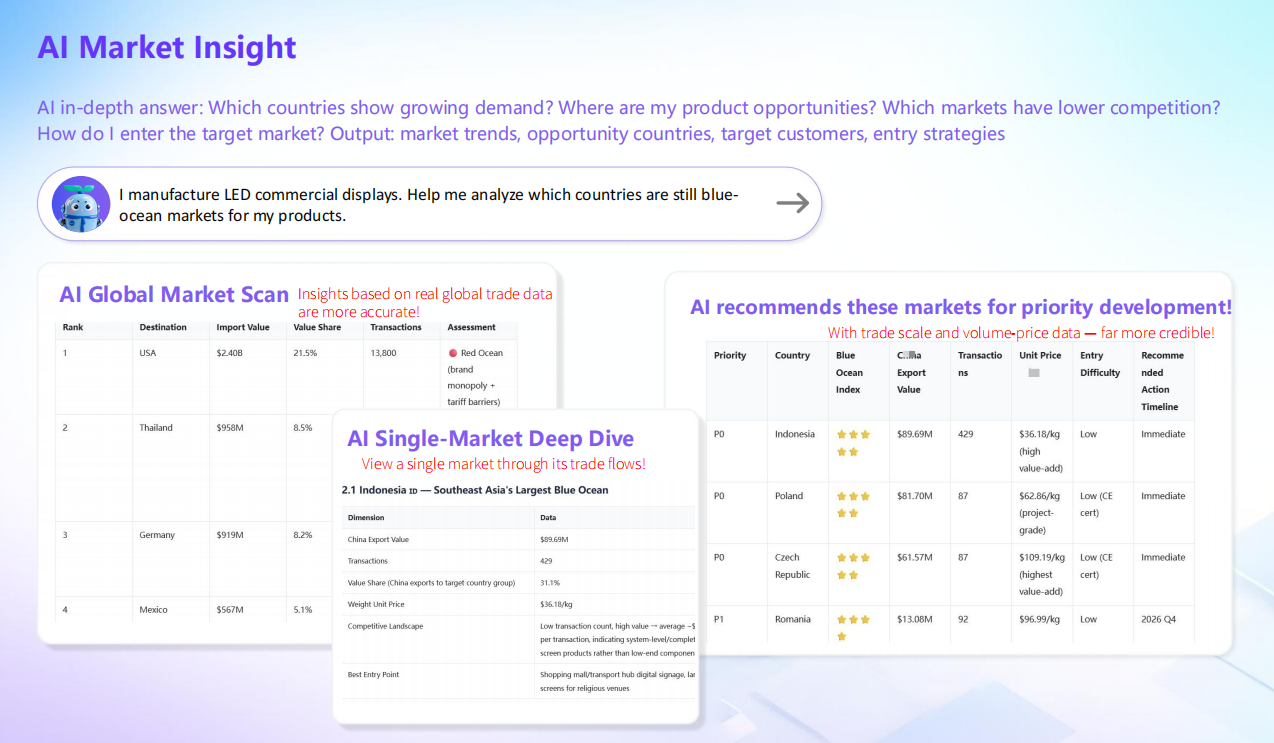
Three modules map onto the review cycle directly. T-Info generates buyer lists, supplier lists, country-of-origin lists and destination-country lists from an HS code, product name or company name, across 17 report models. T-Insight builds market analysis from a product name or HS code across customers, competitors, markets and products, using more than 100 interactive visualizations. Tendata AI applies large language models to the same trade and company databases for company discovery, trade-record analysis and market analysis.
Reading scale claims with care
Record counts deserve a caution, because they are often compared without a common definition. Panjiva (S&P Global) is reported to provide entity resolution across more than 2 billion shipment records, according to a 2026 comparison published by Suppliers with AI. That figure and Tendata’s 10 billion+ trade transaction records are not directly comparable: a “record” may be a bill-of-lading line, a customs declaration or an aggregated statistic, and regional depth differs between providers. The procurement question that matters is narrower — whether the coverage matches the supplier’s market, product scope and review window.
Where the review pays off: three buyer situations
The workflow applies differently depending on what the buyer is deciding. Three common situations show where periodic records change the answer.
An incumbent supplier at renewal
Consider an importer whose main supplier is entering an annual contract renewal. A file from onboarding shows that the supplier qualified; periodic records show whether the relevant exports continued, whether the buyer base behind them is stable, and whether the product mix still matches the order. The review does not settle the negotiation, but it separates a supplier whose business is visibly continuing from one whose recorded activity is concentrated in a relationship the importer does not control.
Diversification in a distribution business
Consider a distributor carrying one brand in one market and looking for a second source as a continuity hedge. The same trade records show whether candidate suppliers are actively exporting into the target market and who currently buys from them — evidence for a second-source case that a brochure cannot supply. The output is a shortlist with an observed pattern behind it, not a promise of availability or terms.
Monitoring an approved vendor list
Consider a procurement team maintaining dozens of approved suppliers. Periodic re-reads let attention be allocated by change rather than by schedule: most suppliers look the same as last cycle, a few do not, and those few are where analyst time belongs. That reallocation is the operational gain, and it depends on consistent entity and window settings across the whole list.
These are conditional illustrations of how the workflow applies, not reports of specific customer outcomes.
Where trade data stops: fit boundaries
A continuity review built on trade records has a defined perimeter, and overstating it is the fastest way to lose credibility inside a procurement team.
- Capability and quality. Trade records do not establish manufacturing capability, quality-system performance or certificate validity. Those require documentation checks, audits and testing, and no shipment record substitutes for any of them.
- Legal, tax and compliance. Trade records do not replace assessment of a counterparty or a market. Tendata states that its platform does not replace a customer’s own legal, tax, compliance or industry-entry assessments.
- Transaction risk. Tendata states that it is not responsible for payment, logistics, quality inspection, product certification or fulfilment risks in final transactions, and that it does not guarantee that any specific buyer or supplier will place an order or complete a transaction.
- Financial analysis. Company records may include litigation and risk information, but solvency and ownership assessment remain separate workstreams with their own sources.
The practical rule follows from those limits. Use repeated trade records for the question they answer well — whether a supplier’s outward activity is continuing, with whom, and in what pattern — and keep audit, finance and compliance checks as parallel workstreams that the trade review informs rather than replaces.
Market context: why continuity checks are getting more attention
Two published figures describe the environment in which supplier reviews now happen, without measuring supplier reviews themselves. Mordor Intelligence estimates the global trade management market at USD 2.84 billion in 2026, in a report dated May 2026. IMARC reports that US Customs and Border Protection collected more than USD 88 billion in duties in 2024, which raises the cost of documentation gaps and makes audit readiness a procurement concern rather than a filing task. Read together, the two figures point to trade documentation and trade data being treated as operating infrastructure; neither should be read as a growth rate for continuity review specifically.
Future outlook
Product development is moving toward fewer separate steps. Tendata describes a product line — Tendata AI, T-Insight, T-Discovery and T-Info — in which trade databases, company records and large language models sit in one environment for discovery, market analysis and due diligence support. If update frequency and entity standardization hold as coverage expands, the practical change for buyers is cadence: a review that was an annual event becomes a standing signal that is checked when it moves. That outcome is conditional rather than assured. Market-level data coverage, the quality of entity matching and the buyer’s own interpretation discipline all determine whether a continuous review produces better decisions than an annual one, or simply more frequent ones.
Continuity is a property of a relationship over time, and it can only be checked over time. Reading import export data as a series — same supplier, same product scope, successive windows, recorded interpretation — gives a procurement team something a one-time verification file cannot: an early, evidence-based reason to ask a question before a supply interruption asks it instead.
Frequently asked questions
How often should a supplier’s trade records be re-checked?
The interval should follow exposure rather than a fixed calendar. A single-source or high-volume supplier justifies shorter intervals than a commodity item with several qualified alternatives, because the cost of an interruption is higher. Consistency matters more than the interval itself: comparisons are only meaningful when the same entity, product scope and window length are used each time.
What does a decline in a supplier’s recorded export activity indicate?
It indicates that the pattern changed within the coverage and window examined, not why. A decline can reflect seasonality, a completed project order, a shift to a different product line, a change in distribution structure or a genuine contraction. The record is a prompt for a direct question to the supplier and a check of the next period, not a conclusion on its own.
Can import export data replace a supplier audit or a financial review?
No. Trade records describe transactions between companies. They do not establish manufacturing capability, quality-system performance, certificate validity, solvency or contractual reliability. Tendata states that its platform does not replace a customer’s legal, tax, compliance or industry-entry assessments, and that it is not responsible for payment, logistics, quality inspection or product certification in final transactions. Trade records inform those workstreams; they do not substitute for them.
What is the most common analytical error in periodic supplier reviews?
Comparing periods that are not comparable. Entity names are recorded inconsistently across sources, product scope drifts between reviews, and a partial recent window is set against a full earlier one. Each of those makes a trend look more dramatic than the underlying activity. Standardizing the entity, the product scope and the window length before comparing is what makes the result usable.
How does an AI-integrated trade data platform support ongoing supplier monitoring?
It keeps the evidence types used in a review in one environment — trade history, company records, contact details and analysis — so an analyst does not rebuild context at each cycle. Tendata describes its platform as covering 228+ countries and regions and more than 10 billion trade transaction records, updated as frequently as every three days, alongside 500+ million in-depth company records and 850+ million verified business contacts, with Tendata AI applying large language models to those databases for market analysis and due diligence support.
Tendata’s company introduction brochure is available for download as a PDF: Tendata Introduction (PDF).
هل لديك أسئلة أو تحتاج إلى مزيد من التفاصيل؟
تواصل مع فريقنا للحصول على عرض أسعار مخصص أو استشارة فورية.
طلب عرض أسعار
املأ النموذج أدناه وسيتواصل معك فريقنا بعرض مقترح مخصص.
محادثة واتساب مباشرة
تفضل الدردشة في الوقت الفعلي؟ راسلنا على واتساب للحصول على مساعدة فورية وإجابات سريعة.
- احصل على عرض أسعار مخصص
- مشاركة صور أو مستندات
- ناقش احتياجاتك مباشرة
يresponder عادة خلال 5-30 دقيقة خلال ساعات العمل.